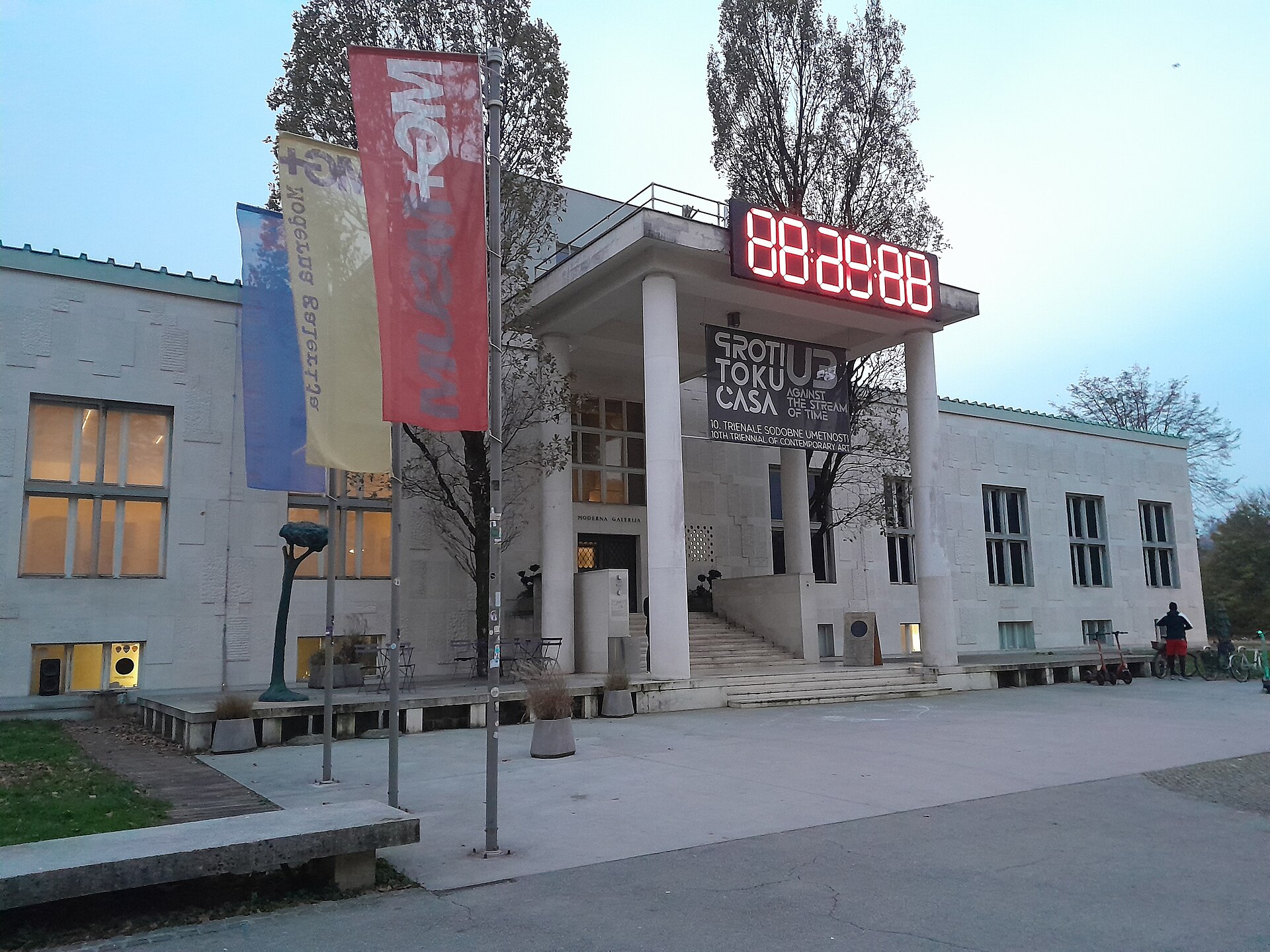
The Ravnikar-designed facade of Moderna galerija on Cankarjeva cesta, with the museum's name lettered above the entrance.
Photograph by Jurij Leban, released CC BY-SA 4.0Moderna galerija
Museum · Founded 1947
Open, admission and hours confirmed 5 September 2026 · 14 sources
On this page 15 sections
ContentsClose
Moderna galerija's strength is depth in a single national tradition rather than international breadth at MG+: 1,301 paintings, 502 sculptures, 3,079 prints and 11,069 drawings covering Slovenian art from the 1889 fin-de-siecle opening of its own historical timeline through to 1991, with the Partisan-era resistance art and the 1920s avant-garde, including the Cernigoj Constructivist Space reconstruction, given equal weight to more conventional interwar and postwar painting. The museum's broader international standing rests less on MG+'s holdings than on the Arteast 2000+ collection and the OHO Group archive, both of which underpin its reputation as a reference point for Eastern European neo-avant-garde and conceptual art history since the 1990s, even though Arteast 2000+ itself is now housed at the separate +MSUM building rather than at Cankarjeva cesta.
| Kind | Museum |
|---|---|
| Founded | 1947 |
| City and country |  Ljubljana, Slovenia Ljubljana, Slovenia |
| Address | Cankarjeva cesta 15, 1000 Ljubljana, Slovenia |
| Website | mg-lj.si/en |
| Status | Open, confirmed |
| Record last verified |
Visiting
- Hours
- Tue-Wed, Fri-Sun10:00 to 18:00
- Thu10:00 to 18:00Extended to 20:00 in July and August
- Dec 24 and Dec 3110:00 to 15:00Reduced holiday-eve hours
- Closed
- Monday. 1 January. 1 May. 1 November. 25 December.
- Admission
- AdultEUR 7Single site, Moderna galerija (MG+) only
- Student, senior (65+)EUR 3.50
- Group, 10+ adults, per personEUR 5
- Group, 10+ students or seniors, per personEUR 3
- Family, 2 adults plus children up to 18EUR 14
- Combined ticket, Moderna galerija (MG+) and Museum of Contemporary Art Metelkova (+MSUM), adultEUR 10.50Covers both buildings
- Combined ticket, both buildings, familyEUR 21
- Guided tour surcharge, up to 10 peopleEUR 20Groups over 10 pay 1 EUR per person instead; book at least five working days ahead
Free entry: First Sunday of the month. Preschool children. Unemployed visitors. EU Disability Card holders and one escort. CIMAM, ICOM, SMS, SMD and SUZD cardholders. Ljubljana Card holders- Tickets
- mg-lj.si/en/visit/778/info_mg The museum's own ticket page.
- Do I need to book?
- No for individual visitors; guided tours need at least five working days' notice
- Address
- Cankarjeva cesta 15, 1000 Ljubljana, Slovenia MapBus Konzorcij or Posta stop, routes 1, 2, 3, 3B, 3G, 6, 6B, 9, 11, 11B, 14, 14B, 18, 19B, 19I, 27
Bus Cankarjev Dom stop, routes 14, 14B, 18
Walking About 20 minutes from Ljubljana railway station; the museum stands at the edge of Tivoli Park - Website
- mg-lj.si/en
- Telephone
- +386 1 2416 834
- [email protected]
Before you go how long, access, photography, bags, eating, shop
- How long to allow
- About ninety minutes to two hours for the permanent display across both floors
- Access
- Elevator and stairs serve every floor. Visitors using wheelchairs or strollers are directed to a step-free entrance at Windischerjeva 2 rather than the main stair on Cankarjeva cesta
- Photography
- Not stated on the museum's own visitor pages at the time of research; not asserted here
- Bags
- Not stated on the museum's own visitor pages at the time of research; not asserted here
- Eating
- Moderna Coffee Shop operates on site
- Shop
- MG Bookstore operates on site
Prices and hours change. We take them from the institution's own pages and print the day we read them, and you can check the current position at the source we used. Confirm before you travel.
What is inside
20th Century. Continuities and Ruptures (permanent display)
The museum's main permanent hang of the National Collection, opened in its current form in August 2011. It sets the Slovenian modernist avant-garde of the 1920s and the art of the wartime Partisan resistance on equal footing with the more familiar interwar and postwar painting, rather than presenting one as background to the other. The centrepiece is a second physical reconstruction of Avgust Cernigoj's Trieste Constructivist Space of 1927, an immersive avant-garde installation rebuilt under Dragan Zivadinov and Miha Tursic of the Delak Institute; the display also carries photography and material on the Slovenian art system across the century.
Points in Time 1889-1991 (permanent display)
A second, circular-timeline hang that runs alongside 20th Century. Continuities and Ruptures, curated by Marko Jenko. It opens with Ivana Kobilca's first public exhibition at the Ljubljana Realgymnasium and Rihard Jakopic's Night Motif from Schwabing, tracks wartime imagery by Zoran Didek and Vladimir Lakovic and postwar realism by Marjan Dovjak and Joze Tisnikar, and closes at Slovenian independence in 1991 with Laibach's video Geburt einer Nation. A visitor can take the chronological route from the 1889 fin-de-siecle opening to 1991, or cut laterally from the 1920s avant-garde straight through the Partisan rooms.
Painting, sculpture and works on paper
The core of the National Collection: 1,301 paintings and 502 sculptures covering twentieth-century Slovenian art, plus a Graphics Collection of 3,079 prints and a Drawing Collection of 11,069 sheets built up over fifty years, substantially enlarged by Marij Pregelj's 1986 bequest and Mila Kacic's 1996 gift of Jakob Savinsek drawings. Selections rotate through the permanent hang and temporary shows rather than staying fixed in one room.
Photography Collection
Founded in 1991 as a dedicated department, holding roughly 4,000 prints and several thousand negatives by about 150 twentieth- and twenty-first-century photographers, with a particular concentration in interwar Slovenian photography including the work of Fran Krasovec.
Media Art Collection
The museum's newest and still-growing department, acquiring video works, film, moving-image installations and internet-based projects that document the development of Slovenian media art from the analogue video era to current digital practice.
Former Yugoslav Collection and the OHO Group archive
136 paintings, sculptures and prints by twentieth-century artists from across the former Yugoslav republics, including Ivan Mestrovic, shown within the Points in Time hang. Alongside it sits the archive of OHO, the Slovenian neo-avant-garde and conceptual group active from the late 1960s, now digitised to 477 items and central to how the museum tells its own history of the period.
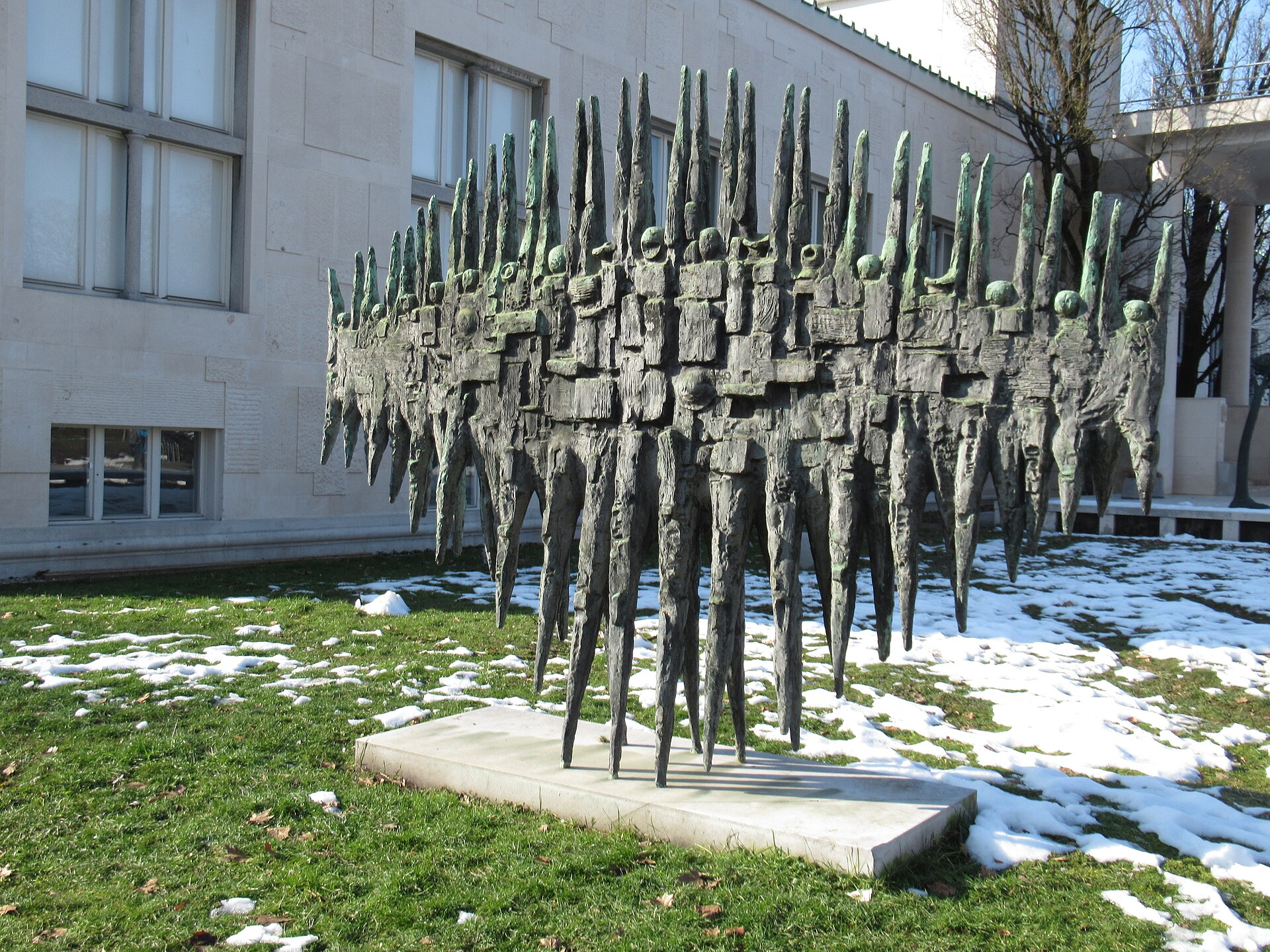
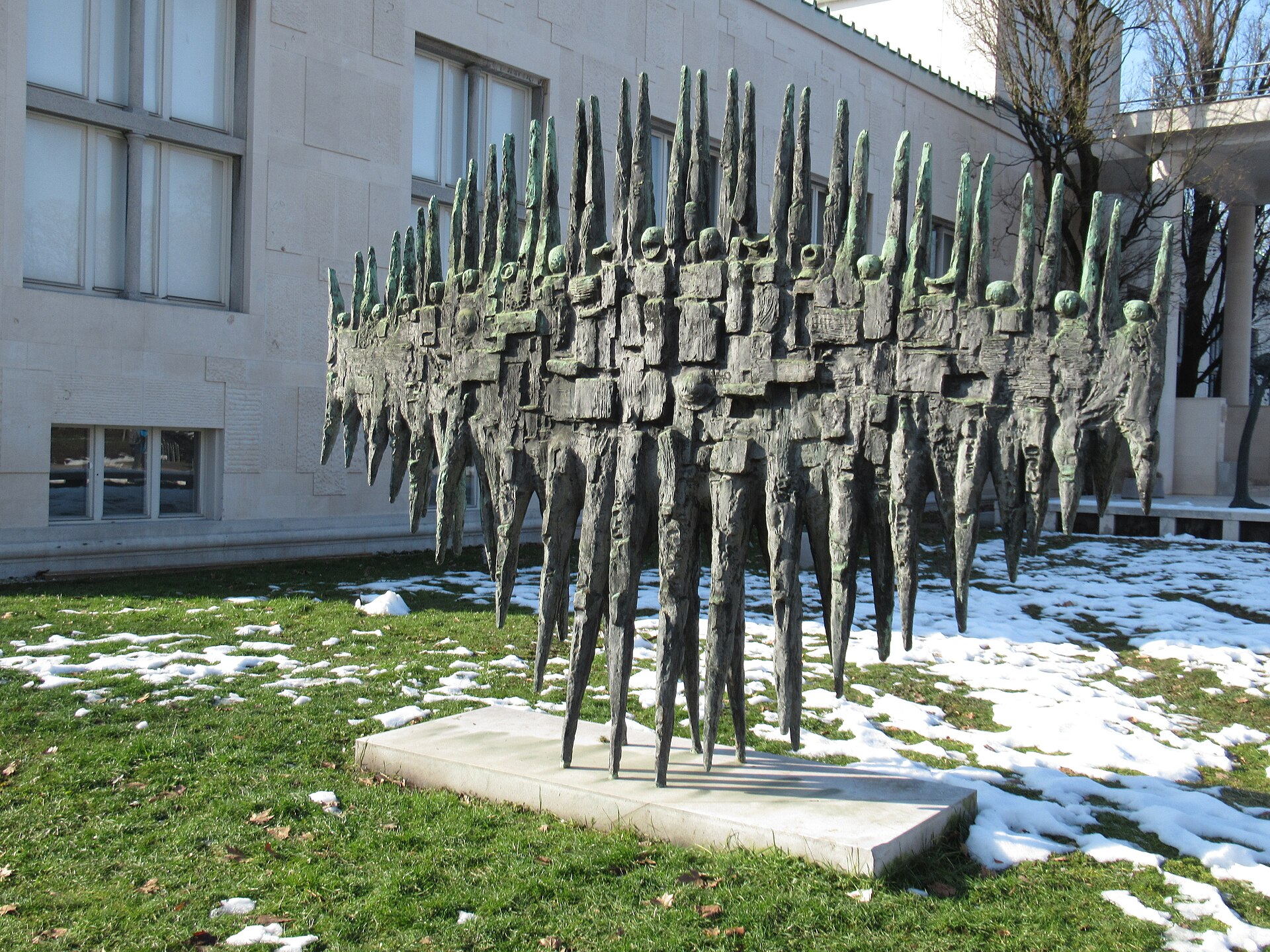
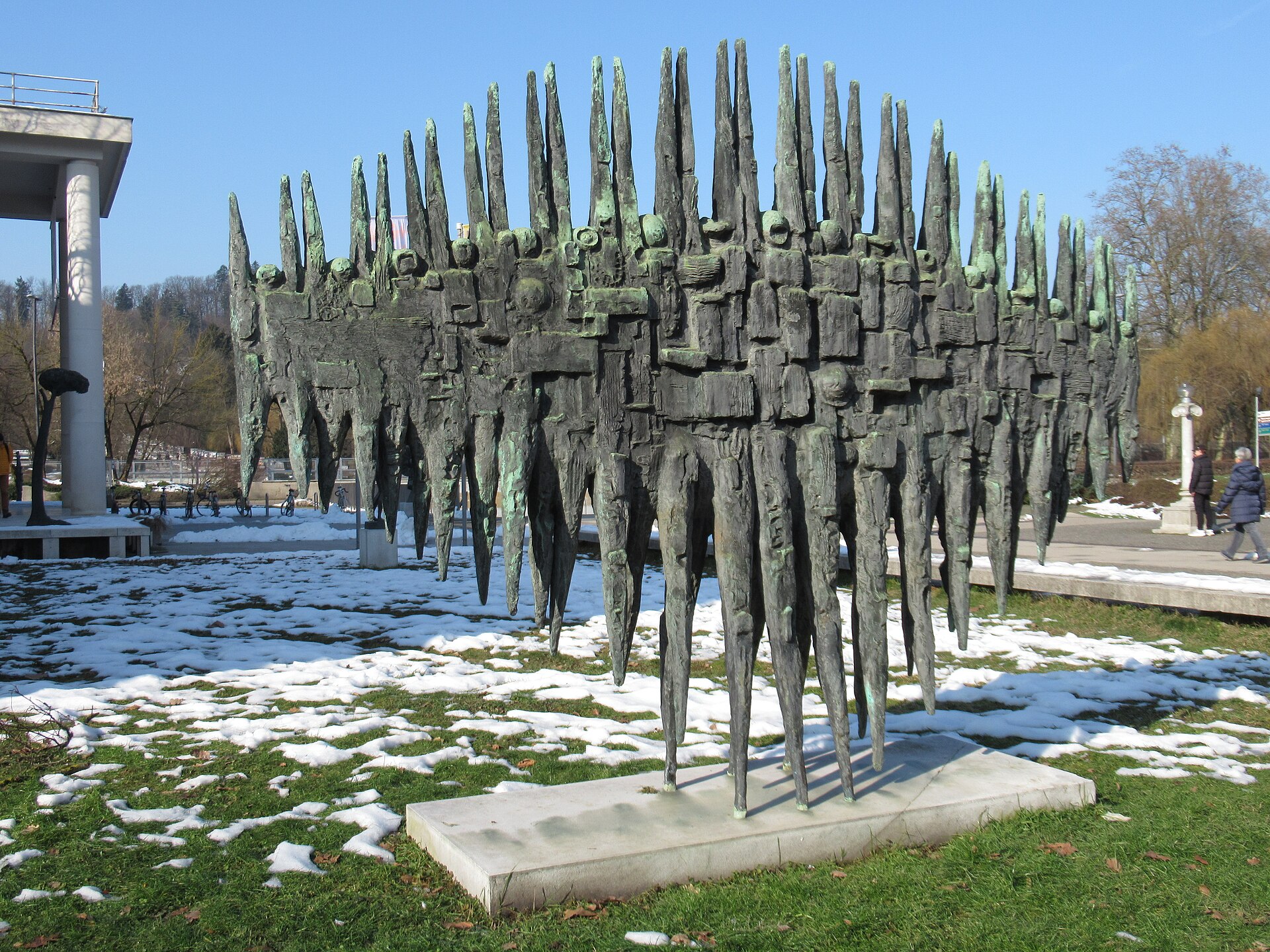
Photograph by Superchilum · CC BY-SA 4.0 Sculpture forecourt
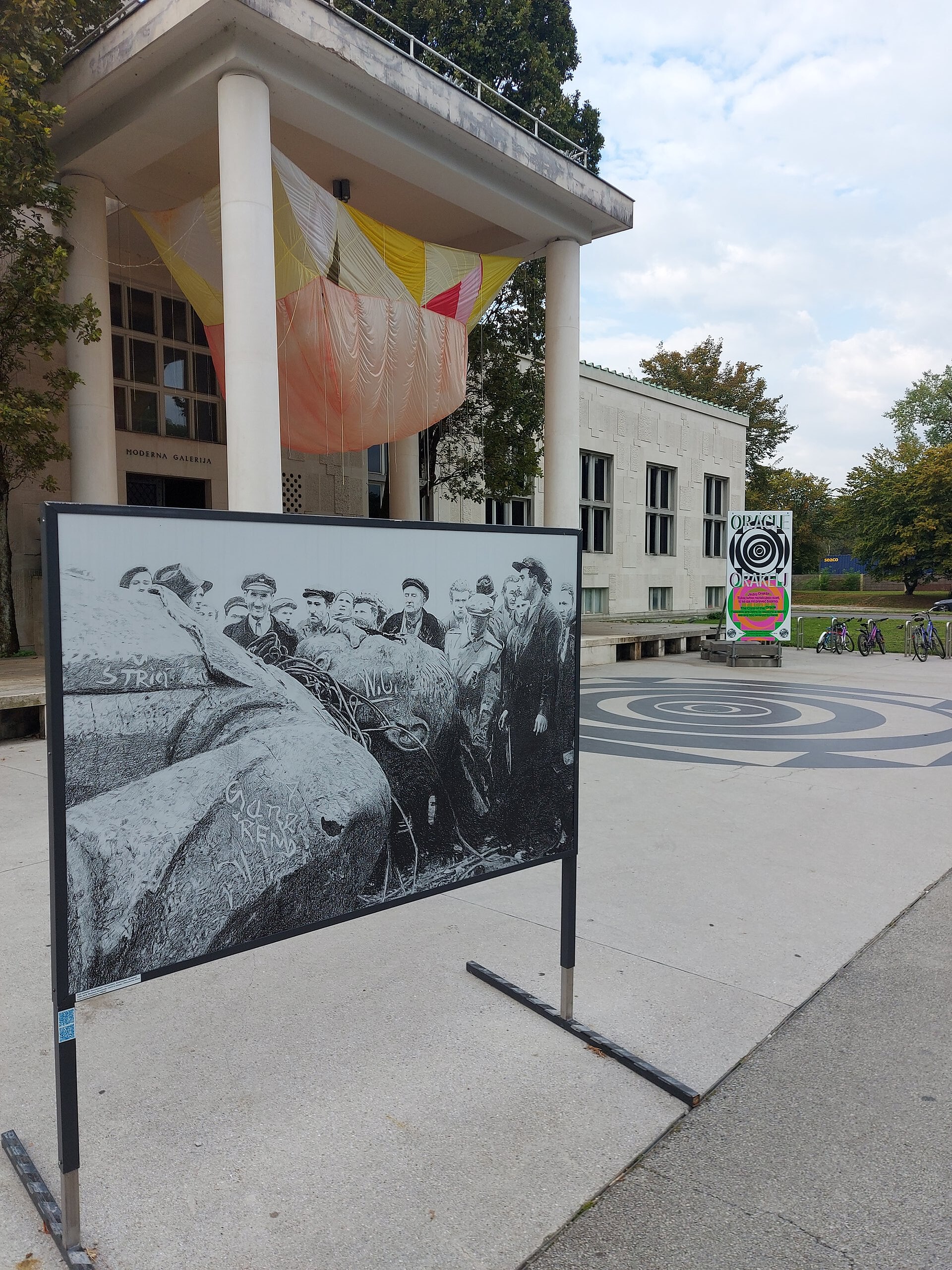
The paved approach and lawn in front of the Ravnikar building carry outdoor sculpture, including a large bronze figural group installed against the museum's stone facade; the space is also used for banners and outdoor elements of current exhibitions and the Ljubljana Triennial.
What to see first
Reconstruction of the Trieste Constructivist Space
Avgust Cernigoj, original 1927; rebuilt under Dragan Zivadinov and Miha TursicA second physical reconstruction of one of the few surviving traces of an immersive Central European Constructivist installation, anchoring the avant-garde section of the permanent display and Cernigoj's own institutional standing in Slovenian art history.7
Night Motif from Schwabing
Rihard JakopicThe painting the museum uses to open its Points in Time 1889-1991 chronology, marking the arrival of Impressionism-derived modernism in Slovenian painting.6
First public exhibition of Ivana Kobilca
Ivana KobilcaThe museum dates the start of its own historical timeline to Kobilca's first showing at the Ljubljana Realgymnasium, crediting a woman painter as the opening figure of its national narrative rather than a footnote to it.6
Geburt einer Nation (video)
LaibachCloses the Points in Time hang at 1991 and stands for the museum's willingness to end its national chronology on a deliberately provocative, popular-culture-facing note rather than a conventional late-modernist painting.6
OHO Group archive
OHO (Slovenian conceptual and neo-avant-garde group, active from the late 1960s)477 digitised items documenting a group whose reismus and land-art experiments gave Moderna galerija the material for Body and the East, the 1998 exhibition that did much to establish its later international reputation in East European art history.11
Former Yugoslav Collection
Various, including Ivan Mestrovic136 works that keep a record, inside the Slovenian national collection, of the wider Yugoslav artistic context Slovenia's own museum system has otherwise had to reconstruct after 1991.5
Drawing Collection bequest of Marij Pregelj
Marij Pregelj, bequeathed 1986The single largest enlargement of an 11,069-sheet drawing collection built up over fifty years, alongside Mila Kacic's 1996 gift of Jakob Savinsek's drawings.5
Exhibitions on now
Past exhibitions here
- Closed20 Jun to 20 Sep 2026Confirmed · check before you travel
A building interrupted by a war
Moderna galerija occupies a building designed in the late 1930s by Edvard Ravnikar, a Slovenian architect who had trained under Joze Plecnik and then spent part of 1939 in Le Corbusier's Paris studio before returning home to build it. Construction began on 12 October 1939 and was nearly finished by 1941, when the German and Italian occupation of Yugoslavia halted the project; the building spent the war years as a military warehouse rather than a gallery. Work resumed only after 1945, and the museum itself was created by a decree of the government of the People's Republic of Slovenia on 30 December 1947, opening to the public on 3 January 1948 with the painter Gojmir Anton Kos as its first director.
Ravnikar's design reads as a deliberately neutral container: a plain-fronted, formally restrained building that the museum's own historians describe as a modernist 'white cube' with galleries treated as hierarchically equal rather than arranged around a single grand hall. That neutrality was not only an aesthetic choice. Under socialist Yugoslavia, Moderna galerija did not sit easily inside the Western template of a museum of modern art, and the formal, apparently apolitical language of Modernism functioned as a way of working around ideological pressure from the state while still, in a different sense, suiting the authorities who preferred art that made no explicit claims. The building underwent a substantial renovation between 2007 and 2009 by the Ljubljana firm Bevk Perovic arhitekti, ahead of the reopened permanent display that followed in 2011.
One institution, two buildings
Since November 2011 Moderna galerija has operated as two physically separate museums under one administration, styled MG+MSUM. The building on Cankarjeva cesta, the Ravnikar building described above, is MG+ and is the subject of this record: it holds the National Collection and the permanent displays of Slovenian twentieth-century art. The second site, the Museum of Contemporary Art Metelkova (+MSUM), opened in a converted former Yugoslav army barracks at Maistrova 3, roughly a kilometre away in Ljubljana's Metelkova culture quarter, and was built to hold the Arteast 2000+ collection of Eastern European neo-avant-garde and international contemporary art together with the museum's archives, library and conservation studios.
The two buildings are frequently sold and reviewed as a single visit, with a combined ticket covering both, and general secondary sources sometimes describe them together as though they were one address. They are not: a photograph, a review or a fact about the Metelkova building is not evidence about the Cankarjeva cesta building, and this record keeps to the original MG+ site that Wikidata identifies, mentioning +MSUM only as the institution's second, separate location.
Two ways through the same century
The permanent display at MG+, opened in its present form in August 2011, is deliberately built to be walked two ways. The chronological route, titled Points in Time 1889-1991 and curated by Marko Jenko, runs as a circular timeline from Ivana Kobilca's first public exhibition at the Ljubljana Realgymnasium and Rihard Jakopic's Night Motif from Schwabing, through the interwar avant-garde, wartime imagery by artists such as Zoran Didek and Vladimir Lakovic, and postwar realist painting by Marjan Dovjak and Joze Tisnikar, ending at Slovenian independence in 1991 with Laibach's video Geburt einer Nation. The lateral route, titled 20th Century. Continuities and Ruptures, cuts straight from the 1920s avant-garde through the art of the wartime Partisan resistance, treating a movement usually kept at the margins of national art histories as continuous with, rather than separate from, better-known interwar and postwar Slovenian painting.
The anchor of the avant-garde section is a second physical reconstruction of Avgust Cernigoj's Trieste Constructivist Space, an immersive installation first built in 1927 with contributions from Giorgio Carmelich and others, drawing heavily on El Lissitzky's Proun rooms. The reconstruction on display was rebuilt under the direction of Dragan Zivadinov and Miha Tursic of the Delak Institute and gives Cernigoj, a Bauhaus-trained Slovenian constructivist who worked mainly out of Trieste, his most substantial permanent presence in a Slovenian public collection.
What the departments hold
Behind the two permanent hangs sit seven working collections. The Painting Collection runs to 1,301 works and the Sculpture Collection to 502, both concentrated on twentieth-century Slovenian art. The Graphics Collection holds 3,079 prints, including work by Zoran Music, Lojze Spacal and France Mihelic, a legacy of the International Biennial of Graphic Arts that Moderna galerija itself founded in 1955 before the Biennial became independent in 1985. The Drawing Collection is larger still, 11,069 sheets built up over fifty years and substantially enlarged by Marij Pregelj's 1986 bequest and Mila Kacic's 1996 gift of drawings by Jakob Savinsek.
The Photography Collection was established as its own department only in 1991 and now holds around 4,000 prints and several thousand negatives by roughly 150 photographers, with particular depth in interwar Slovenian photography, including the work of Fran Krasovec. A Media Art Collection is the newest and still-growing department, acquiring video, moving-image installation and internet-based work. Two further holdings sit alongside the Slovenian material: the Former Yugoslav Collection of 136 paintings, sculptures and prints from across the former republics, including work by Ivan Mestrovic, and the digitised archive of OHO, the Slovenian neo-avant-garde and conceptual art group active from the late 1960s, now 477 items strong and central to how the museum narrates that period of its own history.
From a national gallery to an international reference point
For most of the socialist period Moderna galerija collected almost exclusively within Slovenia, and its international profile was limited chiefly to the Biennial of Graphic Arts. That changed after Slovenian independence in 1991, when the museum, under director Zdenka Badovinac, began building an international collection with a specific regional focus. In 2000 it founded the Arteast 2000+ collection, framed from the outset as the first museum collection built around Eastern European postwar neo-avant-garde art read in dialogue with Western contemporaries such as Joseph Beuys, Jenny Holzer, Anish Kapoor and Lawrence Weiner; its first public showing, in the then-unrenovated Metelkova barracks, included 85 artists and collectives. That collection moved to the newly opened +MSUM building in November 2011, where it remains today, alongside the museum's 1998 exhibition Body and the East, which had already used the OHO archive and related material to argue for a distinct East European conceptual art history rather than treating it as a regional footnote to Western movements.
Moderna galerija co-founded the international museum network L'Internationale in 2009 with several other European institutions built on a shared aim of questioning the canonical, Western-centred account of modern art history. Writing after a 2019 symposium visit, the art historian Maja Fowkes described a museum whose curatorial staff, in Marko Jenko's own account, had deliberately built the permanent hang to hold two histories in tension rather than smoothing them into one linear story, and reported that the Partisan-era central hall was the part of the visit that most resonated with the visiting group of specialists in East European art.
What visitors say
Visitors consistently describe Moderna galerija as a compact, well-curated museum of twentieth-century Slovenian art that rewards more time than its size suggests, built around Yugoslav-era and Partisan history that is unfamiliar to most foreign visitors going in. The building and its cafe are commented on almost as often as the collection; the main complaint is that a visitor expecting a large international modern-art museum on the scale of Tate Modern or the Reina Sofia finds a smaller, more local institution instead.
What is praised, what is criticised
- Praised: the depth and coherence of the Slovenian twentieth-century collection, including artists visitors had not previously heard of
- Praised: the historical framing of Partisan resistance art and Yugoslav-era Slovenian art alongside the modernist avant-garde
- Praised: the on-site Moderna Coffee Shop
- Praised: the reasonable admission price, especially with a Ljubljana Card
- Praised: the compact scale, which some visitors say lets individual works register rather than being lost in a large survey
- Criticised: some visitors unfamiliar with Slovenian art history find the collection's subject matter hard to place and occasionally underwhelming next to better-known European modern-art museums
- Criticised: large exhibition rooms can feel sparsely hung to visitors expecting a denser display
- Criticised: at least one visitor reported no wheelchair access at the main Cankarjeva cesta entrance, though the museum's own visitor information directs wheelchair and stroller users to a separate step-free entrance at Windischerjeva 2
- Criticised: the prevailingly dark, war- and history-inflected tone of much of the collection is noted by some as emotionally heavy rather than an enjoyable visit
Ratings on other platforms
Tripadvisor: 4 from 76 ratings, read 5 September 2026
A platform average is a tertiary source: it moves, it is not audited, and we quote no visitor's words.
Questions about Moderna galerija
Where is Moderna galerija?
Cankarjeva cesta 15, 1000 Ljubljana, Slovenia.
How much does it cost to visit?
Adult: EUR 7; Student, senior (65+): EUR 3.5; Group, 10+ adults, per person: EUR 5; Group, 10+ students or seniors, per person: EUR 3; Family, 2 adults plus children up to 18: EUR 14. As confirmed 5 September 2026.
When is it open?
Tue-Wed, Fri-Sun 10:00-18:00; Thu 10:00-18:00; Dec 24 and Dec 31 10:00-15:00. Closed: Monday. 1 January. As confirmed 5 September 2026.
How do you get there?
Bus: Konzorcij or Posta stop, routes 1, 2, 3, 3B, 3G, 6, 6B, 9, 11, 11B, 14, 14B, 18, 19B, 19I, 27; Bus: Cankarjev Dom stop, routes 14, 14B, 18; Walking: About 20 minutes from Ljubljana railway station; the museum stands at the edge of Tivoli Park.
What should you see first?
Reconstruction of the Trieste Constructivist Space (Avgust Cernigoj, original 1927; rebuilt under Dragan Zivadinov and Miha Tursic); Night Motif from Schwabing (Rihard Jakopic); First public exhibition of Ivana Kobilca (Ivana Kobilca); Geburt einer Nation (video) (Laibach); OHO Group archive (OHO (Slovenian conceptual and neo-avant-garde group, active from the late 1960s)); Former Yugoslav Collection (Various, including Ivan Mestrovic).
What we could not confirm
- The museum's own visitor pages, as fetched for this record, do not state a photography policy or a bag policy for MG+; nothing is asserted here beyond what the pages say.
- No dedicated restitution, provenance or acquisitions controversy specific to the MG+ National Collection surfaced in the sources checked for this record; this should be revisited if the desk's sourcing improves, since it is plausible for a museum built through 20th-century state acquisition.
Images
Sources
- 1Wikidata, Q11234584, Museum of Modern Art (Ljubljana) wikidata.org/wiki/Q11234584
- 2Moderna galerija / Museum of Modern Art, visitor information, MG+MSUM mg-lj.si/en/visit/778/info_mg/
- 3History, MG+MSUM mg-lj.si/en/about-us/682/history/
- 4Architect Edvard Ravnikar (1907-1993) and Moderna galerija, MG+MSUM mg-lj.si/en/visit/3808/architect-edvard-ravnikar-1907-1993/
- 5Collections, MG+MSUM mg-lj.si/en/collections/
- 6Exhibition from the collections: Points in Time 1889-1991, MG+MSUM mg-lj.si/en/exhibitions/1914/points-in-time-1889-1991/
- 7ARTEMIC 8: Reconstruction of the Trieste Constructivist Space (1927/2011), MG+MSUM mg-lj.si/en/exhibitions/2839/trieste-constructivist-space/
- 8Exhibition: 20th Century. Continuities and Ruptures, MG+MSUM mg-lj.si/en/exhibitions/289/mg-20th-century-continuities-and-ruptures/
- 9Getting to Moderna galerija / Museum of Modern Art, MG+MSUM mg-lj.si/en/visit/780/mg-acess/
- 10Moderna galerija (MG), Culture.si culture.si/en/Moderna_galerija_(MG)
- 11Museum of Modern Art (Ljubljana), Wikipedia en.wikipedia.org/wiki/Museum_of_Modern_Art_(Ljubljana)
- 12Maja Fowkes, 'Moderna galerija', UCL Confrontations: Sessions in East European Art History, 29 April 2019 blogs.ucl.ac.uk/confrontations/2019/04/29/moderna-galerija/
- 13Modern Gallery (Moderna Galerija), Ljubljana, Tripadvisor listing and reviews tripadvisor.com/Attraction_Review-g274873-d276325-Reviews-Modern_Gallery_Moderna_Galerija-Ljubljana_Upper_Carniola_Region.html
- 14Category:Museum of Modern Art (Ljubljana), Wikimedia Commons commons.wikimedia.org/wiki/Category:Museum_of_Modern_Art_(Ljubljana)