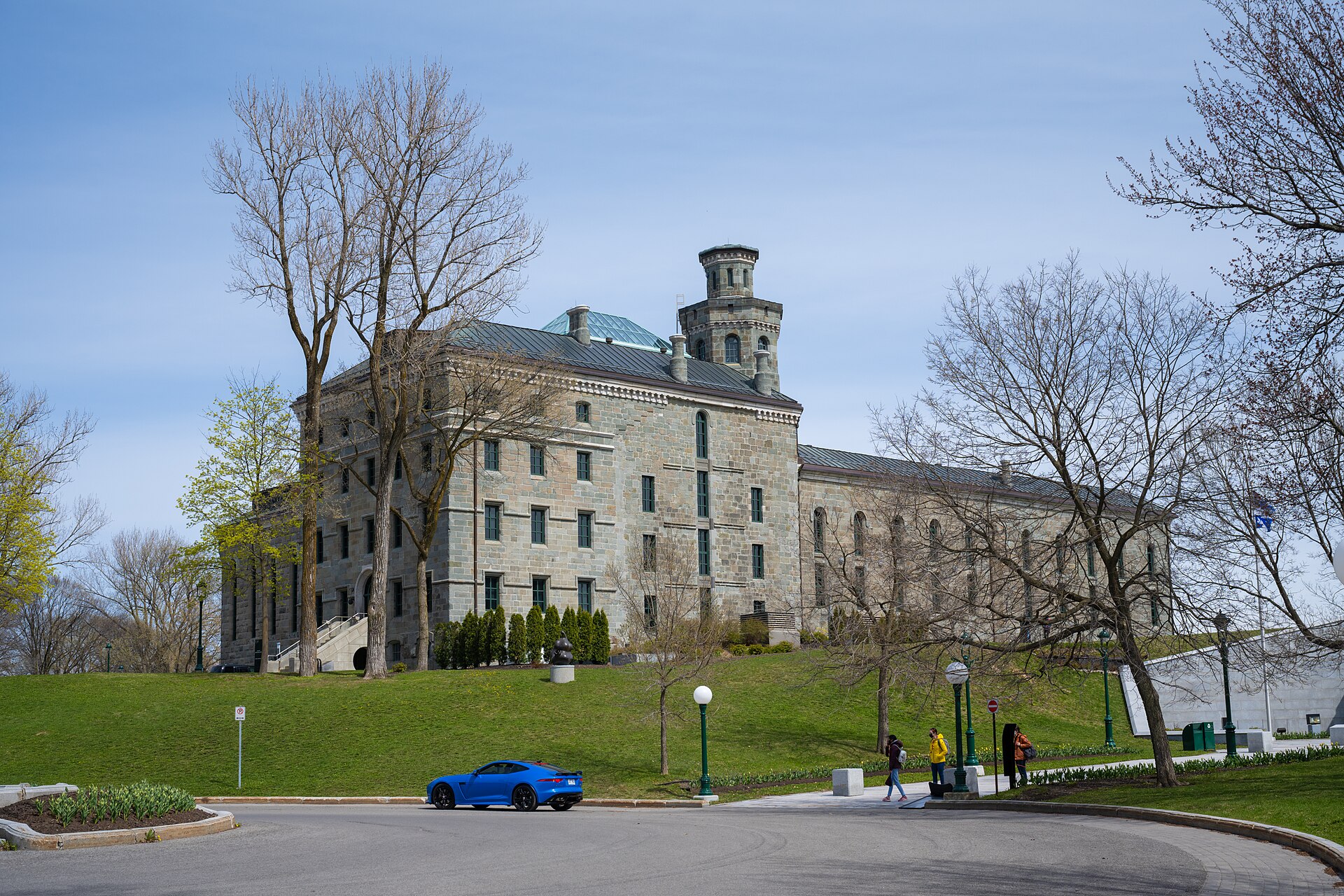
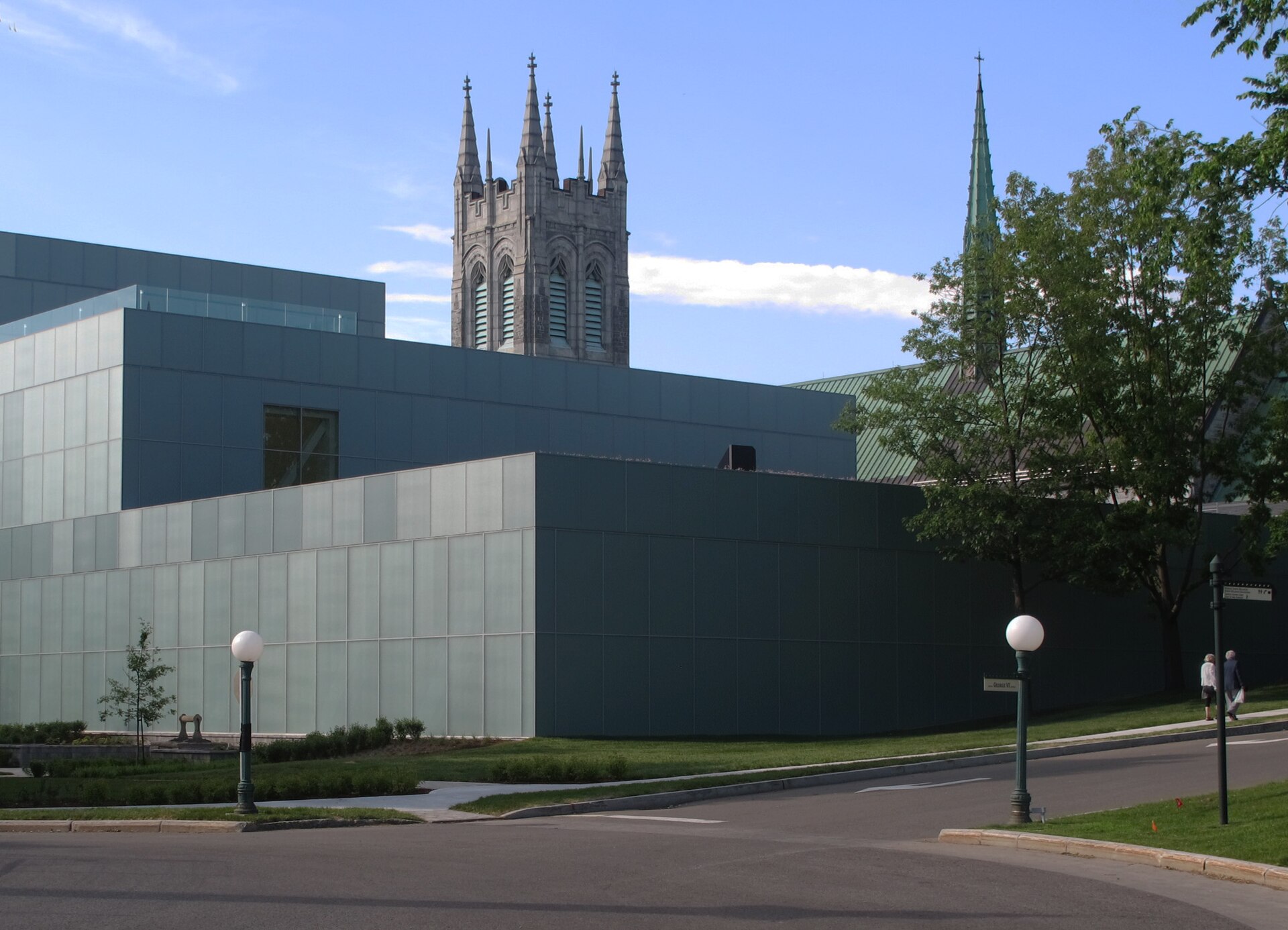
The museum building photographed from Avenue George-VI, inside Parc des Champs-de-Bataille (the Plains of Abraham), Quebec City.
Photo: Wilfredor (CC0)Musee national des beaux-arts du Quebec
Museum · Founded 1933
Open, admission and hours confirmed 5 September 2026 · 13 sources
On this page 16 sections
ContentsClose
The museum's stated claim is depth in one national tradition rather than breadth across many: more than 42,000 works by over 4,500 artists, built as the most complete public survey of Quebec art from the 17th century onward. That is reinforced by two collections large enough to be institutions in their own right - the Brousseau collection of more than 2,600 Inuit sculptures and 250 works on paper, and what the museum describes as the largest public holding of Jean Paul Riopelle anywhere, about to be given its own purpose-built pavilion. The weakness of the model is the one currently on display: because the historical and modern-masters galleries sit in older buildings tied up in the same construction project as the new Riopelle pavilion, the museum's range is not fully visible in any single visit made in 2026.
| Kind | Museum |
|---|---|
| Founded | 1933 |
| City and country |  Quebec City, Canada Quebec City, Canada |
| Address | 179 Grande Allee Ouest, Quebec City, QC G1R 2H1, Canada |
| Website | mnbaq.org |
| Status | Open, confirmed |
| Record last verified |
Visiting
- Hours
- Monday-Sunday, summer hours through 7 September 202610:00 to 17:00Open every day during summer hours; Wednesday stays open until 21:00
- Tuesday-Sunday, regular season from 8 September 202610:00 to 17:00Closed Monday in the regular season; Wednesday stays open until 21:00
- Closed
- Monday, in the regular season only (from 8 September 2026); the museum is open daily during the summer schedule.
- Admission
- MembersFreeFree with an MNBAQ membership
- Child, 12 and underFreeFree, but a reserved ticket is still required
- Youth 13-17CAD 8Tax included
- Young adult 18-30CAD 21CAD 18 when the ticket is bought online
- Adult 31-64CAD 28CAD 25 when the ticket is bought online
- Senior 65+CAD 27CAD 24 when the ticket is bought online
- Family, 2 adults plus up to 5 children 17 and underCAD 60CAD 54 when the ticket is bought online
- Tickets
- mnbaq.org/en/plan-your-visit/practical-inform... The museum's own ticket page.
- Do I need to book?
- No, but the museum recommends buying tickets online: it saves up to CAD 3 per ticket and skips the line. Children 12 and under enter free but still need a reserved ticket.
- Address
- 179 Grande Allee Ouest, Quebec City, QC G1R 2H1, Canada Mapcar Paid lot near the Charles-Baillairge Pavilion: CAD 6 for the first hour, CAD 3 per additional hour, CAD 20 daily maximum; museum members get 20 percent off
- Website
- mnbaq.org
- Telephone
- +1 418-643-2150
- [email protected]
Before you go how long, access, photography, bags, eating, shop
- How long to allow
- One to two hours in the Pierre Lassonde Pavilion. In 2026 that is the only pavilion open, so a visit does not currently reach the historical Quebec-art galleries or the four modern-masters rooms.
- Access
- Free wheelchairs and magnifying glasses are available on request without reservation; certified service dogs are welcome; the museum states it accommodates visitors with special needs.
- Photography
- Permitted in the galleries without flash or tripod, except in the temporary exhibition Hidden Treasure: A Century of Mystery.
- Bags
- Large bags and backpacks must be checked at the free cloakroom at the Pierre Lassonde Pavilion entrance; they are not allowed in the galleries.
- Eating
- Bistro Quebecor, the museum's restaurant, is temporarily closed; dining space remains available inside the Pierre Lassonde Pavilion.
- Shop
- The Librairie-Boutique sells art books, headphones and artisanal products and can be visited without an admission ticket during opening hours.
Prices and hours change. We take them from the institution's own pages and print the day we read them, and you can check the current position at the source we used. Confirm before you travel.
What is inside
Gerard-Morisset Pavilion
The museum's original 1933 neoclassical building, designed by Wilfrid Lacroix. It normally houses the long-run survey 350 Years of Artistic Practices in Quebec, covering Quebec art from the 17th century onward. As of this research it is closed to the public while construction continues on the Espace Riopelle pavilion next door.
Charles-Baillairge Pavilion
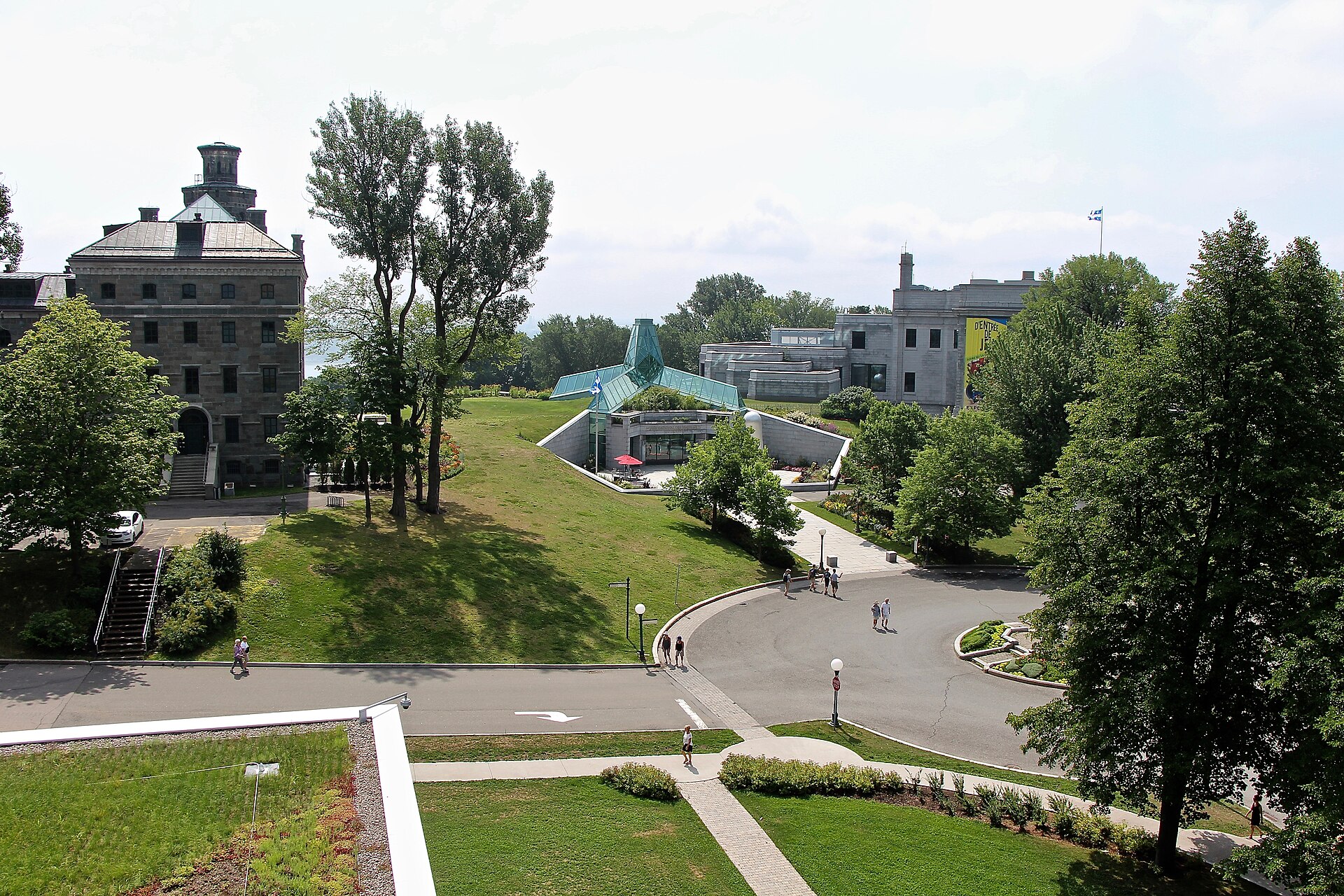
Built in 1867 as Quebec City's prison and used as one until 1970, then converted and joined to the museum in 1991, with some original cells preserved inside. It normally shows the museum's modern Quebec masters: Jean Paul Lemieux, Fernand Leduc, Alfred Pellan and Jean Paul Riopelle. It is currently closed for the same construction work as the Gerard-Morisset Pavilion.
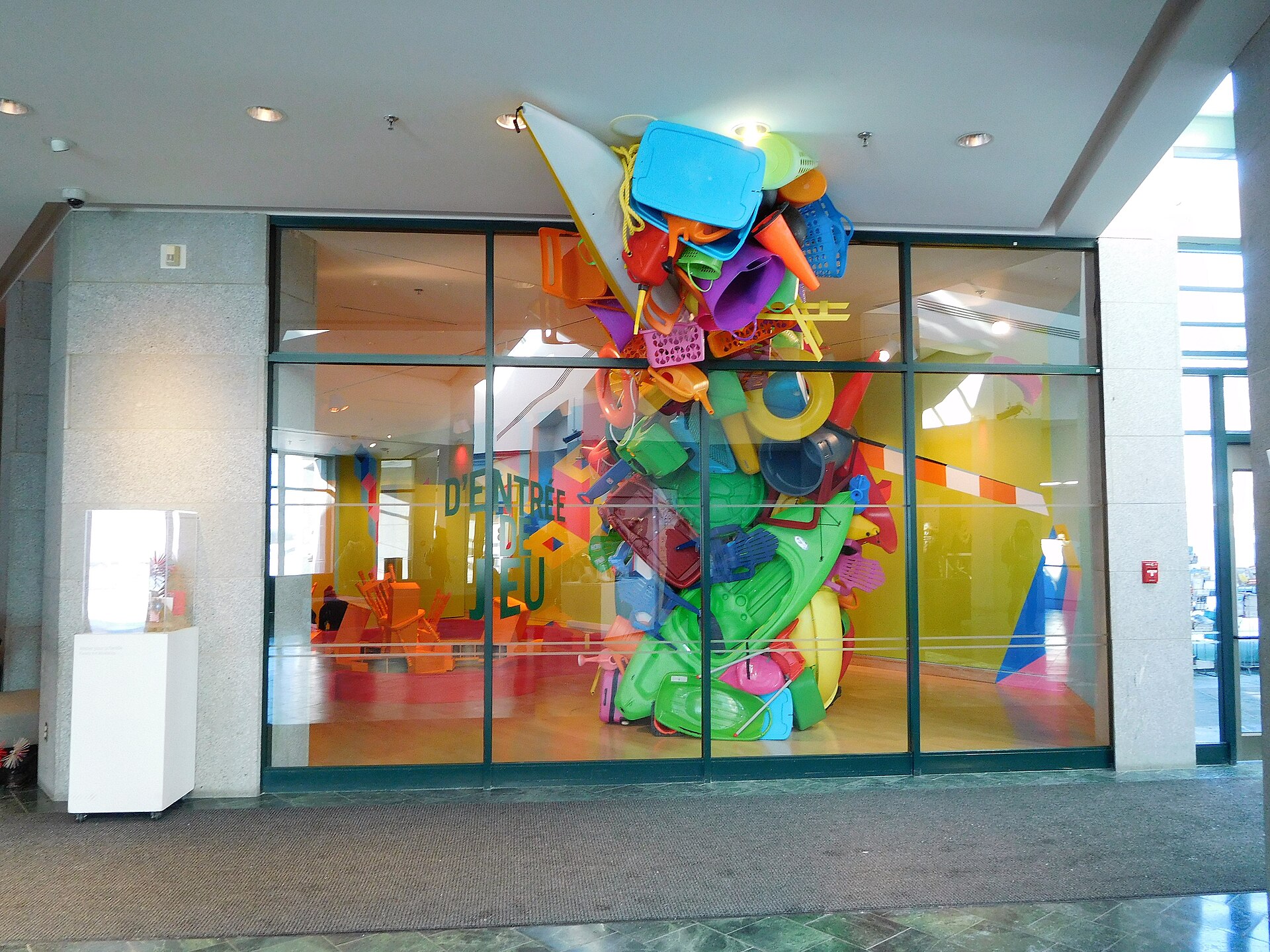
Photograph by Jeangagnon · CC BY-SA 4.0 Central Pavilion (the Grand Hall)
A glass-roofed link pavilion built during the museum's 1989-1991 renovation, historically the main entrance and connector between the older buildings. It holds the Family Gallery, reimagined with a sculptural installation by Argentine-born, Quebec-based artist Jose Luis Torres.
Pierre Lassonde Pavilion
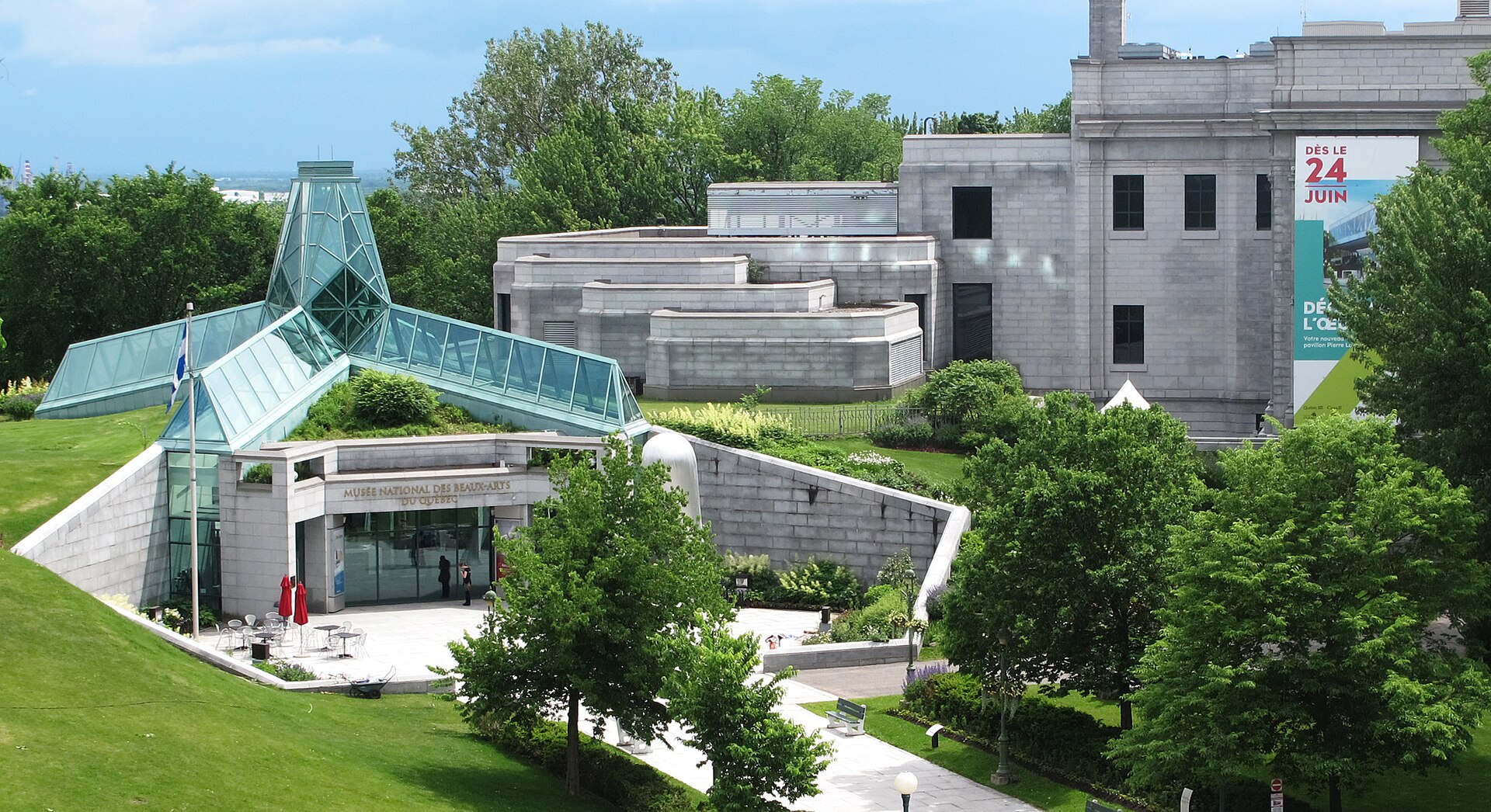
Opened in 2016, designed by OMA (partner Shohei Shigematsu) with Montreal firm Provencher Roy as three stacked glass volumes. It holds the museum's contemporary art from 1960 to the present, its decorative arts and design galleries, and the Brousseau Collection of Inuit art, plus the cafe, boutique and auditorium. As of this research it is the only pavilion open to the public.
Espace Riopelle - Michael Audain Pavilion
A new pavilion under construction since May 2024 and set to open 22-25 October 2026, designed by the Quebec firm Les Architectes fabg. It is being built to hold more than 130 works by Jean Paul Riopelle across three storeys, rising to a circular top-floor room built specifically for his 1992 masterpiece, Tribute to Rosa Luxemburg.
What to see first
Tribute to Rosa Luxemburg (Hommage a Rosa Luxemburg)
Jean Paul RiopelleRiopelle's 1992 masterpiece, a triptych of 30 panels running roughly 40 metres. It is being given a purpose-built circular room at the top of the new Espace Riopelle pavilion when that opens in October 2026.6
The Brousseau Collection of Inuit Art
various Inuit artists; assembled by collector Raymond BrousseauMore than 2,600 sculptures plus about 250 prints and drawings, gathered over 50 years by Raymond Brousseau (1938-2021) and donated to the museum in 2005, drawn from roughly 1,000 artists across Nunavik, Nunavut and the Northwest Territories. Shown in the Pierre Lassonde Pavilion.8
Jean Paul Lemieux gallery
Jean Paul LemieuxOne of four modern Quebec masters given dedicated permanent gallery space in the Charles-Baillairge Pavilion, alongside Leduc, Pellan and Riopelle.4
Alfred Pellan gallery
Alfred PellanPellan's Cubist- and Surrealist-inflected paintings anchor the museum's modern Quebec collection in the Charles-Baillairge Pavilion.4
Fernand Leduc gallery
Fernand LeducThe fourth of the museum's dedicated modern-masters rooms in the Charles-Baillairge Pavilion, shown alongside Lemieux, Pellan and Riopelle.4
350 Years of Artistic Practices in Quebec
The Gerard-Morisset Pavilion's long-run survey of Quebec art from the 17th century to today, in the museum's original 1933 building. It is currently closed to visitors during the Espace Riopelle construction.5
The former Quebec City prison
Charles Baillairge, architectThe Charles-Baillairge Pavilion was built as Quebec City's prison in 1867 and operated until 1970; some original cells survive inside the building, which joined the museum in 1991 and is currently closed for construction.5
The staircase of the Pierre Lassonde Pavilion
OMA (Shohei Shigematsu) with Provencher RoyA sculptural steel staircase running through the building's three levels, singled out by critics as the pavilion's signature interior space and its main circulation route.12
Exhibitions on now
From a provincial art collection to a national museum
The museum's origin dates to March 1920, when the provincial cabinet minister Athanase David announced that Quebec would start buying works by its own artists to build a public collection. The building opened on 5 June 1933 as the Musee de la province de Quebec, a neoclassical structure designed by architect Wilfrid Lacroix on a bluff inside Parc des Champs-de-Bataille, the Plains of Abraham. The institution changed shape twice more before it took its current form: its natural-history holdings were removed around 1962, after which it was renamed the Musee du Quebec, and the provincial archives that had also been housed there moved out in 1979, leaving fine art as its sole subject. In 2002 the Quebec legislature's Bill 125 gave it its present name, Musee national des beaux-arts du Quebec, recognising a national rather than a purely provincial mandate.
Today the museum describes its collection as running to more than 42,000 works by over 4,500 artists, spanning the 17th century to the present day. Its core is Quebec art, shown as a continuous survey rather than a series of period rooms, supplemented by Canadian and international pieces and by the Brousseau collection of Inuit art. It is, on its own account, the most complete public record of Quebec's visual art history anywhere.
Four buildings across a century, on a battlefield
The museum is not one building but a connected complex inside a park built to commemorate the 1759 Battle of the Plains of Abraham. The oldest piece is the 1933 Gerard-Morisset Pavilion, Lacroix's original Beaux-Arts building. Beside it stands a structure with an entirely different first life: the Charles-Baillairge Pavilion, designed by the Quebec City architect Charles Baillairge and built in 1867 as the city's prison, which held inmates until 1970. It was converted for museum use during a 1989-1991 renovation and reopened in May 1991, joined to the older building by a new Central Pavilion whose glass-roofed Grand Hall became the museum's main entrance and link.
The complex grew again in 2016 with the Pierre Lassonde Pavilion, designed by the architecture firm OMA, led by partner Shohei Shigematsu, working with the Montreal firm Provencher Roy. It was OMA's first completed museum building anywhere. Rather than one large volume, the architects stacked three glass boxes of decreasing size in a cascade descending from the park toward Grande Allee, giving the museum the column-free galleries it needed for large contemporary works. The pavilion added roughly 14,900 square metres at a construction cost of about CAD 103.4 million, and it functions today as the museum's public gateway, with its cafe, boutique, auditorium and ticketing desk.
What the collections cover, pavilion by pavilion
Each of the museum's four historic pavilions carries a different slice of its collection. The Gerard-Morisset Pavilion, in its original building, presents the long-run survey 350 Years of Artistic Practices in Quebec, tracing painting, sculpture and decorative art from the 17th century forward. The Charles-Baillairge Pavilion, the former prison, is given over to modern Quebec art and holds dedicated rooms for four artists the museum treats as its core modern figures: Jean Paul Lemieux, Fernand Leduc, Alfred Pellan and Jean Paul Riopelle. The Central Pavilion's Grand Hall includes the Family Gallery, a space reimagined with a sculptural installation by the Argentine-born, Quebec-based artist Jose Luis Torres. The Pierre Lassonde Pavilion carries the museum's contemporary art from 1960 onward, its decorative arts and design galleries, and its Inuit art collection.
A fifth pavilion is being added rather than replacing any of these. Espace Riopelle - the Michael Audain Pavilion, under construction since May 2024 and due to open 22-25 October 2026, is being built specifically to house the museum's Riopelle holdings, which it describes as the largest public collection of his work anywhere.
The Riopelle problem, and the pavilion built to solve it
Jean Paul Riopelle (1923-2002) is treated by the museum as its single most important modern holding, and the collection is large enough that no existing gallery could show it properly, including his 1992 masterpiece Tribute to Rosa Luxemburg, a triptych of 30 panels running to roughly 40 metres. The museum's answer is a purpose-built pavilion, designed by the Quebec firm Les Architectes fabg as a three-storey, glass-and-steel structure exceeding 5,000 square metres, rising to a circular top-floor room designed around the Rosa Luxemburg tribute alone. When it opens the pavilion is expected to display more than 130 Riopelle works spanning five decades of his career, alongside a modern-art display of around 50 other artists.
The project's cost has grown substantially since it was first announced. When the design was unveiled in September 2022 the budget was set at CAD 42.5 million. After what the museum called a comprehensive cost assessment carried out between October 2022 and December 2023, the figure was revised to CAD 84 million when the construction contract was awarded in April 2024, with the increase covered by higher contributions from the Quebec provincial government (from CAD 20 million to CAD 44 million), the City of Quebec, the Fondation du MNBAQ, the Jean-Paul Riopelle Foundation, and named philanthropists including Michael Audain, Pierre Lassonde, France Chretien Desmarais and Andre Desmarais.
What is actually open right now
A visitor planning a trip in 2026 needs to know that most of the museum's historic footprint is closed. The museum's own visitor-information page states plainly that the Pierre Lassonde Pavilion is open and running its full programme, while the Gerard-Morisset and Charles-Baillairge pavilions are closed because of the ongoing construction work on Espace Riopelle next door. That means the 350-years survey of historical Quebec art and the four modern-masters rooms - Lemieux, Leduc, Pellan and Riopelle - are not currently viewable, and will not be until construction finishes and those buildings reopen. The museum's restaurant, Bistro Quebecor, is also temporarily closed, though other dining space remains available inside the Pierre Lassonde Pavilion. None of this makes the museum closed in any sense that matters for this record: the institution is operating, selling tickets, and running exhibitions in its newest building, and it is treating the closures as temporary and tied to a dated construction project rather than as a wind-down.
The Brousseau collection of Inuit art
In 2005 the museum acquired the Inuit art collection built over roughly 50 years by the Quebec collector Raymond Brousseau (1938-2021). It runs to more than 2,600 sculptures plus about 250 original prints and drawings, along with ethnographic material such as jewellery, ivory work, textiles and tools, drawn from close to 1,000 artists working in Nunavik, Nunavut and the Northwest Territories, nearly 200 of them women. A further group of miniatures came from the collector Thomas Kramer. The sculptures are carved chiefly from serpentinite, soapstone, basalt and other stone, along with ivory, caribou antler and whalebone, and their recurring subjects are family life, Arctic animals, and Inuit belief and story. The museum shows the collection in dedicated galleries inside the Pierre Lassonde Pavilion and describes it as one of the finest collections of Inuit art anywhere.
Visiting
The museum sits inside Parc des Champs-de-Bataille at 179 Grande Allee Ouest, on the western edge of Quebec City's old town. During its summer schedule, in effect through 7 September 2026, it opens every day from 10 a.m. to 5 p.m., with Wednesday hours extended to 9 p.m.; from 8 September 2026 it moves to its regular-season schedule, open Tuesday through Sunday 10 a.m. to 5 p.m., Wednesday to 9 p.m., and closed Monday. General admission for an adult aged 31 to 64 is CAD 28 at the door or CAD 25 booked online, with reduced tiers for seniors, young adults and youth, a family rate, and free entry for children 12 and under and for members, though children still need a reserved ticket. A free cloakroom, free wheelchairs and magnifying glasses, and accommodations for visitors with special needs are available without reservation. Paid parking sits near the Charles-Baillairge Pavilion. Given that most of the historic complex is currently closed for construction, a visitor planning around the collections that are not in the Pierre Lassonde Pavilion should confirm on the museum's own site which pavilions have reopened before travelling.
What visitors say
Visitors and critics agree the museum's architecture and its Inuit and modern Quebec collections are its strongest draw, while several note that construction on the new Espace Riopelle pavilion currently limits how much of the museum can actually be seen.
What is praised, what is criticised
- Praised: The Brousseau collection of Inuit art, especially its contemporary sculpture
- Praised: The architecture of the Pierre Lassonde Pavilion, in particular its central staircase and the way its galleries and cafe open onto Parc des Champs-de-Bataille
- Praised: Special and temporary exhibitions, which reviewers on travel sites describe as well curated and world class
- Praised: The free cloakroom, on-site cafe and bookstore, and general accessibility amenities
- Criticised: As of 2026, three of the museum's four pavilions (Gerard-Morisset, Charles-Baillairge, and the still-unopened Espace Riopelle) are closed for construction, so only the Pierre Lassonde Pavilion is open to visitors
- Criticised: Some visitors find the permanent collection modest for a single visit next to larger national museums, and say a short visit is enough outside of special exhibitions
- Criticised: The Espace Riopelle pavilion's construction budget nearly doubled, from CAD 42.5 million when the design was announced in September 2022 to CAD 84 million when the construction contract was awarded in April 2024
Ratings on other platforms
Tripadvisor: 4.4 from 970 ratings, read 5 September 2026
A platform average is a tertiary source: it moves, it is not audited, and we quote no visitor's words.
Questions about Musee national des beaux-arts du Quebec
Where is Musee national des beaux-arts du Quebec?
179 Grande Allee Ouest, Quebec City, QC G1R 2H1, Canada.
How much does it cost to visit?
Members: free; Child, 12 and under: free; Youth 13-17: CAD 8; Young adult 18-30: CAD 21; Adult 31-64: CAD 28. As confirmed 5 September 2026.
When is it open?
Monday-Sunday, summer hours through 7 September 2026 10:00-17:00; Tuesday-Sunday, regular season from 8 September 2026 10:00-17:00. Closed: Monday, in the regular season only (from 8 September 2026); the museum is open daily during the summer schedule. As confirmed 5 September 2026.
How do you get there?
car: Paid lot near the Charles-Baillairge Pavilion: CAD 6 for the first hour, CAD 3 per additional hour, CAD 20 daily maximum; museum members get 20 percent off.
What should you see first?
Tribute to Rosa Luxemburg (Hommage a Rosa Luxemburg) (Jean Paul Riopelle); The Brousseau Collection of Inuit Art (various Inuit artists; assembled by collector Raymond Brousseau); Jean Paul Lemieux gallery (Jean Paul Lemieux); Alfred Pellan gallery (Alfred Pellan); Fernand Leduc gallery (Fernand Leduc); 350 Years of Artistic Practices in Quebec.
What we could not confirm
- The museum's own site does not state whether the Gerard-Morisset and Charles-Baillairge pavilions will reopen before, at the same time as, or only after the Espace Riopelle opening in October 2026.
- The financing breakdown published for the CAD 84 million Espace Riopelle budget names Michael Audain, Pierre Lassonde, France Chretien Desmarais and Andre Desmarais as private donors without stating each individual's contribution.
Images
Sources
- 1MNBAQ, Practical Information mnbaq.org/en/plan-your-visit/practical-information
- 2MNBAQ, Contact Us mnbaq.org/en/about/contact-us
- 3MNBAQ, homepage mnbaq.org/en
- 4MNBAQ, The Musee (history and pavilions) mnbaq.org/en/about/the-musee
- 5MNBAQ, Site and Architecture mnbaq.org/en/about/the-musee/site-and-architecture
- 6MNBAQ, Espace Riopelle - Michael Audain Pavilion mnbaq.org/en/about/the-musee/espace-riopelle
- 7MNBAQ, Frequently Asked Questions mnbaq.org/en/plan-your-visit/frequently-asked-questions
- 8MNBAQ, Inuit Art collection album mnbaq.org/en/collections/albums/inuit-art
- 9Wikipedia, Musee national des beaux-arts du Quebec (, used for identity and history cross-check only) en.wikipedia.org/wiki/Mus%C3%A9e_national_des_beaux-arts_du_Qu%C3%A9bec
- 10The Art Newspaper, 'Cost of Quebec City museum's Jean Paul Riopelle pavilion nearly doubles', 5 April 2024 theartnewspaper.com/2024/04/05/riopelle-pavilion-musee-national-beaux-arts-quebec-budget-double
- 11Tripadvisor, Musee national des beaux-arts du Quebec (MNBAQ) reviews ( rating) tripadvisor.ca/Attraction_Review-g155033-d155593-Reviews-Musee_National_des_Beaux_Arts_du_Quebec_MNBAQ-Quebec_City_Quebec.html
- 12Studio International, Lilly Wei, 'Pierre Lassonde Pavilion', 8 September 2016 studiointernational.com/index.php/pierre-lassonde-pavilion-quebec-opening-review-canada
- 13Wikimedia Commons, Category:Musee national des beaux-arts du Quebec commons.wikimedia.org/wiki/Category:Mus%C3%A9e_national_des_beaux-arts_du_Qu%C3%A9bec