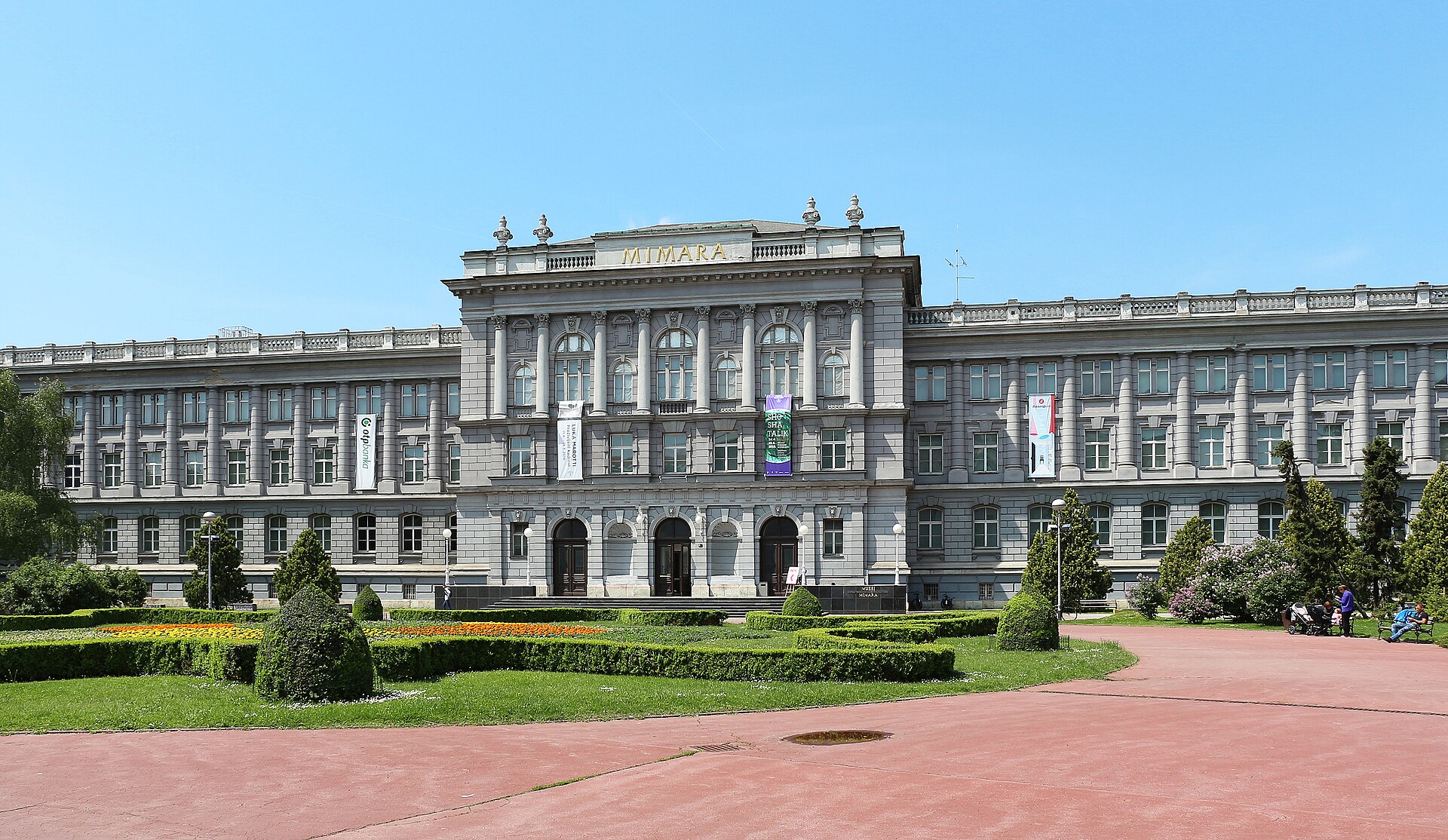
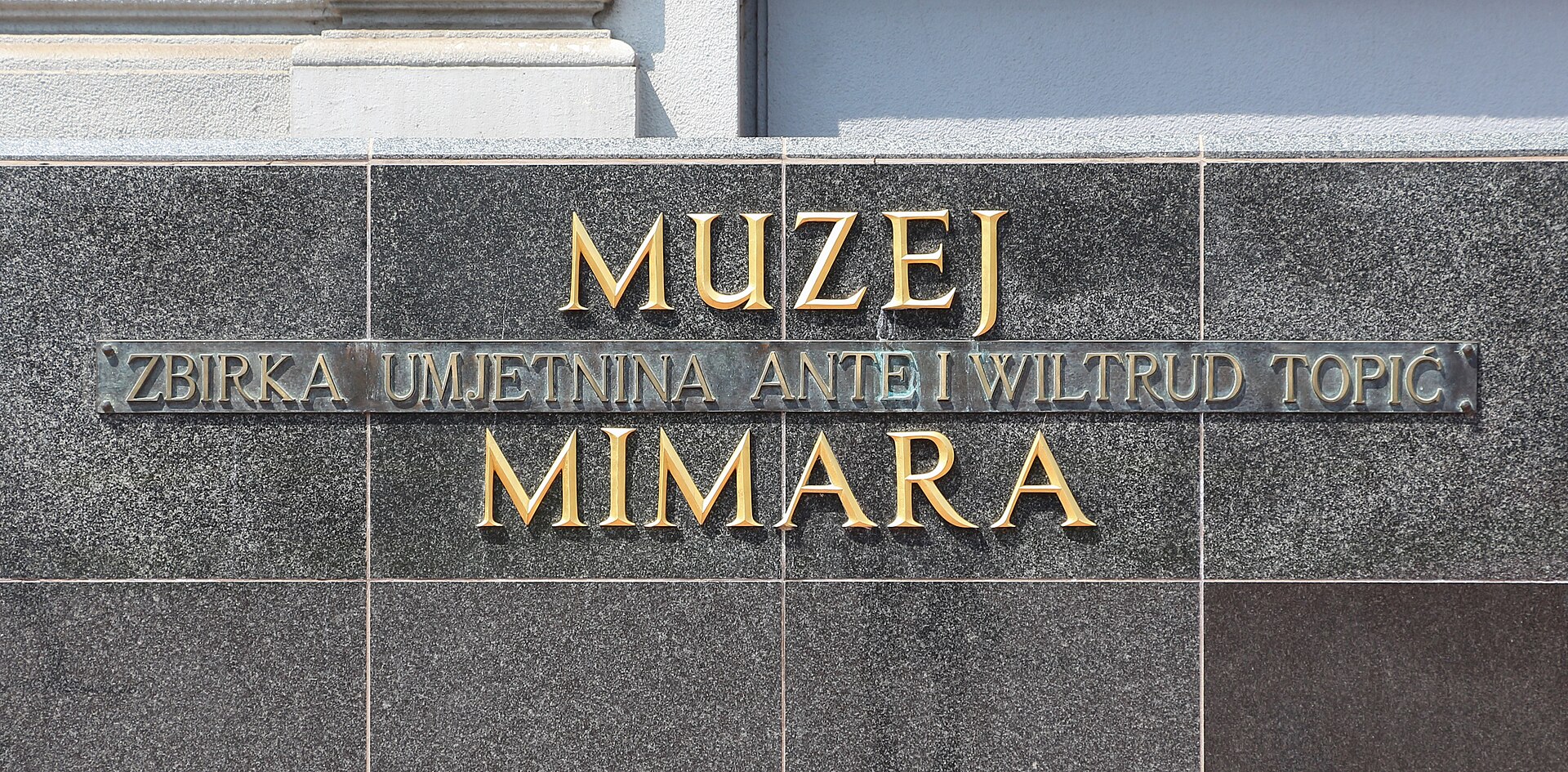
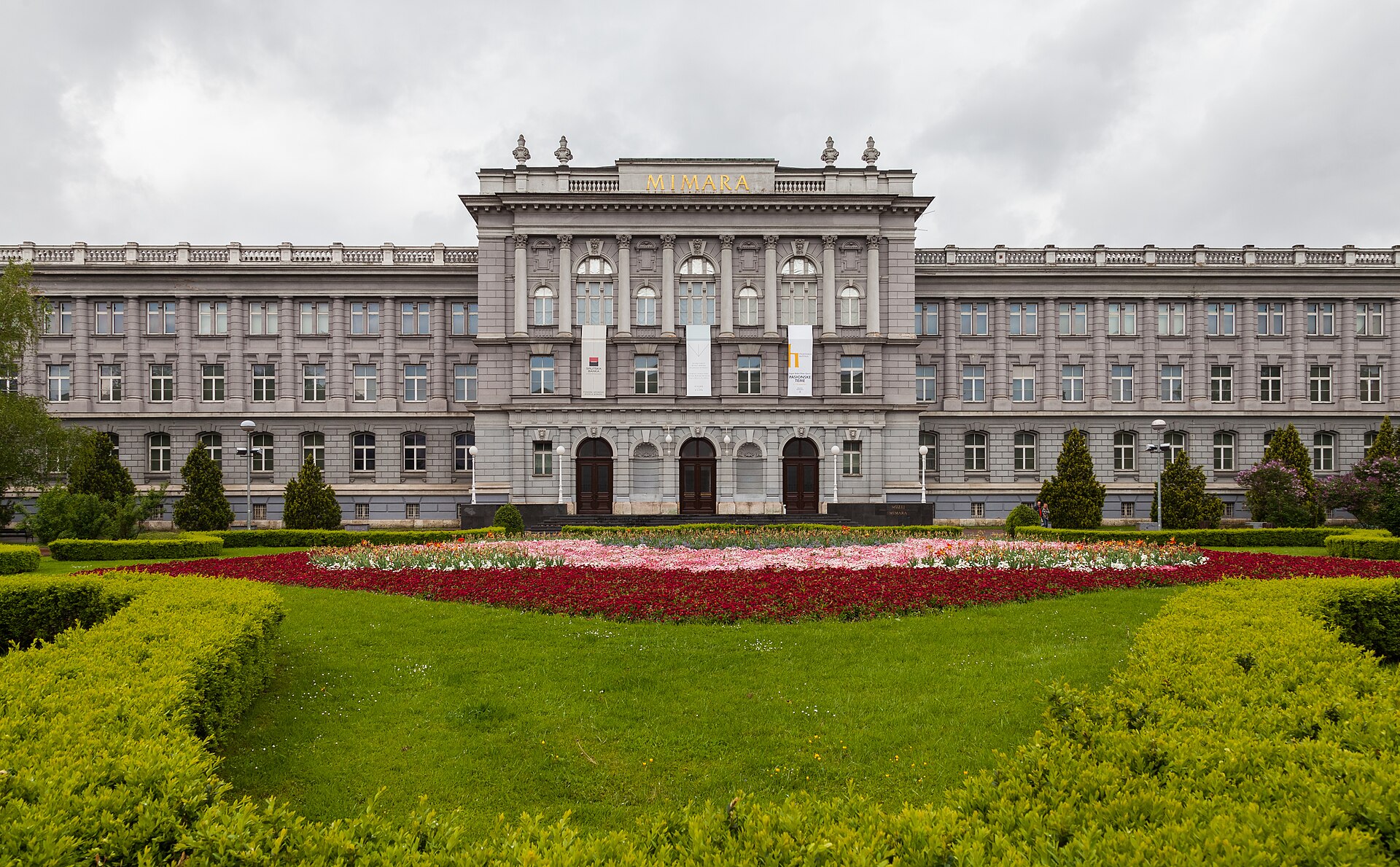
The main facade of the Mimara Museum on Roosevelt Square, Zagreb, in the former Lower Town gymnasium building.
Bernard Gagnon, CC BY-SA 4.0 · Photograph by BgagClosed to visitors - not permanently
Mimara Museum is currently closed. Re-fetched 2026-09-07: the museum own homepage (mimara.hr) still states "Muzej je privremeno zatvoren za posjetitelje" (the museum is temporarily closed to visitors). Not open and not permanently closed.
Expected to reopen: end of October 2026 · a target, not yet confirmed
Closure confirmed from the institution's own page. We re-check this page on a schedule and will update it, from the institution's own announcement, the moment it reopens.
On this page 15 sections
ContentsClose
The museum's own account puts its holdings at more than 3,500 objects; English Wikipedia, citing the museum's press material, gives a higher figure of over 3,750 across roughly 9,450 square metres, one of the largest exhibition areas of any art museum. The two figures are not reconciled in any source seen for this record. What is not in dispute is the breadth: archaeology from the Palaeolithic to the early Middle Ages, European sculpture from the 6th century onward, old-master painting from most of the major Western European schools, one of the largest glass collections in the region, and Chinese, Japanese and South and Southeast Asian art assembled at a scale unusual for a single private collector. The scholarly caveat that runs through every account of the museum, including this one, is that a meaningful share of the attributions announced at its 1987 opening have since been challenged or downgraded, and the museum itself does not discuss that history on its own site.
| Local name | Muzej Mimara |
|---|---|
| Kind | Museum |
| Founded | 1987 |
| City and country |  Zagreb, Croatia Zagreb, Croatia |
| Address | Rooseveltov trg 5, 10000 Zagreb, Croatia |
| Website | mimara.hr |
| Status | Closed temporarily, confirmed |
| Record last verified |
Visiting
- Hours (pre-closure)
- Tue, Wed, Fri, Sat (1 October to 30 June)10:00 to 17:00Pre-closure hours, last published by the museum in 2019.
- Thu (1 October to 30 June)10:00 to 19:00Pre-closure hours.
- Sun (1 October to 30 June)10:00 to 14:00Pre-closure hours.
- Tue-Fri (1 July to 30 September)10:00 to 19:00Pre-closure hours.
- Sat (1 July to 30 September)10:00 to 17:00Pre-closure hours.
- Sun (1 July to 30 September)10:00 to 14:00Pre-closure hours.
- Closed
- Monday. Public holidays.
- Admission (pre-closure)
- Adult, permanent collectionHRK 40Pre-closure 2019 price, last published by the museum before its March 2020 closure. Croatia adopted the euro on 1 January 2023 while the museum was already shut, so this figure was never re-quoted in euros. Re-checked 2026-09-06: the museum's own former prices/visit page (mimara.hr/Info) now returns a server error rather than content, and no post-reopening, euro-denominated price list has been published anywhere by the museum itself; third-party ticket aggregators (e.g. rezerviraj.hr) still only republish this same stale 2019 kuna figure, which is not an independent confirmation.
- Students, pupils and retirees, permanent collectionHRK 30Pre-closure 2019 price. Re-checked 2026-09-06, no update published.
- Temporary exhibitionsHRK 20Pre-closure 2019 price. Re-checked 2026-09-06, no update published.
- Group adult (20-40 persons)HRK 30Pre-closure 2019 price, per person. Re-checked 2026-09-06, no update published.
- Group students, pupils and retirees (20-40 persons)HRK 20Pre-closure 2019 price, per person. Re-checked 2026-09-06, no update published.
- ICOM and Croatian Museum Association (HMD) membersFreeFree entry, pre-closure policy. Re-checked 2026-09-06, no update published.
Free entry: International Museum Day, 18 May (pre-closure policy). European Night of Museums, the Saturday closest to International Museum Day (pre-closure policy). Museum Night, a February date set each year (pre-closure policy; 1 February in 2019)- Do I need to book?
- Not stated for individual visitors on the museum's pre-closure visit page; guided tours needed a phone reservation and were included in the ticket price for groups of 20 or more.
- Address
- Rooseveltov trg 5, 10000 Zagreb, Croatia MapTram ZET lines 12, 13, 14 and 17, Rooseveltov trg stop, right outside the building
Parking City parking in the neighbouring streets, Klaiceva ulica and Ulica Krsnjavoga; only short stops by tourist coaches are allowed directly in front of the museum - Website
- mimara.hr
- Telephone
- +385 1 4828 100
- [email protected]
Before you go how long, access, photography, bags, eating, shop
- How long to allow
- Visitor accounts before the closure describe a few hours across three largely uncrowded floors: prehistoric and ancient civilizations and European sculpture on the lower floors, old-master paintings arranged by national school upstairs.
- Access
- Built-in low, sloped lift platforms for visitors with reduced mobility, per the museum's own pre-closure visit page.
- Photography
- Photography without flash was permitted; filming with a video camera needed the director's prior approval.
- Bags
- Not stated on the museum's own pre-closure visit page.
- Eating
- Pre-closure, Cafe Gymnasium operated in the building with a large terrace and full catering service, Monday to Saturday 08:00 to 22:00, Sunday 09:00 to 14:00. That arrangement is superseded: Zagreb press reported 3 September 2026 that the long-running bistro Rougemarin, relocating from Folnegoviceva after 15 years at that address, will take over the museum's food-and-drink space when the museum reopens, expected late October 2026, with its own director quoted on plans for events tied to the museum's programme. No post-reopening hours or a formal opening date for the bistro itself have been published yet.
- Shop
- A museum shop sold museum publications, souvenirs and art books during opening hours, pre-closure.
The museum is closed (see above). These are the figures published before the closure, kept here for a visitor planning ahead rather than presented as bookable today, and you can check the current position at the source we used. We will re-confirm them once it reopens.
What is inside
Ancient civilizations
Archaeological material from prehistory to the early medieval period: a Palaeolithic bone Venus figurine; Mesopotamian and Persian pieces including a Neo-Sumerian female head and a votive silver pin dedicated to the goddess Ashi; Egyptian Middle Kingdom grave goods; Greek bronze, stone and terracotta sculpture and figural vessels from the 6th to 4th centuries BC; Etruscan and Roman bronzes of athletes, gods and worshippers; and a group of Roman and early Christian ceramic lamps, including fish-shaped hanging lamps used in the catacombs. A small group of Coptic bronzes, ceramic ampullae and textile fragments is, per the museum's own account, the only Coptic Christian material held in any Croatian collection.
European sculpture
A chronological run from a 6th-century Burgundian Saint Avitus and English Romanesque figures through Gothic wood carving, Renaissance bronzes cast after antique models, Mannerist and Baroque sculpture, to Rococo and early-20th-century names. The museum's own listing highlights an oak Archangel Gabriel with Angels group from Flanders, a wood Farnese Hercules made in Florence after 1540, and works by Duquesnoy, Tacca, Clodion, Coustou, Jean-Antoine Houdon and Medardo Rosso.
Glass
Around 600 objects and 450 fragments tracing four millennia of glassmaking, from second-millennium-BC Egypt through the Roman Empire, medieval Western and Islamic glass, Venetian Renaissance work, Baroque glass and Bohemian Biedermeier pieces. Named highlights on the museum's own page include an Egyptian balsamarium, a Greek oinochoe, a winged-stem Venetian goblet and an early-14th-century Syrian mosque lamp.
Italian painting
Sienese and Florentine Gothic and early Renaissance panels (Pietro Lorenzetti, Barna da Siena, Bicci di Lorenzo), high Renaissance work from Florence (Filippo Lippi, Raffaellino del Garbo) and Venice (Vincenzo Catena's Christ Carrying the Cross, Girolamo da Santa Croce), 16th-century Venetian painting by Paolo Veronese and Jacopo Bassano, Mannerist pieces attributed to Domenico Beccafumi and to Raphael, Baroque canvases by Luca Giordano and Giovanni Lanfranco, and 18th-century Venetian view-painting including a Canaletto.
Far Eastern art
Chinese material spanning the Shang dynasty to the 1911 revolution: ritual bronzes, cloisonne and champleve enamel wares, Tang-dynasty ceramics, Song celadon, and Ming and Qing porcelain painted in underglaze blue and in polychrome enamels. The collection also holds carved hardstones (jade, agate, amethyst, carnelian, lapis lazuli), Japanese Kakiemon and Kutani porcelain, and a small but, per the museum's own account, notable group of Gandharan, Indian and Southeast Asian pieces, including a 2nd/3rd-century stone Bodhisattva Maitreya from what is now Pakistan.
What to see first
Christ Carrying the Cross
Vincenzo CatenaA Venetian high-Renaissance panel of around 1525, named by the museum itself as a leading work of its Italian painting collection.11
The Temptation of Saint Anthony
Attributed to Hieronymus Bosch or his workshop, circa 1501One of the museum's best-known Netherlandish attributions, and among the pieces whose authorship later scholarship has treated with caution.13
Portrait of Nicolaas Rubens
Peter Paul Rubens, circa 1634-1636A portrait of the artist's own son, among the museum's most reproduced paintings.13
Apostles Saint John and Saint Bartholomew
Paolo Veneziano, circa 1345A rare mid-14th-century Venetian panel by the founder of the Venetian school, illustrating the depth of the museum's Trecento holdings.11
Archangel Gabriel with Angels
Flemish workshop, second third of the 15th century, oakA Gothic carved wood group the museum's own sculpture listing singles out among its holdings.9
Farnese Hercules
Florentine workshop, after 1540, woodDescribed by the museum itself as an outstanding example of Mannerist sculpture in its collection.9
Bust of Jean-Jacques Rousseau
Jean-Antoine HoudonNamed by the museum as a portrait bust of exceptional force within its Rococo-era sculpture.9
Mosque lamp
Syrian, early 14th century, glassA rare medieval Islamic glass lamp, among the pieces the museum names to represent its Islamic-world holdings within the glass collection.10
Bodhisattva Maitreya
Gandharan workshop, 2nd/3rd century, stoneSingled out by the museum's own Far Eastern art listing as an outstanding piece from the Indo-Iranian world within its Asian holdings.12
A school forum remade as a museum
The Mimara Museum occupies the central block of what was built, from 1892 to 1895, as the Lower Town gymnasium complex on what is now Roosevelt Square, designed by the German architects Alfred Ludwig and Ljudevit Teodor Hulssner, specialists in school buildings for the Austro-Hungarian Empire. The Zagreb art historian and politician Izidor Krsnjavi had originally planned a much larger civic complex, a combined 'school forum' of teaching and museum institutions; money ran short, and only the simpler gymnasium block was built, opening to the public in 1895 on the occasion of a visit by Emperor Franz Joseph I. Until 1985 the building housed two working secondary schools, the First and Fourth Gymnasiums; the north and south wings of the wider complex still hold a school today. The building is listed as a protected cultural asset with Croatia's Ministry of Culture.
Between 1985 and 1987 the central block was adapted for museum use to house the art collection of Ante Topic Mimara, under a decision of the Croatian parliament and the Zagreb city assembly. The conversion kept the historicist facades and the atrium, built in the manner of an ancient Greek temple, that the school complex had given the square.
A donor who called himself Mimara
The museum's own account describes Ante Topic Mimara (1898-1987) as a collector, painter and restorer, born to a farming family in the Dalmatian hinterland, who spent most of his adult life outside Croatia, living in Rome, Paris, Amsterdam, Munich, Berlin, Tangier and finally a castle he bought near Salzburg. He began collecting art in the mid-1920s and, by his own account, built his holdings over five decades into more than 3,500 objects spanning classical archaeology, old-master painting, sculpture and decorative arts, Chinese art and oriental carpets. The museum's biography of its founder, published on its own site, presents the 1973 and 1986 donation agreements that created the museum as an act of patriotism by a lifelong emigre who never stopped thinking of himself as Croatian.
That account omits a great deal that outside researchers have since put on the record. Journalists and historians have identified at least two competing versions of Mimara's own early life, including a claim, reported by ARTnews, that he assumed the identity of a man named Ante Topic after that man's death in a Rome military hospital in 1918. His wife and collaborator, the German art historian Wiltrud Mersmann, worked at the US Central Collecting Point in Munich after the Second World War, the depot where looted and displaced European art was catalogued for return to its countries of origin.
The Central Collecting Point claims
A September 2001 ARTnews investigation by Konstantin Akinsha, drawing on US National Archives records, reported that Mimara appeared at the Munich Collecting Point in December 1948 claiming to represent the Yugoslav government's restitution mission, and by mid-1949 had obtained 166 objects, including 56 paintings, on the strength of claim lists that American investigators later concluded he and Mersmann had fabricated using information she had access to as a junior curator there. The Americans discovered the fraud only after the objects, and Mimara, had disappeared; fearing legal and political fallout, the US State Department chose not to notify the governments whose citizens, in some cases Holocaust victims, appear to have been the true owners. Decades later, ARTnews traced more than a dozen of those objects to museums in Zagreb and Belgrade, including paintings once in the collection of Baron Maurice de Rothschild and works assembled for the museum Hitler planned for Linz.
The same investigation reports that when the Mimara Museum opened in 1987, Yugoslav officials valued the 3,600-object collection at one billion US dollars and announced attributions to Michelangelo, Leonardo, Raphael, Botticelli and Velazquez; it also cites a 1987 ARTnews review by Andrew Decker in which art historians of the day dismissed most of the collection as fake or second-rate, with many attributions since downgraded. The museum's director at the time told ARTnews in 2001 that Mimara had never discussed the collection's origins with staff, and that he answered questions about provenance by saying that anyone who could prove ownership could take an object back. The museum has never addressed the Central Collecting Point allegations on its own site.
What the collection holds
Independent of the dispute over individual attributions, the range of material is not contested: more than 3,500 objects, on the museum's own count, spanning the prehistoric period to the 20th century across roughly 9,450 square metres. The lower floors hold archaeology, from a Palaeolithic bone figurine through Mesopotamian, Egyptian, Greek, Etruscan, Roman and early Christian material, and European sculpture from the 6th century onward. The upper floor holds old-master painting organised by national school; Italian, Flemish, Dutch, German, Spanish, English and French painters are all represented, alongside a large glass collection spanning four millennia and one of the largest holdings of Chinese and other Asian art in Southeastern Europe. A drawings collection and further galleries of ivory, ceramics, porcelain, furniture, textiles and carpets fill out the museum's own account of its holdings.
Closed twice over, five days apart
The museum shut its doors to visitors on 17 March 2020 because of the Covid-19 pandemic; the notice the museum posted that day, still live on its own site, told visitors it hoped to reopen as soon as it safely could. Five days later, on 22 March 2020, a magnitude-5.5 earthquake struck Zagreb, and the museum's own historicist building, part of the same complex that had stood since 1895, was among the cultural properties seriously damaged: the roof and the second-floor grand hall, where many of the old-master paintings hang, took the worst of it, and some works on display were themselves damaged. What had been announced as a temporary pandemic closure became a six-year structural one.
Reconstruction and a planned reopening
The Croatian Ministry of Culture and Media has treated the Mimara Museum's repair as part of a much larger post-earthquake programme; at a closing conference held at the museum on 22 July 2026, the ministry said the wider Zagreb and central Croatia effort had by then rebuilt, or was still rebuilding, more than 50 museums, archives and libraries and more than 500 individually protected buildings and monuments. At that same conference the museum's director, Tajana Plese, and the project's lead architect and conservator presented the completed structural strengthening, energy retrofit, and conservation and restoration work on the building's historic fabric, along with a new permanent-display concept organised around three themes: nature, society and belief. A time capsule containing coins, a newspaper, a shop receipt and a charter signed by the Croatian prime minister, two government ministers and the museum's director was sealed into a display case as the collection's newest object, recording the building's repair.
The museum's own announcement of that conference states that, with construction finished, preparations are now in their final phase ahead of a reopening planned for October 2026. Press coverage through early September 2026, including the Culture Minister's own remarks, narrows that further to "the end of October, as planned" (krajem listopada, po planu) - still a target, not a fixed date, and the museum's site gives no fallback if it slips. As of this record's most recent check, 6 September 2026, the museum's own homepage still displayed a standing notice that it remains closed to visitors.
Visiting, once the doors reopen
The practical detail on this page describes the museum as it operated before the March 2020 closure, because no post-reopening visitor information has yet been published. Admission was inexpensive by regional standards, with free entry for ICOM and Croatian Museum Association members and on set free days each year; the museum sat on the same tram stop, Rooseveltov trg, as several other Zagreb institutions, with city parking in the surrounding streets rather than at the museum itself. Photography without flash was allowed throughout, and a cafe and museum shop operated in the building alongside the galleries. One change is already public: Zagreb press reported in early September 2026 that the long-running bistro Rougemarin will move into the museum's food-and-drink space when it reopens, replacing the pre-closure Cafe Gymnasium arrangement. None of the rest can be booked or relied on until the museum itself publishes updated information; a reader planning a visit around the announced end-of-October 2026 date should check the museum's own site again closer to the time.
What visitors say
Visitor accounts from before the 2020 closure describe an unusually large, wide-ranging private collection, shown across three uncrowded floors of a grand 19th-century building, at a low admission price with helpful staff. Set against that runs a controversy as old as the museum itself: since its 1987 opening, historians and journalists have repeatedly challenged the authenticity of a large share of the paintings and the honesty of the founder's own account of how he acquired them.
What is praised, what is criticised
- Praised: The sheer range of the collection under one roof, from prehistoric and ancient material through old-master painting to 20th-century sculpture, spread across three floors
- Praised: Uncrowded galleries that let visitors linger in front of major names without a crowd
- Praised: Low admission prices, a free cloakroom, and English-language guiding material
- Praised: The building itself: a grand 19th-century former school, also valued as a venue for weddings and other events
- Criticised: Longstanding, published doubts about the authenticity and attribution of a large share of the collection, going back to the museum's 1987 opening
- Criticised: The founder's own contested biography, including a 2001 ARTnews investigation reporting that more than a dozen objects he received from the US Central Collecting Point in Munich in 1949 on fabricated wartime-restitution claims, some with Holocaust-era ownership histories, ended up in the museum's and a Belgrade museum's holdings
- Criticised: No reopening date firmer than a general end-of-October 2026 target, more than six years after the building closed
Ratings on other platforms
TripAdvisor: 4 from 282 ratings, read 4 September 2026
A platform average is a tertiary source: it moves, it is not audited, and we quote no visitor's words.
Questions about Mimara Museum
Where is Mimara Museum?
Rooseveltov trg 5, 10000 Zagreb, Croatia.
How much does it cost to visit?
Adult, permanent collection: HRK 40; Students, pupils and retirees, permanent collection: HRK 30; Temporary exhibitions: HRK 20; Group adult (20-40 persons): HRK 30; Group students, pupils and retirees (20-40 persons): HRK 20. As confirmed 7 September 2026.
When is it open?
Tue, Wed, Fri, Sat (1 October to 30 June) 10:00-17:00; Thu (1 October to 30 June) 10:00-19:00; Sun (1 October to 30 June) 10:00-14:00; Tue-Fri (1 July to 30 September) 10:00-19:00; Sat (1 July to 30 September) 10:00-17:00; Sun (1 July to 30 September) 10:00-14:00. Closed: Monday. Public holidays. As confirmed 7 September 2026.
How do you get there?
Tram: ZET lines 12, 13, 14 and 17, Rooseveltov trg stop, right outside the building; Parking: City parking in the neighbouring streets, Klaiceva ulica and Ulica Krsnjavoga; only short stops by tourist coaches are allowed directly in front of the museum.
What should you see first?
Christ Carrying the Cross (Vincenzo Catena); The Temptation of Saint Anthony (Attributed to Hieronymus Bosch or his workshop, circa 1501); Portrait of Nicolaas Rubens (Peter Paul Rubens, circa 1634-1636); Apostles Saint John and Saint Bartholomew (Paolo Veneziano, circa 1345); Archangel Gabriel with Angels (Flemish workshop, second third of the 15th century, oak); Farnese Hercules (Florentine workshop, after 1540, wood).
What we could not confirm
- Whether any of the objects a 2001 ARTnews investigation traced to erroneous, fabricated wartime-restitution claims against the US Central Collecting Point in Munich, several with Holocaust-era ownership histories, remain among the Mimara Museum's holdings today, and whether Croatia has ever acted on the willingness to investigate that a Ministry of Culture official expressed to ARTnews in 2001.
- How many of the attributions announced at the museum's 1987 opening, including to Michelangelo, Leonardo, Raphael, Botticelli and Velazquez, still stand, given that later scholarship is reported to have downgraded many of them and the museum's own site does not publish a current attribution list.
- Whether the end-of-October 2026 reopening target will hold; a Culture Ministry official was quoted in July 2026 saying the date stands "as planned", but this project's own experience elsewhere shows that museum-reopening targets described only as a plan can still slip, and no source found for this re-check states the date as a confirmed, scheduled fact.
Images
Sources
- 1Mimara Museum, official website, homepage, re-read 6 September 2026 mimara.hr/
- 2Mimara Museum, 'Polaganjem vremenske kapsule simbolicki obiljezen dovrsetak obnove Muzeja Mimara' (time capsule article, reconstruction and reopening plan), 23 July 2026 mimara.hr/aktualno/polaganjem-vremenske-kapsule-simbolicki-obiljezen-dovrsetak-obnove-muzeja-mimara_10911
- 3Mimara Museum, 'Zgrada muzeja' (the museum building), read 4 September 2026 mimara.hr/Muzej/Zgrada%20muzeja
- 4Mimara Museum, 'Povijest muzeja' (history of the museum, legal name and status), read 4 September 2026 mimara.hr/Muzej/Povijest%20muzeja
- 5Mimara Museum, 'O donatoru' (about the donor), read 4 September 2026 mimara.hr/Muzej/O%20donatoru
- 6Mimara Museum, 'Obavijest o privremenom zatvaranju Muzeja Mimara' (notice of temporary closure), 17 March 2020, still live 4 September 2026 mimara.hr/Aktualno/Obavijest%20o%20privremenom%20zatvaranju%20Muzeja%20Mimara%20_8818
- 7Mimara Museum, 'Info / Visiting' page, archived by the Wayback Machine 1 October 2019 web.archive.org/web/20191001141019/http://www.mimara.hr/Info
- 8Mimara Museum, 'Zbirka starih civilizacija' (collection of ancient civilizations), archived by the Wayback Machine 1 October 2019 web.archive.org/web/20191001140937/http://www.mimara.hr/Zbirke/Zbirka%20starih%20civilizacija
- 9Mimara Museum, 'Zbirka europske skulpture' (European sculpture collection), archived by the Wayback Machine 1 October 2019 web.archive.org/web/20191001141027/http://www.mimara.hr/Zbirke/Zbirka%20europske%20skulpture
- 10Mimara Museum, 'Zbirka stakla' (glass collection), archived by the Wayback Machine 1 October 2019 web.archive.org/web/20191001141031/http://www.mimara.hr/Zbirke/Zbirka%20stakla
- 11Mimara Museum, 'Talijansko slikarstvo' (Italian painting), archived by the Wayback Machine 9 December 2019 web.archive.org/web/20191209073532/http://mimara.hr/Zbirke/Talijansko%20slikarstvo
- 12Mimara Museum, 'Zbirka dalekoistocne umjetnosti' (Far Eastern art collection), archived by the Wayback Machine 1 October 2019 web.archive.org/web/20191001140942/http://www.mimara.hr/Zbirke/Zbirka%20dalekoisto%C4%8Dne%20umjetnosti
- 13Wikipedia, 'Mimara Museum', read 4 September 2026 (; used for identity, coordinates, architects' names, visitor figures and the summary of published authenticity criticism) en.wikipedia.org/wiki/Mimara_Museum
- 14Konstantin Akinsha, 'Ante Topic Mimara, The Master Swindler of Yugoslavia', ARTnews, September 2001, reprinted by the Commission for Looted Art in Europe lootedart.com/MFEU4T15383
- 15Wikimedia Commons, File:Mimara Museum, Zagreb 02.jpg, photograph by Bernard Gagnon, licensed CC BY-SA 4.0/3.0/2.5/2.0/1.0 commons.wikimedia.org/wiki/File:Mimara_Museum,_Zagreb_02.jpg
- 16Wikimedia Commons, File:Mimara Museum, Zagreb 01.jpg, photograph by Bernard Gagnon, licensed CC BY-SA 4.0/3.0/2.5/2.0/1.0 commons.wikimedia.org/wiki/File:Mimara_Museum,_Zagreb_01.jpg
- 17Wikimedia Commons, File:Museo Mimara, Zagreb, Croacia, 2014-04-20, DD 01.JPG, photograph by Diego Delso, licensed CC BY-SA 3.0 commons.wikimedia.org/wiki/File:Museo_Mimara,_Zagreb,_Croacia,_2014-04-20,_DD_01.JPG
- 18TripAdvisor, 'Muzej Mimara' attraction page, 282 reviews, read 4 September 2026 () tripadvisor.com/Attraction_Review-g294454-d316420-Reviews-Mimara_Museum-Zagreb_Central_Croatia.html
- 1901portal.hr, 'Mimara spremna za novi pocetak: Muzej u listopadu ponovno otvara vrata posjetiteljima', 23 July 2026, quoting the Culture Minister on the reopening as 'krajem listopada, po planu' (end of October, as planned) 01portal.hr/mimara-spremna-za-novi-pocetak-muzej-u-listopadu-ponovno-otvara-vrata-posjetiteljima/
- 20Glas Slavonije, 'Obnovljeni Muzej Mimara vrata otvara u listopadu', 27 July 2026 glas-slavonije.hr/mozaik/kultura/2026/07/27/obnovljeni-muzej-mimara-vrata-otvara-u-listopadu-776799/
- 21Journal.hr, 'Rougemarin seli se u Muzej Mimara' (Rougemarin bistro relocates into the Mimara Museum), 3 September 2026 - reports the museum's food-and-drink space will be taken over by bistro Rougemarin, relocating after 15 years at Folnegoviceva, when the museum reopens (expected late October 2026); no separate opening date or hours for the bistro itself given journal.hr/lifestyle/gastro/rougemarin-muzej-mimara/


