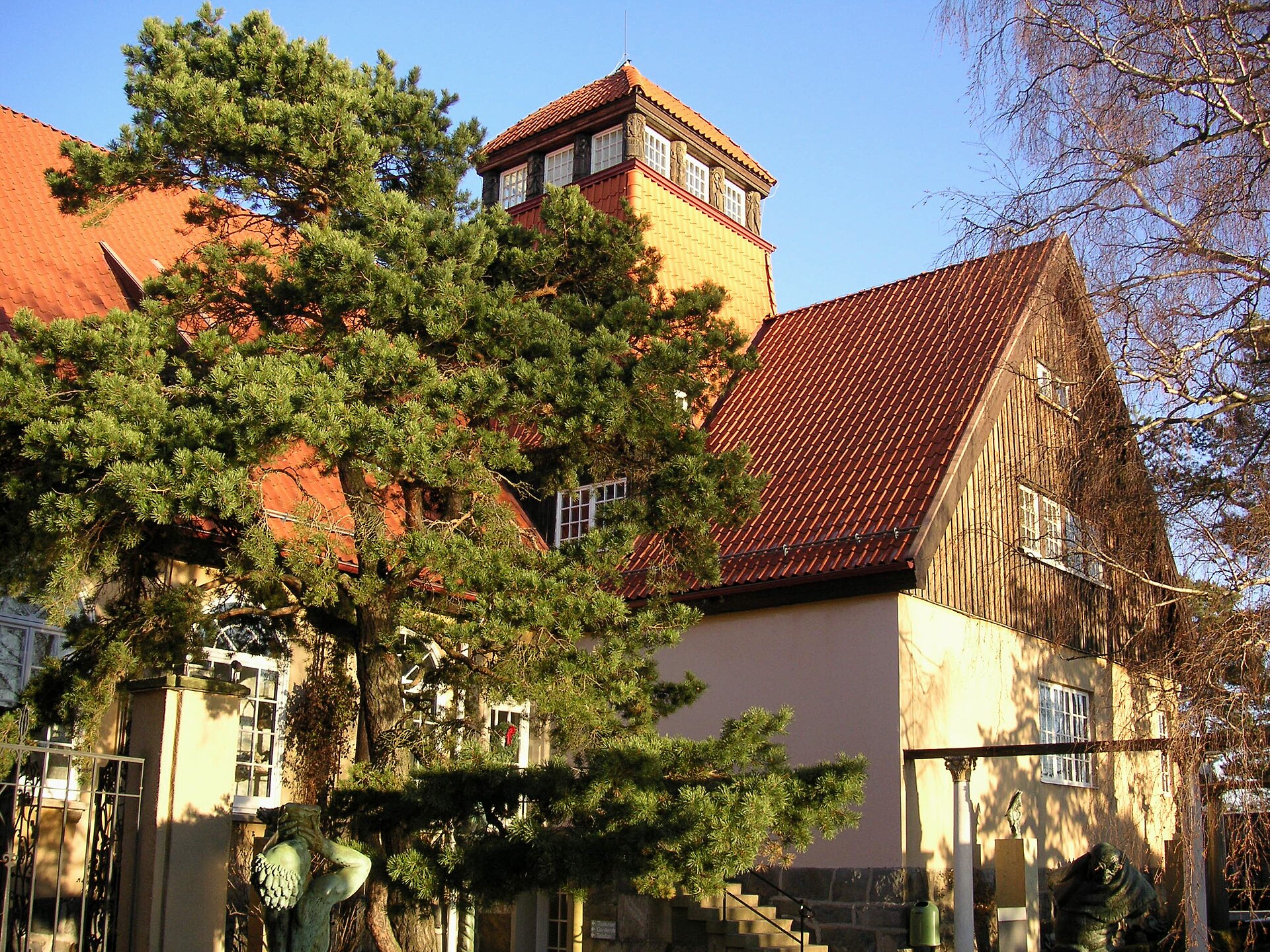
The Milles house at Millesgarden, seen from the garden, with its red-tiled tower and roofs.
Holger Ellgaard, CC BY-SA 3.0Millesgarden
Museum · Millesgården · Founded 1936
Open, admission and hours confirmed 26 September 2026 · 12 sources
On this page 17 sections
ContentsClose
Millesgarden's holding is narrow by design and unusually deep within that narrowness: it is built almost entirely around one sculptor's own working output, shown in the terraced garden and studio he built to hold it, plus the Greek and Roman antiquities he collected as working reference material rather than as a separate connoisseur's cabinet. The art hall's temporary programme is the one part of the site not about Milles himself, and gives Millesgarden a secondary identity as a contemporary and modern exhibition venue on Lidingo.
| Local name | Millesgården |
|---|---|
| Kind | Museum |
| Founded | 1936 |
| City and country |  Lidingo, Sweden Lidingo, Sweden |
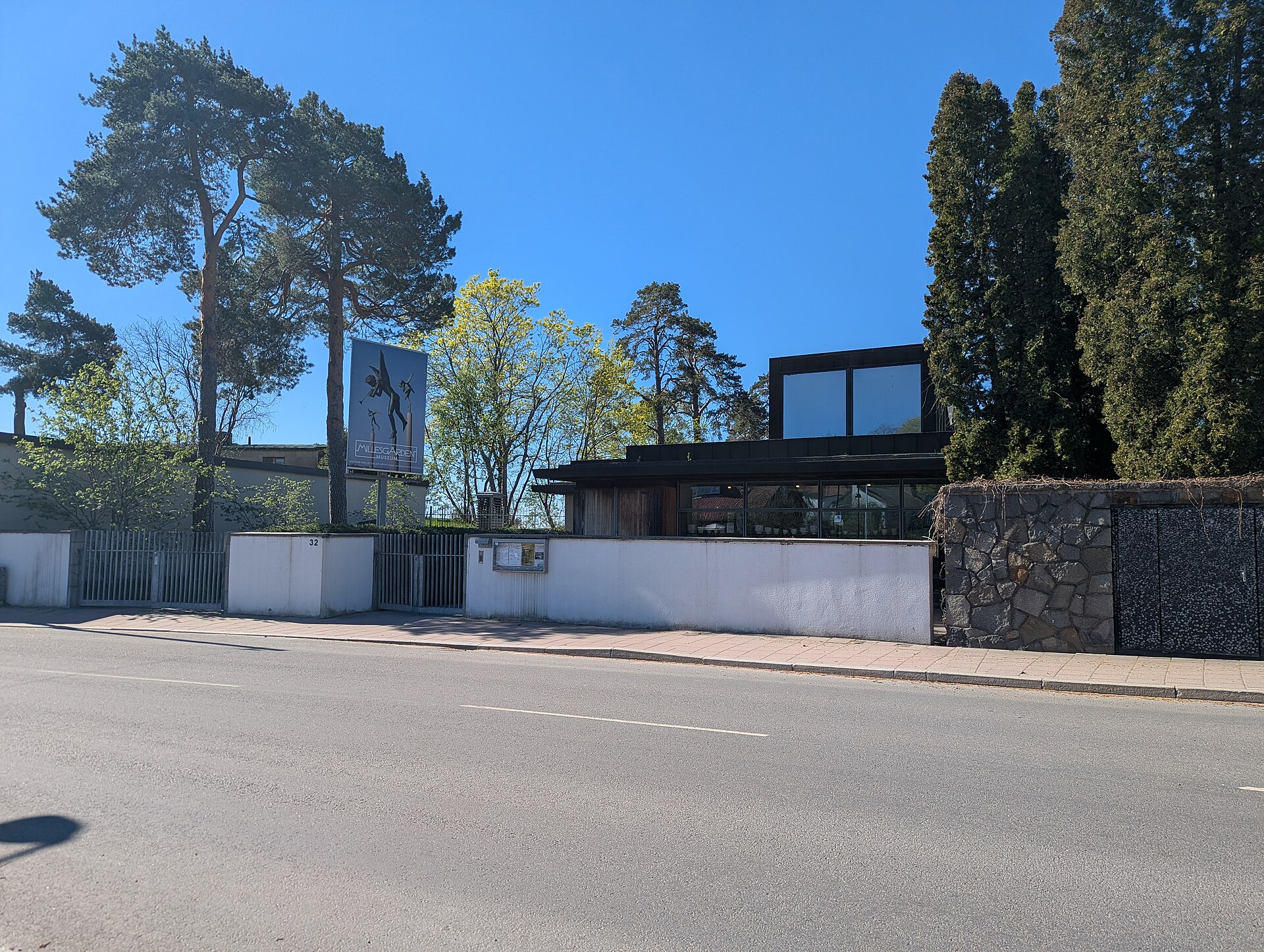
| Address | Herserudsvagen 32, 181 50 Lidingo, Sweden |
| Website | millesgarden.se |
| Status | Open, confirmed |
| Record last verified |
Visiting
- Hours
- Tue-Sun11:00 to 17:00
- Mondayclosed, with occasional exceptions such as Easter Monday and Boxing Day
- Closed
- Monday (year-round, with a small number of published exceptions). 1 January. Midsummer Eve (19 June). 24, 25 and 31 December.
- Admission
- AdultSEK 170
- StudentSEK 140
- Child/youth 0-18Freefree
- Senior FridaySEK 85discounted rate on Fridays
- Group (10+ people)SEK 150per person
- Annual pass, adultSEK 320
- Annual pass, studentSEK 200
- Tickets
- millesgarden.entryevent.se/ticketshop The museum's own ticket page.
- Do I need to book?
- No advance booking is required for individual visitors; tickets can be bought online in advance or at the door
- Address
- Herserudsvagen 32, 181 50 Lidingo, Sweden MapMetro + bus Red line to Ropsten, then bus 201-206 or 211-212 toward Lidingo; about 20 minutes from T-Centralen in central Stockholm
Tram Lidingobanan tram line 21 from Ropsten
Car / coach Free parking for cars and buses opposite the main entrance - Website
- millesgarden.se
- Telephone
- +46 8 446 75 90
- [email protected]
Before you go how long, access, photography, bags, eating, shop
- How long to allow
- Not stated by the museum itself. Visitor reviews consistently describe filling an afternoon across the artist's house, the terraces and whatever exhibition is running in the art hall, rather than a quick stop
- Access
- The sculpture park stands on terraced ground with many stairs and is not adapted for wheelchairs, mobility aids or larger prams; the artist's house and main studio have the same staircase problem. The art hall, built in 1999, is fully accessible, with accessible toilets, a lift and ramps. Three wheelchairs and three baby carriers can be borrowed at reception, and there are baby-changing facilities at three points on site. The lower terrace can be managed with a pram; the upper terraces require using stairs.
- Photography
- Photography for private use is welcomed in the sculpture park and the artist's house; in the art hall, private and press photography is allowed without flash during exhibitions unless a specific show states otherwise. Any commercial use of images of Carl Milles's works, including fashion shoots and sponsored influencer posts made on site, needs Millesgarden's written permission and is normally subject to a fee administered through the Swedish visual-artists' copyright body BUS.
- Bags
- Storage for bags is limited; the museum asks visitors not to bring large bags. E-scooters and spare e-bike/e-scooter batteries are not allowed indoors, for fire safety.
- Eating
- Millesgarden Lanthandel, a cafe and restaurant on site (rated 3.5/5 from 164 reviews on Tripadvisor, read 2026-09-26); visitors in 2026 described a limited food selection, including no gluten-free bread
- Shop
- A museum shop on site, also selling replica sculptures and related items
Prices and hours change. We take them from the institution's own pages and print the day we read them, and you can check the current position at the source we used. Confirm before you travel.
What is inside
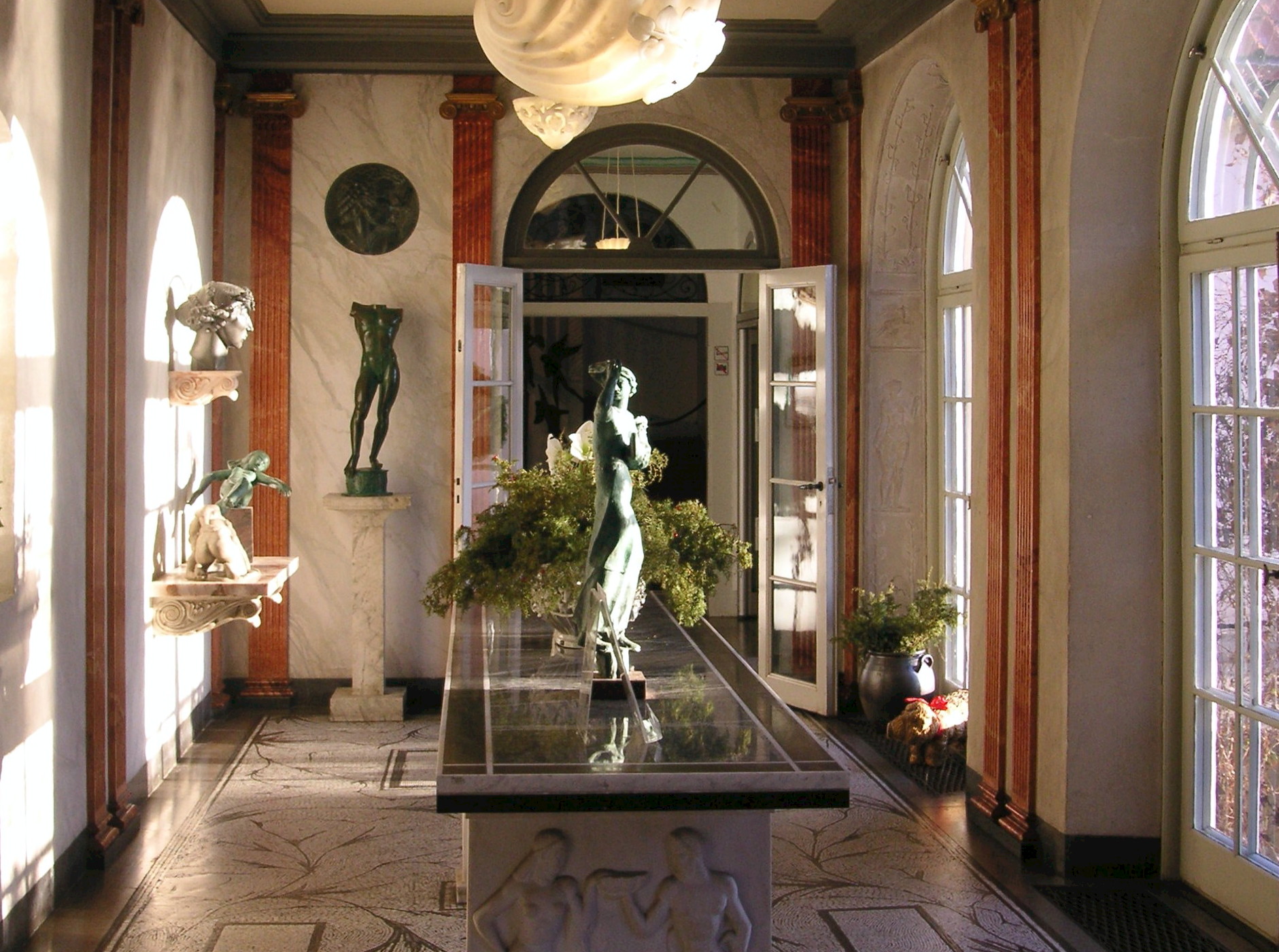
Photograph by Holger.Ellgaard · CC BY-SA 3.0 The artist's house and studio (1908)
Carl and Olga Milles's own home, designed by architect Carl M. Bengtsson and completed in 1908 on the Herserudsklippan cliff. Furnished rooms, corridors and the large sculpture studio where Milles worked are open to visitors, alongside smaller collections of medieval and older art the couple gathered.
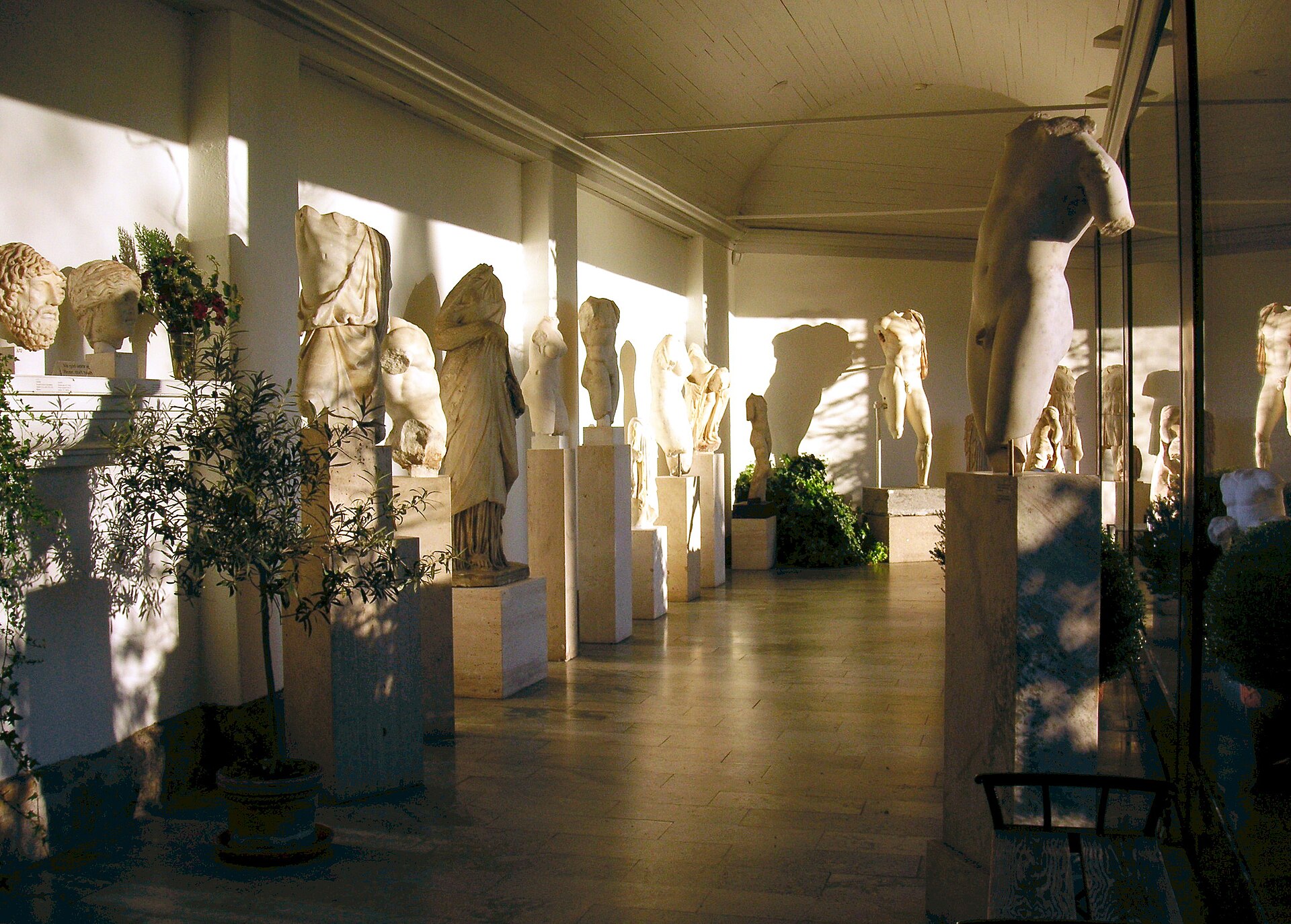
Photograph by Holger.Ellgaard · CC BY-SA 3.0 The antiquities gallery
A covered gallery holding the Greek and Roman antiquities Carl Milles collected, mostly bought in Rome: marble heads, torsos and draped figures set out on plinths along a colonnaded room. On Milles's death the collection passed, with the rest of Millesgarden, to the Swedish state.
Anne's House
A separate house built for the Milles's secretary, Anne Hedmark, designed by Carl Milles's half-brother, the architect Evert Milles, and completed in 1951. Its interior, including the Music Room, was furnished by Josef Frank and Estrid Ericson of Svenskt Tenn, and is shown as an example of Swedish modernist interior design of the period.
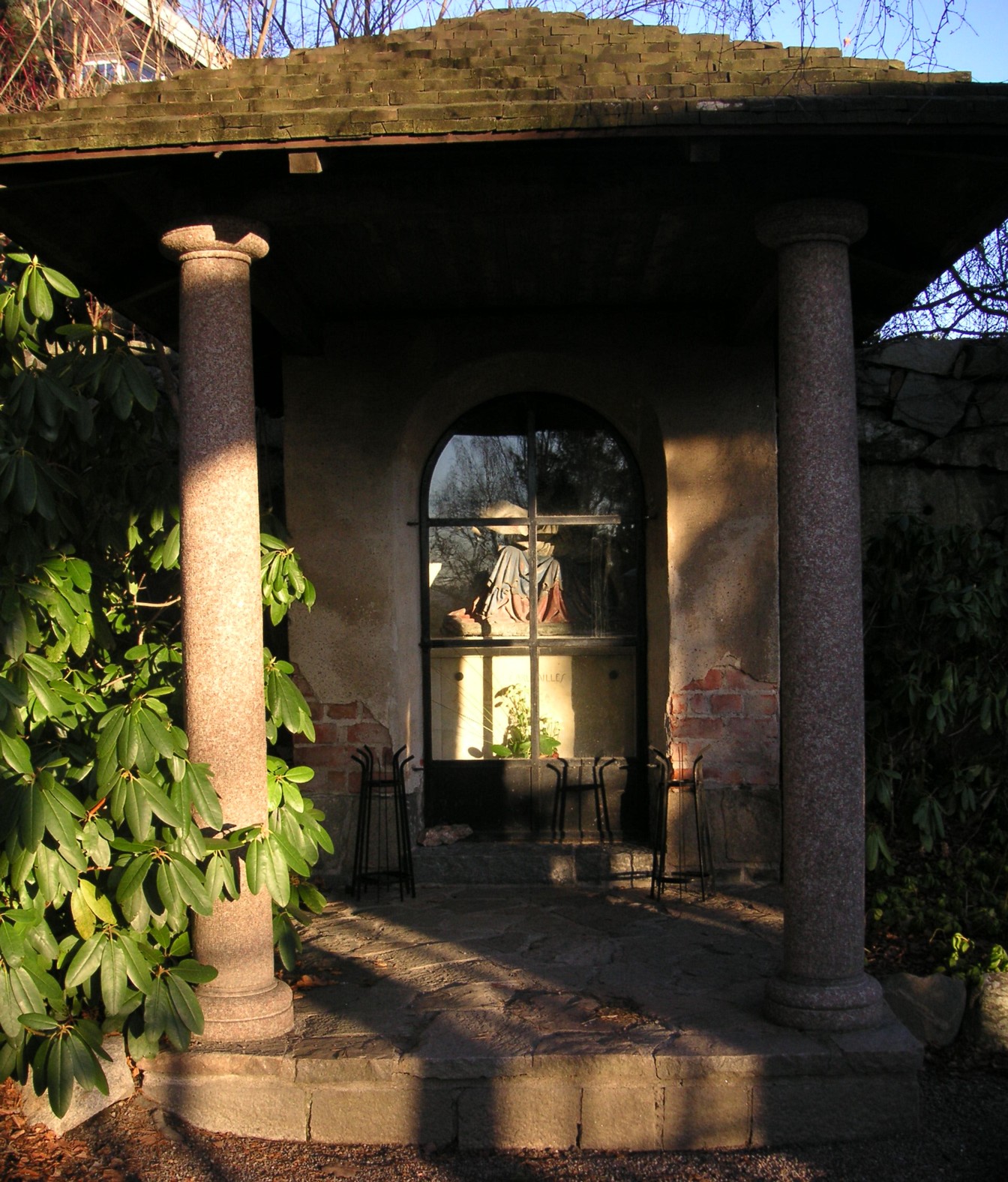
Photograph by Holger.Ellgaard · CC BY-SA 3.0 The Woodland Chapel (Skogskapellet)
A small columned burial chapel in the grounds where Carl Milles (d. 1955) and Olga Milles are buried. It stands apart from the main terraces, reached through the wooded part of the site.
The Millesgarden Art Hall (Konsthallen, 1999)
The newest building on site, designed by architect Johan Celsing and inaugurated in October 1999 along one side of the Lower Terrace. It holds the museum's programme of temporary exhibitions, including the major show marking the 150th anniversary of Carl Milles's birth in 2025. The building won its architect the Kasper Salin Prize, the Swedish Association of Architects' annual award, in 1999.
What to see first
Europa and the Bull
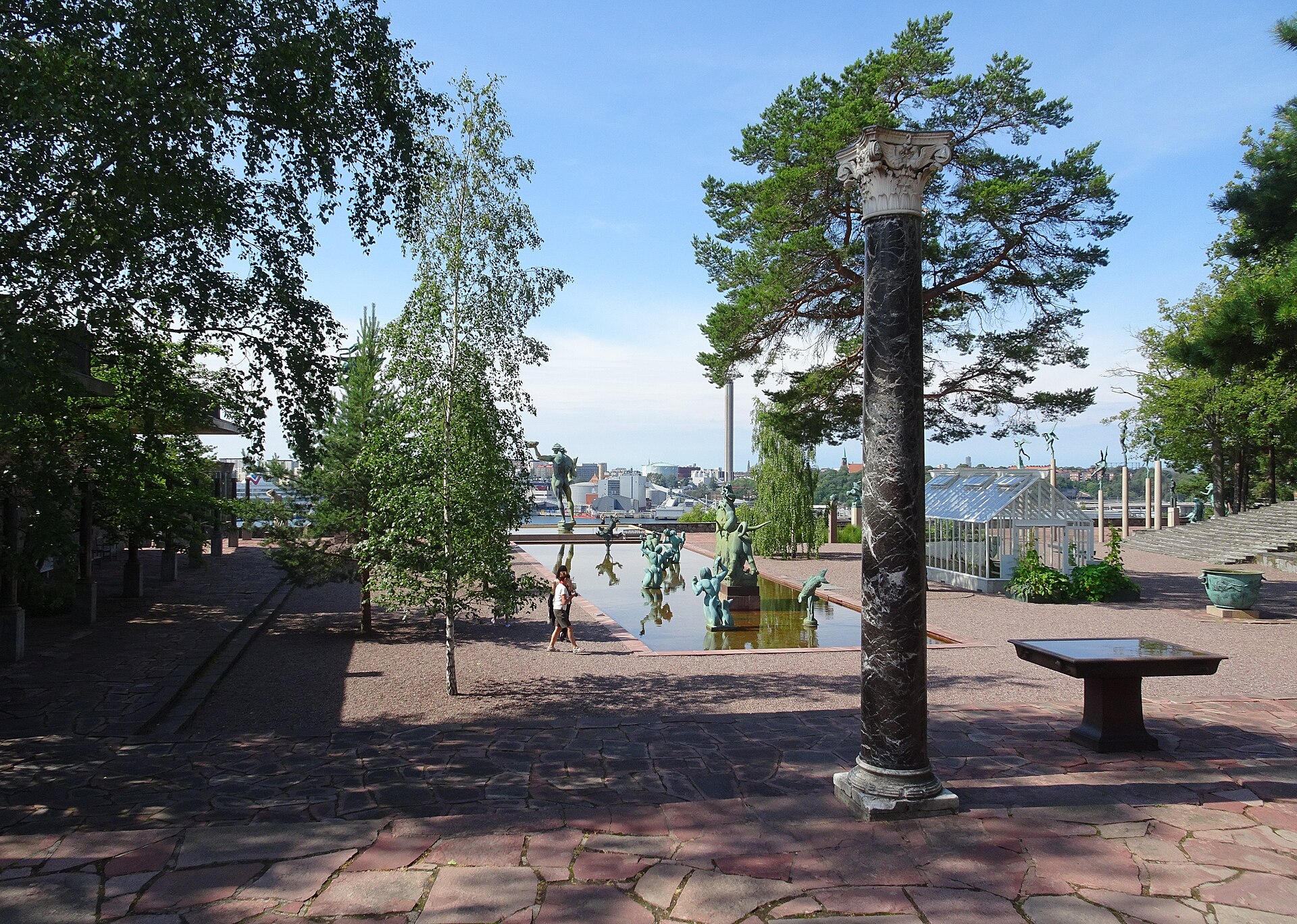
Carl Milles, 1926 (fountain group completed 1942)Millesgarden's largest fountain, on the Lower Terrace: Zeus as a bull carrying off Europa, ringed by muscular triton figures in the water.3
Poseidon
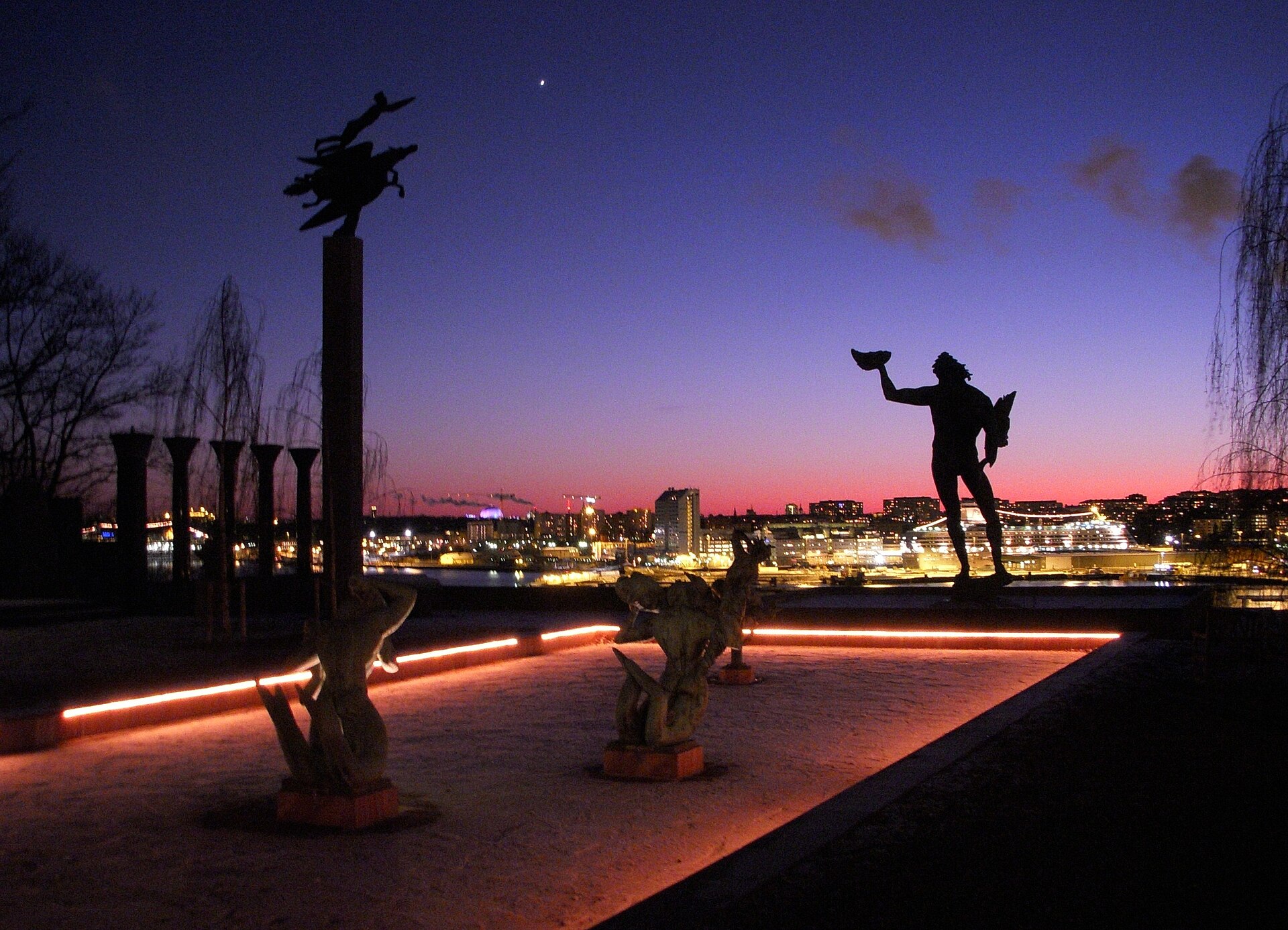
Carl Milles, 1930A roughly seven-metre bronze figure standing astride a rock on the Lower Terrace, holding a fish and a shell and facing out toward Vartan; Milles had planned a 30-metre waterfall to fall past it into the harbour, which was never built.3
Folke Filbyter
Carl Milles, 1927An equestrian bronze on the Lower Terrace showing horse and rider straining in opposite directions; a monumental cast of the same design stands in Linkoping.3
The Astronomer
Carl Milles, 1940A nude male figure on the Lower Terrace holding a compass and a dodecahedron, one of Milles's several figures reaching toward the sky and the cosmos.3
The Hand of God (God's Hand)
Carl Milles, 1949-1953A monumental hand raising a small human figure, among Milles's best-known late works and reproduced in several public casts worldwide; the Millesgarden version stands in the sculpture park.6
Man and Pegasus
Carl Milles, 1949Bellerophon stretched full-length across the winged horse Pegasus, straining to fly higher; one of the pairings of the human figure with flight that recur across the garden.6
Saint Martin's Fountain
Carl Milles, 1955Milles's last completed major work, showing the saint on horseback; finished in the year of his death.3
The Sun Singer (Solsangaren)
Carl Milles, from 1919-1926Originally conceived as a memorial to the poet Esaias Tegner, Milles turned the commission into a nude youth singing to the sun rather than a portrait bust; large-scale casts also stand in Stockholm, and in Illinois and Virginia in the United States.4
A sculptor building his own coastline
Carl Milles and his wife, the Austrian-born painter Olga Milles, bought a plot on the Herserudsklippan cliff on the island of Lidingo, looking across the Vartan strait toward Stockholm, in the first decade of the twentieth century (the museum's own history gives 1907; the English Wikipedia article gives 1906, and neither source resolves the one-year gap). The house that still stands as the core of the site was designed by the architect Carl M. Bengtsson and completed in 1908. From the start it was conceived as a working sculptor's home rather than a showpiece: a studio large enough for monumental commissions sat alongside the couple's living rooms, and the rocky ground of the site was terraced rather than levelled, so that the building and the garden grew together around the cliff instead of one being added to the other afterward.
From a working studio to a gift to the nation
Commissions grew through the 1920s, and Milles and his wife bought adjoining land and kept building: further studio space, and the terraced gardens that now carry most of the sculpture on public view. Milles's half-brother Evert Milles, an architect, worked on several of these later structures. In 1936 the couple turned the whole property into a foundation and gave it to the Swedish people, the point at which Millesgarden became a museum rather than a private house with an unusually large garden; Wikidata records the same 1936 date as the site's formal inception. Carl and Olga Milles then spent much of the 1930s and 1940s in the United States, where Milles taught and installed work at Cranbrook Academy of Art in Michigan (a separate site from Millesgarden, and not to be confused with it), before returning to Lidingo in 1950. Carl Milles died in 1955, by which point the Lower Terrace, the part of the garden most visitors see first, was largely complete.
The Lower Terrace and the fountains that never finished
The Lower Terrace, built through the 1950s, was laid out with the Italian piazza as its model: an open, paved square in red Alvdalen quartzite, meant for gathering rather than passing through. It carries the garden's largest single fountain, Europa and the Bull, alongside Poseidon on his rock, the equestrian Folke Filbyter, The Astronomer with his compass and dodecahedron, and the Hand of God. Milles's ambitions for the terrace outran what was ever built: he proposed a skating rink and a swimming pool for the space, and planned a waterfall roughly 30 metres high, falling from beside Poseidon into Vartan harbour below. The waterfall was never started, and the terrace as it stands today is the pared-back version of a much larger scheme.
The Middle Terrace, above the piazza
A second, higher terrace sits above the Lower Terrace's piazza. Its centrepiece is a fountain to Venus, the goddess of love, and it also carries the Sun Singer, the Wild Boar, and a work titled Spirit of Transportation, spread across a smaller and more sheltered space than the piazza below. At its entrance stands Lilla Ateljen, Milles's small secondary workshop, kept alongside the main studio rather than folded into it. Where the Lower Terrace was built to hold crowds and, in Milles's unbuilt plans, a skating rink and a swimming pool, the Middle Terrace reads as closer in scale to a private garden, and several visitor accounts describe it as the quieter of the two once the piazza's fountains are behind them.
Anne's House and the antiquities Milles brought home from Rome
Not everything at Millesgarden is Milles's own work. A separate house was built on the property for Anne Hedmark, the couple's secretary, to a design by Evert Milles completed in 1951; its interior, down to the Music Room, was furnished by Josef Frank and Estrid Ericson of the Stockholm design house Svenskt Tenn, and the house is shown today chiefly as an example of that partnership's work rather than as a Milles building. Inside the main house, a covered gallery holds the collection of Greek and Roman antiquities Milles bought, mostly in Rome, over decades of working there: marble heads, draped torsos and fragmentary figures set out on plinths under a barrel-vaulted ceiling. Like the rest of Millesgarden, the antiquities passed to the Swedish state as part of the 1936 gift.
The Woodland Chapel and a museum built around a grave
Away from the terraces, in the wooded part of the site, stands the Woodland Chapel, or Skogskapellet: a small, granite-columned pavilion that is the burial place of Carl and Olga Milles. It is a working grave rather than a monument built after the fact, which sets Millesgarden apart from most sculpture parks that carry an artist's name: the person the museum is about is buried inside it. Saint Martin's Fountain, showing the saint on horseback, was Milles's last completed major work, finished in 1955, the year he died.
The art hall and what runs there now
The newest building on the property is the Millesgarden Art Hall, designed by the architect Johan Celsing and opened in October 1999 along one side of the Lower Terrace. Its exhibition rooms sit under a single horizontal roof lit by two kinds of skylight, with rough grey plaster outside and white walls, lye-treated fir floors and red oak fittings in the reception and shop; the Swedish Association of Architects gave Celsing its Kasper Salin Prize for the building the year it opened. The hall carries Millesgarden's programme of temporary exhibitions, most recently a major retrospective in summer 2025 marking 150 years since Carl Milles's birth, alongside solo shows for other artists such as the 2026 exhibition of paintings by Tal R that visitors have singled out as a highlight distinct from the permanent Milles collection.
A complicated man the museum does not hide
Millesgarden's own website carries a page that asks directly, in its own title, whether Carl Milles was a Nazi. Its answer is not a denial. Drawing on the tens of thousands of Milles's letters held at the National Library of Sweden since 2000, the museum states there is no doubt Milles expressed sympathy with Germany and support for elements of Nazi ideology in private correspondence written mostly in the 1930s and early 1940s, while he was living in the United States; the letters record admiration for Adolf Hitler and Benito Mussolini, and anti-Semitic views. He never joined a Nazi party, but belonged to the Riksforeningen Sverige-Tyskland, a Sweden-Germany association the museum describes as working for what its members called a fair assessment of the new Germany. The museum also records that Milles's position was not consistent throughout, and that some of his letters question or criticise Nazism. Rather than leaving this out of its own account, Millesgarden built a filmed public roundtable, held alongside the 2025 anniversary exhibition, in which historians, artists and cultural figures examined Milles's art against his politics directly, and the museum frames the discussion as part of what it calls its educational task: a place where art history is discussed, not only kept.
The foundation today
Millesgarden operates as the private foundation Carl and Olga Milles created in 1936, run day to day as a public museum rather than as a state agency. Onita Wass has been its director since 2009, working with a curatorial team that has kept the site's two identities running side by side: the fixed Milles collection across the house, studio, terraces and antiquities gallery, and a changing programme of loan exhibitions in the 1999 art hall. The museum's own homepage in 2026 cites a design-industry award naming it Place of the Year and describing it, in a visitor survey the same year, as the most welcoming museum environment measured that year -- a claim made by the museum about itself and not independently checked here, but consistent with the consensus in visitor reviews that staff and atmosphere are among the site's strongest points.
What visitors say
Visitors consistently single out the terraced sculpture garden itself over any single object inside it: the fountains, the views across Vartan to the Stockholm skyline, and the way the site rewards slow walking rather than a fixed route. The artist's house and the antiquities gallery are the most-mentioned indoor stops, and reviewers who came for a temporary exhibition often say it exceeded what they expected from a supporting show. Complaints cluster on the practical edges of a visit rather than the collection: cafe food, parking rules and the dog ban, not the art.
What is praised, what is criticised
- Praised: the terraced garden, fountains and the view over Vartan to the Stockholm skyline
- Praised: the artist's house and studio rooms, including the antiquities collection
- Praised: the friendliness and helpfulness of the staff
- Praised: temporary exhibitions in the art hall, more than one visitor calling a show better than they expected going in
- Criticised: the cafe's food range, described in 2026 as limited, with dishes missing advertised ingredients and no gluten-free bread available
- Criticised: a parking system that in mid-2024 accepted only a paper pay-and-display disc and no phone-app payment, which turned at least one visiting family away entirely
- Criticised: a blanket ban on dogs that applies even in the outdoor sculpture park, not just indoors
Ratings on other platforms
Tripadvisor: 4.5 from 850 ratings, read 26 September 2026
A platform average is a tertiary source: it moves, it is not audited, and we quote no visitor's words.
Questions about Millesgarden
Where is Millesgarden?
Herserudsvagen 32, 181 50 Lidingo, Sweden.
How much does it cost to visit?
Adult: SEK 170; Student: SEK 140; Child/youth 0-18: free; Senior Friday: SEK 85; Group (10+ people): SEK 150. As confirmed 26 September 2026.
When is it open?
Tue-Sun 11:00-17:00; Monday closed. Closed: Monday (year-round, with a small number of published exceptions). 1 January. As confirmed 26 September 2026.
How do you get there?
Metro + bus: Red line to Ropsten, then bus 201-206 or 211-212 toward Lidingo; about 20 minutes from T-Centralen in central Stockholm; Tram: Lidingobanan tram line 21 from Ropsten; Car / coach: Free parking for cars and buses opposite the main entrance.
What should you see first?
Europa and the Bull (Carl Milles, 1926 (fountain group completed 1942)); Poseidon (Carl Milles, 1930); Folke Filbyter (Carl Milles, 1927); The Astronomer (Carl Milles, 1940); The Hand of God (God's Hand) (Carl Milles, 1949-1953); Man and Pegasus (Carl Milles, 1949).
What we could not confirm
- Sources disagree by one year on when Carl and Olga Milles bought the Herserudsklippan property: the museum's own history page gives 1907, the English Wikipedia article gives 1906. Both agree the house was completed in 1908.
- Milles's planned 30-metre waterfall beside the Poseidon figure on the Lower Terrace was never built; no source consulted here says whether it was formally abandoned or is still, in principle, an unbuilt part of the design.
- The museum's own account of Carl Milles's Nazi-era sympathies draws on his letters but does not fully resolve how his stated admiration for Hitler and Mussolini in the 1930s squares with the same letters' occasional criticism of Nazism; Millesgarden presents this as an open subject for its 2025 roundtable rather than a settled verdict.
Images
Sources
- 1Millesgarden, "Besoka Millesgarden" (visit information: hours, admission, contact, transport, accessibility notes) millesgarden.se/besoka-museet
- 2Millesgarden, "Om Millesgarden" (institutional history) millesgarden.se/om-millesgarden
- 3Millesgarden, "Nedre terrassen" (Lower Terrace) millesgarden.se/om-millesgarden/om-millesgarden-och-carl-milles/nedre-terrassen
- 4Millesgarden, English-language home page millesgarden.se/en/home
- 5Millesgarden, "Tillganglighet" (accessibility) millesgarden.se/besoka-museet/tillganglighet
- 6Millesgarden, "Was Carl Milles a Nazi?" millesgarden.se/en/about-millesgarden/carl-milles-01/carl-milles-art-artist
- 7Millesgarden, "Art and artist - Milles and the politics" millesgarden.se/en/about-millesgarden/carl-milles-01/art-and-artist-milles-and-the-politics
- 8Millesgarden, "Fotografering" (photography policy) millesgarden.se/besoka-museet/fotografering
- 9Wikipedia, "Millesgarden" (, identity and history cross-check) en.wikipedia.org/wiki/Millesg%C3%A5rden
- 10Wikidata, Q667094 (, inception date and coordinates) wikidata.org/wiki/Q667094
- 11Tripadvisor, "Millesgarden Museum" reviews and rating (, visitor reception) tripadvisor.com/Attraction_Review-g2368258-d208282-Reviews-Millesgarden_Museum-Lidingo.html
- 12Wikimedia Commons, Category:Millesgarden (image sourcing) commons.wikimedia.org/wiki/Category:Millesg%C3%A5rden