Miho Museum
Museum · MIHO MUSEUM · Founded 1997
Open, admission and hours confirmed 18 September 2026 · 17 sources
On this page 14 sections
ContentsClose
The Miho Museum's real strength is the pairing of two collections that rarely sit under one roof: a South Wing of ancient Mediterranean, Near Eastern and Central and South Asian antiquities assembled quickly and at scale in the 1990s, and a North Wing built on Mihoko Koyama's much older, slower collection of Japanese tea-ceremony utensils and Buddhist art, several pieces of which carry Important Cultural Property status. The ancient-world side is the more contested of the two: its speed of formation and its principal dealer are exactly what generated the Shandong Bodhisattva case and the Italian claims discussed above, and a diligence-minded reader should treat the South Wing's undocumented pieces as exactly that, undocumented, rather than assume the museum's own display labels settle the question.
| Local name | MIHO MUSEUM |
|---|---|
| Kind | Museum |
| Founded | Opened November 1997; the founding tea-ceremony collection was assembled by Mihoko Koyama over the preceding decades |
| City and country |  Koka-shi, Japan Koka-shi, Japan |
| Address | 300 Momodani, Tashiro, Shigaraki-cho, Koka-shi, Shiga 529-1814, Japan |
| Website | miho.jp |
| Status | Open, confirmed 18 September 2026 |
| Record last verified | 18 September 2026 |
Visiting
- Hours
- Tuesday to Sunday, spring exhibition period (14 March to 7 June 2026)10:00 to 17:00Last admission 16:00. This period had already ended on the research date.
- Tuesday to Sunday, summer exhibition period (4 July to 30 August 2026)10:00 to 17:00Last admission 16:00. This period had already ended on the research date.
- Tuesday to Sunday, autumn exhibition period (26 September to 6 December 2026)10:00 to 17:00Last admission 16:00. This is the period the museum's own site showed as current and confirmed on the research date.
- Closed
- Monday during each operating period, or the following business day if Monday is a public holiday. Every day outside the three published exhibition periods, including the gap the museum was in on the research date (31 August to 25 September 2026) and the winter closure that follows 6 December 2026 until the next spring exhibition is announced.
- Admission
- AdultJPY 1,300
- High school and university studentJPY 1,000
- Elementary and junior high school studentFreefree
- Visitor with a disability certificateFreefree, certificate required
- Do I need to book?
- No advance booking for individual visitors. Groups of 20 or more must apply in advance by email; the museum cannot accommodate group meal reservations.
- Address
- 300 Momodani, Tashiro, Shigaraki-cho, Koka-shi, Shiga 529-1814, Japan MapBus from JR Ishiyama Station Teisan Bus route 150 toward Miho Museum leaves from lane 3 outside the station's right-hand exit and takes about 50 minutes. Fare is 1000 yen for adults and 500 yen for children under 12, paid in cash on boarding; IC transit cards are not accepted. The service runs only during the museum's spring, summer and autumn operating periods and increases in frequency in peak season.
Taxi About 30 to 40 minutes from Ishiyama, Seta or Minami-Kusatsu stations, or roughly 20 minutes from Shigaraki Kogen Railway's Shigaraki Station.
Car 15 to 35 minutes from several Shin-Meishin and Meishin expressway interchanges. Free parking for about 300 cars and 20 tour buses. - Website
- miho.jp
- Telephone
- +81 748-82-3411
Before you go how long, access, photography, bags, eating, shop
- How long to allow
- Allow 90 to 120 minutes for the two exhibition wings alone. Most visitors give the site several hours once the approach walk, both wings and a meal are included, and the return bus only runs on its own timetable.
- Access
- Full barrier-free access: a barrier-free entrance at basement level, elevators throughout, free loan of wheelchairs, strollers and walking sticks, multifunctional restrooms, breastfeeding and diaper-changing facilities, and an electric shuttle along the approach for anyone who prefers not to walk the tunnel and bridge on foot. Service dogs are permitted.
- Photography
- Photography and video recording are prohibited inside the exhibition galleries. Photography is allowed elsewhere on the grounds, including the approach path, the tunnel, the bridge and the entrance hall, but tripods, selfie sticks, drones and commercial filming are not permitted. Pencil sketching is allowed in the galleries; tracing is not.
- Eating
- Peach Valley Restaurant (11:30 to 14:30) and the Pine View Tea Room (10:30 to 16:30), both inside the ticketed grounds. Lunch dishes run roughly 1200 to 1800 yen.
- Shop
- Museum shops sell exhibition catalogues and craft goods and take credit cards. A mail-order catalogue is also available.
Prices and hours change. We take them from the institution's own pages and print the day we read them, and you can check the current position at the source we used. Confirm before you travel.
What is inside
South Wing, Egypt, the Near East, Greece and Rome
The museum's permanent installation of ancient Mediterranean and Near Eastern antiquities: Egyptian sculpture including a Ptolemaic-period granodiorite goddess figure, Assyrian relief fragments and Greek and Roman marble and bronze work. This is also the wing that carries the collection's most disputed holdings; see the narrative below. Photography is not permitted.
South Wing, South, Central and East Asia
Gandhara Buddhist sculpture in the Greco-Buddhist style, a large holding of Achaemenid-period Central Asian gold and silver work whose findspot scholars dispute, and Chinese and Islamic decorative art. Photography is not permitted.
North Wing, Japanese Buddhist and Shinto art
A programme of changing exhibitions built around the museum's Japanese Buddhist sculpture, paintings and sutras, including several works designated Important Cultural Property by the Japanese government, among them the Enmaten hanging scroll and the reworked Choju-jinbutsu-giga scrolls. Because the North Wing rotates its Japanese-art displays several times a year rather than keeping one fixed installation, what is on view depends on the season and on which of the three annual exhibitions is running. Photography is not permitted.
North Wing, tea ceremony collection
The founding collection Mihoko Koyama assembled before the museum existed: tea bowls, lacquerware and ceramics gathered over more than 40 years, including the Important Cultural Property Yohen Tenmoku tea bowl and pieces of Kenzan ware. Photography is not permitted.
Photograph by 663highland · CC BY-SA 4.0 The approach, tunnel, bridge and entrance hall
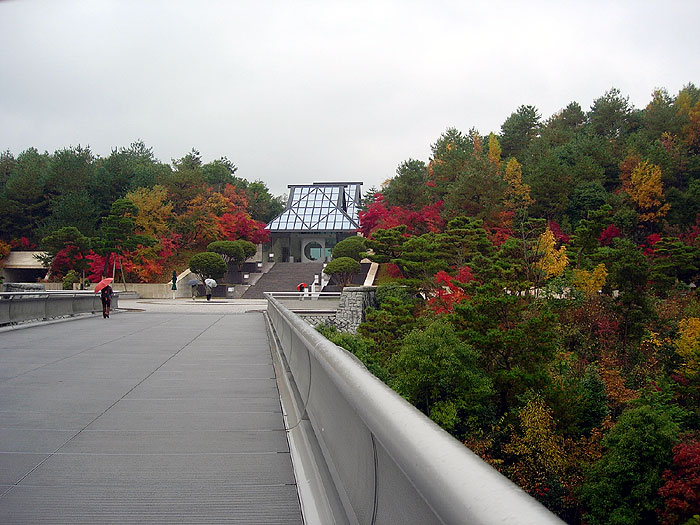
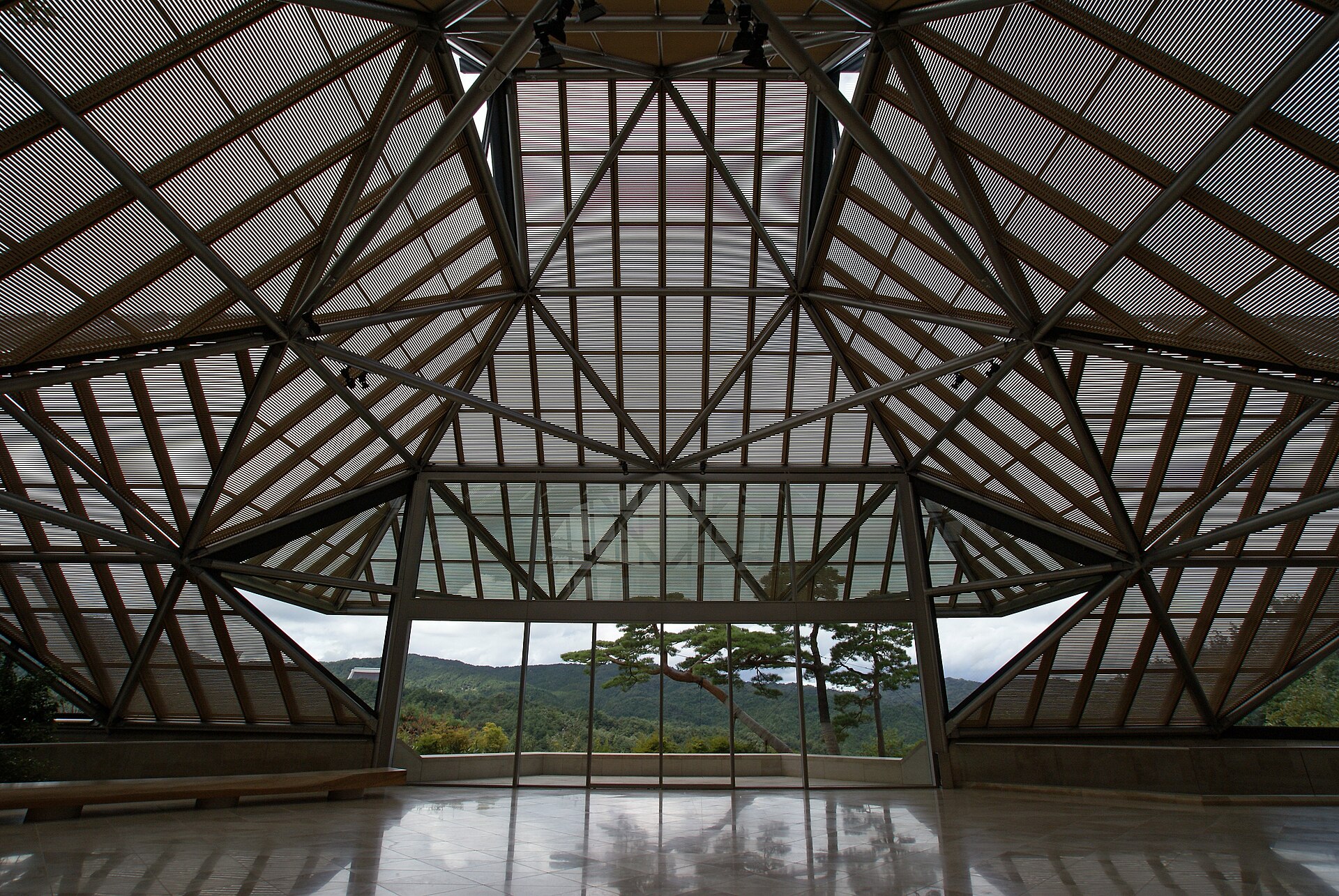
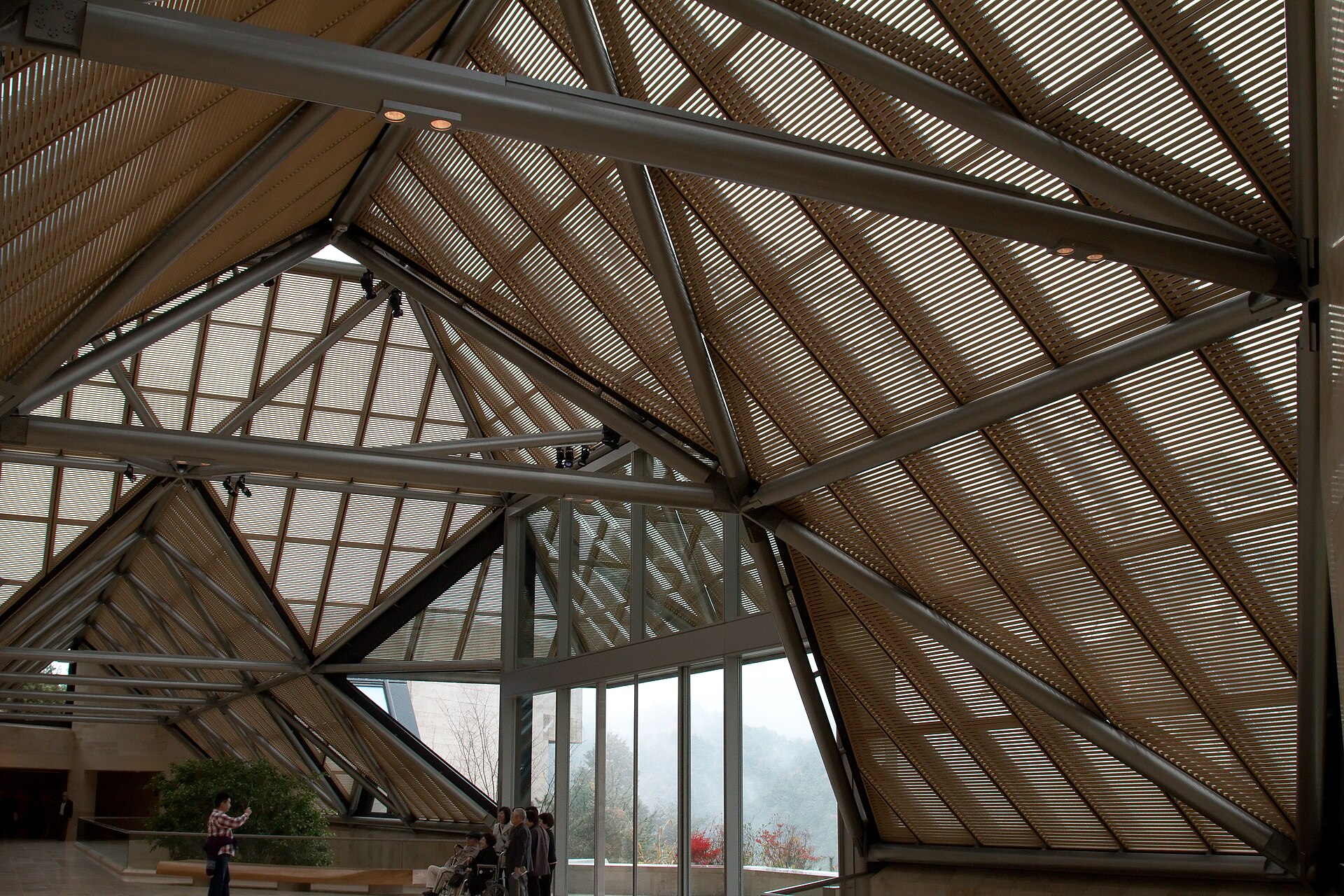
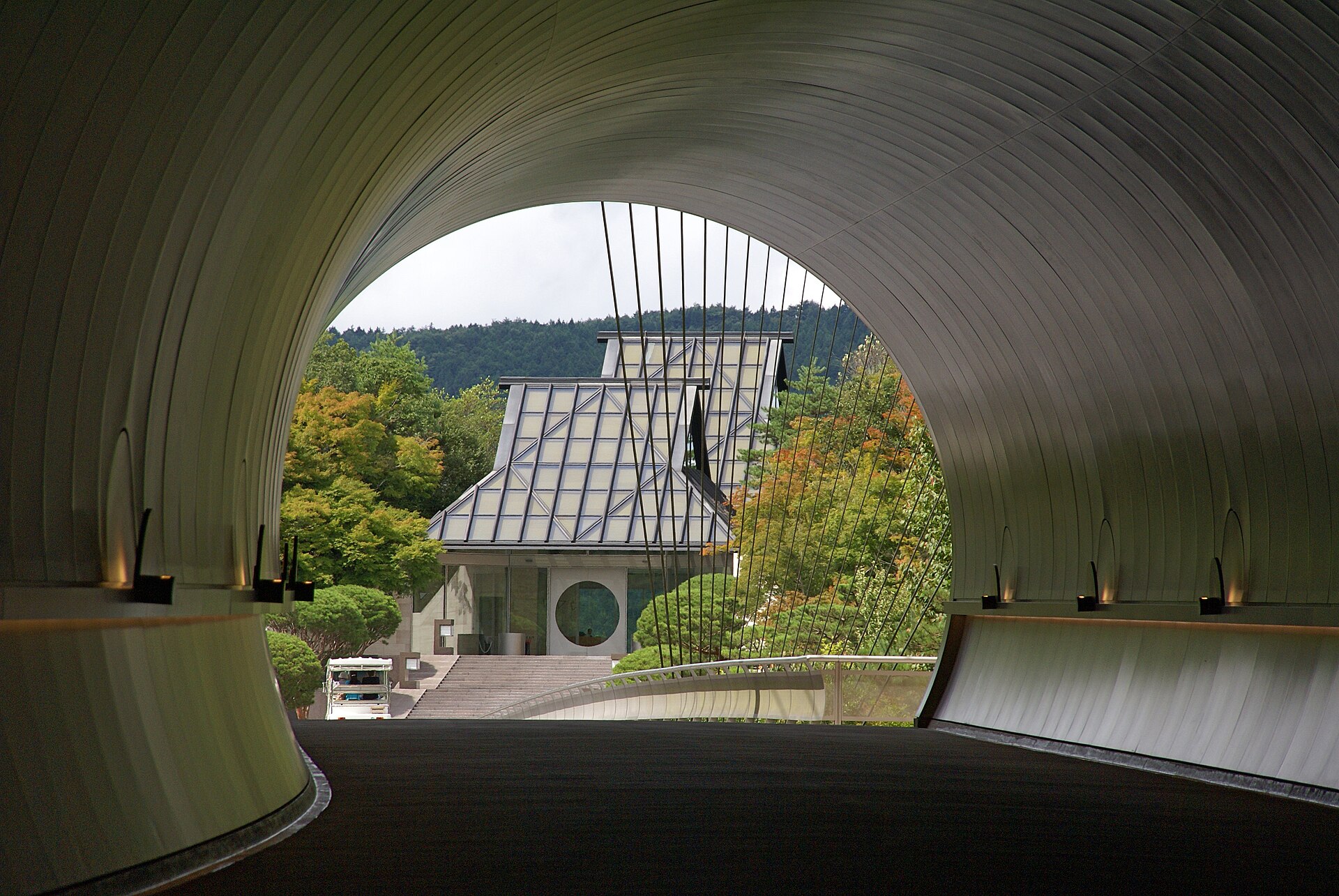
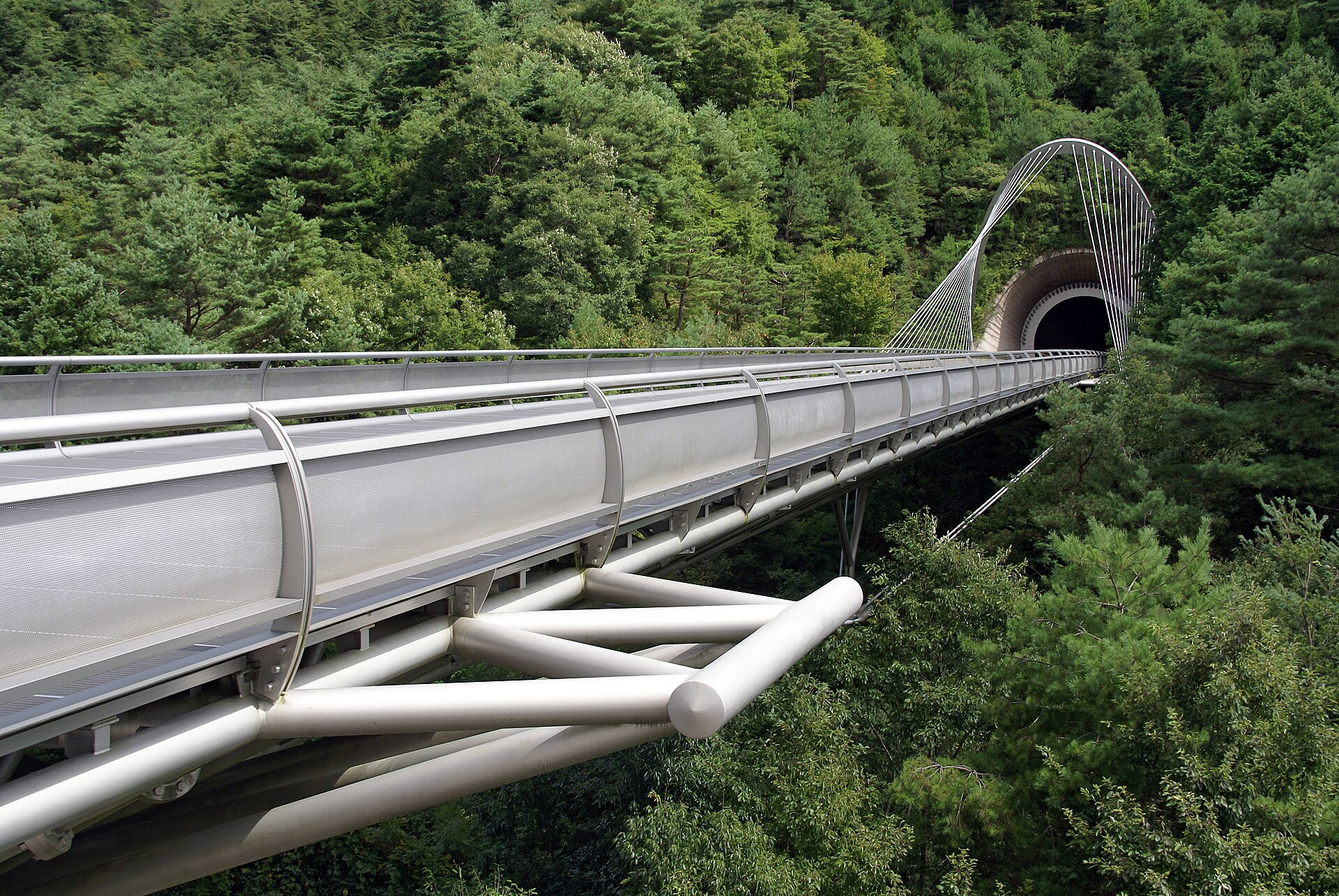
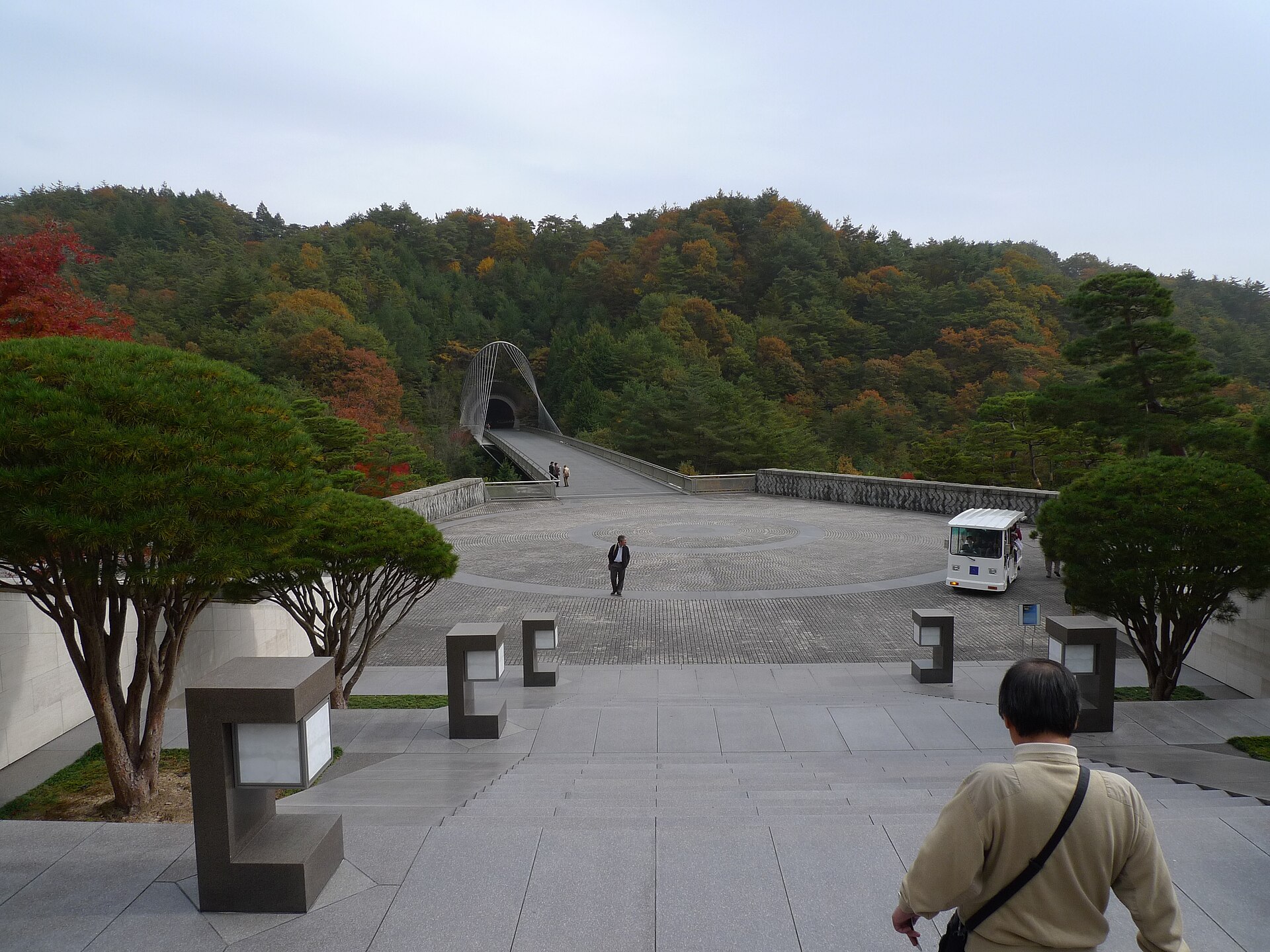
Not a gallery but the architectural sequence I.M. Pei built as part of the museum itself. Visitors buy tickets at a separate Reception Pavilion, then walk or ride a free electric shuttle along a path lined with weeping cherry trees, through a curved, sound-deadened tunnel bored into the mountainside, and across a cable-stayed bridge more than 200 metres long to reach the entrance hall. The hall's triangulated glass-and-steel roof, built from space-frame trusses in honey-coloured limestone surrounds, is the one interior space in the building where photography is allowed.
What to see first
Yohen Tenmoku tea bowl
Chinese kiln, Southern Song dynasty (attribution as given by the museum's Important Cultural Property listing)One of the museum's Important Cultural Property designations. The iridescent yohen glaze effect is among the rarest results in Chinese temmoku ware; only a handful of bowls with this glaze survive anywhere.10
Elephant and Whale folding screens (Zo to Kujira-zu byobu)
Ito Jakuchu, 1796A pair of six-panel screens by one of the best known eccentric painters of the Edo period, rediscovered in a private collection in the Hokuriku region in 2008 and now one of the museum's most recognisable Japanese paintings.10
Standing Jikokuten
Japanese Buddhist sculpture workshop, unattributedAn Important Cultural Property guardian-king figure, representative of the temple sculpture the North Wing rotates through its changing Japanese-art exhibitions.10
Standing Jizo Bosatsu
UnattributedImportant Cultural Property; a devotional figure of the bodhisattva who vows to save beings from suffering, central to Japanese Buddhist temple practice.10
Enmaten hanging scroll
UnattributedA painting of the deity Enmaten designated Important Cultural Property, part of the Buddhist and Shinto-Buddhist imagery that anchors the North Wing's Japanese holdings.10
Sutra of Golden Light on purple paper in gold ink (Shishi konji konkomyo saishookyo)
Unattributed scribeA gold and silver ink Buddhist sutra transcribed on dyed purple paper, designated Important Cultural Property and one of the finer examples of early sutra transcription in the collection.10
Decorative quiver with mother-of-pearl inlay (shitan raden hosoge hoo-mon hirayanagui)
UnattributedA rosewood quiver inlaid with mother-of-pearl in a phoenix and floral pattern, designated Important Cultural Property and representative of the museum's decorative-arts holdings.10
Reworked hanging scrolls from Choju-jinbutsu-giga and Jigoku-zoshi
Unattributed, Heian to Kamakura period originalsThree hanging scrolls, two cut from sections of the famous Scrolls of Frolicking Animals and Humans and one from the Masuda family's Hell Scroll, remounted out of their original handscroll format. Designated Important Cultural Properties in November 2022.10
Statue of a goddess, identified as Isis
Ptolemaic Egypt, circa 3rd century BCEA granodiorite standing figure roughly 160 centimetres tall, one of the South Wing's principal Egyptian antiquities.11
Standing Buddha, Gandhara school
Grey schist, Gandhara regionA large standing Buddha, about 250 centimetres tall, carved in the Greco-Buddhist Gandhara style and frequently singled out as one of the museum's strongest single sculptures. Secondary sources disagree on its exact date; see Open questions.11
Group of Achaemenid-period gold and silver objects from Central Asia
Achaemenid Persian workshops, findspot disputedMore than 1,200 pieces that some scholars have proposed once formed part of the lost Oxus Treasure, rediscovered in Afghanistan in 1993. The connection and the findspot remain contested in the literature.10
A tunnel, a bridge and a hidden valley
Getting to the Miho Museum is part of what the museum is. From the ticket office at the Reception Pavilion, visitors set off down a path lined with weeping cherry trees, either on foot or aboard a small free electric shuttle, and the building itself stays out of sight until the very end of the walk. The path narrows into a tunnel bored through the mountainside, curved and lined in silver-toned panels that were engineered for sound deadening, so that the noise of the approach drops away and the light changes colour with the seasons outside, pink with cherry blossom in spring and gold and red with the maples in autumn. The tunnel opens onto a cable-stayed bridge, suspended on steel cables and running more than 200 metres across a forested valley, and only from partway across it does the museum's entrance hall come into view: a hip-and-gable glass roof framed in steel, set against the tree line.
Architect I.M. Pei, working on one of the last major commissions of his career and his only building in Japan, has said the sequence was built as a deliberate, real-world staging of the Taohua Yuan Ji, the ancient Chinese tale of a fisherman who follows a river of peach blossom through a narrow cave and finds an isolated, harmonious valley on the other side, a story often rendered in English as The Peach Blossom Spring or given the shorthand Shangri-La. Pei described his aim plainly: to make the building's silhouette sit comfortably in the natural landscape rather than dominate it. The choreography, tree-lined path, tunnel, bridge, arrival, is the mechanism by which a museum building gets to make that argument about itself before a visitor has seen a single object inside.
Eighty percent underground
The museum covers about 17,400 square metres, and by the museum's own account and independent architectural surveys, roughly four-fifths of that area is buried in the mountain rather than standing above it. Pei's design team cut into the ridge, built the galleries into the excavated rock, and then restored the mountaintop's profile over the finished structure so that, seen from a distance, the site reads as forest rather than building. Only the entrance hall and a limited run of skylights break the surface. Inside, the hall's roof is made of a space frame, a lattice of triangular steel members chosen, Pei has said, for the simplicity of the geometry, glazed so that daylight is filtered rather than blocked and the surrounding hills stay visible through the structure. The gallery walls use honey-coloured French limestone from the same quarry Pei drew on for the Grand Louvre in Paris a decade earlier, chosen to warm the natural light rather than compete with it.
The engineering brief was unusual even by the standard of Pei's late career: a building whose architectural ambition was to be as invisible as possible from the outside while still working as a modern museum on the inside, with climate control, security and gallery lighting for antiquities and Japanese paintings alike. The bridge and tunnel were built as part of the same commission rather than as approach infrastructure bolted on afterward, which is part of why the arrival sequence reads as unified with the building rather than separate from it.
A tea-ceremony collection becomes a museum
The Miho Museum exists because of one collector, Mihoko Koyama (1910 to 2003), who began acquiring tea-ceremony utensils, ceramics and lacquerware decades before the building existed and kept collecting, eventually reaching across Japanese Buddhist and Shinto art into Egyptian, Near Eastern, Greek, Roman, South Asian and Chinese antiquities. Koyama had left the Church of World Messianity (Sekai Kyusei Kyo), the religious movement founded by Mokichi Okada, and in 1970 founded her own organisation, Shinji Shumeikai, built around the same core teaching that beauty, art and natural living have a purifying and restorative role in life. The Shumei Cultural Foundation, the organisation's cultural arm, built the museum in the hills near Shumei's own temple complex outside Kyoto and has operated it since it opened in November 1997. The same organisation had earlier opened a sister institution, the MOA Museum of Art near Atami, in 1982. Philosopher and religious scholar Takeshi Umehara served as the Miho Museum's first director.
The museum reached one million visitors in 2006 and two million in 2014, and today holds roughly 3,000 objects, of which 250 to 500 are on view at any one time across the two wings, a scale that keeps the collection genuinely rotating rather than fixed behind glass indefinitely.
Two wings: the ancient world and Japan
The collection is organised into a South Wing, given over to the permanent installation of ancient Egyptian, Near Eastern, Greek, Roman, South Asian, Central Asian, Chinese and Islamic art, and a North Wing, reserved for Japanese art and run instead as a programme of exhibitions that change several times a year rather than one static display. The South Wing includes Egyptian sculpture such as a Ptolemaic-period granodiorite goddess figure, Assyrian relief fragments, Gandhara Buddhist sculpture in the Greco-Buddhist idiom, and a large group of Achaemenid-period Persian gold and silver objects from Central Asia whose exact findspot is disputed among scholars, discussed further below. The North Wing's rotating Japanese displays draw on Buddhist sculpture, paintings, sutras and decorative art, several pieces of which the Japanese government has designated Important Cultural Property, alongside the founding tea-ceremony collection of bowls, lacquerware and ceramics that predates the museum building itself.
Because the North Wing changes on its own schedule, what a visitor sees of the Japanese collection depends on which of the year's three exhibition periods they visit during; the South Wing's ancient-world installation is the constant against which the Japanese programme rotates.
Provenance in question: the stolen Bodhisattva and the Italian claims
The Miho Museum's collecting history, concentrated into a short and well-financed period in the 1990s under the guidance of the Japanese dealer Noriyoshi Horiuchi, has generated real and specific disputes rather than vague reputational unease. In 2001 the museum acknowledged that a sixth-century Bodhisattva statue in its collection was the same sculpture stolen from a public garden in Shandong province, China, in 1994, and agreed to return it, which it did by 2007; at the time the Chinese government stated publicly that the museum appeared to have bought the piece in good faith on the open market. Separately, evidence presented at the 2007 Rome trial of dealer Robert Hecht and former Getty curator Marion True linked roughly 50 Roman-period objects in the Miho collection, including a marble oscillum and other pieces without published collecting histories, to material an Italian prosecutor wanted returned; the museum's own cultural department told reporters it did not know which items were under suspicion. Horiuchi, who represented the museum as its principal antiquities agent between 1991 and 1997, is documented elsewhere as having sourced material from Gianfranco Becchina, an Italian dealer later convicted of trafficking in looted antiquities, and in 2008 more than 300 looted antiquities were seized from Horiuchi's own storage facility at the Geneva Freeport and eventually repatriated to Italy.
Archaeologist Lord Colin Renfrew named the Miho Museum specifically as one of the institutions 'flouting the conventions of good conduct' over its handling of the Italian claims, and called on the museum's trustees to accept the same acquisition standards, tied to the 1970 UNESCO Convention, that better-regulated museums have adopted. A separate and older scholarly debate concerns more than 1,200 Achaemenid-period gold and silver objects in the South Wing that some researchers have proposed once formed part of the lost Oxus Treasure, rediscovered in Afghanistan in 1993 with no secure findspot; the connection is disputed rather than settled. None of this is disclosed at length on the museum's own website, which presents the collection through its aesthetic and religious framing rather than its acquisition history. The record here is what published reporting, trial evidence and specialist commentary establish; it does not amount to a finding that any specific object now on display was itself looted, and the museum has not published a full account of its own.
Visiting today
Miho is not a museum a visitor can simply turn up to on any given week. It publishes three exhibition periods a year, roughly mid-March to early June, early July to late August, and late September to early December, and is closed to the public outside those windows as well as on Mondays within them. A visit has to be planned around whichever of the three periods is running, which also determines what is on view in the rotating North Wing. Within an open period the museum keeps standard hours, 10:00 to 17:00 with last admission at 16:00, and reaching it from Kyoto or Otsu means a train to JR Ishiyama Station followed by a dedicated bus that only operates while the museum itself is open, which is itself a signal of how tightly the whole visit is built around the museum's own calendar rather than a conventional urban transport network.
What visitors say
Visitors consistently describe Miho as a day trip that rewards the effort of reaching it. Reviewers routinely say the approach itself, the walk through the tunnel and across the suspension bridge, is as memorable as anything inside the galleries, and many call the building the real headline exhibit. The ancient and Japanese collections both draw praise for quality and range, and the on-site restaurant and tea room are recommended alongside the art. Because the museum keeps to a seasonal calendar rather than opening year round, recent visitor commentary also functions as a reminder to check the current exhibition dates before travelling.
What is praised, what is criticised
- Praised: I.M. Pei's building and the choreographed approach through the tunnel and over the bridge
- Praised: the range and quality of the ancient antiquities and Japanese art on display
- Praised: the on-site restaurant and tea room
- Criticised: the remote mountain location, which typically means a train journey to Ishiyama followed by a roughly 50-minute bus ride
- Criticised: the seasonal calendar and periodic closures for exhibition changes, which catch visitors who assume a museum is open year round
- Criticised: the ban on photography inside the exhibition galleries
Ratings on other platforms
TripAdvisor: 4.6 from 350 ratings, read 18 September 2026
A platform average is a tertiary source: it moves, it is not audited, and we quote no visitor's words.
Questions about Miho Museum
Where is Miho Museum?
300 Momodani, Tashiro, Shigaraki-cho, Koka-shi, Shiga 529-1814, Japan.
How much does it cost to visit?
Adult: JPY 1300; High school and university student: JPY 1000; Elementary and junior high school student: free; Visitor with a disability certificate: free. As confirmed 18 September 2026.
When is it open?
Tuesday to Sunday, spring exhibition period (14 March to 7 June 2026) 10:00-17:00; Tuesday to Sunday, summer exhibition period (4 July to 30 August 2026) 10:00-17:00; Tuesday to Sunday, autumn exhibition period (26 September to 6 December 2026) 10:00-17:00. Closed: Monday during each operating period, or the following business day if Monday is a public holiday. Every day outside the three published exhibition periods, including the gap the museum was in on the research date (31 August to 25 September 2026) and the winter closure that follows 6 December 2026 until the next spring exhibition is announced. As confirmed 18 September 2026.
How do you get there?
Bus from JR Ishiyama Station: Teisan Bus route 150 toward Miho Museum leaves from lane 3 outside the station's right-hand exit and takes about 50 minutes. Fare is 1000 yen for adults and 500 yen for children under 12, paid in cash on boarding; IC transit cards are not accepted. The service runs only during the museum's spring, summer and autumn operating periods and increases in frequency in peak season; Taxi: About 30 to 40 minutes from Ishiyama, Seta or Minami-Kusatsu stations, or roughly 20 minutes from Shigaraki Kogen Railway's Shigaraki Station; Car: 15 to 35 minutes from several Shin-Meishin and Meishin expressway interchanges. Free parking for about 300 cars and 20 tour buses.
What should you see first?
Yohen Tenmoku tea bowl (Chinese kiln, Southern Song dynasty (attribution as given by the museum's Important Cultural Property listing)); Elephant and Whale folding screens (Zo to Kujira-zu byobu) (Ito Jakuchu, 1796); Standing Jikokuten (Japanese Buddhist sculpture workshop, unattributed); Standing Jizo Bosatsu (Unattributed); Enmaten hanging scroll (Unattributed); Sutra of Golden Light on purple paper in gold ink (Shishi konji konkomyo saishookyo) (Unattributed scribe).
What we could not confirm
- Whether the more than 1,200 Achaemenid-period Central Asian objects in the South Wing are connected to the lost Oxus Treasure remains disputed among specialists and is not resolved by the museum's own published material.
- The outcome of the Italian claims raised in and after the 2007 Hecht and True trial, covering roughly 50 Roman-period objects, was not confirmed as settled or resolved by any source consulted for this record.
- Secondary sources disagree on the date of the museum's Gandhara standing Buddha; the museum's own catalogue entry, which would resolve this, was not accessed.
- The museum's own website does not publish acquisition dates or collecting histories for individual South Wing objects, which limits what can be verified about any single piece beyond what has appeared in outside reporting.
Images
Sources
- 1Miho Museum, Information for Visitors miho.jp/en/information/
- 2Miho Museum, Current Exhibitions miho.jp/en/current_exhibition/
- 3Miho Museum, Frequently Asked Questions miho.jp/en/faq/
- 4Miho Museum, Information for First-Time Visitors miho.jp/en/beginner/
- 5Miho Museum, Public Transportation miho.jp/en/access/
- 6Miho Museum, Approach (architecture) miho.jp/en/architecture/approach/
- 7Miho Museum, History and Concept miho.jp/en/intro/history/
- 8Miho Museum, Main Collections miho.jp/en/collectionmain/
- 9Miho Museum, Collection overview miho.jp/en/collectionindex/
- 10Wikipedia, Miho Museum (tertiary, used for Important Cultural Property listings, founding chronology and the Shandong Bodhisattva and Oxus Treasure summaries) en.wikipedia.org/wiki/Miho_Museum
- 11ArchEyes, The Miho Museum by I.M. Pei: An Ode to Harmony archeyes.com/the-miho-museum-by-i-m-pei-an-ode-to-harmony/
- 12Jason Edward Kaufman, Heavenly showcase for cult's collection, The Art Newspaper, December 1997 jasonkaufman.com/heavenly-showcase-for-cults-collection-the-miho-museum-japan/
- 13David Gill, Looting Matters: The Miho Museum, time to resolve its dispute with Italy?, March 2010 lootingmatters.blogspot.com/2010/03/miho-museum-time-to-resolve-its-dispute.html
- 14Trafficking Culture, Operation Andromeda case study traffickingculture.org/encyclopedia/case-studies/operation-andromeda/
- 15Chasing Aphrodite, Noriyoshi Horiuchi tag archive chasingaphrodite.com/tag/noriyoshi-horiuchi/
- 16TripAdvisor, Miho Museum reviews (tertiary, rating aggregate and review themes) tripadvisor.com/Attraction_Review-g1023574-d320695-Reviews-Miho_Museum-Koka_Shiga_Prefecture_Kinki.html
- 17Wikimedia Commons, Category:Miho Museum (image licensing verification) commons.wikimedia.org/wiki/Category:Miho_Museum