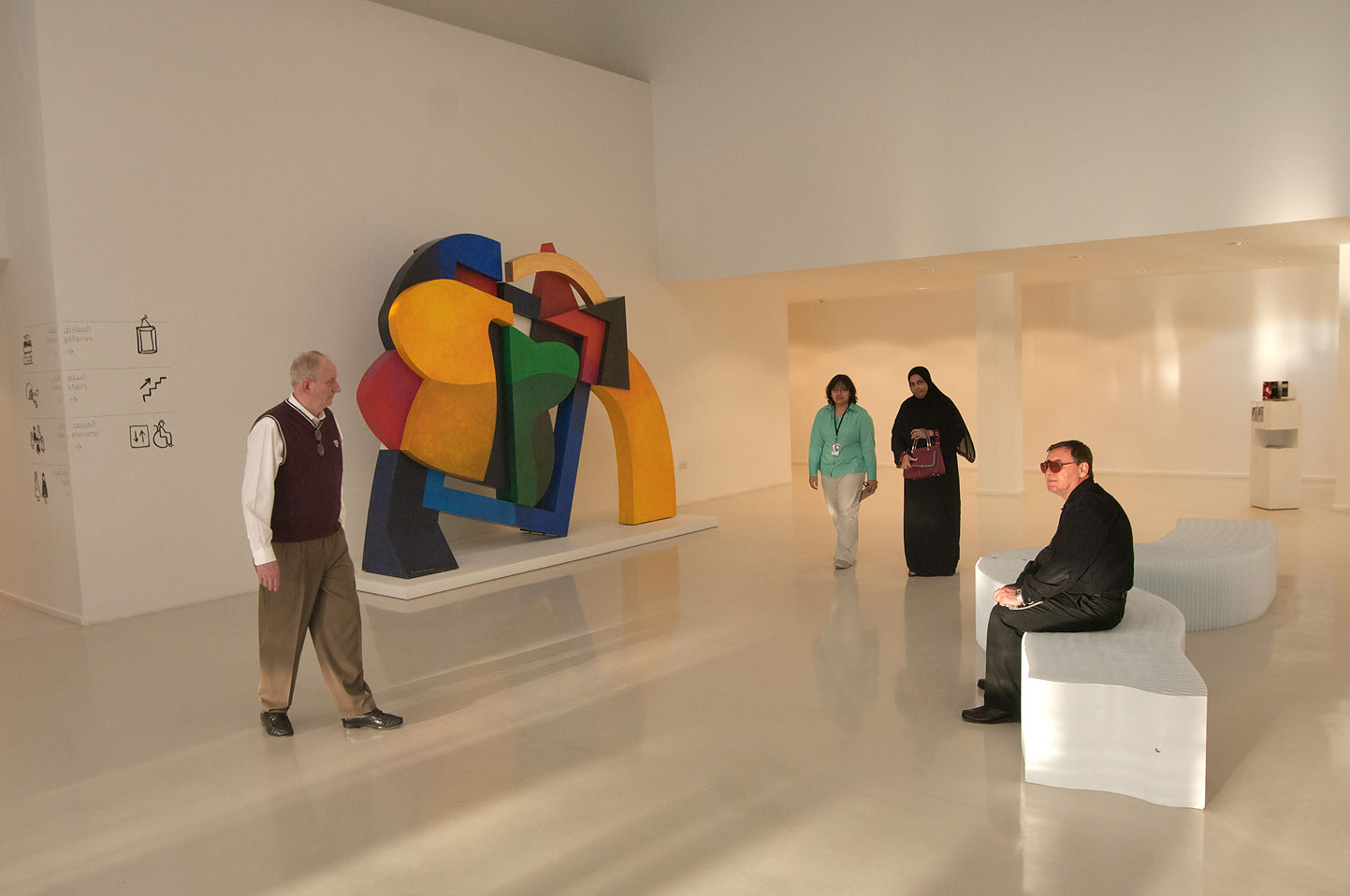
The Mathaf building at Education City, Doha, photographed in 2011.
Alex Sergeev (www.asergeev.com), CC BY-SA 3.0Mathaf: Arab Museum of Modern Art
Museum · Founded 2010
Open, admission and hours confirmed 3 September 2026 · 15 sources
On this page 15 sections
ContentsClose
Mathaf's strength is depth in one specific place: a single, deliberately assembled collection of Arab modernist and contemporary art running from the late 1800s to the 1980s, built by one collector over decades rather than acquired piecemeal by an institution. That gives it holdings, especially in Iraqi modernism through the artists who worked in Sheikh Hassan's Doha villas during the Gulf War, that no other public museum can match. Its limitation is scale of display rather than scale of holding: with only a fraction of roughly 9,000 to 10,000 works shown at once, the museum's public face understates what the collection actually contains.
| Kind | Museum |
|---|---|
| Founded | 2010 |
| City and country |  Doha, Qatar Doha, Qatar |
| Address | Education City, Doha, Qatar |
| Website | mathaf.org.qa |
| Status | Open, confirmed |
| Record last verified |
Visiting
- Hours
- Sunday, Tuesday, Wednesday, Saturday09:00 to 19:00
- Thursday09:00 to 21:00
- Friday13:30 to 19:00
- Closed
- Monday.
- Admission
- General admissionFreeFree to all visitors, but a timed ticket must be reserved online in advance for entry to the permanent collection and any special exhibition
Free entry: Every day - entry has no charge, only a booking requirement- Tickets
- qm.org.qa/tickets/select-tickets/?exhibition-... The museum's own ticket page.
- Do I need to book?
- Yes - a free timed ticket must be booked online in advance through Qatar Museums' ticketing system
- Address
- Education City, Doha, Qatar MapMetro Doha Metro Green Line, Education City station
Tram Free Education City tram, Mathaf Museum stop directly outside the building - Website
- mathaf.org.qa
- Telephone
- +974 4402 8830
- [email protected]
Before you go how long, access, photography, bags, eating, shop
- How long to allow
- Not stated by the museum; visitor accounts describe stays of roughly two hours
- Access
- The visit page links to a dedicated accessibility section; specific accommodations are not detailed on the page itself
- Photography
- The museum directs visitors to its Visitor Guidelines for dress code and photography rules; the guidelines' specific terms were not available on the pages fetched
- Bags
- Not detailed on the pages fetched
- Eating
- Joe & The Juice operates inside the museum, serving coffee, juices, smoothies and food
- Shop
- A museum shop is on site; its stock is not detailed on the visit page
Prices and hours change. We take them from the institution's own pages and print the day we read them, and you can check the current position at the source we used. Confirm before you travel.
What is inside
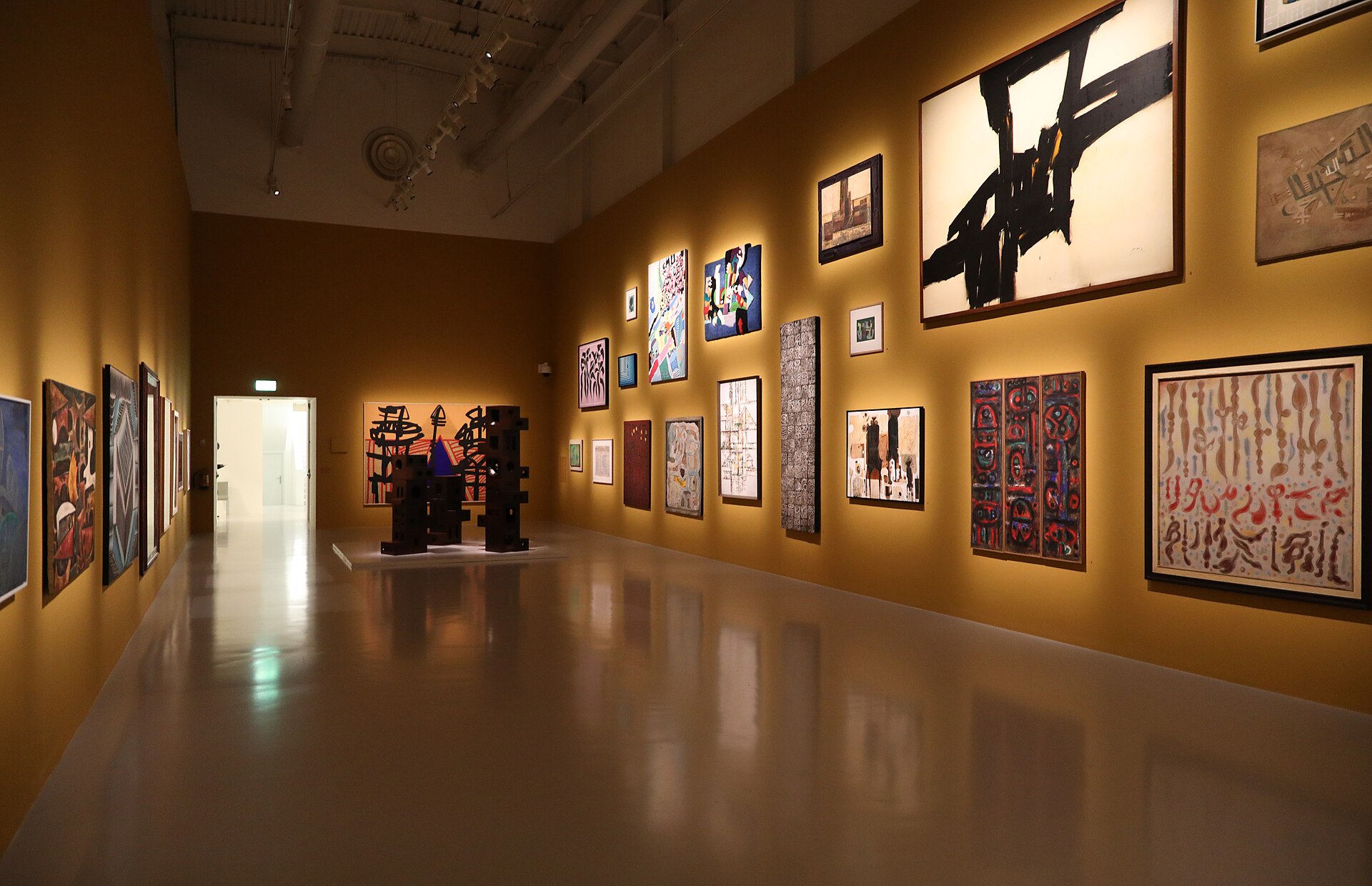
Photograph by Sailko · CC BY-SA 4.0 Permanent Collection Galleries
Two floors of galleries drawing on a founding collection of roughly 9,000 to 10,000 works of Arab art from the late 1800s to the 1980s. Only a small fraction, on the order of 100 pieces at a time, is on view at any one moment. Gallery 08 holds Mahmoud Mokhtar's 1930 bronze Au Bord du Nil (On the Banks of the Nile), one of the collection's signature sculptures.
Special Exhibition Galleries
Rotating temporary shows distinct from the permanent hang. Recent and past examples include the inaugural 2010 exhibitions Sajjil: A Century of Modern Art and Interventions, a 2011-2012 Cai Guo-Qiang survey, a Dia al-Azzawi retrospective, and the 2025-2026 fifteenth-anniversary exhibitions Resolutions and We Refuse_d.
Research Library and the Encyclopedia of Modern Art and the Arab World
A research library supporting Mathaf's scholarly programme. In 2013 the museum launched the online Encyclopedia of Modern Art and the Arab World, offering peer-reviewed artist biographies and essays; the project was paused in the mid-to-late 2010s amid budget constraints and is described by the museum's director as being revived as of the 2025-2026 anniversary programme.
Education Wing
Space for the museum's education programming, including Mathaf Voices, a student-led tour initiative, and Artist Encounters, alongside school and family programmes.
Museum Shop and Cafe
A cafe run by Joe & The Juice and a museum shop for visitors, near the entrance area described by visitors as unobtrusive and easy to miss from outside.
What to see first
Au Bord du Nil (On the Banks of the Nile)
Mahmoud Mokhtar, 1930A life-size bronze of an Egyptian peasant woman (fallaha) carrying a water jug, blending Pharaonic sculptural tradition with a modernist, nationalist reading of rural Egyptian identity under British colonial rule. Mokhtar is credited by Qatar Museums as Egypt's first sculptor in more than 1,700 years, and the work is permanently displayed in Mathaf's Gallery 08.14
From the Years of Palestinian Slaughter
Dia al-Azzawi, 1976 (mixed media)One of several major, dated works by al-Azzawi that Mathaf's own encyclopedia entry lists as part of its holdings, tracing his shift from figuration toward the politically engaged and text-image work for which he is best known.13
Human States
Dia al-Azzawi, 1975 (oil on canvas)A mid-1970s canvas held by the museum, part of the run of dated al-Azzawi works that let Mathaf show a single artist's development across two decades in one collection.13
Figure of Sorrow
Dia al-Azzawi, 1972 (oil on canvas)An earlier, more figurative al-Azzawi canvas in the collection, useful alongside his 1990s and 2010 works for tracing the arc of one of modern Iraq's most significant artists.13
Western Bird
Dia al-Azzawi, 1995-1996 (acrylic on canvas)A later al-Azzawi canvas in Mathaf's holdings, made after his long exile in London, and part of the same documented group of works cited by the museum's own encyclopedia.13
The Doha gallery: works from the villa years
Dia al-Azzawi, Ismail Fattah and Shakir Hassan Al Said, early 1990sDuring the second Gulf War, Sheikh Hassan bin Mohammed bin Ali Al Thani invited Iraqi artists cut off from work by sanctions to live and create in two villas he provided in Doha. Pieces the three artists made there were later shown together in a gallery titled Doha at Mathaf's 2010 opening, and art historian Nada Shabout has called that residency Mathaf before it was Mathaf.10
Takween (Composition): the geometry of Saloua Raouda Choucair
Saloua Raouda Choucair, grouped with Dia al-Azzawi, Mehdi Moutashar, Shafic Abboud, Etel Adnan and othersA gallery grouping built around Choucair's abstracted geometric forms, presented by Mathaf as one strand of the Beirut and the Golden Sixties exhibition alongside contemporaries exploring architecture, science and technology through abstraction.12
Exhibitions on now
- Opening soon25 Oct 2026 to 6 Feb 2027Confirmed , 5 weeks ago
The building and what it was built to hold
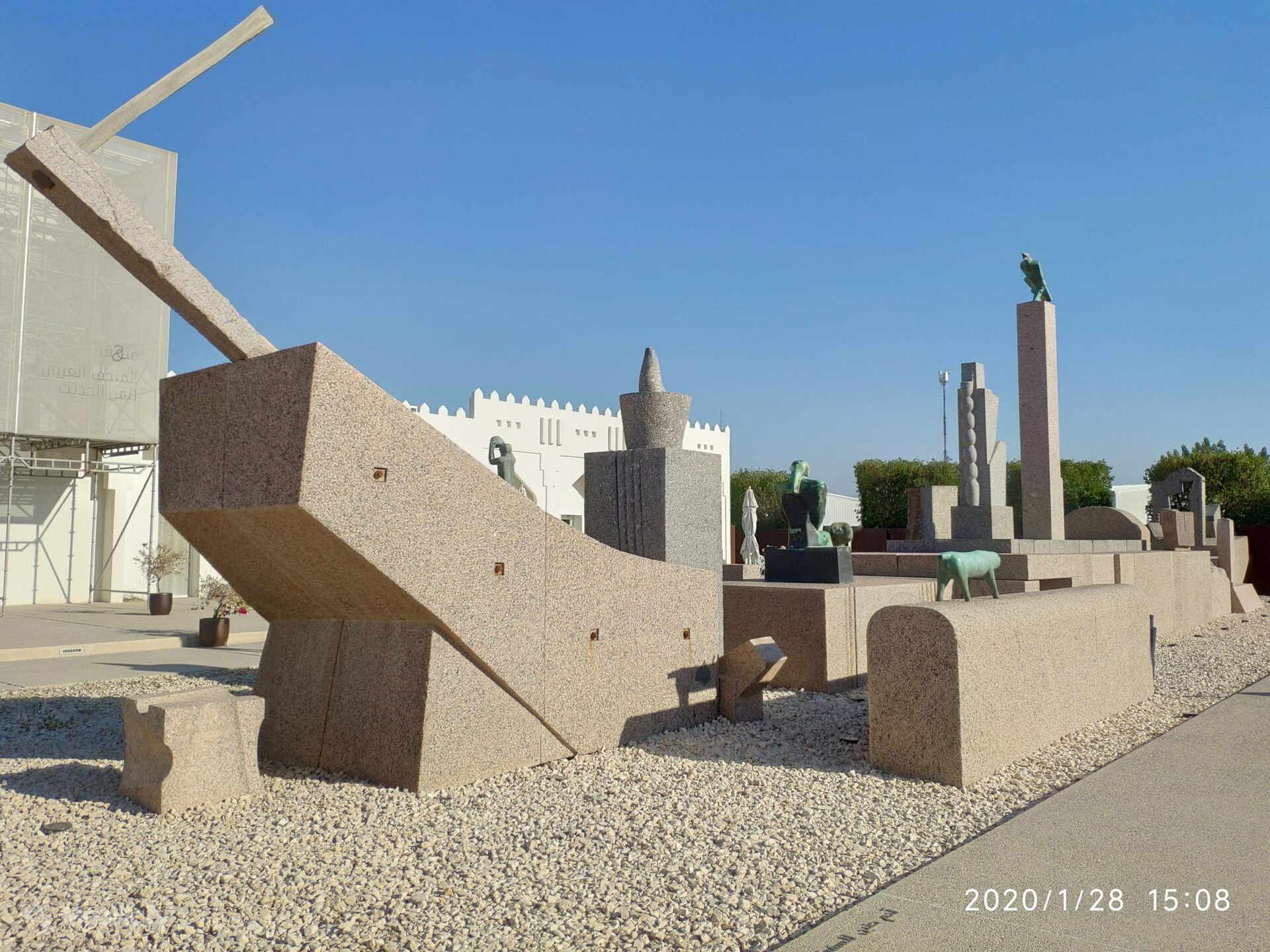
Mathaf occupies a former school building inside Qatar Foundation's Education City in Doha, converted for museum use by the French architect Jean-Francois Bodin. The renovation gave the institution about 5,500 square meters across two floors: permanent and temporary exhibition galleries, a research library, an education wing, a shop and a cafe. From the outside the building keeps the low, unassuming profile of the school it once was, which is precisely the first thing most visitor accounts mention, for better or worse - there is no grand museum facade signaling what is inside.
The museum opened to the public on 30 December 2010, after a preview earlier that year, becoming the first institution in the region built specifically around modern and contemporary Arab art. Before that date the same collection had already had a life of its own, stored and shown in two private villas in Doha's Madinat Khalifa district through the 1990s and early 2000s while its founder and a small team worked out what kind of institution it should become.
Sheikh Hassan's collection and the museum that grew from two villas
Mathaf exists because of one collector: Sheikh Hassan bin Mohammed bin Ali Al Thani, who spent decades quietly acquiring Arab modernist art, eventually assembling what is now described as the largest collection of its kind anywhere, an anthology of Arab art history running from the late 1800s through the 1980s. During the second Gulf War, when international sanctions cut off Iraqi artists from materials and markets, Sheikh Hassan invited several of them, including Dia al-Azzawi, Ismail Fattah and Shakir Hassan Al Said, to live and work in two villas he made available in Doha. Nada Shabout, the art historian who later shaped Mathaf's intellectual foundation and coined its English name, has described that residency as Mathaf before it was Mathaf.
Shabout encountered the collection while completing doctoral research in the United States, after Sheikh Hassan called her directly to say he wanted the world to see what he had built and wanted to open a museum around it. She became central to turning a private holding into a public institution: shaping acquisitions, filling historical gaps in the collection's coverage, and curating two of the three exhibitions that opened Mathaf in December 2010 - Sajjil: A Century of Modern Art, featuring roughly 100 artists, and Interventions, a set of new commissions from modernist figures including Dia al-Azzawi, Farid Belkahia, Ahmed Nawar, Ibrahim el-Salahi and Hassan Sharif. A third opening exhibition, Told, Untold, Retold, was staged nearby at Qatar Museums' Al Riwaq space and is remembered as a defining early moment for its curators and participating artists.
What is actually on the walls
The founding collection now runs to somewhere between 9,000 and 10,000 works, but Mathaf shows only a small part of it at any time - on the order of 100 pieces, by outside estimates roughly one percent of the total holding. What is on view spans sculpture, painting and mixed media across a full century of Arab modernism. Mahmoud Mokhtar's 1930 bronze Au Bord du Nil, a life-size peasant woman carrying a water jug that fuses Pharaonic sculptural language with an explicitly nationalist reading of Egyptian identity under British rule, anchors Gallery 08 and is one of the collection's most frequently cited single objects.
Iraqi modernism runs unusually deep in the collection because of the villa years: Mathaf's own published catalogue entries for Dia al-Azzawi alone list dated works spanning Figure of Sorrow (1972), Human States (1975), From the Years of Palestinian Slaughter (1976), and the later Western Bird (1995-1996) and Victim's Rose (2010), letting the museum trace one artist's development across almost four decades from a single holding. Lebanese and pan-Arab abstraction is represented through gallery groupings such as Takween (Composition), which has placed Saloua Raouda Choucair's geometric abstraction alongside Dia al-Azzawi, Mehdi Moutashar, Shafic Abboud and Etel Adnan, and through galleries built around Beirut's Golden Sixties, pairing Adnan and Paul Guiragossian with painters including Huguette Caland and Aref El Rayess.
Directors, budget cuts, and the years as the perceived stepchild
Mathaf's leadership has changed hands several times since 2010. Wassan Al-Khudhairi served as inaugural chief curator and director from 2007 to 2012, followed by Michelle Dezember as interim director, then the Moroccan curator Abdellah Karroum from June 2013 to May 2021, and Zeina Arida, formerly director of Beirut's Sursock Museum, since November 2021. Reporting on the museum's fifteenth anniversary describes an extended stretch in the middle of that period marked by budget cuts, leadership turnover and Mathaf being widely perceived as the stepchild next to Al Riwaq, the larger Qatar Museums exhibition space that became the venue for the biggest international shows.
The Encyclopedia of Modern Art and the Arab World, an online reference project Shabout initiated in 2013 to give Arab artists peer-reviewed biographies and scholarship, was itself paused in the mid-to-late 2010s during that period of institutional restructuring and tighter budgets. Arida has said the project is now being revived as part of the museum's fifteenth-anniversary programme, alongside a stated intention to expand publishing.
Fifteen years on: an anniversary, a reckoning, and an unbuilt expansion
Mathaf marked its fifteenth year in 2025-2026 with two exhibitions rather than one. Resolutions turns the museum's own history into its subject, using archives, films and recorded interviews with Sheikh Hassan across four sections examining Mathaf as a story of artistic migration, institutional memory, knowledge production and Arab identity. We Refuse_d, co-curated with scholar Nadia Radwan, was conceived after the cancellation of an exhibition by artist Samia Halaby at a university museum in the United States, and gathers fifteen artists whose work addresses censorship, displacement and the pressures on artists making work during the war in Gaza; the curators' published note explicitly frames the show around artists who withdrew from exhibitions and cultural events at real professional cost during that period.
A stated expansion designed by architect Lina Ghotmeh would add artist residencies, studios and a library-cafe intended as a shared space for students and researchers, but as of the reporting available for this page the project has not been built and no firm timetable has been published. Sultan Al Qassemi's assessment, that Mathaf needs a venue several times its current size to show a meaningful share of what it owns, remains the clearest outside statement of what the expansion is meant to solve.
Visiting Mathaf
Entry to Mathaf and to its special exhibitions carries no charge, but a timed ticket must still be booked in advance through Qatar Museums' online system; walk-up entry without a reservation is not the museum's stated process. The museum is open Sunday, Tuesday, Wednesday and Saturday from 9am to 7pm, Thursday from 9am to 9pm and Friday from 1:30pm to 7pm, and closed Monday. It sits inside Education City, reachable by the Doha Metro Green Line's Education City station and, more directly, by the free Education City tram, which has a stop named for the museum immediately outside it. Visitors consistently describe the building itself as easy to walk past: there is no grand entrance, parking is a short walk from the door, and more than one visitor account describes being let into the museum through what reads from outside as a service entrance rather than a main one. A cafe run by Joe & The Juice and a small museum shop are on site once inside.
What visitors say
Reviewers and visitors treat Mathaf as two different things at once: the deepest single collection of modern and contemporary Arab art anywhere, and a small, physically modest building that shows only a sliver of what it owns. Scholars in the field describe the collection itself as without rival; the recurring visitor complaint is that the museum is hard to find, under-signed and easy to miss even once you are standing next to it.
What is praised, what is criticised
- Praised: The depth and rarity of the collection: art historian Nada Shabout has called it the best collection of modern Arab art on the planet, and Barjeel Art Foundation founder Sultan Al Qassemi describes it as unrivaled in the region.
- Praised: Free admission and easy access by public transport, with the Education City tram stopping directly outside and the Doha Metro Green Line a short ride away.
- Praised: The quality of curation in temporary shows: Tripadvisor visitors repeatedly single out specific rotating exhibitions as thought-provoking and well put together, distinct from praise for the building itself.
- Criticised: Only a small fraction of the collection is ever on view: Sultan Al Qassemi puts the figure at around one percent, roughly 100 works out of some 9,000 to 10,000, and says Mathaf needs a venue several times its current size.
- Criticised: The building itself gives no strong signal that it is a major museum: Tripadvisor reviewers describe an unmarked entrance reached through a car park, no visible main door, and being let in through what one visitor called an emergency door.
- Criticised: Limited visitor amenities were noted in several accounts, including sparse seating and uneven gallery lighting.
Ratings on other platforms
Tripadvisor: 4 from 217 ratings, read 3 September 2026
A platform average is a tertiary source: it moves, it is not audited, and we quote no visitor's words.
Questions about Mathaf: Arab Museum of Modern Art
Where is Mathaf: Arab Museum of Modern Art?
Education City, Doha, Qatar.
How much does it cost to visit?
General admission: free. As confirmed 3 September 2026.
When is it open?
Sunday, Tuesday, Wednesday, Saturday 09:00-19:00; Thursday 09:00-21:00; Friday 13:30-19:00. Closed: Monday. As confirmed 3 September 2026.
How do you get there?
Metro: Doha Metro Green Line, Education City station; Tram: Free Education City tram, Mathaf Museum stop directly outside the building.
What should you see first?
Au Bord du Nil (On the Banks of the Nile) (Mahmoud Mokhtar, 1930); From the Years of Palestinian Slaughter (Dia al-Azzawi, 1976 (mixed media)); Human States (Dia al-Azzawi, 1975 (oil on canvas)); Figure of Sorrow (Dia al-Azzawi, 1972 (oil on canvas)); Western Bird (Dia al-Azzawi, 1995-1996 (acrylic on canvas)); The Doha gallery: works from the villa years (Dia al-Azzawi, Ismail Fattah and Shakir Hassan Al Said, early 1990s).
What we could not confirm
- Whether the Lina Ghotmeh-designed expansion, discussed in connection with Mathaf's fifteenth anniversary, has a confirmed construction timetable is not established by the sources available for this page.
- The Encyclopedia of Modern Art and the Arab World is described by the museum's director as being revived as of the 2025-2026 anniversary season, but no relaunch date had been published in the sources checked.
- Two Wikimedia Commons photographs of a Mahmoud Mokhtar bronze captioned in Italian (sulle rive del Nilo, 1930, bronzo) were found in the Commons category for this museum but were not used as plates here, because their description does not establish they were photographed inside Mathaf itself rather than at a loan exhibition elsewhere; a future desk should check this before using them.
Images
Sources
- 1Wikidata, Q1908321 (Mathaf: Arab Museum of Modern Art) wikidata.org/wiki/Q1908321
- 2Wikimedia Commons, File:Mathaf Arab Museum of Modern Art at Education City.jpg commons.wikimedia.org/wiki/File:Mathaf_Arab_Museum_of_Modern_Art_at_Education_City.jpg
- 3Wikimedia Commons, File:Doha, mathaf, una sala 01.jpg commons.wikimedia.org/wiki/File:Doha,_mathaf,_una_sala_01.jpg
- 4Wikimedia Commons, File:Near the entrance to Mathaf Museum in Fereej Al Zaeem.jpg commons.wikimedia.org/wiki/File:Near_the_entrance_to_Mathaf_Museum_in_Fereej_Al_Zaeem.jpg
- 5Mathaf: Arab Museum of Modern Art, official homepage mathaf.org.qa/
- 6Mathaf: Arab Museum of Modern Art, Visit page (hours, admission, contact, cafe) mathaf.org.qa/en/visit
- 7Wikipedia, Mathaf: Arab Museum of Modern Art en.wikipedia.org/wiki/Mathaf:_Arab_Museum_of_Modern_Art
- 8Gulf News, Arab museum of modern art opens in Doha gulfnews.com/world/gulf/qatar/arab-museum-of-modern-art-opens-in-doha-1.730224
- 9Tripadvisor, Mathaf: Musee D'art Moderne (Doha) reviews and rating, read 2026-09-03 tripadvisor.com/Attraction_Review-g294009-d2268344-Reviews-Mathaf_Arab_Museum_of_Modern_Art-Doha.html
- 10Art Basel Stories, Myrna Ayad, 'Inside the world's largest collection of pan-Arab art', 15 January 2026 artbasel.com/stories/doha-qatar-mathaf-arab-museum-of-modern-art-artists-collection
- 11Mathaf, Mathaf Collection Summary, Part 1 (exhibition page) mathaf.org.qa/en/calendar/summary-part-1/
- 12Mathaf, Beirut and the Golden Sixties: About the Galleries mathaf.org.qa/en/calendar/beirut-and-the-golden-sixties/about-the-galleries/
- 13Mathaf Encyclopedia, Dia al-Azzawi artist biography mathaf.org.qa/en/encyclopedia/artists-biographies/dia-al-azzawi/
- 14Qatar Museums, Collection Highlight: Mahmoud Mokhtar and the Pride of a Nation qm.org.qa/en/stories/all-stories/collection-highlight-mahmoud-mokhtar/
- 15Wikipedia, Green Line (Doha Metro) (Education City tram, Mathaf Museum tram stop) en.wikipedia.org/wiki/Green_Line_(Doha_Metro)


