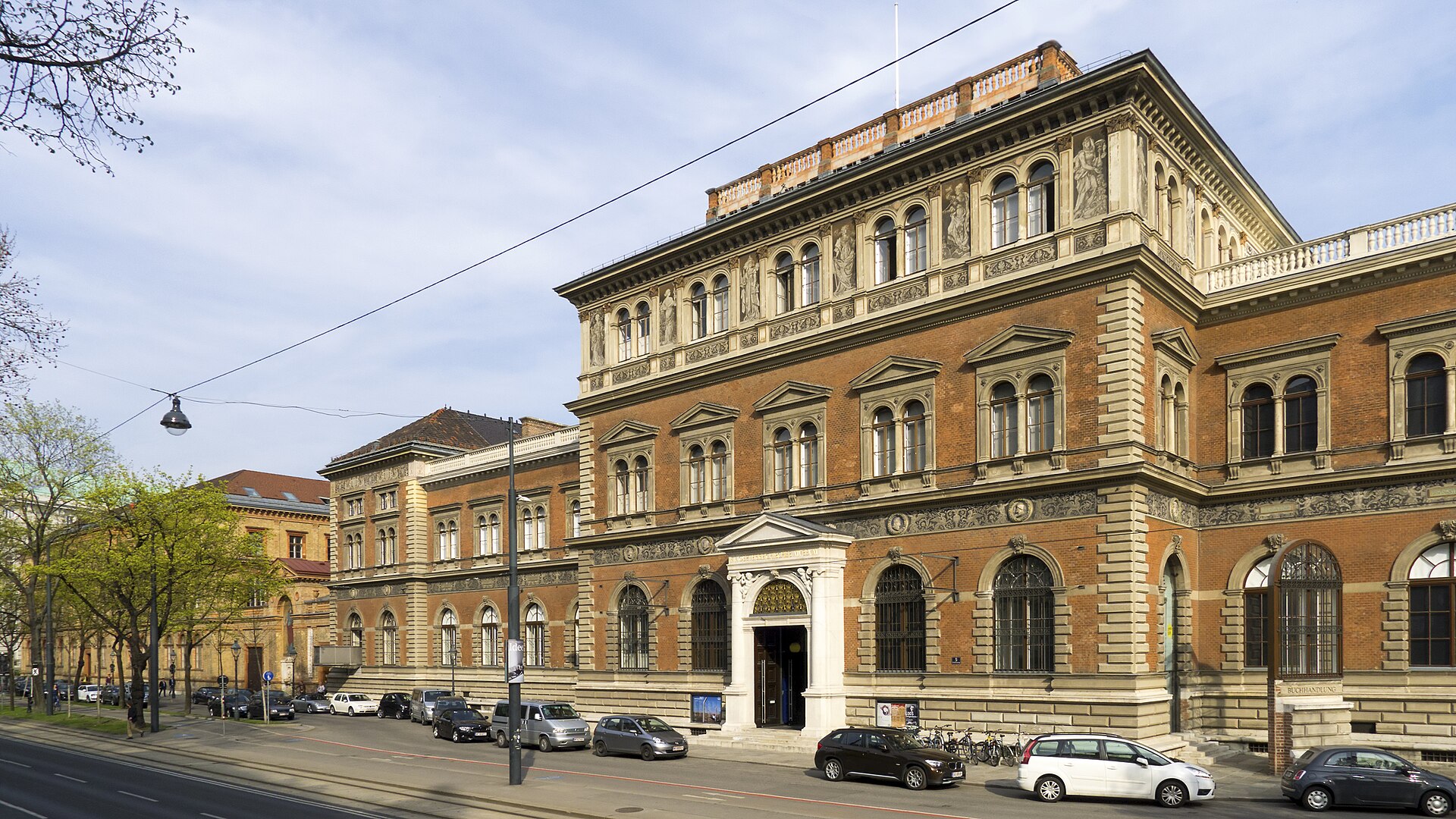
The MAK's Ringstrasse facade at Stubenring 5, designed by Heinrich von Ferstel and completed in 1871
Peter Gugerell (CC0)MAK - Museum of Applied Arts
Museum · MAK - Museum fuer angewandte Kunst · Founded 1863
Open, admission and hours confirmed 9 September 2026 · 15 sources
On this page 15 sections
ContentsClose
The MAK's comparative strength is applied art and design read as a continuous line rather than a series of period rooms: 18th-century Viennese porcelain and Venetian and Bohemian glass sit in the same institution as the Wiener Werkstaette's early 20th-century furniture and metalwork, Klimt's Stoclet Frieze cartoons, and a basement gallery that treats a 1926 fitted kitchen and a living fashion designer's own archive as belonging to the same design-history argument. That range, more than any single object, is what specialists cite when they distinguish MAK from a general fine-art museum with a decorative-arts department attached.
| Local name | MAK - Museum fuer angewandte Kunst |
|---|---|
| Kind | Museum |
| Founded | 1863 |
| City and country |  Vienna, Austria Vienna, Austria |
| Address | Stubenring 5, 1010 Wien, Austria |
| Website | mak.at/en |
| Status | Open, confirmed |
| Record last verified |
Visiting
- Hours
- Tuesday10:00 to 21:00extended evening opening
- Wednesday-Sunday10:00 to 18:00
- Closed
- Monday.
- Admission
- Adult, on-siteEUR 1918 EUR if booked online in advance
- Reduced, on-siteEUR 15.5014.50 EUR online; 15 EUR with certain partner discounts
- Tuesday evening 6-9pm, on-siteEUR 9.508.50 EUR online; applies only in the last three hours of the extended Tuesday opening
- Groups, 10+ personsEUR 15.50per person, on-site booking
- Under 19Freefree, all days
- MAK Annual TicketEUR 41standard annual pass; 31 EUR for ages 19-25
- Tickets
- mak.at/en/tickets The museum's own ticket page.
- Do I need to book?
- No, but online tickets are cheaper and recommended for the Tuesday evening slot
- Address
- Stubenring 5, 1010 Wien, Austria MapU-Bahn / Tram Stubentor stop: U3 and Tram line 2
U-Bahn / S-Bahn Landstrasse (Wien Mitte) stop: U3, U4, S1, S2, S3, S4, S7 and the City Airport Train - Website
- mak.at/en
- Telephone
- +43 1 71136-0
- [email protected]
Before you go how long, access, photography, bags, eating, shop
- How long to allow
- Two to three hours to see the Vienna 1900 and glass-and-ceramics wings properly; a full day for every permanent collection room plus a current exhibition
- Access
- All levels of the main building and the exhibition spaces are wheelchair-accessible by elevator; the ground-floor shop and the Salonplafond restaurant are step-free; companions of visitors with disabilities are admitted free
- Photography
- Private photography and filming without flash or tripod is permitted; commercial use requires prior permission and a fee
- Bags
- Cloakroom available; no animals are permitted inside the museum
- Eating
- Salonplafond, an independently run restaurant and cafe, occupies the ground floor
- Shop
- MAK Design Shop, on the ground floor, sells design objects and museum publications
Prices and hours change. We take them from the institution's own pages and print the day we read them, and you can check the current position at the source we used. Confirm before you travel.
What is inside
Vienna 1900 / Wiener Werkstaette
The museum's reinstalled centrepiece collection: Vienna Secession and Wiener Werkstaette furniture, metalwork, textiles and graphic design presented as everyday objects raised to art, alongside Gustav Klimt's nine surviving cartoons for the Stoclet Frieze
Asia
Chinese, Japanese and Korean holdings including Qing-dynasty temple paintings and porcelain from the Qianlong period (1736-1795), plus Japanese ukiyo-e woodcuts
Renaissance, Baroque, Rococo
Decorative arts of the 16th to 18th centuries: historical textiles, lace, and church and court commissions including ceremonial pieces from Zwettl Monastery
Historicism and Art Nouveau
Decorative arts from the late 19th and early 20th centuries, tracing the transition from historicist revival styles into Vienna's own Secessionist idiom
Empire Style and Biedermeier
Viennese furniture and table ornaments of the early 19th century, including centerpieces from around 1810 and the Sobek clock collection transferred from the Geymuellerschloessel branch
Textiles and Carpets
A dedicated presentation of the museum's carpet and textile holdings, one of the areas the institution has held since its founding purpose as a study collection for Vienna's applied-arts trades
MAK Design Lab
A basement gallery, redeveloped from the former study collection with the Austrian design studio EOOS, that sets historical applied arts against 21st-century design in themed islands - cooking (including a replica of Margarete Schuette-Lihotzky's Frankfurt Kitchen), sitting, production, transport and communication - and houses the Helmut Lang Archive of the fashion designer's own work
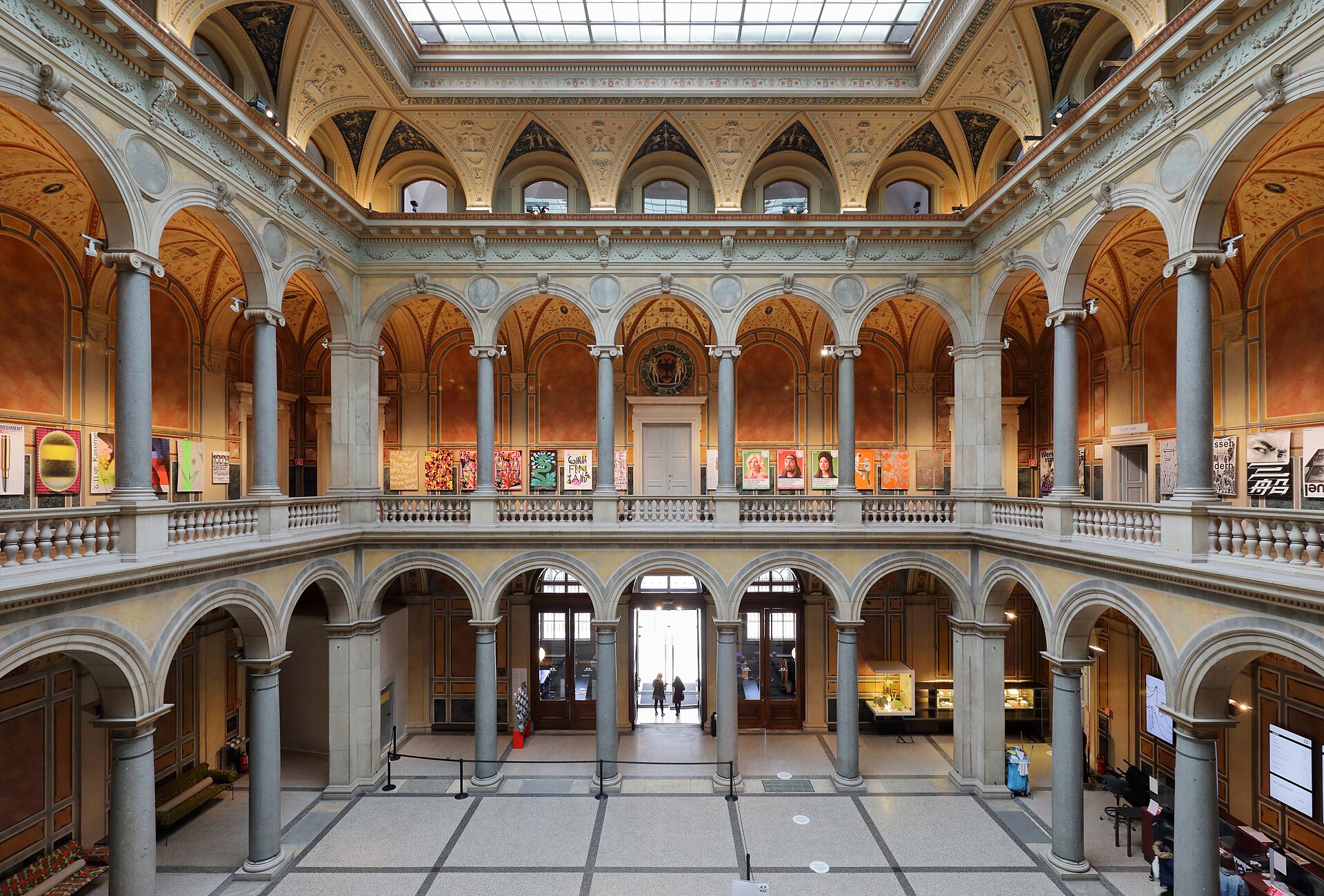
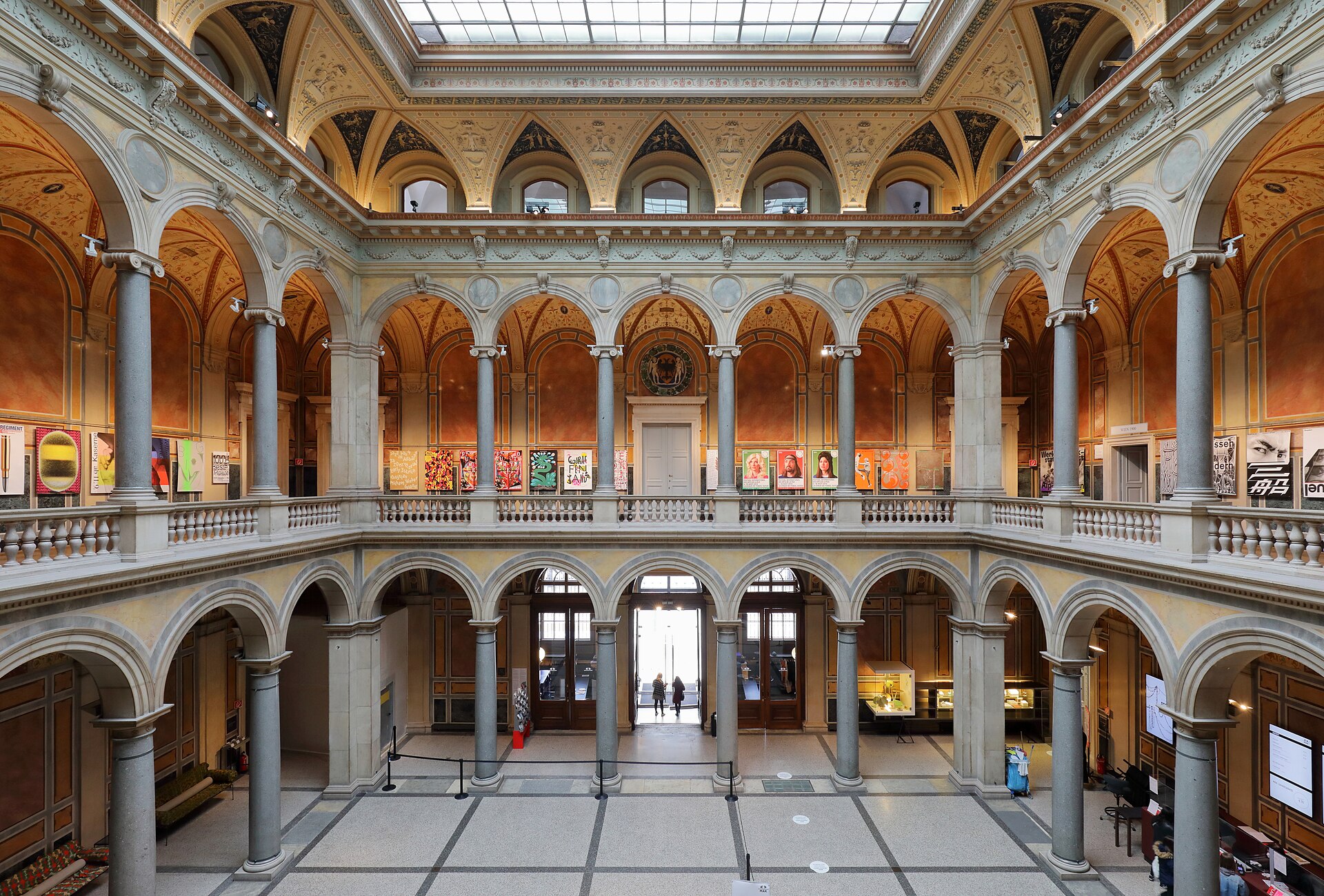
Photograph by Bwag · CC BY-SA 4.0 Column Hall (entrance atrium)
Heinrich von Ferstel's glass-roofed arcade courtyard on 32 stone columns, the ceremonial heart of the 1871 building and the space every visitor crosses before reaching the collection
What to see first
Nine Cartoons for the Stoclet Frieze
Gustav Klimt, 1910-1911Klimt's own full-scale working drawings, handwritten with instructions to the Wiener Werkstaette and Wiener Mosaikwerkstaette, for the mosaic frieze he designed for the dining room of the Stoclet House in Brussels; among his few monumental-scale works and, after years of conservation, the MAK's single most cited holding7
Porcelain Chamber from the Palais Dubsky, Brno
Du Paquier Porcelain Manufactory, Vienna, circa 1740More than 3,000 objects from the second-oldest porcelain manufactory in the West, installed as a complete period room; the manufactory's early Viennese wares are among the rarest survivals of 18th-century European porcelain6
Zwettl Centerpiece
Vienna Porcelain Manufactory, 1768A large ceremonial table centerpiece made for Zwettl Monastery, representative of the imperial porcelain manufactory at the height of its rococo output6
Four Goblets
Designed by Josef Hoffmann, made by J. and L. Lobmeyr, 1913Part of the museum's roughly 3,000-object Lobmeyr glass collection, and a direct record of the working relationship between Vienna's leading Wiener Werkstaette designer and its leading glassworks6
Flora
Vally Wieselthier, 1918A ceramic figure by one of the few women given individual standing in the Wiener Werkstaette's ceramics workshop, at a moment when most of that workshop's women artists went uncredited6
Large Reticello Glass Plate
Venice, 16th centuryAn outstanding survival of the reticello lattice-glass technique developed on Murano, held as one of the museum's reference pieces for Venetian glassmaking before Bohemian and Viennese workshops took up the same methods6
Frankfurt Kitchen replica
Margarete Schuette-Lihotzky, 1926 designA rebuilt example of the fitted, efficiency-planned kitchen Schuette-Lihotzky designed for Ernst May's New Frankfurt housing programme, treated by the MAK Design Lab as a founding object of modern functionalist design and of the politics of unpaid domestic labour9
Exhibitions on now
- On now7 Oct 2026 to 14 Mar 2027Confirmed , 5 weeks ago
- Opening soon16 Dec 2026 to 2 May 2027Confirmed , 5 weeks ago
Past exhibitions here
- Closed11 Feb to 4 Oct 2026Confirmed · check before you travel
- Closed10 Jun to 27 Sep 2026Confirmed · check before you travel
- Closed22 Apr to 20 Sep 2026Confirmed · check before you travel
The building and what it was built to hold
The MAK - the Museum fuer angewandte Kunst, or Museum of Applied Arts - was founded on 7 March 1863 by Rudolf von Eitelberger, Vienna's first professor of art history, on the model of London's newly opened South Kensington Museum (now the Victoria and Albert Museum). The idea, shared across several European capitals in the 1860s, was that industry and craft needed direct contact with historical design if they were to compete with British and French manufacturing, and that the way to provide it was a museum a working tradesman could actually walk into. The collection opened provisionally in 1864 in rooms of the old Ballhaus on Ballhausplatz, before Emperor Franz Joseph gave it a purpose-built home on the newly laid-out Ringstrasse.
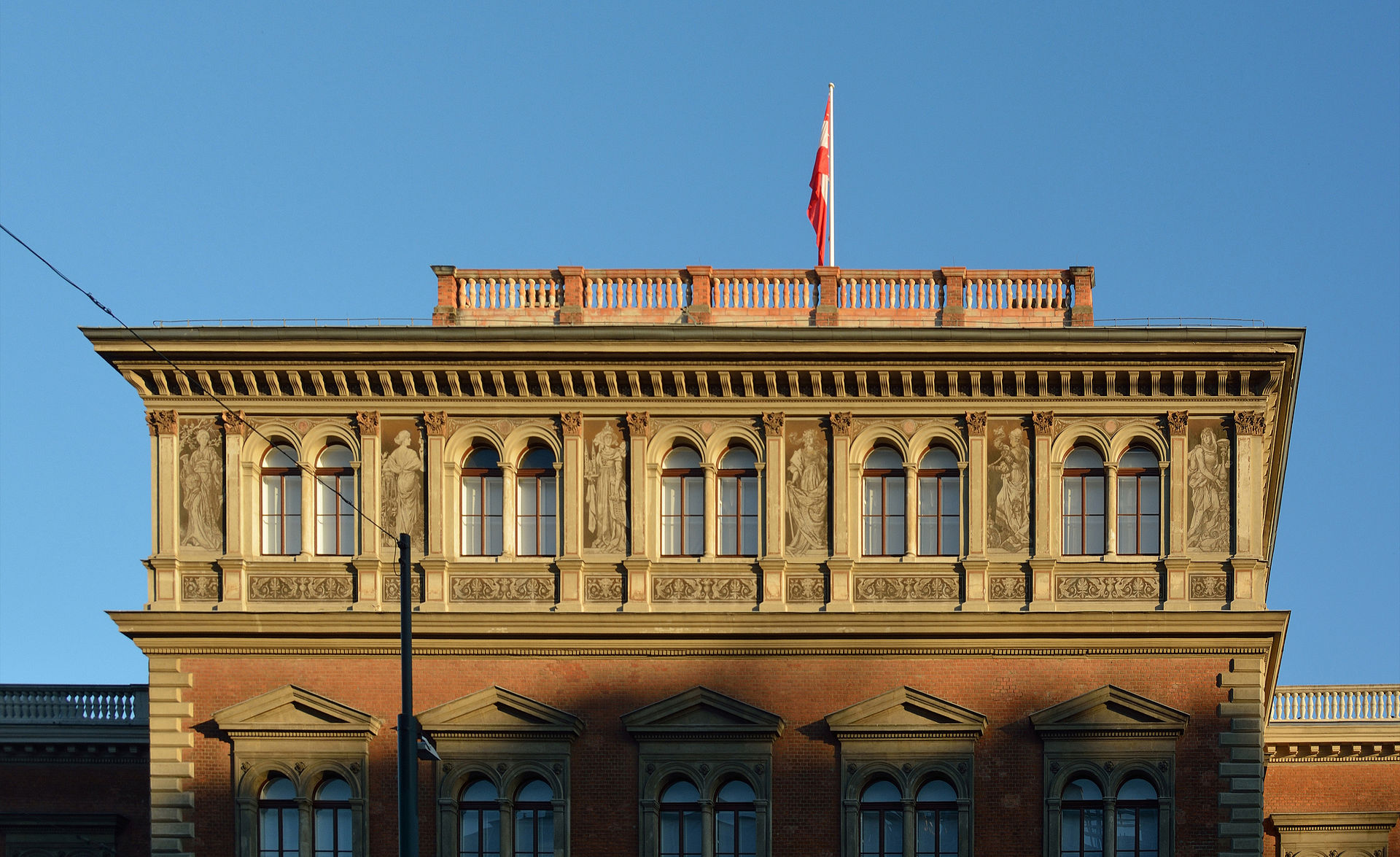
Heinrich von Ferstel, already at work on the Votivkirche, designed the new building in an Italian Early Renaissance style, faced in raw brick with terracotta and majolica ornament framing the entrance. It opened to the public on 15 November 1871, the first museum building to be completed on the Ring - earlier than the Naturhistorisches and Kunsthistorisches museums on Maria-Theresien-Platz. An attached School of Applied Arts followed at Stubenring 3 in 1877, training the same tradesmen the museum's collection was meant to instruct, and an extension on Weiskirchnerstrasse was added in 1906-1908. At the center of Ferstel's plan is a glass-roofed arcade courtyard on 32 stone columns, still the space every visitor crosses on the way into the galleries, and still commonly cited as the clearest surviving statement of what a Ringstrasse museum was supposed to look like from the inside.
What is inside
The permanent collection is arranged by material and period rather than by single-artist rooms, which is itself a small argument the museum makes about applied art: that a chair, a bolt of textile and a piece of porcelain belong in the same conversation as painting and sculpture. The Vienna 1900 rooms carry that argument furthest, gathering Wiener Werkstaette furniture, metalwork, textiles and graphic design as a coherent design movement rather than as decorative footnotes to Klimt and the Secession painters. The Asia collection holds Chinese, Japanese and Korean material including Qing-dynasty temple paintings and Qianlong-period porcelain; the Renaissance, Baroque and Rococo rooms hold historical textiles, lace and church and court commissions; the Empire and Biedermeier rooms hold early 19th-century Viennese furniture together with the Sobek clock collection, transferred from the museum's Geymuellerschloessel branch in the 18th district. A dedicated Textiles and Carpets presentation covers a holding that goes back to the museum's founding purpose as a study collection for Vienna's own textile trades.
In the basement, the MAK Design Lab breaks the historical sequence deliberately. Built with the Austrian design studio EOOS out of the museum's former study collection, it sets historic applied arts against 21st-century design across themed islands covering cooking, sitting, production, transport and communication - including a rebuilt example of Margarete Schuette-Lihotzky's 1926 Frankfurt Kitchen, treated here as a design-history landmark rather than a curiosity - and houses the Helmut Lang Archive, the fashion designer's own retained collection of his work. The arrangement makes an explicit case that applied art does not stop being made, and that a museum built in 1871 to train tradesmen in historical craft has an equally direct stake in the design decisions being made now.
Klimt's Stoclet Frieze and what the cartoons record
The nine cartoons Klimt made in 1910 and 1911 for the dining-room frieze of the Stoclet House in Brussels are the single most cited object in the MAK's collection. They are full-scale working drawings, not the mosaic itself - the frieze in Brussels was executed by the Wiener Werkstaette and the dedicated Wiener Mosaikwerkstaette in enamel, mother-of-pearl and gold leaf, following instructions Klimt wrote directly onto the drawings specifying which materials to use where. The design unfolds across three sections - Expectation, the Tree of Life and Fulfilment - and draws openly on Egyptian, Byzantine and Japanese sources the Stoclet family had themselves collected, which is part of why the museum treats the cartoons as the clearest surviving record of how Klimt actually worked at the largest scale he ever attempted. The cartoons went through an extended conservation programme before being reinstalled in the MAK's permanent Vienna 1900 rooms, and a dedicated exhibition in 2012 set them alongside material on Klimt's own engagement with Japanese painting.
A working collection, and a security failure it has not resolved
The MAK describes itself as having pursued a program of provenance research and restitution since 1998, addressing the period between 1939 and 1945 when Austrian museums, MAK included, took in confiscated private collections; this is the museum's own stated position rather than a claim this page has verified case by case, and it is recorded here as an open question the museum's own provenance department, not this archive, is positioned to answer in full.
More immediate is an episode from the current exhibition calendar. On the afternoon of Thursday 27 August 2026, during normal opening hours, two men who had bought ordinary admission tickets to GLANZSTUECKE - a jewellery exhibition pairing roughly 300 Van Cleef and Arpels pieces with masterworks from the MAK's own collection, running since June - used a hammer to shatter a display case and took a 200-carat platinum necklace set with 673 diamonds that had once belonged to Queen Nazli of Egypt, who wore it at her daughter's 1939 wedding to the future Shah of Iran. The pair fled on foot; Austrian police released security-camera images and pursued the theory, reported by the Kronen Zeitung, that it was a contract job for a criminal gang. No one was hurt, and there were witnesses in the room at the time. A guided tour scheduled for that Friday afternoon was cancelled and the exhibition was closed temporarily before reopening; it remains on show, MAK's own listing confirms, through 27 September 2026. The necklace itself, sold at Sotheby's in New York in 2015 for 4.3 million dollars, has not been recovered. The Guardian's report placed the theft inside a documented run of 2025-2026 European museum robberies - the Louvre's crown-jewel theft the previous October, a Bronze Age gold hoard taken from Spain's Museo de Villena, and a hammer-and-sledgehammer break-in at a museum in Messina, Sicily - that Europol has separately described as trending toward more frequent and more violent methods against under-secured display cases in institutions built, like the MAK itself, well before that threat existed.
Visiting today
The MAK stands at Stubenring 5 in Vienna's first district, reachable on foot from the Stubentor stop (U3 underground line and tram line 2) or from Landstrasse/Wien Mitte (U3, U4, five S-Bahn lines and the City Airport Train). It opens Tuesday to Sunday, with an extended Tuesday evening slot to 9pm at a reduced admission after 6pm, and is closed on Mondays. Standard adult admission is 19 euros on-site or 18 euros booked online in advance; visitors under 19 are admitted free on any day, and companions of visitors with disabilities are admitted free. All levels of the main building and the exhibition spaces are wheelchair-accessible by elevator, and the ground-floor shop and the independently run Salonplafond restaurant are step-free. Private photography without flash or tripod is permitted throughout the permanent collection. A visitor who wants the Vienna 1900 rooms and the glass-and-ceramics galleries properly, rather than as a walkthrough, should plan on two to three hours; seeing every permanent-collection room plus a current temporary exhibition is closer to a full day.
What visitors say
MAK is consistently framed, by its own programming and by outside coverage, as Vienna's design-forward counterpart to the city's fine-art museums: smaller and less visited than the Kunsthistorisches Museum nearby, but with a Wiener Werkstaette and Vienna 1900 collection that specialists treat as unmatched, and a track record of using its contemporary-art and digital programming as a working laboratory rather than a fixed period display. Coverage in the second half of 2026 has been dominated by a single, damaging security failure rather than by the collection.
What is praised, what is criticised
- Praised: The Vienna 1900 and Wiener Werkstaette holdings, anchored by Gustav Klimt's Stoclet Frieze cartoons, are repeatedly singled out as the collection's center of gravity and the reason specialists visit MAK specifically rather than treating it as an overflow from the Kunsthistorisches Museum
- Praised: The museum's willingness to experiment outside period applied arts - founding the Vienna Biennale in 2015 and becoming, the same year, the first museum in the world to buy a work of art using bitcoin - has been covered as evidence of an applied-arts institution acting as a testing ground for contemporary and digital art rather than a purely historical collection
- Criticised: Security at the GLANZSTUECKE jewellery exhibition failed on 28 August 2026: two men bought ordinary admission tickets, shattered a display case with a hammer in full view of other visitors during normal opening hours, and escaped with a 200-carat, 673-diamond platinum necklace once worn by Queen Nazli of Egypt. It has not been recovered, and the Guardian's report placed the theft inside a wider pattern the paper described, citing a Europol finding, as European museum robberies becoming more frequent and more violent
Questions about MAK - Museum of Applied Arts
Where is MAK - Museum of Applied Arts?
Stubenring 5, 1010 Wien, Austria.
How much does it cost to visit?
Adult, on-site: EUR 19; Reduced, on-site: EUR 15.5; Tuesday evening 6-9pm, on-site: EUR 9.5; Groups, 10+ persons: EUR 15.5; Under 19: free. As confirmed 9 September 2026.
When is it open?
Tuesday 10:00-21:00; Wednesday-Sunday 10:00-18:00. Closed: Monday. As confirmed 9 September 2026.
How do you get there?
U-Bahn / Tram: Stubentor stop: U3 and Tram line 2; U-Bahn / S-Bahn: Landstrasse (Wien Mitte) stop: U3, U4, S1, S2, S3, S4, S7 and the City Airport Train.
What should you see first?
Nine Cartoons for the Stoclet Frieze (Gustav Klimt, 1910-1911); Porcelain Chamber from the Palais Dubsky, Brno (Du Paquier Porcelain Manufactory, Vienna, circa 1740); Zwettl Centerpiece (Vienna Porcelain Manufactory, 1768); Four Goblets (Designed by Josef Hoffmann, made by J. and L. Lobmeyr, 1913); Flora (Vally Wieselthier, 1918); Large Reticello Glass Plate (Venice, 16th century).
What we could not confirm
- The museum states publicly that it has restituted works since 1998 arising from 1939-1945 confiscations, but this page has not verified that record case by case against a primary MAK restitution list; a dedicated audit of individual restitution cases would strengthen or qualify the general claim
- The Queen Nazli necklace stolen from the GLANZSTUECKE exhibition on 28 August 2026 had not been recovered and no suspect had been named as of the most recent reporting used for this page; the outcome of the Austrian police investigation is unresolved
- The MAK Tower, the museum's contemporary-art depot in a former Second World War flak tower at Arenbergpark, is currently closed to the public pending official approval and was not independently verified beyond the museum's own listing
Images
Sources
- 1MAK Museum Vienna, homepage mak.at/en
- 2MAK Museum Vienna, Visit (hours, admission, transport, accessibility, photography policy) mak.at/visit
- 3MAK Museum Vienna, Contact mak.at/en/contact_1
- 4MAK Museum Vienna, The MAK (history and mission) mak.at/en/museum/the_mak
- 5MAK Museum Vienna, Permanent Collection overview mak.at/en/exhibitions/permanent
- 6MAK Museum Vienna, Glass and Ceramics Collection mak.at/en/collection/collection/mak-sammlung_artikel?article_id=1730205242081
- 7MAK Museum Vienna, Gustav Klimt: Expectation and Fulfillment (Stoclet Frieze cartoons) mak.at/en/program/exhibitions/gustav_klimt_expectation_and_fulfillment
- 8MAK Museum Vienna, current exhibitions listing mak.at/en/exhibitions/current
- 9MAK Museum Vienna, MAK Design Lab mak.at/en/makdesignlab
- 10Wikipedia, Museum of Applied Arts, Vienna (, history and machine facts only) en.wikipedia.org/wiki/Museum_of_Applied_Arts,_Vienna
- 11The Guardian, Deborah Cole, "Egyptian queen's 673-diamond necklace stolen in Vienna smash-and-grab raid", 28 August 2026 theguardian.com/artanddesign/2026/aug/28/egyptian-queen-diamond-necklace-stolen-vienna-raid
- 12ARTnews, Hannah Ghorashi, "MAK Vienna Becomes First Museum to Use Bitcoin to Acquire Art", 24 April 2015 artnews.com/art-news/market/mak-vienna-becomes-first-museum-to-acquire-art-using-bitcoin-a-harm-van-den-dorpel-3995/
- 13Wikimedia Commons, Category:Osterreichisches Museum fur Angewandte Kunst commons.wikimedia.org/wiki/Category:%C3%96sterreichisches_Museum_f%C3%BCr_Angewandte_Kunst
- 14MAK Museum Vienna, Press mak.at/en/press
- 15MAK Museum Vienna, GLANZSTUECKE: Van Cleef and Arpels High Jewelry x Masterpieces from the MAK Collection mak.at/en/program/exhibitions/glanzstuecke