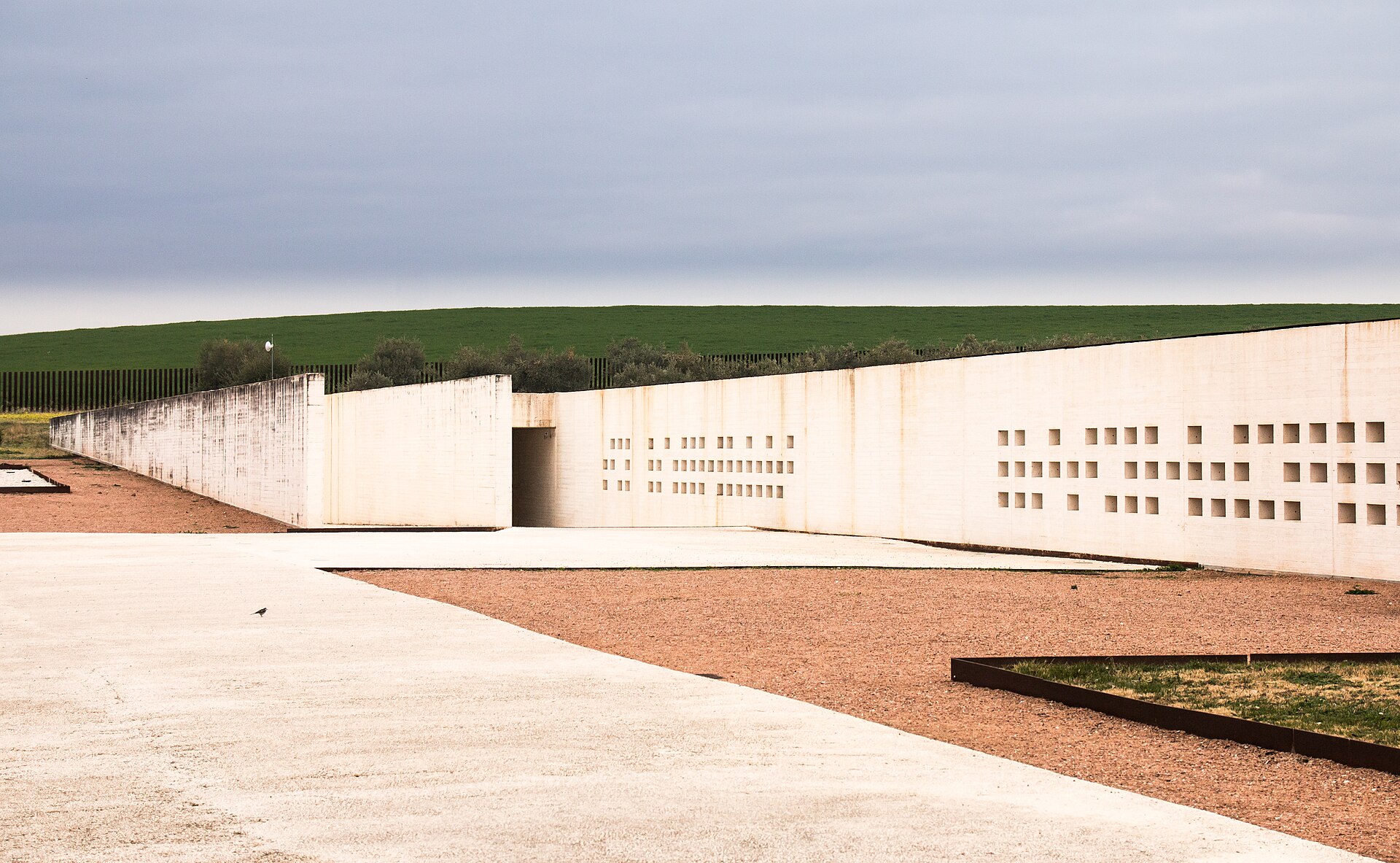
The museum building, designed by Nieto y Sobejano and set low into the landscape outside the walls of the ancient city
mandoft · Photograph by mandoft from El Campello (Alicante), Spain · CC BY-SA 2.0Madinat al-Zahra Museum
Museum · Conjunto Arqueologico de Madinat al-Zahra · Founded 2009
Open, admission and hours confirmed 28 September 2026 · 17 sources
On this page 15 sections
ContentsClose
The museum's holdings are narrow by design and strong within that range: worked white marble from a single mid-tenth-century court workshop tradition, much of it datable within a few years by an inscribed piece found in its original setting, plus the glazed ceramics and cut glass that document everyday life inside a palace otherwise known mainly through its architecture. The material is not a general survey collection; it is the excavated contents of one royal building programme, which is exactly what makes it useful for dating and comparing decorative work elsewhere in Umayyad Cordoba.
| Local name | Conjunto Arqueologico de Madinat al-Zahra |
|---|---|
| Kind | Museum |
| Founded | 2009 |
| City and country |  Cordoba, Spain Cordoba, Spain |
| Address | Carretera Palma del Rio Km 5,5, 14005 Cordoba, Spain |
| Website | museosdeandalucia.es/web/conjuntoarqueologicomadinatalzahra |
| Status | Open, confirmed |
| Record last verified |
Visiting
- Hours
- Tue-Thu, 21 Mar to 20 Jun09:00 to 18:00
- Fri-Sat, 21 Mar to 20 Jun09:00 to 21:00
- Tue-Sat, 21 Jun to 20 Sep09:00 to 14:00site reopens 19:00-24:00 for a night visit of the archaeological zone only; the museum building itself does not open at night
- Tue-Sat, 21 Sep to 20 Mar09:00 to 18:00
- Sun, public holidays, and the Monday immediately before a holiday, all seasons09:00 to 15:00
- Closed
- Monday (except a Monday that falls immediately before a public holiday).
- Admission
- European Union citizens (accredited)Freefree admission, every day, covering both museum and archaeological site
- Visitors from outside the EUEUR 1.50covers both museum and archaeological site
- Do I need to book?
- Not required for individuals or groups under 10; advance reservation is mandatory for groups of 10 or more. Individual visitors collect a ticket at the museum reception during opening hours
- Address
- Carretera Palma del Rio Km 5,5, 14005 Cordoba, Spain MapTourist bus from Cordoba Cordoba's Instituto Municipal de Turismo runs a bus to the site, twice a day Tuesday to Sunday (three times on some Saturdays depending on season), leaving from Paseo de la Victoria
Car Via the A-431 road, Km 5.5; the site is about 8 km from Cordoba, with parking at the museum
Shuttle bus, museum to ruins A dedicated shuttle connects the museum car park to the hilltop ruins continuously through opening hours, every 15-20 minutes; visitors cannot walk up or drive up. Fare EUR 3 return, EUR 1.50 reduced (ages 5-12 and over 65), free under 5 - Website
- museosdeandalucia.es/web/conjuntoarqueologicomadinatalzahra
- Telephone
- 600 14 30 71
- [email protected]
Before you go how long, access, photography, bags, eating, shop
- How long to allow
- About two and a half to three hours for the full visit, museum plus the archaeological site, linked by the shuttle bus
- Access
- Adapted toilets are provided at the museum reception. The institution has not published further detail on step-free access across the open-air site; several named areas of the archaeological zone are currently closed to all visitors for conservation work, not specifically for accessibility reasons
- Photography
- Not stated on the museum's own visitor pages
- Bags
- Not stated on the museum's own visitor pages
- Eating
- The museum's cafeteria-restaurant is listed by the institution as temporarily closed (cerrada temporalmente); no reopening date is published
- Shop
- A shop sells books, ceramic reproductions, jewellery, stationery and other souvenirs
Prices and hours change. We take them from the institution's own pages and print the day we read them, and you can check the current position at the source we used. Confirm before you travel.
What is inside
Auditorio (Auditorium)
Screens the introductory audiovisual 'Madinat al-Zahra: la ciudad brillante' (Madinat al-Zahra: the shining city), about 15 minutes, and hosts courses and educational events; the institution recommends seeing it before walking the site
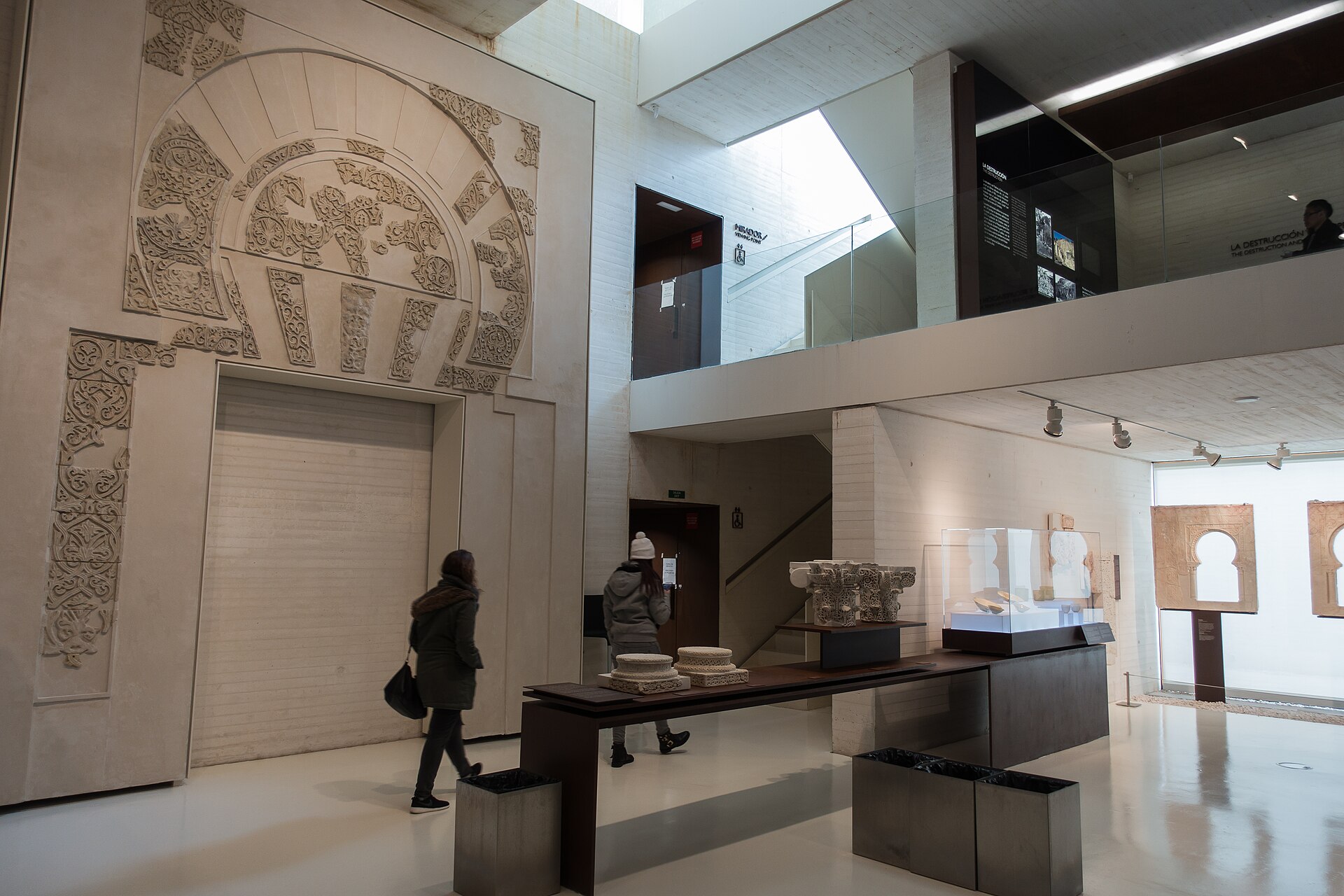
Photograph by ElBute · CC BY-SA 4.0 Sala de Exposicion Permanente (Permanent Exhibition Hall)
The core display, arranged in four linked sections: the founding of the city and its context, the construction of Madinat al-Zahra, the city and its inhabitants, and its destruction and recovery. Shows original carved marble, ceramics and glass alongside interactive and audiovisual material
Almacenes visibles (Visible open storage)
Open storage of architectural fragments and carved stucco (ataurique) recovered from the site, kept viewable rather than held back-of-house
Biblioteca especializada Manuel Ocana
A specialised research library built around several thousand volumes on the Islamic world in general and on al-Andalus and Madinat al-Zahra in particular, open to the public as a reading and research space
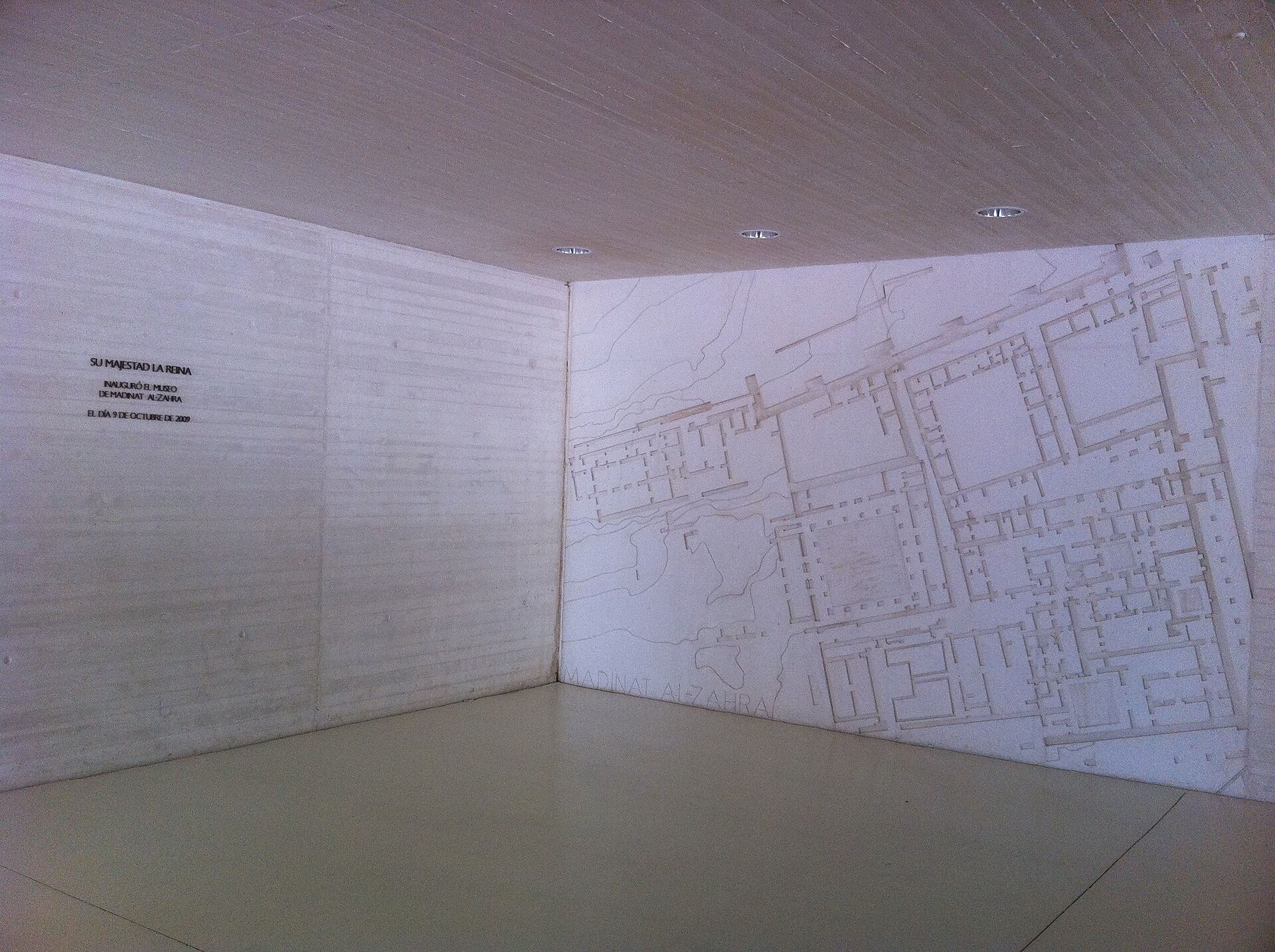
Photograph by fraboof · CC BY-SA 2.0 Vestibulo de entrada (Entrance hall)
The entrance carries a large engraved plan of the palace-city on one wall and a plaque recording that Queen Sofia of Spain inaugurated the museum on 9 October 2009
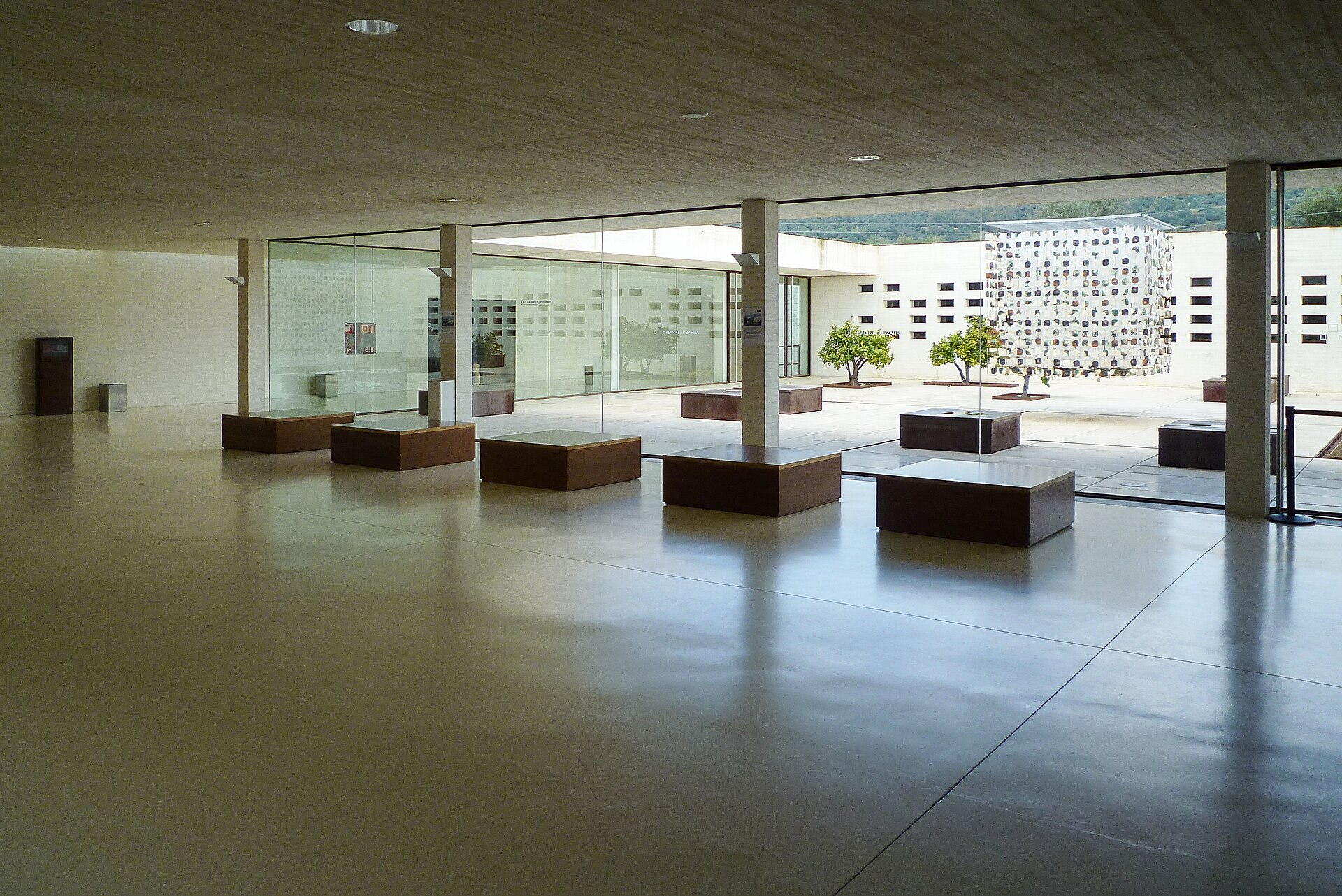
Photograph by ElBute · CC BY-SA 4.0 Patio interior (Interior courtyard)
A courtyard visible from the entrance vestibule, part of the building's sequence of concrete-and-glass volumes opening onto the surrounding landscape
What to see first
Capitel (Capital)
Caliphal court workshop, Madinat al-ZahraMarble capital carved with a drill (trepano), mid-10th century, recovered from the platform south of the Dar al-Mulk (Royal House); representative of the standardised, high-precision decorative vocabulary produced for the palace4
Tablero decorativo (Decorative panel)
Caliphal court workshop, Madinat al-ZahraWhite marble panel carved in low relief, mid-10th century, from the rooms adjoining the Salon de Abd al-Rahman III; part of the decorative scheme of the palace's principal reception hall4
Dintel (Lintel)
Caliphal court workshop, Madinat al-ZahraBevel-carved white marble lintel, mid-10th century, also from the rooms adjoining the Salon de Abd al-Rahman III4
Basa epigrafiada (Inscribed base)
Caliphal court workshop, Madinat al-ZahraMarble base carved with bevel and drill work and an inscription dating it precisely to 953-4; found in the Salon de Abd al-Rahman III in its original location, giving the palace's decorative programme a fixed date4
Lucernario (Skylight/roof lamp)
Caliphal court workshop, Madinat al-ZahraCarved and polished white marble piece, mid-10th century, from the bath attached to the rooms beside the Salon de Abd al-Rahman III4
Jarra (Jar)
Caliphal-period potter, workshop unidentifiedWheel-thrown ceramic jar, mid-10th century, glazed honey-green inside and tin-white outside with green-and-manganese decoration; found within the palace though its precise findspot is unrecorded4
Vaso (Cut-glass vessel)
Caliphal-period glassworker, workshop unidentifiedCut glass vessel, 10th century, recovered from Madinat al-Zahra's own sanitation network together with other glass objects, unusually direct evidence of everyday material culture inside the palace4
Recipiente zoomorfo (Zoomorphic vessel)
Caliphal-period potter, workshop unidentifiedWheel-thrown ceramic vessel in animal form, mid-10th century, white-glazed with green-and-manganese decoration; its findspot within the site is unknown4
A new capital built to declare a caliphate
Madinat al-Zahra was built from the ground up as the seat of a newly declared state. In 929 Abd al-Rahman III, emir of Cordoba, took the title of caliph, breaking with the Abbasid caliphate in Baghdad and asserting an independent western caliphate centred on al-Andalus. Construction of the new capital began soon after, in 936 or 940 depending on the source; the Conjunto Arqueologico's own visitor material gives both years without resolving the discrepancy.
Built roughly eight kilometres from Cordoba on the lower slopes of the Sierra Morena, the city covered some 112 hectares and combined a royal residence, the seat of the caliphal administration, and housing for the state's most senior officials, all of it transferred out of Cordoba itself. During the reigns of Abd al-Rahman III and his son al-Hakam II, Madinat al-Zahra functioned as the effective capital of al-Andalus, receiving embassies from across the Mediterranean and from what is now central Europe. Popular tradition holds that the name, meaning roughly 'the shining city,' recalled a favourite of the caliph, though the Conjunto's own material presents this as legend rather than established fact.
Civil war, abandonment, and six centuries as a quarry
The city's political life was short. Between 1010 and 1013, during the civil war (fitna) that broke the Umayyad caliphate of Cordoba apart, Madinat al-Zahra was abandoned and sacked. What had briefly been the seat of an empire spent the following centuries as an open quarry: cut stone, carved marble and reusable architectural elements were carted off for buildings elsewhere in the region, a process that continued for hundreds of years and explains why so much of what survives is fragmentary or was recovered out of its original context.
UNESCO's own listing for the site credits this same isolation with an unintended benefit: because the ruins were effectively forgotten rather than built over or redeveloped, the surviving urban plan was never overwritten by a later town, and the site could later be read, once rediscovered, as a largely complete and legible whole rather than a handful of isolated remains beneath a modern city.
Rediscovery: 1911 to the transfer to Andalusia
Formal excavation began only in 1911, late compared with other major sites in Spain, and the work continued through the twentieth century with interruptions during the Civil War and again during the early process of regional devolution. The bulk of the twentieth-century campaign, and particularly the excavation of the central alcazar (the palace-fortress core, some 10.5 hectares), was carried out under the architect Felix Hernandez, whose team also defined the basic layout of the palace's urban plan and undertook major restoration work, including on the Salon de Abd al-Rahman III.
In 1985 responsibility for the site passed to the regional government of Andalusia, which created the Conjunto Arqueologico as the institutional and legal framework for its protection, along with new instruments for its management and conservation. A large body of material recovered from the site is held not on-site but at the Museo Arqueologico y Etnologico de Cordoba. The site's significance was given international recognition on 1 July 2018, when UNESCO inscribed it as a World Heritage Site under the name Caliphate City of Medina Azahara, citing both its testimony to Umayyad state-building and its urban planning, engineering and decorative programme as an outstanding example of the western Islamic civilisation of al-Andalus at its height.
A museum built to step aside for the ruins
The Museo de Madinat al-Zahra, the building most visitors reach first, opened to the public on 9 October 2009, inaugurated by Queen Sofia of Spain, a fact recorded on a plaque in the entrance hall beside an engraved plan of the palace-city. Its creation addressed a problem that had been building since excavation began in 1911: the original support building for the dig had become inadequate for the volume of material being recovered and had little real space to exhibit it.
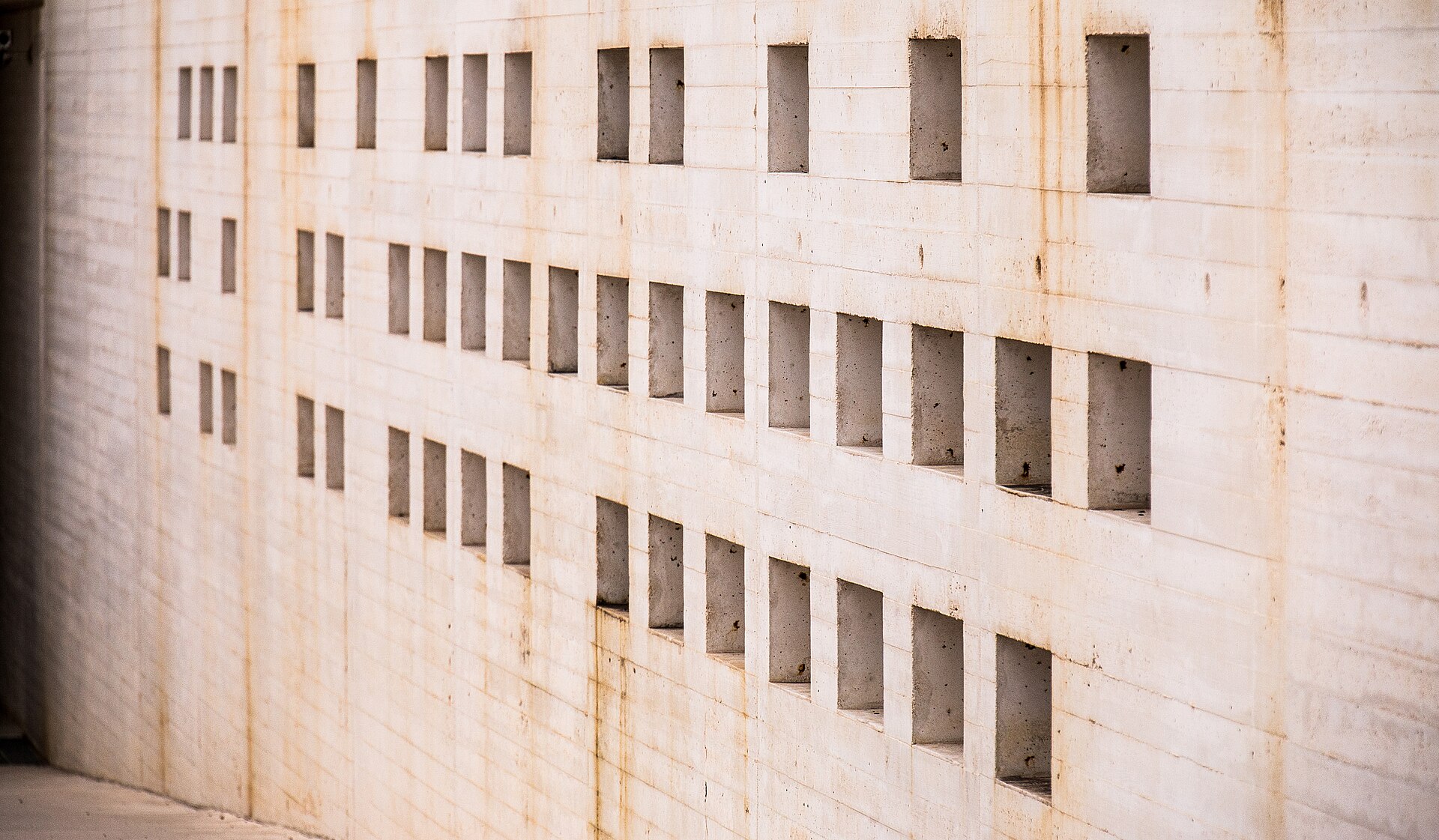
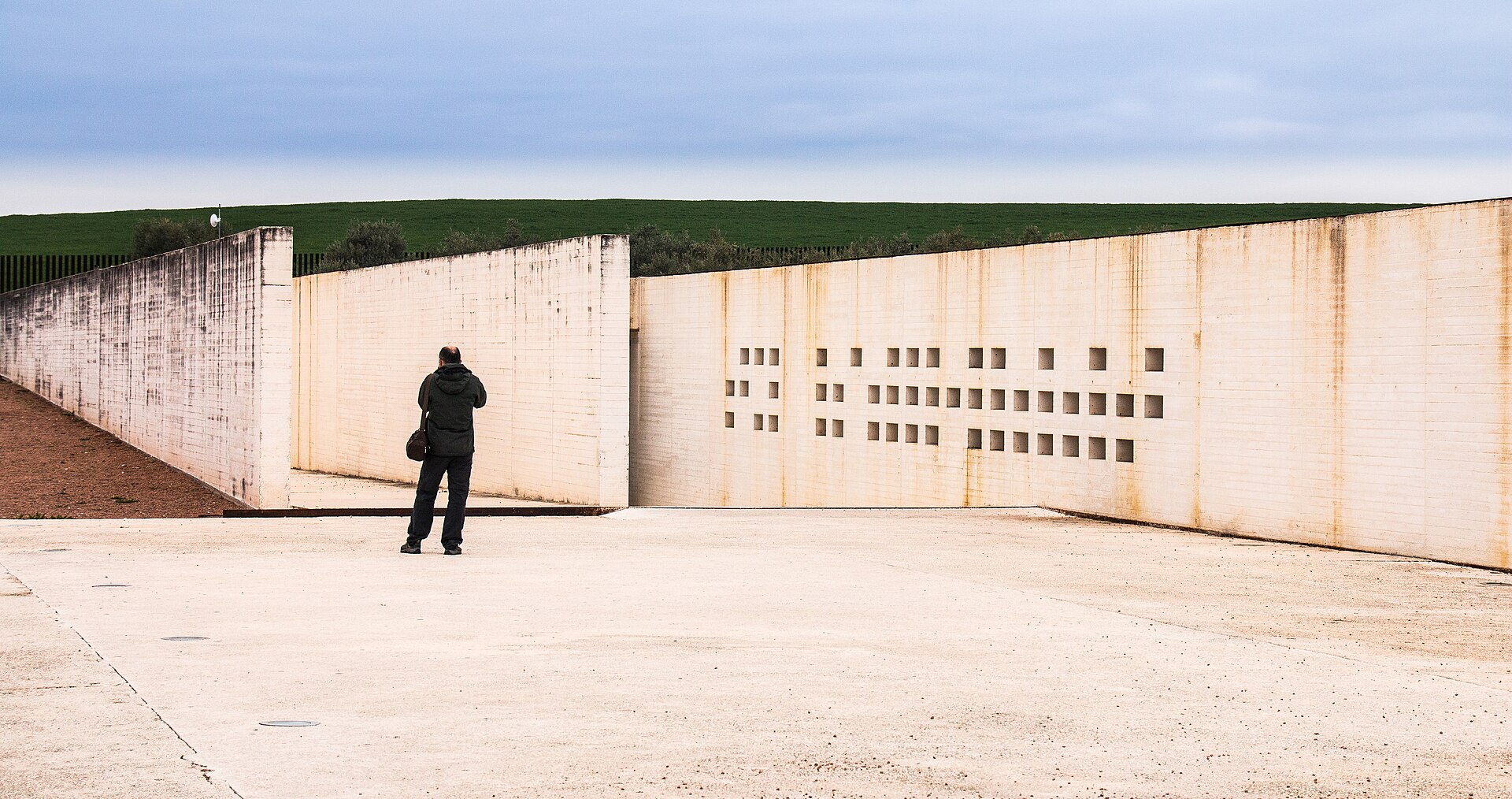
Designed by the Madrid-based architecture practice Nieto y Sobejano, the museum was deliberately sited outside the boundaries of the ancient city itself, using one of its original access routes, so that it would not constrain future excavation or the site's own growth. The building is conceived as an installation partly hidden within the terrain: a long, low concrete volume, its principal facade marked by a grid of small rectangular window openings, designed to compete as little as possible with the landscape or with the ruins it exists to introduce. The design was recognised with the European Museum of the Year Award in 2012.
What the galleries and the visible stores hold
The museum's permanent exhibition is organised into four linked sections: the founding of the city and its historical context; the construction of Madinat al-Zahra; the city and its inhabitants; and the destruction and eventual recovery of the site. Original pieces are shown alongside interactive and audiovisual material intended to help visitors read a site that is, on the ground, largely a field of dismantled and partly reassembled architecture.
The collection's core strength is worked white marble from the mid-tenth century: capitals, decorative panels, lintels and an inscribed base dated by its own inscription to 953-4, most of it recovered from the rooms and platforms around the Salon de Abd al-Rahman III and the residential quarter attached to it. Alongside the marble, the museum holds glazed ceramics decorated in the green-and-manganese palette associated with the caliphal court workshops, and cut glass recovered, in one case, from the city's own sanitation network. The museum also keeps visible open stores of architectural fragments and carved stucco (ataurique) that would elsewhere be held back-of-house, and a specialised library, the Biblioteca Manuel Ocana, built around several thousand volumes on the Islamic world and on al-Andalus specifically.
The route through the palace: from the north gate to the private quarters
The Conjunto Arqueologico's own itinerary follows a single protocol route through the official and residential zones of the alcazar (the palace-fortress core), and it is worth setting out because it explains why the ruins read as a sequence rather than a scatter. Visitors enter the walled area through the Puerta Norte, a bent gate in the north wall, from where one of the original roads to Cordoba departed. Immediately inside lies the Edificio Basilical Superior, a plain basilical hall of five parallel naves that the institution identifies, tentatively, with the Dar al-Yund (the House of the Army), one of the senior organs of the caliphal state; its original baked-clay floor survives largely intact.
From there a two-stage ramped street, lined with benches painted with red-ochre geometric and vegetal motifs, leads to the Gran Portico, a monumental fourteen-arch arcade that served as the ceremonial entrance to the palace's official quarter and closes one side of a plaza roughly 115 by 150 metres. Below this terrace, visible from the path but not open to visitors, stands the Mezquita Aljama, the city's principal mosque, correctly oriented toward Mecca, where the caliph attended Friday prayers. The official route culminates at the Salon de Abd al-Rahman III, the palace's grand reception hall, set within a sunken cruciform garden that originally held a pavilion and four pools; the hall is currently closed for restoration.
The private, residential half of the alcazar is reached past the Caballerizas, stables that could hold around 25 to 30 horses, through the Casa de Yafar, a senior official's residence, and past the Viviendas de Servicio, service housing with its own bread oven. Two of the largest residential complexes on this side, the Vivienda de la Alberca and the Patio de los Pilares, are both currently under consolidation and closed to the public; a third, the Casa Real (Dar al-Mulk), understood as the caliph's own private residence, sits at the highest point of the alcazar and is presently inaccessible for conservation reasons, outside the standard visit route entirely.
Visiting today: the shuttle, the closures, and what a ticket covers
A visit begins at the museum, where tickets for both the museum and the archaeological site are issued at reception and the audiovisual 'Madinat al-Zahra: la ciudad brillante' is shown in the auditorium, a roughly fifteen-minute introduction the institution recommends seeing before walking the ruins. From the museum car park a shuttle bus runs continuously through opening hours, at intervals of fifteen to twenty minutes, up to the hilltop site and back; visitors cannot reach the ruins on foot or by private car. The full visit, museum and site together, takes around two and a half to three hours.
Not everything described in the site's own visitor literature is currently open to the public. The Patio de los Pilares and the Vivienda de la Alberca are both described by the Conjunto Arqueologico's own visit-planning page as being in the process of consolidation and not open to visitors; the Casa Real (Dar al-Mulk) is listed as currently inaccessible for conservation reasons; and the Salon de Abd al-Rahman III, the single most important interior on the site, is currently closed for restoration work. The museum's own cafeteria-restaurant is listed on the institution's services page as temporarily closed, with no reopening date published. A reader planning a visit around any one of these spaces should check the Conjunto's own site immediately before travelling.
What visitors say
Visitors consistently rate the combined museum-and-site visit highly and treat the introductory film and permanent exhibition as the right way to make sense of a ruin that is, in large part, a field of dismantled and reassembled stone. The most repeated practical notes are that several of the palace's best-known interiors are currently closed for conservation, and that a guide, or at least the museum's own audiovisual, is worth having before setting out, because the fragments on the ground do not explain themselves.
What is praised, what is criticised
- Praised: the free or near-free admission and the well-organised shuttle bus linking the museum to the hilltop ruins
- Praised: the introductory audiovisual and permanent exhibition, credited with making sense of a heavily fragmented site before visitors walk it
- Praised: the scale and historical importance of the remains, reinforced for visitors by the 2018 UNESCO listing
- Praised: guided tours, repeatedly recommended by visitors who found the unguided ruins hard to read on their own
- Criticised: several of the most-discussed spaces, including the Patio de los Pilares, the Vivienda de la Alberca and the Salon de Abd al-Rahman III, are currently closed to visitors for conservation work, which changes what a ticket actually delivers on the day
- Criticised: without a guide, some visitors say they struggled to work out what they were looking at across the open, heavily reconstructed terrain
Ratings on other platforms
TripAdvisor: 4.3 from 2,943 ratings, read 28 September 2026
A platform average is a tertiary source: it moves, it is not audited, and we quote no visitor's words.
Questions about Madinat al-Zahra Museum
Where is Madinat al-Zahra Museum?
Carretera Palma del Rio Km 5,5, 14005 Cordoba, Spain.
How much does it cost to visit?
European Union citizens (accredited): free; Visitors from outside the EU: EUR 1.5. As confirmed 28 September 2026.
When is it open?
Tue-Thu, 21 Mar to 20 Jun 09:00-18:00; Fri-Sat, 21 Mar to 20 Jun 09:00-21:00; Tue-Sat, 21 Jun to 20 Sep 09:00-14:00; Tue-Sat, 21 Sep to 20 Mar 09:00-18:00; Sun, public holidays, and the Monday immediately before a holiday, all seasons 09:00-15:00. Closed: Monday (except a Monday that falls immediately before a public holiday). As confirmed 28 September 2026.
How do you get there?
Tourist bus from Cordoba: Cordoba's Instituto Municipal de Turismo runs a bus to the site, twice a day Tuesday to Sunday (three times on some Saturdays depending on season), leaving from Paseo de la Victoria; Car: Via the A-431 road, Km 5.5; the site is about 8 km from Cordoba, with parking at the museum; Shuttle bus, museum to ruins: A dedicated shuttle connects the museum car park to the hilltop ruins continuously through opening hours, every 15-20 minutes; visitors cannot walk up or drive up. Fare EUR 3 return, EUR 1.50 reduced (ages 5-12 and over 65), free under 5.
What should you see first?
Capitel (Capital) (Caliphal court workshop, Madinat al-Zahra); Tablero decorativo (Decorative panel) (Caliphal court workshop, Madinat al-Zahra); Dintel (Lintel) (Caliphal court workshop, Madinat al-Zahra); Basa epigrafiada (Inscribed base) (Caliphal court workshop, Madinat al-Zahra); Lucernario (Skylight/roof lamp) (Caliphal court workshop, Madinat al-Zahra); Jarra (Jar) (Caliphal-period potter, workshop unidentified).
What we could not confirm
- The museum's own material gives two different founding years for the city, 936 and 940, without resolving which is correct
- No reopening date has been published for the Salon de Abd al-Rahman III, closed for restoration, or for the Patio de los Pilares and the Vivienda de la Alberca, both described as under consolidation and closed to visitors
- The museum's cafeteria-restaurant is listed as temporarily closed with no reopening date given
- The Casa Real (Dar al-Mulk), identified as the likely private residence of Abd al-Rahman III, is currently inaccessible to visitors for conservation reasons and lies outside the standard visit route
Images
Sources
- 1Conjunto Arqueologico Madinat al-Zahra, official site, Informacion general (hours, admission, contact, shuttle fares) museosdeandalucia.es/web/conjuntoarqueologicomadinatalzahra/informacion-general
- 2Conjunto Arqueologico Madinat al-Zahra, official site, Historia Investigaciones museosdeandalucia.es/web/conjuntoarqueologicomadinatalzahra/historia
- 3Conjunto Arqueologico Madinat al-Zahra, official site, Presentacion Conjunto (founding, political history) museosdeandalucia.es/web/conjuntoarqueologicomadinatalzahra/las-colecciones
- 4Conjunto Arqueologico Madinat al-Zahra, official site, Elementos muebles (collection highlights) museosdeandalucia.es/web/conjuntoarqueologicomadinatalzahra/elementos-muebles
- 5Conjunto Arqueologico Madinat al-Zahra, official site, Espacios singulares (named architectural spaces of the site) museosdeandalucia.es/web/conjuntoarqueologicomadinatalzahra/espacios-singulares
- 6Conjunto Arqueologico Madinat al-Zahra, official site, Propuestas de recorrido (visit itinerary, current closures) museosdeandalucia.es/web/conjuntoarqueologicomadinatalzahra/propuestas-de-recorrido
- 7Conjunto Arqueologico Madinat al-Zahra, official site, Servicios e instalaciones (museum building, opening 2009, architects, services) museosdeandalucia.es/web/conjuntoarqueologicomadinatalzahra/servicios-e-instalaciones
- 8Conjunto Arqueologico Madinat al-Zahra, official site, Acceso (transport, shuttle bus, visit duration) museosdeandalucia.es/web/conjuntoarqueologicomadinatalzahra/acceso
- 9UNESCO World Heritage Centre, Caliphate City of Medina Azahara, official listing description whc.unesco.org/en/list/1560/
- 10Wikidata, Q211252 (identity, coordinates), wikidata.org/wiki/Q211252
- 11TripAdvisor, Medina Azahara attraction page, aggregate rating and visitor comments, , read 2026-09-28 tripadvisor.com/Attraction_Review-g187430-d14768516-Reviews-Medina_Azahara-Cordoba_Province_of_Cordoba_Andalucia.html
- 12Wikimedia Commons, File:Museo Medina Azahara (26309131778).jpg, photograph by mandoft, CC BY-SA 2.0 commons.wikimedia.org/wiki/File:Museo_Medina_Azahara_(26309131778).jpg
- 13Wikimedia Commons, File:Museo de Medina Azahara (39283697065).jpg, photograph by mandoft, CC BY-SA 2.0 commons.wikimedia.org/wiki/File:Museo_de_Medina_Azahara_(39283697065).jpg
- 14Wikimedia Commons, File:Museo de Medina Azahara (40182199271).jpg, photograph by mandoft, CC BY-SA 2.0 commons.wikimedia.org/wiki/File:Museo_de_Medina_Azahara_(40182199271).jpg
- 15Wikimedia Commons, File:Centro de interpretacion de Madinat Al-Zahra (Cordoba, Espana).jpg, photograph by fraboof, CC BY-SA 2.0 commons.wikimedia.org/wiki/File:Centro_de_interpretaci%C3%B3n_de_Madinat_Al-Zahra_(C%C3%B3rdoba,_Espa%C3%B1a).jpg
- 16Wikimedia Commons, File:Madinat Al-Zahra Museum 1.jpg, photograph by Edmundo Saez (ElBute), CC BY-SA 4.0 commons.wikimedia.org/wiki/File:Madinat_Al-Zahra_Museum_1.jpg
- 17Wikimedia Commons, File:Madinat Al-Zahra Museum 4.jpg, photograph by Edmundo Saez (ElBute), CC BY-SA 4.0 commons.wikimedia.org/wiki/File:Madinat_Al-Zahra_Museum_4.jpg
.jpg)
.jpg)
.jpg)
.jpg)

