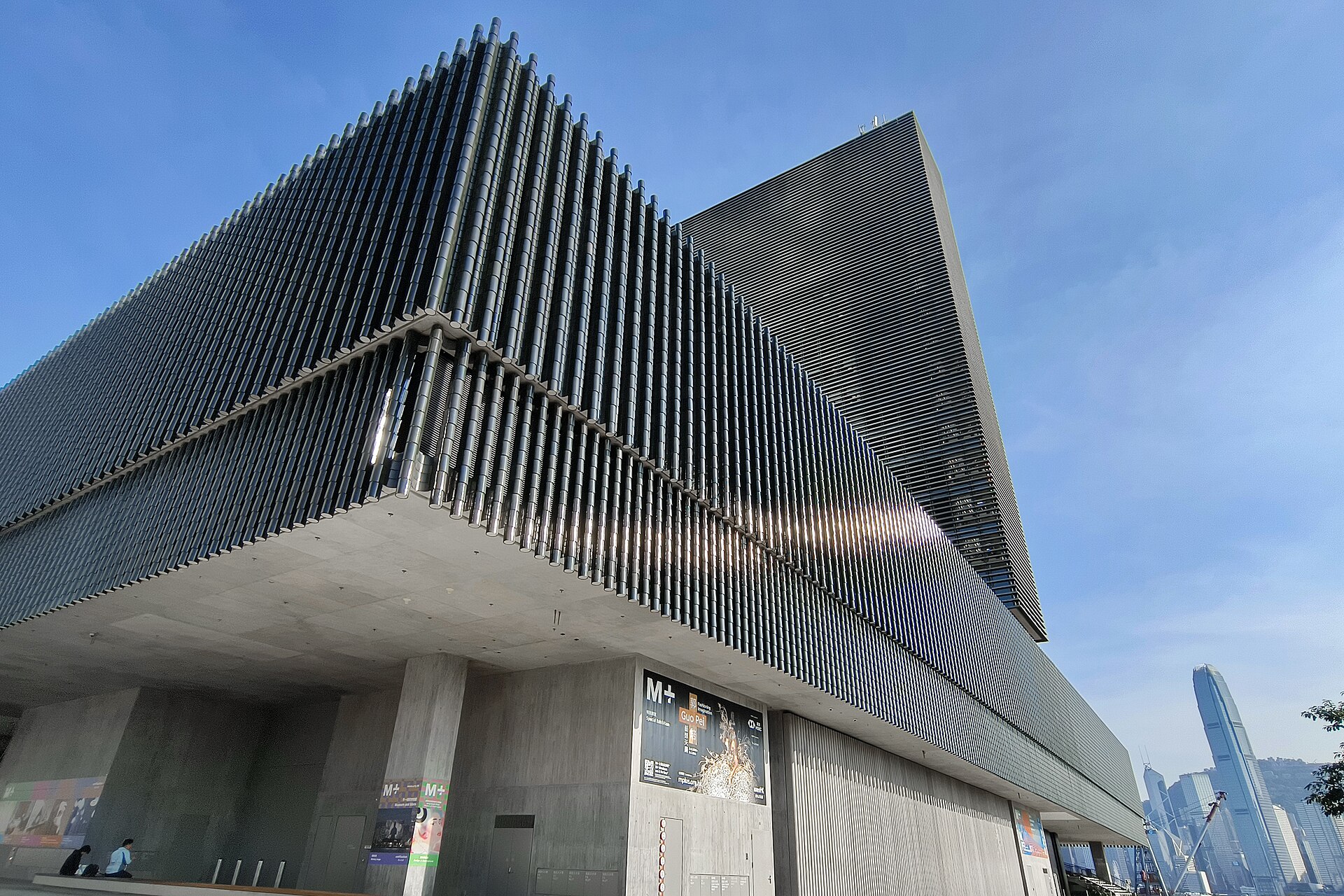
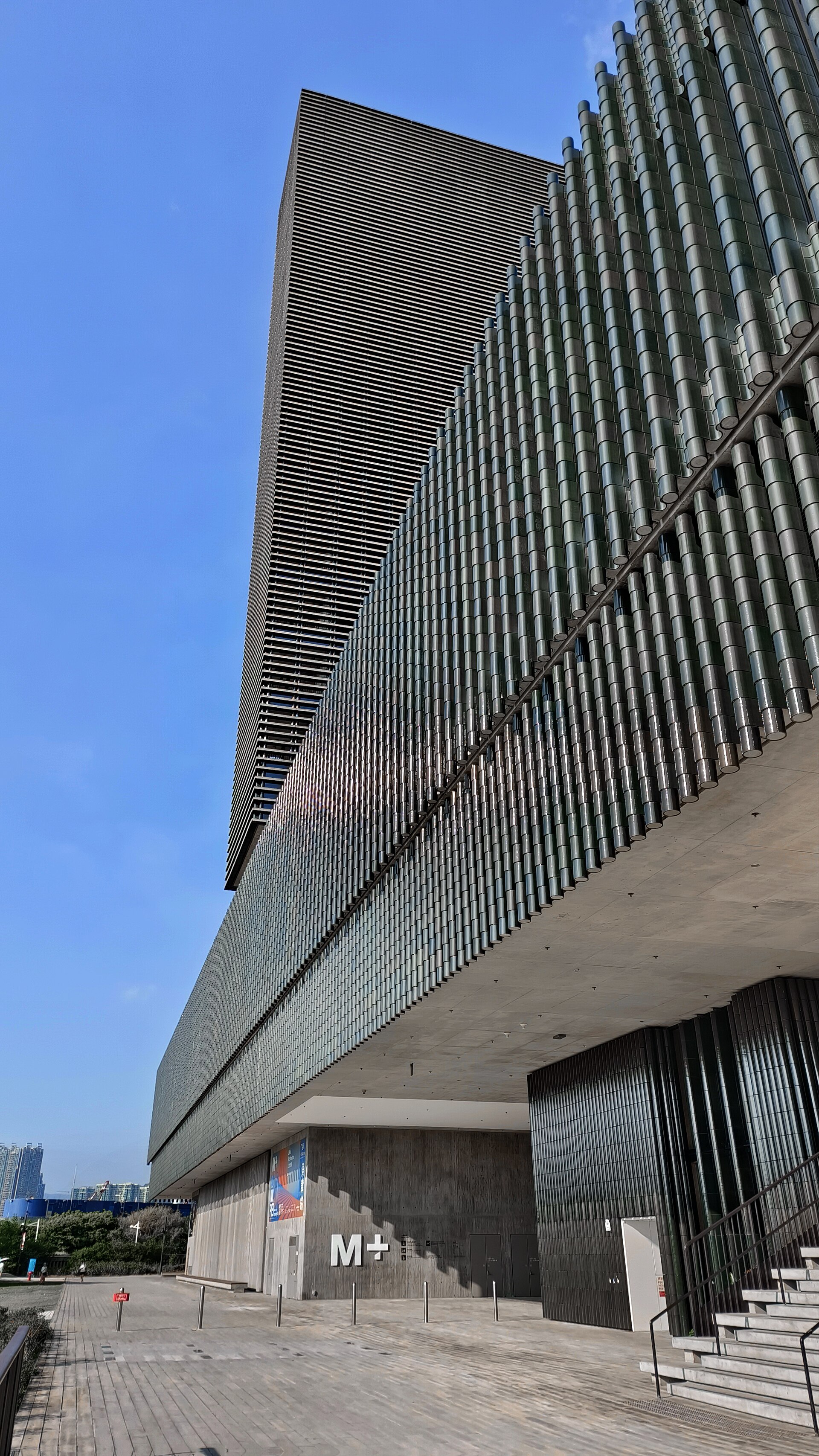
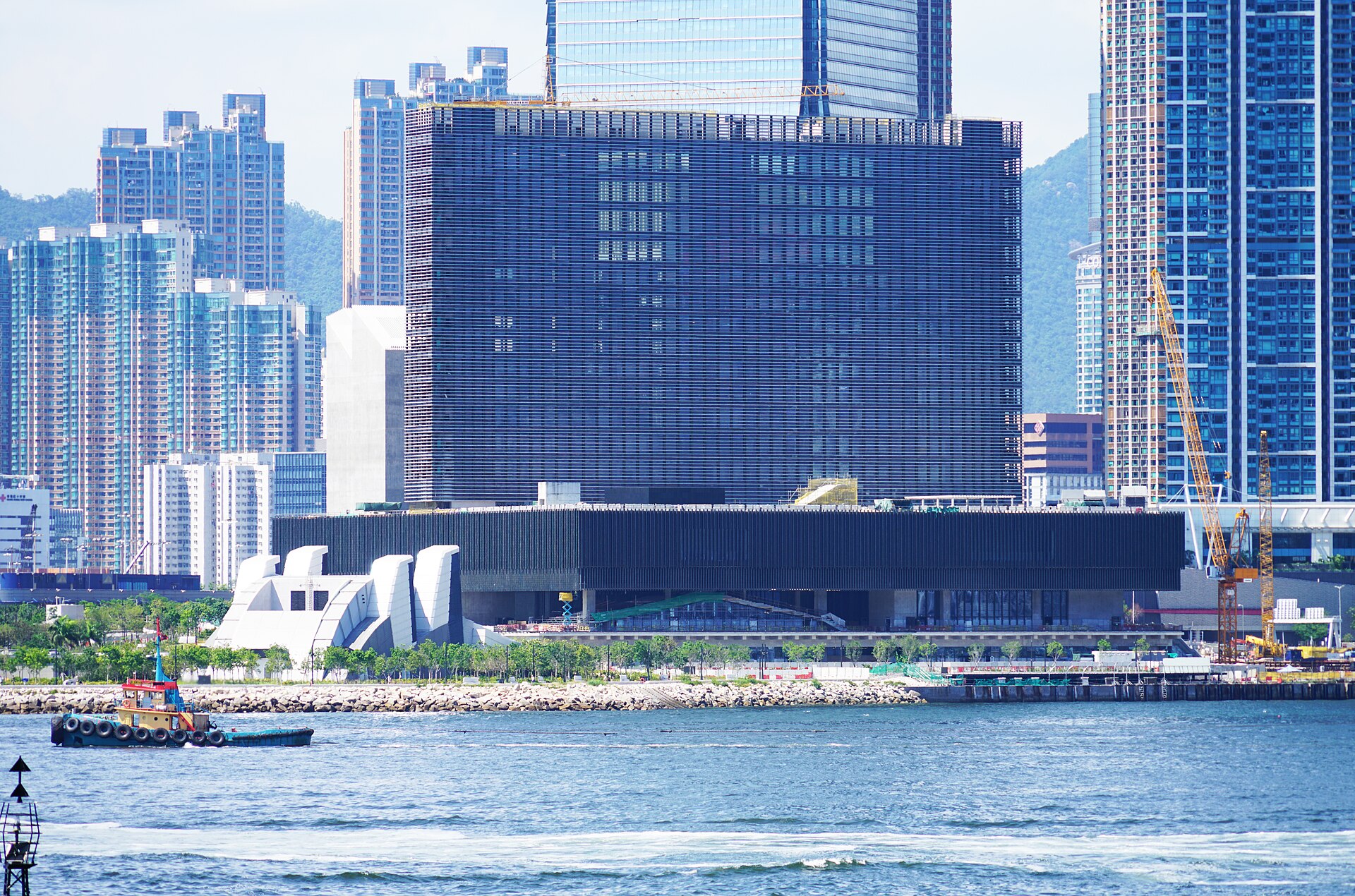
The M+ building at West Kowloon, Hong Kong, with the M+ sign on its concrete base and the ribbed facade above.
Mk2010, CC BY 4.0On this page 16 sections
ContentsClose
The museum's strength is breadth across disciplines in one Asian institution: design and architecture, moving image and visual art sit under one roof, with the Sigg Collection of Chinese contemporary art as its anchor and the Archigram Archive, Metabolist fragments and Hong Kong neon among its distinctive holdings. The FAQ gives over 6,000 objects, more than 51,000 archival documents and over 500 rare books, with about 20 percent on view.
| Kind | Museum |
|---|---|
| Founded | 2021 |
| City and country |  Hong Kong, Hong Kong |
| Address | M+, West Kowloon Cultural District, 38 Museum Drive, Kowloon, Hong Kong |
| Website | mplus.org.hk |
| Status | Open, confirmed |
| Record last verified |
Visiting
- Hours
- Tue-Thu, Sat, Sun10:00 to 18:00Last admission 30 minutes before closing
- Fri10:00 to 22:00Last admission 30 minutes before closing
- Closed
- Monday; open on public holidays except Mondays.
- Admission
- StandardHKD 190Single price covering all galleries since 15 July 2025
- ConcessionHKD 100Full-time students, children 7 to 11, seniors 60 and over, persons with disabilities and one companion, CSSA recipients
- Kid & Adult Combo (1 adult + 1 child)HKD 250Adult and child enter together; child aged 7 to 11
- Kid & Adult Combo (2 adults + 1 child)HKD 400Adults and child enter together; child aged 7 to 11
- Children 6 and underFreeNo ticket needed
Free entry: Mediatheque, Grand Stair (except ticketed events), B1, B2, Found Space and Roof Garden are always free; some exhibitions such as Janet Cardiff: The Forty Part Motet are marked free entry- Tickets
- mplus.org.hk/en/admission-tickets The museum's own ticket page.
- Do I need to book?
- Tickets are sold on the museum's Get Tickets page; the museum's ticket page says timed morning, afternoon and Friday night session tickets will soon launch, valid from 10 July 2026, so confirm whether a session is needed before you go
- Address
- M+, West Kowloon Cultural District, 38 Museum Drive, Kowloon, Hong Kong MapMTR Kowloon Station (Exit C1/D1 or E4/E5) or Austin Station (Exit B4/B5), about 10 to 15 minutes on foot
High Speed Rail Hong Kong West Kowloon Station (Exit M), about 15 minutes on foot
Ferry WestK Ferry from Central Pier No. 9, about 8 minutes - Website
- mplus.org.hk
- Telephone
- +852 2200 0217
Before you go how long, access, photography, bags, eating, shop
- How long to allow
- No visit length is published by the museum; the displays are spread over a 65,000 square metre building, so allow a half day for the ticketed galleries
- Access
- The FAQ says all areas are wheelchair-friendly; free manual wheelchairs and strollers can be borrowed first come first served; trained service animals are welcome; priority lanes at the information desk, cloakroom, admission checkpoints and lifts; audio guides in Cantonese, English and Mandarin are free
- Photography
- Personal non-commercial photography is welcome without flash; video only where signs say so; commercial shoots need advance arrangement
- Bags
- Bags under 30 x 42 x 10 cm are allowed in galleries, backpacks worn on the front; larger items go in lockers or the cloakroom (small locker HKD 5 per hour, medium and large HKD 10 per hour, cloakroom HKD 10 per hour)
- Eating
- AGATE, Mosu Hong Kong, nodi and the Members' Lounge, with hours listed on the museum's visit page; food and drink only in cafes and restaurants
- Shop
- M+ Shop and The Other Shop, Tue-Thu and weekends 11:00 to 19:00, Fri 11:00 to 22:00, closed Monday
Prices and hours change. We take them from the institution's own pages and print the day we read them, and you can check the current position at the source we used. Confirm before you travel.
What is inside
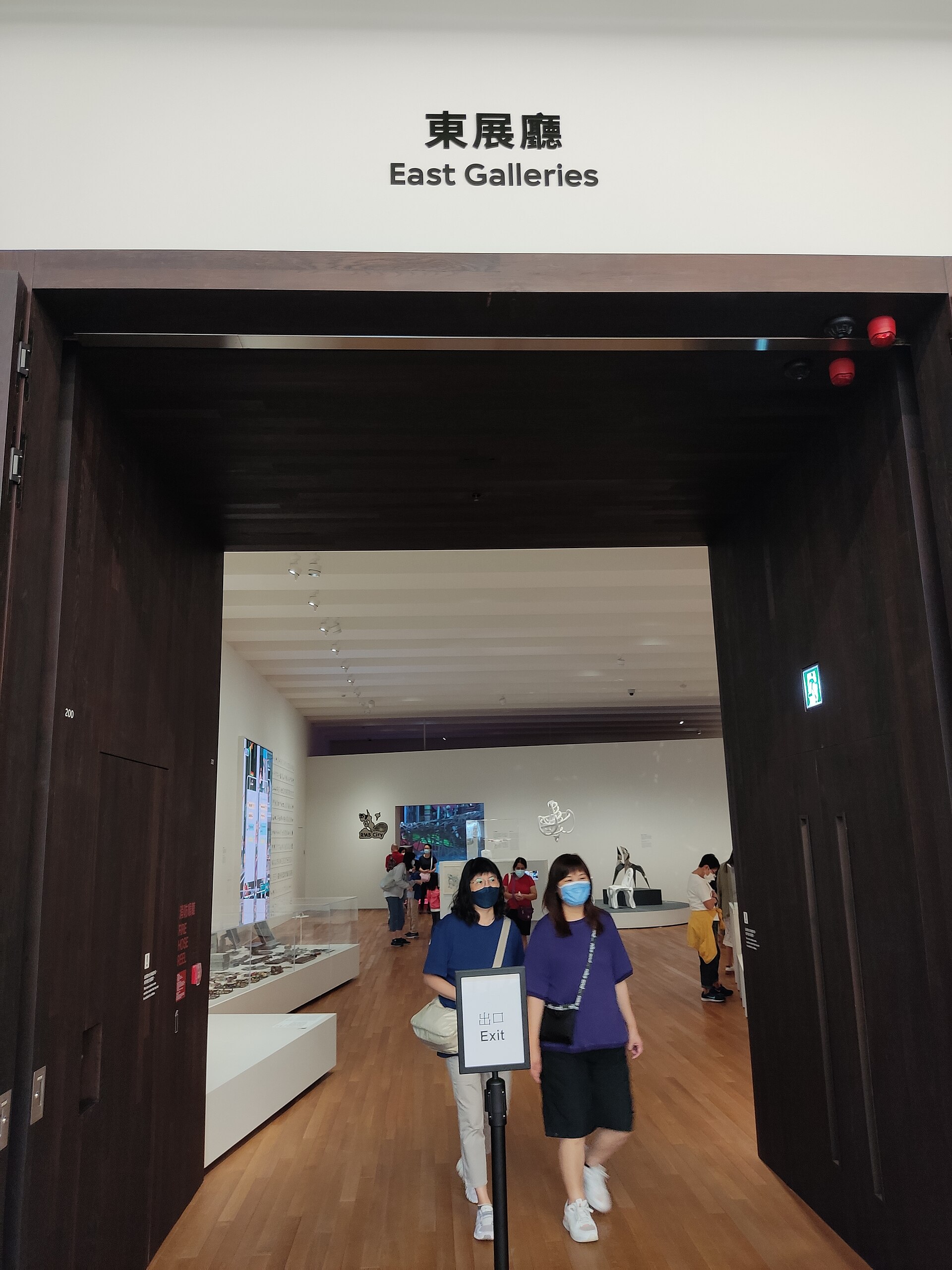
Photograph by Tong Tong Ying Yung Lim Liu Lau · CC BY-SA 4.0 East Galleries
Level 2. The design and architecture displays: Things, Spaces, Interactions has run here since the November 2021 opening, and Nakagin and Kiyotomo shows the restored Nakagin Capsule Tower Unit A806 beside the Kiyotomo sushi bar interior. The museum's must-sees for these galleries also name the Archigram Archive and the 1955 Toshiba automatic rice cooker.
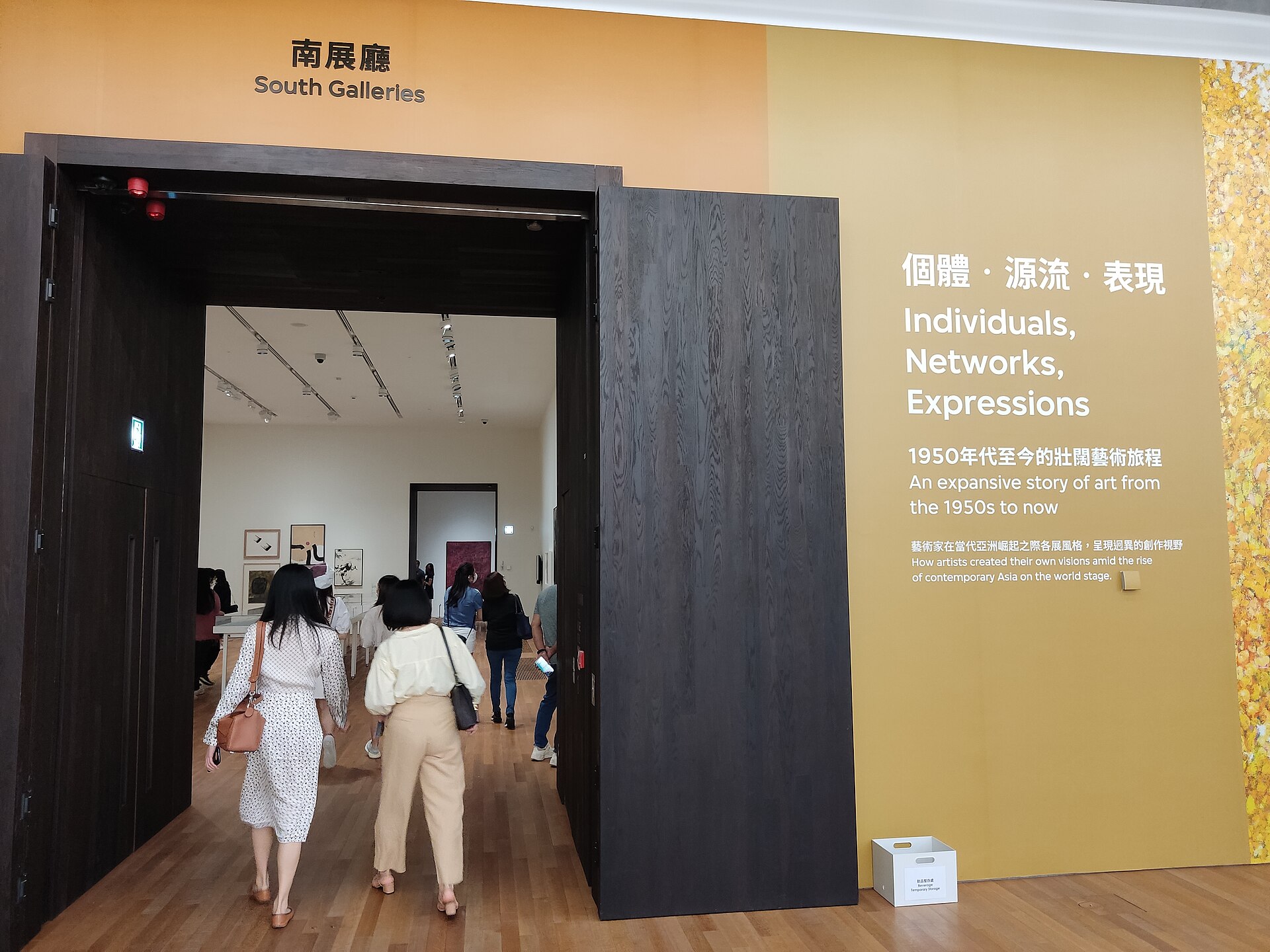
Photograph by Tong Tong Ying Yung Lim Liu Lau · CC BY-SA 4.0 South Galleries
Level 2. Home to Shanshui: Echoes and Signals, open since 3 February 2024, including Lee Ufan's Relatum, The Mirror Road, Liu Chuang's three-channel video Bitcoin Mining and Field Recordings of Ethnic Minorities and Heidi Lau's ceramic sculptures.
Photograph by Tong Tong Ying Yung Lim Liu Lau · CC BY-SA 4.0 West Gallery
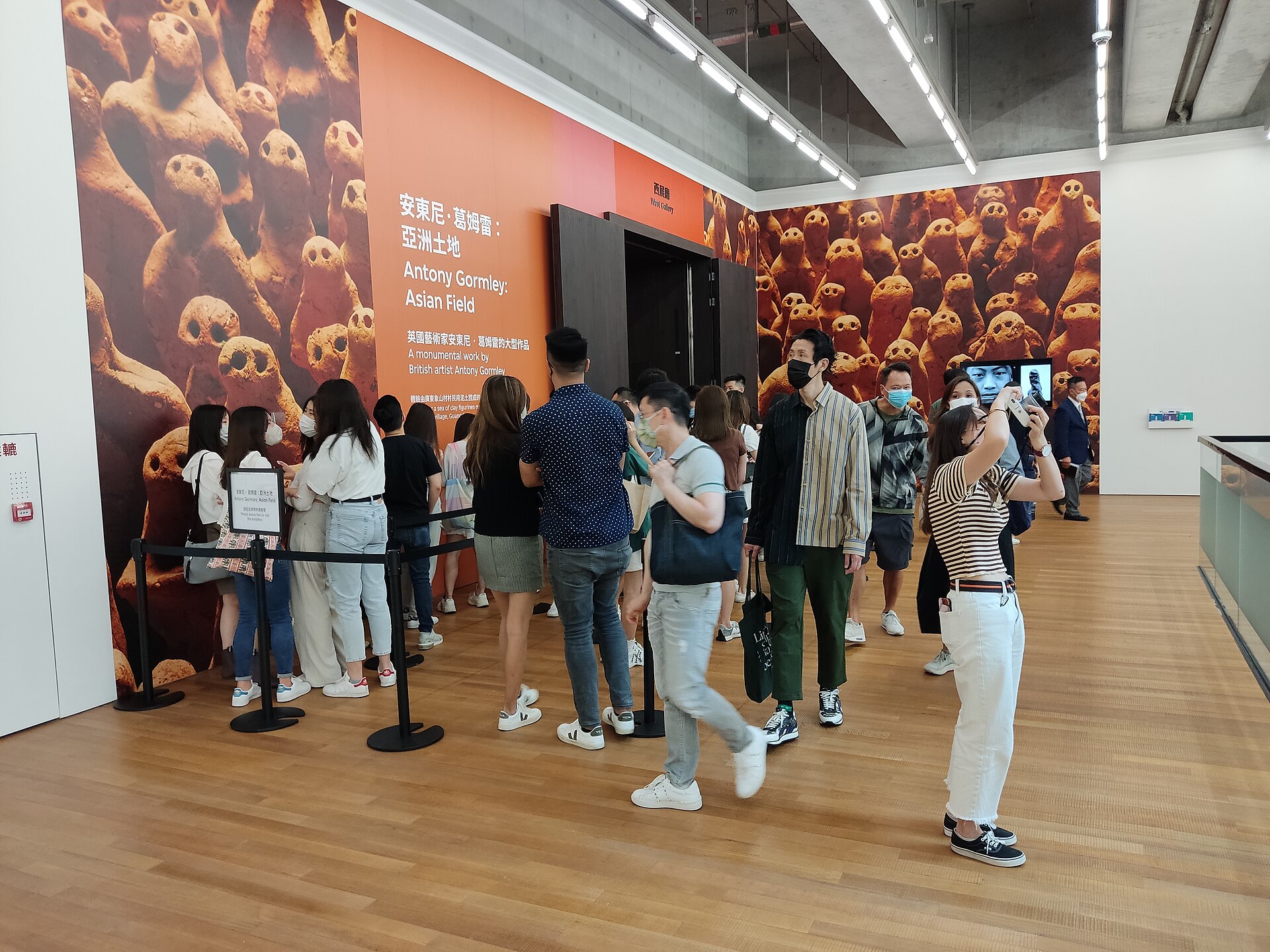
Level 2. The large special-exhibition gallery. In November 2026 it holds Myths and Monsters: The Art of Fantasy in Asia, running 17 October 2026 to 4 April 2027. Landmarks: Architecture in Asia for the 21st Century is announced for 12 June 2027.
Sigg Galleries
Level 2. The permanent home of the M+ Sigg Collection of contemporary Chinese art. M+ Sigg Collection: Inner Worlds has run here since 27 June 2025 with 38 artists; a fourth Sigg presentation, City Lives, is announced for September 2027.
Main Hall Gallery and the free ground-floor and basement spaces
The Main Hall Gallery on the ground floor holds special exhibitions (Design Ah! to 10 January 2027). Free to enter are the Mediatheque on the lower ground floor, where about 350 moving-image works can be viewed on demand, the Grand Stair, B1 and B2, the Found Space with Danh Vo in Situ: Akari by Noguchi, and The Studio, which holds Janet Cardiff's The Forty Part Motet.
Photograph by Fred Cherrygarden · CC BY-SA 4.0 M+ Cinema
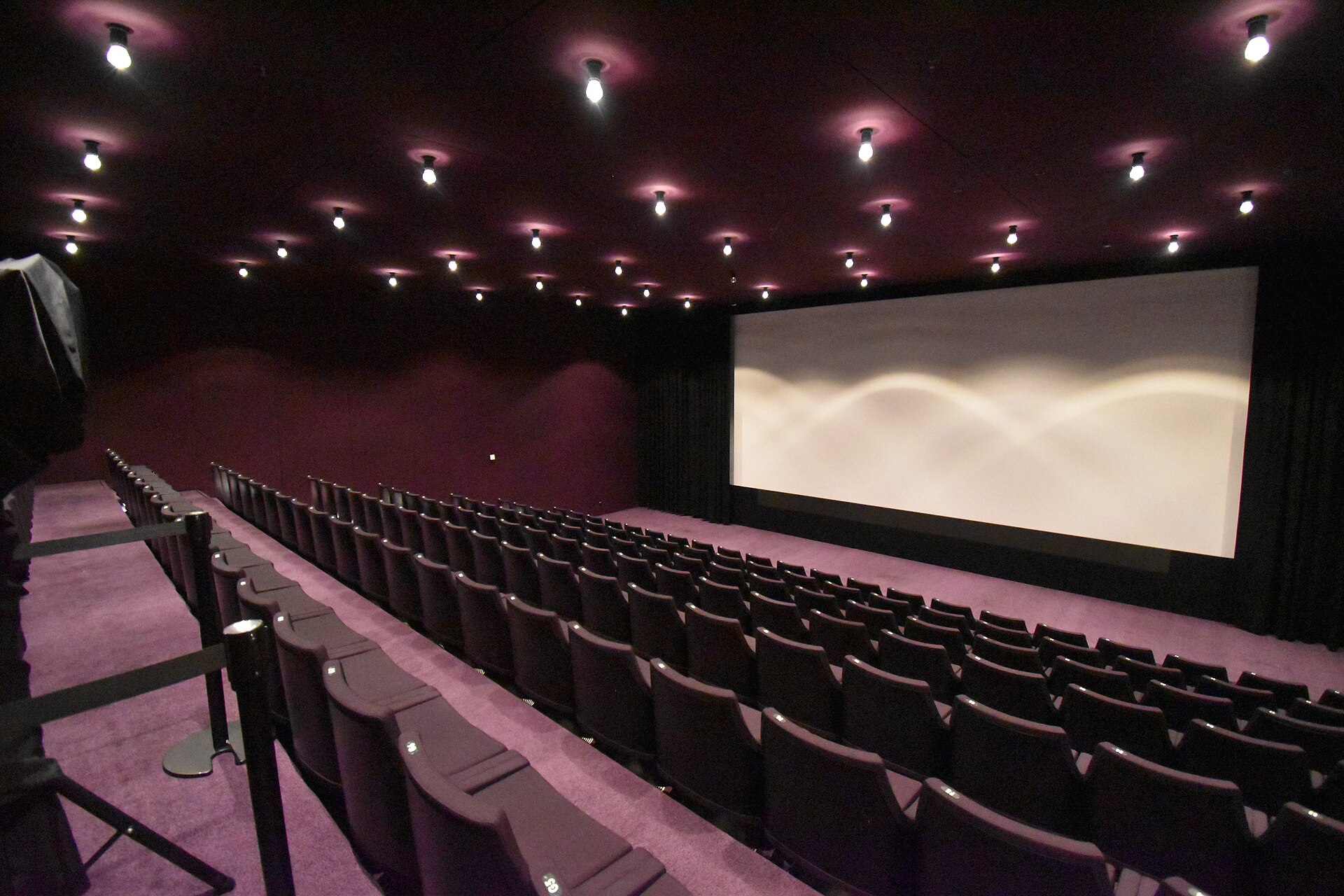
The museum's cinema programme. The FAQ notes wheelchair-accessible seating in the cinema houses, and events and screenings may need separate tickets.
Photograph by Bkemaoe HOMA · CC BY-SA 4.0 Roof Garden
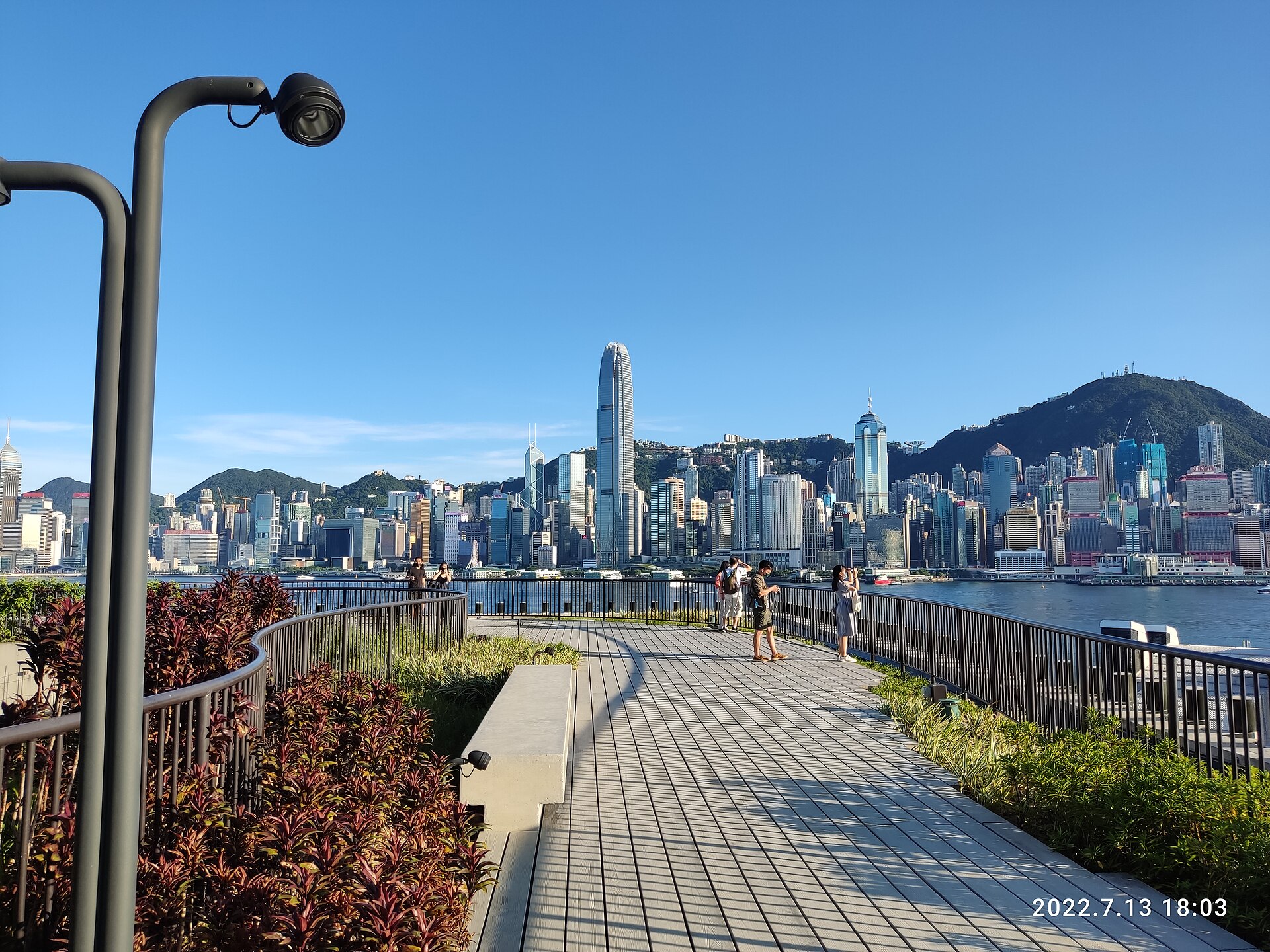
Free to enter. The North Roof Garden on Level 3 holds M+ Playscape by Isamu Noguchi, and the garden has views across Victoria Harbour towards Hong Kong Island.
What to see first
Kiyotomo sushi bar
Kuramata Shiro and Ishimaru Co. Ltd.The museum lists it among its must-sees as an interior whose timeless design transports visitors to 1980s Tokyo; the exhibition page describes it as one of few Kuramata interiors still intact.8
Unit A806, Nakagin Capsule Tower (1970-1972)
Kurokawa KishoA restored unit from the tower of 140 small units demolished in 2022, which the museum calls one of the few built examples of the Metabolist movement.10
Relatum, The Mirror Road (2021/2024)
Lee UfanAn immersive installation of stones, lights and mirrors in the South Galleries that the museum offers as a meditative walk by one of Asia's most prominent artists.8
2000 A.D. (Group of sculptures, 25 figures)
Yue MinjunA crowd of identical life-size figures based on the artist's laughing self-portrait, shown in the Sigg Galleries.8
The Forty Part Motet (2001)
Janet CardiffA free 14-minute sound installation in The Studio on loan from MoMA, in which forty speakers each play one voice of a Salisbury Cathedral Choir recording of Tallis's Spem in Alium; the first project under the M+ and MoMA memorandum signed in February 2025.11
Archigram Archive
ArchigramThe museum highlights the models and drawings of this British architecture group, whose radical visions shaped how future cities and technology are imagined.8
New Beijing (2001)
Wang XingweiA painting that replaces the injured students of Liu Heung Shing's Tiananmen photograph with penguins; the Frieze critic took its display as evidence that political work would be shown, and Artnet reported it among three paintings removed from the Sigg Galleries in April 2022.15
Neon sign, Sammy's Kitchen (ca. 1978)
Sammy YipA sign that shone over Queen's Road West for almost four decades and, in the museum's words, shaped Hong Kong's visual identity; shown in the Conservation and Storage Facility Gallery.8
Exhibitions on now
A building shaped like an upside-down T
M+ stands on the Victoria Harbour waterfront of the West Kowloon Cultural District, in Kowloon. Herzog & de Meuron designed it with TFP Farrells and Arup, and the museum gives the building a total floor area of 65,000 square metres and 33 galleries. Dezeen's report of 15 November 2021 describes two volumes, one long and flat and one tall and thin, meeting in an inverted T. The long horizontal part holds most of the public areas: the galleries, the screening rooms and the learning hub. The tall part rises above it.
Critics read the form differently. In Architectural Record, Alexandra Seno praised the architects for turning a constraint into a feature. Two metro tunnels run diagonally through the site, and the ledge of concrete built over them became the Found Space, a below-ground area for oversized works and performance. She also called the tower flat and billboard-like and the main hall slightly industrial, and noted that five mega-trusses keep the galleries nearly column-free. In ArtReview, Aaina Bhargava called the interiors neobrutalist, with high ceilings, grey concrete and black railings, and found them familiar after Tate Modern, another Herzog & de Meuron conversion.
Sources differ on the height of the tower. Architectural Record calls it 18 stories and the Hong Kong Free Press reporting says 18 floors, while Dezeen describes a 12-storey screen at the top, so this page gives no single figure. The harbour-facing side carries a large LED display, which the museum describes as one of the largest LED screens in the world, showing commissioned artworks on the skyline each evening. Seno counts 5,600 LED tubes behind it.
How it got here: Sigg, a long build and a November 2021 opening
M+ opened to the public on 12 November 2021, the date given in The Art Newspaper's review and in Al Jazeera's report of the same day. Al Jazeera describes a 14-year development process. Wikipedia, a tertiary source used here for background only, records that the architects were chosen in 2013 after a competition, that construction began in 2014 and that the building was completed in December 2020. The project cost HK$5.9 billion according to the Hong Kong Free Press.
The collection that gave the museum its credibility was assembled before the building existed. The Swiss collector and former ambassador to China Uli Sigg donated more than 1,500 works of contemporary Chinese art, a gift announced in 2012. The museum now lists the M+ Sigg Collection as one of its four permanent collections. The others are the M+ Collection itself, an interdisciplinary body of design and architecture, moving image and visual art; the M+ Library Special Collection of printed material as a creative medium; and the M+ Collection Archives of primary documents about how artists and makers worked.
The museum's own visitor FAQ gives the scale as over 6,000 objects, more than 51,000 archival documents and over 500 rare books, with about 20 percent on display at any time and the rest held in a Conservation and Storage Facility. Other outlets quoted larger or different totals at the time of opening, so the FAQ is the figure used here.
Walking it: levels, galleries and free spaces
The museum describes the visit in layers. The ticketed galleries are mostly on Level 2, arranged around a central atrium: the East Galleries, the South Galleries, the West Gallery, the Sigg Galleries and a Focus Gallery, with smaller spaces such as the Open Gallery and The Cabinet. The Main Hall Gallery is on the ground floor. Several areas need no ticket: the Mediatheque on the lower ground floor, the Grand Stair, the basement levels B1 and B2 including the Found Space and The Studio, and the Roof Garden.
Dezeen noted that the Courtyard Galleries are entirely clad in bamboo, and ArtReview singled out the bamboo-walled gallery of the opening show The Dream of the Museum as calm and distinct from the rest of the building. The Frieze critic Ophelia Lai remarked on the white spiral staircase where visitors queue for photographs. Families are pointed to the Learning Hub and Breakout spaces on Level 2 in the East and South Galleries, and the North Roof Garden on Level 3 holds M+ Playscape, a set of climbable sculptures by Isamu Noguchi.
The museum's own listing for November 2026 shows the building mid-programme. Myths and Monsters: The Art of Fantasy in Asia runs in the West Gallery from 17 October 2026 to 4 April 2027, Design Ah! Experience the Wonder of Everyday Design runs in the Main Hall Gallery to 10 January 2027, and Herzog & de Meuron: In Focus, about the building's own architects, is in the Focus Gallery. Upcoming entries include Hong Kong Here and Beyond 2027 from 13 March 2027 and Do Ho Suh: Belonging from 25 September 2027. Check the exhibitions page before travelling, because the listing changes.
What the permanent displays do
Four long-running collection displays carry the museum. M+ Sigg Collection: Inner Worlds, open since 27 June 2025 in the Sigg Galleries, is the third Sigg presentation after From Revolution to Globalisation and Another Story. It features 38 artists and reads Chinese art from the mid-1990s to the 2010s through emotional expression, organised around joy, sadness, calm, anxiety, doubt and wonder. Yue Minjun's 2000 A.D., a group of identical life-size laughing figures, is among the works named.
Shanshui: Echoes and Signals, open since 3 February 2024 in the South Galleries, was curated by Silke Schmickl and reworks the Chinese landscape tradition of mountain and water through sculpture, moving image, sound, design, architecture and ink painting. It includes Lee Ufan's Relatum, The Mirror Road, Tatsuo Miyajima's LED installation Region No. 43701 to No. 43900 and a garden of Isamu Noguchi's galvanised steel sculptures. The museum describes a three-year display period with regular rotations.
Things, Spaces, Interactions has been in the East Galleries since the opening and covers design and architecture. Since November 2024 the same galleries also hold Nakagin and Kiyotomo: Architectural Icons from Tokyo, 1970s to 1980s, which shows a restored capsule from Kurokawa Kisho's Nakagin Capsule Tower beside the interior of the Kiyotomo sushi bar by Kuramata Shiro. The tower, which had 140 small units, was demolished in 2022, and the exhibition argues that keeping commercial interiors like Kiyotomo matters because design shapes everyday experience.
What the critics said
The opening reviews were warm about ambition and cautious about politics. Ilaria Maria Sala in The Art Newspaper (12 November 2021) called the museum a major achievement and praised the Hong Kong displays and the Sigg presentation for covering political subjects. She also pointed to the 2020 National Security Law, a new film censorship law that could touch the cinemas and Mediatheque, and the thin captions in the Sigg galleries, which leave viewers to recognise political references on their own.
Ophelia Lai in Frieze (22 November 2021) found the Sigg survey bold and noted that the inclusion of Wang Xingwei's New Beijing supported the director's assurance that political work would be shown. She also doubted that a museum owned by the West Kowloon Cultural District Authority can operate freely, and she called the South Galleries show occasionally thin. In ArtReview (10 December 2021) Aaina Bhargava welcomed local artists getting institutional recognition but wrote that the board chairman's answers on how censorship would apply were unclear, and that crowds of photographers and influencers at the opening distracted from the works.
Alexandra Seno's Architectural Record review of the building was mostly positive. Her drawbacks were the billboard-like tower and the industrial feel of the main hall.
The censorship question, on the record
Any honest account of M+ has to include the dispute over political work. Al Jazeera reported on opening day that officials had said all exhibits fall under the National Security Law and that M+ had dropped a photograph by Ai Weiwei, Study of Perspective: Tian'anmen, from its opening shows. The Hong Kong Free Press reported that the work was described as under review and that its image had been replaced by a logo on the museum's website. West Kowloon Cultural District chair Henry Tang said the museum must comply with the law and that the opening did not put artistic expression above it. Other Ai Weiwei works were in the opening Sigg show.
On 21 April 2022 Artnet reported that three politically engaged paintings had been removed from the Sigg Galleries: Wang Xingwei's New Beijing, Zhou Tiehai's Press Conference III and Wang Guangyi's Mao Zedong: Red Grid No. 2. The cultural district authority told Artnet that nine of over 200 works had been rotated, in particular those needing conservation, and that it had always planned to rotate over 200 works in the first year. Artnet noted that M+ did not answer questions about the three particular works. This page does not draw a conclusion beyond what those reports say, and it has not found a later published reckoning of the question.
Planning a visit
The museum is open Tuesday to Thursday and at weekends from 10:00 to 18:00, and on Fridays from 10:00 to 22:00. It is closed on Mondays. Last admission is 30 minutes before closing, and the museum opens on public holidays except Mondays. A single standard ticket costs HKD 190 and a concession ticket HKD 100. Children aged 6 and under need no ticket, and combo tickets for an adult and a child cost HKD 250 or HKD 400 with two adults. Single-price admission began on 15 July 2025.
The museum's ticket page says morning, afternoon and Friday night session tickets will soon launch, valid from 10 July 2026, but the page is not explicit about the current state, so confirm on the day. The Mediatheque, Grand Stair, B1, B2, Found Space and Roof Garden remain free.
By public transport, the museum names Kowloon Station and Austin Station on the MTR, about 10 to 15 minutes on foot, and the High Speed Rail terminus at West Kowloon, about 15 minutes. A ferry runs from Central Pier No. 9 in about 8 minutes. Bags larger than 30 by 42 by 10 cm must be left in a locker or the cloakroom, charged hourly, and wheelchairs and strollers can be borrowed free.
What visitors say
The published criticism converges on two points. The building and the Asian-focused collection are admired for their ambition in the reviews read, and the Hong Kong and Sigg displays were praised for engaging with local and political history. The persistent worry in the opening reviews was independence: whether a museum owned by a government-backed authority can show politically sensitive work, with the removal of Ai Weiwei's photograph from the opening and the April 2022 withdrawal of three Sigg paintings fuelling that doubt. This summary rests on four named reviews and news reports from late 2021 and 2022, not on a visitor survey, and no star rating was read for this page.
What is praised, what is criticised
- Praised: The scale and Asian focus of the collection, and the Sigg Collection presentation covering Chinese art since the 1990s (The Art Newspaper, Frieze, ArtReview)
- Praised: The architecture's handling of the metro tunnels as the Found Space, and its near column-free galleries (Architectural Record)
- Praised: Institutional recognition for Hong Kong artists in the Hong Kong: Here and Beyond display (Frieze, ArtReview)
- Criticised: Doubts about curatorial independence under the National Security Law, including the withheld Ai Weiwei work and the removal of three Sigg paintings in April 2022 (Al Jazeera, Artnet, The Art Newspaper)
- Criticised: Minimal captions in the Sigg galleries that assume prior knowledge of political references (The Art Newspaper)
- Criticised: A flat, billboard-like tower and an industrial-feeling main hall (Architectural Record); crowds of photographers distracting from the works at the opening (ArtReview)
Questions about M+
Where is M+?
M+, West Kowloon Cultural District, 38 Museum Drive, Kowloon, Hong Kong.
How much does it cost to visit?
Standard: HKD 190; Concession: HKD 100; Kid & Adult Combo (1 adult + 1 child): HKD 250; Kid & Adult Combo (2 adults + 1 child): HKD 400; Children 6 and under: free. As confirmed 18 November 2026.
When is it open?
Tue-Thu, Sat, Sun 10:00-18:00; Fri 10:00-22:00. Closed: Monday; open on public holidays except Mondays. As confirmed 18 November 2026.
How do you get there?
MTR: Kowloon Station (Exit C1/D1 or E4/E5) or Austin Station (Exit B4/B5), about 10 to 15 minutes on foot; High Speed Rail: Hong Kong West Kowloon Station (Exit M), about 15 minutes on foot; Ferry: WestK Ferry from Central Pier No. 9, about 8 minutes.
What should you see first?
Kiyotomo sushi bar (Kuramata Shiro and Ishimaru Co. Ltd.); Unit A806, Nakagin Capsule Tower (1970-1972) (Kurokawa Kisho); Relatum, The Mirror Road (2021/2024) (Lee Ufan); 2000 A.D. (Group of sculptures, 25 figures) (Yue Minjun); The Forty Part Motet (2001) (Janet Cardiff); Archigram Archive (Archigram).
What we could not confirm
- Whether the museum's later Sigg presentations show politically sensitive works that were withdrawn or withheld in 2021 and 2022; this page found no published account either way.
- The current state of session tickets: the museum's ticket page speaks of a launch valid from 10 July 2026 but still says it will soon launch.
Images
Sources
- 1M+, Plan Your Visit (hours, prices, transport, dining, shops), read 2026-11-18 mplus.org.hk/en/plan-your-visit/
- 2M+, Ticket Information (prices, free spaces, session notice), read 2026-11-18 mplus.org.hk/en/admission-tickets/
- 3M+, Contact Us, read 2026-11-18 mplus.org.hk/en/contact-us/
- 4M+, Frequently Asked Questions (collection scale, photography, lockers, accessibility), read 2026-11-18 mplus.org.hk/en/frequently-asked-questions/
- 5M+ press release, M+ introduces single-price admission, 23 June 2025 mplus.org.hk/en/press/mplus-introduces-single-price-admission/
- 6M+, About (architects, area, galleries, LED facade) mplus.org.hk/en/about/
- 7M+, Exhibitions listing, read 2026-11-18 mplus.org.hk/en/exhibitions/
- 8M+, Must-Sees mplus.org.hk/en/plan-your-visit/mplus-must-sees/
- 9M+, About the Collection mplus.org.hk/en/about-the-collection/
- 10M+, Nakagin and Kiyotomo exhibition page mplus.org.hk/en/exhibitions/nakagin-and-kiyotomo/
- 11M+, Janet Cardiff: The Forty Part Motet exhibition page mplus.org.hk/en/exhibitions/janet-cardiff-the-forty-part-motet/
- 12M+, Shanshui: Echoes and Signals exhibition page mplus.org.hk/en/exhibitions/shanshui-echoes-and-signals/
- 13M+, M+ Sigg Collection: Inner Worlds exhibition page mplus.org.hk/en/exhibitions/m-sigg-collection-inner-worlds/
- 14Ilaria Maria Sala, review of M+, The Art Newspaper, 12 November 2021 theartnewspaper.com/2021/11/12/review-hong-kong-mplus-museum-opens
- 15Ophelia Lai, Does Hong Kong's M+ Live up to Its Promise?, Frieze, 22 November 2021 (read in full in the in-app browser after a 403 to plain fetch) frieze.com/article/m-museum-hong-kong
- 16Rima Sabina Aouf, M+ museum by Herzog & de Meuron, Dezeen, 15 November 2021 dezeen.com/2021/11/15/herzog-de-meuron-m-museum-hong-kong-opens-architecture/
- 17Alexandra A. Seno, M+ by Herzog & de Meuron, Architectural Record, 19 November 2021 architecturalrecord.com/articles/15403-m-by-herzog-de-meuron
- 18Aaina Bhargava, Can Hong Kong's newest museum live up to the hype?, ArtReview, 10 December 2021 artreview.com/can-hong-kong-newest-museum-live-up-to-the-hype-m-plus/
- 19Al Jazeera, Hong Kong opens top art museum amid fear of cultural dark ages, 12 November 2021 aljazeera.com/news/2021/11/12/m-art-hong-kong
- 20Hong Kong Free Press, in pictures, M+ opening, 12 November 2021 hongkongfp.com/2021/11/12/in-pictures-hong-kongs-new-hk5-9bn-m-museum-offers-stunning-showcase-for-the-arts-organisers-play-down-censorship-fears/
- 21Vivienne Chow, The M+ Museum Has Removed Three Political Paintings, Artnet News, 21 April 2022 (read in the in-app browser after a 403 to plain fetch) news.artnet.com/art-world/political-chinese-paintings-removed-m-plus-hong-kong-2102659
- 22Wikipedia, M+ (; background only, labelled as such) en.wikipedia.org/wiki/M%2B