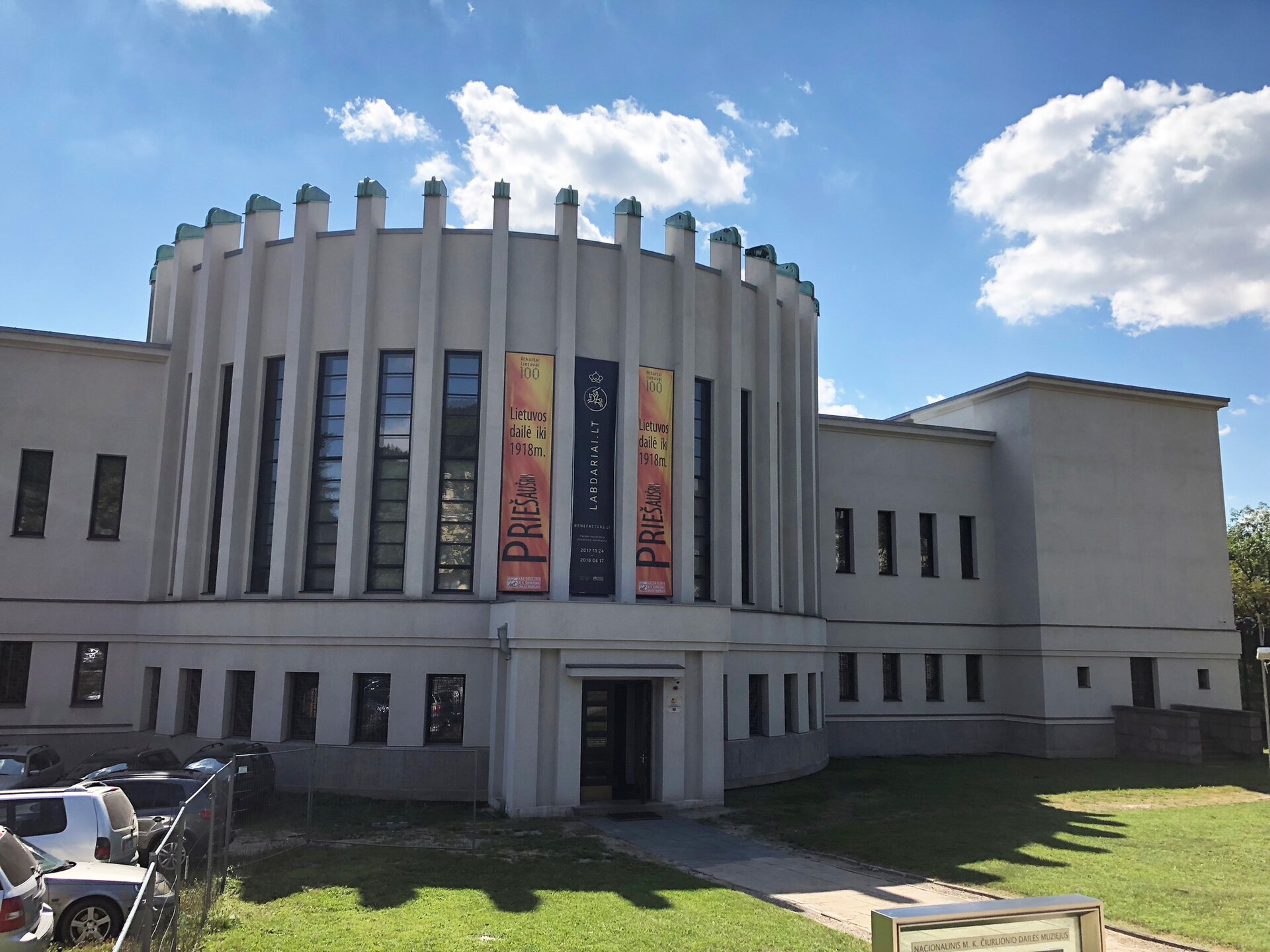
The M. K. Ciurlionis National Art Museum building at V. Putvinskio g. 55, Kaunas, photographed in 2018 after exterior renovation.
Photograph by Pofka · CC BY-SA 4.0M. K. Ciurlionis National Art Museum
Museum · Nacionalinis M. K. Ciurlionio dailes muziejus · Founded 1921
Open, admission and hours confirmed 26 August 2026 · 13 sources
On this page 16 sections
ContentsClose
The largest concentration of Mikalojus Konstantinas Ciurlionis's surviving paintings, graphics and music manuscripts anywhere, held inside the museum built specifically to protect that legacy since 1921, plus five centuries of Lithuanian art, a folk-art and cross-crafting archive, and the numismatic and applied-art holdings the wider ten-branch institution has assembled since. Its distinguishing strength against any other Ciurlionis holding elsewhere in the world is completeness paired with context: the paintings, the surviving scores, and a Music Hall to hear them in, under one roof.
| Local name | Nacionalinis M. K. Ciurlionio dailes muziejus |
|---|---|
| Kind | Museum |
| Founded | 14 December 1921, as the M. K. Ciurlionis Gallery; opened to the public 13 December 1925; renamed the Vytautas the Great Museum of Culture in 1936; received its current name in 1944 |
| City and country |  Kaunas, Lithuania Kaunas, Lithuania |
| Address | V. Putvinskio g. 55, LT-44248 Kaunas, Lithuania |
| Website | ciurlionis.lt |
| Status | Open, confirmed |
| Record last verified |
Visiting
- Hours
- Tue, Fri, Sat, Sun10:00 to 18:00Last admission 30 minutes before closing
- Wed, Thu11:00 to 19:00Last admission 30 minutes before closing
- Closed
- Monday, on the evidence that the museum's own schedule lists opening hours only for Tuesday through Sunday.
- Admission
- AdultEUR 10Full-price ticket to the permanent exhibitions in this building
- DiscountedEUR 5Students, pupils, seniors and other discounted categories the museum's own price list defines
- Child, added to an adult ticketEUR 2At this building specifically; the museum's other branches add EUR 1.00 instead
- Combined ticket with Kaunas Picture Gallery (Dviguba meno doze / Double Dose of Art)EUR 14Discounted rate for the same combined ticket is EUR 7.00. Kaunas Picture Gallery is a separate branch building, not this one
- Audio guide, M. K. Ciurlionis galleryEUR 4Lithuanian, English, French, Russian and Polish
Free entry: Last Sunday of each month, permanent exhibitions, all visitors, on the museum's own price list. Standing free-entry categories on presentation of documentation: pre-school children, orphans, visitors with disabilities plus one companion, visitors aged 80 and over, Ukrainian citizens, and specified professional categories (museum workers, ICOM cardholders and similar)- Tickets
- ciurlionis.lt/veiklos/lankytojams/bendra-info... The museum's own ticket page.
- Do I need to book?
- Not stated as required on the museum's own visitor pages; tickets are sold at the counter
- Address
- V. Putvinskio g. 55, LT-44248 Kaunas, Lithuania MapCentral location The building sits in Kaunas New Town (Naujamiestis), a short walk from Vienybes aikste (Unity Square) and from the pedestrian Laisves aleja, the main axis of the city Leon and Ruth's brief describes visitors reaching on foot from most of the historic centre. It shares its building with the separate Vytautas the Great War Museum, which fronts Vienybes aikste itself.
- Website
- ciurlionis.lt
- Telephone
- +370 684 84463
- [email protected]
Before you go how long, access, photography, bags, eating, shop
- How long to allow
- Not published by the museum in the sources read for this record; TripAdvisor visitors describe the collection as compact enough to see thoroughly in an unhurried hour or two
- Access
- Not published in the sources read for this record
- Photography
- Not published in the sources read for this record
- Bags
- Not published in the sources read for this record
- Eating
- Not published in the sources read for this record
- Shop
- A museum shop selling reproductions, postcards, books and souvenirs is listed among the branch's services on the museum's own page
Prices and hours change. We take them from the institution's own pages and print the day we read them, and you can check the current position at the source we used. Confirm before you travel.
What is inside
M. K. Ciurlionis' Creation
The core permanent exhibition and the reason the museum exists: the largest single holding of paintings, graphic works and photographs by the painter-composer Mikalojus Konstantinas Ciurlionis (1875-1911), alongside his surviving music manuscripts, letters and personal belongings. The building's Music Hall lets visitors hear his compositions, drawn from an archive of roughly 350 to 400 works, mostly for piano, of which a substantial part did not survive the twentieth century intact. Major paintings on display include Rex, Fairy Tale of the Kings, the Zodiac cycle and the Sonata series discussed individually below.
Lithuanian Art of the 14th to 19th centuries
Devotional and secular painting, sculpture and applied art documenting Lithuanian visual culture across five centuries, predating the museum's own founding by hundreds of years and giving the collection a chronological depth the Ciurlionis material alone does not cover.
Archaics: Lithuanian Folk Art, 18th to 20th centuries
Wood carving, textiles and everyday craft from the Lithuanian countryside, the material base of the folk-art archive the museum's own history describes building up alongside its fine-art holdings since the interwar period.
Lithuania: The Land of Crosses
A courtyard exhibition on the carved wooden crosses and shrines (kryzdirbyste, cross-crafting) that are among Lithuania's most distinctive folk traditions and, since 2001, inscribed by UNESCO as an Intangible Cultural Heritage practice in their own right; the museum presents its own holdings of this material in the open air rather than inside the exhibition halls.
What to see first
Rex
M. K. Ciurlionis, 1909Tempera on canvas and, on the museum's own telling, the largest single painting Ciurlionis made: an enthroned figure on an architectural throne, its shadow doubling the throne itself, with the sun rising in one upper corner and the crescent moon in the other. It stands at the far end of a decade in which Ciurlionis moved from stained-glass design toward the fully symbolic cosmology his later paintings are known for.12
Fairy Tale of the Kings (Karaliu pasaka)
M. K. Ciurlionis, 1909, after a 1908 sketchTempera, showing two crowned figures in a dark forest, one holding a glass globe containing a village, the other a sword. Donated to the museum in 1922 by the artist's widow, Sofija Kymantaite-Ciurlioniene, it is among the most reproduced single images associated with the painter and travelled to the Dulwich Picture Gallery in London for the 2022-2023 Ciurlionis retrospective there.8
Sonata No. 6 (Sonata of the Stars), Allegro
M. K. Ciurlionis, 1908One of a series of paintings Ciurlionis structured on musical forms, using the movements of a sonata (Allegro, Andante and so on) as the organising principle for a sequence of related canvases rather than for a single image; this Allegro renders the night sky as interwoven currents of stars and mist crossed by the path of the Milky Way.12
Sonata of the Sun, Allegro
M. K. Ciurlionis, 1907An earlier entry in the same sonata-form series, built around suns that read as a visual road climbing from the base of the canvas to its upper register. Held alongside the Sonata of the Stars, it lets a visitor see the same compositional method applied to two different cosmological subjects within a single year of the artist's short working life.13
The Zodiac cycle
M. K. Ciurlionis, 1906-1907A set of tempera paintings assigning each sign of the zodiac its own symbolic landscape, among the works that established Ciurlionis, ahead of Kandinsky's first fully abstract compositions, as a candidate for the earliest European painter to move systematically away from representational subject matter.12
Rex, Diptych for Stained Glass
M. K. Ciurlionis, 1904An early design for stained glass rather than a finished painting, made five years before the large canvas of the same title, and useful on this page precisely because it shows the Rex composition still in an applied-art, workshop register before it became the museum's largest single picture.13
The manuscript and instrument archive of M. K. Ciurlionis
M. K. Ciurlionis, mostly before 1911Roughly 350 to 400 music compositions are attributed to Ciurlionis, the majority for solo piano but including symphonic poems (In the Forest, The Sea) and a cantata for choir and orchestra; a substantial part of the manuscript record did not survive the century, some of it reportedly lost to wartime fire. What remains, together with letters and personal belongings, is held here and heard, not just read, in the building's own Music Hall.3
Wooden cross-crafting collection (Land of Crosses)
Lithuanian folk carvers, 18th-20th centuriesThe museum's own courtyard holding of carved wooden crosses and wayside shrines documents kryzdirbyste, a craft tradition UNESCO separately recognised as Intangible Cultural Heritage in 2001; displaying it outdoors, rather than in a gallery case, keeps the material closer to the roadside and cemetery settings it was actually made for.2
Exhibitions on now
Past exhibitions here
- Closed4 Jun to 30 Aug 2026Confirmed · check before you travel
A gallery built to save one artist's legacy, 1921 to 1936
The museum's official founding date is 14 December 1921, and its own account of that founding is unusually specific about why: the need to collect and preserve the creative legacy of Mikalojus Konstantinas Ciurlionis, the Lithuanian painter and composer who had died a decade earlier, in 1911, at thirty-five. In 1924 the young institution found the person who would shape it for the next two decades, Paulius Galaune, the only art professional in Lithuania at the time with a formal museum education, gained at the Ecole du Louvre in Paris. Under his direction the M. K. Ciurlionis Gallery opened to the public on 13 December 1925 with roughly 4,500 exhibits, a temporary arrangement that nonetheless established the pattern the institution has followed ever since: a single artist's work as the anchor, with Lithuanian art and folk material gathered in around it.
Growth outpaced the temporary gallery quickly enough that a purpose-built museum building opened in 1936, and the institution took a new name to match its new ambitions: the Vytautas the Great Museum of Culture, honouring the medieval Grand Duke whose reign is treated in Lithuanian national memory as the country's high-water mark. The name change mattered less for its content, which stayed centred on Ciurlionis and on Lithuanian art, than for its symbolism: a museum founded to protect one modern artist's paintings now stood, in name, alongside the country's foundational medieval ruler. Kaunas itself explains why this happened here rather than in Vilnius. Between the wars Kaunas was Lithuania's provisional capital, Vilnius having been under Polish control, and the interwar building programme this period gave the city is the same programme that produced the museum's own 1936 structure.
War, occupation and an ideological bastion, 1940 to 1963
The museum's own institutional history does not soften what came next. When Soviet forces first occupied Lithuania in 1940, the museum's direction changed to match the new state's ideological requirements. The Nazi occupation that followed from 1941 brought a different but related problem: German administrators asserted a claim over the museum's collections as property of the occupying authority, a treatment the museum's own account distinguishes explicitly from how the Soviet administration had approached the same holdings. When the Soviet Union reoccupied Lithuania after the war, the museum was reshaped again, this time into what its own history page describes in translation as an ideological bastion, an institution reorganised around mass appeal and Soviet cultural messaging rather than around Galaune's original curatorial programme. A further, more technical reorganisation of the collections took place between 1954 and 1963, under the same Soviet administrative framework. The institution took the name it carries today, M. K. Ciurlionis National Art Museum, in 1944, in the middle of this same occupied period rather than after Lithuanian independence.
None of this is a footnote on a page built around a single artist's paintings. A museum whose stated purpose from 1921 was to protect Ciurlionis's own legacy spent two subsequent decades under two different occupying administrations that each tried, in different ways, to redirect what the institution was for. That the Ciurlionis paintings themselves survived both periods intact enough to anchor the museum's current identity is itself part of the record, not an incidental detail of Lithuanian twentieth-century history.
From one gallery to a ten-branch complex
Lithuanian independence in 1990 and the years after it changed the museum's trajectory again, this time toward expansion rather than redirection. The Ciurlionis Gallery itself was renovated and reopened in 2003 with dedicated funding, and the institution formally gained national status in 1997, the year its current full name, M. K. Ciurlionis National Art Museum, took on its present administrative weight. A major single event drove the next phase of physical growth: in 1995 the museum received the Mykolas Zilinskas collection, 1,682 works of European and world art assembled by the Lithuanian-born collector, and absorbing a gift of that size required building two further exhibition facilities.
The institution today is not one museum but a complex of roughly ten branches across Kaunas and, for the Ciurlionis family's own former residence, Druskininkai: alongside the main building described on this page, the group includes the Mykolas Zilinskas Art Gallery, the Kaunas Picture Gallery, the Kaunas Historical Presidential Palace, a Ceramics Museum, the Devils' Museum, the M. K. Ciurlionis Memorial Museum in Druskininkai, the Antanas Zmuidzinavicius Memorial Museum, the Paulius Galaune Family House, the Juozas Zikaras Museum and the Vytautas Kazimieras Jonynas Gallery. This page describes only the building at V. Putvinskio g. 55, the main national museum building holding the core Ciurlionis collection; the branches are administered by the same institution but occupy separate buildings, keep separate hours and separate admission arrangements, and their own holdings are not folded into the facts recorded here.
A modernist building, and a shared address with a second museum
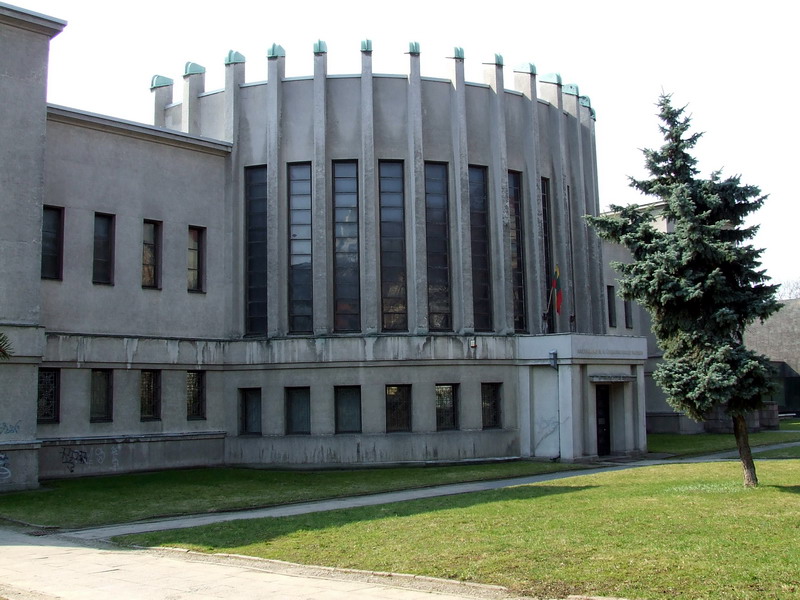
The building itself belongs to the same interwar construction wave that gives Kaunas its architectural identity: built in Art Deco and early functionalist style as part of the city's transformation into a provisional national capital between 1919 and 1939, it was expanded in 1969 under Soviet administration. In 2015 it was one of forty-four Kaunas buildings named to the European Heritage Label, and in September 2023 the wider ensemble of interwar Kaunas architecture it belongs to, nominated as Modernist Kaunas: Architecture of Optimism, 1919-1939, was inscribed on the UNESCO World Heritage List.
One fact worth stating plainly, because a reader checking this address against other sources will meet it quickly: the building at V. Putvinskio g. 55 is shared with a second, separate national institution, the Vytautas the Great War Museum, which fronts the adjoining Vienybes aikste (Unity Square). The two museums are administratively distinct, cover entirely different subject matter, an artist's legacy in one case and Lithuanian military history in the other, and this page describes only the M. K. Ciurlionis National Art Museum's own exhibition space and collection. Nothing about the war museum's own holdings, hours or admission is repeated here.
What is on the walls: Ciurlionis complete
The reason a visitor comes to this specific building rather than to any of the museum's other branches is the concentration of Ciurlionis material inside it. The artist left behind a body of work usually put at somewhere between 220 and roughly 300 surviving paintings and graphic works, depending on which cataloguing convention is used, and the large majority of it is held here rather than dispersed across other institutions. The Zodiac cycle of 1906-1907, assigning each sign its own symbolic landscape, and the Sonata series that followed it, tempera paintings organised on musical structures such as Sonata of the Sun (1907) and Sonata No. 6, the Sonata of the Stars (1908), are usually cited as the works that place Ciurlionis among the earliest European painters to move systematically away from representational subject matter, ahead of the fully abstract compositions Kandinsky began several years later. Rex (1909), described by the museum itself as the largest single painting Ciurlionis made, and Fairy Tale of the Kings (1909), donated to the museum in 1922 by the artist's widow Sofija Kymantaite-Ciurlioniene and lent to the Dulwich Picture Gallery in London for a 2022-2023 retrospective, are the two most reproduced individual images in the collection.
Painting is only half of what the room holds. Ciurlionis was a composer before and alongside his painting career, and the museum's own account puts his surviving musical output at somewhere between 350 and roughly 400 compositions, mostly for solo piano but including symphonic poems and a cantata for choir and orchestra; a meaningful part of the manuscript record is reported not to have survived the twentieth century, some of it reportedly lost to fire during wartime. What has survived is held in this building alongside his letters and personal belongings, and the Music Hall lets a visitor hear the compositions rather than only read about them, a pairing of painting and music that is the single thing distinguishing this collection from any other public holding of Ciurlionis's work.
Lithuanian art, folk carving and a courtyard of crosses
Three further permanent exhibitions extend the building beyond its Ciurlionis core. Lithuanian Art of the 14th to 19th Centuries covers five centuries of devotional and secular painting, sculpture and applied art, giving the museum a chronological range the Ciurlionis material alone, concentrated as it is into roughly the decade before 1911, cannot provide. Archaics: Lithuanian Folk Art of the 18th to 20th Centuries holds wood carving, textiles and everyday rural craft, the base material of a folk-art archive the museum's own history describes assembling alongside its fine-art collection since the interwar period. The museum's broader holdings, spread across this and its other branches, also include ancient world art, foreign fine and applied art, and a numismatics collection, together contributing to a stated total across the whole institution of more than 355,000 items; this page records only what is presented in this specific building.
The fourth permanent exhibition, Lithuania: The Land of Crosses, is shown outdoors, in the museum's own courtyard, rather than inside a gallery hall. It presents Lithuanian wooden cross-crafting, kryzdirbyste, the wayside crosses and shrines that mark roads, farmsteads and cemeteries across the Lithuanian countryside and that UNESCO recognised as Intangible Cultural Heritage in its own right in 2001. Showing this material in the open air rather than in a case keeps it visibly closer to the roadside and cemetery settings the objects were actually made for, and it is the one part of the permanent collection that a visitor sees before, rather than after, walking through the building's front door.
What visitors say
We publish no visitor-review prose and no unverified aggregate beyond a cited platform score, so what follows draws on named, characterised accounts. Visitors consistently single out two things: the depth of the Ciurlionis holding itself, which nowhere else in the world can match, and the modernist interwar building it is shown in, whose architecture reviewers repeatedly describe as working with rather than against the paintings. The museum reads, in this material, as a calm, purpose-built encounter with a single artist rather than an encyclopaedic survey, and its affordability and the option to hear Ciurlionis's own compositions in the Music Hall are mentioned often enough to count as part of the consensus rather than incidental detail.
What is praised, what is criticised
- Praised: the completeness and concentration of the Ciurlionis holding, seen by reviewers as the definitive place to encounter the painter-composer's work rather than a partial or provincial sample of it
- Praised: the interwar modernist building itself, repeatedly described as complementing the exhibits rather than merely housing them
- Praised: the calm, uncrowded, well-lit galleries and the option to hear Ciurlionis's compositions performed or played in the Music Hall
- Praised: low admission prices relative to the depth of the collection, and staff visitors describe as friendly and informative
- Criticised: gaps and inconsistency in explanatory signage across the wider Ciurlionis museum complex, with some visitors and travel-site summaries noting that not every gallery gives as much context in English as the Ciurlionis rooms themselves, and recommending an audio guide or a guided tour to fill the difference
- Criticised: at least one visitor reported arriving to find the museum closed despite online information stating it was open, a reminder that a listed schedule is not a guarantee on any given day
Ratings on other platforms
TripAdvisor: 4.5 from 193 ratings, read 26 August 2026
A platform average is a tertiary source: it moves, it is not audited, and we quote no visitor's words.
Questions about M. K. Ciurlionis National Art Museum
Where is M. K. Ciurlionis National Art Museum?
V. Putvinskio g. 55, LT-44248 Kaunas, Lithuania.
How much does it cost to visit?
Adult: EUR 10; Discounted: EUR 5; Child, added to an adult ticket: EUR 2; Combined ticket with Kaunas Picture Gallery (Dviguba meno doze / Double Dose of Art): EUR 14; Audio guide, M. K. Ciurlionis gallery: EUR 4. As confirmed 26 August 2026.
When is it open?
Tue, Fri, Sat, Sun 10:00-18:00; Wed, Thu 11:00-19:00. Closed: Monday, on the evidence that the museum's own schedule lists opening hours only for Tuesday through Sunday. As confirmed 26 August 2026.
How do you get there?
Central location: The building sits in Kaunas New Town (Naujamiestis), a short walk from Vienybes aikste (Unity Square) and from the pedestrian Laisves aleja, the main axis of the city Leon and Ruth's brief describes visitors reaching on foot from most of the historic centre. It shares its building with the separate Vytautas the Great War Museum, which fronts Vienybes aikste itself.
What should you see first?
Rex (M. K. Ciurlionis, 1909); Fairy Tale of the Kings (Karaliu pasaka) (M. K. Ciurlionis, 1909, after a 1908 sketch); Sonata No. 6 (Sonata of the Stars), Allegro (M. K. Ciurlionis, 1908); Sonata of the Sun, Allegro (M. K. Ciurlionis, 1907); The Zodiac cycle (M. K. Ciurlionis, 1906-1907); Rex, Diptych for Stained Glass (M. K. Ciurlionis, 1904).
What we could not confirm
- Sources disagree on the size of Ciurlionis's surviving painted and graphic output, citing figures from roughly 220 to roughly 300 works, and on his surviving musical output, citing figures from roughly 350 to roughly 400 compositions; this page gives both ranges rather than picking one as authoritative.
- The precise circumstances of the museum's collections during the 1941-1944 Nazi occupation of Kaunas, beyond the museum's own brief statement that German administrators asserted a property claim over them, were not established from any source read for this record and would need dedicated archival research (see Collecting Art in the Turmoil of War: Lithuania in 1939-1944, not itself fetched for this page) before any further claim could be made.
- This page does not establish which specific highlighted paintings are on public display in the permanent hang versus in storage or on loan at any given time; museum hangs change, and a visitor should confirm current gallery contents against the museum's own site before travelling.
Images
Sources
- 1M. K. Ciurlionis National Museum of Art, official site, English homepage. Fetched for open status and general orientation, 26 August 2026. ciurlionis.lt/en/
- 2M. K. Ciurlionis National Museum of Art, official site, branch page for the main museum building. Address, correspondence address, phone, email, opening hours, the four permanent exhibitions, and museum-shop and services listing. Fetched 26 August 2026. ciurlionis.lt/activities/branches/m-k-ciurlionis-national-museum-of-art/
- 3M. K. Ciurlionis National Museum of Art, official site, institutional history page. Founding date, Paulius Galaune's directorship, the 1925 gallery opening, the 1936 renaming as the Vytautas the Great Museum of Culture, the WWII and Soviet-occupation history, the 1995 Mykolas Zilinskas gift, and 1997 national status. Fetched 26 August 2026. ciurlionis.lt/our-history/
- 4M. K. Ciurlionis National Museum of Art, official site, admission price list (Lithuanian). Full and discounted ticket prices, child pricing, the combined ticket with Kaunas Picture Gallery, free-admission categories including the last Sunday of each month, and audio-guide pricing. Fetched 26 August 2026. ciurlionis.lt/veiklos/lankytojams/bendra-informacija-br-bilietu-kainos/
- 5Wikidata, M. K. Ciurlionis National Art Museum (Q4381425). Verified by label match and claims: P31 art museum, P17 Lithuania, coordinates 54.9,23.91139, inception 14 December 1921, official website ciurlionis.lt. wikidata.org/wiki/Q4381425
- 6English Wikipedia, M. K. Ciurlionis National Art Museum. Building architecture (Art Deco and early functionalism), the 1969 expansion, the 2015 European Heritage Label, the full list of the institution's ten other branches, and a holdings figure of more than 355,000 items. en.wikipedia.org/wiki/M._K._%C4%8Ciurlionis_National_Art_Museum
- 7English Wikipedia, Vytautas the Great War Museum. Confirms this separate national institution shares its building with the M. K. Ciurlionis National Art Museum, at Vienybes aikste. en.wikipedia.org/wiki/Vytautas_the_Great_War_Museum
- 8English Wikipedia, Fairy Tale of the Kings. Painting date (1909, after a 1908 sketch), medium and dimensions, 1922 donation by the artist's widow Sofija Kymantaite-Ciurlioniene, and its 2022-2023 loan to the Dulwich Picture Gallery, London. en.wikipedia.org/wiki/Fairy_Tale_of_the_Kings
- 9UNESCO World Heritage Centre, Modernist Kaunas: Architecture of Optimism, 1919-1939. Confirms the 23 September 2023 World Heritage inscription of the interwar Kaunas architectural ensemble that includes this museum building's own construction period. Fetched 26 August 2026. whc.unesco.org/en/list/1661/
- 10TripAdvisor, National M. K. Ciurlionis Art Museum, Kaunas, attraction review page. Aggregate rating 4.5 out of 5 from 193 reviews, and characterised (not quoted) visitor praise and complaint themes: architecture complementing the collection, calm and well-curated galleries, affordable admission, and one report of arriving to find the museum closed despite an online listing showing it open. Fetched 26 August 2026. tripadvisor.com/Attraction_Review-g274948-d284414-Reviews-National_M_K_Ciurlionis_Art_Museum-Kaunas_Kaunas_County.html
- 11Wikimedia Commons, Category:M. K. Ciurlionis National Museum of Art. K. Ciurlionis National Art Museum (2018).jpg (CC BY-SA 4.0, Pofka), File:Nacionalinis M. K. Ciurlionio dailes muziejus.jpg (CC BY-SA 3.0, Tocekas / Tomas Cekanavicius), File:Ciurlionio muziejus.jpg (CC BY-SA 4.0, Blowwhite). All three vetted by eye as exterior views of this building before use. commons.wikimedia.org/wiki/Category:M._K._%C4%8Ciurlionis_National_Museum_of_Art
- 12The Art Story, Mikalojus Konstantinas Ciurlionis. Biographical and stylistic account confirming Rex (1909, tempera, described as his largest painting), the Zodiac cycle (1906-1907) and Sonata No. 6 / Sonata of the Stars (1908) as held at the M. K. Ciurlionis National Museum of Art, Kaunas. Fetched 26 August 2026. theartstory.org/artist/ciurlionis-mikalojus-konstantinas/
- 13DailyArt Magazine, 'M. K. Ciurlionis in 10 Artworks'. Confirms Sonata of the Stars (1908) and Rex, Diptych for Stained Glass (1904) as held at the M. K. Ciurlionis National Museum of Art, Kaunas, alongside further works (Profiles with Accolades, Serenity, Steps in the Rocks) not used individually on this page. Fetched 26 August 2026. dailyartmagazine.com/m-k-ciurlionis-in-10-artwork/