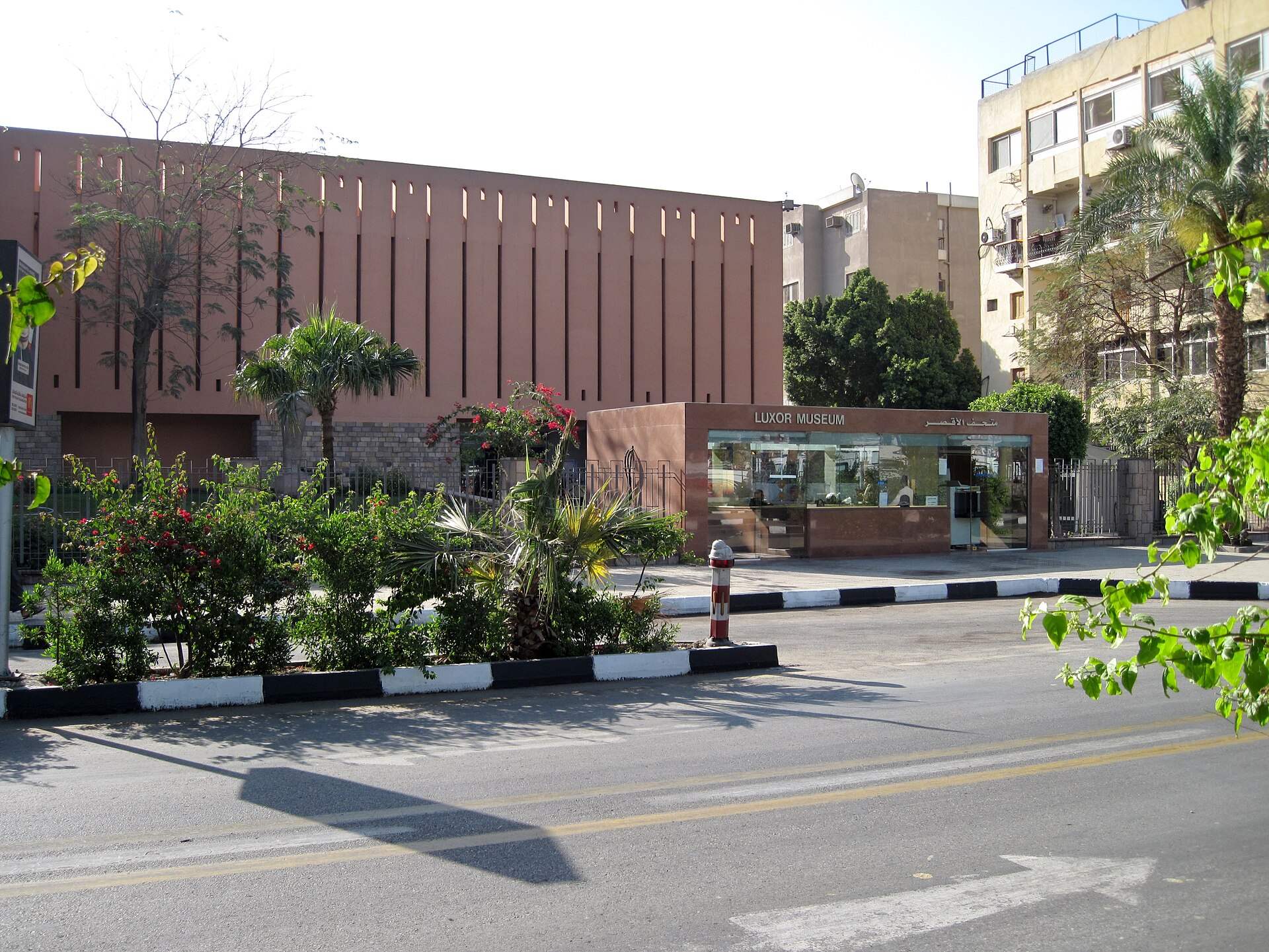
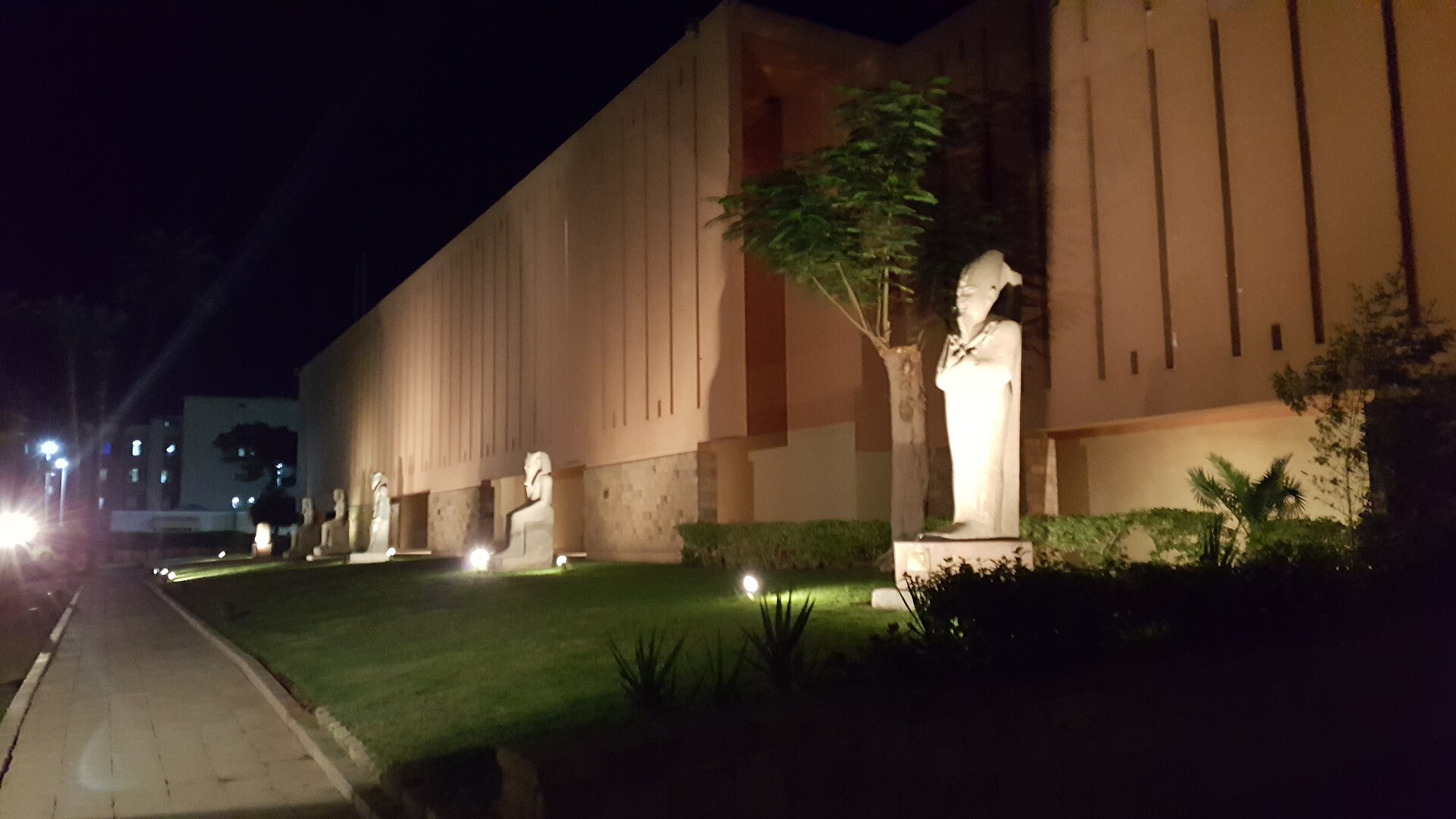
Luxor Museum's street entrance and boundary wall, seen from the Corniche el-Nil in daylight, with the museum's name sign visible beside the ticket kiosk.
Olaf Tausch · Photograph by Oltau · CC BY 3.0Luxor Museum
Museum · متحف الأقصر · Founded 1975
Open, admission and hours confirmed 15 September 2026 · 9 sources
On this page 14 sections
ContentsClose
A deliberately small, deliberately curated collection rather than an encyclopaedic one: the Ministry of Culture built Luxor Museum in the 1960s and 1970s to show a limited run of first-rate objects from Thebes, ancient Luxor, with the labeling and display clarity that a much larger museum cannot always manage. Two later extensions widened its range without changing its logic, adding a hall for the twenty-six royal and divine statues found buried at Luxor Temple in 1989, and a wing built around the mummies of the pharaohs who founded Egypt's 18th and 19th Dynasties. What ties the collection together is provenance: almost everything on display was excavated at Luxor and Karnak themselves, so the museum functions as a close reading of the two temple complexes it sits between, rather than a general survey of Egyptian civilisation.
| Local name | متحف الأقصر |
|---|---|
| Kind | Museum |
| Founded | 1975 (commissioned 1962) |
| City and country |  Luxor, Egypt Luxor, Egypt |
| Address | Sharia al-Corniche (Corniche el-Nil), East Bank, Luxor, Egypt |
| Website | egymonuments.com/locations/details/LuxorMuseum |
| Status | Open, confirmed |
| Record last verified |
Visiting
- Hours
- Daily, winter, morning session09:00 to 13:00Last entry 13:00, per the Ministry's own booking page
- Daily, winter, evening session17:00 to 20:00Last entry 20:00
- Daily, summer, morning session09:00 to 12:00Last entry 12:00
- Daily, summer, evening session17:00 to 19:00Last entry 19:00
- Daily, during Ramadan, morning session09:00 to 13:00Last entry 13:00
- Daily, during Ramadan, evening session17:00 to 19:00Last entry 19:00
- Admission
- Foreign adultEGP 400Card payment only at the museum; the Ministry's own booking page is the only cash-free way to guarantee entry
- Foreign studentEGP 200Valid student ID required, age must not exceed 24
- Egyptian adultEGP 30
- Egyptian studentEGP 10Valid student ID required, age must not exceed 24
Free entry: Children under 6. Egyptians with special needs. Egyptians aged 60 and over- Tickets
- egymonuments.com/locations/details/LuxorMuseum The museum's own ticket page.
- Do I need to book?
- No booking required; tickets are sold at the gate or through the Ministry's own online booking page, and payment is by card only, not cash, per the museum's own site and confirmed by multiple 2025-2026 visitor reports
- Address
- Sharia al-Corniche (Corniche el-Nil), East Bank, Luxor, Egypt MapOn foot On the Corniche el-Nil on the East Bank, a short walk north of Luxor Temple and roughly a mile south of the Karnak Temple complex
Taxi or caleche Luxor has no fixed-route bus or metro network built for visitors; taxis, hotel transfers and horse-drawn caleches are the practical way to reach the museum from Nile-side hotels and from the West Bank ferry landing - Website
- egymonuments.com/locations/details/LuxorMuseum
- Telephone
- +20 2 3531 7344
- [email protected]
Before you go how long, access, photography, bags, eating, shop
- How long to allow
- Reviewers who go through both floors consistently describe an hour to ninety minutes, longer with a guide
- Access
- Not published on the museum's own pages; one 2026 visitor review specifically describes the building as wheelchair accessible, but that is a single visitor account rather than a museum policy statement
- Photography
- Personal photography is permitted throughout, including of the two royal mummies, and 2025-2026 visitor reviews report no restriction or surcharge for personal cameras or phones
- Bags
- Not published on the museum's own pages
- Eating
- Not published on the museum's own pages; a small cinema near the entrance shows a short film on the 1989 discovery of the Luxor Temple cachette before visitors reach the galleries, per multiple 2025 and 2026 visitor accounts
- Shop
- A fixed-price gift shop at the entrance; one 2026 reviewer described its prices as high relative to similar items sold elsewhere in Luxor
Prices and hours change. We take them from the institution's own pages and print the day we read them, and you can check the current position at the source we used. Confirm before you travel.
What is inside
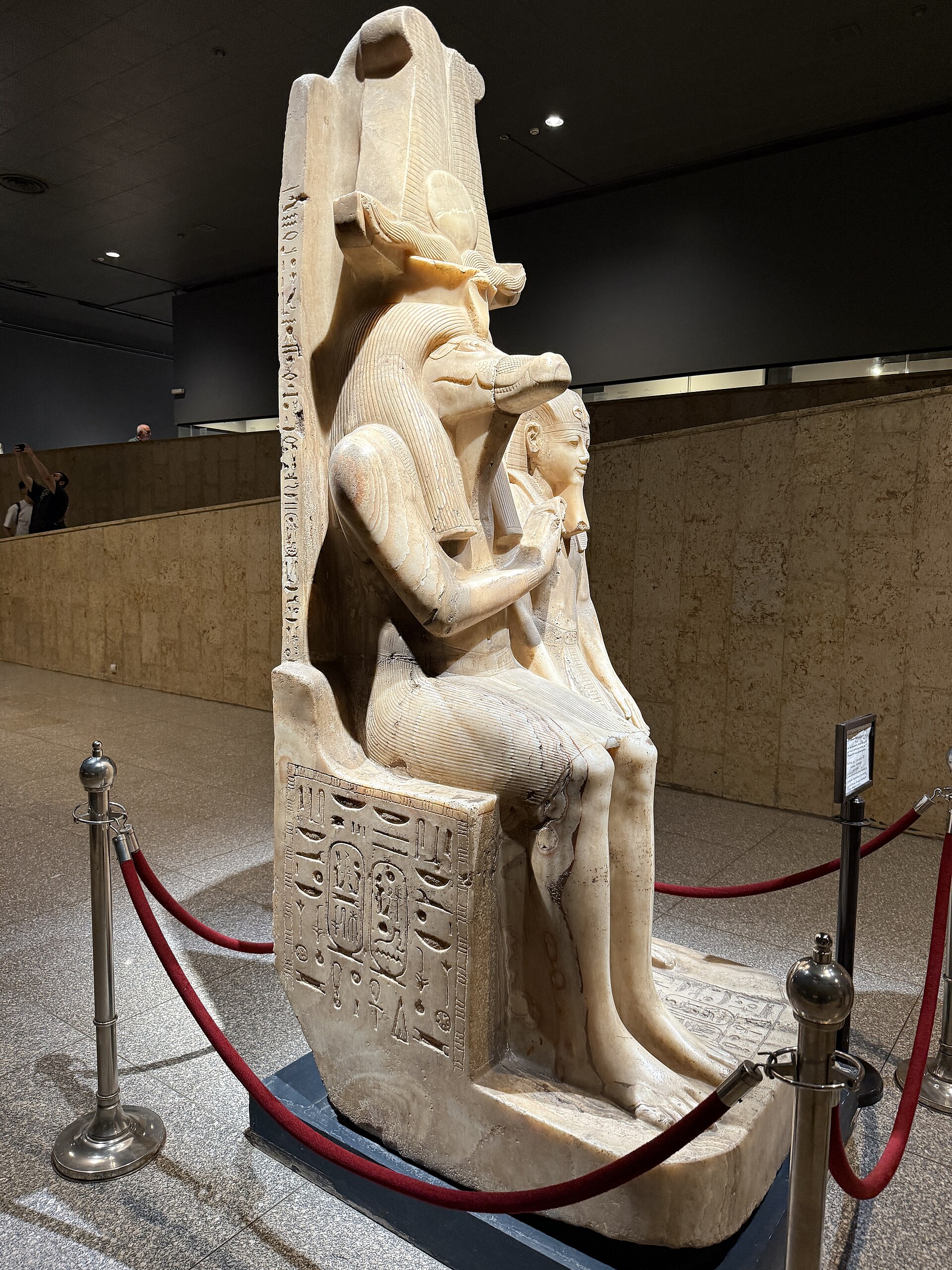
Photograph by Chabe01 · CC BY-SA 4.0 Ground-floor New Kingdom statuary
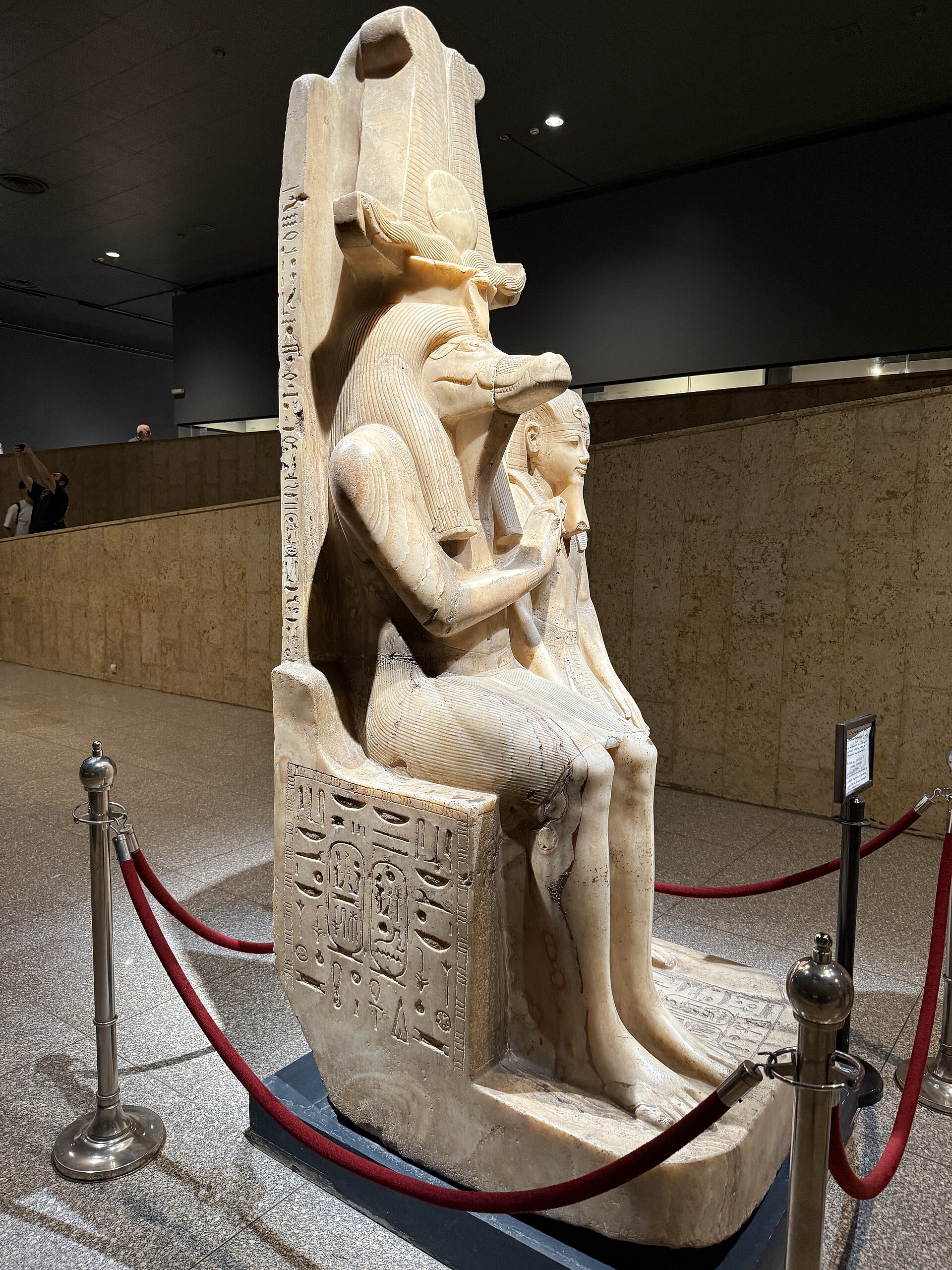
The museum's best-known single pieces: a colossal quartzite statue of Amenhotep III standing 2.49 metres, the calcite double statue of the crocodile god Sobek and the young Amenhotep III found at Dahamsha in 1967, the granodiorite scribe statue of the courtier Amenhotep son of Hapu, and the limestone Kamose stela recording the campaign that ended Hyksos rule.
The New Hall - the Luxor Temple cachette
Twenty-six statues of gods, goddesses and pharaohs, buried under the courtyard of Amenhotep III at nearby Luxor Temple during its Roman-era conversion into a military camp and rediscovered by chance in 1989. A dedicated hall for the find opened in 1991 and was rebuilt in 2026 to display all 26 pieces together for the first time in one setting.
Thebes' Glory Hall - military and technology
Part of the museum's second extension, opened in May 2004, given over to objects illustrating the military power and technological reach of New Kingdom Thebes at the height of its influence, complementing the statuary and religious material shown elsewhere in the building.
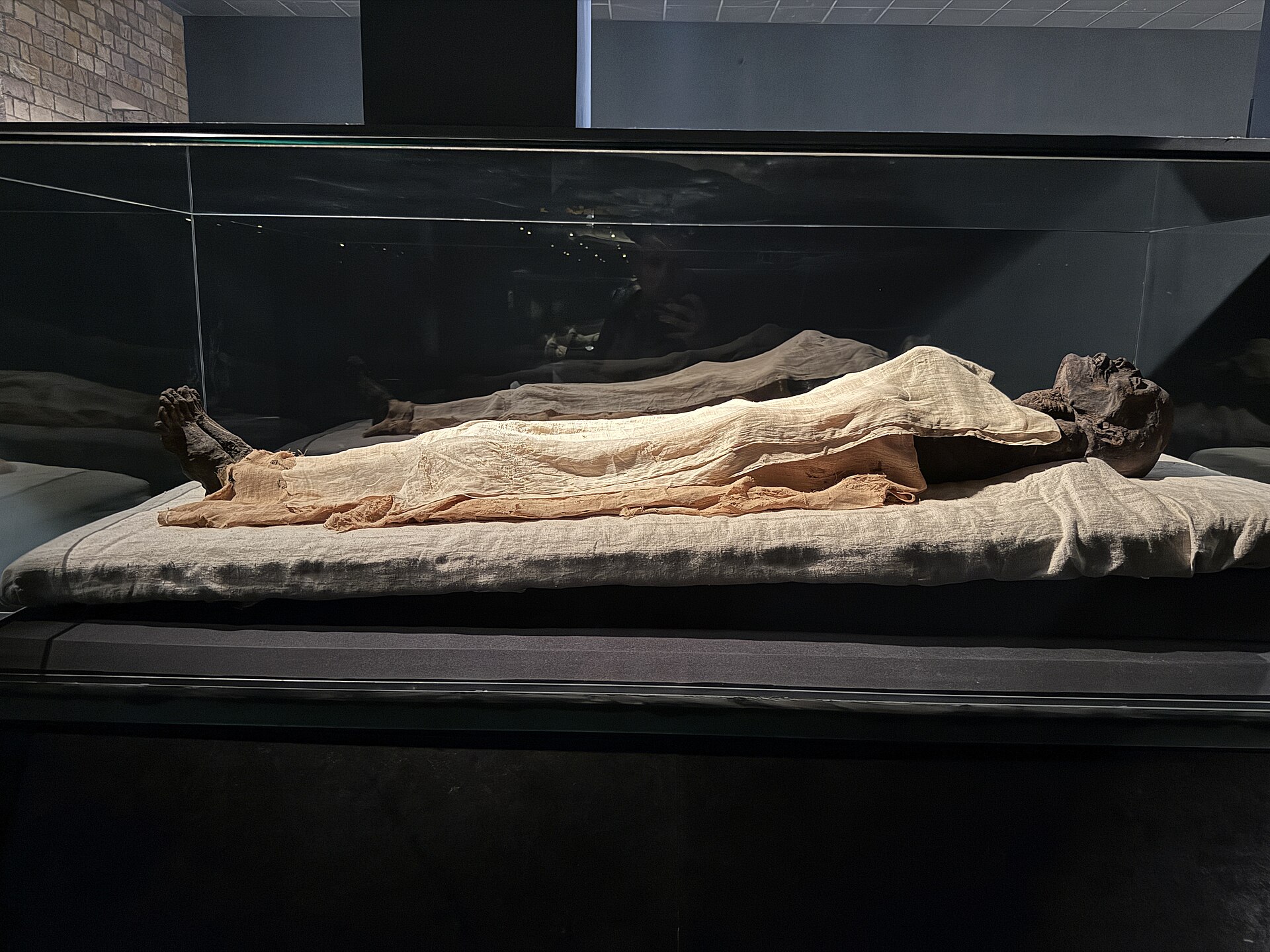
Photograph by Chabe01 · CC BY-SA 4.0 Royal Mummies Hall
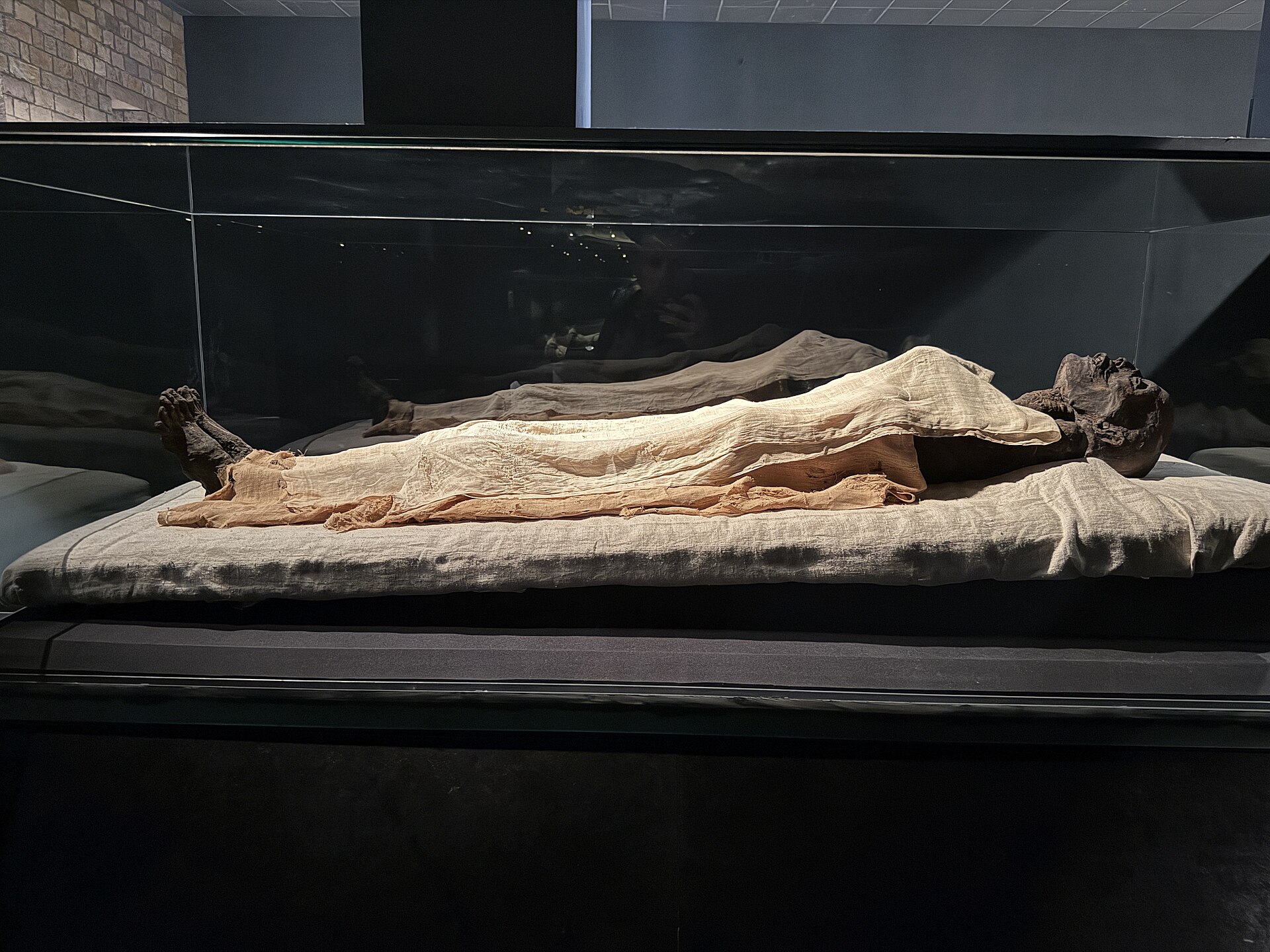
The mummies of two pharaohs, Ahmose I, founder of the 18th Dynasty and the ruler who expelled the Hyksos from Egypt, and Ramesses I, founder of the 19th Dynasty, unveiled in this hall in March 2004 alongside weapons and ceremonial objects connected to their reigns.
Akhenaten talatat wall
A reconstructed wall assembled from hundreds of small sandstone blocks known as talatat, carved during the reign of Akhenaten for his temple at Karnak and later dismantled and reused as building fill; reassembled here to show the informal, naturalistic style of Amarna-period relief, including scenes of Akhenaten and Nefertiti with their daughters.
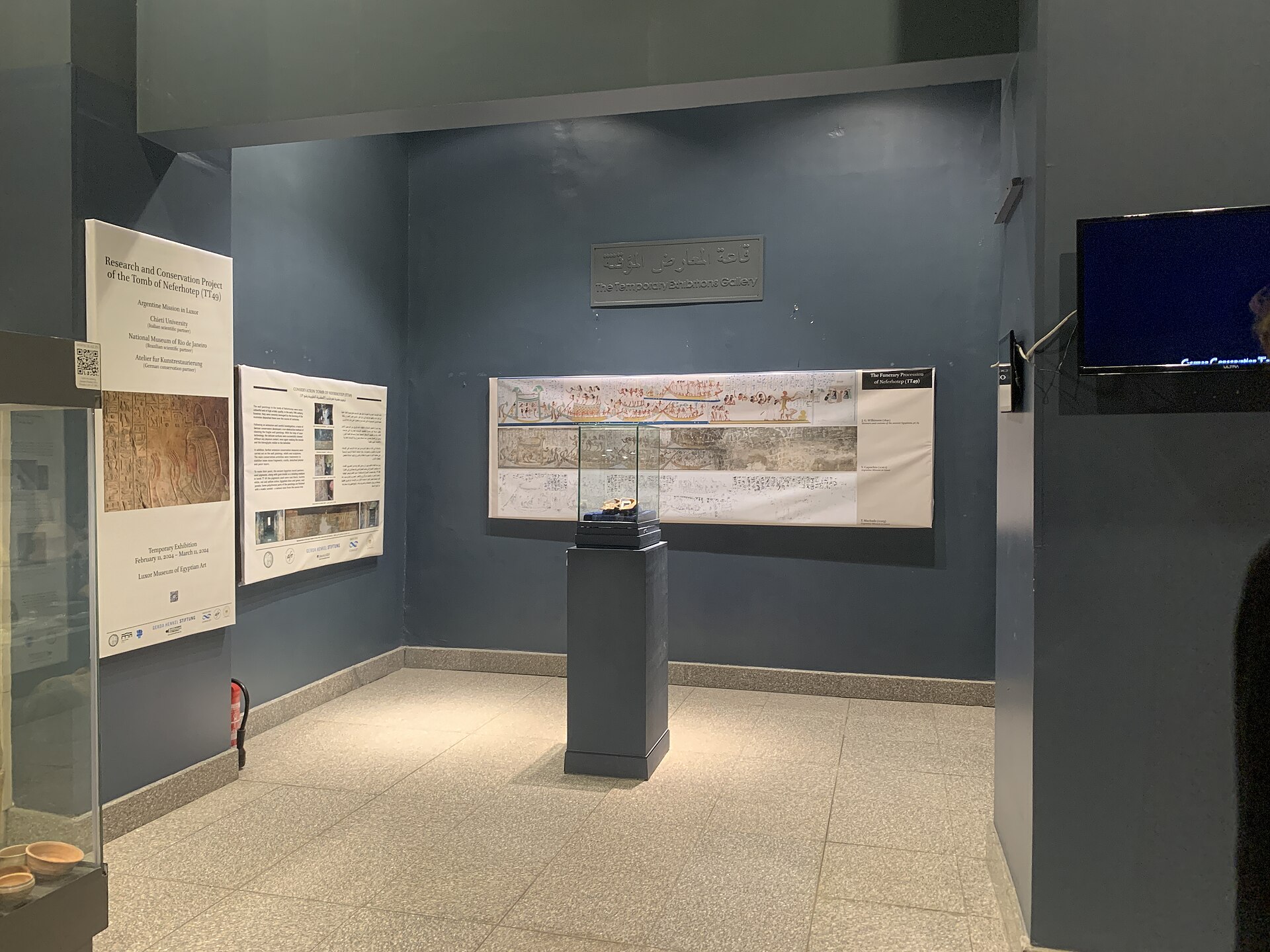
Photograph by Marsupium · CC BY 4.0 Temporary Exhibitions Gallery
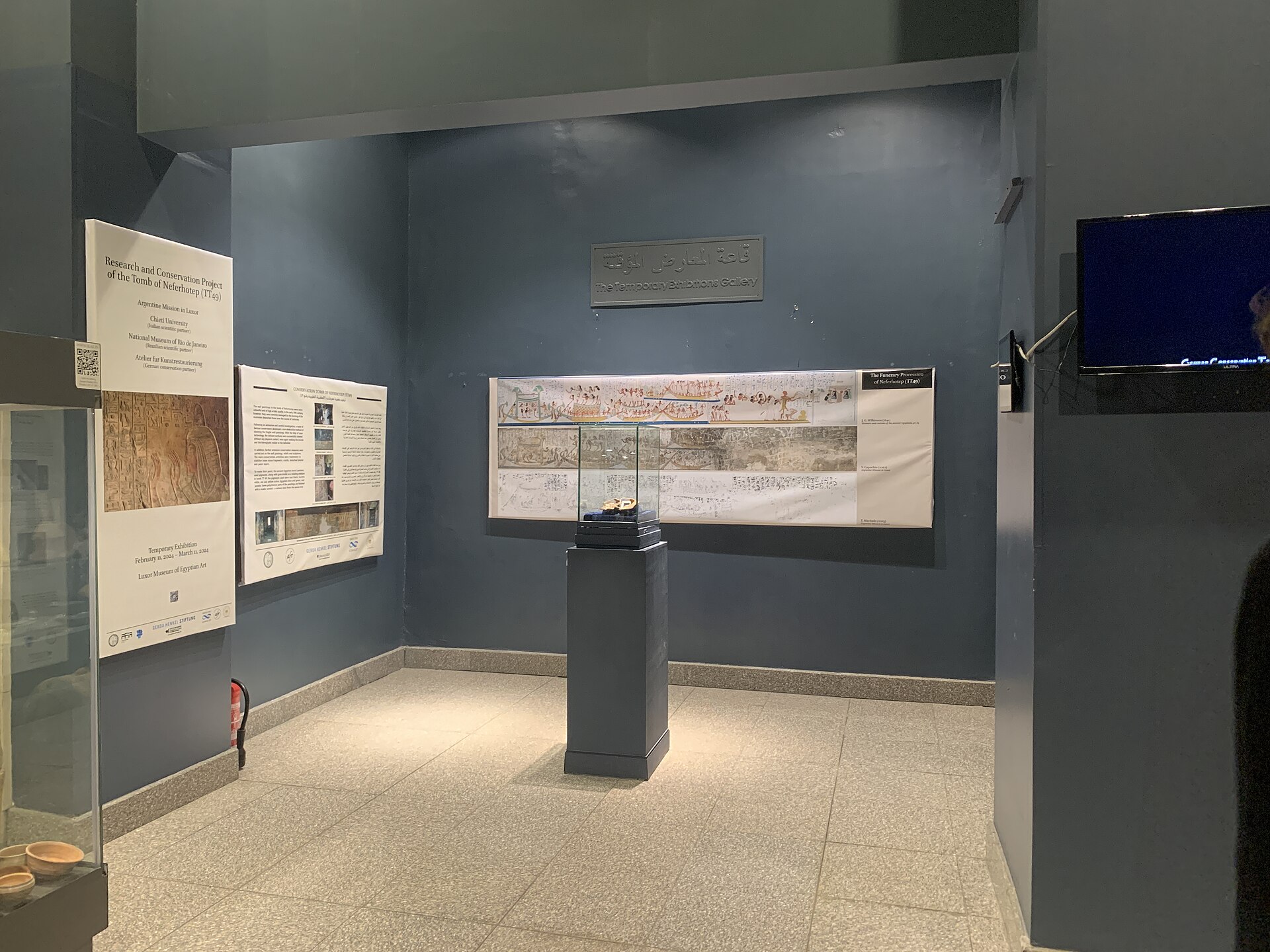
A rotating display space; photographed in March 2024 showing material on the research and conservation of the Theban tomb of Neferhotep, part of the museum's ongoing practice of presenting current excavation and conservation projects to visitors rather than only its permanent holdings.
What to see first
Calcite statue of Sobek and Amenhotep III
18th Dynasty, circa 1390-1352 BCA rare large-scale statue pairing a crocodile-headed god with a king carved from a single block of calcite, found sealed in a shaft at Dahamsha in 1967 and later re-inscribed for Ramesses II.6
Colossal quartzite statue of Amenhotep III
18th Dynasty, circa 1390-1352 BCAt 2.49 metres, one of the best-preserved large-scale royal portraits of Amenhotep III's reign on display anywhere in Egypt.4
Scribe statue of Amenhotep, son of Hapu
18th Dynasty, circa 1390-1352 BCA non-royal courtier honored with statuary at near-royal scale; he served as Amenhotep III's chief scribe and architect and was venerated as a sage for centuries afterward.4
Kamose stela
17th Dynasty, circa 1550 BCA rare contemporary royal account, in the king's own words, of the campaign against the Hyksos that set up the wars of reunification and the New Kingdom that followed.4
The 1989 Luxor Temple cachette, 26 statues
Various reigns, buried in the Roman periodThe largest single hoard of royal and divine statuary found in Egypt since Tutankhamun's tomb, deliberately buried under a temple courtyard roughly two thousand years ago and recovered largely intact.5
Akhenaten talatat wall reconstruction
Reign of Akhenaten, 18th DynastyOne of the few places outside Karnak's own open-air museum where Amarna-period relief carving from Akhenaten's reign can be seen reassembled at scale.4
Royal mummies of Ahmose I and Ramesses I
18th and 19th Dynasty foundersVisitors can view the mummies of the men who founded two successive royal dynasties at close range, without the queues that Cairo's larger mummy halls draw.7
A modern building for a small, curated collection
The Egyptian Ministry of Culture commissioned the architect Dr. Mahmud El Hakim to design the museum in 1962, and installation of its collection ran from 1972 to 1975, when it opened on the Corniche el-Nil overlooking the east bank of the Nile. From the start it was built around a different idea than Cairo's Egyptian Museum: rather than displaying as much as possible, the collection was kept deliberately restricted, with the museum's own emphasis falling on the quality of individual pieces, an uncluttered installation, and clear labeling in more than one language. That founding choice is still the clearest way to describe the museum today, and it is the reason visitors who have also been to the Egyptian Museum in Cairo tend to describe Luxor Museum as the more legible of the two, even though it holds a fraction of the objects.
The cachette that came up out of a temple courtyard
On the morning of 22 January 1989, the archaeologist Mohammed al-Saghir was overseeing routine maintenance in the courtyard of Amenhotep III at Luxor Temple, a few hundred metres from the museum, when workers found the first of what became twenty-six statues of gods, goddesses and pharaohs buried beneath the paving. Digging continued until 20 April of that year, with the last piece recovered at a depth of about 4.5 metres. The statues had been placed there deliberately, most likely when the temple precinct was converted into a Roman military camp, sealing what had been standing statuary safely below ground for roughly two thousand years. A large new hall, designed by Italian architects, opened in December 1991 to hold seventeen of the find; the remaining pieces were kept elsewhere in storage and on rotating display. In April 2026 the Ministry of Tourism and Antiquities completed a renovation of that hall, with new flooring, lighting, display cases and an installation concept built around recreating the moment of discovery, and for the first time brought the full run of twenty-six statues together in a single dedicated room.
Two extensions, twenty-nine years apart
The 1991 cachette hall was the museum's first major expansion beyond its original 1975 building; its second came on 20 May 2004, when a further set of rooms opened together as what the museum calls Thebes' Glory Hall, built around the military power and technological reach of Thebes at the height of the New Kingdom. The same extension included a new Royal Mummies Hall and a small visitor centre, and in March 2004 the museum put the mummies of two pharaohs on public display there for the first time: Ahmose I, the 18th Dynasty king credited with driving the Hyksos out of Egypt, and Ramesses I, the short-reigned founder of the 19th Dynasty. Both are shown in climate-controlled cases alongside weapons and ceremonial objects connected to their reigns, a pairing of ruler and regalia that the original 1975 building, built before either mummy had been prepared for display, was never designed to hold.
Statues that outlasted the men who commissioned them
Away from the cachette and the mummies, the ground floor holds the objects most individual reviewers name first. A calcite double statue shows the crocodile god Sobek handing the ankh, the sign of life, to a youthful Amenhotep III; it was found sealed inside a stone shaft at Dahamsha, south of Luxor, in 1967, and its reverse carries five columns of hieroglyphic text added later, when the statue was re-inscribed in the name of Ramesses II rather than carved fresh for him. Nearby stands a colossal quartzite statue of Amenhotep III himself, 2.49 metres tall and among the best-preserved large royal portraits from his reign anywhere in Egypt, and a granodiorite scribe statue of Amenhotep, son of Hapu, the courtier who served as the king's chief architect and was still venerated as a sage centuries after his death. A reconstructed wall built from hundreds of small sandstone talatat blocks, carved during the reign of Akhenaten for his temple at Karnak and later broken up and reused as building fill elsewhere, shows the informal, naturalistic style of Amarna-period relief that this king's short reign is remembered for, including scenes of Akhenaten and Nefertiti with their daughters.
On the corniche, between two temples
The museum sits on the Corniche el-Nil, a short walk from Luxor Temple and roughly a mile from the Karnak Temple complex, and most visitors combine it with one or both on the same day, often at the end of an afternoon rather than the start of one. Tickets are sold at the gate or through the Ministry's own booking page and, per the museum's own site and multiple 2025-2026 visitor accounts, by card only; the site publishes three separate daily schedules for winter, summer and Ramadan, each split into a morning session ending at midday and an evening session starting at five, rather than a single continuous opening. A small cinema near the entrance shows a short film on the 1989 discovery of the cachette before visitors reach the galleries themselves, and a fixed-price gift shop sits at the exit.
What reviewers actually find there now
At 4.6 out of 5 across 1,621 Tripadvisor reviews, with the large majority rated Excellent or Good, Luxor Museum is one of the more highly regarded attractions in the city, and the reviews read as specific rather than generic: visitors name the Sobek and Amenhotep III statue, the royal mummies and the cachette pieces rather than writing only about the collection in general terms, and several explicitly compare the museum favourably to the much larger and more crowded Egyptian Museum in Cairo for its lighting, labeling and pace. The recurring complaint is proportion: more than one reviewer in 2026 described the standard 400-pound foreign-adult ticket as expensive for a museum that takes most visitors under two hours to see in full, and the card-only payment system, with no cash option at the gate, produced at least one reported billing error. Both criticisms sit alongside consistently high marks for the objects themselves, which is the pattern the aggregate score reflects.
What visitors say
Across a large review base (1,621 ratings on Tripadvisor, averaging 4.6 of 5, with the large majority marked Excellent or Good), visitors consistently describe Luxor Museum as small but exceptionally well curated: modern, uncrowded, clearly lit and labeled in English and Arabic, and repeatedly contrasted with the much larger and more crowded Egyptian Museum in Cairo. The two royal mummies and the Sobek and Amenhotep III statue are named again and again as the reason to come. The recurring reservation is value for the ticket price set against the museum's modest size, along with its unusual split, midday-closing hours and card-only payment.
What is praised, what is criticised
- Praised: the clarity and quality of the displays, with modern lighting, bilingual labeling and an uncrowded, air-conditioned setting that reviewers repeatedly contrast with the much larger Egyptian Museum in Cairo
- Praised: the chance to see the two royal mummies and the Luxor Temple cachette statues up close without the queues or crowds of Cairo's museums
- Praised: specific named pieces, above all the calcite statue of Sobek and Amenhotep III and the colossal quartzite Amenhotep III, called out individually by multiple reviewers rather than described only in general terms
- Criticised: the small size and limited number of objects relative to the standard foreign-adult ticket price of 400 Egyptian pounds, raised by more than one 2026 reviewer as expensive for what is shown
- Criticised: the split, midday-closing opening hours (roughly 9am-1pm and 5pm-8pm) and a card-only payment system with no cash option, which one reviewer says produced a billing error at the gate
Ratings on other platforms
Tripadvisor: 4.6 from 1,621 ratings, read 13 August 2026
A platform average is a tertiary source: it moves, it is not audited, and we quote no visitor's words.
Questions about Luxor Museum
Where is Luxor Museum?
Sharia al-Corniche (Corniche el-Nil), East Bank, Luxor, Egypt.
How much does it cost to visit?
Foreign adult: EGP 400; Foreign student: EGP 200; Egyptian adult: EGP 30; Egyptian student: EGP 10. As confirmed 15 September 2026.
When is it open?
Daily, winter, morning session 09:00-13:00; Daily, winter, evening session 17:00-20:00; Daily, summer, morning session 09:00-12:00; Daily, summer, evening session 17:00-19:00; Daily, during Ramadan, morning session 09:00-13:00; Daily, during Ramadan, evening session 17:00-19:00. As confirmed 15 September 2026.
How do you get there?
On foot: On the Corniche el-Nil on the East Bank, a short walk north of Luxor Temple and roughly a mile south of the Karnak Temple complex; Taxi or caleche: Luxor has no fixed-route bus or metro network built for visitors; taxis, hotel transfers and horse-drawn caleches are the practical way to reach the museum from Nile-side hotels and from the West Bank ferry landing.
What should you see first?
Calcite statue of Sobek and Amenhotep III (18th Dynasty, circa 1390-1352 BC); Colossal quartzite statue of Amenhotep III (18th Dynasty, circa 1390-1352 BC); Scribe statue of Amenhotep, son of Hapu (18th Dynasty, circa 1390-1352 BC); Kamose stela (17th Dynasty, circa 1550 BC); The 1989 Luxor Temple cachette, 26 statues (Various reigns, buried in the Roman period); Akhenaten talatat wall reconstruction (Reign of Akhenaten, 18th Dynasty).
What we could not confirm
- No named published criticism, restitution claim or provenance dispute specific to Luxor Museum's own holdings was found during this research; the acquisition history of individual pieces such as the Dahamsha Sobek and Amenhotep III statue is documented as an excavation find rather than a transfer, and nothing consulted here suggests a live dispute over any object on display.
- The exact identity of the mummy in the Royal Mummies Hall shown in this record's photograph (Ahmose I or Ramesses I) is not stated in the Commons file description and was not independently confirmed; the caption describes it only as one of the hall's two mummies rather than naming one.
- No verifiable free-licence photograph of Thebes' Glory Hall's interior or of the Akhenaten talatat wall itself was located on Commons at the time of writing; both wings are described from written sources only, and a future desk should not substitute an unrelated gallery photograph for either.
Images
Sources
- 1Ministry of Tourism and Antiquities, official visit and booking page for Luxor Museum: admission prices for foreign and Egyptian adults and students, free-entry policy, winter, summer and Ramadan opening hours with last-entry times, and the Ministry support contact phone and email printed on the page. Read directly on 13 August 2026. egymonuments.com/locations/details/LuxorMuseum
- 2State Information Service (Arab Republic of Egypt), 'Luxor Museum to reopen cache hall after major upgrade', 13 April 2026: renovation of the New Hall housing the Luxor Temple cachette, new flooring and display systems, statements from Minister of Tourism and Antiquities Sherif Fathy and Supreme Council of Antiquities Secretary-General Hisham el-Leithy, and confirmation that all 26 cachette artefacts are displayed together in one hall for the first time. sis.gov.eg/en/media-center/news/luxor-museum-to-reopen-cache-hall-after-major-upgrade/
- 3Ministry of Tourism and Antiquities (Discover Egypt's Monuments), event page marking the 30th anniversary of the Luxor Temple cachette discovery: the find date of 22 January 1989, the role of archaeologist Mohammed al-Saghir, and confirmation that most of the statues are held at Luxor Museum. egymonuments.gov.eg/events/celebrating-the-30th-anniversary-of-the-discovery-of-the-cache-at-luxor-temple/
- 4Wikipedia, 'Luxor Museum': the 1962 commission of architect Mahmud El Hakim, installation of the collection between 1972 and 1975, the 1975 opening, the 1989 cachette and its display, the March 2004 unveiling of the mummies of Ahmose I and Ramesses I, the Akhenaten talatat wall, and named highlight objects including the Kamose stela, the quartzite Amenhotep III statue and the scribe statue of Amenhotep son of Hapu, with coordinates. en.wikipedia.org/wiki/Luxor_Museum
- 5Wikipedia, 'Luxor statue cache': details of the 1989 discovery, including the roughly 4.5-metre depth of the final find, digging continuing to 20 April 1989, the burial of the statues during the Roman-era conversion of the temple courtyard into a military camp, and named statues within the cachette. en.wikipedia.org/wiki/Luxor_statue_cache
- 6Ancient Egypt and Archaeology Web Site, page on the calcite statue of Amenhotep III and Sobek: its 1967 discovery in a sealed shaft at Dahamsha, its material and dating, and its later re-inscription in the name of Ramesses II. Read directly on 13 August 2026. ancient-egypt.co.uk/luxor_museum/pages/amenhotep%20iii%20sobek%201.htm
- 7Explore Luxor, Luxor Museum visitor guide: description of the Royal Mummies Hall and its climate-controlled cases, the Akhenaten talatat reliefs, and current opening hours and admission prices, cross-checked against the museum's own booking page. exploreluxor.org/luxor-museum/
- 8Tripadvisor, Luxor Museum listing: current aggregate rating of 4.6 out of 5 from 1,621 reviews, the rating breakdown by band, distances to nearby attractions, and individual visitor review text on exhibits, hours, payment and pricing, read directly, including full review text, in the in-app browser on 13 August 2026. tripadvisor.com/Attraction_Review-g294205-d318020-Reviews-Luxor_Museum-Luxor_Nile_River_Valley.html
- 9Wikidata, Luxor Museum (Q1878362): label, description, coordinates and country, cross-checked against the museum's own address and against the GPS coordinates recorded in the lead photograph's own Commons file description before use. wikidata.org/wiki/Q1878362