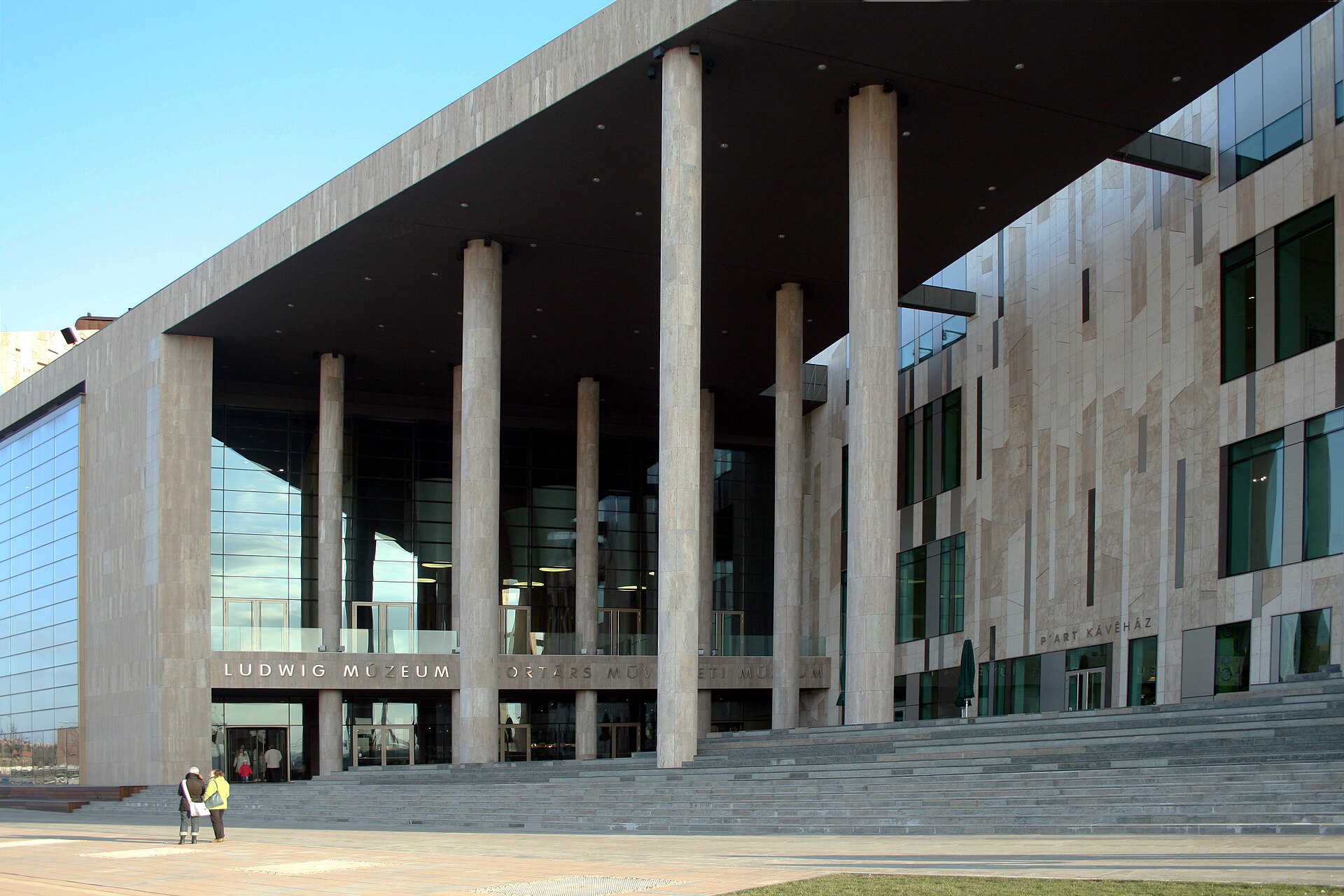
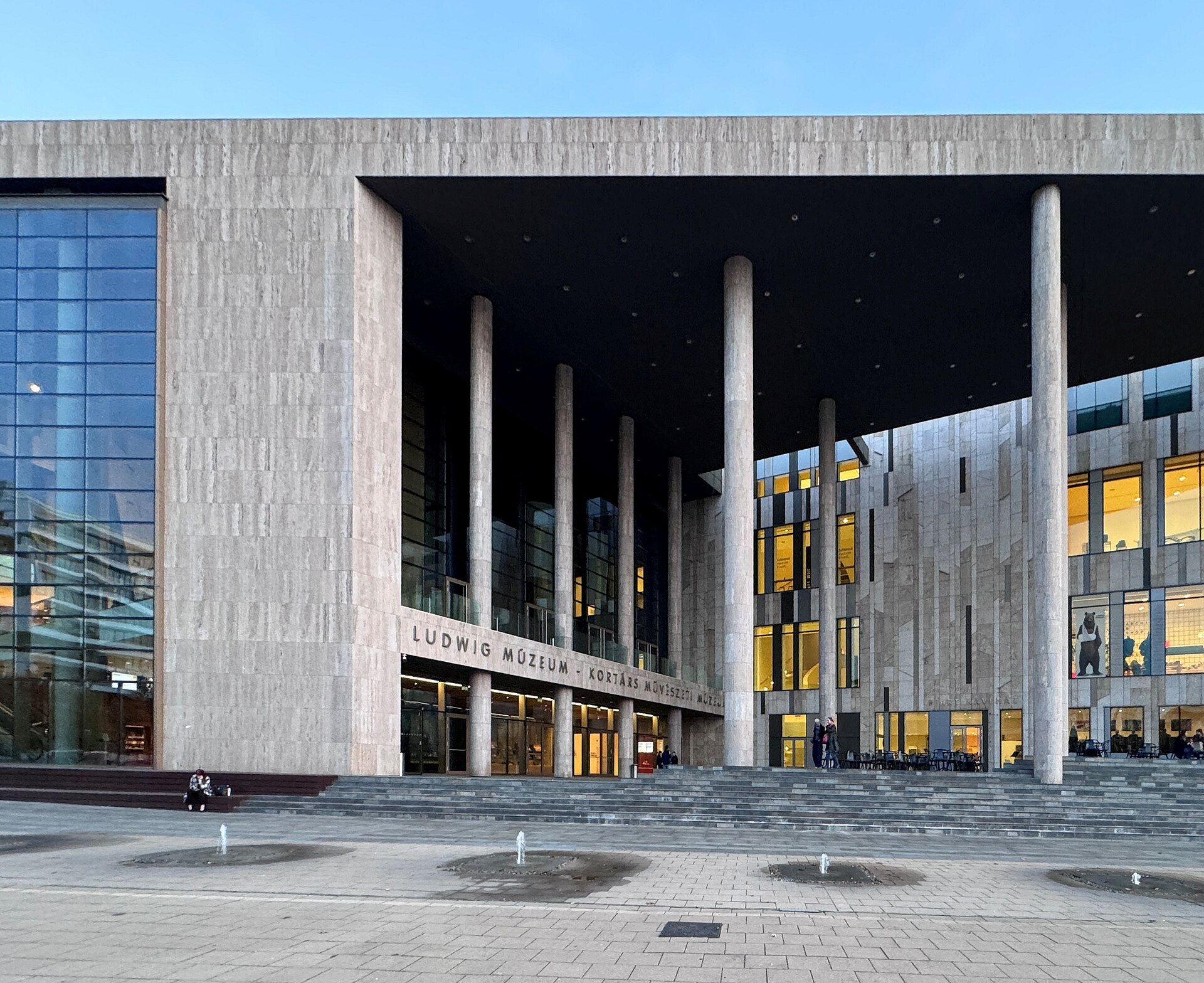
The Ludwig Museum's own entrance front, cut into the travertine facade of the Mupa Budapest complex on the Danube side of the building; the museum's name is carved into the stone above the doors.
Peter Siroki · Photograph by Peter Siroki from Budapest, Hungary · CC BY 2.0Ludwig Museum - Museum of Contemporary Art
Museum · Ludwig Muzeum - Kortars Muveszeti Muzeum · Founded 1989
Open, admission and hours confirmed 28 September 2026 · 26 sources
On this page 14 sections
ContentsClose
The Ludwig Museum's distinct strength is holding two collections that most museums keep apart: an internationally significant core of American and Western European pop art and photorealism, assembled by a single collecting couple in the 1960s to 1980s and still anchored by three late Picasso paintings and signature works by Warhol, Lichtenstein, Oldenburg and Rauschenberg; and, built independently since the 1990s, one of the more complete institutional holdings of Hungarian and wider Central and Eastern European contemporary art from the 1960s to the present, read deliberately against that international backdrop rather than in isolation. Few collections anywhere pair a blue-chip Western pop core with a deep regional contemporary holding under one roof.
| Local name | Ludwig Muzeum - Kortars Muveszeti Muzeum |
|---|---|
| Kind | Museum |
| Founded | 1989 |
| City and country |  Budapest, Hungary Budapest, Hungary |
| Address | H-1095 Budapest, Komor Marcell utca 1. |
| Website | ludwigmuseum.hu/en |
| Status | Open, confirmed |
| Record last verified |
Visiting
- Hours
- Tue-Sun10:00 to 20:002nd floor exhibition space
- Tue-Sun10:00 to 18:003rd floor exhibition space
- Closed
- Monday.
- Admission
- Standard, one exhibition floorHUF 3,3002nd or 3rd floor exhibition only
- Standard, combined ticket (both exhibition floors)HUF 5,000
- Groups of 10+, one floorHUF 3,100per person
- Students and seniors, groups of 10+, one floorHUF 1,600per person
- Family, 1 adult + 1 childHUF 5,100combined ticket
- Family, 1 adult + 2-4 childrenHUF 7,000combined ticket; price rises with the number of children, 7000-9000 HUF
- Annual pass, adultHUF 16,000365 days
- Annual pass, concessionHUF 8,000365 days
- Visitors with disabilities and one companionFreeon presentation of a valid disability ID, European Disability Card, or official certificate
- Tickets
- ludwigmuseum.hu/en/online-tickets The museum's own ticket page.
- Do I need to book?
- No for individual visitors; the museum advises booking ahead and requires it for guided tours (minimum group of 2)
- Address
- H-1095 Budapest, Komor Marcell utca 1. MapHEV suburban rail Line H7, stop Kozvagohid
Tram Tram 1, stop Kozvagohid; trams 2 and 24, stop Mupa - Nemzeti Szinhaz
Bus Buses 23, 54 and 55, stop Mupa - Nemzeti Szinhaz
Boat BKK boat lines D11 (weekdays only) and D12, southbound to the Mupa - Nemzeti Szinhaz HEV stop
Cycling MOL Bubi docking station and secured bicycle racks on site
Car Free street parking nearby, or the Mupa underground garage at 400 HUF per hour - Website
- ludwigmuseum.hu/en
- Telephone
- +36 1 555 3444
- [email protected]
Before you go how long, access, photography, bags, eating, shop
- How long to allow
- Not stated by the museum in hours; the two exhibition floors together cover 3,300 square metres
- Access
- The entire building, all floors and all exhibition rooms are step-free, with lift access throughout. The museum lends wheelchairs free of charge from the Information Desk on request, and admission is free for visitors with disabilities and one companion on presentation of a valid disability ID, European Disability Card or official certificate. Designated accessible parking is provided in the Mupa underground garage.
- Photography
- Not stated on the museum's own visitor pages checked for this record
- Bags
- Not stated on the museum's own visitor pages checked for this record
- Eating
- P'Art Kavehaz on the ground floor, wallpapered by the artist Tamas Komoroczky, seats 60 and can be hired for events. Open daily from 10:00, until 22:00 on non-performance days and until 24:00 on days Mupa has a performance.
- Shop
- Museum Shop on the first floor, open daily 10:00-17:30, free to enter without an exhibition ticket. Sells the museum's own publications and past exhibition catalogues, art albums and magazines, and souvenirs, prints and postcards by Hungarian designers including Malinovka, Blacklist Design, Artkores and Personal Perception.
Prices and hours change. We take them from the institution's own pages and print the day we read them, and you can check the current position at the source we used. Confirm before you travel.
What is inside
3rd floor exhibition space
The museum's own collection, shown in rotating selections such as the 2023-24 hang '1-2-3: The Collection in Focus'. This is where the founding Ludwig gift of Western pop art and photorealism is shown alongside the progressive Hungarian painting of the 1960s that the museum has built its Central and Eastern European holdings around since the 1990s.
2nd floor exhibition space
The museum's temporary exhibition programme, changing several times a year; as of this record it holds 'Black Mirror. The Long Shadow of the Future', which opened 7 April 2026. This is the floor visiting curators and lenders use for loan shows.
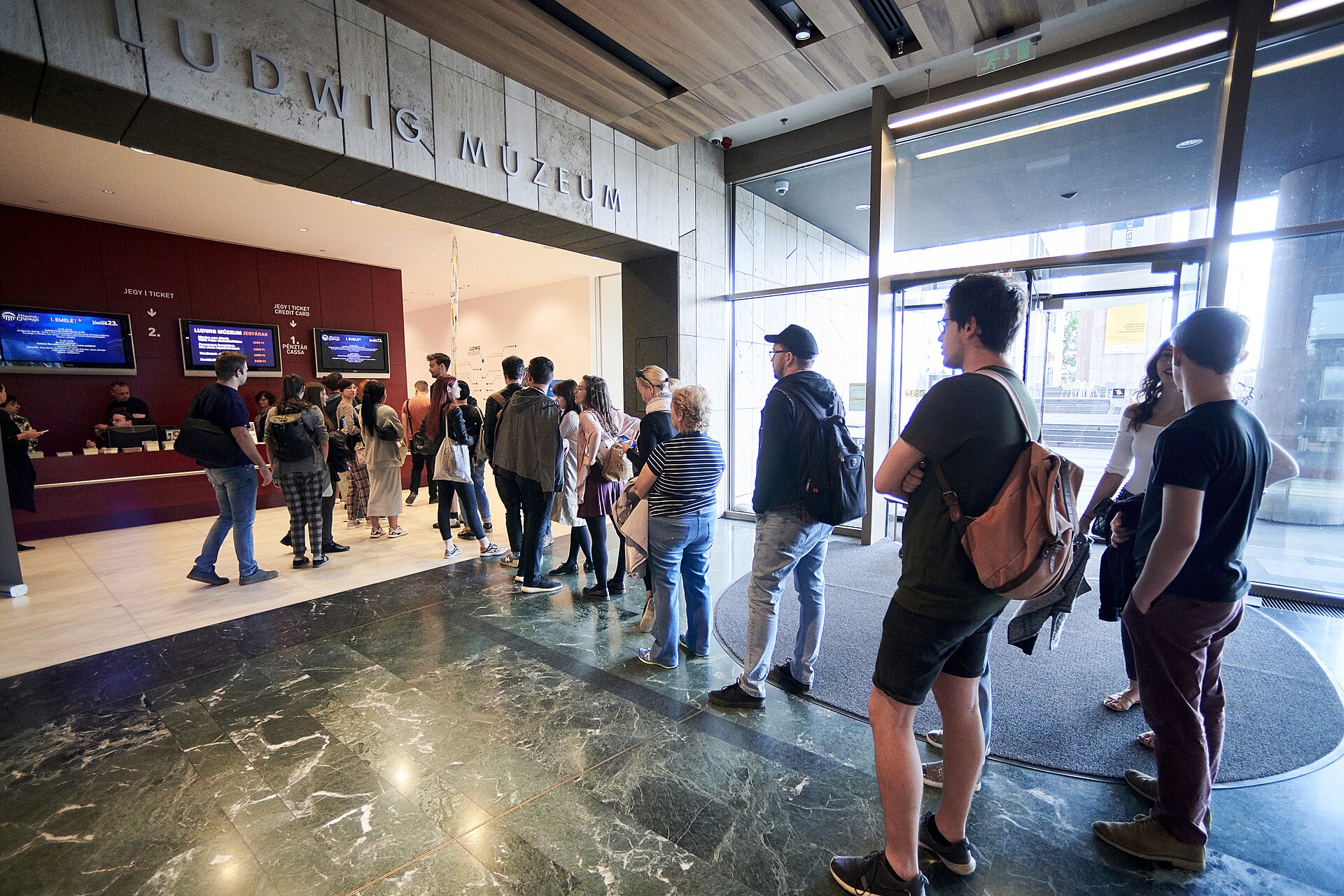
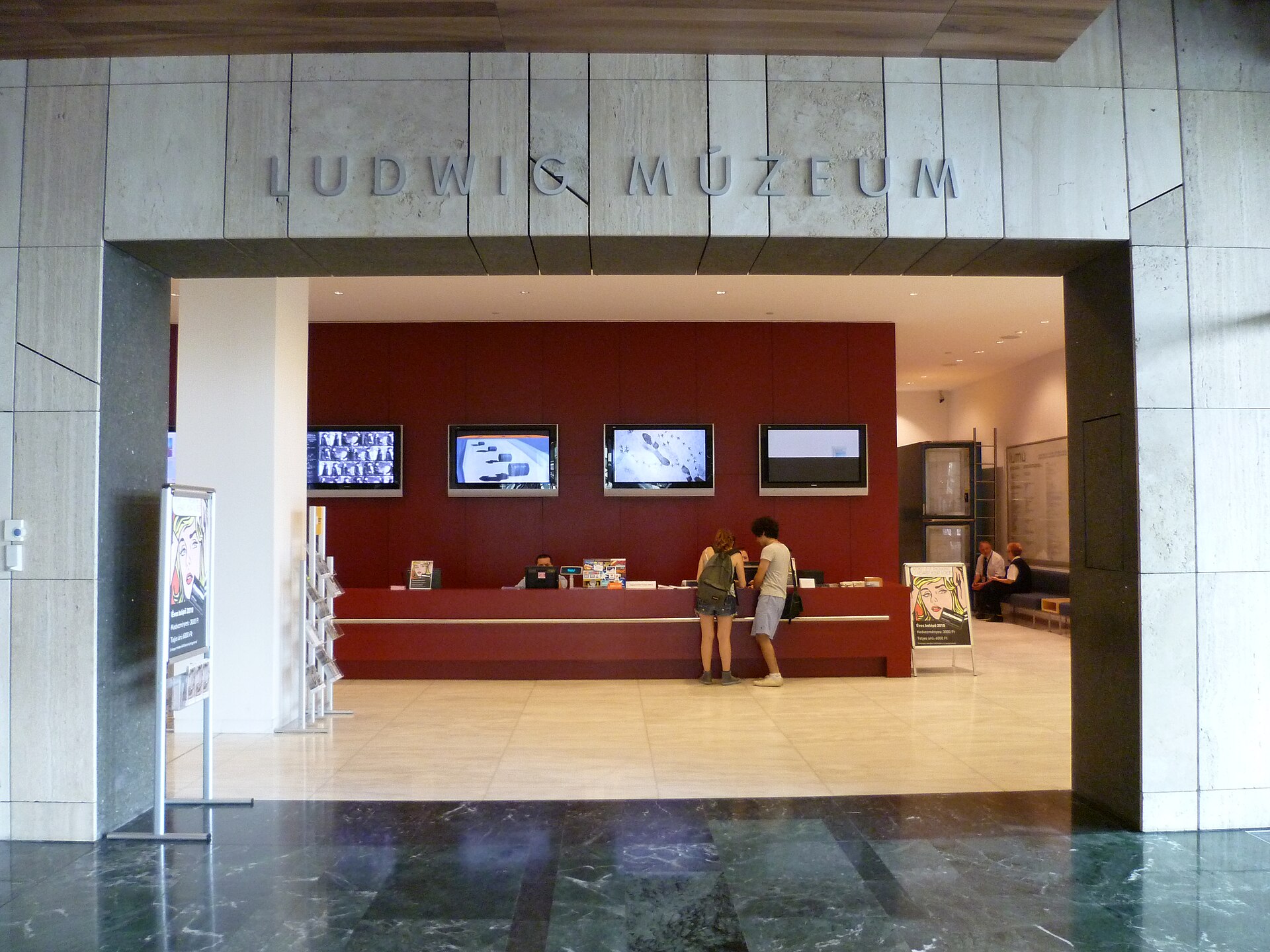
Photograph by Végel Dániel https://vegeldaniel.com/rendezveny-fotozas-budapest · CC BY-SA 4.0 Entrance hall and ticket desk
The ground-floor lobby where the museum's own entrance, separate from the Mupa concert-hall foyer, opens off the building's main hall; the ticket desk and information point sit here, with the museum's name cut into the stone lintel above.
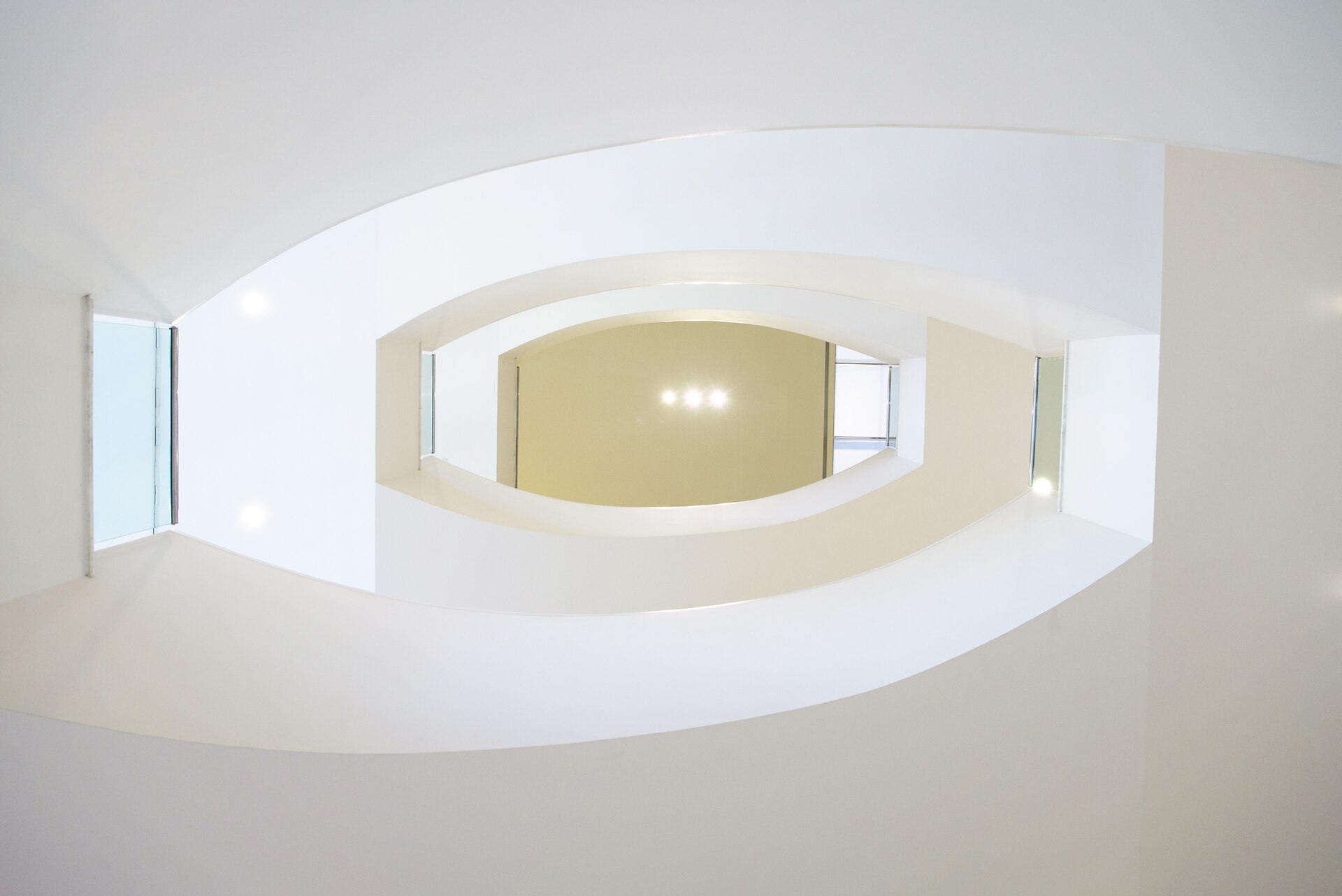
Photograph by Szabó Zsófia · CC BY-SA 4.0 Atrium and staircase
A top-lit, sculptural stairwell connecting the museum's floors, part of the poured-concrete and travertine interior architecture that runs through the whole Mupa building.
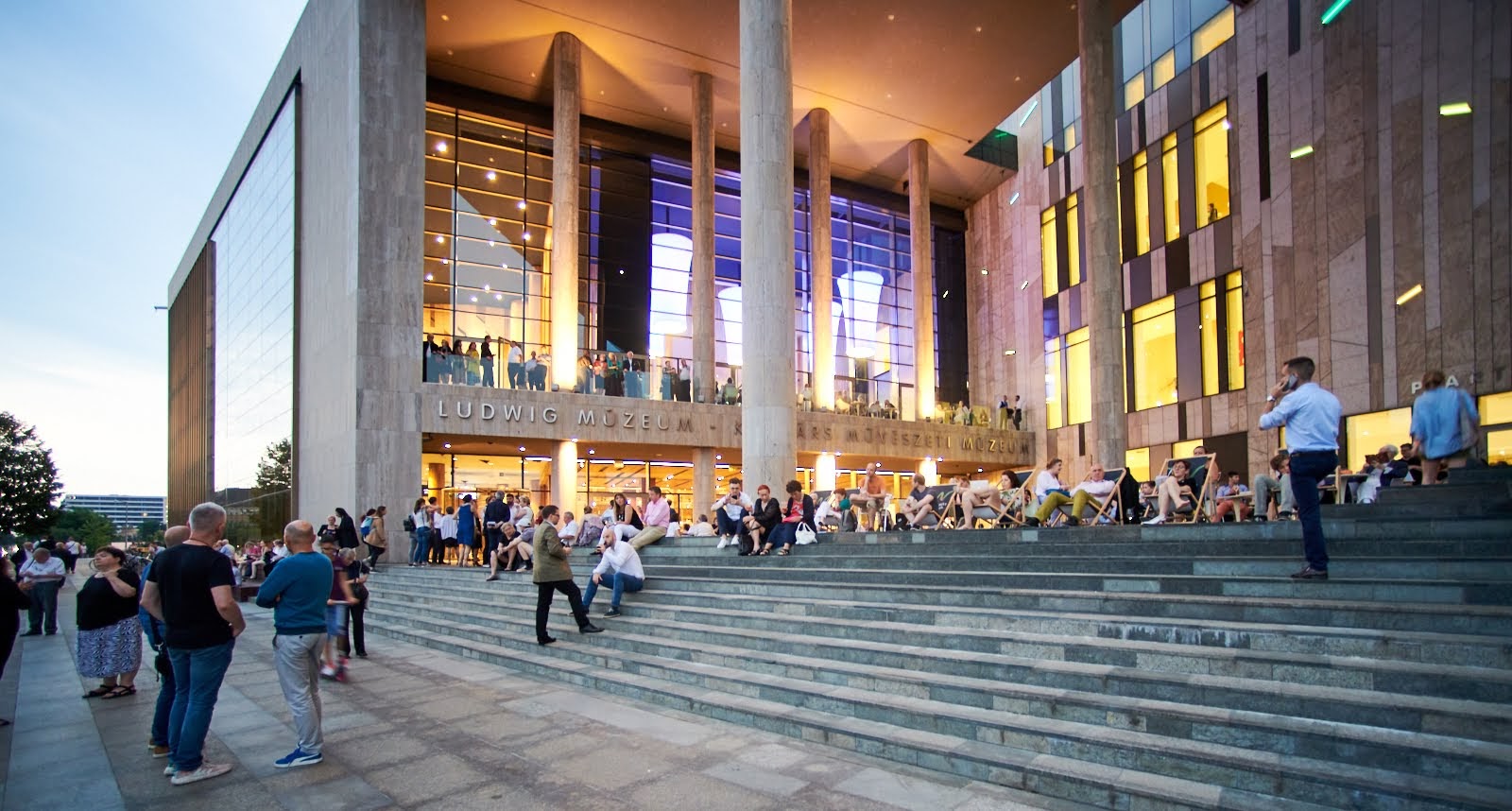
Photograph by Végel Dániel https://vegeldaniel.com/rendezveny-fotozas-budapest · CC BY-SA 4.0 Riverside terrace
An open-air terrace on the Danube side of the building, used for evening events such as the annual Museum Night; it looks out toward the river past the same stone colonnade that fronts the main entrance.
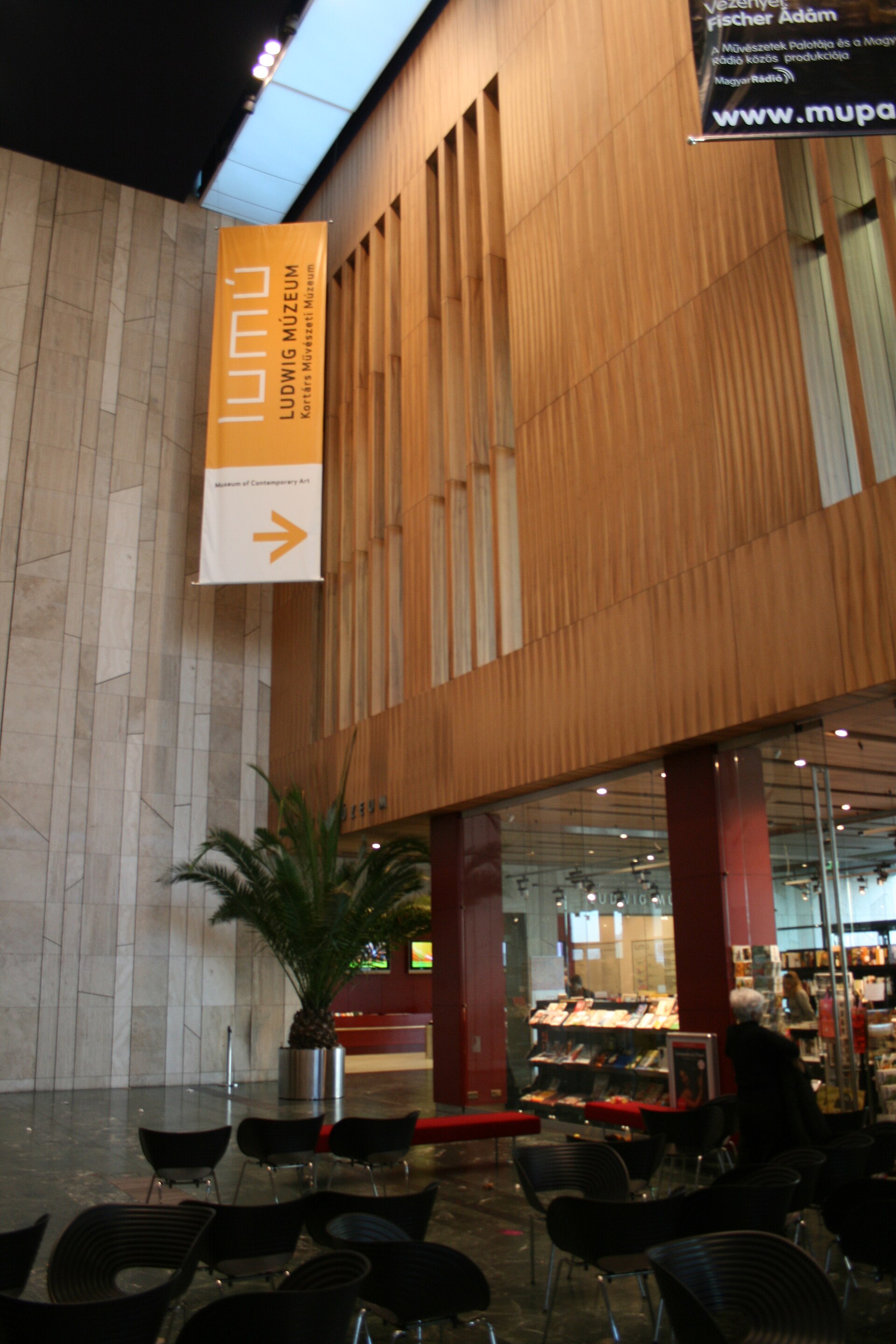
Photograph by Peter Siroki from Budapest, Hungary · CC BY 2.0 Museum Shop
A first-floor shop selling the museum's own publications, past exhibition catalogues, art books and magazines, and prints, postcards and design objects by Hungarian makers; open without an exhibition ticket.
What to see first
Single Elvis
Andy WarholOne of the American pop works from the Ludwigs' own 1989 founding gift, and among the collection's best-known individual pieces.18
Hedge
Robert RauschenbergA large combine-era work from the founding donation, representing the collection's core strength in 1960s American pop and assemblage.18
Lingerie Counter
Claes OldenburgOne of the sculptural pop works given by the Ludwigs, exemplifying the collection's early emphasis on American consumer imagery.18
Vicki
Roy LichtensteinA signature Lichtenstein held since the museum's founding gift and regularly shown on the 3rd floor collection displays.18
Musketeers
Pablo PicassoOne of three late Picasso paintings in the collection; important enough that the Ludwig Museum in Cologne borrowed it for a 2021-22 Picasso exhibition, with the Budapest work 'Bust of the Man in the Hat' (1970) standing in on the 3rd floor while it travelled.19
Five Senses (Vision)
Joe TilsonA 1968-69 British pop work shown in the museum's 'Westkunst - Ostkunst' selection, used to represent the wider European pop art the collection sits alongside its American core.14
Silence (Hommage a Joseph Beuys)
Laszlo LaknerAn early example of Hungarian Photorealism by one of the collection's key Hungarian conceptual artists, part of the post-1990s Central and Eastern European holdings the museum has built since it left the founding gift behind as its sole basis.15
A museum built into a concert hall
The Ludwig Museum - Museum of Contemporary Art occupies the wing of the Mupa Budapest complex nearest the Danube, at Komor Marcell utca 1 in the city's 9th district, Ferencvaros. It shares the building with the Bela Bartok National Concert Hall and the Festival Theatre; all three were built in parallel over 28 months and opened together in 2005, designed by the architectural office Zoboki, Demeter and Partners as part of the Millennium City Centre development on the Pest bank of the river. The complex won the FIABCI Prix d'Excellence in 2006.
The Ludwig Museum is Hungary's only museum dedicated exclusively to the collection and display of contemporary art. It is administratively and financially independent of Mupa, which is itself a performing-arts institution built around the Bartok concert hall; the museum is simply Mupa's tenant, occupying 3,300 square metres across two exhibition floors closest to the water. A reader looking for Mupa's concert programme, or for the Festival Theatre's dance and opera seasons, is looking for a different institution under the same roof.
From a Cologne collectors' gift to an independent museum, 1989-2005
The museum's origin lies with the German collectors Peter and Irene Ludwig, who in 1982 set up the Ludwig Foundation for Art and International Understanding. Following the success of a Budapest exhibition of their holdings the following year, the Foundation donated 70 artworks to the Hungarian state in 1989, and followed the gift with 95 further works on long-term deposit in 1991. The museum opened that year as an autonomous institution on the first floor of the Hungarian National Gallery, received its own operating licence in 1993, and became an independent specialist museum in 1995. Peter Ludwig died in 1996; Irene Ludwig then established the Peter and Irene Ludwig Foundation, which continues to support the museum. Under its founding director, Katalin Neray, who led the museum from 1991 to 2007, it mounted more than 200 temporary exhibitions across three floors of the National Gallery's A wing before relocating to the newly built Mupa complex in 2005.
The Ludwig name is not unique to Budapest: the Peter and Irene Ludwig Foundation supports around a dozen museums worldwide that carry it, of which the best known is the Museum Ludwig in Cologne, Germany - a separate institution with its own building, collection and staff, not a branch of the Budapest museum, though the two occasionally lend to each other.
Two collections under one roof
As of the museum's own most recent published count, the collection holds 1,021 artworks and several hundred further deposits, growing by roughly 20 to 30 pieces a year through grants and continued support from the Peter and Irene Ludwig Foundation. It divides into two distinct bodies of work. The first is the founding gift itself: American and Western European pop art and photorealism, brought together by the Ludwigs from the 1960s onward and including pieces by Andy Warhol, Roy Lichtenstein, Claes Oldenburg, Robert Rauschenberg and three late paintings by Pablo Picasso. The second is everything collected since the museum's own curators began building an independent holding in the 1990s: contemporary and progressive art from Hungary, Slovakia, Poland, Romania and the former Yugoslavia, with a deliberate emphasis on Hungarian art from the 1960s onward read in an international context, including Hungarian Fluxus, conceptual and body-art work of the 1960s and 70s and the new painting of the 1980s.
The museum also holds a specialist Library, focused on Hungarian and international art after 1945 with an emphasis on Central and Eastern Europe, and an Archive established in 2009 that collects documents, photographs and recordings relating to the museum's own history and exhibitions. The full collection catalogue is published on the museum's own online database.
What is on the walls
The 3rd floor carries the museum's own collection in rotating selections; the display used for this record, drawn from the museum's own exhibition pages, groups the founding pop and photorealist gift (Picasso, Warhol, Lichtenstein, Oldenburg, and the photorealists Chuck Close and Malcolm Morley) with the progressive Hungarian painting of the 1960s (Tamas Keseru, Imre Bak, Istvan Nadler), European currents of the same years (Jean Tinguely, Karel Appel, Simon Hantai), politically engaged work of the 1970s and 80s (Wolf Vostell, Gerhard Richter), and Hungarian conceptual, Fluxus, performance and body art (Miklos Erdely, Janos Lakner, Gabor Hajas, alongside Joseph Beuys). A related selection, titled 'Westkunst - Ostkunst', pairs the same Western pop holdings against Eastern and Central European contemporaries, including a large 1968-69 pop work by the British artist Joe Tilson.
The 2nd floor is given over to a changing programme of loan and thematic exhibitions; the show on view as this record was researched, 'Black Mirror. The Long Shadow of the Future', opened 7 April 2026. The museum also gives space in this programme to its own Hungarian holdings in depth: its collection page for the painter Laszlo Lakner highlights his 1972 painting 'Silence (Hommage a Joseph Beuys)', made by enlarging a photograph from a Soviet magazine and described by the museum as an early example of Hungarian Photorealism.
A museum that became a stage for politics
The Ludwig Museum's recent history is inseparable from the wider fight over who controls Hungary's state cultural institutions. In May 2013, more than 30 artists and cultural workers, organised as 'United for Contemporary Art', occupied the museum for close to two weeks, from 9 to 22 May, turning its staircase into what their own public statement called a democratic forum. Their stated grievance was the State Secretariat for Culture's lack of transparency in choosing a new museum director, together with withheld funding owed to independent performing-arts groups; they demanded institutional and professional autonomy and a transparent selection process. Julia Fabenyi took up the post of director the following month, June 2013, and has been reappointed several times since, most recently in 2023 for a further five years; she had previously directed the Mucsarnok exhibition hall from 1998 to 2002. Writing in 2026, the arts publication Hyperallergic named the Ludwig Museum, alongside the Mucsarnok, among the flagship institutions where the Orban government placed loyalists in leadership roles over the following decade, and reported that curators left in numbers afterward, some moving abroad, some into the commercial sector, some founding independent spaces of their own.
The clearest single episode came in 2019. As part of the museum's 30th-anniversary programme, the artist Janos Bruckner was invited to build a large-scale participatory wall drawing with visitors over two months; the piece, titled 'Here and Now' (2019), slowly resolved into a portrait of Prime Minister Viktor Orban, his eyes formed from two clocks spelling out 'This Too Shall Pass'. Artnet News reported, on 14 May 2019, that on the day the installation was due to close, the museum took it off view; that director Fabenyi told the artist, at a meeting on 1 April, that the image did not belong in the museum and risked a negative public reaction; and that Fabenyi did not respond to Artnet's requests for comment on the removal. A former Ludwig curator, Kata Oltai, told the same publication she had left the museum because she no longer felt the freedom she once had there.
Hungary's political landscape changed again in April 2026, when Peter Magyar's Tisza party won a landslide election victory that ended Viktor Orban's sixteen years in power; Zoltan Tarr, a Tisza politician, has served as culture minister since 13 May 2026. Named press coverage of the transition describes the new government's cultural programme as still vague beyond a general promise to restore institutional autonomy, and reports that leadership changes across major museums are expected; as of the sources checked for this record, no change to the Ludwig Museum's own directorship had been confirmed.
Visiting: floors, tickets and access
The two exhibition floors are ticketed separately or together, with a lower combined rate; the museum publishes group, student, senior and family rates alongside the standard price, and sells 365-day passes for regular visitors. Tickets to a Mupa performance carry one free museum visit up to the day of the show. The building is step-free throughout, with lift access to every floor, free wheelchair loans from the information desk, and free admission for visitors with disabilities and one companion. A free-to-enter shop on the first floor sells the museum's own catalogues and publications alongside Hungarian-designed objects, and the ground-floor P'Art Kavehaz, papered in a design by the artist Tamas Komoroczky, serves as the building's cafe until late on performance evenings. A QR-code guide, MyLUMU, supplies additional video and interview content from within the galleries.
What visitors say
Visitors consistently single out the building itself, the light-filled top-floor galleries with their Danube views, and the strength of the temporary exhibition programme over the permanent collection, which several call thin for a museum of this scale. The museum shop and the wall texts come in for comment: the shop for its range of catalogues and Hungarian design objects, the labels for being harder to follow for visitors who do not read Hungarian.
What is praised, what is criticised
- Praised: the architecture of the building and the top-floor galleries, with their views over the Danube
- Praised: the quality and turnover of the temporary exhibition programme
- Praised: the museum shop's range of catalogues, art books and Hungarian-designed objects
- Criticised: wall text and object labelling that some non-Hungarian-speaking visitors find thin in English
- Criticised: an entrance fee that some visitors consider high for the size of the permanent collection on view at any one time
Ratings on other platforms
Google: 4.5 from 2,153 ratings, read 28 September 2026
TripAdvisor: 3.8 from 180 ratings, read 28 September 2026
A platform average is a tertiary source: it moves, it is not audited, and we quote no visitor's words.
Questions about Ludwig Museum - Museum of Contemporary Art
Where is Ludwig Museum - Museum of Contemporary Art?
H-1095 Budapest, Komor Marcell utca 1.
How much does it cost to visit?
Standard, one exhibition floor: HUF 3300; Standard, combined ticket (both exhibition floors): HUF 5000; Groups of 10+, one floor: HUF 3100; Students and seniors, groups of 10+, one floor: HUF 1600; Family, 1 adult + 1 child: HUF 5100. As confirmed 28 September 2026.
When is it open?
Tue-Sun 10:00-20:00; Tue-Sun 10:00-18:00. Closed: Monday. As confirmed 28 September 2026.
How do you get there?
HEV suburban rail: Line H7, stop Kozvagohid; Tram: Tram 1, stop Kozvagohid; trams 2 and 24, stop Mupa - Nemzeti Szinhaz; Bus: Buses 23, 54 and 55, stop Mupa - Nemzeti Szinhaz; Boat: BKK boat lines D11 (weekdays only) and D12, southbound to the Mupa - Nemzeti Szinhaz HEV stop.
What should you see first?
Single Elvis (Andy Warhol); Hedge (Robert Rauschenberg); Lingerie Counter (Claes Oldenburg); Vicki (Roy Lichtenstein); Musketeers (Pablo Picasso); Five Senses (Vision) (Joe Tilson).
What we could not confirm
- Whether Hungary's post-April-2026 government under Peter Magyar's Tisza party will change the Ludwig Museum's leadership as part of a wider reversal of the previous government's cultural appointments; named press coverage as of this record describes the new administration's plans as still unannounced.
- Where Janos Bruckner's 2019 work 'Here and Now' is now held, and whether it has been shown publicly since its removal from the Ludwig Museum on the day its display was due to end.
- The current display status and location within the collection of Picasso's 'Musketeers' (1967) following its 2021-22 loan to the Museum Ludwig in Cologne.
Images
Sources
- 1Wikidata, Ludwig Museum Budapest (Q958750) wikidata.org/wiki/Q958750
- 2Ludwig Museum, homepage, read 28 September 2026 ludwigmuseum.hu/en
- 3Ludwig Museum, 'Opening hours and ticket prices' ludwigmuseum.hu/en/opening-hours-and-ticket-prices
- 4Ludwig Museum, 'History' ludwigmuseum.hu/en/history-0
- 5Ludwig Museum, 'Collection and resource' ludwigmuseum.hu/en/collection-and-resource
- 6Ludwig Museum, 'Plan your visit!' ludwigmuseum.hu/en/plan-your-visit
- 7Ludwig Museum, 'Accessibility - Barrier-free museum' ludwigmuseum.hu/en/accessibility-barrier-free-museum
- 8Ludwig Museum, 'Contacts' ludwigmuseum.hu/en/contacts
- 9Ludwig Museum, 'Colleagues' ludwigmuseum.hu/en/colleagues
- 10Ludwig Museum, 'Ludwig Museum Shop' ludwigmuseum.hu/en/ludwig-museum-shop
- 11Ludwig Museum, 'Cafe' ludwigmuseum.hu/en/cafe
- 12Ludwig Museum, 'Location, getting here' ludwigmuseum.hu/en/location-getting-here
- 13Ludwig Museum, '1-2-3: The Collection in Focus - 3rd Floor Exhibition Space' ludwigmuseum.hu/en/exhibition/1-2-3-collection-focus-3rd-floor-exhibition-space
- 14Ludwig Museum, 'Westkunst - Ostkunst. A Selection from the Collection' ludwigmuseum.hu/en/exhibition/westkunst-ostkunst-selection-collection
- 15Ludwig Museum, author page, 'Lakner, Laszlo' ludwigmuseum.hu/en/author/lakner-laszlo
- 16Mupa Budapest, 'The building' mupa.hu/en/about/the-building
- 17Mupa Budapest, 'Ludwig Museum' mupa.hu/en/about/the-building/ludwig-museum
- 18Budapest.com, venue page, 'Ludwig Museum' (, named artworks) budapest.com/en/locations/ludwig-museum-budapest
- 19Daily News Hungary, 'A new Picasso painting can be seen at the Ludwig Museum in Budapest' dailynewshungary.com/a-new-picasso-painting-can-be-seen-at-the-ludwig-museum-budapest/
- 20Hyperallergic, 'Dismantling Orban's 16-Year Grip on Hungary's Art World' (2026) hyperallergic.com/dismantling-orbans-16-year-grip-on-hungarys-art-world/
- 21Art Leaks, 'Enough is Enough! Ludwig Museum, Budapest, Hungary', 12 May 2013, statement of the occupying artists art-leaks.org/2013/05/12/enough-is-enough-ludwig-museum-budapest-hungary/
- 22Artnet News, Mia Harrison, 'Bowing to Political Pressure, a Budapest Museum Censored an Unflattering Portrait of Hungary's Autocratic Prime Minister', 14 May 2019 news.artnet.com/art-world/viktor-orban-ludwig-museum-1544659
- 23TripExpert, ratings aggregate for Ludwig Museum of Contemporary Art (), read 28 September 2026 tripexpert.com/budapest/attractions/ludwig-museum-of-contemporary-art
- 24WhichMuseum, visitor themes summary for Ludwig Museum - Museum of Contemporary Art (), read 28 September 2026 whichmuseum.com/museum/ludwig-museum-museum-of-contemporary-art-budapest-7369
- 25Urgent Matter, 'Viktor Orban's election defeat offers a test case for unwinding politicized culture policy' (2026) urgentmatter.press/orbans-election-defeat-offers-a-test-case-for-unwinding-politicized-culture-policy/
- 26Wikipedia, 'Mupa Budapest' (, machine facts: architect, opening date only) en.wikipedia.org/wiki/M%C3%BCpa_Budapest