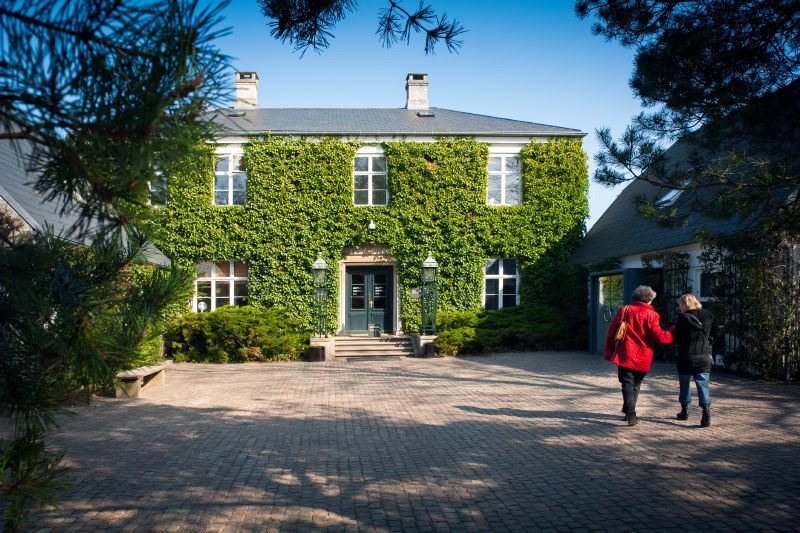
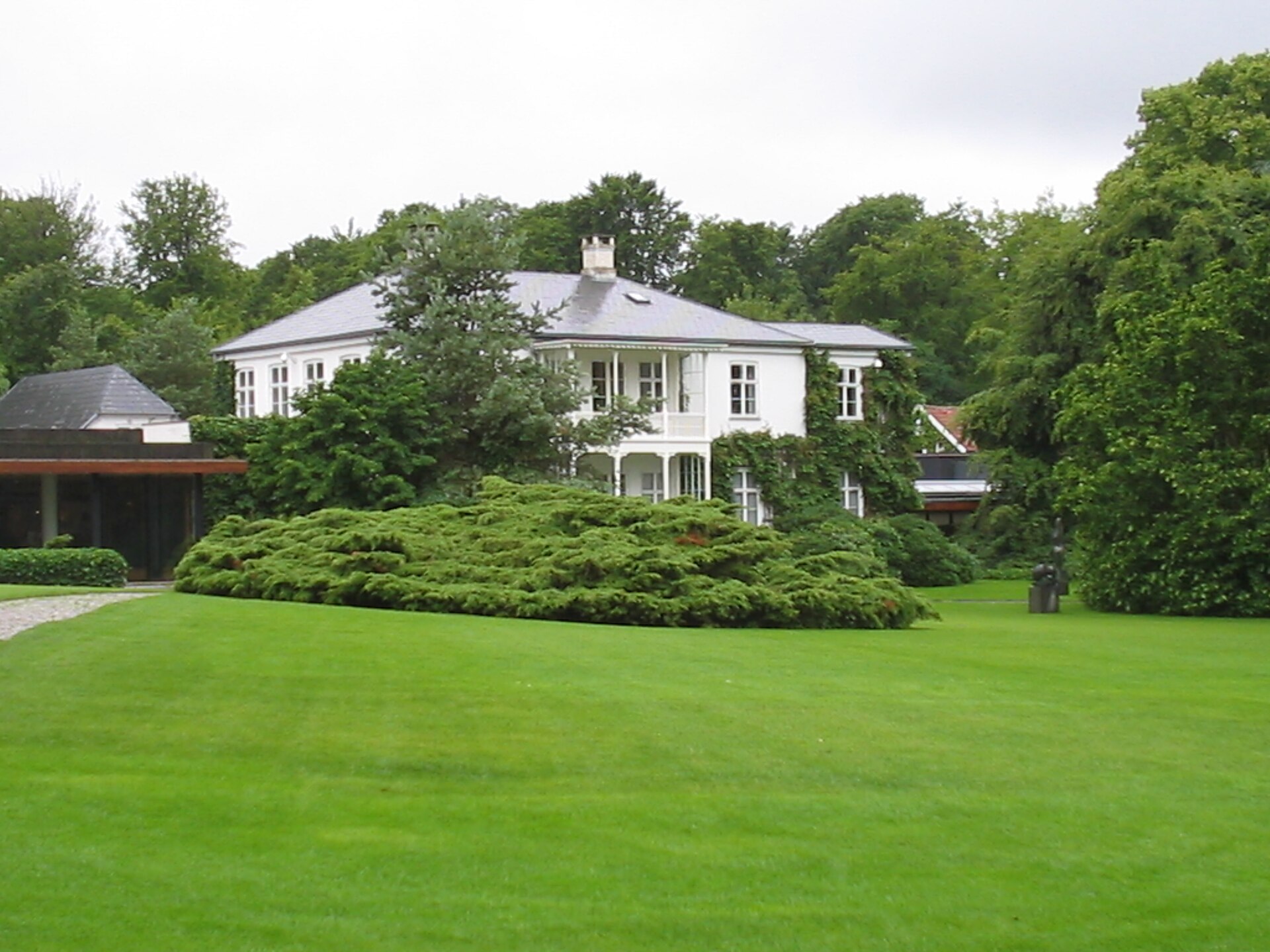
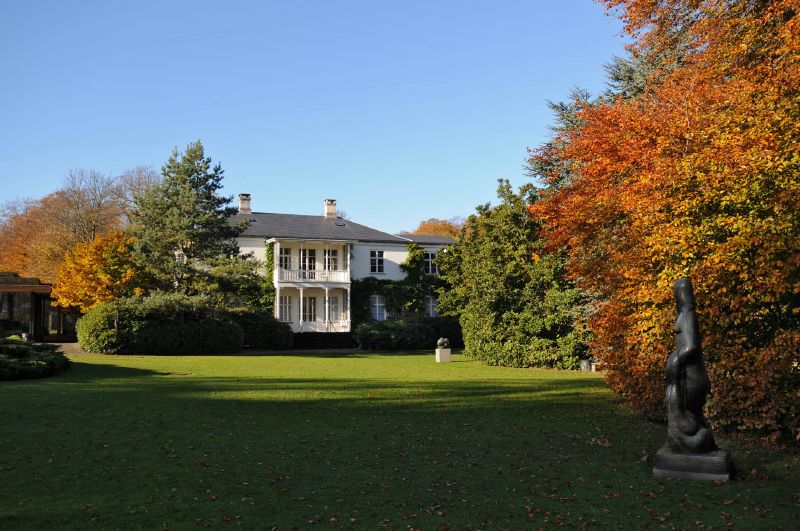
The ivy-covered entrance front of the old villa, the museum's original 1855 building and the start of the North Wing.
Louisiana Museum of Modern Art / Kim Hansen · Photograph by Katrine Louisiana · CC BY-SA 4.0Louisiana Museum of Modern Art
Museum · Louisiana Museum for Moderne Kunst · Founded 1958
Open, admission and hours confirmed 17 August 2026 · 12 sources
On this page 16 sections
ContentsClose
Louisiana's collection is built around European and American art from 1945 onward, strongest where the museum's own history is strongest: figurative sculpture through Giacometti and Moore, the postwar generation through Dubuffet and Picasso's late work, American Pop and Minimalism through Lichtenstein and Warhol, and a deliberately maintained contemporary layer, Kusama, Abramovic, Kentridge, Sherman, Goldin, that keeps the collection acquiring rather than treating 1945-2000 as a closed period. The Sculpture Park functions as an extension of the same collection rather than a separate attraction, holding site-specific commissions that exist nowhere else.
| Local name | Louisiana Museum for Moderne Kunst |
|---|---|
| Kind | Museum |
| Founded | 1958 |
| City and country |  Humlebaek, Denmark Humlebaek, Denmark |
| Address | Gl. Strandvej 13, 3050 Humlebaek, Denmark |
| Website | louisiana.dk |
| Status | Open, confirmed |
| Record last verified |
Visiting
- Hours
- Tue-Fri10:00 to 22:00July and August hours; the museum opens an hour later, at 11:00, the rest of the year
- Sat-Sun10:00 to 18:00July and August hours; the museum opens an hour later, at 11:00, the rest of the year
- Closed
- Monday.
- Admission
- Adult (18+)DKK 145
- Student, with valid cardDKK 130
- Under 18Freefree
- Louisiana memberFreefree entry with membership
- Group, 15 or more paying togetherDKK 130per person
- Do I need to book?
- No. Tickets can be bought on site or online; tickets bought online are valid for single use within one year of purchase
- Address
- Gl. Strandvej 13, 3050 Humlebaek, Denmark MapTrain DSB direct trains from Copenhagen Central Station to Humlebaek Station, about 40 minutes; the museum is a 10-15 minute walk from the station
Bus Bus 388 stops at Humlebaek Strandvej/Louisiana, connecting to Lyngby Station, Klampenborg and Helsingor Station
Car 35 km north of Copenhagen via the E47/E55 motorway or the coastal road (Strandvejen); free car park at the museum's main entrance - Website
- louisiana.dk
- Telephone
- +45 49 19 07 19
- [email protected]
Before you go how long, access, photography, bags, eating, shop
- How long to allow
- TripAdvisor lists a typical visit at 2 to 3 hours (see sources[10])
- Access
- Level access via automatic doors in the corner of the entrance courtyard. Wheelchairs can be borrowed, advance reservation recommended; ramps, elevators and stair lifts serve the multi-level wings. Service dogs are admitted with advance notice. The Concert Hall has hearing-loop transmission equipment. The museum takes part in the Hidden Disabilities Sunflower lanyard scheme.
- Photography
- Generally allowed in the temporary exhibitions without flash, tripod or selfie stick, subject to exceptions posted at individual shows; freely allowed in the Sculpture Park and the permanent collection spaces.
- Bags
- Coin-operated lockers (20 DKK deposit) on the lower shop level, including large lockers for suitcases; backpacks, large bags and umbrellas may not be taken into the galleries.
- Eating
- Louisiana Cafe, overlooking the Sound; accepts major cards and several currencies.
- Shop
- Museum shop and a separate design shop, both reached from inside the entrance.
Prices and hours change. We take them from the institution's own pages and print the day we read them, and you can check the current position at the source we used. Confirm before you travel.
What is inside
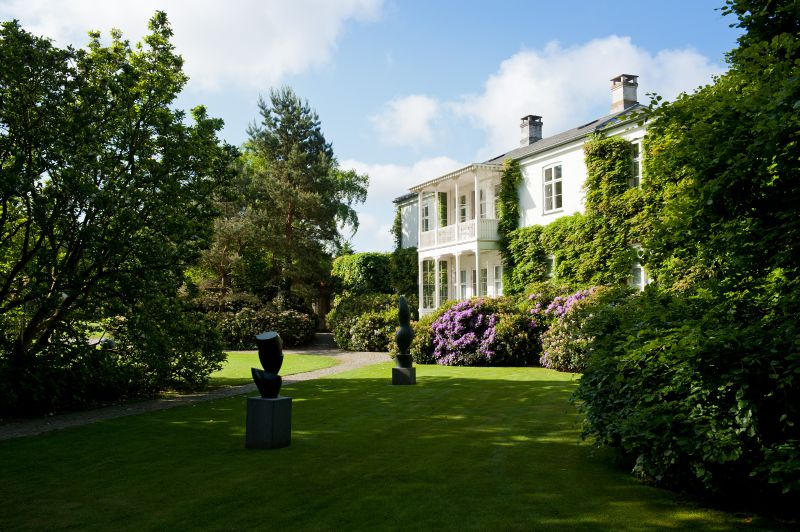
Photograph by Katrine Louisiana · CC BY-SA 4.0 North Wing (Nordfloj) and the old villa
The museum's starting point: the 1855 villa Knud W. Jensen bought in 1955, joined by three small glass-corridor pavilions that architects Jorgen Bo and Vilhelm Wohlert completed in 1958. The North Wing corridor holds the Giacometti Hall and the Jorn Hall, both lined with glass looking onto the lawn and the Sound.
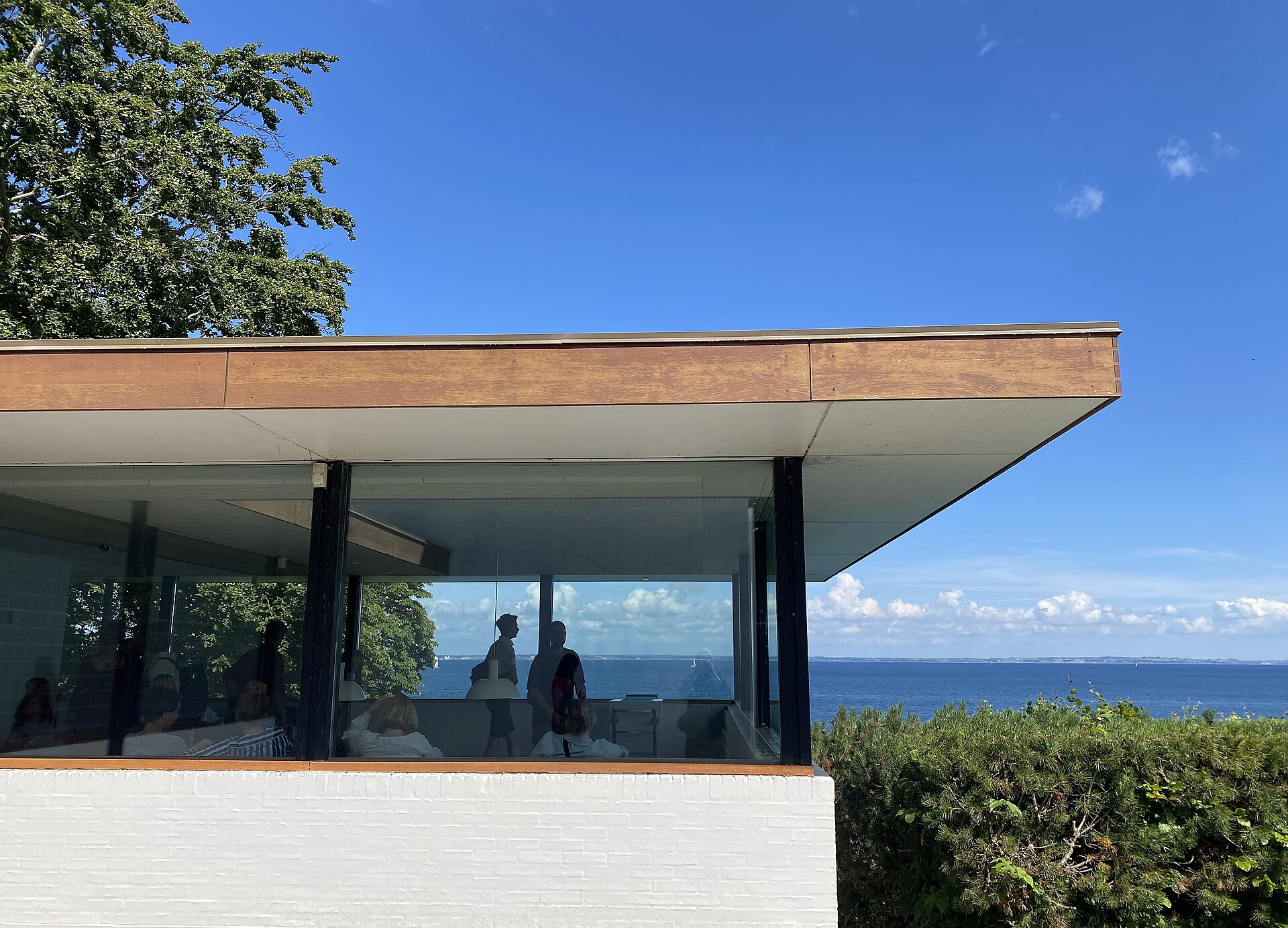
Photograph by Jenny Andersson / News Oresund · CC BY 2.0 The glass corridors
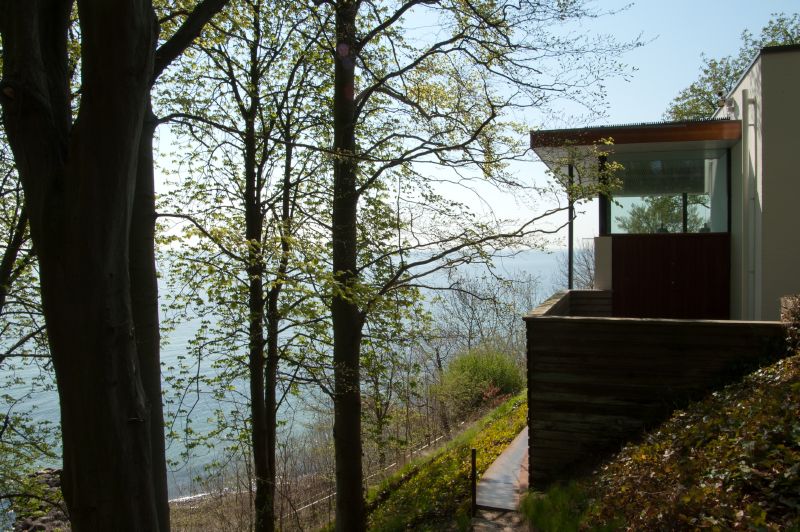
The covered walkways that Bo and Wohlert built to link the original pavilions and every wing added after them, floor-to-ceiling glass at eye height so the route between galleries runs alongside the sculpture park and the water rather than shutting it out.
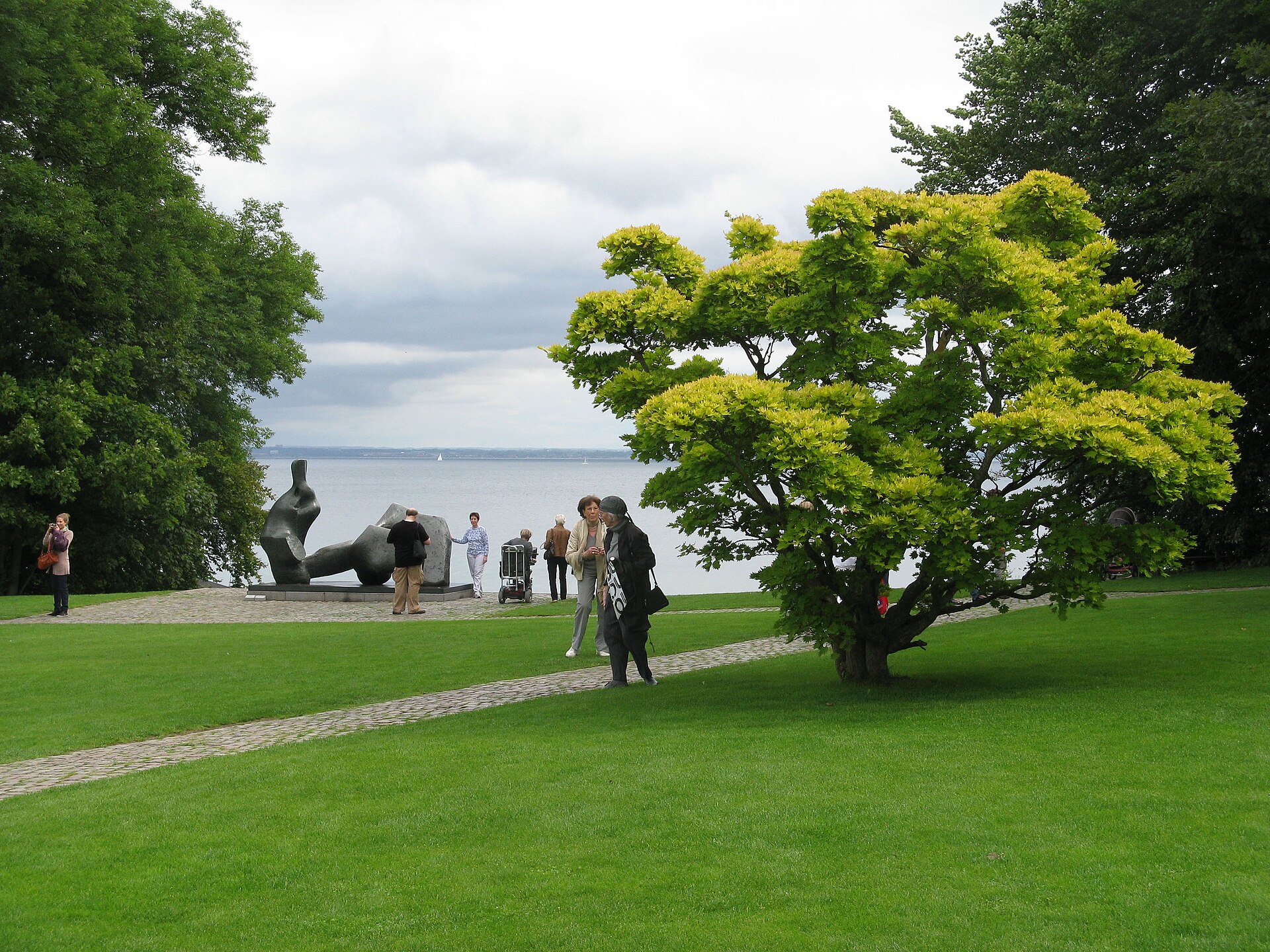
Photograph by Yair-haklai · CC BY-SA 3.0 The Sculpture Park
About fifty works set into the sloping grounds between the wings and the shoreline, some acquired and installed as site-specific commissions rather than moved in after the fact. Landscaping originally by Ole and Edith Norgaard, reworked by Lea Norgaard and Vibeke Holscher as later wings were added.
West Wing and Concert Hall
The West Wing gained two extra floors between 1966 and 1971 as attendance outgrew the original pavilions. The Concert Hall, added in 1976 for chamber music and lectures, has seating designed by Poul Kjaerholm.
South Wing (Sydfloj)
Opened in 1982 with higher ceilings and larger rooms than the original North Wing, built into the hillside so the roofline stays low; designed to take the international loan exhibitions the 1958 galleries could not physically hold.
East Wing, or Graphics Wing
Completed in 1991 to close the circular visitor route. Built underground, which lets it control light for works on paper and photography that cannot hang in the glass corridors.
Children's Wing
Added between 1994 and 1998 alongside an expanded museum shop; dedicated exhibition and activity space for young visitors, run alongside the main programme rather than as a side room.
What to see first
Giacometti Hall
Alberto GiacomettiA glass-walled corridor in the North Wing built specifically to show Giacometti's attenuated figures against the lawn outside rather than a blank interior wall.7
Reclining Figure No. 5 (Seagram)
Henry MooreSet against a cliff edge in the Sculpture Park with the Oresund as its backdrop, one of the park's fixed points since it was installed.6
Three works near the cafe
Alexander CalderCalder pieces grouped near the Louisiana Cafe, among the works the museum's own park page singles out by name.6
The Gate in the Gorge
Richard SerraA site-specific commission built into a natural gorge in the park grounds; the museum describes such pieces as becoming part of the terrain rather than sitting on top of it.6
Self Passage
George TrakasAnother site-specific park commission, built to the contours of its own stretch of ground rather than placed on a plinth.6
Stone globes
Alicja KwadeA more recent addition to the Sculpture Park, extending its run of site-responsive contemporary sculpture into the present day.6
Gleaming Lights of the Souls
Yayoi KusamaA mirror-room installation with permanent-display status in the collection, one of the works most associated with Louisiana's contemporary holdings.8
Exhibitions on now
Past exhibitions here
- Closed11 Jun to 27 Sep 2026Confirmed · check before you travel
- Closed28 Apr to 23 Aug 2026Confirmed · check before you travel
A cheese merchant's museum
Louisiana exists because Knud W. Jensen, a Danish businessman who had taken over the publishing house Gyldendal in 1952 and founded the Art at the Workplace scheme lending art to companies, wanted to build a museum with what he called an appropriate atmosphere, one visitors would want to be in rather than merely file through. Turned down for a site near Rungstedlund, he bought an abandoned villa built in 1855 and its grounds at Humlebaek in 1955. He first asked Jorn Utzon to design the building; Utzon declined because he was already committed to the Sydney Opera House. Jensen then hired two young architects, Jorgen Bo and Vilhelm Wohlert, who spent months studying the site before drawing anything.
The museum opened on 14 August 1958 as a single wing: three small pavilions linked by glass corridors and attached to the old villa. Jensen expected around 40,000 visitors in the first year; the museum's own history page states no less than 225,000 came, a turnout it attributes partly to deliberately provocative early exhibitions. The Swedish newspaper Dagens Nyheter mocked the new institution as Cirkusiana for mixing cafe culture, film, music and public debate in with painting and sculpture. Jensen's answer was that good food and drink were part of experiencing art, not a distraction from it, and the museum kept the mixture.
Architecture built to lose the argument with the landscape
Jensen's brief to Bo and Wohlert was that neither the art nor the surrounding nature should have to compete with the other for a visitor's attention. Their design drew on Rudolph Schindler's Kings Road House in Los Angeles and on Bay Area and Japanese domestic building, arriving at whitewashed walls, laminated wood ceilings and long runs of glass set at eye height, so the corridor between galleries reads as a covered stroll through the park rather than a hallway that happens to have windows.
The building grew in stages rather than as a single plan. The West Wing gained two additional floors between 1966 and 1971 as demand outgrew the 1958 pavilions. A Concert Hall followed in 1976, seated with chairs designed by Poul Kjaerholm, for chamber music and lectures. The South Wing opened in 1982 with higher ceilings and more floor area, cut into the hillside so the roofline stayed low, built specifically to take international loan exhibitions too large for the original rooms. An East, or Graphics, Wing completed the circular visitor route in 1991; built underground, it lets the museum control light levels for works on paper and photography that cannot hang in the glass corridors. A Children's Wing and an enlarged shop followed between 1994 and 1998.
The Sculpture Park: the building's argument made outdoors
The Sculpture Park is not a garden the museum happens to own; it is where the design idea of art without competition from its setting is easiest to see. About fifty works sit across the sloping lawns that run from the wings down to the Oresund shore, and several were acquired as site-specific commissions rather than moved onto the grounds after being bought elsewhere. Richard Serra's The Gate in the Gorge and George Trakas's Self Passage were both built to the shape of their own particular stretch of ground; the museum's own description of the park says such pieces become a concrete part of the terrain rather than objects placed on top of it.
Henry Moore's Reclining Figure No. 5 (Seagram) stands against a cliff edge with the Sound behind it. Three works by Alexander Calder are grouped near the Louisiana Cafe. Granite figures by Henry Heerup and, more recently, stone globes by Alicja Kwade extend the park's range from the museum's founding decades into current practice. The park's landscaping is not static either: it was originally laid out by Ole and Edith Norgaard and has been reworked more than once, by Lea Norgaard and Vibeke Holscher, to fit new wings as they were built, rather than left as leftover ground around them. A separate, sculpture-free Lake Garden connects the grounds to the Giacometti Hall and the Children's Wing.
What is inside: the collection since 1945
The permanent collection covers art made from 1945 to the present, and its named strengths track the building's own growth: Alberto Giacometti's figures in the North Wing's Giacometti Hall, a corridor glassed on one side specifically so the sculptures sit against the lawn rather than a blank wall; postwar and contemporary American and European names including Pablo Picasso, Jean Dubuffet, Louise Bourgeois, Andy Warhol, Diane Arbus, Roy Lichtenstein, David Hockney and Gerhard Richter; and a contemporary layer that includes Yayoi Kusama's mirror-room installation Gleaming Lights of the Souls, on permanent display, alongside work by Roni Horn, Pipilotti Rist, William Kentridge, Marina Abramovic, Cindy Sherman and Nan Goldin. Roy Lichtenstein and Sam Francis are both recorded as having made work specifically for the museum during visits there.
The collection is put at roughly 4,500 works by Wikipedia; a lower figure of roughly 3,500 circulates on museum-aggregator sites but could not be traced to any source this page actually fetched, so it is not repeated here.
Programming beyond the galleries
Louisiana runs six to ten temporary exhibitions a year alongside two ongoing public programmes that are unusual in scale for a museum of its size. The Louisiana Literature Festival, launched in 2010, brings around forty writers to the museum each year and draws more than 15,000 visitors; past participants recorded include Haruki Murakami, Joyce Carol Oates, Ian McEwan and Colm Toibin. The Louisiana Channel, launched in 2012, is a video platform built around interviews with and profiles of artists, writers and thinkers, described as having used streaming video more ambitiously than most museum operations of its kind. The Concert Hall keeps a season of chamber music and public lectures running alongside the exhibition programme.
Growth, criticism and where the record still has gaps
The museum gained state authorization and government support in 1968. Poul Erik Tojner has been director since 2000, a period in which the museum's own account describes it consolidating both its artistic standing and its finances. It now draws more than 700,000 visitors a year, 715,820 in 2024 on the figure available to this page, making it the most-visited museum of modern and contemporary art in Scandinavia. In 2023 it adopted a sustainability strategy running to 2050, covering climate, circularity, biodiversity and social responsibility, and has been recognised as a Green Attraction on that basis.
The institution has not been free of internal friction. Beyond the early Cirkusiana mockery, younger Danish artists criticised Louisiana as old-fashioned during the 1960s even as it went on to show Nouveau Realisme, Pop art and Minimalism; a Nam June Paik concert at the museum is recorded as having ended in a largely hostile audience reaction. None of this amounts to a live dispute today, but it is part of the record and this page states it rather than smoothing it out. Two things this research did not settle: the exact current size of the permanent collection, given the 3,500-versus-4,500 discrepancy above, and whether a free-licence interior photograph exists on Wikimedia Commons for the West, South, Graphics or Children's Wings; none was found, so those four wings carry no photograph on this page rather than an unverified one.
What visitors say
Visitors and critics consistently single out the same thing: the fit between the modernist pavilions, the sculpture park and the Oresund coastline, which reviewers describe as inseparable from the art itself rather than a scenic backdrop to it. The cafe's water view and the sculpture park are the two most-mentioned reasons people say the museum is worth the train ride from Copenhagen. Set against that, a recurring complaint is that peak-season crowding turns what the architecture was built for, a quiet unhurried walk between small galleries, into queueing and jostling, and some visitors call the admission price steep given how much of what they see is temporary programming rather than the permanent collection.
What is praised, what is criticised
- Praised: the integration of the 1958 villa, the later wings and the Sculpture Park with the Oresund shoreline, named repeatedly as the museum's defining trait
- Praised: the Sculpture Park itself, with site-specific and collected works by Moore, Calder, Serra, Trakas and Kwade set directly into the landscape rather than displayed on plinths
- Praised: the Louisiana Cafe and its view over the Sound, a favoured stop even among visitors mainly there for the art
- Criticised: peak-season crowding, which visitors say works against the low-key, uncompetitive way of seeing art the architects designed the galleries for
- Criticised: the admission price, which some visitors call high relative to a permanent collection they see as thinner than the special exhibitions
- Criticised: slow service at busy times in the cafe and restaurant, noted by a number of visitors given the prices charged
Ratings on other platforms
TripAdvisor: 4.6 from 2,629 ratings, read 17 August 2026
A platform average is a tertiary source: it moves, it is not audited, and we quote no visitor's words.
Questions about Louisiana Museum of Modern Art
Where is Louisiana Museum of Modern Art?
Gl. Strandvej 13, 3050 Humlebaek, Denmark.
How much does it cost to visit?
Adult (18+): DKK 145; Student, with valid card: DKK 130; Under 18: free; Louisiana member: free; Group, 15 or more paying together: DKK 130. As confirmed 17 August 2026.
When is it open?
Tue-Fri 10:00-22:00; Sat-Sun 10:00-18:00. Closed: Monday. As confirmed 17 August 2026.
How do you get there?
Train: DSB direct trains from Copenhagen Central Station to Humlebaek Station, about 40 minutes; the museum is a 10-15 minute walk from the station; Bus: Bus 388 stops at Humlebaek Strandvej/Louisiana, connecting to Lyngby Station, Klampenborg and Helsingor Station; Car: 35 km north of Copenhagen via the E47/E55 motorway or the coastal road (Strandvejen); free car park at the museum's main entrance.
What should you see first?
Giacometti Hall (Alberto Giacometti); Reclining Figure No. 5 (Seagram) (Henry Moore); Three works near the cafe (Alexander Calder); The Gate in the Gorge (Richard Serra); Self Passage (George Trakas); Stone globes (Alicja Kwade).
What we could not confirm
- The size of the permanent collection is given as roughly 4,500 works by Wikipedia (sources[8]); a lower figure of roughly 3,500 circulates on museum-aggregator sites but was not corroborated by any source this page fetched directly, and is not stated on the page for that reason.
- No free-licence interior photograph could be found on Wikimedia Commons for the West Wing/Concert Hall, the South Wing, the East/Graphics Wing or the Children's Wing; those four entries carry no image rather than a substitute from elsewhere in the museum.
- Museum-published visitor figures more recent than 2024 (715,820) were not located; the 700,000-plus annual figure and the 2024 total both come from a tertiary source, not a museum annual report fetched directly for this page.
Images
Sources
- 1Louisiana Museum of Modern Art, Opening hours and tickets, fetched 2026-08-17 louisiana.dk/en/plan-your-visit/opening-hours/
- 2Louisiana Museum of Modern Art, homepage, fetched 2026-08-17 louisiana.dk/en/
- 3Louisiana Museum of Modern Art, Kontakt (Contact), fetched 2026-08-17 louisiana.dk/om-louisiana/kontakt/
- 4Louisiana Museum of Modern Art, Practical info and accessibility, fetched 2026-08-17 louisiana.dk/en/plan-your-visit/practical-info-accessibility/
- 5Louisiana Museum of Modern Art, Getting here, fetched 2026-08-17 louisiana.dk/en/plan-your-visit/getting-here/
- 6Louisiana Museum of Modern Art, The Sculpture Park, fetched 2026-08-17 louisiana.dk/en/museum/park/
- 7Louisiana Museum of Modern Art, Architecture and History, fetched 2026-08-17 louisiana.dk/en/museum/architecture-and-history/
- 8Wikipedia, Louisiana Museum of Modern Art, fetched 2026-08-17 (, used for history, visitor-figure and collection facts not found on the museum's own pages) en.wikipedia.org/wiki/Louisiana_Museum_of_Modern_Art
- 9Wikidata, Q1410617, fetched 2026-08-17 (, used to confirm identity, coordinates and inception date) wikidata.org/wiki/Q1410617
- 10TripAdvisor, Louisiana Museum of Modern Art, read 2026-08-17 (, rating datum and address confirmation) tripadvisor.com/Attraction_Review-g680939-d259686-Reviews-Louisiana_Museum_of_Modern_Art-Humlebaek_Fredensborg_Municipality_Copenhagen_Regio.html
- 11Wikimedia Commons, Category:Louisiana Museum of Modern Art, fetched 2026-08-17 (image sourcing and licence verification) commons.wikimedia.org/wiki/Category:Louisiana_Museum_of_Modern_Art
- 15Louisiana Museum of Modern Art, own history page, fetched 2026-08-17 (primary, first-year visitor figure) louisiana.dk/en/museum/louisiana-history/