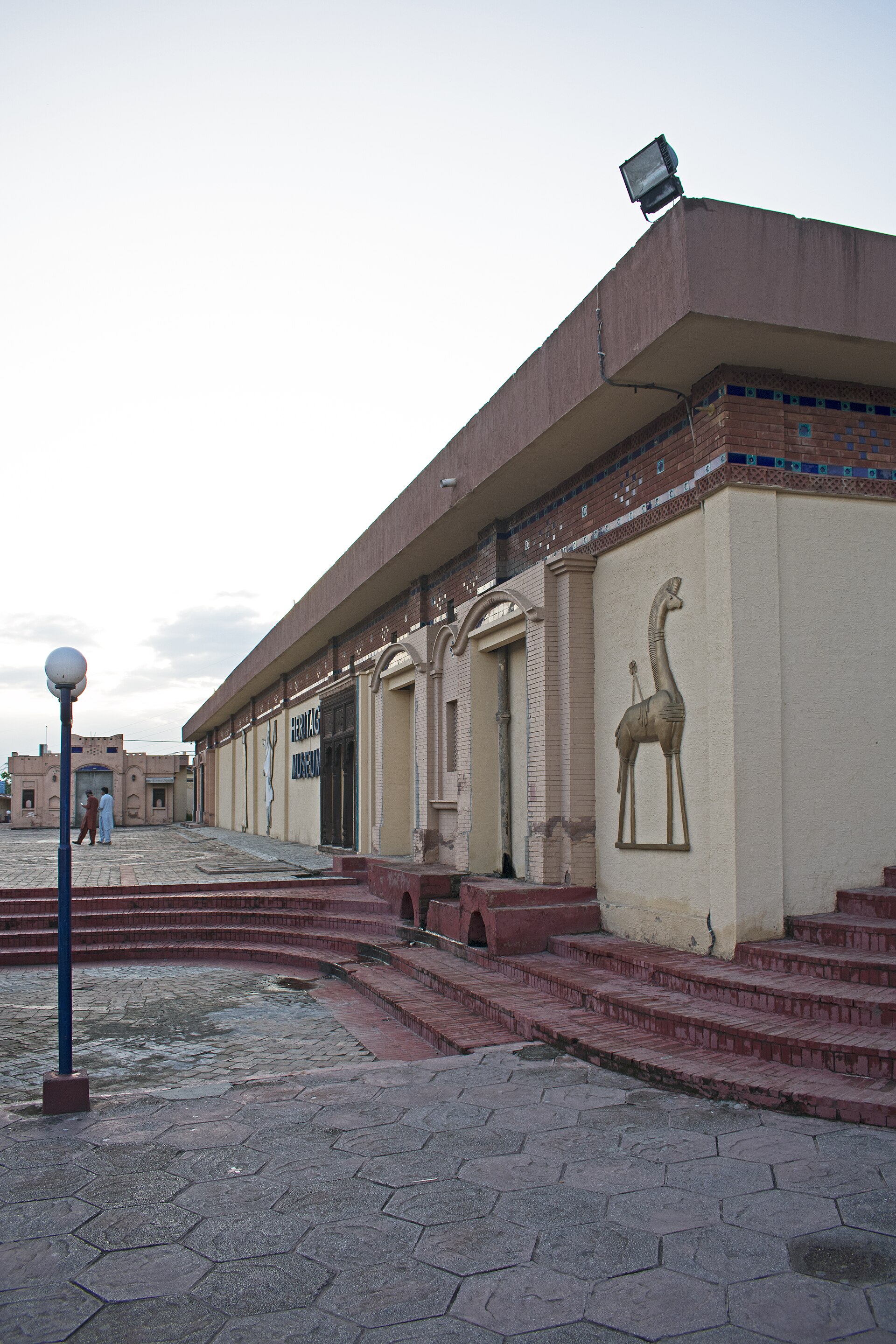
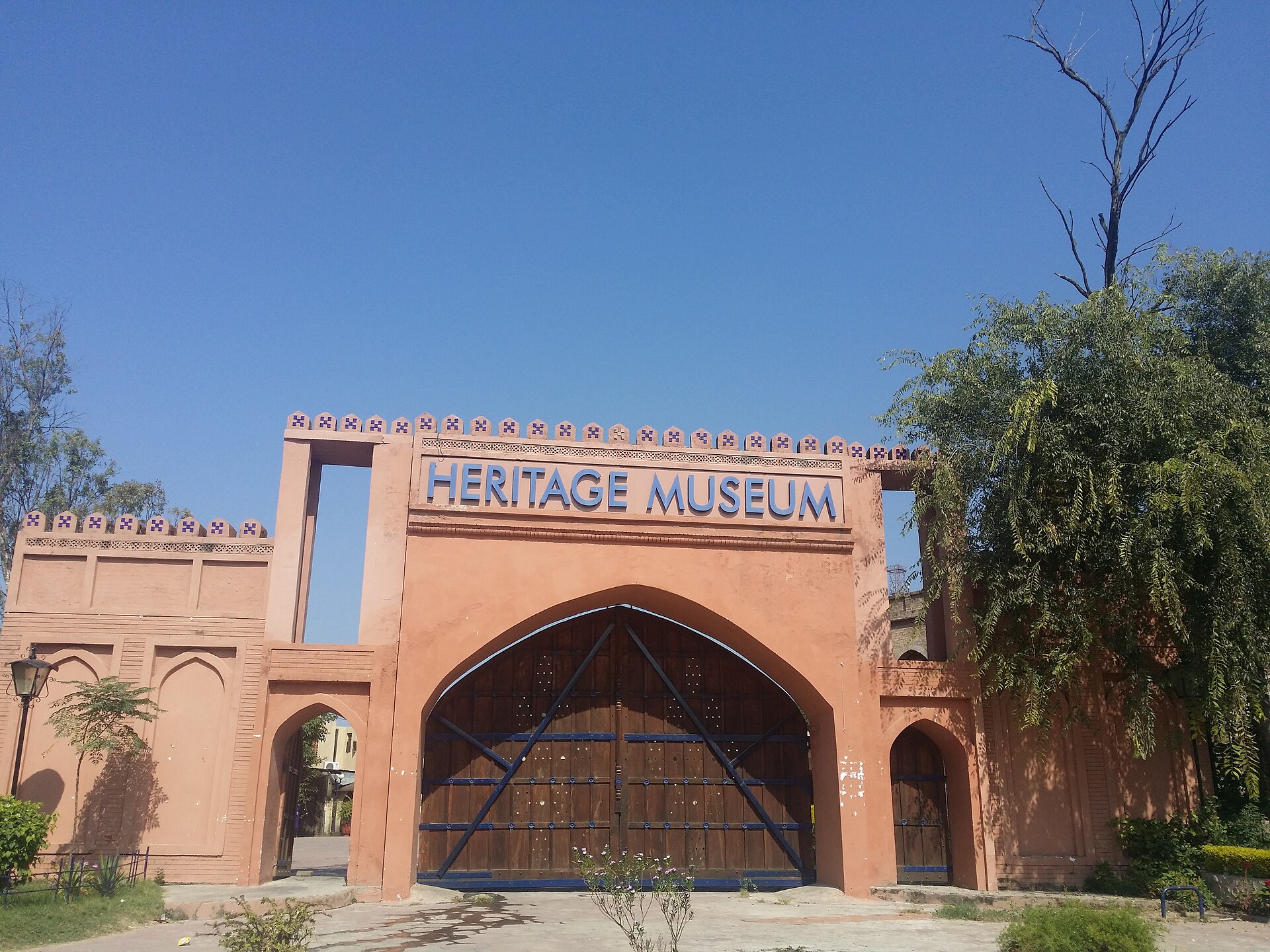
The main exhibition building of the Lok Virsa Heritage Museum, Shakarparian Hills, Islamabad.
Ymblanter, CC BY-SA 4.0Lok Virsa Museum
Museum · Founded 1982
Open, admission and hours confirmed 28 September 2026 · 13 sources
On this page 14 sections
ContentsClose
Lok Virsa's strength is breadth of coverage rather than depth on any single object: it is built to hold the folk material culture of every major region of Pakistan under one institute, from Punjab and Sindh to Gilgit-Baltistan and Kashmir, plus a hall specifically devoted to Sufi devotional and musical culture and sections tracing Pakistan's folk links outward to Iran, Turkey, Azerbaijan and Central Asia. Its indoor collection of costumes, jewellery, woodwork, metalwork and architectural crafts is backed by an unusually large intangible-heritage archive - a 32,000-item reference library and roughly three thousand hours of field-recorded audio - that few comparably sized ethnology museums maintain in-house.
| Kind | Museum |
|---|---|
| Founded | 1982 |
| City and country |  Islamabad, Pakistan Islamabad, Pakistan |
| Address | Garden Avenue, Shakarparian, P.O. Box 1184, Islamabad, Pakistan |
| Website | lokvirsa.org.pk |
| Status | Open, confirmed |
| Record last verified |
Visiting
- Hours
- All week10:00 to 20:00Per the museum's own homepage timings notice for the National Museum of Ethnology (Heritage Museum)
- Admission
- Local adultPKR 150
- StudentPKR 80
- Foreign visitorPKR 1,500
- ECO/SAARC delegatePKR 1,000
- Child under 7Freefree
- Tickets
- lokvirsa.org.pk/heritage-museum The museum's own ticket page.
- Do I need to book?
- No booking stated for individual visitors; a Book Now / venue-booking route exists on the museum's site for group and event bookings
- Address
- Garden Avenue, Shakarparian, P.O. Box 1184, Islamabad, Pakistan MapBus Shakarparian Stop is the nearest public bus stop; the museum is a short walk from it
Air Islamabad International Airport is about 30 km away, roughly 40 minutes by road depending on traffic
Car Reached from Jinnah Avenue, the Islamabad Expressway or Murree Road; on-site parking is available - Website
- lokvirsa.org.pk
- Telephone
- +92 51 9249209
- [email protected]
Before you go how long, access, photography, bags, eating, shop
- How long to allow
- One and a half to three hours, longer on a day when the craft bazaar is active
- Access
- Ground-level galleries and paved grounds; no lift or step-free route is described on the museum's own site
- Photography
- Not restricted on the museum's own visitor information; several visitors' own photographs are the basis of this page's images
- Bags
- Not stated on the museum's own site
- Eating
- A food court operates on the grounds alongside the craft and artisan bazaar
- Shop
- Craft and artisan stalls sell embroidery, woodwork and other handmade goods on the grounds; a separate online shop is also listed on the museum's site
Prices and hours change. We take them from the institution's own pages and print the day we read them, and you can check the current position at the source we used. Confirm before you travel.
What is inside
Folk Heritage Museum - the regional galleries
The indoor museum proper, about 20,000 square feet across several halls, arranged by the regions of Pakistan - Punjab, Sindh, Balochistan, Khyber Pakhtunkhwa, Gilgit-Baltistan and Kashmir among them. Each hall carries the embroidered costumes, jewellery, woodwork, metalwork, block printing and ivory and bone work associated with that region, set inside life-size dioramas and reconstructed village and market scenes rather than in plain cases.
Traditional architecture and facade gallery
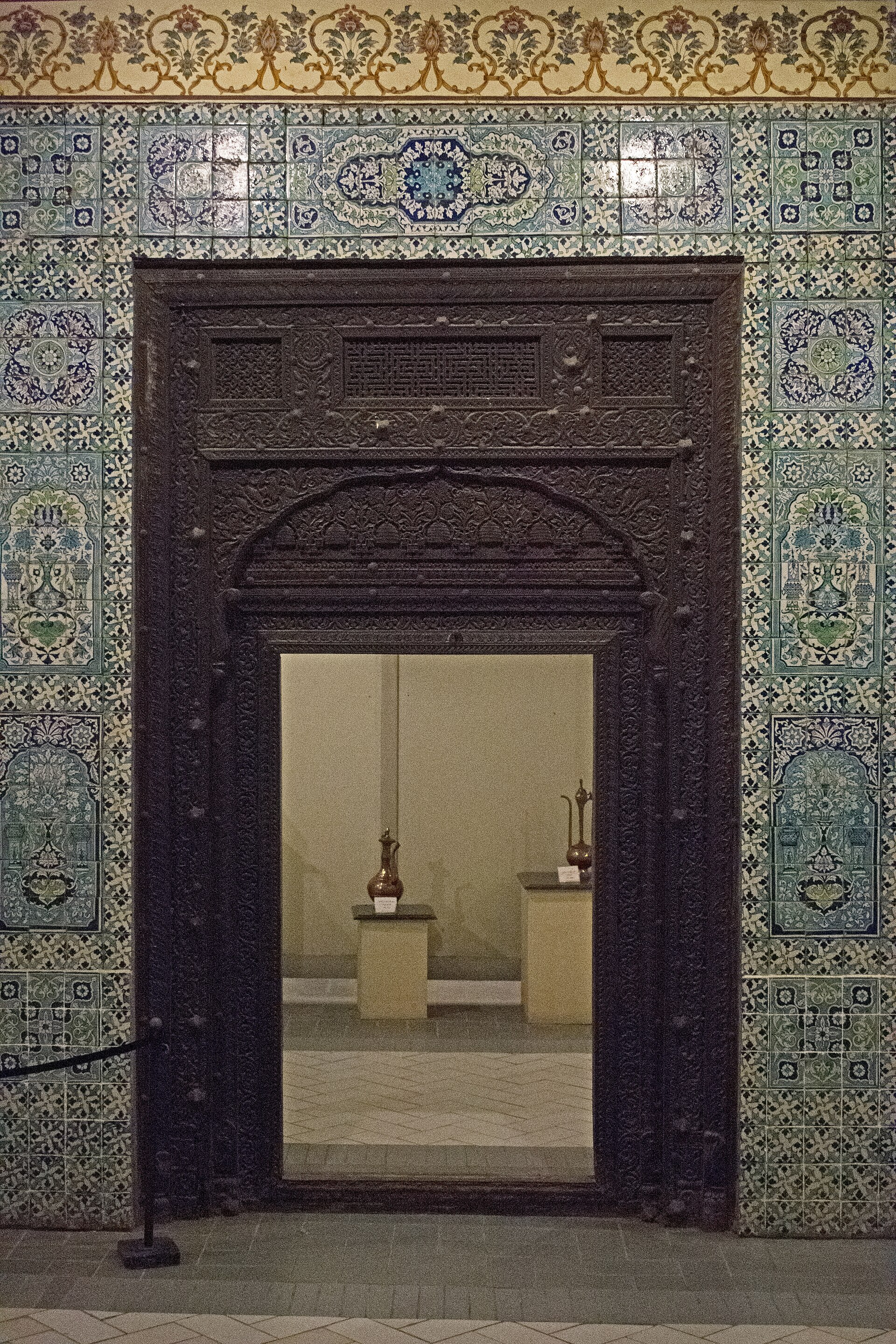
A gallery built around reproduced building facades rather than portable objects: fresco work, mirror work, marble inlay, and tile mosaic and stucco tracery drawn from Pakistan's regional building traditions, shown as walk-through architectural set-pieces rather than wall panels.
Sufis and Shrines Hall
Opened in 2013, this hall is built around the devotional and musical life of Pakistan's Sufi shrines: imagery of musicians in performing pose singing the poetry of Sufi saints, and depictions of shrines and venerated figures, presented as a single narrative rather than a case-by-case display.
The outdoor museum and craft bazaar
Lok Virsa is explicit that it is not only the indoor halls: an outdoor museum and grounds accommodating up to 3,000 visitors surround the buildings, with a working craft and artisan bazaar and food court open daily, horse-cart rides across the grounds on some days, and festival-day stalls for traditional food and music.
Heritage Library and Virsa Media Centre
Not a display hall but part of the same institute and building complex: a reference library holding over 32,000 books, journals, manuscripts and field reports on ethnography, anthropology, folk music, art, history and crafts, and a media centre that has produced fifty-one cultural documentaries and roughly three thousand hours of audio recordings of Pakistani oral and musical tradition.
What to see first
The regional costume and jewellery halls
Regional artisans of PakistanThe core of the Folk Heritage Museum: embroidered costumes and jewellery gathered from across Pakistan's provinces and territories, shown region by region rather than as a single generic 'traditional dress' case.3
The traditional architecture facades
Regional craftsmen (fresco, mirror work, marble inlay, tile mosaic and stucco tracery)The museum reproduces the building crafts themselves - fresco, mirror work, marble inlay, tile mosaic and stucco tracery - as walk-through architecture rather than photographing them, which is unusual for an ethnology museum of this size.4
The life-size village and market dioramas
Reconstructed village, market and household scenes carry the costumes, tools and domestic objects in a setting rather than a vitrine, which reviewers repeatedly single out as the museum's strongest way of explaining regional life at a glance.9
The Sufis and Shrines Hall
A single hall, added in 2013, built around the devotional and musical culture of Pakistan's Sufi shrines rather than treated as one case inside a broader religion gallery.3
Decorated truck ('truck art') display
Pakistani truck-decoration artisansPakistani truck art is a recognised folk-art form in its own right, and visitors specifically cite the museum's decorated-truck display as a highlight among the crafts on show.7
The Central Asian and West Asian link gallery
Sections connecting Pakistan's folk culture to Iran, Turkey, Azerbaijan and Central Asia, which the museum itself frames as 'global link passages' and which visitors from the region note as unusually well explained for a domestic ethnology museum.1
The Virsa Media Centre's oral-tradition archive
Fifty-one cultural documentaries and about three thousand hours of audio recordings of Pakistani folk music and oral tradition, built up by the institute's own field research rather than acquired - the intangible counterpart to the museum's physical collection.3
An institute before it was a museum
The Heritage Museum in Islamabad's Shakarparian Hills is the flagship museum of Lok Virsa, the National Institute of Folk and Traditional Heritage, which the Pakistani state set up in 1974 to record and preserve folk culture it judged to be disappearing under rapid modernisation. Lok Virsa became a formally autonomous institute in 2002 under the Lok Virsa Legal Status Ordinance of that year, and the museum a reader can walk into today - officially the Pakistan National Museum of Ethnology, and popularly the Heritage Museum - opened in 1982 as the Folk Art Museum before a 2004 renovation gave it its current name and form. It was Pakistan's first state museum of ethnology, and the institute describes its wider mandate as promoting cultural heritage's role in education, tourism, industry and human development, not simply displaying it.
Lok Virsa also operates a second, separate museum on the same Shakarparian grounds, the Pakistan Monument Museum, opened in 2010 beside the Pakistan Monument to commemorate independence. The two are administered by the same institute and sit within walking distance of each other, but they are distinct museums with distinct collections and distinct Wikidata identities, and this record is about the Heritage Museum only.
The building and what it was built to hold
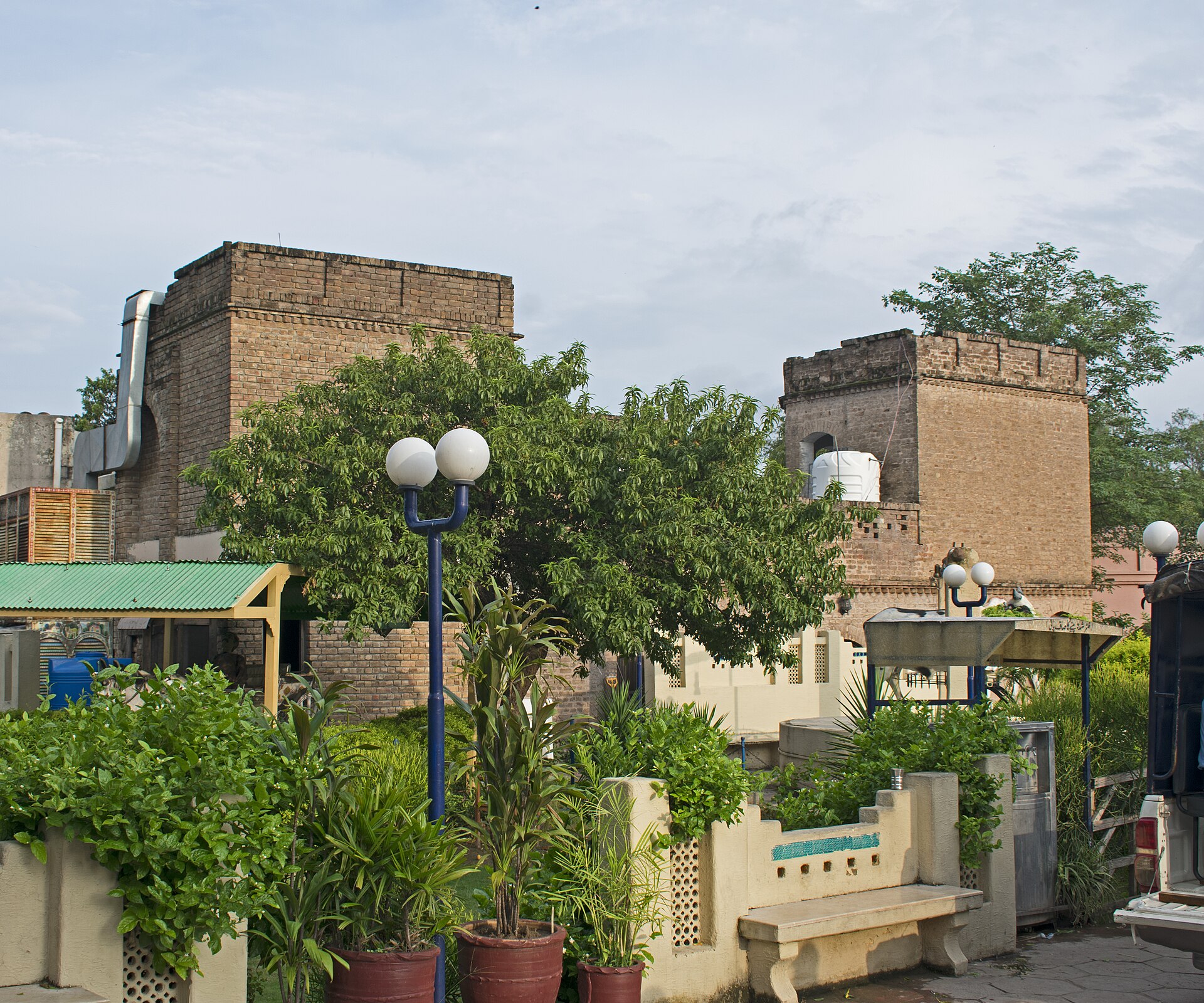
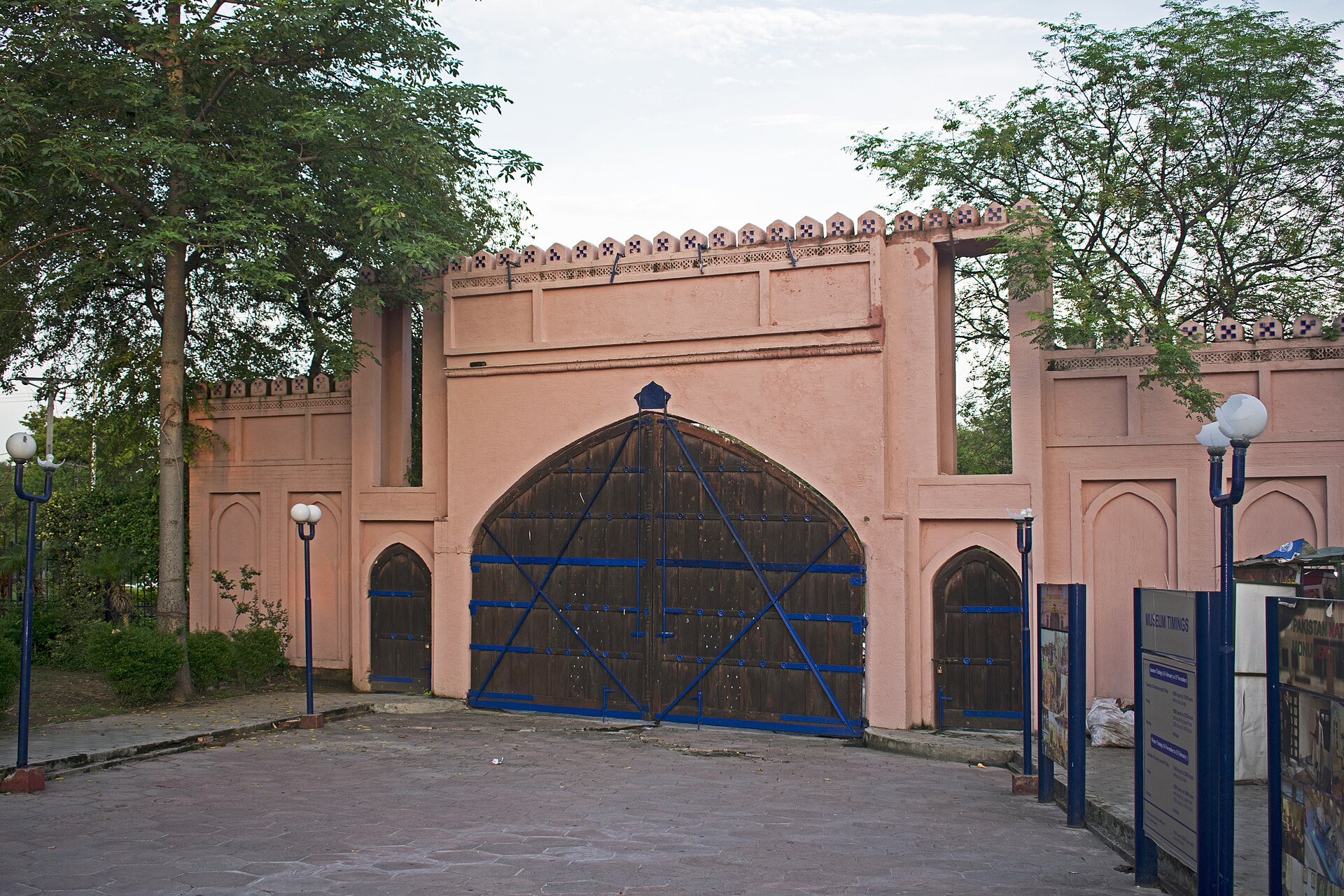
The Heritage Museum describes itself as Pakistan's largest museum by floor area: 60,000 square feet in total, of which roughly 20,000 square feet is indoor exhibition space, spread across several buildings plus an outdoor museum on the grounds, together able to hold up to 3,000 visitors at once. The scale is deliberate. Lok Virsa's founding brief was to cover the folk traditions of a large and regionally varied country - Punjab, Sindh, Balochistan, Khyber Pakhtunkhwa, Gilgit-Baltistan and Kashmir all have to fit inside one institution - and the museum answers that brief by building itself out sideways into multiple halls and an open-air complex rather than trying to compress everything into a conventional single gallery run.
The building itself is part of the display. Rather than photographing the traditional facade crafts of the regions it covers, the museum reproduces them: fresco work, mirror work, marble inlay, and tile mosaic and stucco tracery appear as walk-through architecture inside the museum, not as wall panels describing them from a distance.
Inside the Heritage Museum: from the regions to the shrines
The core of the museum is organised by region. Separate halls carry the embroidered costumes, jewellery, woodwork, metalwork, block printing, and ivory and bone work associated with Punjab, Sindh, Balochistan, Khyber Pakhtunkhwa, Gilgit-Baltistan and Kashmir, most of it set inside life-size dioramas and reconstructed village or market scenes rather than plain vitrines - a visitor sees a household or a market stall built at full scale, populated with the objects that would actually have furnished it, rather than the objects alone. A separate strand of the museum works outward from Pakistan rather than region by region within it: sections the institute itself calls its 'global link passages' connect Pakistani folk culture to Iran, Turkey, Azerbaijan and Central Asia, an emphasis visitors from that wider region single out as unusually well done for a domestic ethnology museum.
The Sufis and Shrines Hall, added in 2013, is the newest addition described in the sources for this record. It is built as a single narrative rather than a case-by-case display: imagery of musicians in performing pose singing the poetry of Sufi saints, alongside depictions of shrines and the figures venerated at them, carrying the devotional and musical culture around Pakistan's Sufi tradition rather than treating it as one case inside a broader religion gallery. Among the individual crafts on show, visitors repeatedly single out the museum's decorated-truck display - Pakistani truck art, a recognised folk-art form in its own right, given space alongside the costumes and metalwork rather than left outside as roadside decoration.
The grounds, the bazaar, and the institute at work
Lok Virsa is explicit that the museum is not only what stands indoors. An outdoor museum and grounds, sized to hold up to 3,000 visitors, surround the buildings, and a craft and artisan bazaar operates on the grounds daily alongside a food court, selling embroidery, woodwork and other handmade goods directly from makers rather than through a museum shop alone; visitors mention horse-cart rides across the grounds and, on festival days, stalls for traditional food and live music. The bazaar is also where several reviewers say the museum earns its keep twice over - once as a museum, and once as a place to buy the kind of regional craft that the halls indoors have just explained.
Behind the public galleries, the same institute runs a Heritage Library holding more than 32,000 books, journals, manuscripts and field reports on ethnography, anthropology, folk music, art, history and crafts, a Research and Publications department, and a Virsa Media Centre that has produced fifty-one cultural documentaries and roughly three thousand hours of audio recordings of Pakistani oral tradition and folk music - the institute's own field research feeding the intangible half of its mandate, alongside the physical objects on display in the museum itself.
What it costs and when it is open, and the fee gap visitors keep raising
The museum's own price list sets local adult admission at 150 Pakistani rupees, student admission at 80 rupees, and admission for children under seven free; foreign visitors pay 1,500 rupees, and visitors from ECO and SAARC member states pay 1,000 rupees. That four-tier structure, and specifically the gap between the 150-rupee local price and the 1,500-rupee foreign price - a tenfold difference - is the single complaint that recurs most often across independent visitor reviews, raised even by reviewers who otherwise rate the museum highly and say they were glad to pay it. The museum's own homepage lists the Heritage Museum as open all week from 10am to 8pm; its dedicated Heritage Museum page separately notes the museum is closed on Mondays when describing its ticket prices, and third-party travel sites disagree further, with figures ranging from a 9am-5pm day to a 10am-7pm day with a Friday prayer break. This record follows the museum's own homepage timings notice as the most current statement of its own hours, and flags the conflict with the museum's own ticket-price page rather than silently picking one.
What people say, and what the museum itself admits
Independent reviewers converge on a consistent picture: a large, well-stocked, inexpensive (for local visitors) museum that explains Pakistan's regional folk cultures more completely than anywhere else in the capital, let down by thin interpretation and inconsistent upkeep rather than by its collection. One detailed 2026 review on Tripadvisor, from a visitor who had also seen the museum before its 2004 renovation, noted that the collection did not appear to have changed much despite the renovation, and pointed to specific gaps: little coverage of how Pakistan's larger mainstream communities - Sindhi, Punjabi, Baloch, Pashtun - relate to the smaller ethnic groups also on show, little attention to how the groups displayed relate to the Islamic mainstream, no treatment of gender diversity, and almost no treatment of cultural links with India, including the history of people who migrated from India to Pakistan at independence, which the reviewer suggested might be an omission made to avoid controversy. A 2021 review in The Karachi Collective by Shireen Ikramullah Khan made a related but more institutional argument: that chronic government under-funding, tied to culture and heritage not being treated as a priority, has left the museum without trained guides or a proper education department, so that text panels are often poorly connected to the objects beside them and a visit rarely goes beyond a basic group tour. Both criticisms describe the same underlying constraint from different angles - a museum whose physical collection and premises are larger than its budget for explaining them.
What visitors say
Visitors consistently describe Lok Virsa as the most complete single introduction to Pakistan's regional folk cultures available in one place, and as good value for the nominal local admission price. The complaint that recurs most often, across independent reviewers, is the size of the gap between the local ticket price and the price charged to foreign visitors, which several reviewers raise unprompted even in otherwise positive reviews. A second, less frequent complaint is that the museum offers little in the way of guiding, interactive programming or an education department to connect a visitor to what the halls are showing, and that maintenance of some display cases has been allowed to slip.
What is praised, what is criticised
- Praised: the breadth of Pakistan's regional folk cultures gathered in one place, from Punjab to Gilgit-Baltistan and Kashmir
- Praised: the life-size dioramas and reconstructed village and market scenes, praised as more vivid than a conventional case-and-label museum
- Praised: the nominal entry fee for local and student visitors
- Praised: the working craft and artisan bazaar on the grounds, and the chance to buy directly from makers
- Praised: the sections connecting Pakistani folk culture to Iran, Turkey, Azerbaijan and Central Asia
- Criticised: the large gap between the local ticket price and the price charged to foreign visitors, the single most repeated complaint across independent reviews
- Criticised: the lack of trained guides, an education department or interactive programming to connect the text panels to what is on display
- Criticised: inconsistent cleaning and maintenance of some display cases and public facilities
- Criticised: chronic government under-funding, which reviewers and at least one named commentator link directly to the gaps in programming
Ratings on other platforms
Tripadvisor: 4.4 from 173 ratings, read 28 September 2026
A platform average is a tertiary source: it moves, it is not audited, and we quote no visitor's words.
Questions about Lok Virsa Museum
Where is Lok Virsa Museum?
Garden Avenue, Shakarparian, P.O. Box 1184, Islamabad, Pakistan.
How much does it cost to visit?
Local adult: PKR 150; Student: PKR 80; Foreign visitor: PKR 1500; ECO/SAARC delegate: PKR 1000; Child under 7: free. As confirmed 28 September 2026.
When is it open?
All week 10:00-20:00. As confirmed 28 September 2026.
How do you get there?
Bus: Shakarparian Stop is the nearest public bus stop; the museum is a short walk from it; Air: Islamabad International Airport is about 30 km away, roughly 40 minutes by road depending on traffic; Car: Reached from Jinnah Avenue, the Islamabad Expressway or Murree Road; on-site parking is available.
What should you see first?
The regional costume and jewellery halls (Regional artisans of Pakistan); The traditional architecture facades (Regional craftsmen (fresco, mirror work, marble inlay, tile mosaic and stucco tracery)); The life-size village and market dioramas; The Sufis and Shrines Hall; Decorated truck ('truck art') display (Pakistani truck-decoration artisans); The Central Asian and West Asian link gallery.
What we could not confirm
- The museum's own site gives conflicting hours: the homepage timings notice says the Heritage Museum is open all week 10am-8pm, while the dedicated Heritage Museum page notes 'Monday Closed' beside its ticket prices. Which is current has not been resolved from the museum's own site alone.
- Ticket prices on the museum's own site (150 rupees local adult) are lower than the 500 rupees per person reported by at least one 2022 visitor review; whether this reflects a since-reversed price rise, a group-booking rate, or a reviewer error has not been established.
- No source consulted for this record gives a precise date for when the Sufis and Shrines Hall's stated 2013 opening was formally inaugurated, or names the hall's curator.
Images
Sources
- 1Lok Virsa, 'Heritage Museum' (official visit and ticket-price page) lokvirsa.org.pk/heritage-museum/
- 2Lok Virsa, official homepage (timings notice and contact details) lokvirsa.org.pk/
- 3Wikipedia, 'Lok Virsa Museum' () en.wikipedia.org/wiki/Lok_Virsa_Museum
- 4Directorate/Department heritage-sites directory, 'Lok Virsa Museum, Islamabad' () doam.gov.pk/public/heritage-sites/789
- 5Dawn, 'AROUND TOWN: Lok Virsa' (unsigned), 21 November 2008 dawn.com/news/amp/429687
- 6Shireen Ikramullah Khan, 'The Lok Virsa: A Cultural & Educational Repository', The Karachi Collective, 28 June 2021 thekarachicollective.com/the-lok-virsa-a-cultural-educational-repository/
- 7Tripadvisor, 'Lok Virsa Museum - Islamabad' (aggregate rating and visitor reviews, ) tripadvisor.com/Attraction_Review-g293960-d2268066-Reviews-Lok_Virsa_Museum-Islamabad_Islamabad_Capital_Territory.html
- 8Wikidata, Q3694624 'Lok Virsa Museum' (, identity and coordinates) wikidata.org/wiki/Q3694624
- 9Chakor Ventures, 'Guide to Lok Virsa Heritage Museum' ( travel guide) chakorventures.com/guide-to-lok-virsa-heritage-museum-2025/
- 10Global InCH - International Journal of Intangible Cultural Heritage, 'Lok Virsa Museum & Heritage Library' () globalinch.org/museum/lok-virsa-museum-heritage-library/
- 11TravelSetu, 'How To Reach Lok Virsa Museum (Islamabad)' () travelsetu.com/guide/lok-virsa-museum-tourism/how-to-reach-lok-virsa-museum
- 12Wikimedia Commons, File:Islamabad Lok Virsa Museum exterior 02.jpg (Ymblanter, CC BY-SA 4.0) commons.wikimedia.org/wiki/File:Islamabad_Lok_Virsa_Museum_exterior_02.jpg
- 13Wikipedia, 'National Institute of Cultural Studies, Islamabad' (, context on a co-located but separate institution) en.wikipedia.org/wiki/National_Institute_of_Cultural_Studies,_Islamabad
