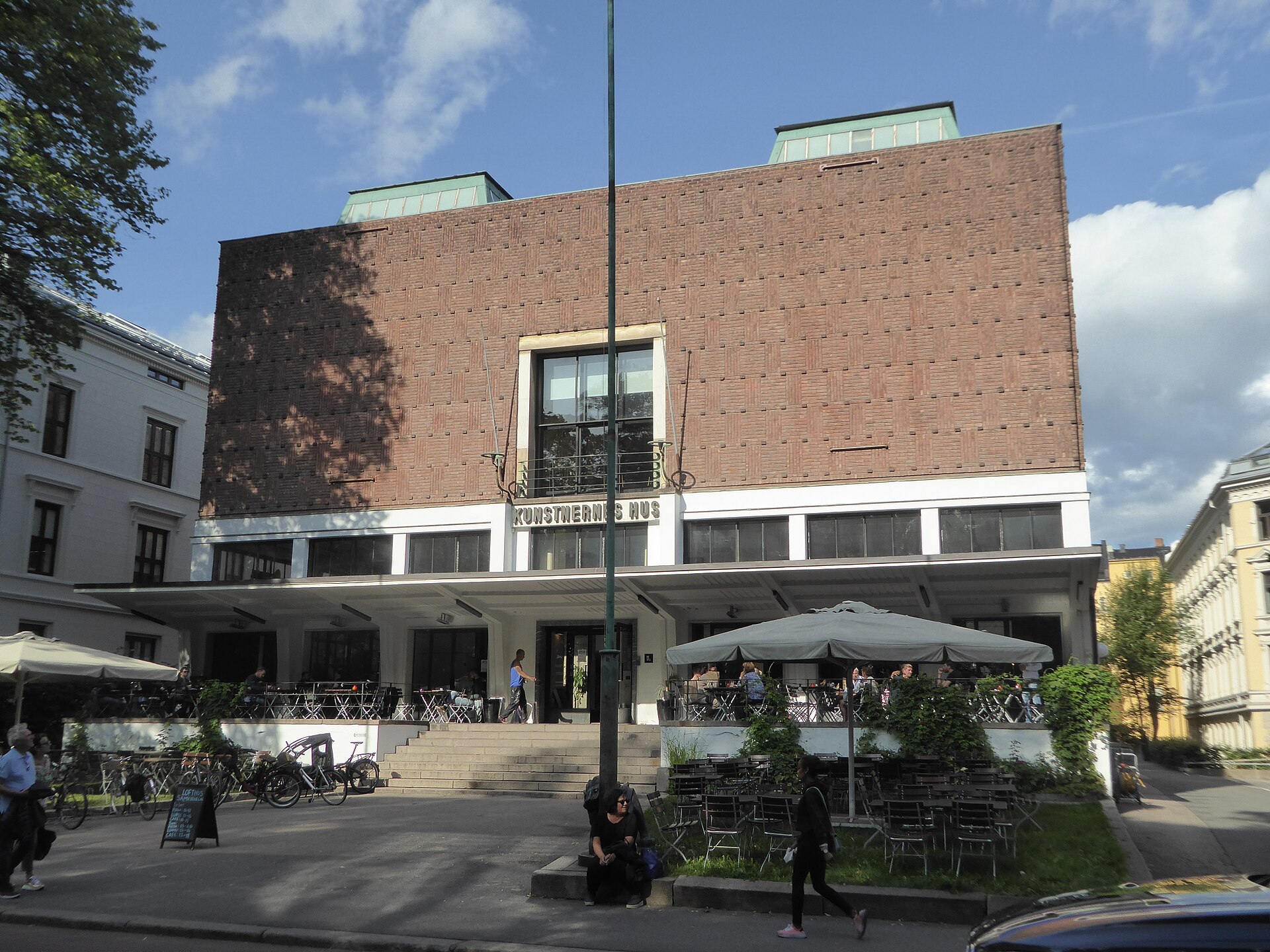
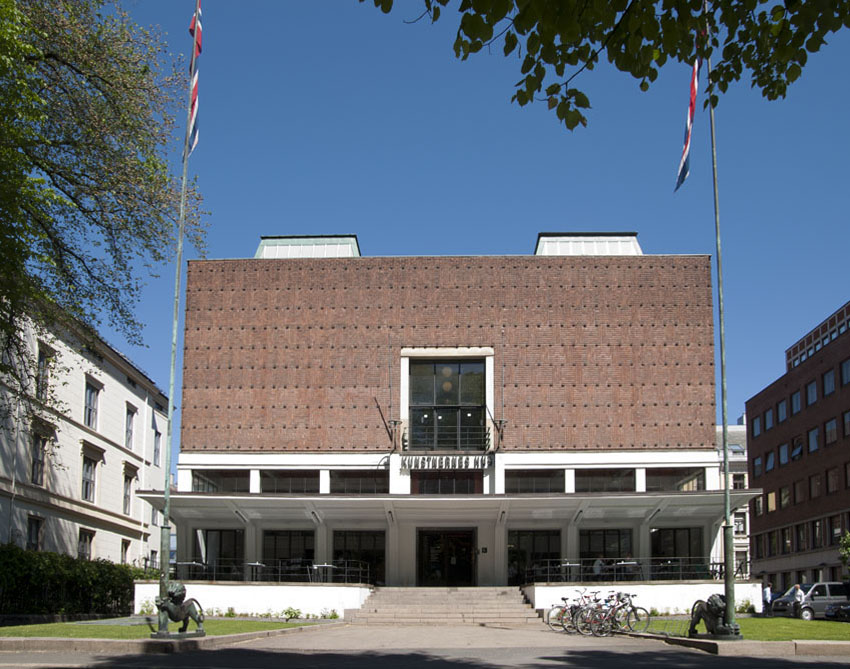
The main facade of Kunstnernes Hus on Wergelandsveien, Oslo, photographed in August 2019.
Photograph by Nemo bis, CC BY-SA 3.0Kunstnernes Hus
Gallery · Founded 1930
Open, admission and hours confirmed 28 September 2026 · 22 sources
On this page 14 sections
ContentsClose
Kunstnernes Hus holds no permanent collection and does not claim one. It is an artist-run exhibition house, or Kunsthalle in the European sense: everything on its walls is there on loan or by submission, for the length of one show. Its strength instead is continuity of programme. It has hosted the Norwegian state's Hostutstillingen every autumn without interruption since the building opened in 1930, run by open submission and jury selection rather than by the house itself, making it one of the longest-running and most accessible showcases of contemporary Norwegian art anywhere in the country. Its loan exhibitions have, at points across the twentieth century, briefly brought work of the first international rank to Oslo, most notably Picasso's Guernica in January 1938 and nearly 40 paintings by Van Gogh the year before. A reader coming to this record for a collection to study will not find one; a reader coming to it for what has passed through a single Oslo address for very nearly a century will find a great deal.
| Kind | Gallery |
|---|---|
| Founded | 1930 |
| City and country |  Oslo, Norway Oslo, Norway |
| Address | Wergelandsveien 17, NO-0167 Oslo, Norway |
| Website | kunstnerneshus.no |
| Status | Open, confirmed |
| Record last verified |
Visiting
- Hours
- Tuesday-Wednesday11:00 to 18:00
- Thursday11:00 to 19:00
- Friday-Sunday11:00 to 18:00
- Closed
- Monday.
- Admission
- Adult (current exhibition, Hostutstillingen 2026)NOK 175Price for the 139th Hostutstillingen, the house's current show; ticket prices are set per exhibition and are not a flat year-round rate
- Student / concession, age 18-25NOK 115
- Under 18FreeFree
- Members and artists (NBK, UKS, FFF, NK, SDS, ICOM/IAA)FreeFree on presentation of membership
- Escort/companion with a valid escort certificateFreeFree
- Tickets
- kunstnerneshus.no/besok The museum's own ticket page.
- Do I need to book?
- No advance booking for the exhibition halls; tickets are sold at reception on arrival. The cinema and some guided tours are booked separately
- Address
- Wergelandsveien 17, NO-0167 Oslo, Norway MapTram Lines 11, 17 and 18 to Holbergs plass
Train/Metro Nationaltheatret station, about a 6 minute walk - Website
- kunstnerneshus.no
- Telephone
- +47 22 85 34 10
- [email protected]
Before you go how long, access, photography, bags, eating, shop
- How long to allow
- The house does not publish a typical-visit figure. Visitor accounts describe a single current exhibition as roughly an hour's stop, longer when paired with the cafe or a film in the house cinema
- Access
- No ramp at the main entrance; step-free access is via a lift at the rear of the building (240 x 88 cm), reached by an intercom button beside it, serving the lower exhibition hall, the upper skylit galleries and the cinema. An accessible toilet with a changing table sits past reception. Seating is available in every exhibition room and portable chairs can be requested at reception. Service dogs are permitted throughout, including Atelier Felix. The cinema holds wheelchair space about 4 metres from the screen, reserved in advance by email. Akademirommet and the outreach rooms, including Atelier Felix, do not have step-free access, and the house does not provide tactile guide lines or sign-language interpretation
- Photography
- Personal photography is allowed and the house invites visitors to share it under #kunstnerneshus; images from the exhibitions may not be used commercially
- Bags
- A cloakroom is on the lower floor, opposite the toilets
- Eating
- Juret, the house's own cafeteria and bar, describes itself as a meeting place for artists and visitors alike, serving breakfast, lunch, pastries from the Mjol bakery and an informal dinner menu, open Tuesday-Saturday 11:00-22:00 and Sunday 11:00-20:00, closed Monday. Members get filter coffee free and 10 percent off food
- Shop
- A small shop behind the reception desk on the ground floor sells art books, exhibition posters and screenprints, limited editions by exhibiting artists, and house publications; members get 10 percent off
Prices and hours change. We take them from the institution's own pages and print the day we read them, and you can check the current position at the source we used. Confirm before you travel.
What is inside
Upper skylit galleries
The main daylit exhibition halls under the building's roof monitors, the space the 1930 competition was designed around: natural light from the ceiling, a limited building height, and a facade meant to sit quietly beside its neighbours. This is where the changing exhibition programme, including Hostutstillingen, is usually hung, and where Picasso's Guernica was shown in January 1938.
Photograph by Ondavolante · CC BY-SA 4.0 Lower exhibition hall
A ground-floor gallery that runs the rotating programme alongside the upper halls; recent visitor accounts describe a masters-degree degree show here in parallel with a solo exhibition upstairs, which is the house's usual pattern of running two or more shows at once rather than a single headline exhibition.
Akademirommet
A first-floor room reached from the back of the house, run by the Oslo National Academy of the Arts (Kunstakademiet) since 2014 for free-admission student exhibitions, concerts, presentations, launches and workshops, mostly running October to May. From 1930 into the 1990s the same room was one of the teaching studios of the old State Academy of Art, so it has been used to train and show artists for nearly the building's whole life.
Atelier Felix
A small multipurpose room for outreach, families and children, divided by a curtain into a reading corner, a workshop and a display wall for temporary work. It was redesigned in 2022 by the Oslo architecture practice Superunion, which sampled its blue paint from the fresco in the building's foyer. The room takes its name from Felix, the title Gudolf Blakstad and Herman Munthe-Kaas gave their winning 1928 competition entry.
Photograph by Matija Puzar · CC BY-SA 4.0 Kunstnernes Hus Kino
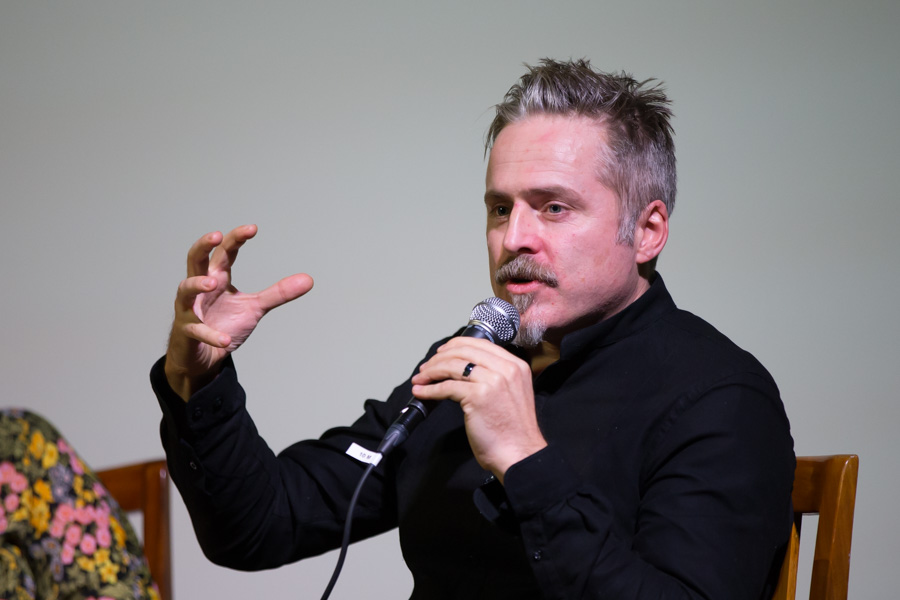
An 85-seat independent cinema that opened in 2016, one of Oslo's few independent screens, doubling as a 113 square metre hall for seminars, talks and film screenings with a 4K projector and surround sound. Laibach's Ivan Novak and film-maker Morten Traavik spoke here in November 2017 around the documentary Liberation Day.
Entrance hall and main staircase
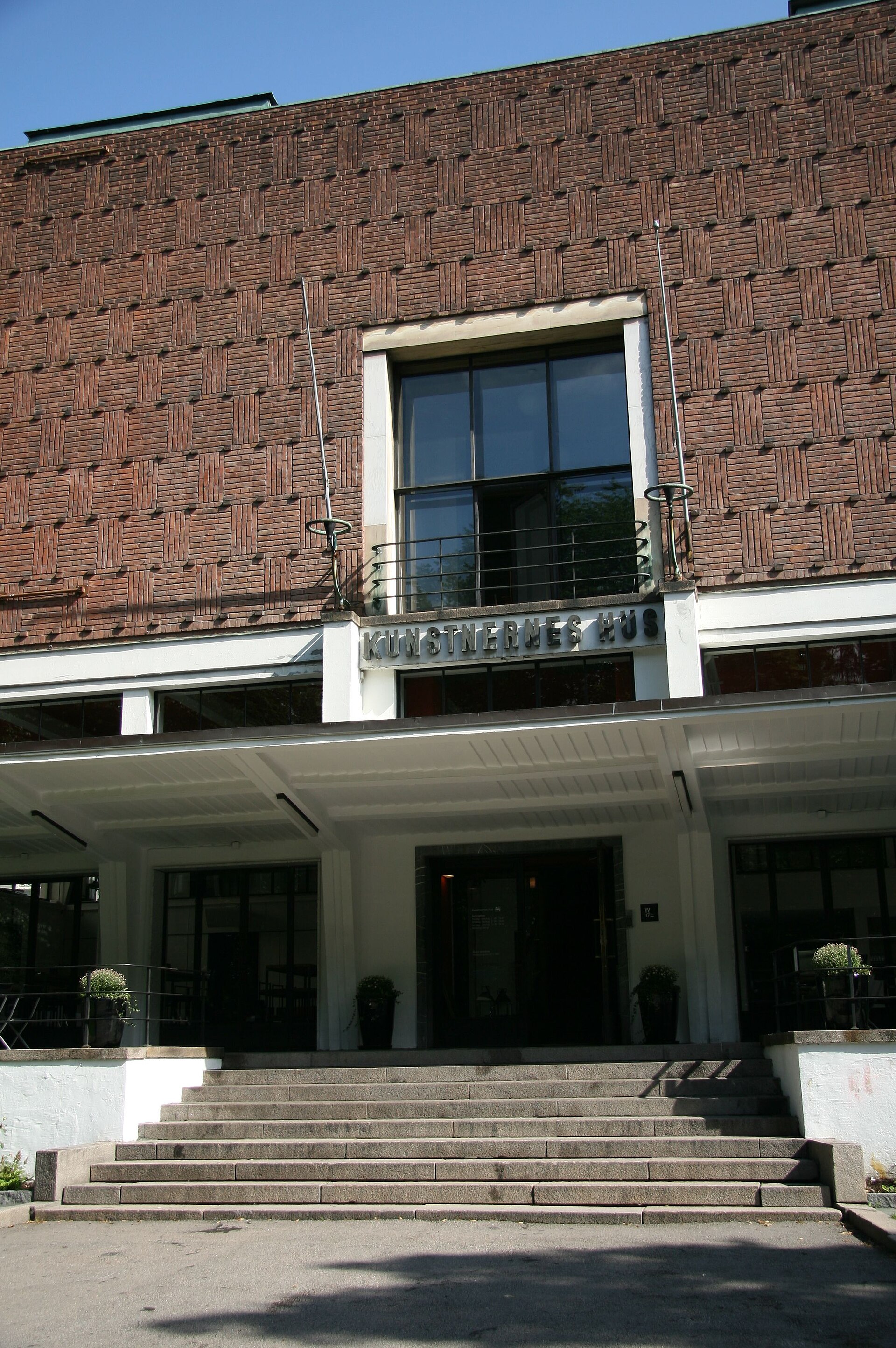
The front door is flanked by Ornulf Bast's bronze lions, installed in spring 1931 and given by the wholesaler Alf Bjercke, reading as freedom and creativity either side of the threshold. Above the main staircase is Per Krohg's ceiling fresco, 22 by 3.5 metres, finished in summer 1932 and showing what the house describes as an artist's thorny path toward the heights.
What to see first
Opening day and the first Hostutstillingen in the new building
Kunstnernes Hus opened on 1 October 1930 with that year's Hostutstillingen, the Norwegian state's open-submission autumn exhibition, which had existed since the 1880s but now had a purpose-built home. King Haakon VII and Crown Prince Olav and Crown Princess Martha attended, and the press called the new building Europe's most modern exhibition space. Hostutstillingen has opened there every autumn since, and its 139th edition is the exhibition running as this page was written.4
Vincent van Gogh in Oslo
Vincent van GoghIn 1937 the house showed nearly 40 works by Van Gogh, including The Potato Eaters and Fishing Boats on the Beach at Saintes-Maries, one of the largest gatherings of his painting Norway had seen.4
Den Franske Utstillingen: Matisse, Picasso, Braque, Laurens, with Guernica
Pablo Picasso and othersOrganised by Walther Halvorsen and opened in January 1938, this exhibition brought Picasso's Guernica to Kunstnernes Hus only months after it was first shown in Paris, alongside work by Henri Matisse, Georges Braque and Henri Laurens; Oslo was the first city to host the painting after Paris. The Museo Reina Sofia's own Guernica documentation project records the Oslo showing. On 20 January 1938 part of the National Gallery of Norway's acquisitions committee met to consider buying from the show; the sculptors present wanted a Laurens, the painters' representatives did not attend, and the chance to buy Guernica for Oslo was not taken, a near-miss only identified by the art educator Morten Krogh in 2006.20
Etruskernes gate (The Etruscan Riddle)
In 1956 the house borrowed nearly 500 objects from 34 collections in Italy, Germany and France for what its own history page calls the most ambitious exhibition project it has ever undertaken. It ran at a loss of about a quarter of a million kroner, a scale of ambition and risk the house has rarely repeated since.4
Cuba
Cuban artists, variousA 1976 exhibition of 162 works by Cuban artists whose catalogue introduction was credited to Fidel Castro, part of a run of politically engaged international exhibitions the house hosted through the 1970s.4
Palestinian artists, organised with the PLO
Palestinian artists, variousIn November 1981 the house hosted what it describes as a Norwegian premiere, a large exhibition of Palestinian artists organised by the PLO in solidarity with Palestine, continuing the same run of politically committed programming.4
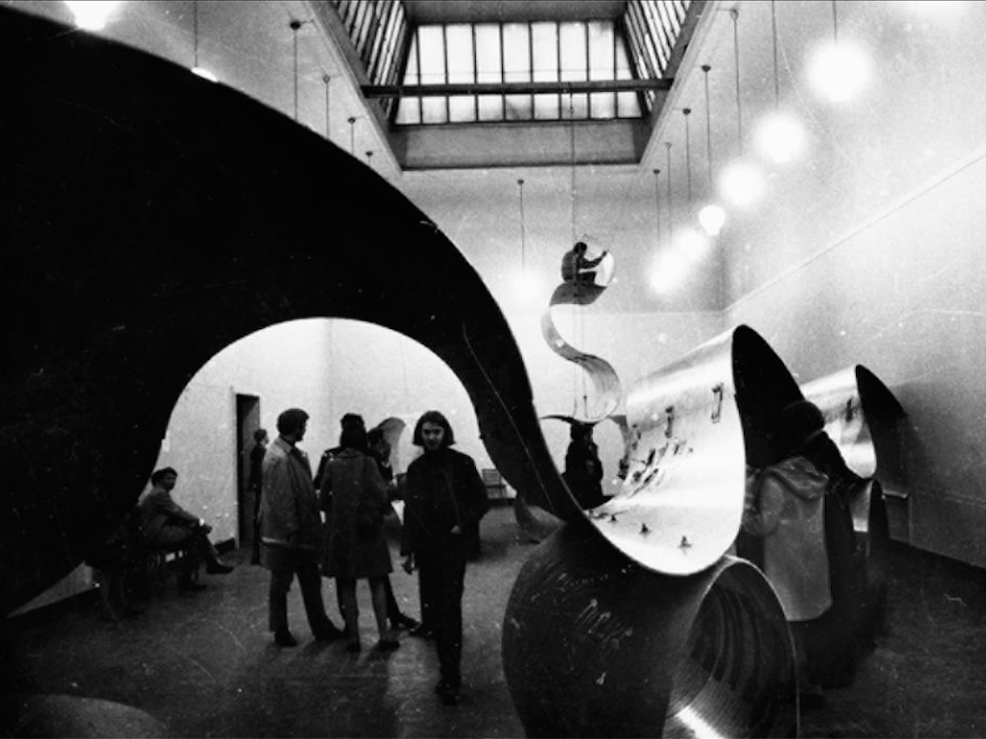
Siri Aurdal: Omgivelser (Environment)
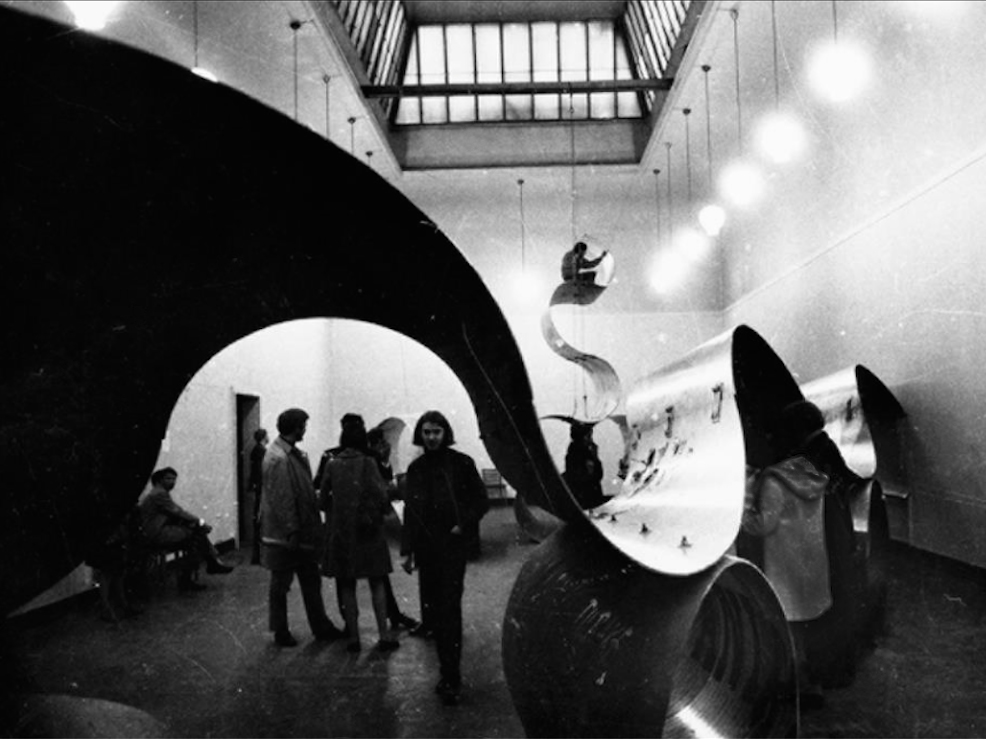
Siri AurdalAn installation and environment-art exhibition shown in May 1969, documented in a surviving photograph of the gallery hung with the artist's sculptural forms, from a period when the house was showing some of the first environment and kinetic art seen in Norway.19
Katya Garcia-Anton: Actions of Art and Solidarity
Various artists, curated by Katya Garcia-AntonShown 20 January to 21 March 2021, this exhibition on political solidarity art was reviewed for Kunstkritikk by Nicholas Norton, who praised Gavin Jantjes's apartheid-era work and Heather Dewey-Hagborg's piece built around Chelsea Manning's DNA, while flagging a tension the show itself raised: distinct political struggles risk being flattened once they are gathered under one institutional banner.10
Hostutstillingen 2026 (139th Autumn Exhibition)
Various, selected by an open-submission juryRunning 11 September to 18 October 2026 and open to any artist through unrestricted submission and a jury selection, this year's edition was reviewed unfavourably by Dagsavisen critic Lars Elton, who wrote that after two strong years the show had gone flat, though he singled out veteran Rangnhild Monsen's textile piece Introspection and Kjersti Vetterstad's video installation as its bright spots.11
A competition, a functionalist house, and an opening day in 1930
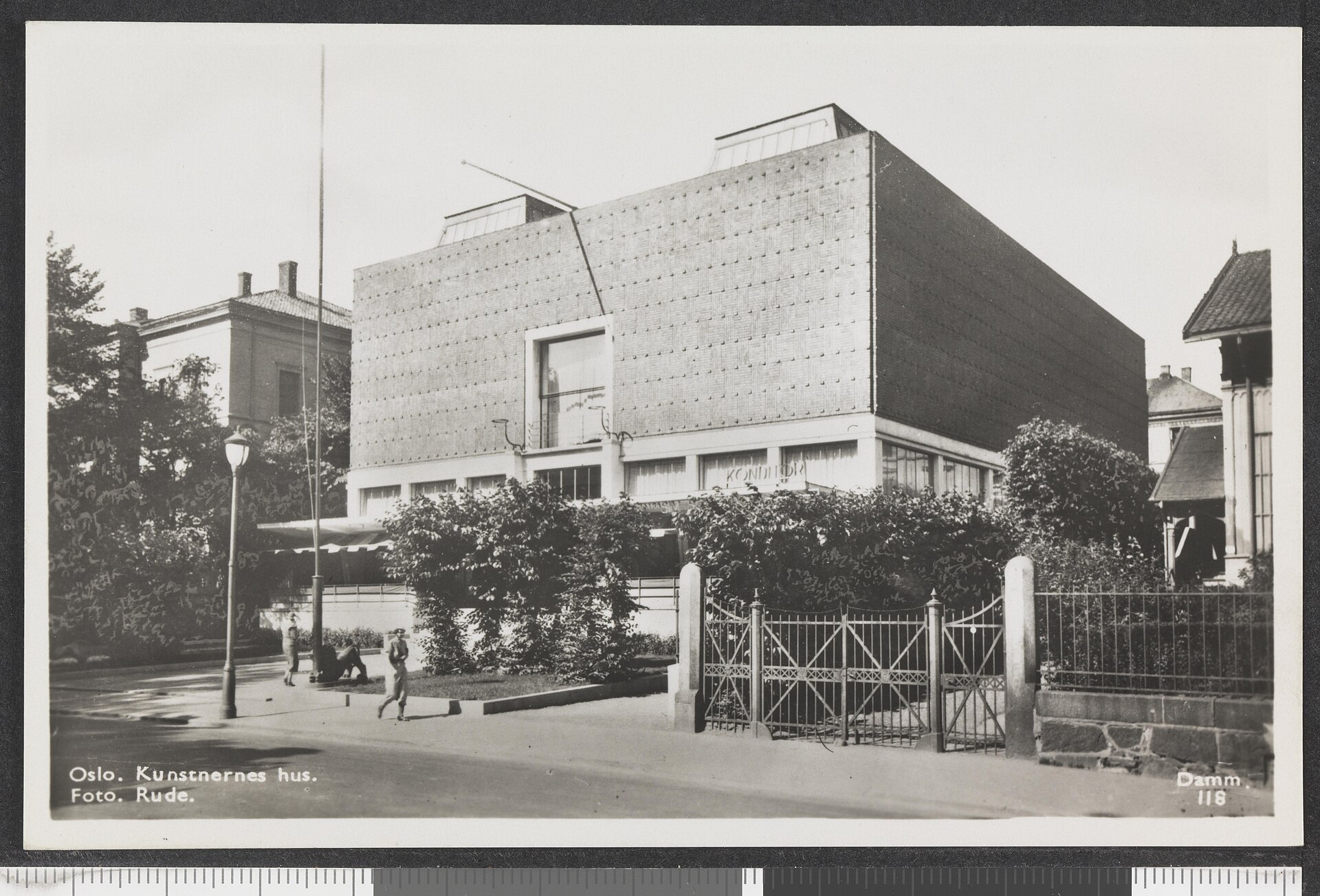
Kunstnernes Hus exists because Norway's Visual Artists Association wanted a building the state did not control. It bought the site on Wergelandsveien, across from the grounds of the Royal Palace, in 1927 and ran an open architectural competition the following year. Sixty-two proposals came in; the winner was an entry titled Felix by Gudolf Blakstad and Herman Munthe-Kaas, simplified before construction started in spring 1929. The finished building is cast concrete, its upper storey clad in brick laid in a pattern that makes plain the brick is decorative rather than load-bearing, and it was built to a brief that still describes what the galleries do today: natural light falling from the ceiling, a restrained building height, and a facade that would not shout over its residential neighbours.
It opened on 1 October 1930, on what the house's own history calls a sunny autumn day, with that year's Hostutstillingen, the Norwegian state's open-submission autumn exhibition that had existed since the 1880s but had never had a purpose-built home of its own. King Haakon VII, Crown Prince Olav and Crown Princess Martha attended the opening. The building cost 650,000 kroner and the press at the time called it Europe's most modern exhibition space. It won the Houen Prize for architecture the following year. Hostutstillingen has returned to the same rooms every autumn since 1930, through war, occupation and a century of Norwegian art, and its 139th edition was running when this record was researched.
The lions, the fresco, and the rooms behind them
Two bronze lions by the sculptor Ornulf Bast were installed either side of the entrance in the spring of 1931, a gift from the wholesaler Alf Bjercke, and the house reads them as freedom and creativity standing guard at the door. A year later, in the summer of 1932, the painter Per Krohg finished a ceiling fresco above the main staircase, 22 by 3.5 metres, which the house describes as showing an artist's thorny climb toward the heights. Both have stayed in place ever since and are usually the first things a visitor sees, before a single exhibition is reached.
The building was never only exhibition space. Its rear wing housed classrooms and studios for the State Academy of Art across three floors from the start, a function the room now called Akademirommet still carries: it was an academy teaching room from 1930 into the 1990s and has been run by the Academy since 2014 for free, weekly student exhibitions, concerts and workshops. A small multipurpose room near the front, Atelier Felix, was rebuilt in 2022 for children's and outreach work and takes its name, and its blue paint, from the same competition entry and the same foyer fresco that gave the building its shape in the first place. An independent cinema, opened in 2016, sits downstairs and doubles as a lecture hall. None of this is separate from the art programme; it is the same institution using the same rooms differently across nearly a century.
Guernica's winter, and the exhibitions Kunstnernes Hus used to be able to borrow
The single most consequential loan the house ever hosted arrived in December 1937. Walther Halvorsen organised Den Franske Utstillingen, opened in January 1938, bringing Picasso's Guernica to Oslo only months after its first showing in Paris, hung with work by Henri Matisse, Georges Braque and Henri Laurens; contemporary reporting called it the greatest artistic shock Oslo had experienced. Oslo was the first city to host the painting after Paris. On 20 January 1938 part of the National Gallery of Norway's own acquisitions committee met to weigh a purchase from the exhibition; the sculptors present wanted a Laurens, the painters' representatives never showed up, and the opportunity to buy Guernica for Norway passed unused, a fact only rediscovered by the art educator Morten Krogh in 2006. The same run of loan exhibitions had already brought nearly 40 paintings by Van Gogh in 1937, including The Potato Eaters.
The house kept borrowing at that scale for decades. In 1956, Etruskernes gate assembled almost 500 objects from 34 collections across Italy, Germany and France, a project its own history page calls the most ambitious it has ever attempted, and one that lost about a quarter of a million kroner. The 1970s and early 1980s turned the same loan capacity toward explicitly political programming: 162 works by Cuban artists in 1976, with a catalogue introduction credited to Fidel Castro, and in November 1981 a Norwegian premiere, a large exhibition of Palestinian artists organised with the PLO in solidarity with Palestine. That capacity to move major international loans in and out of the building is now itself in question, for reasons the building's current condition makes plain below.
Occupied, emptied, and reopened
On 1 April 1942 the German Wehrmacht seized Kunstnernes Hus under the occupation, and the house's own account says the building was emptied to the last pencil. Its exhibition programme moved to temporary quarters for the rest of the war. German prisoners of war were used to clean and restore the building after the capitulation, and it reopened on 22 November 1945. The house treats the closure as a wound to the institution rather than a gap in its record, and folds it into the same continuous history as the opening in 1930 and the exhibitions that came before and after it.
Governed by artists, and never a collection of its own
Kunstnernes Hus has no permanent collection and never has had one. It describes itself as Norway's oldest artist-governed institution, founded and built by artists in 1930, and its value to a visitor is not a fixed set of objects but an unbroken record of what has passed through its rooms: Hostutstillingen every autumn since 1930, the loan exhibitions above, and a continuous run of contemporary and student shows through Akademirommet and the main galleries. A five-member board runs the institution, four elected by the Norwegian Visual Artists Association and one appointed by the Ministry of Culture, which the house names as central to its independence from any single funding body or curatorial line. That governance model is also why the house's own history page, rather than a collections catalogue, is the closest thing to a permanent record this venue has, and why this record's highlights section is built from exhibition history rather than holdings.
A house that has outlived its own windows
By 2026 the building's age had become the story on its own terms. Kunstnernes Hus's own leadership says the skylit upper galleries can drop to about 5 degrees Celsius in winter because of failing insulation and old windows, that water leaks in through ageing pipes at the rear, and that the terrace is sinking; adhesives on an Ahmed Umar exhibition are reported to have cracked because the rooms were too cold. Director Sarah Lookofsky has said the swings in temperature now make it harder to borrow historically sensitive work in the way the house once could, the same lending capacity that brought Guernica and the Etruscan loan show decades earlier. A full rehabilitation is costed at around 186 million kroner, with the building's own portion near 115 million; the house has applied four times for a National Culture Buildings grant, been turned down three times, and was seeking 64.6 million kroner, about a third of the total, as this record was researched. A conditional 40 million kroner pledge from Sparebankstiftelsen DNB depends on the state contributing first, which board chair Ebba Moi has described as a funding loop in which private donors wait on public money that has not yet arrived. Leadership has said publicly that without that state contribution the institution may have to close its doors before its 2030 centenary. The building sits on the city's protected list, so any repair has to preserve its original materials and character rather than simply patch it, which is part of why the estimated cost runs as high as it does.
What visitors say
Visitors and critics agree on the building well before they agree on any single exhibition. The functionalist architecture, the skylit upper galleries, the bronze lions and the Krohg ceiling fresco are named as reasons to visit on their own, independent of what happens to be on show. What divides opinion is the changing exhibition programme itself: because Kunstnernes Hus has no permanent collection and depends entirely on its current show, an excellent visit and a thin one can sit only months apart, and both visitors and named critics describe exactly that swing, most recently a named critic calling the 2026 Hostutstillingen a comedown after two strong preceding years.
What is praised, what is criticised
- Praised: The 1930 functionalist building itself, its daylit upper galleries and the Bast lions and Krohg fresco at the entrance, called out as worth the visit even by reviewers unimpressed by a given show
- Praised: Juret, the in-house cafeteria and bar, for its setting and informal food, described as chill and cool by one visitor and as having a lush, fitting atmosphere for an event by another
- Praised: The range of what is under one roof: exhibitions, an independent cinema, a childrens workshop space, a reading lounge and a small bookshop, letting a visit run longer than a single gallery would
- Criticised: Inconsistency in the exhibition programme from one booking to the next: because there is no permanent collection to fall back on, a visitor who catches a weak edition can find, in one reviewer's words, almost nothing to see for the ticket price
- Criticised: Service at the restaurant, flagged separately from the art in more than one account, including long waits and uneven attentiveness on business and social bookings
- Criticised: The state of the building itself has become a live complaint in its own right in 2026 reporting: cold winter galleries, leaks and a sinking terrace, reported by the house's own leadership rather than by visitors
Ratings on other platforms
Tripadvisor: 3.4 from 37 ratings, read 28 September 2026
A platform average is a tertiary source: it moves, it is not audited, and we quote no visitor's words.
Questions about Kunstnernes Hus
Where is Kunstnernes Hus?
Wergelandsveien 17, NO-0167 Oslo, Norway.
How much does it cost to visit?
Adult (current exhibition, Hostutstillingen 2026): NOK 175; Student / concession, age 18-25: NOK 115; Under 18: free; Members and artists (NBK, UKS, FFF, NK, SDS, ICOM/IAA): free; Escort/companion with a valid escort certificate: free. As confirmed 28 September 2026.
When is it open?
Tuesday-Wednesday 11:00-18:00; Thursday 11:00-19:00; Friday-Sunday 11:00-18:00. Closed: Monday. As confirmed 28 September 2026.
How do you get there?
Tram: Lines 11, 17 and 18 to Holbergs plass; Train/Metro: Nationaltheatret station, about a 6 minute walk.
What should you see first?
Opening day and the first Hostutstillingen in the new building; Vincent van Gogh in Oslo (Vincent van Gogh); Den Franske Utstillingen: Matisse, Picasso, Braque, Laurens, with Guernica (Pablo Picasso and others); Etruskernes gate (The Etruscan Riddle); Cuba (Cuban artists, various); Palestinian artists, organised with the PLO (Palestinian artists, various).
What we could not confirm
- Whether the Ministry of Culture will approve a fourth application for a National Culture Buildings grant of 64.6 million kroner, after three prior rejections, before the building's 2030 centenary
- Whether the conditional 40 million kroner pledge from Sparebankstiftelsen DNB will be released, since it is contingent on the state funding arriving first
- Whether the house can keep borrowing internationally significant or historically sensitive work while its galleries still swing as low as about 5 degrees Celsius in winter, after adhesive failure was already reported on an Ahmed Umar exhibition
- How the exhibition and loan programme will be maintained through the rehabilitation building work, which the house's own reporting places across 2026 to 2028
Images
Sources
- 1Kunstnernes Hus, home page (current exhibition, hours, prices), fetched 28 September 2026 kunstnerneshus.no
- 2Kunstnernes Hus, Besok (visit: hours, admission, contact, transport, cafe) kunstnerneshus.no/besok
- 3Kunstnernes Hus, Tilgjengelighet (accessibility) kunstnerneshus.no/besok/tilgjengelighet
- 4Kunstnernes Hus, Our history kunstnerneshus.no/en/about/history
- 5Kunstnernes Hus, Var historie (Norwegian-language history) kunstnerneshus.no/om/historie
- 6Kunstnernes Hus, About (mission and governance) kunstnerneshus.no/en/about
- 7Wikipedia, Kunstnernes Hus en.wikipedia.org/wiki/Kunstnernes_Hus
- 8Wikidata, Kunstnernes Hus (Q1772519) wikidata.org/wiki/Q1772519
- 9Wikimedia Commons, Category:Kunstnernes Hus commons.wikimedia.org/wiki/Category:Kunstnernes_Hus
- 10Kunstkritikk, Nicholas Norton, 'Revolution at the Office', 3 February 2021 kunstkritikk.com/revolution-at-the-office/
- 11Dagsavisen, Lars Elton, 'Hostutstillingen 2026: Mer a irritere seg over', 9 September 2026 dagsavisen.no/kultur/hostutstillingen-2026-mer-a-irritere-seg-over/10523639
- 12Dagbladet, Anastasia Moyland (photographs by Kristin Svorte), 'Historisk bygg forfaller: - Veldig fortvilende', 27 September 2026 dagbladet.no/nyheter/historisk-bygg-forfaller-veldig-fortvilende/85185222
- 13Kunstnernes Hus, '40 million kroner for #HusetVart' kunstnerneshus.no/en/articles/huset-vart
- 14Tripadvisor, Kunstnernes Hus listing and visitor reviews, read 28 September 2026 tripadvisor.com/Attraction_Review-g190479-d3477525-Reviews-Kunstnernes_Hus-Oslo_Eastern_Norway.html
- 15Kunstnernes Hus, Juret (cafe and bar) kunstnerneshus.no/besok/juret
- 16Kunstnernes Hus, Butikk (shop) kunstnerneshus.no/besok/butikk
- 17Kunstnernes Hus, Ofte stilte sporsmal (FAQ) kunstnerneshus.no/besok/ofte-stilte-sporsmal
- 18Wallpaper*, Philippine Wright, 'Atelier Felix expands within Oslo's iconic Kunstnernes Hus', 25 October 2022 wallpaper.com/architecture/atelier-felix-expands-within-oslos-iconic-kunstnernes-hus
- 19Wikimedia Commons, File:Fra utstillingen Omgivelser mai 1969 pa Kunstnernes Hus i Oslo.jpg (file description page) commons.wikimedia.org/wiki/File:Fra_utstillingen_Omgivelser_mai_1969_p%C3%A5_Kunstnernes_Hus_i_Oslo.jpg
- 20Museo Reina Sofia, Repensar Guernica / Rethinking Guernica, 'Guernica at Kunstnernes Hus' guernica.museoreinasofia.es/en/document/guernica-kunstnernes-hus
- 21Kunstnernes Hus, Akademirommet kunstnerneshus.no/konsepter/akademirommet
- 22culturanotes.com, 'I Picassos fotspor', 7 January 2024 (on the 1938 National Gallery acquisitions committee and Guernica) culturanotes.com/2024/01/07/i-picassos-fotspor/
