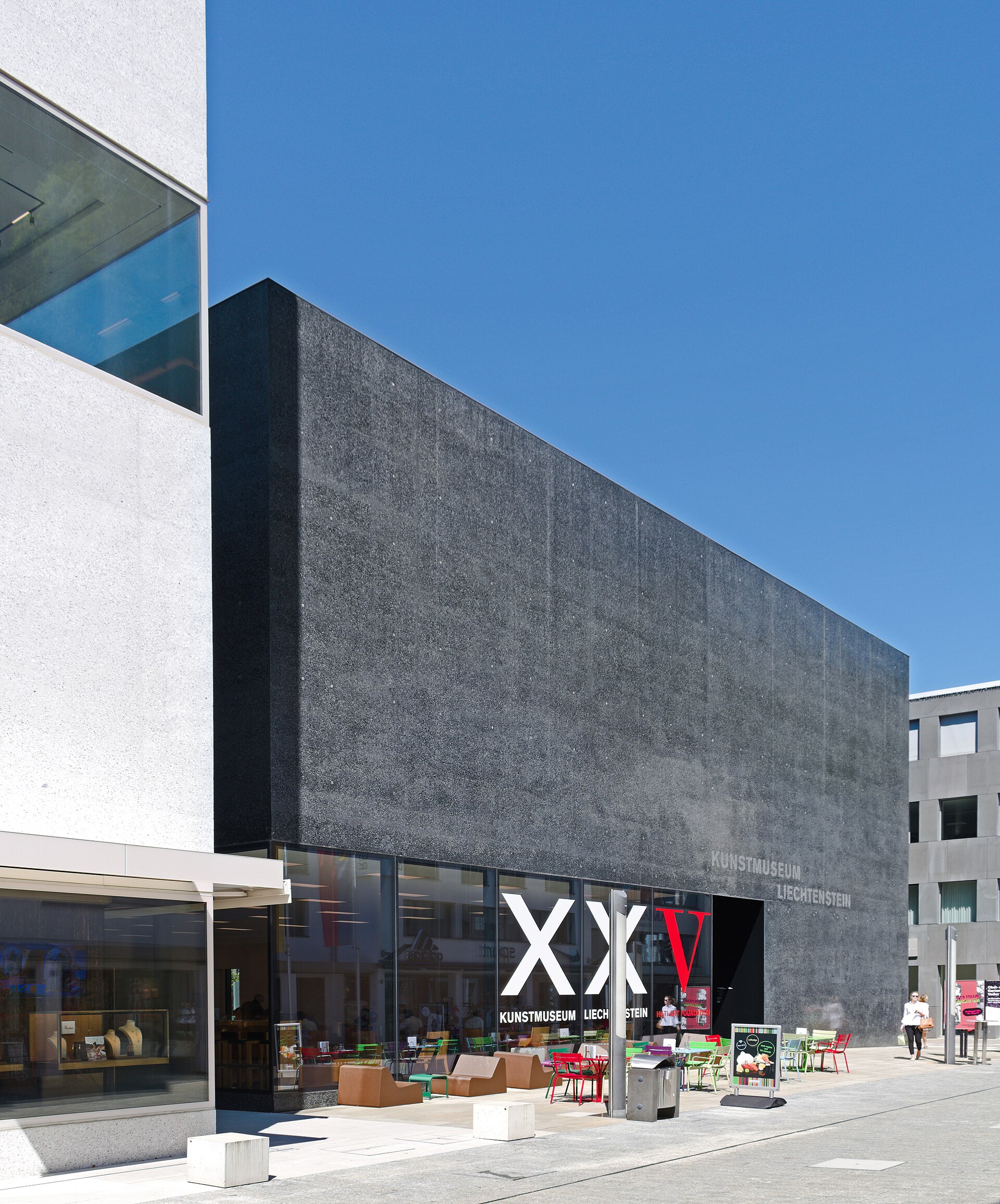
The black basalt-concrete cube of Kunstmuseum Liechtenstein on the Staedtle in Vaduz, with a temporary XXV banner marking the museum's 25th anniversary since its November 2000 opening
Ymblanter, CC BY-SA 4.0Kunstmuseum Liechtenstein
Museum · Founded 2000
Open, admission and hours confirmed 20 August 2026 · 10 sources
On this page 16 sections
ContentsClose
The museum's declared strength is postwar and contemporary process and installation art, built on the Rolf Ricke Collection of American art since the 1960s and anchored by the complete Marcel Duchamp boites-en-valise, the Andre Thomkins estate and the Anne Marie Jehle estate. Its Hilti Art Foundation partner supplies the counterweight of European classical modernism from about 1880 to 1950 and postwar abstraction through to the present, with depth in Klee, Kirchner, Picasso and Giacometti. Between the two, a single visit covers early twentieth-century European modernism and American postminimalism under one ticket, which is unusual for a museum of this size.
| Kind | Museum |
|---|---|
| Founded | 2000 |
| City and country |  Vaduz, Liechtenstein Vaduz, Liechtenstein |
| Address | Staedtle 32, 9490 Vaduz, Liechtenstein |
| Website | kunstmuseum.li |
| Status | Open, confirmed |
| Record last verified |
Visiting
- Hours
- Tue-Sun10:00 to 17:00Last entry 15 minutes before closing
- Thu10:00 to 20:00Extended Thursday hours; last entry 15 minutes before closing
- Closed
- Monday, except Easter Monday and Whit Monday, when the museum opens 10:00-17:00. 1 January. 24 December. 25 December. 31 December.
- Admission
- StandardCHF 15
- Concession (seniors, people with disabilities and their carers, students, trainees, groups of 10 or more, Oe1 Club)CHF 10
- Children and youth under 16Freefree
Free entry: Every Wednesday, free admission for all visitors. 15 August, Liechtenstein National Day, free admission with hours extended to 20:00- Tickets
- kunstmuseum.li/en/your-visit/plan-your-visit The museum's own ticket page.
- Do I need to book?
- No booking is required for general admission to either the museum or the Hilti Art Foundation
- Address
- Staedtle 32, 9490 Vaduz, Liechtenstein MapBus LIEmobil buses connect Vaduz to the Swiss rail stations at Sargans and Buchs/SG and the Austrian station at Feldkirch; the museum stands in the pedestrian Staedtle zone with its entrance on the pedestrian-zone side
Walking In the centre of Vaduz, on the pedestrian Staedtle between the Staedtle itself and Aeulestrasse - Website
- kunstmuseum.li
- Telephone
- +423 235 03 00
- [email protected]
Before you go how long, access, photography, bags, eating, shop
- How long to allow
- A morning or half a day covers both the Kunstmuseum Liechtenstein building and the adjoining Hilti Art Foundation, which share one entrance and one ticket
- Access
- Wheelchairs and rollators are welcome, a wheelchair can be borrowed on site, toilets and several lifts are accessible, guide dogs are permitted in the galleries, and step-free entry is available through the Zentrum underground car park with advance notice
- Photography
- Non-flash photography for personal use is allowed; tripods and selfie sticks are prohibited
- Bags
- A4-size bags and small backpacks are permitted in the galleries; free lockers are provided for larger items
- Eating
- The museum cafe serves Japanese-influenced dishes, including sushi, salads and cakes, with a summer terrace; open Wednesday to Friday 9:00-21:00 and Saturday to Tuesday 9:00-18:00, closed Monday
- Shop
- The museum shop can be visited without a museum ticket
Prices and hours change. We take them from the institution's own pages and print the day we read them, and you can check the current position at the source we used. Confirm before you travel.
What is inside
Kunstmuseum Liechtenstein building (2000)
The original black cube by Morger and Degelo with Christian Kerez, containing six exhibition rooms arranged around two opposing staircases that give diagonal sightlines through the building. It houses the museum's own collection - the national art collection of Liechtenstein, running from early modernism to the present with an emphasis on work since 1945 - and rotating temporary exhibitions
Hilti Art Foundation building (2015)
The adjoining exhibition building added in May 2015, designed by Morger Partner Architekten and physically connected to the original museum with a shared entrance and ticket desk. It presents the Hilti family's private collection of European classical modernism (about 1880-1950) and postwar to contemporary art, including painting, sculpture, works on paper and photography
Kollabor
A dedicated art space inside the museum for children, families and adults, used for interactive and participatory programming alongside the main exhibitions
Museum cafe
A cafe serving Japanese-influenced food including sushi, salads and cakes, with a summer terrace; the Side-Light Gallery next to it is one of the few places inside the building where food and drink are permitted
Museum shop
A shop selling books, catalogues and design objects, accessible without buying a museum ticket
What to see first
The complete set of Marcel Duchamp's boites-en-valise
Marcel DuchampHeld in full, Duchamp's series of miniature portable museums in a box is treated by the museum as a central reference point for its own collection of art since 19454
The Rolf Ricke Collection of American art since the 1960s
Richard Artschwager, Donald Judd, Barry Le Va, Lee Lozano, Richard Serra, Keith Sonnier and othersAcquired in 2006 jointly with Kunstmuseum St. Gallen and Frankfurt's Museum fuer Moderne Kunst from collector Rolf Ricke, an early champion of process and installation art; it gives the museum its particular strength in Arte Povera and postminimalism4
The Andre Thomkins estate
Andre Thomkins (1930-1985)More than 6,500 works on permanent loan since 2004, spanning experimental language-based art, drawings and watercolours by the Swiss artist4
The Anne Marie Jehle estate
Anne Marie Jehle (1937-2000)Donated by the Anne Marie Jehle Foundation in 2022, over 1,600 works by the Austrian-Liechtenstein artist engaging critically with everyday life, social structures and power relations4
The Hilti Art Foundation's core collection
Max Beckmann, Alexander Calder, Alberto Giacometti, Ernst Ludwig Kirchner, Paul Klee, Pablo Picasso, Sophie Taeuber-Arp and othersMore than 500 paintings, sculptures, works on paper and photographs of museum quality, spanning European classical modernism through to contemporary artists such as Callum Innes and Sean Scully7
The Lettrist holdings from the Robert Altmann gift
Artists of the Lettrist movementA gift from collector Robert Altmann that gives the museum a notable concentration of 1950s Lettrism, a movement rarely held in depth outside France4
The Monauni Collection of Art Informel
Art Informel artists of the 1950sHeld as a long-term loan, this collection is one of the museum's named strengths in postwar European abstraction4
The building itself
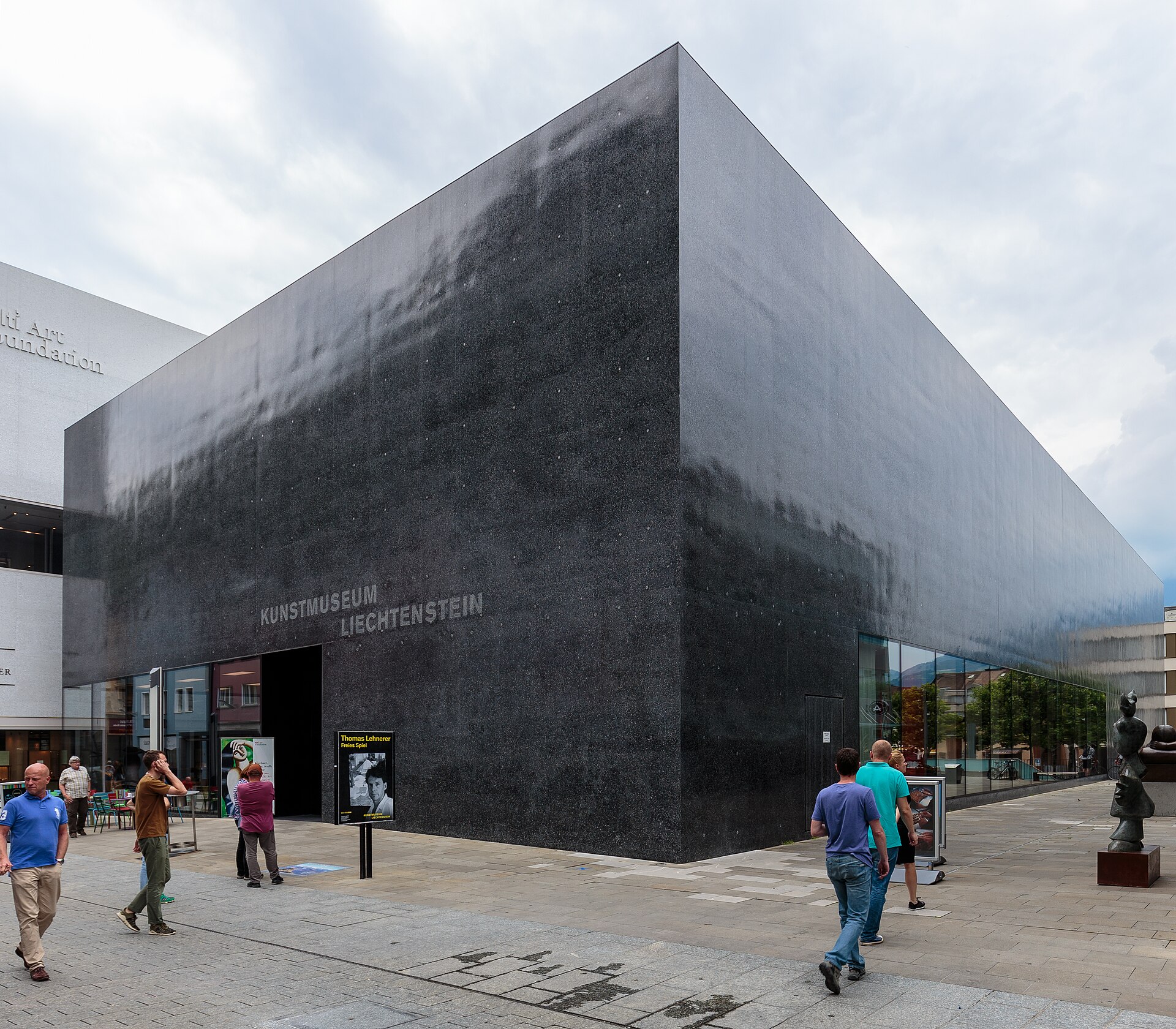
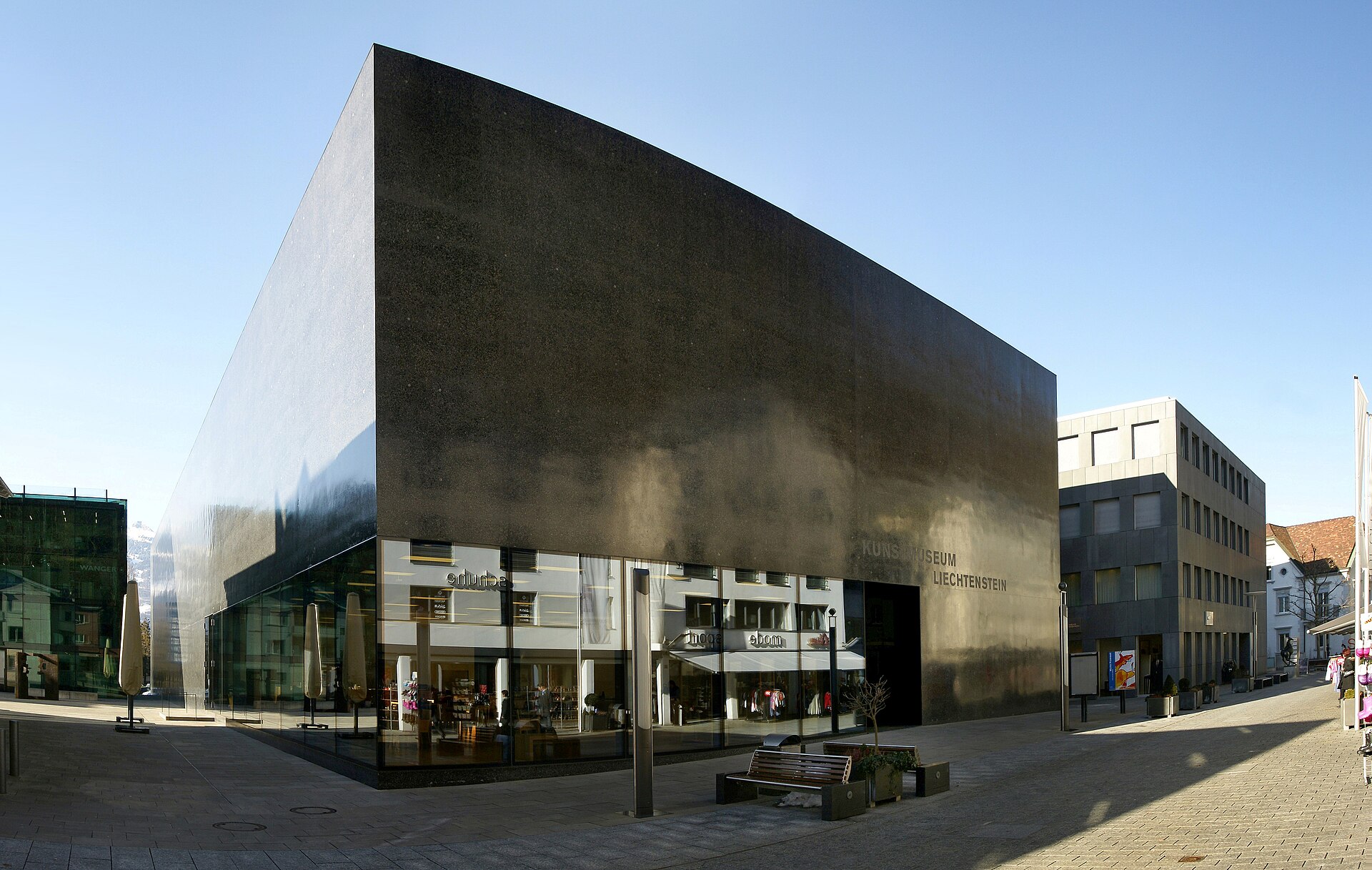
Meinrad Morger and Heinrich Degelo with Christian KerezPlaced second in the 1997 design competition but built as the winning scheme, the black cuboid of tinted concrete faced in basalt with embedded river pebbles opened in November 2000 as a millennium gift to the Principality of Liechtenstein, and is itself one of the most photographed objects in Vaduz5
Exhibitions on now
- On now8 May 2026 to 17 May 2027Confirmed , 7 weeks ago
Past exhibitions here
A black cube in the middle of Vaduz
Kunstmuseum Liechtenstein stands at Staedtle 32, in the pedestrian heart of Vaduz, between the Staedtle itself and Aeulestrasse. What a visitor sees first is not a facade of stone plaques or a grand portico but a windowless black cuboid, its surface a mix of concrete tinted with carbon black and iron oxide and black basalt with river pebbles embedded in it, giving the walls a faint sheen that shifts with the light. The building was designed by the Swiss architects Meinrad Morger and Heinrich Degelo working with Christian Kerez, whose scheme placed second in a 1997 design competition and was nonetheless the one built. Construction ran from 1998 to 2000 for a client called the Stiftung zur Errichtung eines Kunstmuseums, the Foundation for the Establishment of an Art Museum, and the finished building measures 3,500 square metres of total floor space. It opened to the public on 11 November 2000, given to the Principality of Liechtenstein as a millennium gift arranged between private donors, the national government and the Municipality of Vaduz. Inside, six exhibition rooms are arranged around two opposing staircases, a layout that lets a visitor see diagonally across the building rather than moving room to room in a single loop.
From ten donated paintings to a national collection
The museum's collection predates its building by more than three decades. In 1967 the State of Liechtenstein received a gift of ten paintings, and the following year that gift became the basis of the Liechtensteinische Staatliche Kunstsammlung, the State Art Collection. Its first curator, the artist and art historian Georg Malin, pushed the young collection toward international modern and contemporary art rather than a narrower national focus, a decision that still shapes what the museum shows. The State Art Collection had no purpose-built home for more than thirty years, and it was only with the 2000 building that the collection acquired a museum to match its ambitions. Dr Friedemann Malsch directed the institution from 1996 to 2021, overseeing the opening of the building and its first two decades; Letizia Ragaglia took over as director on 1 July 2021, and Christiane Meyer-Stoll was announced to succeed her from 1 January 2026.
Two collections under one roof
What makes Kunstmuseum Liechtenstein unusual among small national museums is that it is not one collection but two, run as a public-private partnership sharing a single building and a single ticket. The museum's own holdings are the national art collection described above. Standing against it, physically connected since May 2015, is the Hilti Art Foundation, an exhibition building designed by Morger Partner Architekten that presents the private collection built up by the Hilti family. The Hilti family began collecting in the 1970s, developed the collection systematically from 1997, and formally established the Hilti Art Foundation as an institution in 1998; the foundation now describes itself as holding the collection of the Martin Hilti family trust together with the private collection of Caroline and Michael Hilti. Its declared focus is European classical modernism from roughly 1880 to 1950 - Expressionism, Cubism, Constructivism, Surrealism, Concrete Art - together with Zero, Minimal Art and abstraction after 1980, and it puts the two institutions' different collecting strategies to work as complements rather than duplicates: modernism and contemporary process art on the museum side, canonical classical modernism and postwar European abstraction on the Foundation side.
What is actually on the walls
The museum's own collection statement names Marcel Duchamp as a central reference point, and it holds his full series of miniature boxed museums, the boites-en-valise, in their entirety. Its declared strengths for the postwar period are Arte Povera and postminimalism, built above all on the Rolf Ricke Collection of American art since the 1960s - Richard Artschwager, Donald Judd, Barry Le Va, Lee Lozano, Richard Serra and Keith Sonnier among the names - which the museum acquired jointly in 2006 with Kunstmuseum St. Gallen and Frankfurt's Museum fuer Moderne Kunst from Ricke, an early champion of process and installation art. Two further estates anchor the collection: more than 6,500 works by the Swiss artist Andre Thomkins have been on permanent loan since 2004, and more than 1,600 works by the Austrian-Liechtenstein artist Anne Marie Jehle were donated by her foundation in 2022. A gift from the collector Robert Altmann gives the museum a concentration of 1950s Lettrism, and the Monauni Collection, held on long-term loan, does the same for Art Informel of the same decade. On the Hilti Art Foundation side, the foundation states it holds more than 500 paintings, sculptures, works on paper and photographs of what it calls museum quality, with multiple works each by Max Beckmann, Alexander Calder, Alberto Giacometti, Ernst Ludwig Kirchner, Paul Klee, Pablo Picasso and Sophie Taeuber-Arp, alongside contemporary artists including Callum Innes and Sean Scully.
Visiting the black cube
The museum and the Hilti Art Foundation are entered through one shared door and covered by one ticket: CHF 15 standard, CHF 10 concession for seniors, people with disabilities and their carers, students, trainees, groups of ten or more and Oe1 Club members, and free for children and young people under 16. Admission is free for everyone every Wednesday, and again on 15 August, Liechtenstein's National Day, when the museum also stays open until 20:00. Regular hours are Tuesday to Sunday 10:00 to 17:00, with Thursday extended to 20:00; the museum is closed Mondays except for Easter Monday and Whit Monday, and closed entirely on 1 January, 24, 25 and 31 December. Wheelchairs and rollators are welcome, a wheelchair can be borrowed on site, and step-free entry is available through the Zentrum underground car park with advance notice. Photography without flash is allowed for personal use, though tripods and selfie sticks are not. The Kollabor space inside the museum is set aside for children, families and adults to engage with art hands-on, separate from the main galleries. A cafe serving Japanese-influenced food, including sushi, with a summer terrace, sits alongside a shop that can be visited without a ticket.
A small state's museum, and what it does not carry
Liechtenstein is a country of roughly forty thousand people, and Kunstmuseum Liechtenstein functions simultaneously as the national gallery of a microstate and as the exhibition venue for a private industrial family's collection, an arrangement that is unusual among the institutions this archive covers. Research for this page turned up no restitution claim, ownership dispute or public controversy attached to the museum or to either collection it presents; that absence is what the sources available to this desk show, not a certified clean bill, and it should be read as the limit of what could be verified rather than as a settled fact. What is well documented is the practical shape of a visit: a building whose exterior draws more comment from visitors than any single work inside it, a collection built as much through long-term loans and family gifts as through purchase, and a second, adjoining institution whose different focus is the reason most visitors are advised to see both sides in one trip rather than treat the Hilti Art Foundation as an optional extra.
What visitors say
Visitors consistently rate the building itself as the strongest part of a visit - the black cuboid and its internal staircases draw more comment than any single artwork - and are surprised by the international names on view (Picasso, Giacometti, Klee, Matisse, Munch) given the museum's location in a small state capital. The most repeated practical complaint is scale: the collection is spread across two adjoining buildings connected by stairs, with only a handful of rooms open at a time, so visitors who expect a full afternoon are often finished within one to two hours unless they also take in the Hilti Art Foundation side
What is praised, what is criticised
- Praised: The black basalt-concrete facade and the diagonal stair sightlines inside, repeatedly singled out as the most memorable part of a visit
- Praised: Seeing internationally significant names (Picasso, Giacometti, Klee, Matisse, Munch) without crowds, in a small city visitors did not expect this from
- Praised: Helpful, informative staff
- Praised: Free admission every Wednesday
- Criticised: The museum is compact and split across separate buildings linked by steep staircases, which some visitors find physically demanding and note leaves only a few rooms to see in a single visit
- Criticised: Because both the museum and the Hilti Art Foundation change their displays on a rotation, a visitor arriving between major exhibitions may find less on view than the building's size suggests
Ratings on other platforms
Tripadvisor: 4 from 184 ratings, read 20 August 2026
A platform average is a tertiary source: it moves, it is not audited, and we quote no visitor's words.
Questions about Kunstmuseum Liechtenstein
Where is Kunstmuseum Liechtenstein?
Staedtle 32, 9490 Vaduz, Liechtenstein.
How much does it cost to visit?
Standard: CHF 15; Concession (seniors, people with disabilities and their carers, students, trainees, groups of 10 or more, Oe1 Club): CHF 10; Children and youth under 16: free. As confirmed 20 August 2026.
When is it open?
Tue-Sun 10:00-17:00; Thu 10:00-20:00. Closed: Monday, except Easter Monday and Whit Monday, when the museum opens 10:00-17:00. 1 January. As confirmed 20 August 2026.
How do you get there?
Bus: LIEmobil buses connect Vaduz to the Swiss rail stations at Sargans and Buchs/SG and the Austrian station at Feldkirch; the museum stands in the pedestrian Staedtle zone with its entrance on the pedestrian-zone side; Walking: In the centre of Vaduz, on the pedestrian Staedtle between the Staedtle itself and Aeulestrasse.
What should you see first?
The complete set of Marcel Duchamp's boites-en-valise (Marcel Duchamp); The Rolf Ricke Collection of American art since the 1960s (Richard Artschwager, Donald Judd, Barry Le Va, Lee Lozano, Richard Serra, Keith Sonnier and others); The Andre Thomkins estate (Andre Thomkins (1930-1985)); The Anne Marie Jehle estate (Anne Marie Jehle (1937-2000)); The Hilti Art Foundation's core collection (Max Beckmann, Alexander Calder, Alberto Giacometti, Ernst Ludwig Kirchner, Paul Klee, Pablo Picasso, Sophie Taeuber-Arp and others); The Lettrist holdings from the Robert Altmann gift (Artists of the Lettrist movement).
What we could not confirm
- The museum's own collection page states the Rolf Ricke Collection was acquired in 2006; Wikipedia's account of the institution's history gives 2007 for the same joint acquisition. This page follows the museum's own site as the primary source and flags the one-year discrepancy for a future check against the joint acquisition announcement.
- No named journalistic review of the museum or its architecture could be reached for this page (Arquitectura Viva's professional assessment returned a bot block); a future pass should retry it or find an alternate architecture-critical source.
Images
Sources
- 1Kunstmuseum Liechtenstein, official homepage kunstmuseum.li/en
- 2Kunstmuseum Liechtenstein, Plan your visit (hours, admission, contact, accessibility, cafe, shop, photography and bag policy) kunstmuseum.li/en/your-visit/plan-your-visit
- 3Kunstmuseum Liechtenstein, About us (founding history, mission, Hilti Art Foundation building, directors) kunstmuseum.li/en/museum/about-us
- 4Kunstmuseum Liechtenstein, Collection (Duchamp boxes, Rolf Ricke Collection, Andre Thomkins estate, Anne Marie Jehle estate, Robert Altmann gift, Monauni Collection) kunstmuseum.li/en/museum/collection
- 5Morger Partner Architekten, Kunstmuseum Liechtenstein, Vaduz (project page: architects, 1997 competition, 1998-2000 construction, floor space, awards) morgerpartner.ch/en/kunstmuseum-liechtenstein-vaduz-li-2/
- 6Hilti Art Foundation, Kunstmuseum Liechtenstein partnership page haf.li/en/kunstmuseum-liechtenstein
- 7Hilti Art Foundation, Collection page (history, scope, named artists, holdings) haf.li/en/collection
- 8Wikipedia, Kunstmuseum Liechtenstein (: predecessor State Art Collection, opening date, building materials, director succession) en.wikipedia.org/wiki/Kunstmuseum_Liechtenstein
- 9Tripadvisor, Kunstmuseum Liechtenstein reviews and rating (184 reviews, 4.0/5, read directly) tripadvisor.com/Attraction_Review-g190371-d238249-Reviews-Kunstmuseum_Liechtenstein-Vaduz.html
- 10Official tourism website of the Principality of Liechtenstein, Travel and mobility (rail stations, LIEmobil bus connections) en.tourismus.li/reiseland/anreise-mobilitaet.html