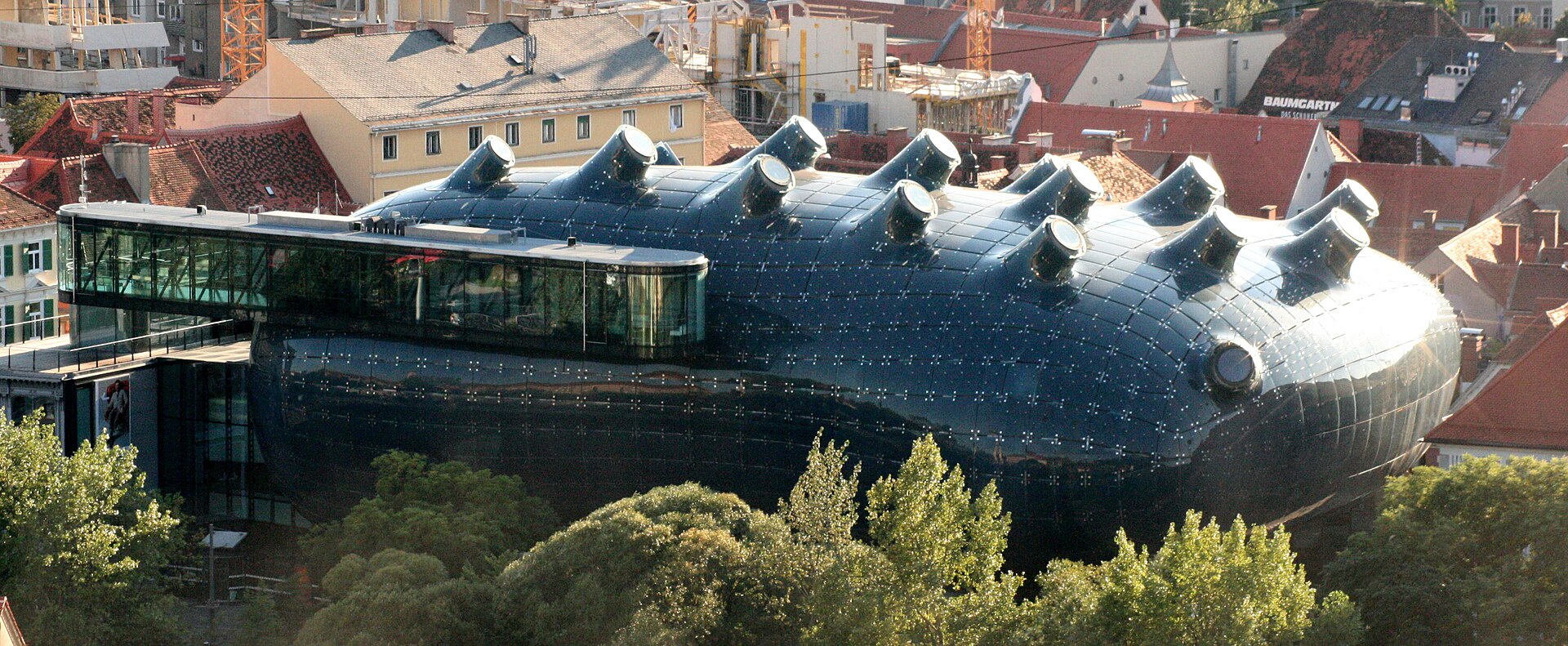
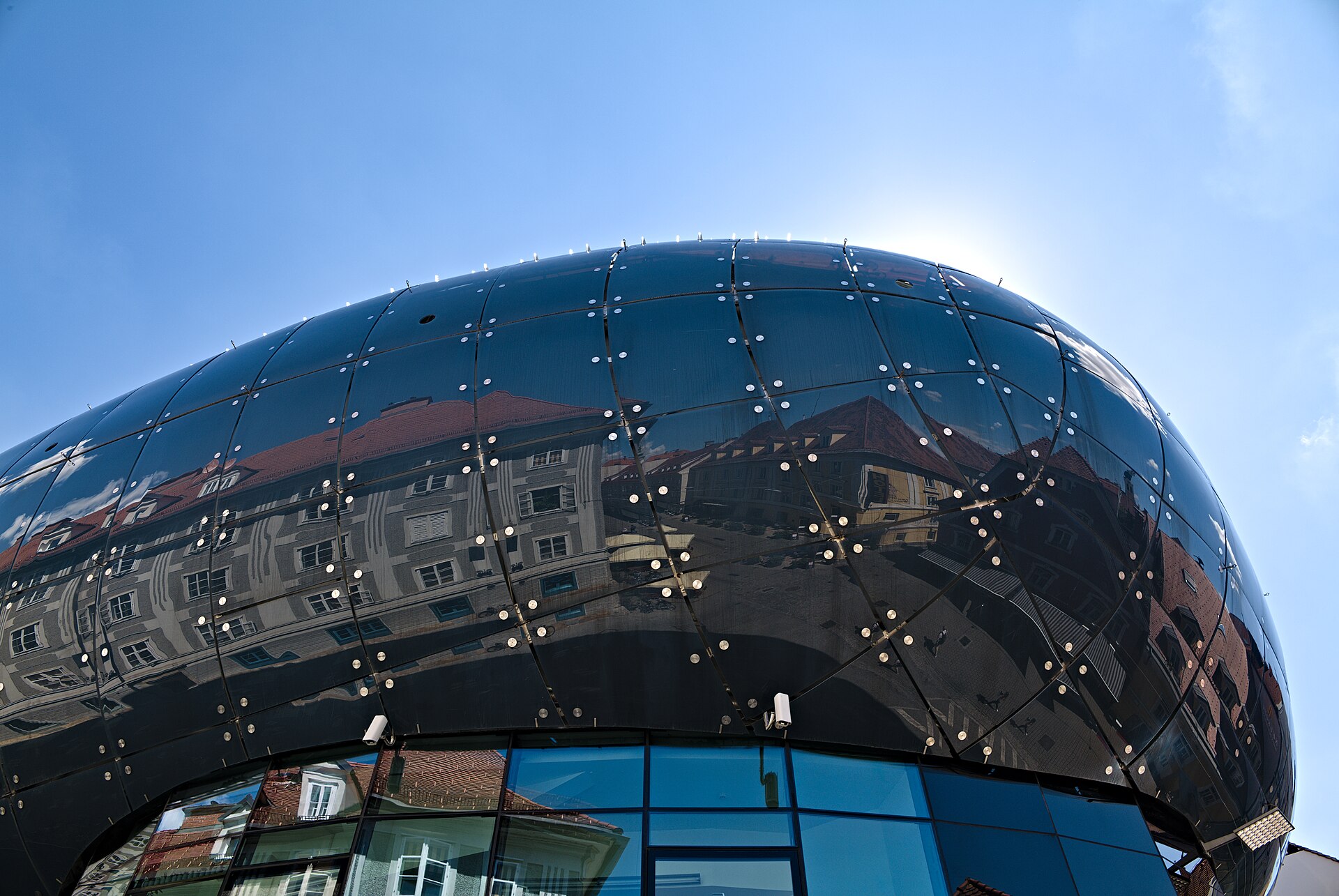
The full biomorphic shell of the Kunsthaus Graz, its nozzle skylights and the elevated glass entrance walkway, photographed from street level with the roofs of Graz's old town behind it.
Photograph by Marion Schneider and Christoph Aistleitner; public domainKunsthaus Graz
Museum · Founded 2003
Open, admission and hours confirmed 12 September 2026 · 24 sources
On this page 15 sections
ContentsClose
The Kunsthaus Graz has no permanent collection to be strong or weak in the conventional sense; what it holds instead is a building that is itself the standing exhibit, and a curatorial track record built almost entirely on temporary loans and commissions. Its real, durable holding is architectural and institutional rather than art-historical: the Friendly Alien shell and the BIX facade as a landmark of early twenty-first-century media architecture, the restored Eisernes Haus as a rare survival of early cast-iron construction, and Camera Austria's continuously running photography programme and archive as the one part of the building with genuine curatorial continuity rather than a rotating cast of borrowed shows. A visitor comes for the building first and the programme second, and the two decades of exhibitions since 2003 have mostly been judged, fairly, on how well they use a space that was never built to be a neutral white cube.
| Kind | Museum |
|---|---|
| Founded | 2003, designed by Peter Cook and Colin Fournier and opened 27 September 2003 as the architectural centerpiece of Graz's year as European Capital of Culture; built beside, and incorporating, the 1848 Eisernes Haus |
| City and country |  Graz, Austria Graz, Austria |
| Address | Lendkai 1, 8020 Graz, Austria |
| Website | museum-joanneum.at/en/kunsthaus-graz |
| Status | Open, confirmed |
| Record last verified |
Visiting
- Hours
- Tuesday to Sunday and public holidays10:00 to 18:00
- MondayClosed, except when Monday is a public holiday
- Closed
- 24 and 25 December 2026.
- Admission
- Adult, single-visit ticket (Kunsthaus Graz only, valid one calendar day)EUR 13Joanneum 24-hour combined ticket (valid at all Universalmuseum Joanneum sites) 20 EUR; 48-hour combined ticket 26 EUR
- Under 19 years, single-visit ticketFreeFree on the single-visit ticket; Joanneum 24-hour combined ticket 5 EUR; 48-hour combined ticket 6.50 EUR
- Seniors, visitors with a disability, groups of 12 or more (per person), single-visit ticketEUR 11Joanneum 24-hour combined ticket 17 EUR; 48-hour combined ticket 22 EUR
- Students, apprentices, conscripts and those doing civilian service aged 19 to 25, single-visit ticketEUR 6.50Joanneum 24-hour combined ticket 10 EUR; 48-hour combined ticket 13 EUR
- Student groups and groups from social institutions, single-visit ticketEUR 3Joanneum 24-hour combined ticket 5 EUR; 48-hour combined ticket 6.50 EUR
- Guided tour supplementEUR 4Per person, on top of admission; pre-booked group guided tours (up to 25 people) 55 EUR per group; student/social-institution course groups 3 EUR; audioguide or multimedia guide 3 EUR
Free entry: Visitors under 19 years of age: free on the single-visit ticket. Graz Card holders: free entry to all Universalmuseum Joanneum sites in Graz. Steiermark-Card holders: free entry from 1 April to 31 October. ICOM members: free entry to all Universalmuseum Joanneum museums. Holders of the 'Hunger auf Kunst und Kultur' (Hunger for Art and Culture) pass: free admission- Tickets
- museum-joanneum.at/en/kunsthaus-graz/tickets The museum's own ticket page.
- Do I need to book?
- No, walk-up entry for general admission; the museum sells tickets online and at the desk. Guided-tour bookings should be requested at least one week in advance.
- Address
- Lendkai 1, 8020 Graz, Austria MapTram Lines 1, 4, 6 and 7 to Suedtiroler Platz - Kunsthaus; lines 3 and 5 to Hauptplatz - Graz Congress, then a short walk via Murgasse
- Website
- museum-joanneum.at/en/kunsthaus-graz
- Telephone
- +43-316/8017-9200
- [email protected]
Before you go how long, access, photography, bags, eating, shop
- How long to allow
- About one to two hours for the two exhibition halls and the Needle viewing platform together
- Access
- Step-free throughout the building by lift, with Braille and audio floor announcements; wheelchairs loaned free at the ticket counter; two fully accessible toilets; white gloves and a touchable building model for blind visitors; an induction hearing loop and sign-language tours on request; companions of visitors with a disability are admitted free
- Photography
- Not published in the sources read for this record
- Bags
- Not published in the sources read for this record
- Eating
- The Kunsthaus Cafe sits inside the Eisernes Haus at the entrance, with its own published opening hours separate from the exhibition halls
- Shop
- The museum shop occupies the Eisernes Haus entrance area and carries an extensive selection of art and architecture books, noted specifically by visitors
Prices and hours change. We take them from the institution's own pages and print the day we read them, and you can check the current position at the source we used. Confirm before you travel.
What is inside
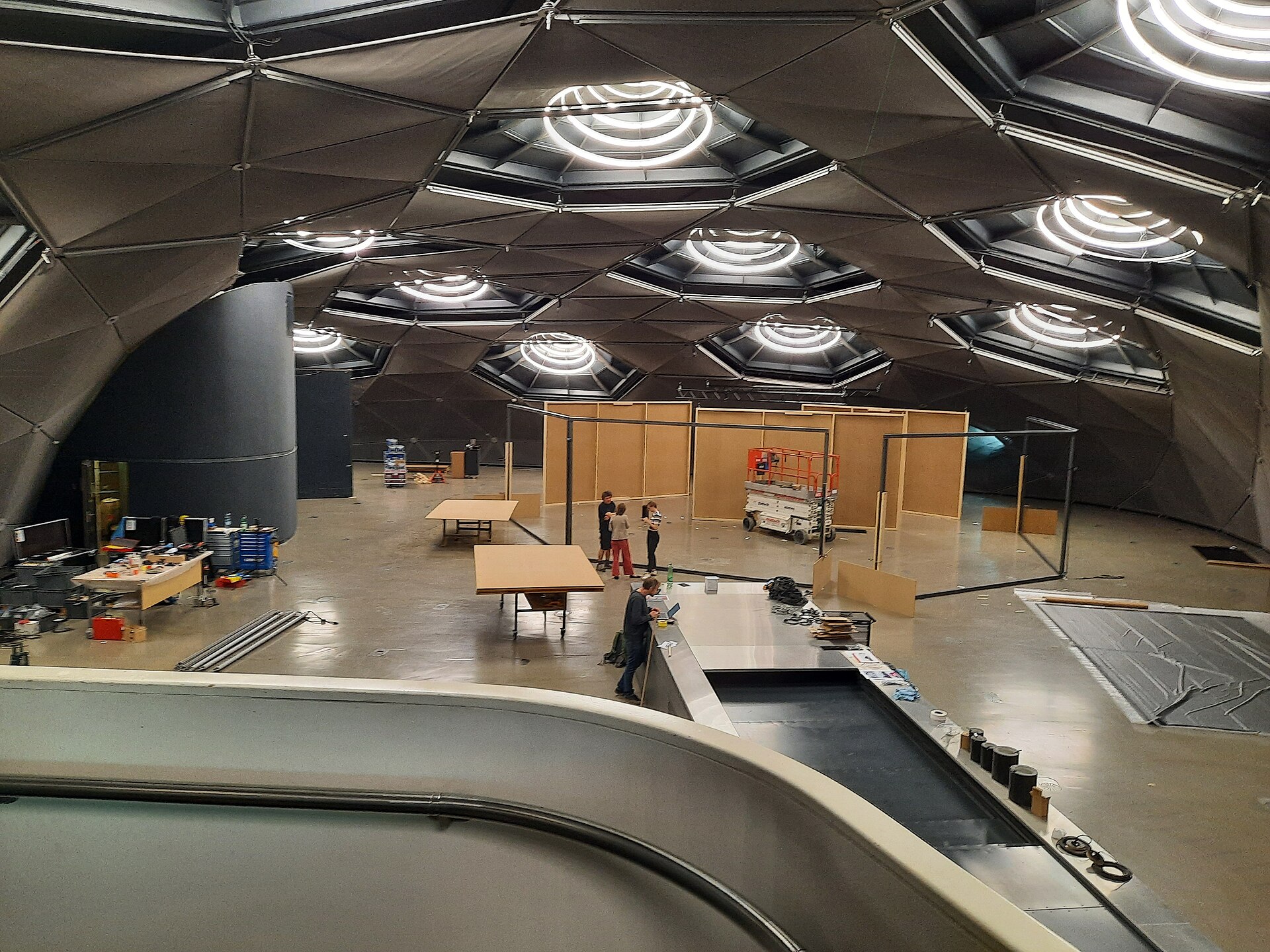
Photograph by Peter Christian Riemann · CC BY-SA 4.0 Space01
The upper of the two exhibition halls, reaching eight metres at its highest point inside the biomorphic shell, used for one of the two or three exhibitions the Kunsthaus runs concurrently. It holds Hybrid Pleasures, a retrospective of the British artist Helen Chadwick shown alongside sculptor Liesl Raff, from 21 March to 20 September 2026; Eva Schlegel's Falling up is confirmed to follow in the same hall from 23 October 2026 to 29 March 2027.
Space02
The lower exhibition hall, reached from Space01 by a thirty-metre travelator that bisects the building and carries visitors between the two levels. It holds 30% Dandelion, part of the museum's 2026 Bloom initiative programme, from 21 March to 8 November 2026; Space Race. Outer Spaces is confirmed to follow in the same hall from 11 December 2026 to 30 May 2027.
Photograph by Peter Christian Riemann · CC BY-SA 4.0 The Needle
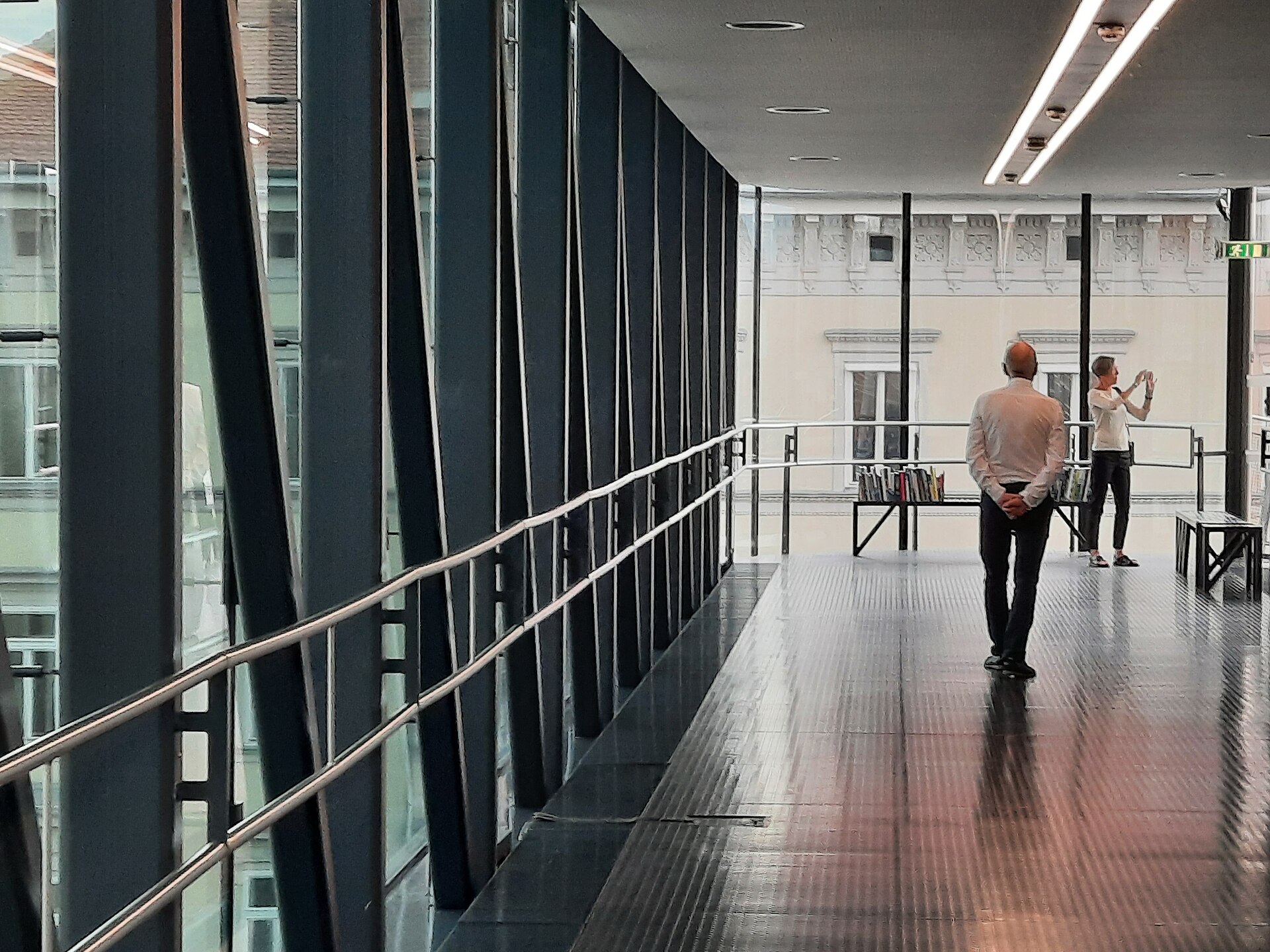
A forty-metre glass viewing gallery projecting from the building at a height of sixteen metres, connecting the old Eisernes Haus to the biomorphic Bubble and ending in an all-glass platform with a panorama over Graz's old town, the Schlossberg and the Clock Tower; it doubles as a rentable event space and is open to visitors who are not there for an exhibition.
Camera Austria (in the Eisernes Haus)
A dedicated photography institution and its long-running magazine, housed inside the restored 1848 cast-iron Eisernes Haus alongside the museum shop and administration offices; it runs its own programme of photography exhibitions independent of Space01 and Space02, and is one of the reasons the Kunsthaus building functions as more than a single gallery.
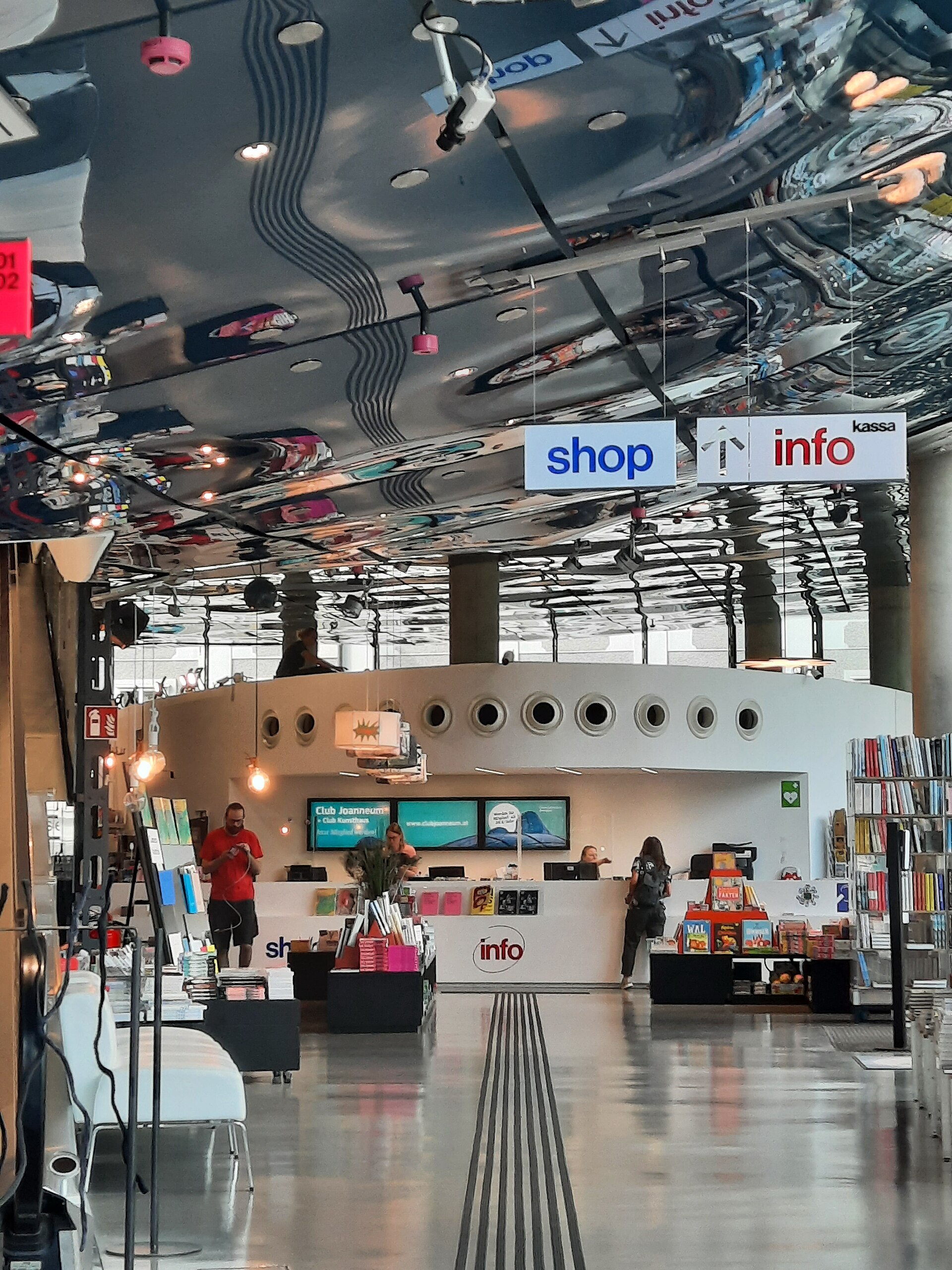
Photograph by Peter Christian Riemann · CC BY-SA 4.0 Foyer and entrance hall
The ground-floor entrance where visitors buy tickets, pass the shop and reach the travelator up into Space01; the same level gives access to the Needle and, at street level, faces the BIX media facade on the building's east elevation, a nine-hundred-square-metre programmable light installation visible from outside without a ticket.
What to see first
BIX Media Facade
realities:united (Jan and Tim Edler), 2003A nine-hundred-square-metre programmable light installation of 930 ordinary fluorescent lamps built into the building's east skin, turning the whole elevation into a low-resolution screen; the concept entered the Museum of Modern Art's permanent Architecture and Design Collection in 20118
The Needle
Peter Cook and Colin Fournier, 2003A forty-metre glass viewing gallery sixteen metres above street level, linking the historic Eisernes Haus to the new biomorphic Bubble with a panorama over Graz's old town and the Schlossberg, and the single most consistently praised experience in the building12
The biomorphic bubble skin
Peter Cook and Colin Fournier, 2003A double-walled acrylic and reinforced-concrete shell spanning up to sixty metres with no orthogonal geometry, the structure that earned the building its Friendly Alien nickname and made it the most photographed piece of contemporary architecture in Graz9
The Eisernes Haus
Josef Benedict Withalm, 1848One of the earliest cast-iron buildings in continental Europe, gutted and folded into the Kunsthaus design as a condition of the competition; restoration work in 2003 rediscovered the building's original cast-iron statue of Polyhymnia, muse of hymn and sacred music12
The 1999-2000 design competition
Jury chaired for the city of GrazAn international competition announced in October 1999 drew 102 entries after two earlier attempts at a Graz contemporary-art building had stalled, one of them blocked by a 1998 public referendum; the jury voted unanimously for Cook and Fournier's design in April 200013
Re-Imagine the Future, 20th-anniversary programme
Kunsthaus Graz, 2023A week of exhibitions and performative interventions in September and October 2023 marking twenty years since the building opened, built around reactivating the less-visible parts of the museum's own exhibition history rather than a single retrospective show11
Two decades of international programming
Kunsthaus Graz exhibition programme, 2003-presentA no-permanent-collection Kunsthalle that has staged four to six exhibitions a year since 2003, drawing more than 70,000 visitors annually since 2015, with past exhibitions of work by Sol LeWitt, Andy Warhol, Ai Weiwei, Katharina Grosse and Hito Steyerl among others10
Exhibitions on now
Past exhibitions here
- Closed21 Mar to 20 Sep 2026Confirmed · check before you travel
Three attempts at a building, and a referendum that stopped one
Graz tried three times to build a home for contemporary art before the Kunsthaus opened. An architecture competition for a Trigon Museum was held in 1988, but the plans were abandoned when the province's government changed in 1991. A site study by the architect Klaus Gartler followed in 1996, and a further international competition was staged in 1997 for a site on the Schlossberg, the wooded hill above the old town; a scheme by the Swiss firm Weber Hofer Partner Architekten won that round, and Peter Cook and Colin Fournier submitted a separate, unbuilt design of their own for the same site, an organic roof structure with distinctive nozzle-shaped skylights they called The Tongue. The Weber Hofer scheme never broke ground: the museum's own history page records that its construction was blocked by a public referendum in 1998, after Graz voters were asked directly whether the Schlossberg was an acceptable place to build. Two competitions and a decade of planning had produced nothing on the ground, and the city was left needing a third site and a third design before it could try again.
The 1999-2000 competition and the Friendly Alien
The break came when city councillor Helmut Strobl and mayor Alfred Stingl identified a different site, a plot beside the historic Eisernes Haus on the west bank of the river Mur, and tied the project to Graz's bid to become European Capital of Culture for 2003. A new international competition was announced in October 1999, this time away from the contested Schlossberg, and drew 102 entries; the jury voted unanimously in April 2000 for a design by Peter Cook and Colin Fournier, two architects associated with the experimental 1960s group Archigram and, at the time, teachers at the Bartlett School of Architecture in London. Construction ran from 1999, when the city purchased the site, through to completion, and the building opened on 27 September 2003 as the architectural centerpiece of Graz's year as European Capital of Culture. Fournier gave the finished building its lasting nickname, calling it a Friendly Alien, a biomorphic, indefinable hybrid he compared to a friendly mixed-breed stray dog rather than a conventional museum.
A biomorphic skin built to talk to the city
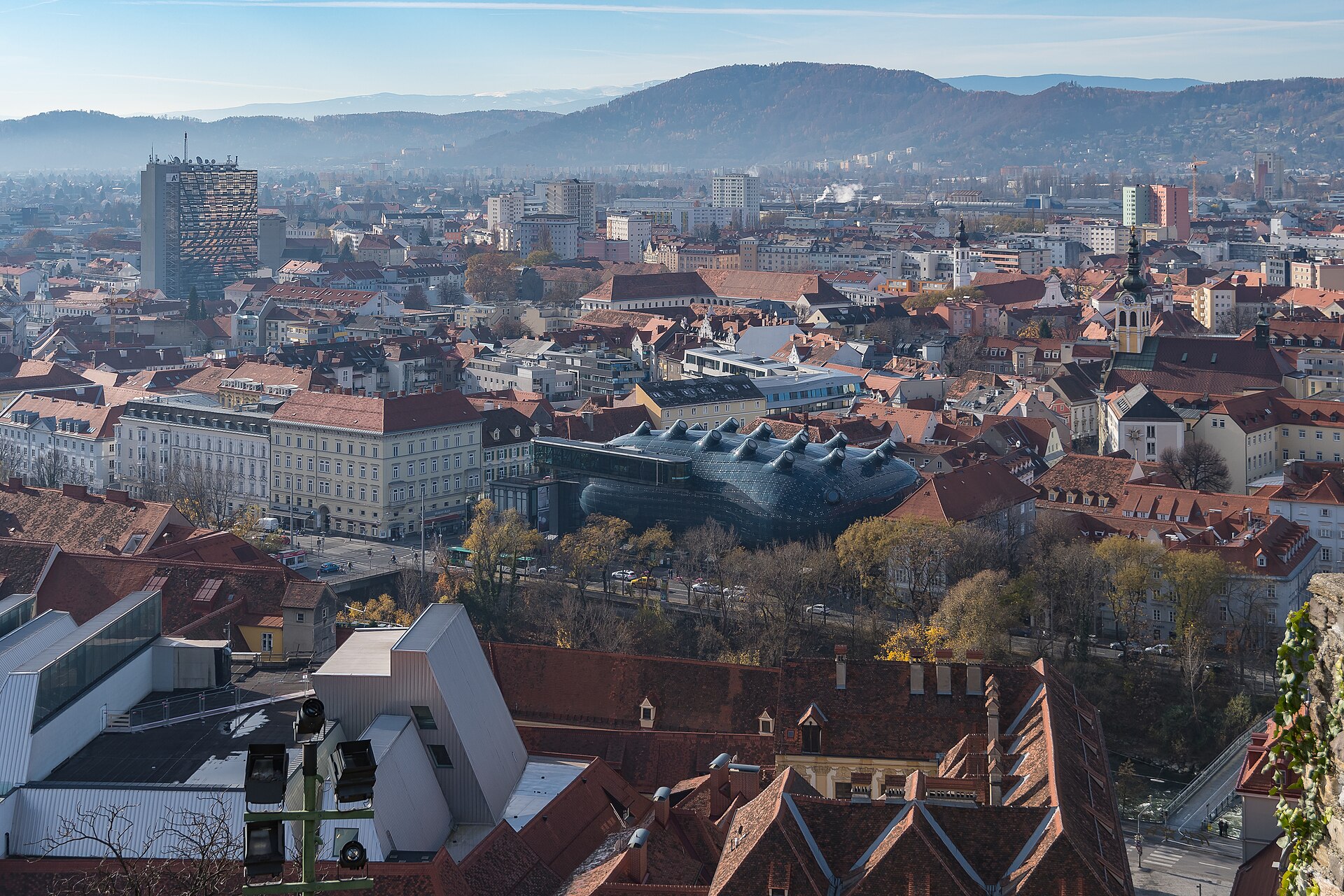
The Kunsthaus rejects orthogonal geometry almost entirely. Its double-walled biomorphic shell, a reinforced-concrete structure over two floors clad in deep-blue acrylic glazing, spans up to sixty metres without a straight roofline, and is punctured by sixteen nozzle-shaped skylights, fifteen of them turned north for even daylight and one turned east so that it looks directly across the river at the old town's Clock Tower, a deliberate visual handshake between the new building and the historic skyline it sits beside. The building's east elevation carries the BIX Media Facade, an installation by the Berlin studio realities:united, Jan and Tim Edler, that turns 930 ordinary circular fluorescent lamps spread across nine hundred square metres of skin into a low-resolution, programmable screen, capable of showing text, animations or simple video visible from across the river. The concept was significant enough in the history of media architecture that a full-scale prototype of a single BIX light element entered the Museum of Modern Art's permanent Architecture and Design Collection in New York in 2011, one of the first works to represent the fusion of architecture, media and art in that collection.
The Needle and the old Iron House
A condition of the 1999-2000 competition was that an adjacent protected monument, the Eisernes Haus, had to be integrated into whatever design won. Built in 1848 by the Graz architect Josef Benedict Withalm, the Eisernes Haus is one of the earliest cast-iron buildings anywhere in continental Europe, originally a department store; Cook and Fournier gutted its interior while keeping its listed facade and upper-storey cast-iron structure, and linked it directly to the new Bubble. Restoration work in 2003 turned up the building's own original cast-iron statue of Polyhymnia, the muse of sacred song, which had been lost from view for decades. The two buildings are joined by the Needle, a forty-metre glazed gallery projecting from the Bubble at a height of sixteen metres, which visitors reach at the end of a tour through the dark exhibition halls; stepping into the Needle's all-glass viewing platform opens onto a panorama of Graz's old town and the Schlossberg that has become, by visitor accounts, the single most talked-about moment inside the building.
A kunsthalle with no collection of its own
Unlike most institutions called a museum, the Kunsthaus Graz holds no permanent collection. It operates as a kunsthalle, mounting four to six temporary exhibitions a year of international contemporary art from the 1960s onward, generally split between the upper hall, Space01, and the lower hall, Space02, connected by a thirty-metre travelator that bisects the building. Since Peter Pakesch's founding directorship from 2003 to 2015, followed by Barbara Steiner, an interim period under Katrin Bucher Trantow, and Andreja Hribernik since 2023, the programme has hosted work by artists including Sol LeWitt, Andy Warhol, Ai Weiwei, Katharina Grosse and Hito Steyerl, and the building has drawn more than 70,000 visitors a year since 2015, pandemic years and 2018 excepted. The museum marked its twentieth anniversary in September and October 2023 with Re-Imagine the Future, a programme that deliberately reactivated overlooked corners of its own exhibition history alongside new commissions rather than staging a single retrospective. Through 2026 the museum's Bloom initiative runs Hybrid Pleasures, a retrospective of the British artist Helen Chadwick shown with sculptor Liesl Raff, in Space01 to 20 September 2026, and 30% Dandelion, a group show of more than 35 works, in Space02 to 8 November 2026. Eva Schlegel's Falling up is confirmed to open in Space01 on 23 October 2026, running to 29 March 2027, and Space Race. Outer Spaces is confirmed to open in Space02 on 11 December 2026, running to 30 May 2027.
What visitors say
Visitors and critics consistently separate the building from the programme inside it. The Friendly Alien exterior and the Needle draw close to universal praise, called out as worth the trip even by visitors who skip the exhibitions; the changing contemporary-art shows in Space01 and Space02 get a much wider spread of reaction, since the experience depends entirely on what happens to be on when a visitor arrives. Architectural critics writing soon after the 2003 opening were more pointed, arguing the finished building compromised the transparency of Cook and Fournier's original competition scheme.
What is praised, what is criticised
- Praised: The exterior architecture, the Friendly Alien bubble and the BIX facade, is praised as a landmark worth seeing even by visitors who never buy a ticket for the exhibitions inside
- Praised: The Needle's glass viewing gallery over Graz's old town and the Schlossberg is repeatedly singled out as the single best experience in the building
- Praised: Staff and guided tours are frequently described as friendly and well-informed, and the museum shop's book selection draws specific mentions in visitor reviews
- Criticised: A named 2004 critical essay in Volume (published by the Archis foundation) argued that the completed building's closed, deep-blue glazed skin abandoned the translucent, floating quality Cook and Fournier's original competition-winning scheme had promised, and that the finished exhibition interior, faced in grey metal panelling, limits how the space can be used compared to that vision
- Criticised: Visitor reviews on TripAdvisor show a wide spread rather than consensus, with the temporary-exhibition programme repeatedly described as inconsistent from one visit to the next: some travellers land on a show they find strong and well-explained, others on one they call thin or hard to connect with
Ratings on other platforms
TripAdvisor: 3.7 from 504 ratings, read 13 August 2026
A platform average is a tertiary source: it moves, it is not audited, and we quote no visitor's words.
Questions about Kunsthaus Graz
Where is Kunsthaus Graz?
Lendkai 1, 8020 Graz, Austria.
How much does it cost to visit?
Adult, single-visit ticket (Kunsthaus Graz only, valid one calendar day): EUR 13; Under 19 years, single-visit ticket: free; Seniors, visitors with a disability, groups of 12 or more (per person), single-visit ticket: EUR 11; Students, apprentices, conscripts and those doing civilian service aged 19 to 25, single-visit ticket: EUR 6.5; Student groups and groups from social institutions, single-visit ticket: EUR 3. As confirmed 12 September 2026.
When is it open?
Tuesday to Sunday and public holidays 10:00-18:00; Monday closed. Closed: 24 and 25 December 2026. As confirmed 12 September 2026.
How do you get there?
Tram: Lines 1, 4, 6 and 7 to Suedtiroler Platz - Kunsthaus; lines 3 and 5 to Hauptplatz - Graz Congress, then a short walk via Murgasse.
What should you see first?
BIX Media Facade (realities:united (Jan and Tim Edler), 2003); The Needle (Peter Cook and Colin Fournier, 2003); The biomorphic bubble skin (Peter Cook and Colin Fournier, 2003); The Eisernes Haus (Josef Benedict Withalm, 1848); The 1999-2000 design competition (Jury chaired for the city of Graz); Re-Imagine the Future, 20th-anniversary programme (Kunsthaus Graz, 2023).
What we could not confirm
- Whether the 1997 Weber Hofer Partner Architekten scheme blocked by the 1998 referendum and Cook and Fournier's rejected 1997 'Tongue' design were entries in the same competition round or two separate processes is not stated clearly enough in any source read for this record to be certain
- No source read for this record gives a total, disclosed construction budget for the 2003 building
- No verified interior photograph of Space02 or of the Camera Austria galleries inside the Eisernes Haus was found on Wikimedia Commons for this record; only Space01, the Needle and the entrance hall could be verified as this specific venue
Images
Sources
- 1Museum Joanneum, Kunsthaus Graz main page (current exhibitions, hours summary, contact) museum-joanneum.at/en/kunsthaus-graz
- 2Museum Joanneum, Kunsthaus Graz admission and opening hours museum-joanneum.at/en/kunsthaus-graz/your-visit/admission
- 3Museum Joanneum, Kunsthaus Graz directions and location museum-joanneum.at/en/kunsthaus-graz/your-visit/directions-and-location
- 4Museum Joanneum, Kunsthaus Graz accessibility museum-joanneum.at/en/kunsthaus-graz/your-visit/accessibility
- 5Museum Joanneum, About Kunsthaus Graz (mission statement) museum-joanneum.at/en/kunsthaus-graz/about-us/kunsthaus-graz
- 6Museum Joanneum, History of Kunsthaus Graz (competitions, 1998 referendum, Eisernes Haus, Polyhymnia) museum-joanneum.at/en/kunsthaus-graz/discover/architecture/historykunsthausgraz
- 7Museum Joanneum, The architects (Peter Cook and Colin Fournier biographies) museum-joanneum.at/en/kunsthaus-graz/discover/architecture/thearchitects
- 8Museum Joanneum, Kunsthaus Graz architecture overview (BIX facade, parking) museum-joanneum.at/en/kunsthaus-graz/discover/architecture
- 9Museum Joanneum, The building (dimensions: 60-metre span, Space01 height, travelator length) museum-joanneum.at/en/kunsthaus-graz/discover/architecture/building
- 10Museum Joanneum, Kunsthaus Graz press page (directors, visitor numbers, exhibited artists) museum-joanneum.at/en/kunsthaus-graz/press
- 11Museum Joanneum, Kunsthaus Graz exhibitions listing (current and upcoming shows, 20 years programme) museum-joanneum.at/en/kunsthaus-graz/our-programme/exhibitions
- 12Graz Tourismus, Kunsthaus Graz sightseeing page (nozzles, Needle, Eisernes Haus, Camera Austria, architect Josef Benedict Withalm) graztourismus.at/en/sightseeing-culture/sights/kunsthaus-graz_shg_1462
- 13archiweb.cz, 'Kunsthaus Graz' (competition announced October 1999, 102 entries, jury decision April 2000, construction dates) archiweb.cz/en/b/kunsthaus-graz
- 14ArchDaily, 'Kunsthaus Graz: A Friendly Alien Among Historic Landmarks' (; blob architecture, materials) archdaily.com/1024004/kunsthaus-graz-a-friendly-alien-among-historic-landmarks
- 15BIX facade lamp count, MoMA 2011 acquisition) en.wikipedia.org/wiki/Kunsthaus_Graz
- 16Wikidata, Q597137 (; identity confirmation, coordinates, official website, architects, opening year) wikidata.org/wiki/Q597137
- 17Volume (Archis), Karin Christof, 'Kunsthaus Graz: The Convention of an Alien Object', 1 January 2004 (named critical essay) archis.org/volume/kunsthaus-graz-the-convention-of-an-alien-object/
- 18TripAdvisor, Kunsthaus Graz listing ( aggregate rating and review distribution, read 13 August 2026) tripadvisor.com/Attraction_Review-g190432-d286312-Reviews-Kunsthaus_Graz-Graz_Styria.html
- 19ArchDaily, 'BIX Light and Media Facade at MoMA' (realities:united credit, 900 sqm installation) archdaily.com/89408/bix-light-and-media-facade-at-moma
- 20Wikimedia Commons, Category:Kunsthaus Graz and Category:Interior of Kunsthaus Graz (image licensing: Marion Schneider and Christoph Aistleitner public domain, Leonhard Lenz CC0, Isiwal CC BY-SA 4.0, Peter Christian Riemann CC BY-SA 4.0) commons.wikimedia.org/wiki/Category:Kunsthaus_Graz
- 21Museum Joanneum, Kunsthaus Graz free entry and concessions (Graz Card, Steiermark-Card, ICOM, Hunger auf Kunst und Kultur) museum-joanneum.at/en/kunsthaus-graz/your-visit/admission/free-entry
- 22Museum Joanneum, exhibition event page 'Hybrid Pleasures' (Space01, dates, curators) museum-joanneum.at/en/kunsthaus-graz/our-programme/exhibitions/event/hybrid-pleasure
- 23Museum Joanneum, exhibition event page '30% Dandelion' (Space02, dates, curators) museum-joanneum.at/en/kunsthaus-graz/our-programme/exhibitions/event/30-dandelion-1
- 24Museum Joanneum, exhibition event page 'Eva Schlegel: Falling up' (Space01, confirmed dates 23 Oct 2026 - 29 Mar 2027, curator) museum-joanneum.at/en/kunsthaus-graz/our-programme/exhibitions/event/eva-schlegel-1