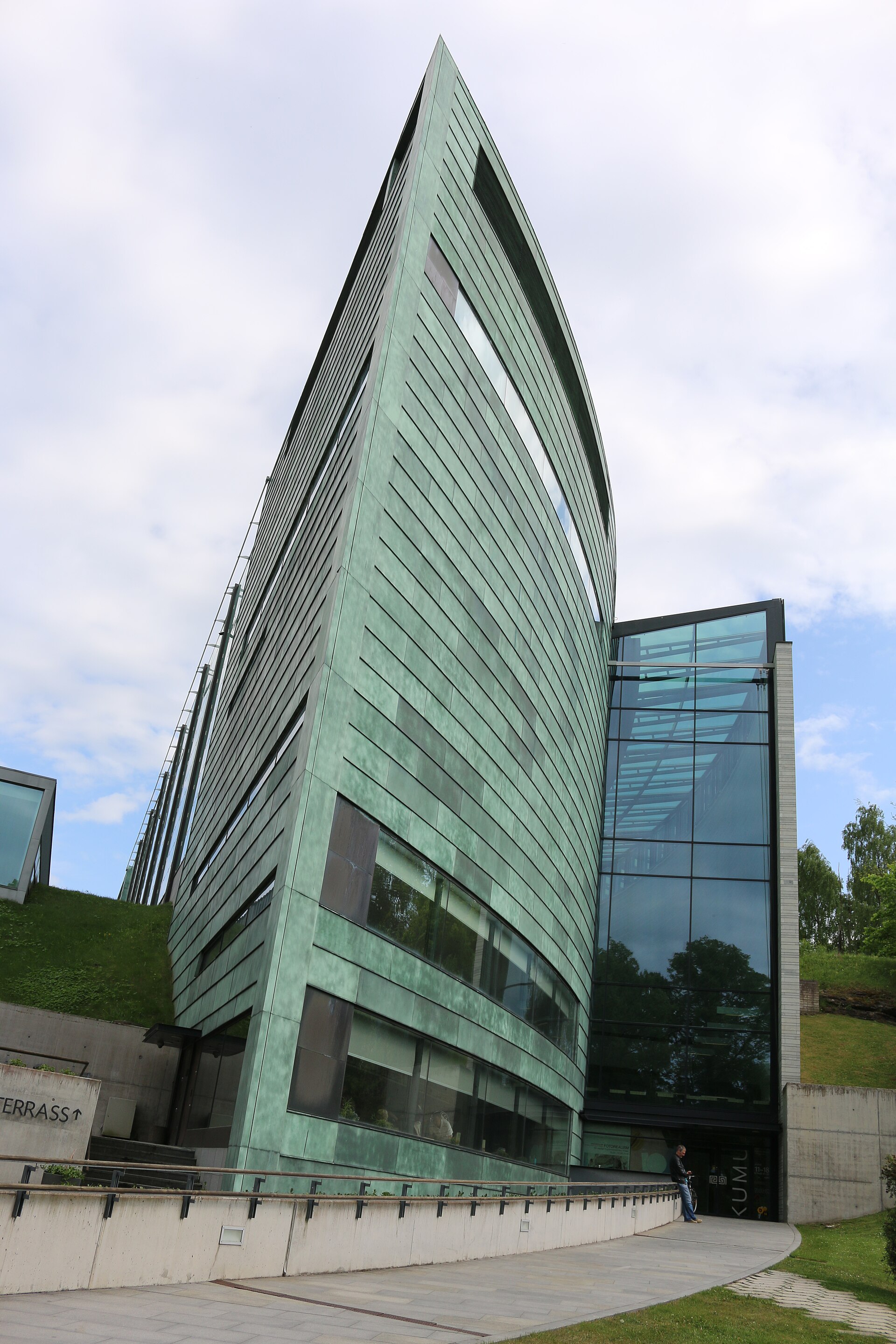
The copper and glass entrance front of Kumu, the Art Museum of Estonia's main building in Kadriorg Park, Tallinn.
FrDr · CC BY-SA 4.0Kumu
Museum · Kumu Kunstimuuseum · Founded 2006
Open, admission and hours confirmed 22 August 2026 · 15 sources
On this page 15 sections
ContentsClose
Kumu's strength is coverage rather than a single trophy object: it is the one building where Estonian art from the early 18th century Baltic German period through the National Awakening, the Soviet decades and the 1990s can be seen as one continuous, chronologically arranged story, supported by a public art-history library in continuous operation since 1924.
| Local name | Kumu Kunstimuuseum |
|---|---|
| Kind | Museum |
| Founded | 2006 |
| City and country |  Tallinn, Estonia Tallinn, Estonia |
| Address | Weizenbergi 34 / Valge 1, Kadriorg, 10127 Tallinn, Estonia |
| Website | kumu.ekm.ee/en |
| Status | Open, confirmed |
| Record last verified |
Visiting
- Hours
- Tue-Wed, Fri-Sun10:00 to 18:00
- Thu10:00 to 20:00
- Mon10:00 to 18:00open Mondays only from 25 May to 30 September while the Kristi Kongi: Chromatic Drift exhibition runs; closed Mondays the rest of the year
- Closed
- Monday, except the seasonal exception above. 1 January. 23-24 February. 3 April. 23-24 June. 24-25 December. 31 December.
- Admission
- AdultEUR 16single visit, ticket valid for use within one year of purchase
- Discount (student, senior 65+, conscript, Estonian Artists Association member, ISIC/ITIC holder)EUR 11proof of eligibility required at entry
- FamilyEUR 32covers up to two adults and their underage children; collect day tickets at the counter
- Donation ticketEUR 25admits to any of the five Art Museum of Estonia branches
- Children 8 and underFreefree
Free entry: 1 June (Children's Day): free entry for visitors aged 18 and under- Tickets
- kunstimuuseum.ekm.ee/en/tickets The museum's own ticket page.
- Do I need to book?
- No advance booking required for individual visitors; groups and guided tours are booked ahead
- Address
- Weizenbergi 34 / Valge 1, Kadriorg, 10127 Tallinn, Estonia MapTram Lines 1 and 3 to the Kadriorg terminus, then about a 10-minute walk along Weizenbergi street
Bus Lines 31, 42 and 67 stop near the museum; line 39 stops directly beside it; lines 1, 5, 8, 29, 34, 35, 38, 44, 51 and 66 serve the nearby J. Poska stop
Car Free parking on Valge street (Kumu Parking) and Maekalda street (Kumu), with disabled parking on Maekalda street and a coach bay on Valge street - Website
- kumu.ekm.ee/en
- Telephone
- +372 602 6000
Before you go how long, access, photography, bags, eating, shop
- How long to allow
- Two to three hours to cover the permanent floors; longer with a temporary exhibition
- Access
- Step-free access throughout; wheelchairs and walking frames can be borrowed at the museum; the building won a 2006 Achievement of the Year award from the Estonian Union of Persons With Mobility Impairment
- Photography
- Personal photography and filming allowed without flash or a tripod; commercial photography requires prior permission and payment
- Bags
- Coats, umbrellas and bags larger than A4 (20 x 30 cm) must be left in the unattended cloakroom or a locker
- Eating
- Reval Cafe operates the ground-floor cafe near the Kadriorg Park entrance, serving daily specials, soups and baked goods
- Shop
- Museum shop stocks exhibition-linked books and postcards plus jewellery, textiles, glass and ceramics by Estonian designers
Prices and hours change. We take them from the institution's own pages and print the day we read them, and you can check the current position at the source we used. Confirm before you travel.
What is inside
Landscapes of Identity (3rd floor)
Baltic German artistic heritage of the 19th century shown alongside Estonian national art of the early 20th century, spanning the National Awakening through National Romanticism, Symbolism and early Estonian modernism
Conflicts and Adaptations (4th floor)
Estonian art of the Soviet era, 1940 to 1991, tracing how artists worked within and against the constraints of Soviet cultural policy
The Future is in One Hour (4th floor)
Estonian art of the 1990s, the transitional decade after the restoration of independence
Gallery of Contemporary Art (5th floor)
A rotating programme of new exhibitions of current Estonian and international contemporary practice
Great Hall (ground floor)
The museum's largest space, used for major loan exhibitions and extensive research-based temporary shows rather than the permanent collection
Library
A public art-history reading room of about 47,800 publications, in continuous operation since 1924 and at Kumu since the building opened in 2006, with eight reading places, an open-shelf collection and a focus on Estonian, Netherlandish and Flemish art
What to see first
Landscapes of Saaremaa and the Estonian countryside
Konrad MagiMagi's colour-saturated landscapes are treated as founding works of a distinct Estonian modernism and anchor the Landscapes of Identity floor10
Prints and etchings on the National Awakening floor
Eduard WiiraltWiiralt is the most internationally exhibited Estonian printmaker of the 20th century; his graphic work is a centrepiece of the permanent collection10
Illustrations for the national epic Kalevipoeg
Kristjan RaudRaud's drawings for Estonia's national epic made him a defining figure of the National Awakening and are shown on the third floor10
Academic portraiture from the Baltic German period
Johann KolerKoler was the first ethnic Estonian painter to train at the Imperial Academy of Arts in St Petersburg and become a recognised portraitist, bridging the Baltic German and Estonian national narratives the third floor sets side by side10
Symbolist and Expressionist work of the pre-independence years
Nikolai TriikTriik's Symbolist and Expressionist paintings mark the international currents Estonian artists absorbed before the first republic10
Paintings under a male pseudonym
Natalie MeiOne of the Mei sisters, Natalie Mei worked across several techniques and, like many women artists of her generation, exhibited under a male pseudonym; her work has been the subject of a dedicated museum exhibition and a 2023 art-history dissertation13
Sunday (1924)
Felix RandelUsed by the museum itself as the representative image for the Landscapes of Identity floor, spanning the interwar late-Impressionist current in Estonian painting10
Exhibitions on now
- On now11 Sep 2026 to 14 Mar 2027Confirmed , 7 weeks ago
Past exhibitions here
The building and what it was built to hold
Kumu is the main building of the Art Museum of Estonia, set into a limestone slope of Lasnamae at the edge of Kadriorg Park in Tallinn. The name is a contraction of the Estonian words for art and museum, and also happens to mean response or rumour in the language. The building was designed by the Finnish architect Pekka Vapaavuori, whose scheme, submitted under the title Circulos, won an international competition held in 1993 that drew 233 entries from ten countries. Construction began in 2002 and the finished museum opened to the public on 18 February 2006, closing a project whose roots go back to a museum competition held in the 1930s and interrupted by the Second World War; Estonia did not get a purpose-built national art museum until more than sixty years after the idea was first competed for.
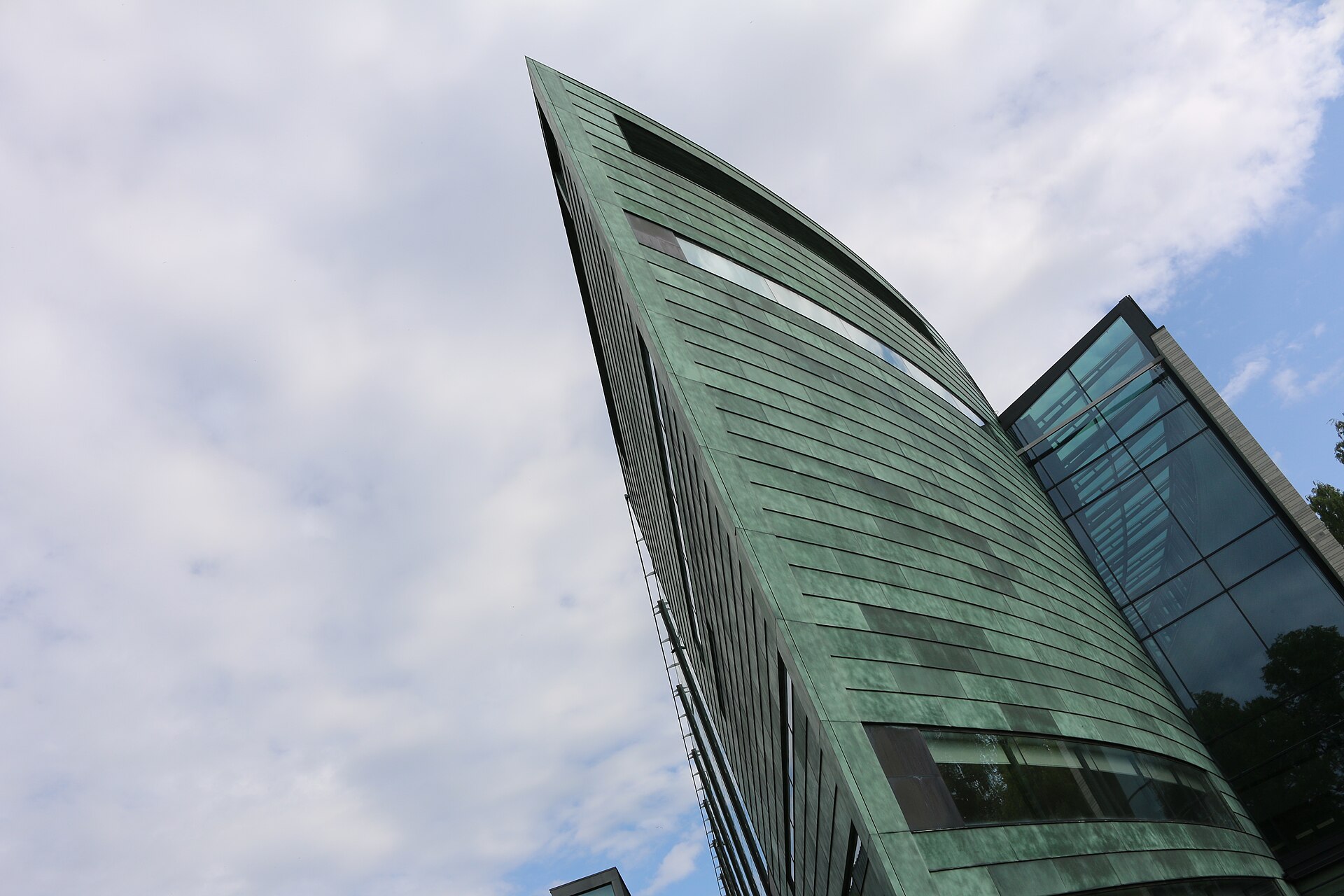
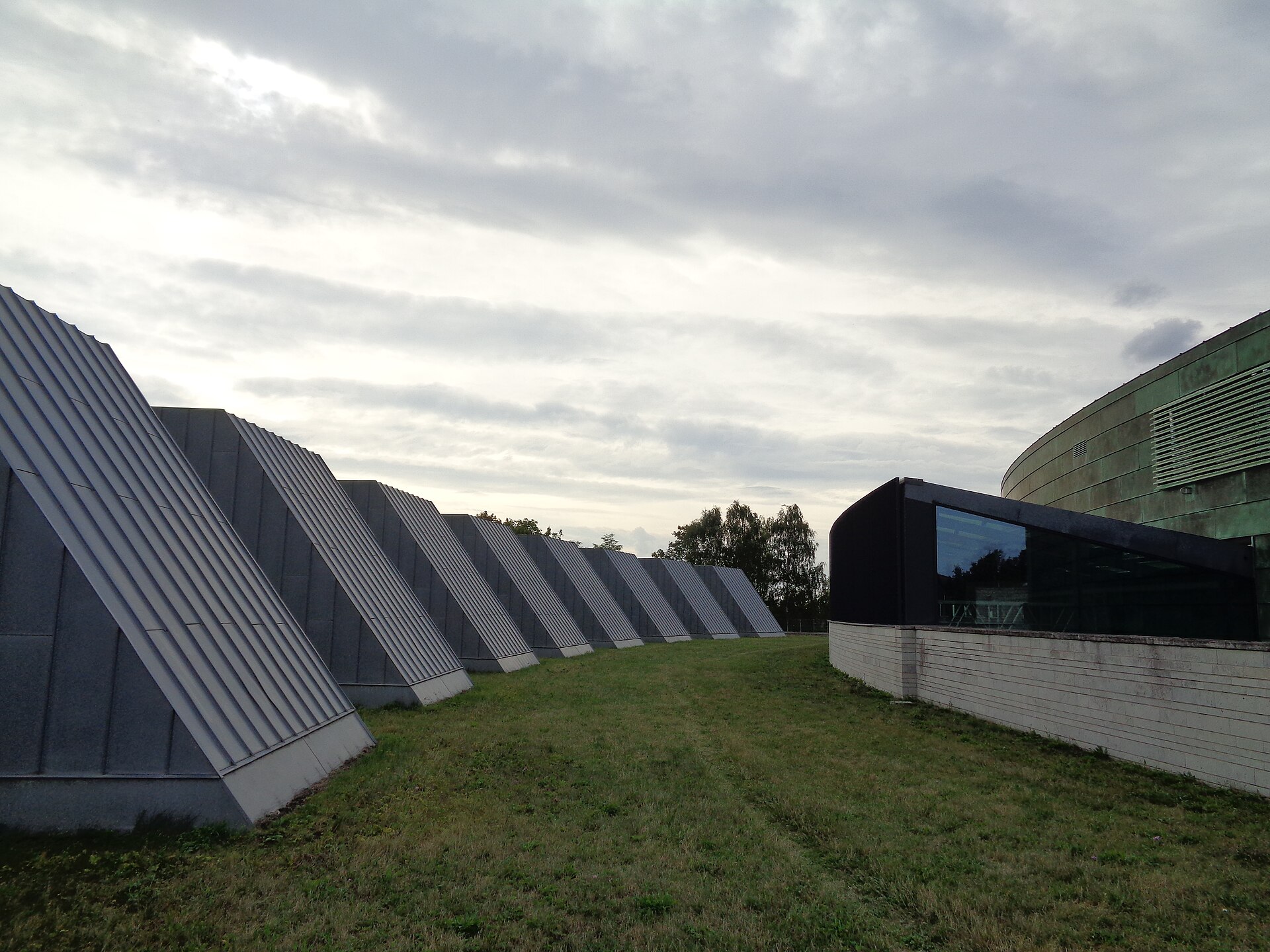
Vapaavuori worked in dolomite limestone, wood and copper, materials he described as chosen for their local tradition, and gave the building a curved, prow-like copper-clad wing that rises out of the hillside beside a lower limestone block pierced by a tall glazed atrium. The building is dug into the slope rather than placed on top of it, so that from Kadriorg Park itself only a low limestone face is visible, and the copper form is seen fully only from the Lasnamae side. That siting was a deliberate answer to the difficulty of putting a large modern museum next to an 18th-century baroque park without one damaging the other. The building has since collected its own list of citations independent of what hangs inside it, including the Chicago Athenaeum International Architecture Award for Best Global Design in 2007 and the European Museum of the Year Award in 2008, chosen from 140 nominated museums across 20 countries.
What the museum was built to hold
Before Kumu opened, Estonia had no single building where the full run of its own art history could be seen. Baltic German-era portraiture, the National Awakening generation, and Soviet-period Estonian art had been split across storerooms, other institutions or simply kept out of permanent public view; Soviet-era work in particular had not been shown as a matter of course. Kumu was built to hold all of it under one roof, from the early 18th century to the present, and to let a visitor walk the political history of the country through its art rather than around it.
The permanent collection runs across three upper floors. The third floor, under the title Landscapes of Identity, sets 19th-century Baltic German artistic heritage beside Estonian national art of the first decades of the 20th century, covering the National Awakening, National Romanticism, Symbolism and the country's early absorption of European modernism. The fourth floor is split between Conflicts and Adaptations, covering Estonian art made under Soviet rule between 1940 and 1991, and The Future is in One Hour, devoted to the art of the 1990s and the disorientation and improvisation of the first post-Soviet decade. The fifth floor, the Gallery of Contemporary Art, is given over to a changing programme of current work rather than a fixed display. The ground-floor Great Hall is reserved for the museum's largest loan exhibitions and research-driven temporary shows, and a public library of roughly 47,800 volumes on art and art history, in continuous operation since 1924 and housed at Kumu since the building opened, sits alongside the exhibition floors.
What is worth the two hours
The Landscapes of Identity floor is where the museum makes its clearest case for itself. Baltic German academic portraiture by figures such as Johann Koler, the first ethnic Estonian to train and succeed as a painter at the Imperial Academy of Arts in St Petersburg, is shown next to the generation that followed it into a distinctly Estonian idiom: Kristjan Raud's drawings for the national epic Kalevipoeg, Nikolai Triik's Symbolist and Expressionist canvases, and the vivid, near-psychedelic landscapes of Saaremaa and the Estonian countryside painted by Konrad Magi, which the museum and its visitors alike treat as founding works of a national modernism. Felix Randel's 1924 painting Sunday, used by the museum as the representative image for the floor, sits in the same run as the late-Impressionist current of the 1930s. Eduard Wiiralt, Estonia's most exhibited printmaker internationally, anchors the graphic side of the same story.
The two Soviet-era floors do quieter but harder work. Conflicts and Adaptations does not present Soviet-period Estonian art as either propaganda or pure resistance but as a record of artists adapting, working sideways, and occasionally pushing back within a closed system; The Future is in One Hour picks the story up at the point of collapse and improvisation. The museum has also used its temporary exhibition slots to recover artists the permanent chronology risks flattening: a dedicated exhibition and accompanying scholarship on Natalie Mei, one of the Mei sisters, who worked across several techniques and exhibited under a male pseudonym, is one example, and the museum's own major loan exhibitions, such as its 2018 show of the Reval-born Renaissance court painter Michel Sittow with works borrowed from the Prado and the National Gallery of Art in Washington, show the scale of ambition the building was built to support.
Visiting Kumu today
Kumu is open Tuesday to Sunday, 10:00 to 18:00, with late opening to 20:00 on Thursday; it is closed on Monday except for a seasonal window, from 25 May to 30 September, when a temporary exhibition keeps the museum open on Mondays as well. It is closed on New Year's Day, 23 and 24 February, 3 April, 23 and 24 June, 24 and 25 December and 31 December, and closes early, at 15:00, on 22 June and 23 December. An adult ticket is 16 euros, with an 11 euro discount rate for students, seniors, conscripts, members of the Estonian Artists' Association and ISIC or ITIC cardholders, and a 32 euro family ticket covering up to two adults with their underage children. A 25 euro donation ticket admits to any of the five branches of the Art Museum of Estonia. Children aged 8 and under go free year-round, and on 1 June, Estonia's Children's Day, entry is free for everyone 18 and under.
The museum sits at the edge of Kadriorg Park at Weizenbergi 34 / Valge 1, reachable by tram lines 1 and 3 to the Kadriorg terminus followed by a ten-minute walk, or directly by bus lines 31, 42, 67 and 39. Free parking is available on Valge and Maekalda streets, the latter with a disabled bay, and a coach bay is provided on Valge street. The building is step-free throughout and wheelchairs and walking frames can be borrowed on site; the 2006 building itself won an Achievement of the Year award from the Estonian Union of Persons With Mobility Impairment. Personal photography without flash or a tripod is allowed everywhere; coats and any bag larger than A4 must go into the unattended cloakroom or a locker. Reval Cafe runs the ground-floor cafe near the Kadriorg Park entrance, and the museum shop sells exhibition-linked books alongside jewellery, textiles, glass and ceramics by Estonian designers.
What visitors say, and what the museum does not say
Kumu holds a 4.4 out of 5 rating on TripAdvisor across 1,082 reviews, placing it among the highest-rated attractions in Tallinn. The praise is repetitive in a useful way: visitors credit the architecture first, then the clarity of a permanent collection that lets someone with no background in Estonian history follow the country's art from the Baltic German period through the Soviet decades to the present in a single visit, and they single out the introductory film and guided tours for making that chronology legible. The complaints are narrower and more specific than the praise: at least one detailed, named review describes unfriendly and non-English-speaking staff on the exhibition floors, in contrast to a welcoming ticket counter and cloakroom, and a smaller number of visitors weighing ticket cost against the length of a visit, or comparing the collection to larger national museums elsewhere, came away less impressed.
What the museum's own site does not do, in its English-language public pages, is set out the individual provenance of the Baltic German and early Estonian works nationalised or otherwise brought into state hands during the 20th century's changes of regime, beyond describing the general historical circumstance in gallery-wall terms. That is consistent with how most national art museums in the region present a Baltic German-era collection formed under a very different property regime, and it is not evidence of any specific disputed object; it is simply a gap a reader doing further provenance work on any individual painting from that period should expect to have to close through Estonian archival and academic sources rather than the museum's own visitor-facing pages.
What visitors say
Visitors consistently single out the building itself first, then the clarity of the permanent collection: a walk through Baltic German portraiture, the National Awakening, Soviet-era art and the 1990s laid out floor by floor so that a visitor with no prior background in Estonian art history can follow the story. The introductory film and guided tours are repeatedly credited with making that history legible. The most common complaints are about staff manner on the exhibition floors rather than the collection, and, from a minority of visitors, that ticket prices feel high for the length of a visit.
What is praised, what is criticised
- Praised: The building's architecture: the curved copper and limestone form set into the Lasnamae limestone slope beside Kadriorg Park
- Praised: The clarity and depth of the permanent Estonian art displays, floor by floor from the 18th century to the 1990s
- Praised: The introductory video and guided tours, credited with turning an unfamiliar national art history into something visitors follow easily
- Praised: The temporary exhibition programme layered on top of the permanent floors
- Criticised: Staff on some exhibition floors described by at least one visitor as unfriendly and not speaking English, in contrast to the ticket counter and cloakroom staff
- Criticised: Ticket prices, which some visitors weighing the combined-branch ticket or comparing to other European museums consider high for what is on show
- Criticised: A minority of visitors familiar with larger national art museums elsewhere found the collection less impressive by comparison
Ratings on other platforms
TripAdvisor: 4.4 from 1,082 ratings, read 22 August 2026
A platform average is a tertiary source: it moves, it is not audited, and we quote no visitor's words.
Questions about Kumu
Where is Kumu?
Weizenbergi 34 / Valge 1, Kadriorg, 10127 Tallinn, Estonia.
How much does it cost to visit?
Adult: EUR 16; Discount (student, senior 65+, conscript, Estonian Artists Association member, ISIC/ITIC holder): EUR 11; Family: EUR 32; Donation ticket: EUR 25; Children 8 and under: free. As confirmed 22 August 2026.
When is it open?
Tue-Wed, Fri-Sun 10:00-18:00; Thu 10:00-20:00; Mon 10:00-18:00. Closed: Monday, except the seasonal exception above. 1 January. As confirmed 22 August 2026.
How do you get there?
Tram: Lines 1 and 3 to the Kadriorg terminus, then about a 10-minute walk along Weizenbergi street; Bus: Lines 31, 42 and 67 stop near the museum; line 39 stops directly beside it; lines 1, 5, 8, 29, 34, 35, 38, 44, 51 and 66 serve the nearby J. Poska stop; Car: Free parking on Valge street (Kumu Parking) and Maekalda street (Kumu), with disabled parking on Maekalda street and a coach bay on Valge street.
What should you see first?
Landscapes of Saaremaa and the Estonian countryside (Konrad Magi); Prints and etchings on the National Awakening floor (Eduard Wiiralt); Illustrations for the national epic Kalevipoeg (Kristjan Raud); Academic portraiture from the Baltic German period (Johann Koler); Symbolist and Expressionist work of the pre-independence years (Nikolai Triik); Paintings under a male pseudonym (Natalie Mei).
What we could not confirm
- The museum's English-language pages describe the Baltic German and early national collections in general historical terms rather than publishing individual provenance chains, so a researcher tracing a specific painting's ownership through the nationalisations of the 20th century should expect to need Estonian archival sources beyond the museum's own site.
Images
Sources
- 1Kumu Art Museum, official site, homepage kumu.ekm.ee/en/
- 2Kumu Art Museum, opening hours kumu.ekm.ee/en/opening-hours-kumu-art-museum/
- 3Art Museum of Estonia, tickets kunstimuuseum.ekm.ee/en/tickets/
- 4Kumu Art Museum, About the Museum: History and the Building kumu.ekm.ee/en/about-the-museum/history-and-the-building/
- 5Kumu Art Museum, Permanent Exhibitions kumu.ekm.ee/en/permanent-exhibitions/
- 6Kumu Art Museum, About the Museum kumu.ekm.ee/en/about-the-museum/
- 7Kumu Art Museum, Shop and Cafe kumu.ekm.ee/en/shop-cafe/
- 8Kumu Art Museum, Getting Here kumu.ekm.ee/en/getting-here/
- 9Art Museum of Estonia, Visitor's Reminder kunstimuuseum.ekm.ee/en/visitors-reminder/
- 10Kumu Art Museum, permanent exhibition Treasury: Classics of Estonian Art from the Beginning of the 18th Century until the End of the Second World War kumu.ekm.ee/en/syndmus/treasury/
- 11Art Museum of Estonia, Library kunstimuuseum.ekm.ee/en/library/
- 12Art Museum of Estonia, Recognitions of Kumu Art Museum kunstimuuseum.ekm.ee/en/recognitions-of-art-museum-of-estonia/recognitions-of-kumu-art-museum/
- 13Tripadvisor, review by user Anu, Kumu Art Museum tripadvisor.com/Attraction_Review-g274958-d634535-Reviews-Kumu_Art_Museum-Tallinn_Harju_County.html
- 14Tripadvisor, review 'Average museum, bad staff.' by 367yasin_, Kumu Art Museum tripadvisor.com/ShowUserReviews-g274958-d634535-r482846906-Kumu_Art_Museum-Tallinn_Harju_County.html
- 15Wikidata, Kumu (Q919611) wikidata.org/wiki/Q919611