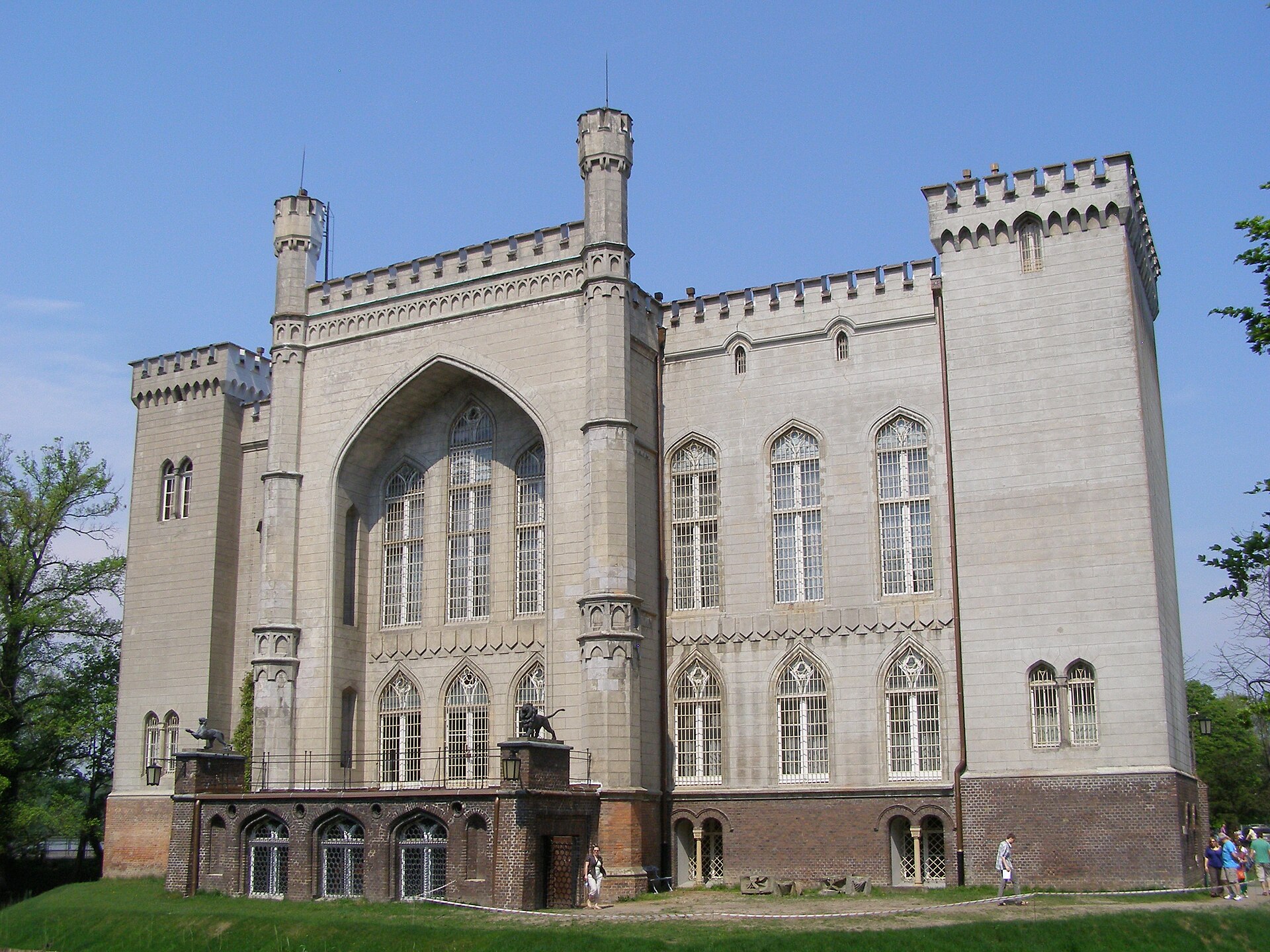
The south front of the castle, with the pointed arch of the Moorish Hall, the terrace and the corner towers rebuilt in the 1850s.
Andrzej Otrebski, CC BY-SA 3.0Kornik Castle
Museum · Zamek w Kornik · Founded 1419
Open, admission and hours confirmed 20 November 2026 · 10 sources
On this page 15 sections
ContentsClose
The strength of Kornik is not any single painting but the survival of the whole: a family seat from the 1800s with its original floors, heraldic ceilings and furnishings, a Polish patriotic collection of portraits, hussar armour and national memorabilia, and one of Poland's older libraries in the same building. The weaker side is the visitor route: the heaviest treasures, the manuscripts, are mostly in stores and not shown in the rooms.
| Local name | Zamek w Kornik |
|---|---|
| Kind | Museum |
| Founded | Construction begun about 1419 by Mikolaj of Gorka (museum guide); oldest known document 1426 |
| City and country |  Kornik, Poland |
| Address | ul. Zamkowa 5, 62-035 Kornik, Poland |
| Website | bkpan.poznan.pl/zamek-w-korniku |
| Status | Open, confirmed |
| Record last verified |
Visiting
- Hours
- Tue-Sun, low season (14 Feb - 30 Apr and 1 Oct - 30 Nov)10:00 to 15:15Last entry 14:30
- Tue-Sun, high season (1 May - 30 Sep)10:00 to 17:00Last entry 16:15
- Thursdays in May and June10:00 to 20:00Last entry 19:00
- Closed
- Monday. The museum's 2026 holiday list gives 1 November as closed, 11 November 10:00-15:00 and, earlier in the year, 4-5 April and 25 June as closed. The 2026 tourist season closes on 14 December; the page read gives no dates for 15 December to 13 February.
- Admission
- Adult (individual visit)PLN 40Normal ticket, sold at the castle ticket office or online
- ReducedPLN 20Includes pupils, students, teachers, pensioners, people over 65 and disabled visitors with carers; proof required
- Free entryFreeChildren to age 7; under-18 residents of Kornik commune with the Kornik resident card; pupils of schools and nurseries in Kornik town and commune; holders of certain state orders; staff of museums on the national register; ICOM and ICOMOS members; holders of the Karta Polaka
- Guided tour in PolishPLN 150Booked by email at least a week ahead, per the museum
- Guided tour in English or GermanPLN 200Booked by email at least a week ahead, per the museum
- Audio guide loan on sitePLN 15The same recording is a free app for Android; own headphones needed, or buy a pair at the ticket office
- Tickets
- tobilet.pl/zamek-w-korniku.html The museum's own ticket page.
- Do I need to book?
- No booking for individual visitors; tickets can be bought at the ticket office or online. Guided tours must be booked by email at least a week ahead, and the museum takes group bookings no earlier than three months ahead
- Address
- ul. Zamkowa 5, 62-035 Kornik, Poland MapBus From Poznan, by car or bus: the museum names the Poznan Glowny bus station (PKS) and the Rondo Rataje stop as the easiest bus departures
Train The museum advises against the train: the Kornik railway station is about 5 km from the town centre and the castle
Car Paid parking for about 30 cars beside the castle; a free car park about 400 m away at Provent, which also has free bays for coaches - Website
- bkpan.poznan.pl/zamek-w-korniku
- Telephone
- +48 61 817 00 81
- [email protected]
Before you go how long, access, photography, bags, eating, shop
- How long to allow
- The museum states no visit length. Visitors on Tripadvisor describe about an hour for the audio-guided tour of the rooms, and some spend a half or whole day adding the arboretum
- Access
- A lift serves visitors with disabilities; ask staff to use it. Pushchairs cannot be taken in because of the historic floors, and the castle has no space to store them. Reduced tickets cover disabled visitors with carers
- Photography
- Photographs of the interiors are free for private use; flash and tripods are banned. Publishing interior images commercially needs the library director's consent. Drone photography of the castle needs prior notice to a nearby air force base, per the museum
- Bags
- The museum pages we read do not describe a cloakroom
- Eating
- The museum pages we read do not mention a cafe inside the castle; the town has shops and cafes
- Shop
- Guidebooks to the castle are sold at the ticket office: 20 PLN in English, 15 PLN in German, French or Russian
Prices and hours change. We take them from the institution's own pages and print the day we read them, and you can check the current position at the source we used. Confirm before you travel.
What is inside
Entrance hall, corridor and ground-floor rooms
The entrance hall, in the north wing added in the later 1500s, is ringed by Moorish-style doorways and a ceiling of 18 panels, 12 of them painted with coats of arms in oriental plaiting. Beyond is a vaulted corridor with a stone display of fragments from the older castle, and the former bedroom where Tytus Dzialynski, his son Jan and his grandson Wladyslaw Zamoyski spent their last years. A mahogany writing desk there is the only piece left from Zamoyski's time, and the room's tradition says he slept on it as a penance.
The family rooms: Generalowa, Maria Zamoyska and the boudoir
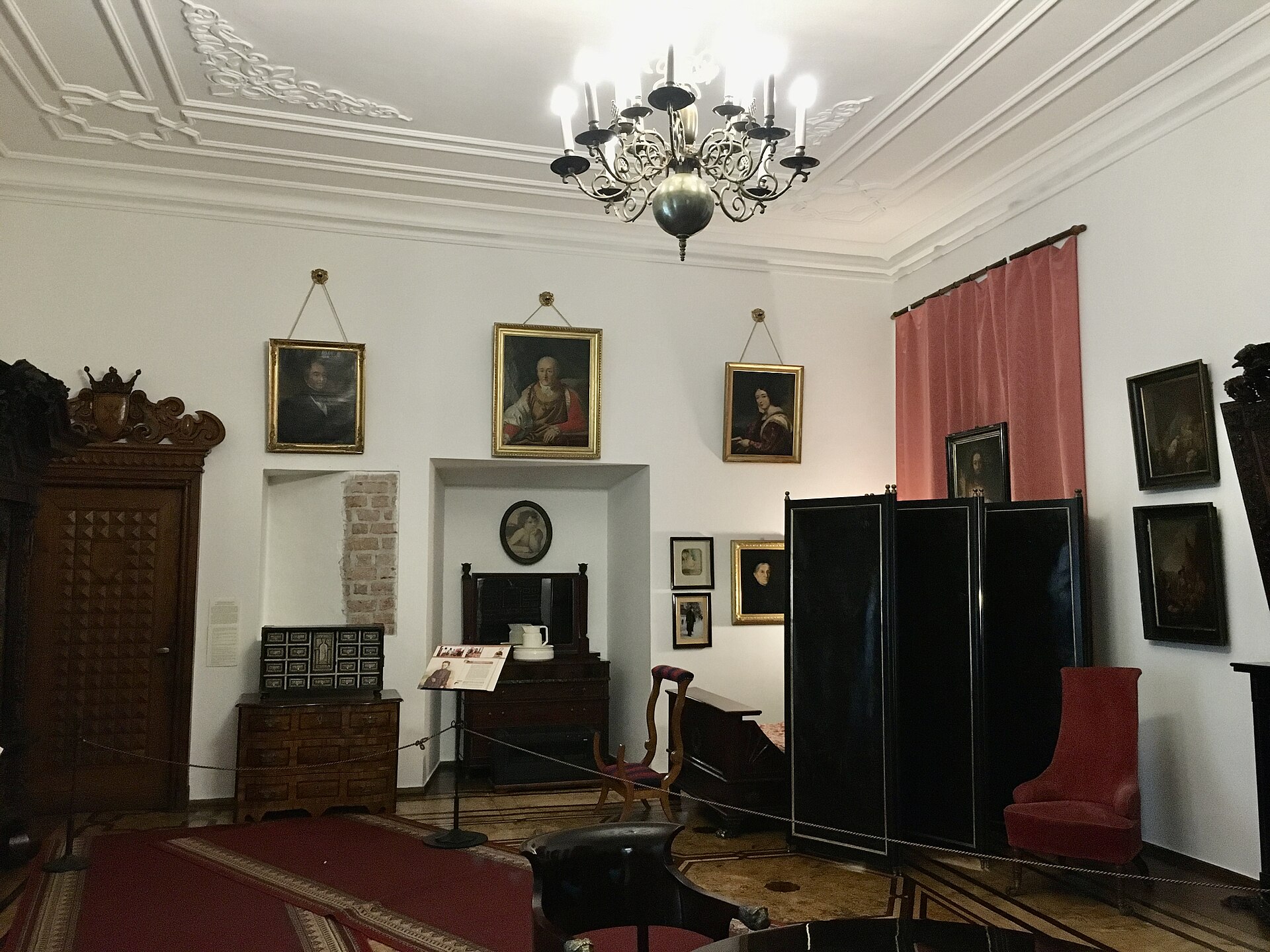
Rooms of the women of the house, laid out as the Dzialynski and Zamoyski families lived. Celestyna Dzialynska's room holds a Dutch ebony cabinet she was given in 1854 and drawings by Artur Grottger; Maria Zamoyska's room keeps memorabilia of the last owners and portraits of the three founders painted in 1938; the boudoir has watercolours by Juliusz Kossak dated 1859. Floors in several of these rooms are original inlaid wood laid in the 1800s.
Salon, Black Room, south terrace and Dining Hall
The Salon is the grandest living room, with a gilded ceiling, an Italian marble fireplace and portraits of the family members jailed or condemned for the uprisings of 1794, 1830 and 1863. The Black Room, named for a black-painted cement floor laid as a temporary base, opens onto the south terrace and holds a Pompeii dog mosaic and a view painting of Bnin and Kornik. The Dining Hall ceiling carries 71 shields of Polish knightly families copied from a Jan Dlugosz armorial, with one deliberately empty panel.
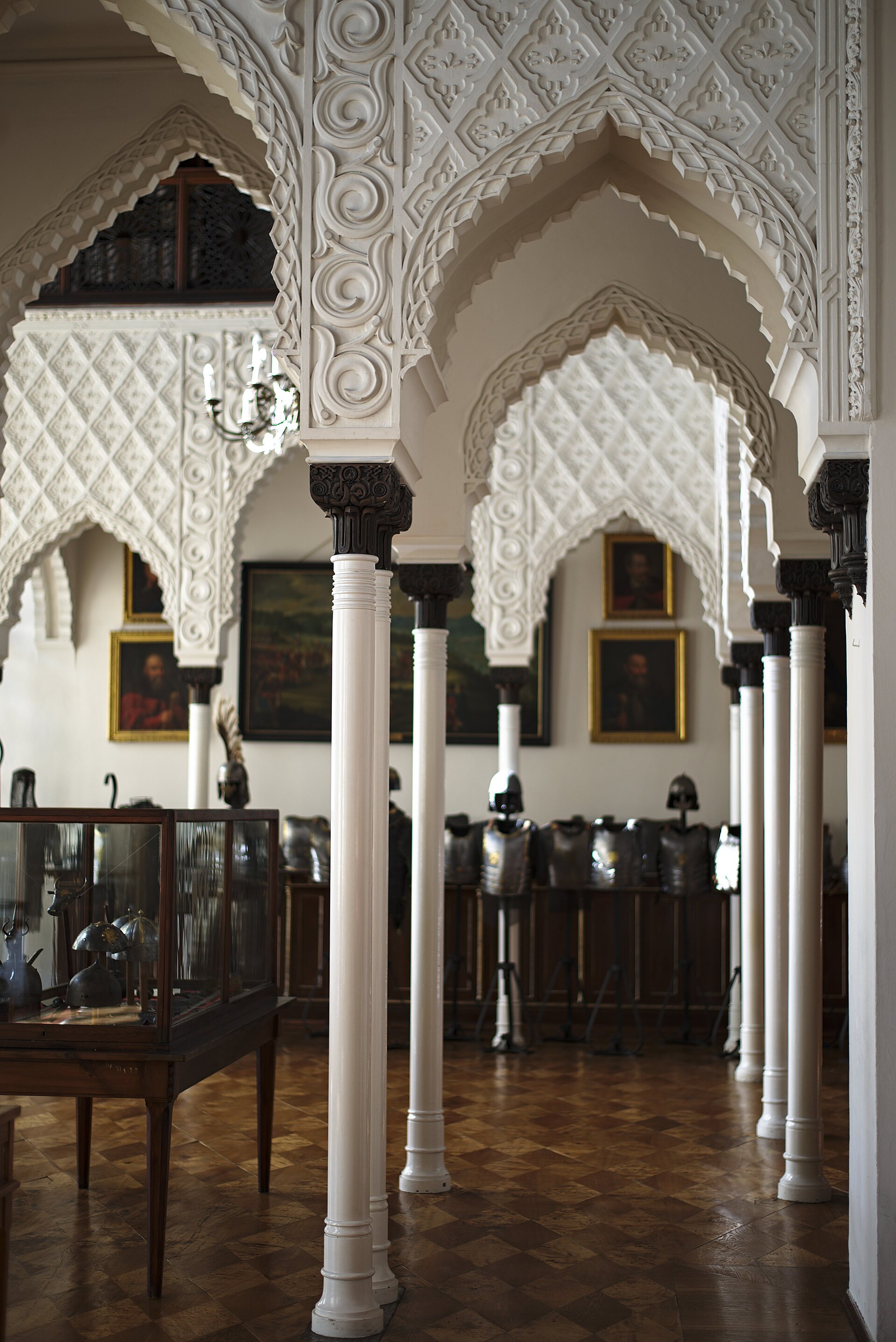
Photograph by Jakub T. Jankiewicz from Bliżyn, Poland · CC BY-SA 2.0 The Moorish Hall and armoury
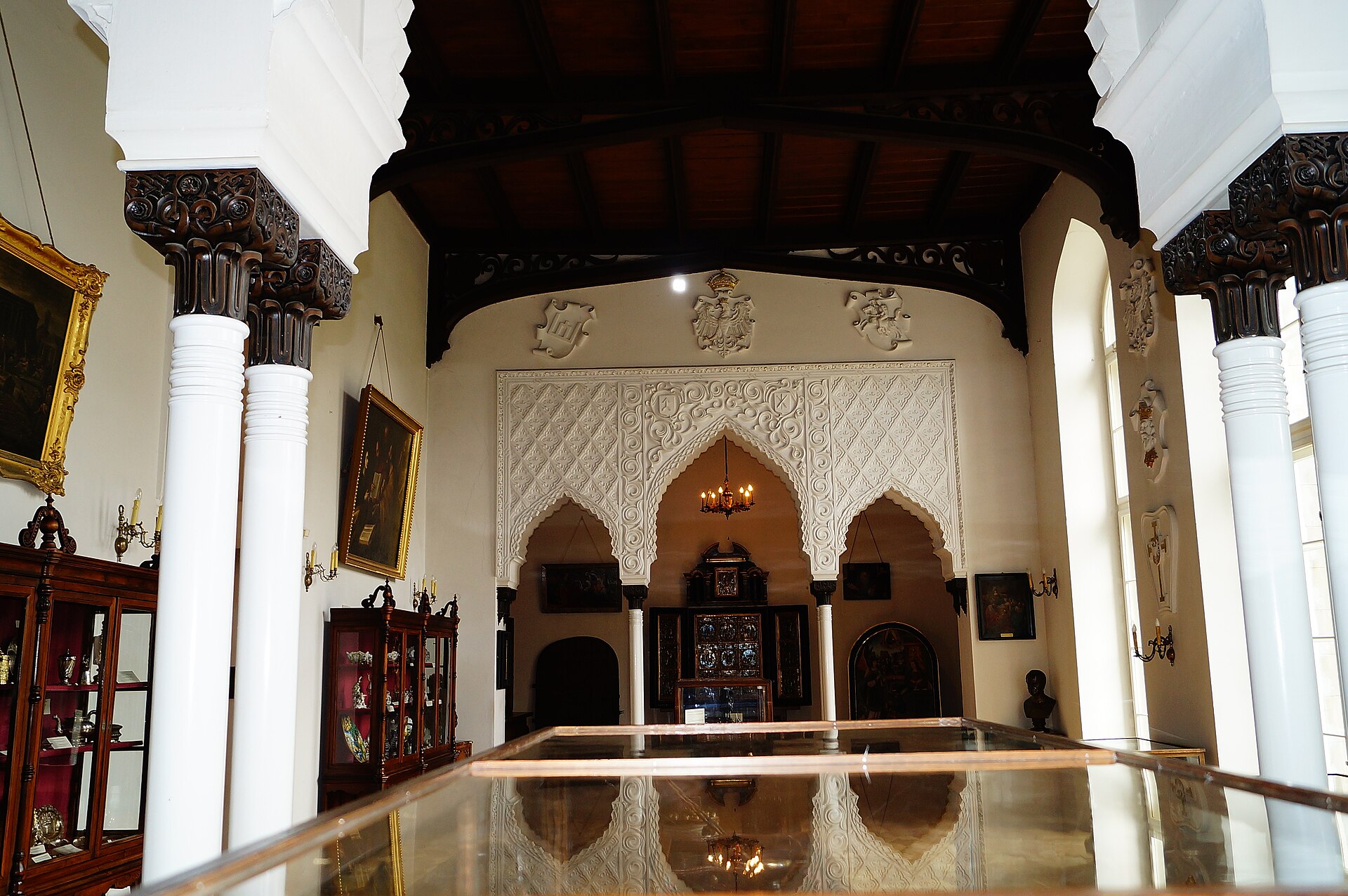
Built in the 1850s by joining two rooms and raising them a storey, the hall was modelled on the Alhambra in Granada, in simplified form from English and French albums. Triple arcades on paired cast-iron columns divide it; the west part holds an armoury, mostly hussar equipment including lances over five metres long, and a gallery carries the oldest library holdings. The museum's guide says the name Moorish Hall only became common after 1945.
First-floor hall, north-east tower and the Isabella apartment
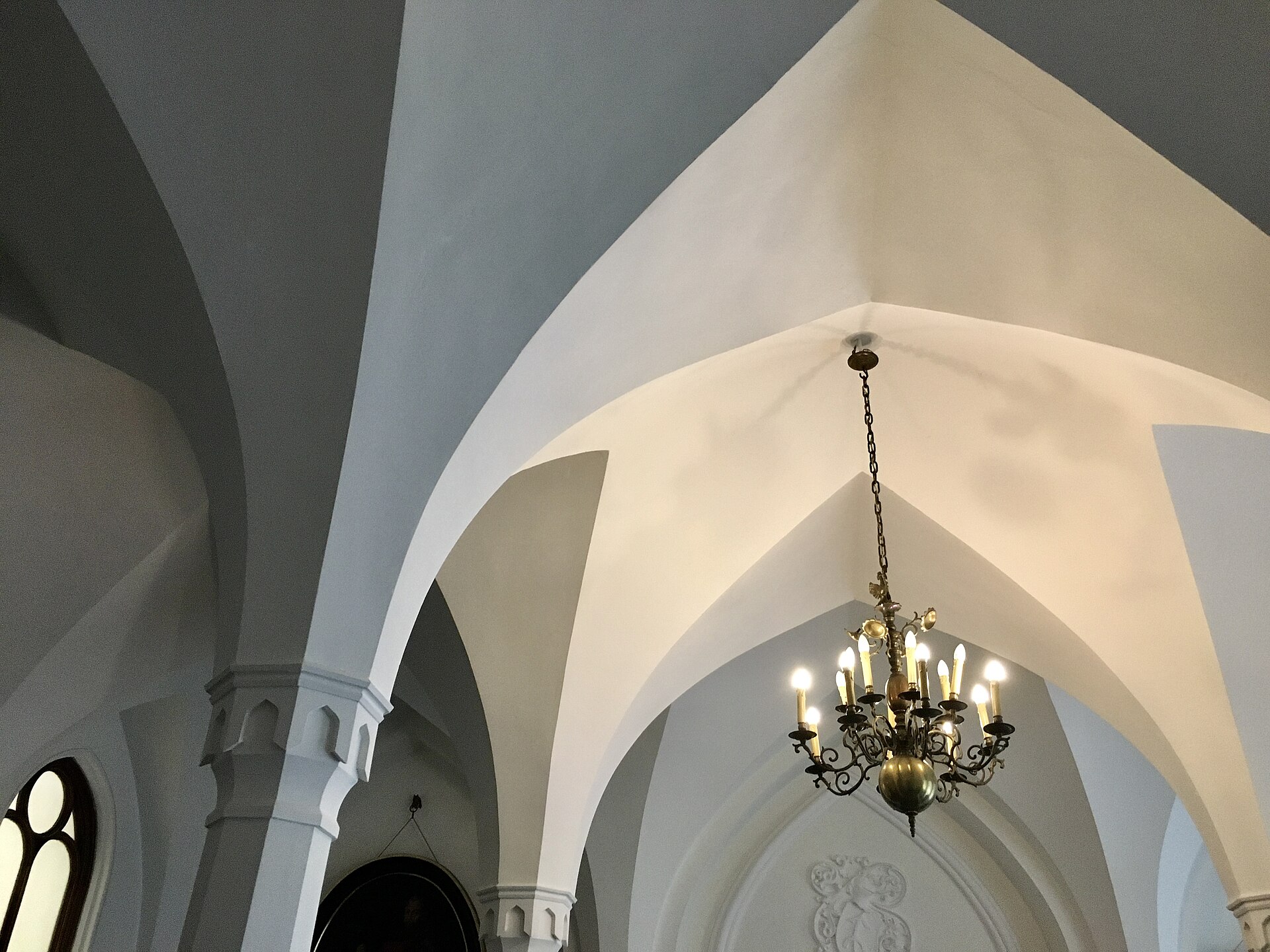
The first-floor hall, with two parts divided by a triple arcade and a gallery of royal portraits, is the castle's concert room because of its acoustics. The north-east tower, built 1856-57 on the footings of its medieval predecessor, has a star vault with seven shields of the Dzialynski spouses. The apartment of Izabela Dzialynska is now partly library work rooms and a reading room for researchers.
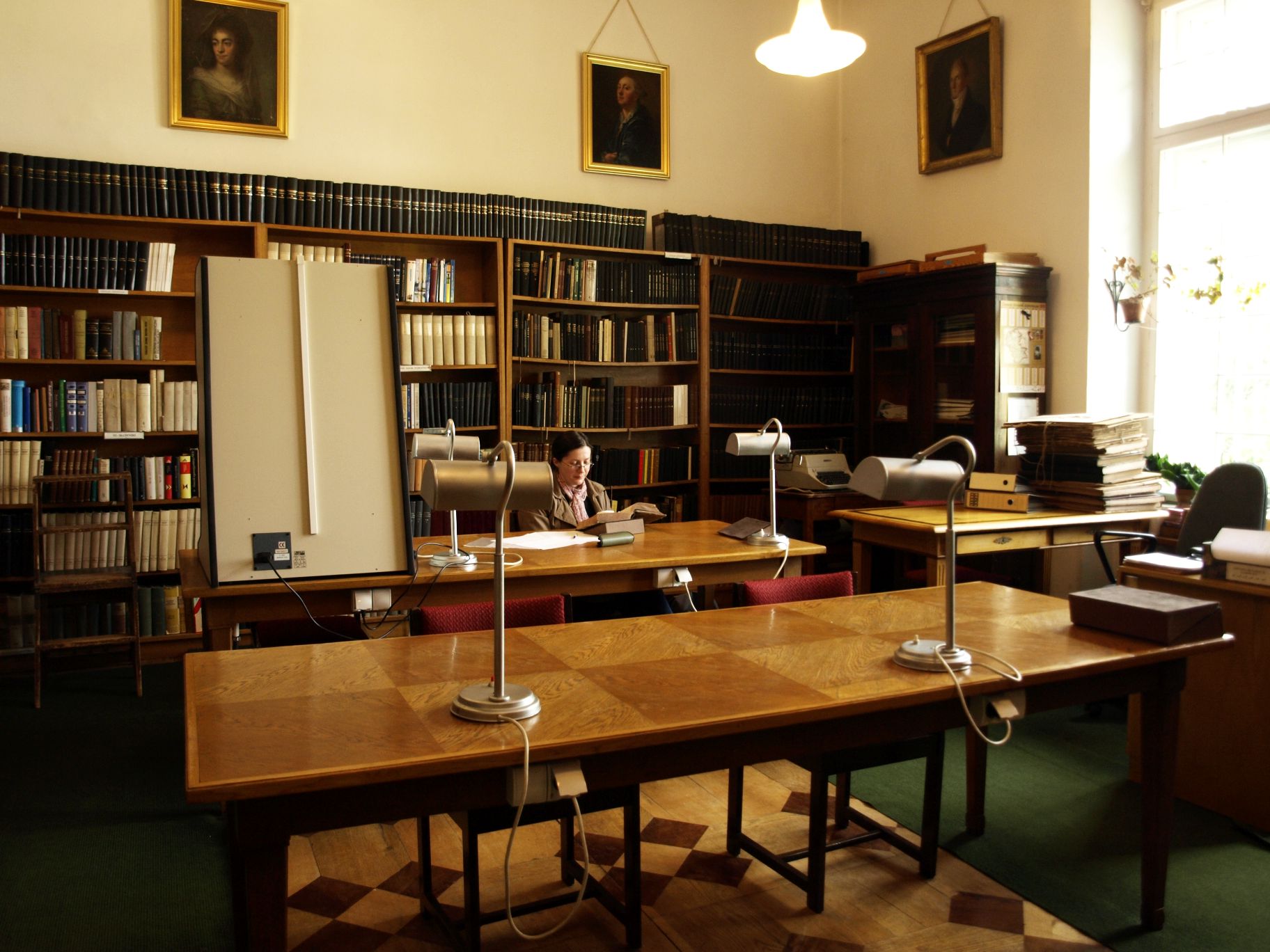
Photograph by Weronika M. Jakubowska · CC BY-SA 3.0 pl Library and reading rooms
The castle is the seat of the Kornik Library, founded by Tytus Dzialynski and part of the Polish Academy of Sciences since 1953. Its reading room at the castle is listed with hours of 08:00 to 16:00 on the library's front page, without naming days. The collection of more than 470,000 volumes is described in the museum's guide, and the manuscripts are held in stores rather than shown on the visitor route as far as the pages read say.
What to see first
The Moorish Hall
Tytus Dzialynski with builder Marian Cybulski, 1850sThe castle's showpiece: Alhambra-inspired arcades, a heraldic ceiling and an armoury under one roof, the largest single room on the visitor route.3
The hussar armoury
17th to 18th century Polish cavalry equipment, collected by Tytus and Jan DzialynskiHollow wooden hussar lances over five metres long that weigh little more than two kilograms, according to the museum guide, part of one of the most valuable such collections in Poland despite wartime losses.3
The Dining Hall heraldic ceiling
Tytus Dzialynski, mid 19th century71 shields of Polish knightly families copied from a 15th century armorial; the one empty coffer stood for a guest's arms.3
The Annunciation panel of 1529
Centre of a triptych commissioned by Lukasz GorkaOne of the oldest paintings in the Kornik collection and a Renaissance donor portrait of Lukasz Gorka, a descendant of the castle's first owning family.3
The Pompeii dog mosaic
Roman, 1st century ADOriginally a warning that a dog guarded the house, brought back from Italy by Izabela and Jan Dzialynski and set in the Black Room.3
The Zamoyski collection from Australia and Oceania
Collected by Wladyslaw Zamoyski, 1879-81Ethnographic and natural-history objects from a voyage to Sydney, New Caledonia, New Zealand, Samoa and Hawaii, shown in the hunting corner in the north-east tower.3
The Salon of the condemned
Dzialynski family portraitsPortraits of relatives sentenced to prison or death for the uprisings of 1794, 1830 and 1863, in a room Zamoyski himself named for them.3
The Kornik Library manuscripts
Includes Napoleon's Clisson et Eugenie, Mickiewicz, Slowacki and Norwid autographsThe reason the castle exists as a library; the 15th century block book Ars Moriendi and a first edition of Copernicus's De revolutionibus are named in the museum's guide. They are library stores, not a displayed route.3
A castle on an island of oak piles
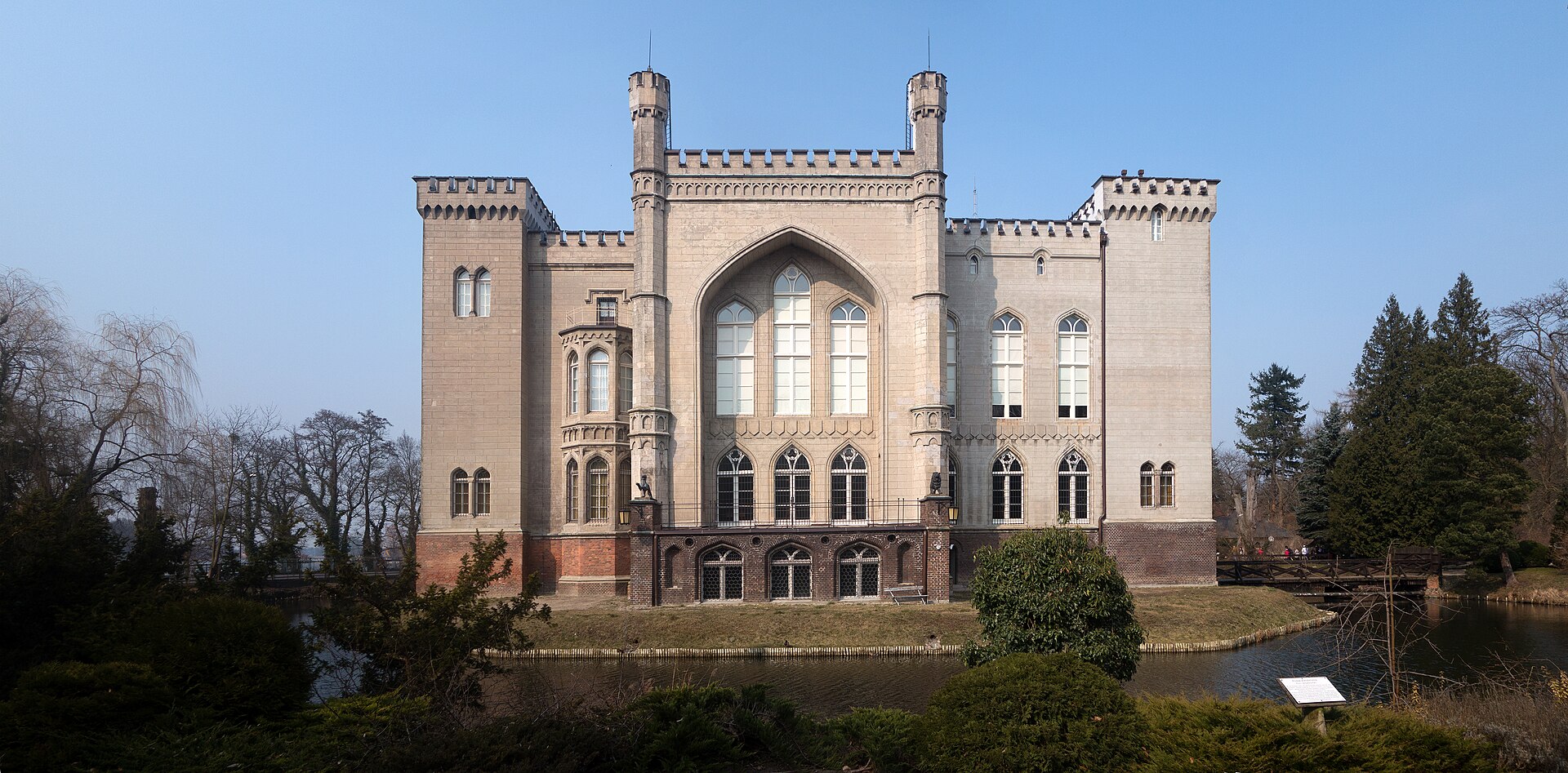
Kornik Castle stands on a small island in a moat beside Lake Kornik, about 20 kilometres south-east of Poznan, and what you see today is a nineteenth century romance built over a fifteenth century fortress. The museum's guide, published by the library that now runs the building, dates the start of the first brick residence to about 1419 for Mikolaj of Gorka, a canon who chose the site for its position near Poznan and Gniezna. The oldest known document, a contract of 31 October to 1 November 1426 for carpentry to finish the work, is the one the museum treats as its birth certificate.
The ground is the first thing to understand about the place. The island was strengthened with hundreds of oak piles driven in as a grid, and they stay sound only while wet. When the lake level dropped around 1900 the exposed timbers rotted, walls and vaults cracked, and in 1947 to 1953 the walls were propped on reinforced concrete and the soil of the island was consolidated by electro-petrification, a method the guide ascribes to Professor Romuald Cebertowicz. The moat now has to be topped up with water, which the guide compares to a bath with a leaking plug.
Five families and one White Lady
The museum names the owners in turn: the Gorka family, then the Czarnkowski and Grudzinski families, then the Dzialynskis from 1676. Stanislaw Gorka rebuilt the north wing and vaulted the lowest floor in the 1500s and received the future King Henry of Valois here on 1 February 1574 on his way to be crowned. Sigismund III Vasa dined here with his family on 1 August 1623.
The best-known resident is Teofila Dzialynska, who married into the Szoldrski and then the Potulicki families and is remembered as the Kornik White Lady. From 1732 she turned the castle into a baroque palace under one roof, with a new bridge, three service wings and a garden of fountains and aviaries. Her portrait hangs in the dining hall and legend says she steps out of it at midnight. The museum's own guide sets the ghost stories beside the facts and says plainly that one popular tale, that Tytus Dzialynski hid in the chimney recess from Prussian gendarmes, is told only in a family memoir and that he was in fact away from Kornik when the uprising of 1830 began.
Tytus Dzialynski and the Gothic rebuild
The look of the castle comes from Tytus Dzialynski (1796-1861), who moved his collections to Kornik in October and November 1826, the date the library counts as its founding. He commissioned designs from Antonio Corazzi, Enrico Marconi and Karl Friedrich Schinkel in 1827 and 1828; the Poznan builder Marian Cybulski then made a working compilation of them with Dzialynski. Work stopped when Tytus took part in the November uprising and was sentenced by Prussia to confiscation and prison; he came back on 19 November 1839 after winning his case, and the second stage ran from 1842 to his death.
He could not enlarge the castle beyond its medieval footprint, since the island would not bear it, so he added the north-east tower, corner turrets and loggias and the south terrace. His son Jan carried the work on, mainly inside, and his unfinished floors lasted well into the twentieth century: some rooms had grey cement until the 1960s. The museum guide corrects a pleasing legend here too. Tytus was said to use only Polish hands and materials, but the guide records that the cast iron and the animal sculptures on the bridge and terrace came from Berlin and that the designs were Italian and German.
From private house to national foundation
Jan Dzialynski died in 1880 and left everything to his nephew Wladyslaw Zamoyski, then travelling in Australia. Zamoyski, with his mother Jadwiga and sister Maria, signed in 1912 a declaration of intent to give the whole estate to the Polish nation, and the Sejm created the Foundation Zaklady Kornickie by an act of 30 July 1925. The castle ceased to be a residence and became a museum; Maria Zamoyska stayed on as a resident and acted as a guide.
The foundation was abolished in 1952 and on 10 January 1953 the property passed to the Polish Academy of Sciences, which still holds it. The museum describes the castle as having escaped the Second World War with fewer losses than most noble houses in Poland, though items were taken to exhibitions and a governor's residence and the rooms were looted in January and February 1945, with searches for lost objects continuing today. Since 2011 the castle and its park, with the parish church that holds the family mausolea, have the status of a Polish Historic Monument.
What a visit looks like
You cross the brick bridge over the moat and walk through the rooms in sequence, through the ground floor and then the first floor. The museum's guide counts 17 numbered stops: entrance hall, the owners' bedroom, the rooms of Jadwiga and Maria Zamoyska, the Salon, the Black Room, the Dining Hall, a boudoir, the hunting corner with the Oceania objects, then upstairs the Moorish Hall, a guest room, the north-east tower, the first-floor hall and Izabela's apartment.
The rooms are not a gallery of masterpieces. The point is the ensemble: inlaid wooden floors, heraldic ceilings, Gdansk furniture and the family's collections as they were arranged. The wooden floors are original and so thin on top that the museum has long insisted on felt overshoes, bought in 47 pairs in the 1930s according to the guide. Whether that is a pleasure or an annoyance depends on the visitor; people on review sites describe an intimate, well organised visit of roughly an hour.
The library behind the rooms
The Kornik Library is the reason the castle is in the hands of an academy rather than a heritage trust. According to the museum's guide it holds more than 470,000 volumes, including about 15,000 manuscripts, 40,000 old prints, 3,000 maps, 15,000 photographs and 15,000 bookplates, and the museum collections of the two families run to more than 20,500 inventory items. Named treasures include a ninth century codex of the Rule of St Benedict, Napoleon's novella Clisson et Eugenie, autographs of Mickiewicz, Slowacki and Norwid, a fifteenth century block book of the Ars Moriendi and a first edition of Copernicus's De revolutionibus.
Most of this is in stores and reading rooms rather than on view. The library runs a digital platform and, in 2026, an EU-funded project for free digital access to a large part of the collection, which suits how the place is really used: a working research institution with a museum floor attached. In 2026 it also marks 200 years since Tytus Dzialynski brought his library to Kornik.
The grounds and the day around it
The castle is set in a park that holds the Kornik Arboretum, which the guide says has more than 3,500 species and varieties and which is managed by the Institute of Dendrology of the Polish Academy of Sciences. It was in the eighteenth century a French garden with fountains and statues. Many visitors on review sites combine castle and arboretum into a day out from Poznan, and the Tripadvisor listing names the arboretum as a reason to come in itself.
A winter note matters here. The museum's page gives low-season hours of 10:00 to 15:15 and says the 2026 tourist season closes on 14 December; In Your Pocket says the castle shuts from mid December to mid February. The museum page read gives no dates for the gap itself, so check by phone before travelling between 15 December and 13 February.
What visitors say
Visitors rate Kornik well but not extravagantly: Tripadvisor 4.1 from 128 reviews and Google 4.5 from about 2,660 in the figures we read. What people say they like is the intimacy of rooms that still look like a family home, the audio guide and the arboretum outside. What they wish they had known is that the visit is short, the ticket is not cheap for what is shown, pushchairs are not allowed and the low-season opening is only until 15:15.
What is praised, what is criticised
- Praised: Rooms that are furnished as lived in, with original floors and heraldic decoration, rather than a set of cases
- Praised: The free app or on-site audio guide, which Tripadvisor visitors describe as worth using
- Praised: The arboretum and lakeside setting around the moat, which many visitors treat as half the day
- Criticised: Price against content: some Google reviewers read by Wanderlog found 40 PLN without an audio guide expensive for the rooms shown
- Criticised: Practical limits that the museum states itself: no pushchairs, no flash or tripods, low-season closing at 15:15, and the winter gap between mid December and mid February
- Criticised: The museum's own guide concedes that damp-proofing the island in 1952-53 with the Cebertowicz electro-petrification method saved the castle but left heavy salt damage in the ground-floor walls, and that a favourite guide story, that no foreign hand touched the building, is not borne out by the sources: cast iron and animal sculptures came from Berlin and the plans from Italian and German architects
Ratings on other platforms
Tripadvisor: 4.1 from 128 ratings, read 20 November 2026
Google (as shown by Wanderlog): 4.5 from 2,659 ratings, read 20 November 2026
A platform average is a tertiary source: it moves, it is not audited, and we quote no visitor's words.
Questions about Kornik Castle
Where is Kornik Castle?
ul. Zamkowa 5, 62-035 Kornik, Poland.
How much does it cost to visit?
Adult (individual visit): PLN 40; Reduced: PLN 20; Free entry: free; Guided tour in Polish: PLN 150; Guided tour in English or German: PLN 200. As confirmed 20 November 2026.
When is it open?
Tue-Sun, low season (14 Feb - 30 Apr and 1 Oct - 30 Nov) 10:00-15:15; Tue-Sun, high season (1 May - 30 Sep) 10:00-17:00; Thursdays in May and June 10:00-20:00. Closed: Monday. The museum's 2026 holiday list gives 1 November as closed, 11 November 10:00-15:00 and, earlier in the year, 4-5 April and 25 June as closed. As confirmed 20 November 2026.
How do you get there?
Bus: From Poznan, by car or bus: the museum names the Poznan Glowny bus station (PKS) and the Rondo Rataje stop as the easiest bus departures; Train: The museum advises against the train: the Kornik railway station is about 5 km from the town centre and the castle; Car: Paid parking for about 30 cars beside the castle; a free car park about 400 m away at Provent, which also has free bays for coaches.
What should you see first?
The Moorish Hall (Tytus Dzialynski with builder Marian Cybulski, 1850s); The hussar armoury (17th to 18th century Polish cavalry equipment, collected by Tytus and Jan Dzialynski); The Dining Hall heraldic ceiling (Tytus Dzialynski, mid 19th century); The Annunciation panel of 1529 (Centre of a triptych commissioned by Lukasz Gorka); The Pompeii dog mosaic (Roman, 1st century AD); The Zamoyski collection from Australia and Oceania (Collected by Wladyslaw Zamoyski, 1879-81).
What we could not confirm
- The museum page read does not say whether the castle is closed from 15 December 2026 to 13 February 2027; In Your Pocket says it is closed from mid December to mid February.
- The museum's 2026 visiting rules were read only as a title; the file is a scan we could not read as text, so visiting limits beyond those on the museum's visit page are unconfirmed.
- No official visitor-number figure for the castle itself was read; the museum's page says more than a hundred thousand guests a year.
- Whether the manuscripts named in the guide are ever shown to visitors is not stated on the pages read.
Images
Sources
- 1PAN Biblioteka Kornicka, Zamek w Korniku visit page: hours, prices, tours, practical notes, contact (read 2026-11-20) bkpan.poznan.pl/zamek-w-korniku/
- 2PAN Biblioteka Kornicka, front page: reading room hours, contact, notices (read 2026-11-20) bkpan.poznan.pl/
- 3Edyta Batkiewicz-Szymanowska, Malgorzata Potocka, Mikolaj Potocki, Opowiesc o Zamku w Korniku: Przewodnik, PAN Biblioteka Kornicka, 2023 (PDF, read 2026-11-20) bkpan.poznan.pl/wp-content/uploads/2026/05/PRZEWODNIK-ZAMEK-KORNIK-PL-web.pdf
- 4PAN Biblioteka Kornicka, Zasady stosowania ulg i zwolnien z oplat (PDF, read 2026-11-20) bkpan.poznan.pl/wp-content/uploads/2026/10/Bilety-ulgowe-i-zwolnienia-z-oplat.pdf
- 5Wikipedia, Kornik Castle, used for machine facts only (read 2026-11-20) en.wikipedia.org/wiki/K%C3%B3rnik_Castle
- 6Tripadvisor, Kornik Castle, rating and count read 2026-11-20 in the in-app browser tripadvisor.com/Attraction_Review-g946537-d3248772-Reviews-Kornik_Castle-Kornik_Greater_Poland_Province_Central_Poland.html
- 7Wanderlog, Kornik trip planner, Google rating and review themes (read 2026-11-20) wanderlog.com/tp/28400/kornik-trip-planner
- 8In Your Pocket, Kornik Castle, undated entry (read 2026-11-20) inyourpocket.com/kornik-castle_168397v
- 9Anna Szczypczynska, Zamek w Korniku. Romantyczna rezydencja z wlasnym duchem, National Geographic Polska, 7 September 2015 (read 2026-11-20) national-geographic.pl/nauka/cuda-polski-zamek-w-korniku/
- 10Wikimedia Commons categories for Kornik Castle, used to choose and license-check the plates (read 2026-11-20) commons.wikimedia.org/wiki/Category:K%C3%B3rnik_Castle