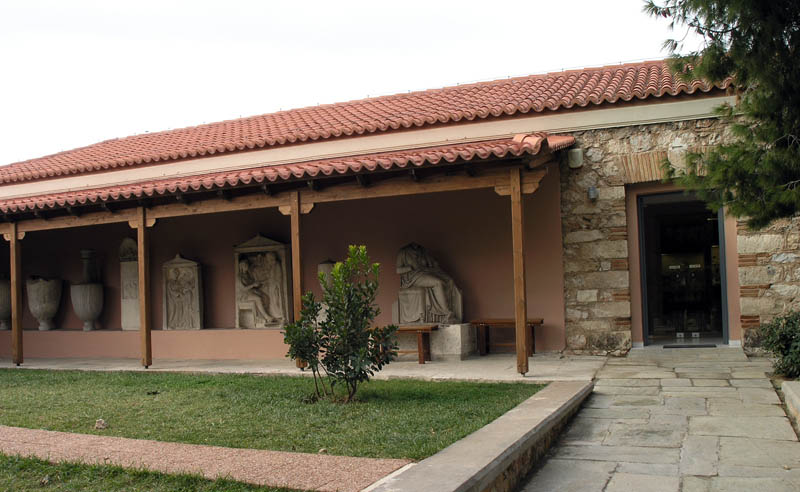
The entrance front of the Kerameikos Archaeological Museum, with grave stelai and urns under the timber-and-tile portico and the stone-framed entrance door at right. Photograph by Marsyas, CC BY-SA 2.5.
Marsyas, CC BY-SA 2.5, via Wikimedia CommonsKerameikos Archaeological Museum
Museum · Αρχαιολογικό Μουσείο Κεραμεικού · Founded 1937
Open, admission and hours confirmed 23 November 2026 · 15 sources
On this page 15 sections
ContentsClose
The museum's strength is concentration: a century of German Archaeological Institute excavation in the principal cemetery of ancient Athens produced a collection almost wholly funerary, arranged in chronological sections from Geometric pottery to Roman glass. Its sculpture, from the Sacred Gate kouros and sphinxes to the Dexileos and Ampharete stelai, shows the evolution of Attic grave monuments in one place. It is a specialist's museum in a small building and holds fewer objects than the national museum, which has some of the cemetery's most famous vases.
| Local name | Αρχαιολογικό Μουσείο Κεραμεικού |
|---|---|
| Kind | Museum |
| Founded | 1937 |
| City and country |  Athens, Greece |
| Address | Ermou 148, 10553 Athens, Greece |
| Website | efaathculture.gr |
| Status | Open, confirmed |
| Record last verified |
Visiting
- Hours
- Winter 1 Nov-31 Mar: Mon, Wed, Thu, Fri08:30 to 15:30Last entry 20 minutes before closing
- Winter 1 Nov-31 Mar: Tue10:00 to 15:30
- Winter 1 Nov-31 Mar: Sat, Sun08:00 to 17:00
- Summer 1 Apr-31 Oct: daily except Tue08:00 to 18:00Hellenic Heritage lists longer summer hours; phone ahead
- Summer 1 Apr-31 Oct: Tue10:00 to 18:00
- Closed
- 1 January, 25 March, 1 May, Orthodox Easter Sunday, 25 and 26 December (Hellenic Heritage). Monday 23 November 2026 only: closed for urgent operational needs (Ephorate notice).
- Admission
- FullEUR 10Covers the Kerameikos archaeological site and the museum
- ReducedEUR 5Stated by Hellenic Heritage; the museum directorate page gives only the 10 euro price
Free entry: 6 March. 18 April. 18 May. Last weekend of September. 28 October. First Sunday of each month, November to March (Hellenic Heritage also lists the third Sunday)- Tickets
- etickets.tap.gr The museum's own ticket page.
- Do I need to book?
- No. Tickets can be bought online through the Ministry e-ticket service or at the new reception building at the Ermou entrance.
- Address
- Ermou 148, 10553 Athens, Greece MapMetro Line 1 to Thiseio (about 7 minutes on foot) or Line 3 to Kerameikos (about 11 minutes on foot)
On foot Tripadvisor lists Thissio as a 4 minute walk and Monastiraki as a 9 minute walk - Website
- efaathculture.gr
- Telephone
- +30 210 3463552
- [email protected]
Before you go how long, access, photography, bags, eating, shop
- How long to allow
- One to two hours for the museum and the cemetery site together, as visitors on Tripadvisor describe it
- Access
- The directorate lists a ramp, tactile items and accessible toilets. Hellenic Heritage lists step-free accessible areas and downloadable autism-friendly guides.
- Photography
- Not stated on any page read for this page
- Bags
- Not stated on any page read for this page
- Eating
- A cafe in the new 1,700 square metre building at the Agion Asomaton Street exit (travel.gr, 1 October 2026)
- Shop
- A gift shop is listed by the directorate; travel.gr says the new shop sells hand-painted white-ground lekythoi and prints of the Hirschfeld Krater
Prices and hours change. We take them from the institution's own pages and print the day we read them, and you can check the current position at the source we used. Confirm before you travel.
What is inside
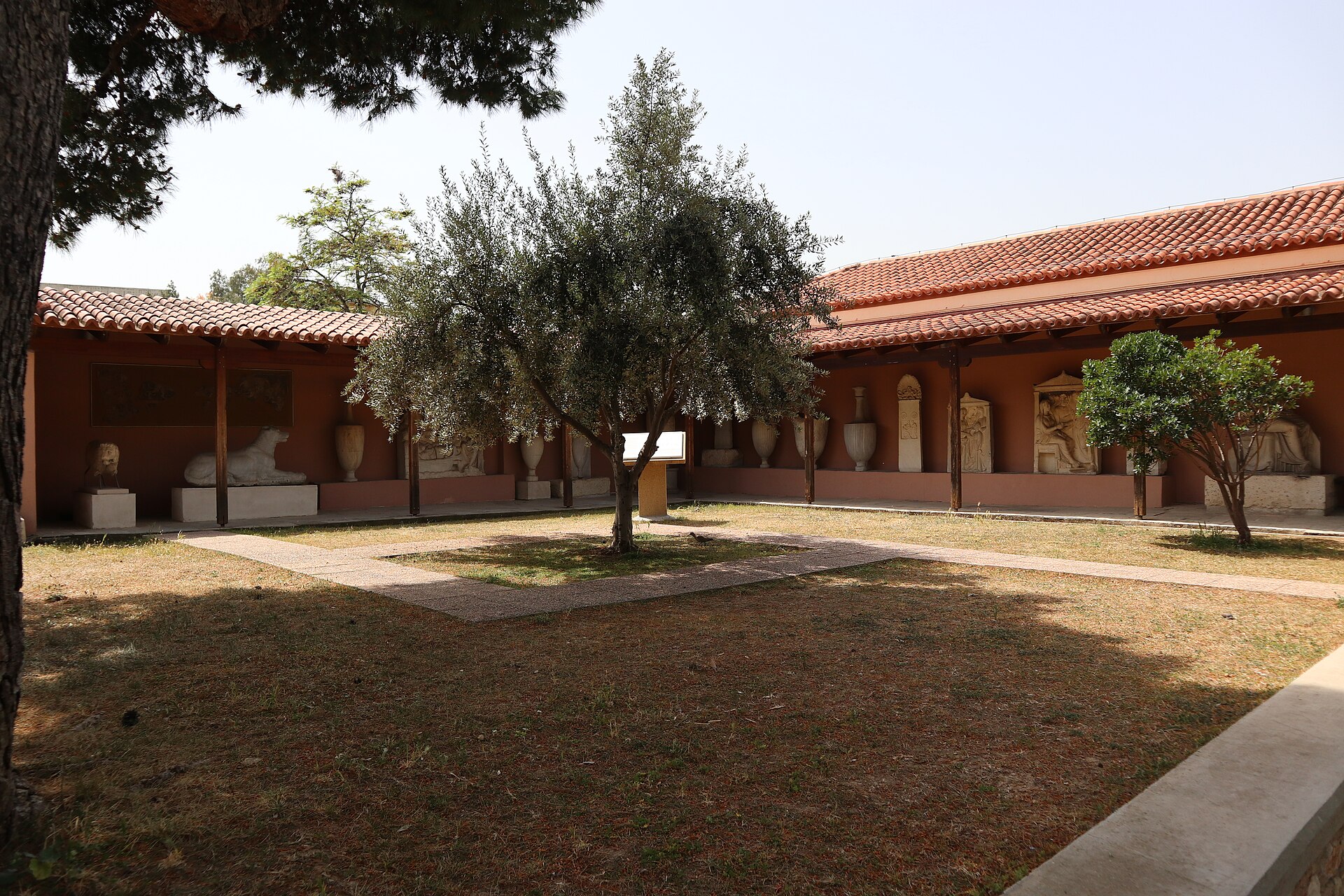
CC0 The cloister and forecourt
An open, tile-roofed portico around a planted forecourt where grave monuments, funerary urns and stelai stand outdoors, with the entrance door to the galleries at its corner. It is the first space most visitors cross and holds mostly marble pieces: funerary lekythoi, loutrophoroi, stelai and a seated headless female figure seen from the entrance garden.
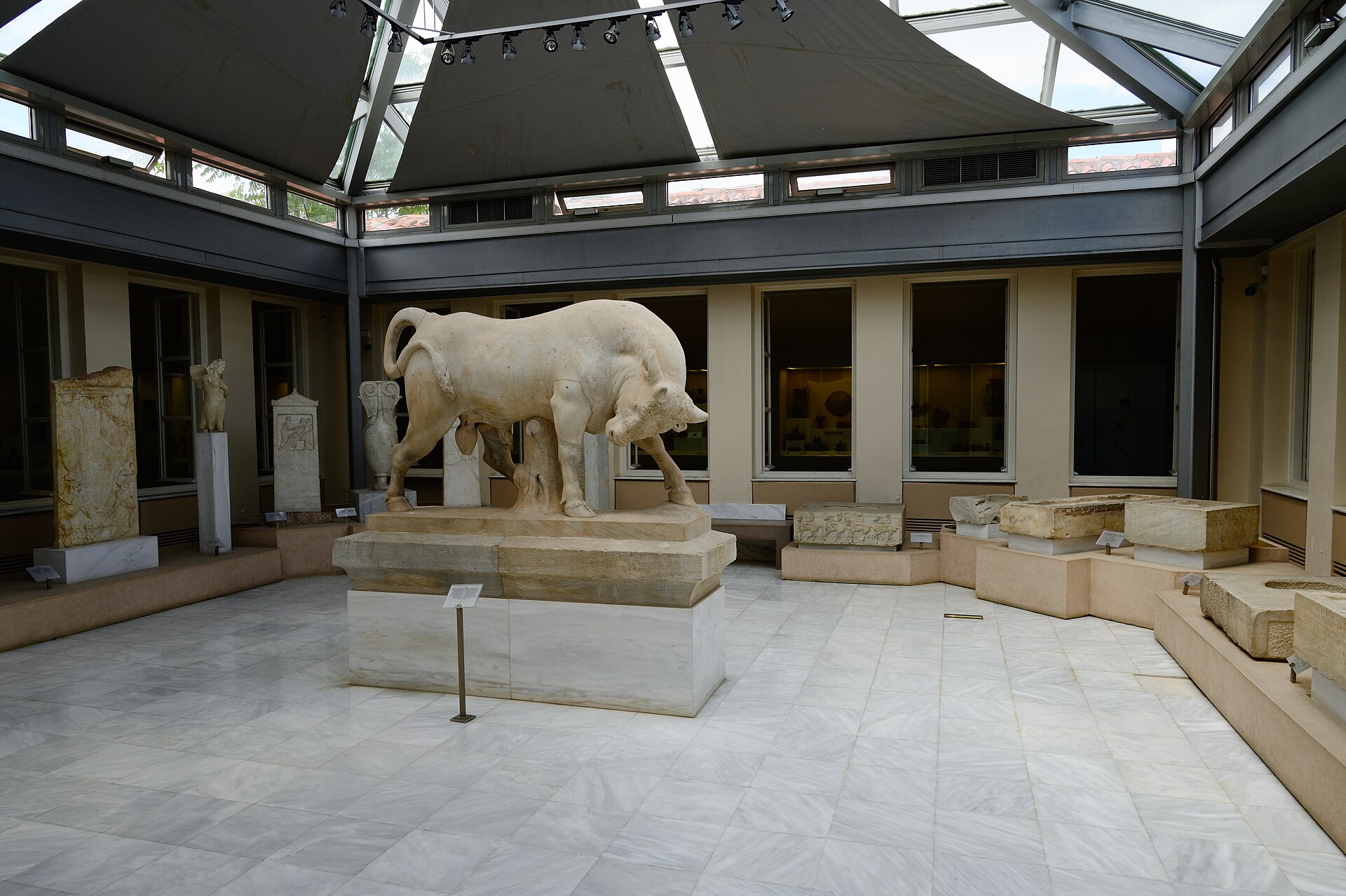
Photograph by Zde · CC BY-SA 4.0 The roofed courtyard
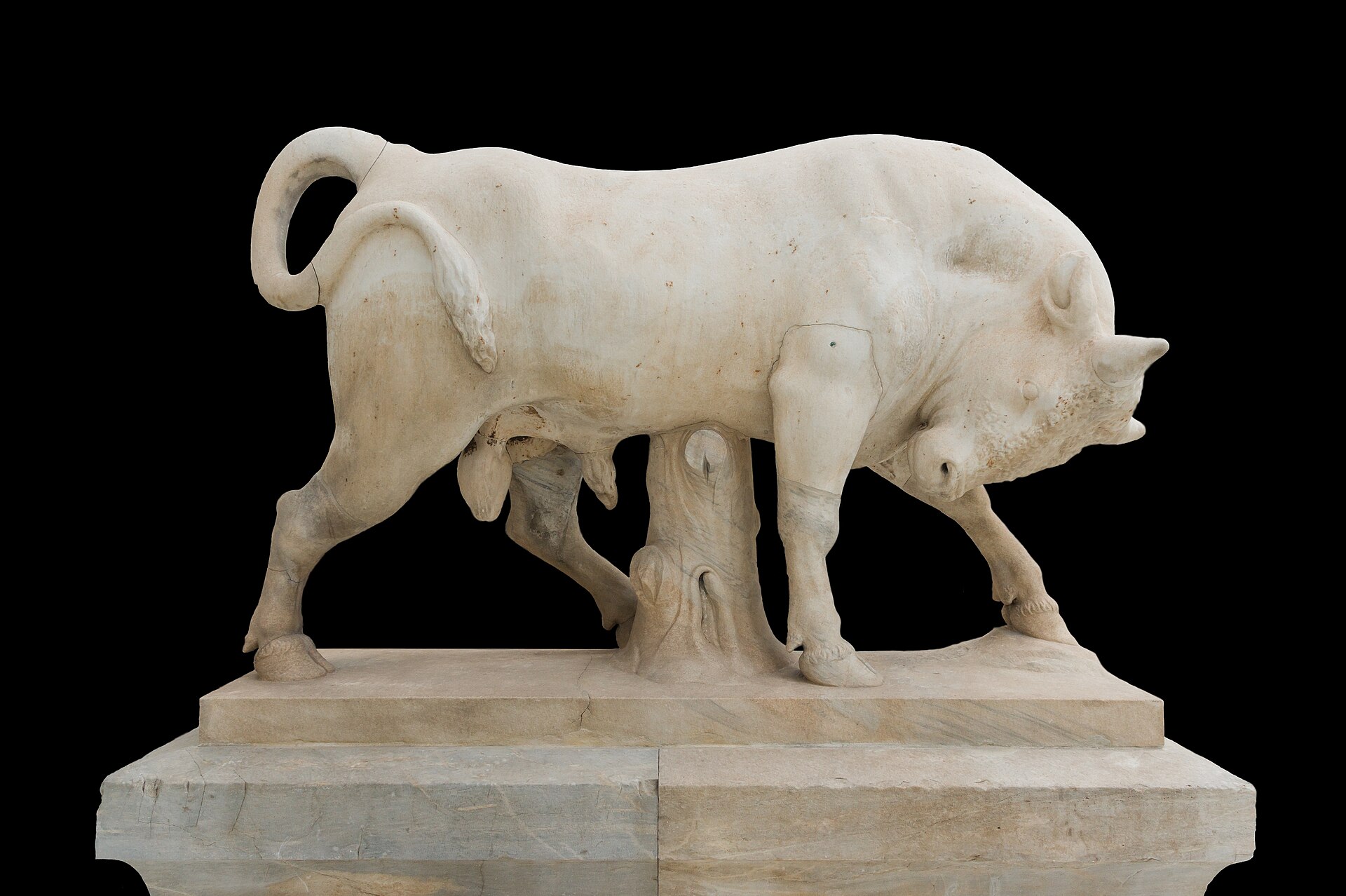
A glass-roofed inner court with a white marble floor whose centrepiece is the bull from the grave enclosure of Dionysios of Kollytos, about 345 to 340 BC, on a high pedestal. Grave stelai, bases and a funerary naiskos stand around it, among them the stele of Zosimos and Blaste of the first century AD and a statue of a siren as photographed on Commons.
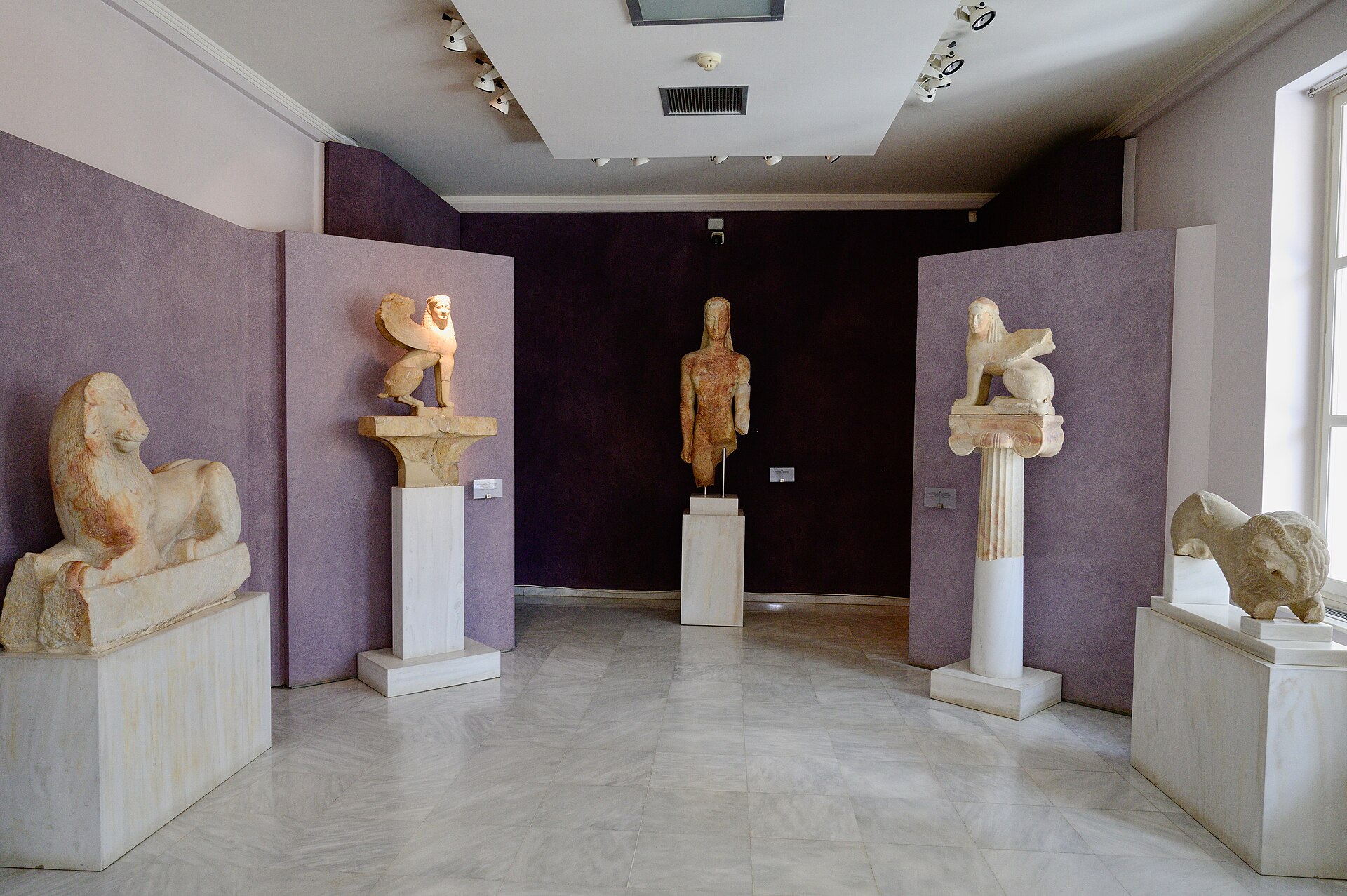
Photograph by Zde · CC BY-SA 4.0 Room 1, the archaic sculpture
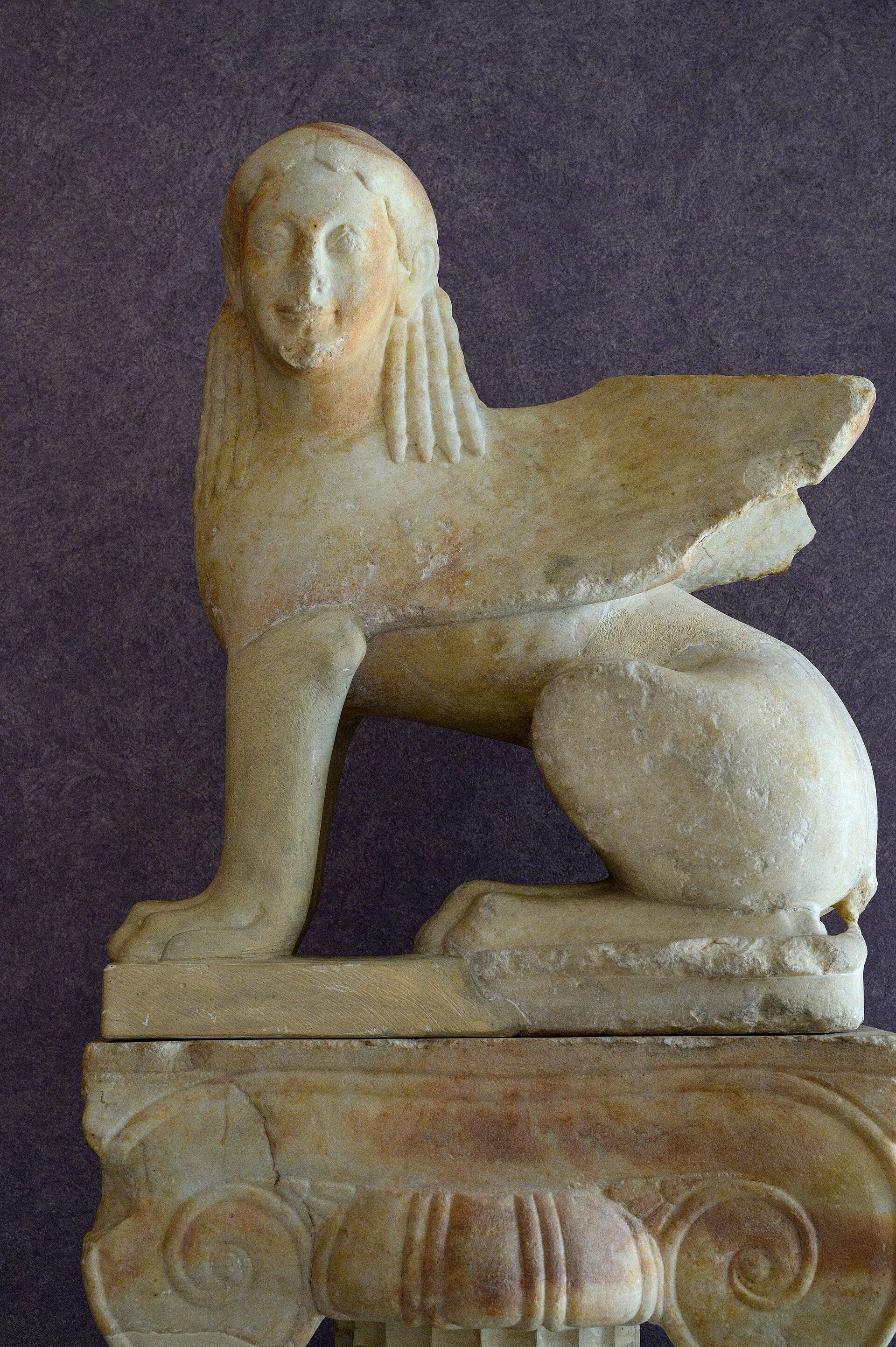
A room with violet walls devoted to the sixth century BC: the Sacred Gate sphinx on an Ionic column, a second sphinx on a pedestal, a pair of marble lions and, at the centre, the kouros found near the Sacred Gate in 2002. Commons also files the Ampharete relief of about 400 BC under this room.
Room 4, Geometric period
Cases of pottery and small objects of the tenth to eighth centuries BC, labelled Late Geometric Period in Greek and English: a cinerary urn amphora, tripod, ring-shaped askos, jugs, dishes, clay beads, spindle whorls and dolls, and a wheeled toy horse that the Ephorate's children's series on the museum also features.
Room 5, post-Geometric and Proto-Attic pottery
Seventh and sixth century BC vases from graves and offering pits, including an olpe of about 600 BC, a hydria, a bowl of about 510 BC, an alabastron with a courtship scene, and the miniature gaming table with four mourners of about 580 BC.
Rooms 7 and 9, Classical period
White-ground lekythoi, including a Group R lekythos of about 420 BC and one by the Reed Painter, and a group of pottery from a mass burial of about 430 BC (Room 7), then wider Classical pottery, plastic vases, black-figure pieces and Tanagra-type figurines (Room 9).
Rooms 10 and 11, Hellenistic and Roman
A marble ossuary, a marble pyxis, leather sandal soles and two curse tablets (Room 10), then West Slope pottery of the fourth century BC, Hellenistic oil lamps, glass unguentaria of about AD 150 and embossed gold sheets of about AD 50 (Room 11). A golden laurel wreath of Hellenistic date is also catalogued from the museum on Commons.
What to see first
Grave stele of Dexileos
The Dexileos Sculptor (attributed)A Pentelic marble relief, 1.86 m high, of a 20-year-old Athenian cavalryman killed near Corinth in 394 BC, found in his family plot in 1863 and now in the museum with a copy outdoors at the Dipylon cemetery.8
Ampharete relief
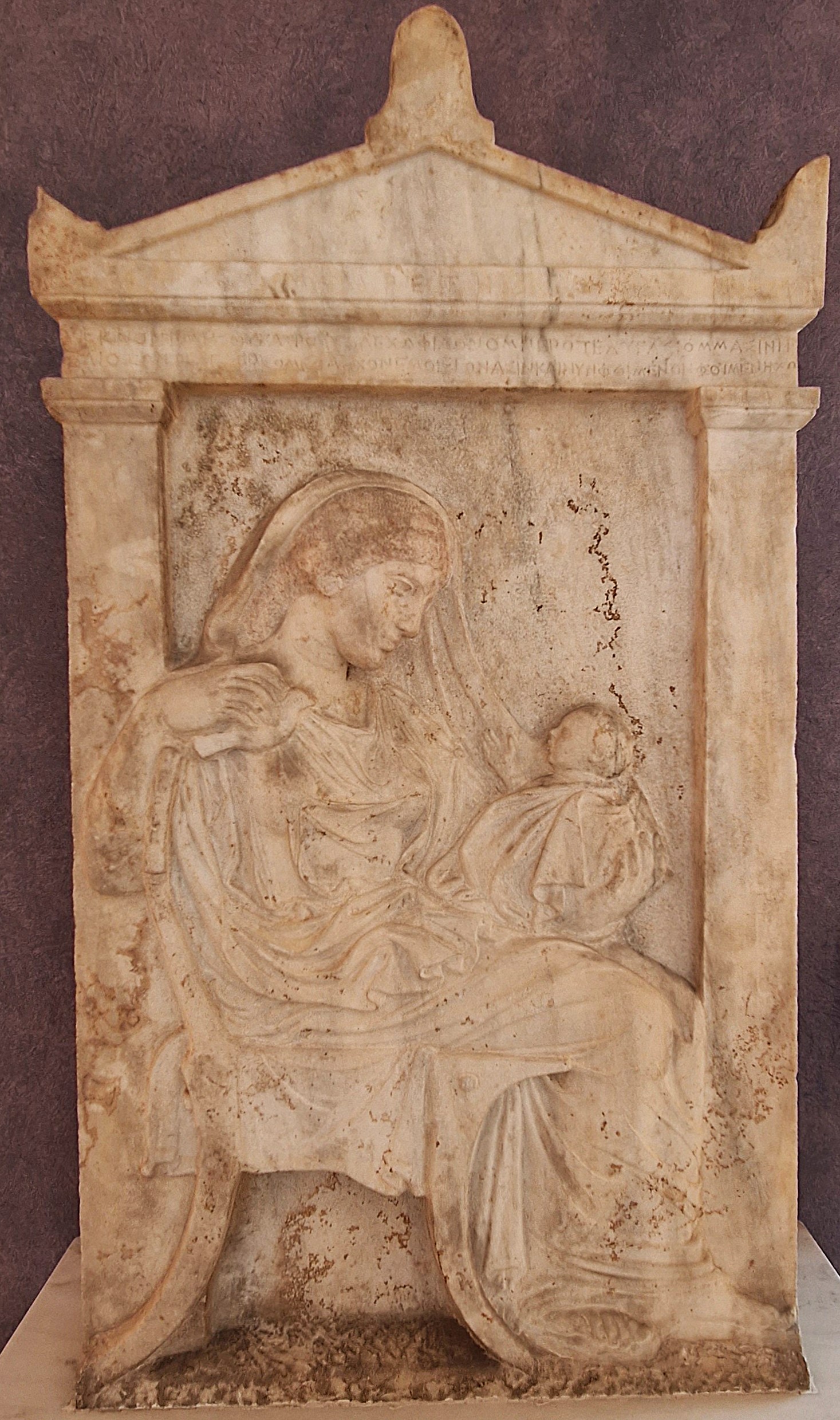
Unknown Attic sculptorA grave stele of about 400 BC (accession P695) in which a seated woman holds her infant grandchild, the piece travel.gr and Commons single out for its intimacy.5
Sacred Gate sphinx
Unknown Attic sculptorA sphinx on an Ionic column of about 550 to 560 BC with traces of its painted decoration, from the Sacred Gate area (P 1697).13
Kouros found near the Sacred Gate
Attributed to the Dipylon MasterA 2.1 m archaic youth found in 2002, called the larger twin of a kouros in the Metropolitan Museum of Art by Wikipedia.7
Bull of Dionysios of Kollytos
Unknown Attic sculptorA marble bull of about 345 to 340 BC that stood on a high pedestal in the grave enclosure of Dionysios, son of Alphinos, who died unmarried, and now anchors the roofed courtyard.13
Miniature gaming table with mourners
Unknown Attic workshopA clay table with four mourning figurines from an offering pit of about 580 BC, an unusually direct image of grief from a burial.13
Bearded boxer stele fragment
UnknownA grave stele fragment of 560 to 550 BC showing the dead man as a bearded boxer, from the Piraeus Gate area outside the site (P 1054).13
Geometric pottery cases
Attic workshopsTenth to eighth century BC vases, dolls, beads and a wheeled toy horse that trace how Athenians equipped their dead before the Archaic period.1
A small museum at the edge of the cemetery it explains
The Kerameikos Archaeological Museum is a low, single-storey building inside the archaeological site of Kerameikos, entered from Ermou Street, a few minutes' walk from the Thiseio and Kerameikos metro stations. It was built in 1937 with money from the German-American industrialist Gustav Oberlaender, to house finds from the German Archaeological Institute, which has excavated the site since 1913. The Ministry of Culture's museum directorate lists it as opened in 1938 and describes a collection made up mainly of sculpture and pottery, almost all of it funerary, arranged in chronological sections. Wikipedia adds that the Boehringer brothers paid for an expansion in the 1960s; that detail rests on a tertiary source and has not been matched to a primary one.
The scale is the first thing to understand. English Wikipedia describes a small museum with four rooms on a single floor and a garden of olive and laurel trees inside it, three rooms for the necropolis finds and a fourth for sculpture from all periods. Wikimedia Commons, by contrast, sorts its photographs of the museum into a courtyard, a cloister and numbered rooms running up to Room 11, so the arrangement visitors meet today is probably more extensive than the older description suggests. The two accounts do not agree and the museum's own site publishes no floor plan, so this page lists spaces by what the photographs show and flags the gap.
What the building does well is sequence. You pass through the open cloister where grave monuments stand under a timber-and-tile portico, cross a roofed courtyard dominated by a marble bull, and then move into galleries that run from the tenth century BC toward the Roman period. The site outside is where those objects were found, and the museum is, in effect, the indoor half of a single excavation.
The ground it stands on
Kerameikos takes its name from the potters, the Kerameis, whose district lay on the clay-rich banks of the Eridanos river. According to English Wikipedia the marshy ground was used for burials as early as the third millennium BC, with an organised cemetery from about 1200 BC. Hellenic Heritage, the Ministry's visitor-information service, dates the first burials to the Early Bronze Age and says the area remained the city's principal burial ground without interruption until the sixth century AD.
After the Persian sack of 480 BC the Athenians built a new city wall in 478 BC and set funerary sculpture into it. Two gates faced northwest, the Sacred Gate on the south, through which the Sacred Way ran to Eleusis, and the Dipylon on the north. Wikipedia places the public graves outside the Dipylon, where the Pericles funeral oration of 431 BC was delivered, and records a decree of about 317 BC that banned lavish tombs and allowed only small columns or inscribed blocks. The Roman general Sulla's troops broke through near this spot when they took Athens in 86 BC. The quarter faded after Avar and Slavic raids at the end of the sixth century AD and was forgotten until a worker unearthed a stele in April 1863, which led to the first excavations.
The excavated area is only a small part of the ancient district. Large adjoining areas lie under modern Athens, and Wikipedia notes that expropriation has been delayed pending funding. The site sits several metres below the modern street, buried under flood silt from the Eridanos.
What is in the collection
The collection is a record of how Athenians treated their dead across roughly nine centuries. The Ministry directorate describes urns, lekythoi, grave reliefs, stelai and jewellery. The earliest pottery on view is Geometric, with Commons labelling a case of tenth-century BC objects (clay beads, dolls, spindle whorls, a ring-shaped askos and a cinerary amphora) and later Geometric jugs and dishes of the eighth century BC. Further rooms carry post-Geometric and Proto-Attic pottery of the seventh and sixth centuries, Classical vases including white-ground lekythoi painted for the grave, Hellenistic West Slope pottery and lamps, and Roman glass perfume vessels of about AD 150 and embossed gold sheets of about AD 50.
Two details make the pottery more than a catalogue. A miniature gaming table with four mourning figurines, from an offering pit of about 580 BC, shows grief staged as a toy. And a clay sphinx that served as an incense burner, dated 660 to 650 BC, shows how early the monster later carved on gravestones was already attached to death. Room 10 as labelled on Commons also holds a marble ossuary, a marble pyxis, the soles of leather sandals and two curse tablets, catalogued as IG II3 8.1 199 and 362, which gives the museum a strand of ordinary and sometimes ugly life that the grand monuments leave out.
Wikipedia also reports finds linked to victims of the plague of Athens, and a mass-burial pottery group of about 430 BC is photographed in Room 7. The plague pit itself was found during metro construction, held 89 individuals and is dated by its pottery to 430 to 426 BC. Treat the link between that pit and this museum's display with care until the museum's own labels are read on site.
The objects people come for
The best-known single work is the grave stele of Dexileos, an Athenian cavalryman, son of Lysanias of Thorikos, killed near Corinth in 394 BC at the age of about twenty. English Wikipedia describes a high relief of the youth on a rearing horse charging a fallen enemy, carved in Pentelic marble, 1.86 metres high, found in 1863 by Athanasios Rhousopoulos in the family plot and now in the museum, with a copy standing at the Dipylon cemetery. The poet Kostis Palamas, Hellenic Heritage notes, called the Kerameikos the marble Elysium of art in a poem on this monument.
The Ampharete relief, dated by Commons to about 400 BC, shows a seated woman holding her infant grandchild and is the piece most visitors single out for its tenderness. The Sacred Gate sphinx, about 550 BC on an Ionic column, still carries traces of paint. Beside it stands a kouros 2.1 metres tall found near the Sacred Gate in 2002; Wikipedia calls it the larger twin of one in the Metropolitan Museum of Art and attributes both to the anonymous Dipylon Master. The bull from the grave enclosure of Dionysios of Kollytos, of about 345 to 340 BC, once stood on a high pedestal behind a naiskos carrying epigrams, and now fills the roofed courtyard. A bearded boxer on a stele fragment of 560 to 550 BC came from the Piraeus Gate area outside the site.
Many of the monuments outside are plaster replicas, with the originals indoors. Wikipedia says so and travel.gr's report from the reopening points visitors to the museum for the originals.
The rebuild of 2023 to 2026
The site around the museum has just come out of a long closure. A Ministry of Culture project announced in 2023 was funded by the Recovery and Resilience Facility and aimed at routes, rest points, drainage, fire protection and access for disabled visitors. A January 2025 report gave its budget as 5.8 million euros and completion by the end of 2025. Travel.gr, writing on 1 October 2026, says the site reopened in mid-September 2026 after three years of restoration costing 4 million euros. The two figures are not reconciled in anything read for this page, and the completion date moved by about nine months.
The reported changes are substantial. About 4,500 square metres were added to the visitor route, of which 2,700 had been closed to the public and hold Hellenistic and Roman fortifications, houses and workshops. More than 3,500 trees, shrubs and smaller plants were planted. A new 1,700 square metre building at the Agion Asomaton Street exit contains a cafe, a shop, rooms for study and rest, and space for exhibitions and children's programmes, with the Roman sarcophagus of Philotera in a glass case facing the street. At the Ermou entrance a new reception building replaces a temporary ticket booth installed in 2011, fronted by a replica of the funerary shrine of Aristonautes. The Ephorate of Antiquities of Athens published a notice on 24 September 2026 saying the site was handed back renovated and fully accessible.
Nothing read describes changes to the museum building itself, so a reader should not assume its galleries were redisplayed. A Tripadvisor reviewer in September 2026 wrote of new exhibits and pathways, which is a visitor's impression and not a museum statement.
Planning the visit
Admission is 10 euros for the site and the museum together, with a reduced ticket of 5 euros according to Hellenic Heritage. The Ministry directorate lists tickets for sale online through its e-ticket service and a list of free days: 6 March, 18 April, 18 May, the last weekend of September, 28 October and the first Sunday of each month from November to March. Hellenic Heritage adds the third Sunday of those months, so the two official pages disagree.
The hours also disagree. The directorate gives winter hours (1 November to 31 March) of 08:30 to 15:30 Monday, Wednesday, Thursday and Friday, 10:00 to 15:30 on Tuesday and 08:00 to 17:00 on weekends, with 08:00 to 18:00 daily in summer (10:00 on Tuesday). Hellenic Heritage gives 08:00 to 15:00 for the whole winter and 08:00 to 20:00 in spring and summer. This page follows the directorate, which dates its entry 27 October 2026, and recommends phoning ahead. Last entry is 20 minutes before closing on both pages. Hellenic Heritage lists the closed days as 1 January, 25 March, 1 May, Orthodox Easter Sunday and 25 and 26 December.
One-off closure: the Ephorate announced that on Monday 23 November 2026 the Kerameikos, Lykeion and Roman Agora sites would be closed to the public because of urgent operational needs. That is a single day and not a closure of the museum.
Allow one to two hours. Visitors on Tripadvisor repeatedly say the site is quiet compared with the Acropolis, that the museum is worth entering first because it sets up the site, and that summer visits are hot with little shade. The Metro stations are Thiseio on Line 1 and Kerameikos on Line 3.
What it does not hold and where it falls short
The famous Dipylon Amphora, a Geometric masterpiece from this cemetery, is in the National Archaeological Museum and not here, as travel.gr notes. Anyone arriving expecting the full run of Kerameikos finds will find that the largest and best-known Geometric vases left long ago. The museum also has a recorded loss: Wikipedia, citing a 1984 issue of the Journal of Field Archaeology, says a black-figure lekythos was stolen in 1982.
The weaker points are informational. Public timetables and free-day lists disagree, as above. The museum's own web page does not state its current status, and the Ephorate's site pages are announcements without hours or prices. English-language descriptions of the museum rest heavily on Wikipedia and travel journalism rather than a catalogue. A reader who wants provenance for individual objects should look to the German Archaeological Institute's excavation publications, which this page does not cite.
What visitors say
Visitors rate the Kerameikos as a calm, uncrowded alternative to the Acropolis and Ancient Agora and say the small museum is worth entering, ideally before the outdoor site, because it explains what the graves held. They praise the tortoises that wander the site, the short, easy walk and the clear information panels, and in autumn 2026 several note the new paths and facilities. The recurring complaints are practical: there is little shade in summer heat, some find the service clutter visible beside the ruins, and a few say the museum is vague for a layperson. Public information is also inconsistent, because the ministry pages and Hellenic Heritage give different hours and free days.
What is praised, what is criticised
- Praised: Quiet, uncrowded and easy to walk in one to two hours
- Praised: The small museum is worth visiting and helps explain the site
- Praised: Free-roaming tortoises and a peaceful atmosphere
- Praised: New paths and facilities after the 2026 reopening
- Criticised: Little shade, so summer visits are hot
- Criticised: Visible service items such as hoses and bins beside the monuments, according to one reviewer
- Criticised: The museum is small and some visitors find its explanation thin for non-specialists
- Criticised: Official pages disagree on hours and free-entry days, and the museum's own page does not state its status
Ratings on other platforms
Tripadvisor (Kerameikos Cemetery listing, includes the museum): 4.1 from 727 ratings, read 23 November 2026
A platform average is a tertiary source: it moves, it is not audited, and we quote no visitor's words.
Questions about Kerameikos Archaeological Museum
Where is Kerameikos Archaeological Museum?
Ermou 148, 10553 Athens, Greece.
How much does it cost to visit?
Full: EUR 10; Reduced: EUR 5. As confirmed 23 November 2026.
When is it open?
Winter 1 Nov-31 Mar: Mon, Wed, Thu, Fri 08:30-15:30; Winter 1 Nov-31 Mar: Tue 10:00-15:30; Winter 1 Nov-31 Mar: Sat, Sun 08:00-17:00; Summer 1 Apr-31 Oct: daily except Tue 08:00-18:00; Summer 1 Apr-31 Oct: Tue 10:00-18:00. Closed: 1 January, 25 March, 1 May, Orthodox Easter Sunday, 25 and 26 December (Hellenic Heritage). Monday 23 November 2026 only: closed for urgent operational needs (Ephorate notice). As confirmed 23 November 2026.
How do you get there?
Metro: Line 1 to Thiseio (about 7 minutes on foot) or Line 3 to Kerameikos (about 11 minutes on foot); On foot: Tripadvisor lists Thissio as a 4 minute walk and Monastiraki as a 9 minute walk.
What should you see first?
Grave stele of Dexileos (The Dexileos Sculptor (attributed)); Ampharete relief (Unknown Attic sculptor); Sacred Gate sphinx (Unknown Attic sculptor); Kouros found near the Sacred Gate (Attributed to the Dipylon Master); Bull of Dionysios of Kollytos (Unknown Attic sculptor); Miniature gaming table with mourners (Unknown Attic workshop).
What we could not confirm
- The museum's room count: English Wikipedia says four rooms while Commons categories number rooms to 11; no floor plan was found on an official page.
- Whether the 2023 to 2026 works changed the museum galleries, since no source read describes the museum interior as rebuilt.
- The project's cost: 5.8 million euros reported in January 2025 against 4 million euros reported in October 2026.
- Official hours and free days differ between the Ministry directorate page and Hellenic Heritage.
- The Boehringer brothers' 1960s expansion rests on Wikipedia alone.
Images
Sources
- 1Ministry of Culture, Directorate of Archaeological Museums: Archaeological Museum of Kerameikos (hours, tickets, phone, description), updated 27 Oct 2026 archaeologicalmuseums.gr/el/museum/5df34af3deca5e2d79e8c181
- 2Hellenic Heritage: Kerameikos (history, hours, tickets, transport, contacts) hh.gr/destinations/kerameikos/
- 3Ephorate of Antiquities of Athens: notice, closure of Kerameikos, Lykeion and Roman Agora on 23 Nov 2026 efaathculture.gr/notice/
- 4Ephorate of Antiquities of Athens: Kerameikos Archaeological Site, 24 Sep 2026 efaathculture.gr/arxaiologikos-xoros-kerameikou-2/
- 5travel.gr: Athens Kerameikos cemetery reopens bigger and greener, 1 Oct 2026 travel.gr/en/arts-and-culture-en/athens-kerameikos-cemetery-reopens-bigger-and-greener/
- 6Wikipedia: Kerameikos Archaeological Museum () en.wikipedia.org/wiki/Kerameikos_Archaeological_Museum
- 7Wikipedia: Kerameikos () en.wikipedia.org/wiki/Kerameikos
- 8Wikipedia: Stele of Dexileos () en.wikipedia.org/wiki/Stele_of_Dexileos
- 9Tripadvisor: Kerameikos Cemetery, rating 4.1 from 727 reviews read 23 Nov 2026 (; read in the in-app browser after a plain GET returned 403) tripadvisor.com/Attraction_Review-g189400-d242832-Reviews-Kerameikos_Cemetery-Athens_Attica.html
- 10parapolitika.gr: Ministry of Culture creates new routes at the Ancient Agora and Kerameikos, 14 Jan 2025 parapolitika.gr/politismos/article/1504595/to-upourgeio-politismou-dimiourgei-nees-diadromes-stin-arhaia-agora-ton-athinon-kai-ton-kerameiko/
- 11CNN Greece: the Kerameikos archaeological site is being upgraded, 6 Mar 2023 cnn.gr/ellada/story/352924/anavathmizetai-o-arxaiologikos-xoros-tou-kerameikoy
- 12Ephorate of Antiquities of Athens: home page and Kerameikos announcements efaathculture.gr/
- 13Wikimedia Commons: Category Kerameikos Archaeological Museum (Athens) with room subcategories and file descriptions () commons.wikimedia.org/wiki/Category:Kerameikos_Archaeological_Museum_(Athens)
- 14Wikidata: Q2574469 Kerameikos Archaeological Museum (identity and coordinates, ) wikidata.org/wiki/Q2574469
- 15Ephorate of Antiquities of Athens: Gegone, Inside the Museum, children's series featuring Kerameikos finds, 25 Nov 2022 efaathculture.gr/gegone-mesa-sto-mouseio/