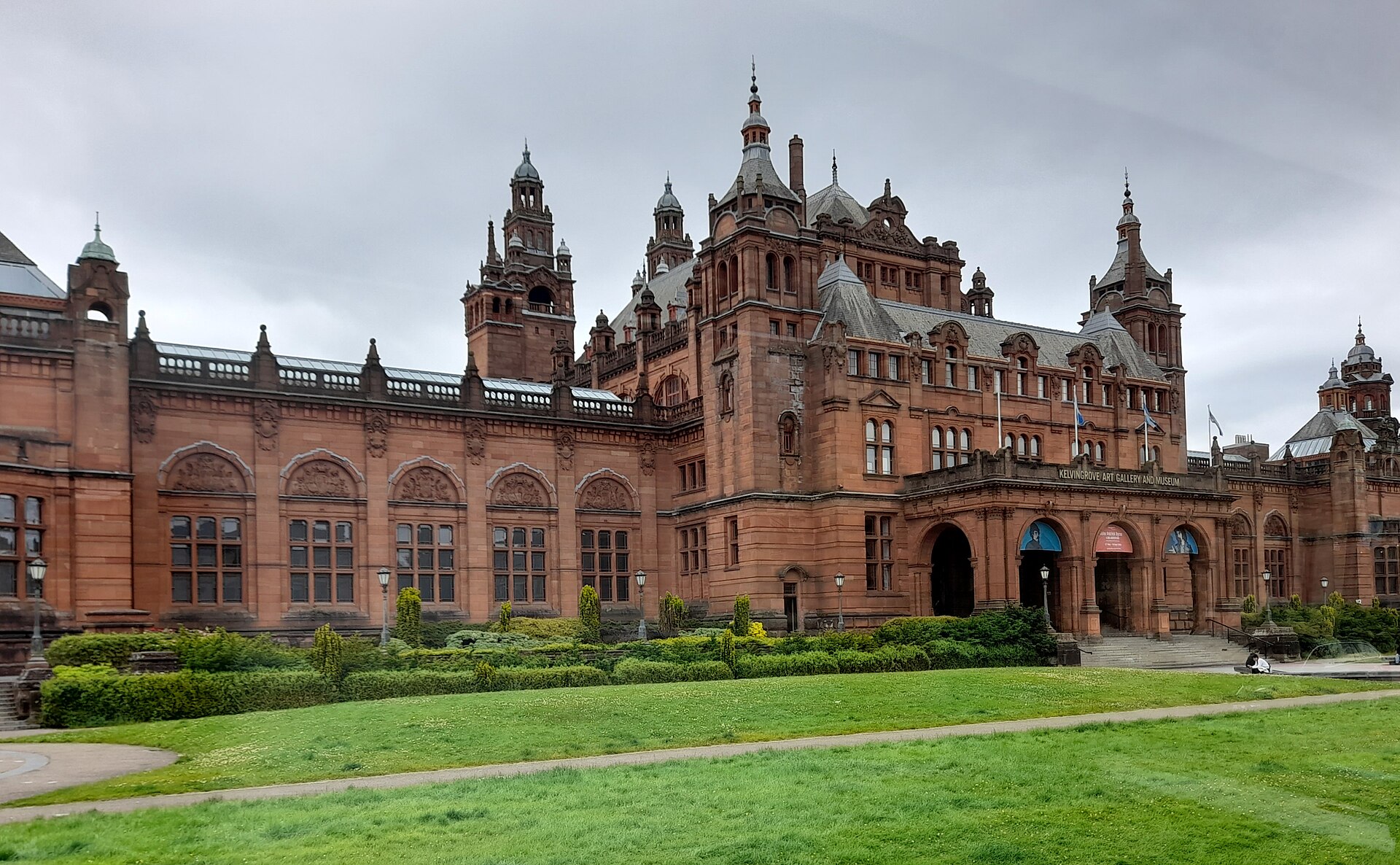
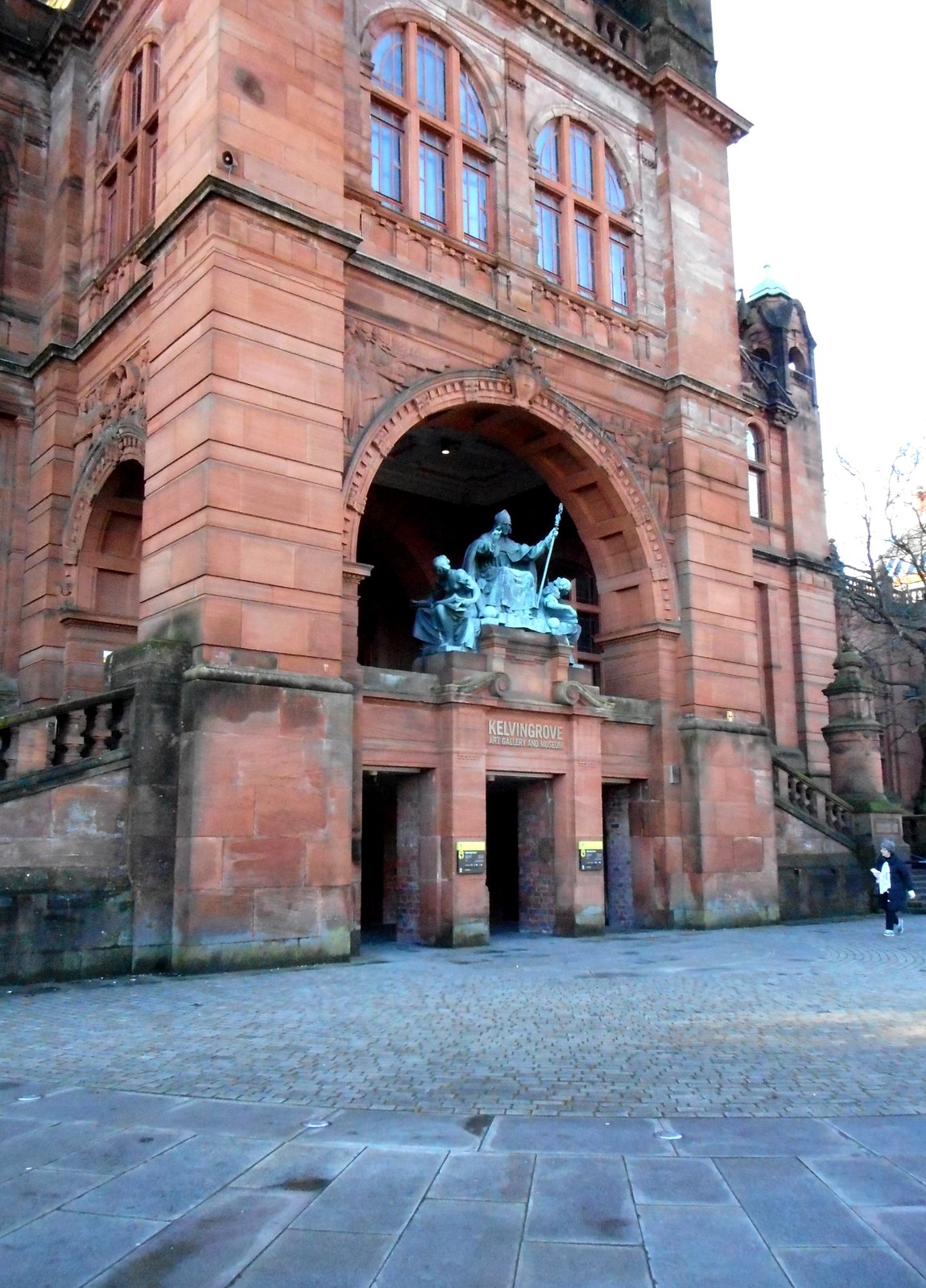
The Argyle Street facade of Kelvingrove Art Gallery and Museum, with the building's name carved above the central entrance arch.
Alex McGregor, CC BY-SA 2.0Kelvingrove Art Gallery and Museum
Museum · Founded 1901
Open, admission and hours confirmed 11 September 2026 · 10 sources
On this page 14 sections
ContentsClose
Kelvingrove's strength is breadth held together by a single civic habit repeated for over a century: whatever Glasgow acquired, by gift, bequest or purchase, went on public display rather than into a closed store. That habit produced a museum that can hang a Rembrandt, a Van Gogh and a Mackintosh gesso panel within a few rooms of a Spitfire, a taxidermied elephant and a named Egyptian sarcophagus, all under one free ticket, which is not a combination most single-discipline museums attempt. The same habit is also what put contested colonial-era material on the same shelves as the fine art, and Glasgow Life's active restitution programme since 2022 is the current, unfinished answer to that half of the collection's history.
| Kind | Museum |
|---|---|
| Founded | Opened 1901 as the Palace of Fine Arts for the Glasgow International Exhibition, part-funded from the profits of the earlier 1888 exhibition; established as the city's civic art gallery and museum from 1902 |
| City and country |  Glasgow, United Kingdom Glasgow, United Kingdom |
| Address | Argyle Street, Glasgow, G3 8AG, Scotland, United Kingdom |
| Website | glasgowlife.org.uk/museums/venues/kelvingrove-art-gallery-and-museum |
| Status | Open, confirmed |
| Record last verified |
Visiting
- Hours
- Monday-Thursday10:00 to 17:00
- Friday11:00 to 17:00
- Saturday10:00 to 17:00
- Sunday11:00 to 17:00
- Admission
- General admission, permanent galleriesFreeFree entry to all 22 permanent galleries; donations are invited but not required. Kelvingrove is Scotland's most visited free attraction.
- Barbie: The Exhibition, adult (peak, to 18 Oct 2026)GBP 16Ticketed, timed-entry special exhibition, separate from the free permanent collection. Peak adult GBP 16.00, concession (student, 65+, disabled) GBP 15.00, child 6-17 GBP 7.00, under-6 free; off-peak pricing is roughly GBP 2.00 lower per ticket. Family tickets run GBP 31.50 to GBP 45.50. A 12 percent booking fee and a GBP 1.50 transaction fee apply per order; an optional Gift Aid uplift of about 10 percent lets Glasgow Life reclaim tax on the donation element.
Free entry: Every day, for the permanent galleries; only the temporary Barbie exhibition is ticketed- Tickets
- glasgowlife.org.uk/museums/venues/kelvingrove... The museum's own ticket page.
- Do I need to book?
- No for the permanent galleries; timed tickets are required for the paid Barbie: The Exhibition
- Address
- Argyle Street, Glasgow, G3 8AG, Scotland, United Kingdom MapSubway Kelvinhall subway station, on the SPT Subway, is about half a mile away, roughly a 10-minute walk; Kelvinbridge and Hillhead stations are also within a 10 to 15 minute walk, the Kelvinbridge route running through Kelvingrove Park.
Rail The nearest ScotRail stations are Partick, Charing Cross and Exhibition Centre, each about a mile away; Glasgow Central and Glasgow Queen Street mainline stations are roughly 1.5 to 2 miles distant.
Bus Stops directly outside the museum on Argyle Street are served by First Bus routes 2, 3 and 77, McGill's route 17, and the City Sightseeing tour bus.
Parking and cycling An on-site car park has 58 spaces, 10 reserved for blue badge holders and 2 with EV charging, priced from GBP 3.00 for the first hour up to a GBP 10.00 daily maximum; the west-side spaces are closed while the repair programme continues. Short-stay cycle shelters stand next to Kelvin Hall. - Website
- glasgowlife.org.uk/museums/venues/kelvingrove-art-gallery-and-museum
- Telephone
- +44 141 276 9599
- [email protected]
Before you go how long, access, photography, bags, eating, shop
- How long to allow
- Two to three hours to see the permanent galleries; a full day is not unusual with the cafe and a temporary exhibition added
- Access
- Free wheelchair and pram access to all public areas by lift, accessible toilets on every floor, an induction hearing loop, and guide and assistance dogs welcome
- Eating
- Two in-house venues: the KG Cafe on the lower level, table service with a licensed bar, and the KG Coffee Shop on the upper ground floor, counter service for drinks, sandwiches and light bites; both list vegan, gluten-free and dairy-free options
Prices and hours change. We take them from the institution's own pages and print the day we read them, and you can check the current position at the source we used. Confirm before you travel.
What is inside
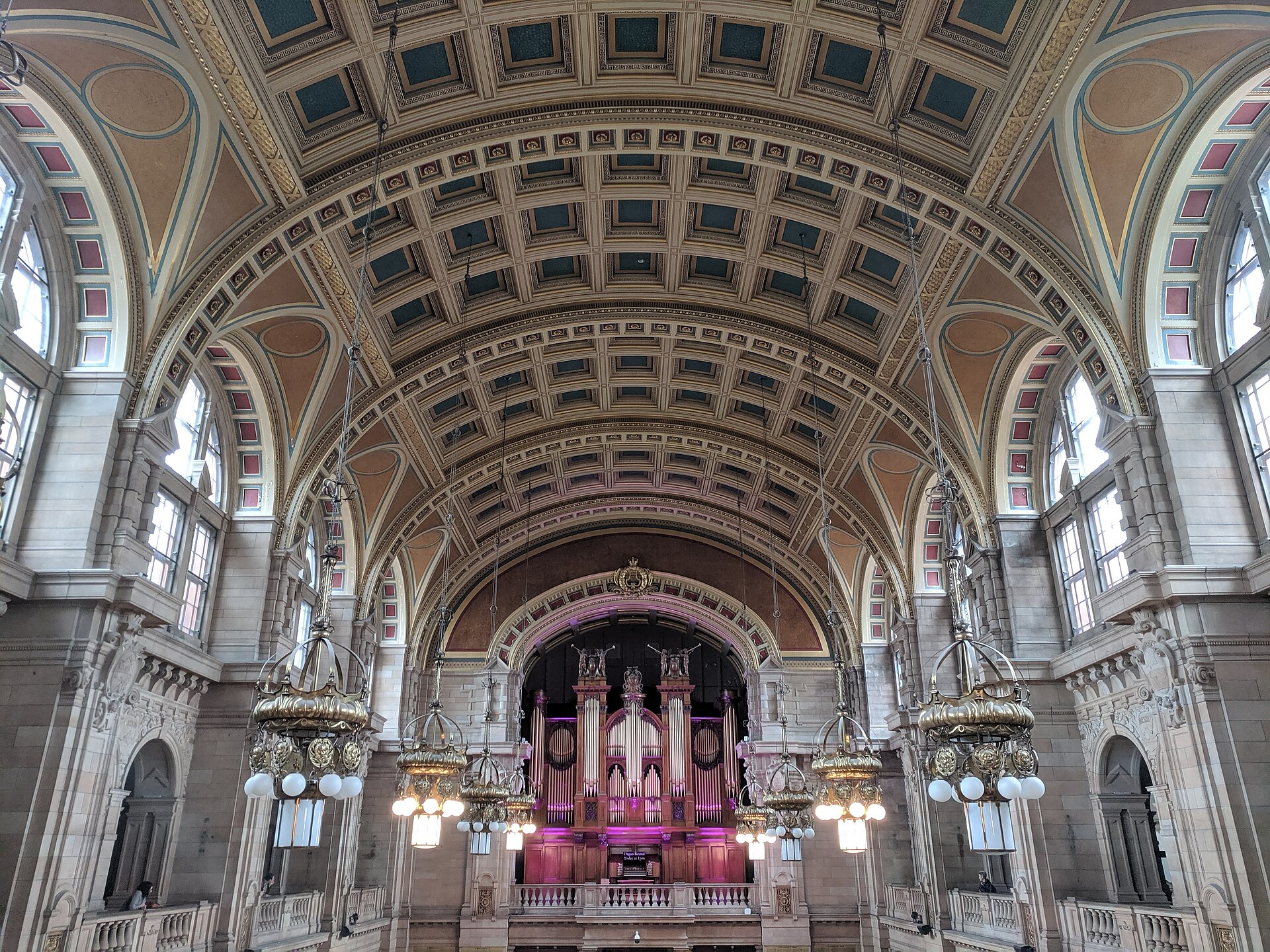
Photograph by Grendelkhan · CC BY-SA 4.0 Centre Hall
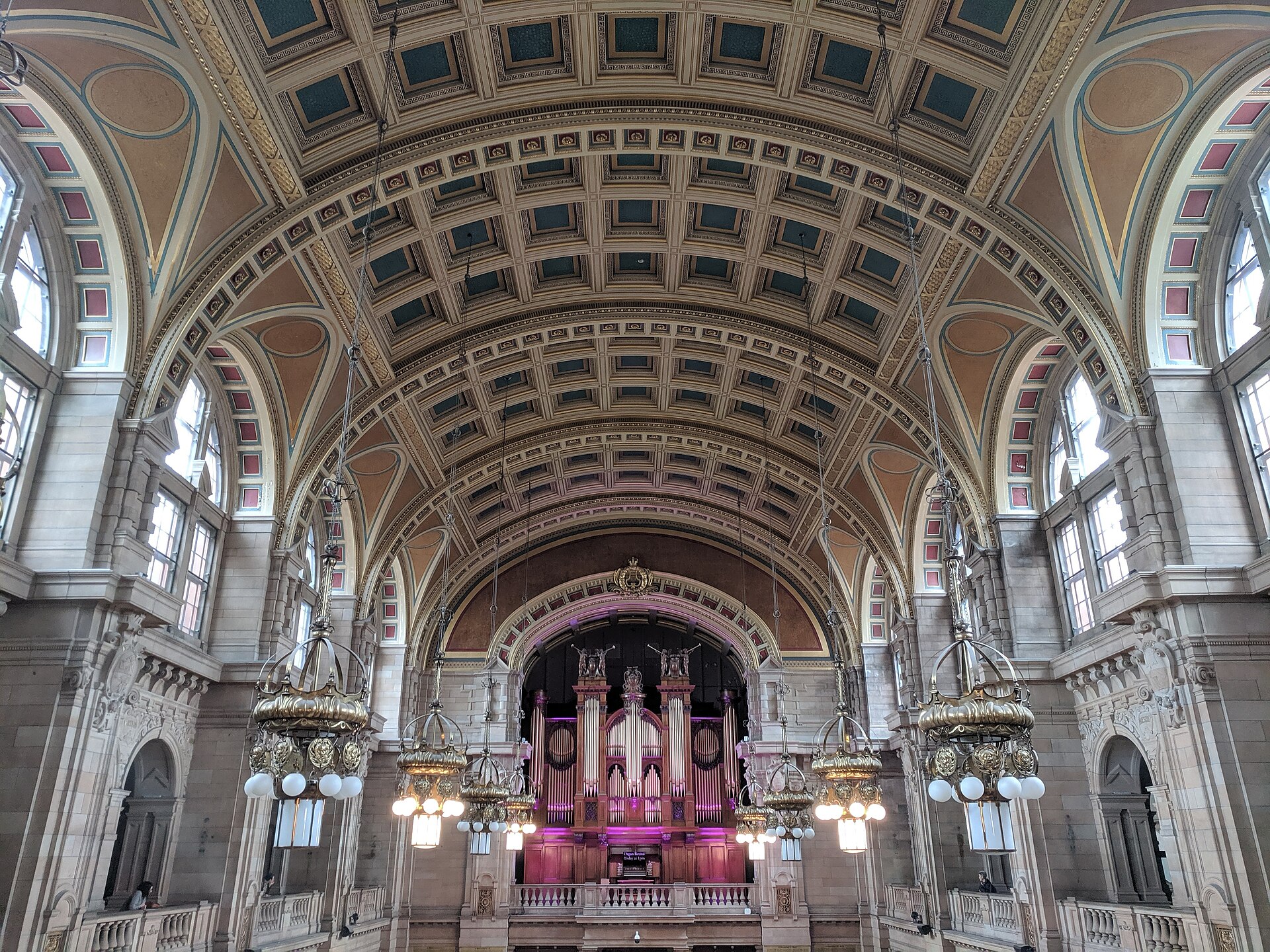
The barrel-vaulted Centre Hall beneath the museum's twin towers holds the 1901 Lewis and Co concert pipe organ, built for the Glasgow International Exhibition's own concert hall and moved here after a councillor argued the new galleries would otherwise be a body without a soul. Free recitals are still played twice daily, light and popular pieces on weekdays and Saturdays, classical programmes on Sundays.
West Court
A genuine Supermarine Spitfire Mark 21, serial LA198, built for 602 City of Glasgow Squadron, hangs from the roof of the West Court above Sir Roger, a taxidermied Asian elephant that toured British circuses between 1885 and 1897 before ending up here. The Glasgow Stories displays on the city's own history run off this court.
East Court
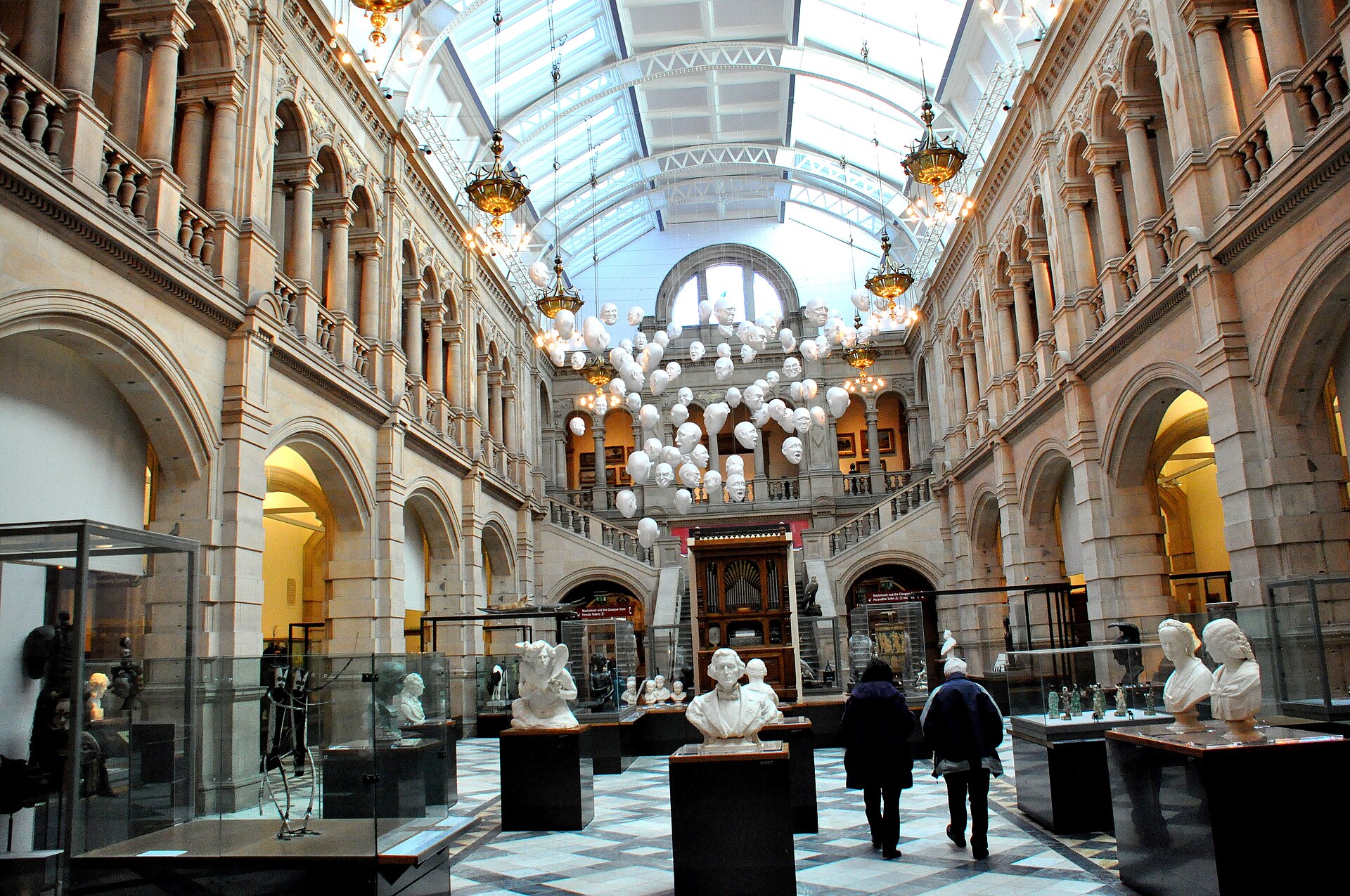
Added in the 2003-2006 rebuild, the glass-roofed East Court is hung with Sophie Cave's 2006 sculpture Floating Heads, dozens of plaster heads suspended above cases of sculpture and decorative art, and serves as the main circulation route between the museum's two wings.
Expression: fine art galleries
The upper-floor Expression half holds Dutch and Flemish old masters, French Impressionist and Post-Impressionist paintings by Van Gogh, Monet, Renoir, Pissarro and Cassatt, the Scottish Colourists, the Glasgow Boys, and a room devoted to Charles Rennie Mackintosh and the Glasgow Style, including gesso panels rescued from a demolished Glasgow tearoom.
Arms and armour
One of the largest arms and armour displays outside London fills its own gallery with European and Asian edged weapons, firearms and suits of armour, built up mainly through twentieth-century civic gifts, bequests and museum purchases rather than a single founding collection.
Ancient Egypt and world cultures
The Ancient Egypt gallery centres on the sarcophagus of the noble Pa-Ba-Sa, dated to around 656 to 640 BC, and a granite statue of the goddess Sekhmet, alongside natural history and world-culture displays that make up the museum's Life half, several of which now carry labels explaining recent restitution of related material.
What to see first
Christ of Saint John of the Cross
Salvador Dali, 1951One of the most reproduced religious paintings of the twentieth century, and the single work visitors most often ask staff to direct them to.4
Supermarine Spitfire LA198
Vickers-Armstrongs / Supermarine, 1944A genuine Mark 21 fighter flown by 602 City of Glasgow Squadron, hung intact over the West Court rather than shown as a replica or scale model.4
Sir Roger the elephant
A real circus elephant that toured Britain between 1885 and 1897 before being taxidermied, and a fixture that has startled generations of Glasgow schoolchildren on their first visit.4
Sarcophagus of Pa-Ba-Sa
A named Egyptian noble's own coffin of around 656 to 640 BC, not a generic display piece, and one of the earliest objects to enter the collection.4
The Wassail
Charles Rennie Mackintosh, gesso panelA surviving decorative panel rescued from the demolished Ingram Street Tearooms, tying the museum directly to a Mackintosh interior that no longer exists anywhere else.4
Alexander Reid
Vincent van Gogh, 1887A portrait of Van Gogh's own Glasgow art dealer and flatmate, hung in the French gallery and mistaken by generations of visitors for a self-portrait.4
The Kelvingrove organ and its daily recitals
Lewis and Co, 1901A working exhibition-era concert organ, still played free twice a day in the Centre Hall it was bought specifically to fill.4
Old Willie, the Village Worthy
James GuthrieA key work of the Glasgow Boys' plein-air realism, painted by one of the group's own founding members rather than a follower.4
Exhibitions on now
A palace built from an exhibition's profits
Kelvingrove exists because an earlier Glasgow exhibition made money. The 1888 International Exhibition, held in the same park, turned a surplus large enough that the city used it to build a permanent home for its art and industrial collections rather than spend it on a single event. The result, designed by Sir John W. Simpson and E. J. Milner Allen in a Spanish Baroque style faced in red Locharbriggs sandstone outside and pale Giffnock sandstone within, opened in 1901 as the Palace of Fine Arts for that year's Glasgow International Exhibition, then reopened as the city's own civic art gallery and museum in 1902. It brought together two older collections under one roof: an industrial museum that had operated since 1870 out of Kelvingrove House, an eighteenth-century mansion in the same park, and the fine art collection previously shown at the McLellan Galleries on Sauchiehall Street. The building was never a converted mansion or a repurposed exhibition hall; it was designed from the ground up to hold both.
Closed for three years, reopened in two halves
The museum most visitors walk through today is substantially a 2006 building. A three-year closure from 2003 allowed a roughly GBP 35 million rebuild, funded jointly by the Heritage Lottery Fund, public donations and the city, that added a large basement extension holding thousands more objects and rebuilt the East Court under a new glass roof. Queen Elizabeth II reopened the building on 11 July 2006. The London firm Event Communications used the rebuild to reorganise the entire collection around two themes rather than the old chronological, department-by-department hang: Life, covering natural history, world cultures and human history, and Expression, covering fine art. Not every visitor who remembered the pre-2003 hang welcomed the change; some who knew the old arrangement have described the new thematic groupings as less coherent for finding a specific painting, even as the reorganisation is widely credited with making the building easier for a first-time visitor to navigate.
The organ that a council argued the building needed
The concert pipe organ in the Centre Hall was not part of the original museum brief. It was built by Lewis and Co for the 1901 exhibition's own 3,000-seat concert hall, a temporary structure demolished once the exhibition closed. A city councillor pushed to have the organ bought for the permanent museum instead of scrapped with the rest of the exhibition buildings, arguing that an art gallery without one would be a body with no soul. The purchase went ahead, and the organ has stayed in near-continuous use since: free recitals still run twice most days, a lighter programme at 1pm Monday to Saturday and a more classical one at 3pm on Sundays, played to whoever happens to be standing in the hall rather than a ticketed audience.
What the building actually holds
Twenty-two galleries hold roughly 8,000 objects on public display, out of a wider civic collection many times that size. The West Court pairs a real Second World War Spitfire, flown by a Glasgow-based RAF squadron, with a taxidermied Victorian circus elephant and a set of Glasgow history displays; the East Court adds a suspended sculpture of plaster heads above cases of decorative art. The Expression galleries run from Dutch and Flemish Old Masters through French Impressionism to the Scottish Colourists, the Glasgow Boys and a dedicated Charles Rennie Mackintosh room built around salvaged panels from a demolished city-centre tearoom. A separate gallery holds one of the larger arms and armour collections outside London, and the Ancient Egypt displays are built around named individual objects, not an undifferentiated case of antiquities. The range is the point: the same ticket, which costs nothing, covers a Dali centrepiece and a dinosaur-era fossil cast in the same afternoon.
A collection now partly returning what it took
Kelvingrove's collection was assembled the way most large nineteenth and twentieth-century civic museums were, through gift, bequest, purchase and, for some categories of object, acquisition during and after colonial military campaigns. In April 2022 Glasgow City Council approved what Glasgow Life's own head of museums and collections called the largest repatriation of cultural artefacts in Scottish history: 17 Benin bronzes taken during the British Punitive Expedition of 1897, 25 Lakota items connected to the Wounded Knee Massacre site, and seven antiquities stolen from Hindu temples in India, several of which had been displayed at Kelvingrove itself. The Indian return was the first of its kind by a UK museum. None of this is presented on the page as a settled or finished process; restitution claims from other communities whose material sits in Glasgow's wider collection remain open, and the museum's own current practice is to negotiate returns case by case rather than issue a blanket policy.
Visiting it now, mid-repair
Kelvingrove is not shut for any of this. An external repair programme, triggered by plaster falling from the north roof lantern in 2022 and covering stonework, roofing, windows and decorative plasterwork across the Argyle Street frontage, began on site in September 2025 and is expected to run for a considerable period, with sections of the building temporarily scaffolded and the car park's west-side spaces closed for the duration. Glasgow Life's own visitor pages are explicit that the museum remains open to the public throughout, and nothing about the current programme touches the free general admission, the gallery hours or the daily organ recitals. A paid, timed-entry Barbie exhibition running to October 2026 sits alongside the permanent, free collection rather than replacing any part of it, and a visitor who arrives on a quiet weekday morning will still find the West Court, the organ and the Dali painting exactly where they have been since 2006.
What visitors say
Visitors consistently single out two things: that a collection of this range and quality costs nothing to see, and that there is simply more here than a single visit covers, from Dali and the Impressionists to a full-size Spitfire and taxidermied animals. The most common complaint is timing rather than content: weekend afternoons and school holidays bring queues at the busiest single-object displays, and the on-site cafe is repeatedly described as crowded and priced higher than visitors expect for a museum cafe.
What is praised, what is criticised
- Praised: the free general admission to a collection of genuinely national scale
- Praised: the daily organ recitals in the Centre Hall
- Praised: the sheer variety in one building, from Old Masters and Impressionists to a Spitfire, arms and armour, and natural history
- Praised: the building itself, which visitors repeatedly call as much the attraction as anything inside it
- Criticised: weekend and school-holiday crowds that make the busiest single displays, especially the Dali painting, hard to see without queueing
- Criticised: an on-site cafe that visitors describe as both crowded and pricier than expected for what it serves
- Criticised: a collecting history, now under active correction, that included objects taken from Nigeria, the Lakota Sioux and Indian temples without consent, some of which were displayed at Kelvingrove itself before being agreed for return from 2022 onward
Ratings on other platforms
TripAdvisor: 4.7 from 16,120 ratings, read 11 September 2026
A platform average is a tertiary source: it moves, it is not audited, and we quote no visitor's words.
Questions about Kelvingrove Art Gallery and Museum
Where is Kelvingrove Art Gallery and Museum?
Argyle Street, Glasgow, G3 8AG, Scotland, United Kingdom.
How much does it cost to visit?
General admission, permanent galleries: free; Barbie: The Exhibition, adult (peak, to 18 Oct 2026): GBP 16. As confirmed 11 September 2026.
When is it open?
Monday-Thursday 10:00-17:00; Friday 11:00-17:00; Saturday 10:00-17:00; Sunday 11:00-17:00. As confirmed 11 September 2026.
How do you get there?
Subway: Kelvinhall subway station, on the SPT Subway, is about half a mile away, roughly a 10-minute walk; Kelvinbridge and Hillhead stations are also within a 10 to 15 minute walk, the Kelvinbridge route running through Kelvingrove Park; Rail: The nearest ScotRail stations are Partick, Charing Cross and Exhibition Centre, each about a mile away; Glasgow Central and Glasgow Queen Street mainline stations are roughly 1.5 to 2 miles distant; Bus: Stops directly outside the museum on Argyle Street are served by First Bus routes 2, 3 and 77, McGill's route 17, and the City Sightseeing tour bus; Parking and cycling: An on-site car park has 58 spaces, 10 reserved for blue badge holders and 2 with EV charging, priced from GBP 3.00 for the first hour up to a GBP 10.00 daily maximum; the west-side spaces are closed while the repair programme continues. Short-stay cycle shelters stand next to Kelvin Hall.
What should you see first?
Christ of Saint John of the Cross (Salvador Dali, 1951); Supermarine Spitfire LA198 (Vickers-Armstrongs / Supermarine, 1944); Sir Roger the elephant; Sarcophagus of Pa-Ba-Sa; The Wassail (Charles Rennie Mackintosh, gesso panel); Alexander Reid (Vincent van Gogh, 1887).
Images
Sources
- 1Glasgow Life, Kelvingrove Art Gallery and Museum venue page (hours, admission, contact, transport, restoration status), read 12 August 2026, re-confirmed unchanged 11 September 2026. glasgowlife.org.uk/museums/venues/kelvingrove-art-gallery-and-museum
- 2Glasgow Life, Barbie: The Exhibition ticket prices, read 12 August 2026, re-confirmed unchanged 11 September 2026 (exhibition still running, prices unchanged, booked through 18 October 2026). glasgowlife.org.uk/museums/venues/kelvingrove-art-gallery-and-museum/barbie-the-exhibition/tickets
- 3Glasgow Life, The story of Kelvingrove, read 12 August 2026, re-checked 11 September 2026 with no changes found. glasgowlife.org.uk/museums/venues/kelvingrove-art-gallery-and-museum/the-story-of-kelvingrove
- 4Glasgow Life, Top ten must-see at Kelvingrove, read 12 August 2026, re-confirmed unchanged 11 September 2026 (all eight highlights drawn from this list still listed). glasgowlife.org.uk/museums/venues/kelvingrove-art-gallery-and-museum/top-ten-must-see
- 5Wikipedia, Kelvingrove Art Gallery and Museum, read 12 August 2026 (, for architectural and refurbishment background). en.wikipedia.org/wiki/Kelvingrove_Art_Gallery_and_Museum
- 6Wikidata, Q1061094, Kelvingrove Art Gallery and Museum, read 12 August 2026 (, for identity and coordinates). wikidata.org/wiki/Q1061094
- 7The Art Newspaper, 'Glasgow museums to return 49 looted objects, including Benin bronzes, in biggest restitution in Scottish history', 14 April 2022. theartnewspaper.com/2022/04/14/glasgow-museums-to-return-49-looted-objectsincluding-benin-bronzesin-biggest-restitution-in-scottish-history
- 8The Skinny, Evie Glen, review of Barbie: The Exhibition at Kelvingrove, 30 June 2026. theskinny.co.uk/art/reviews/barbie-the-exhibition-kelvingrove-art-gallery-and-museum
- 9TripAdvisor, Kelvingrove Art Gallery and Museum aggregate rating and review count, read 12 August 2026 (4.7 from 16,104 reviews), re-read 11 September 2026 (4.7 from 16,120 reviews). tripadvisor.com/Attraction_Review-g186534-d189009-Reviews-Kelvingrove_Art_Gallery_and_Museum-Glasgow_Scotland.html
- 10GlasgowWorld, Sarah Hilley, 'Plans put forward for Kelvingrove Museum and Art Gallery repairs', 6 September 2024. glasgowworld.com/news/plans-put-forward-for-kelvingrove-museum-and-art-gallery-repairs-4771552