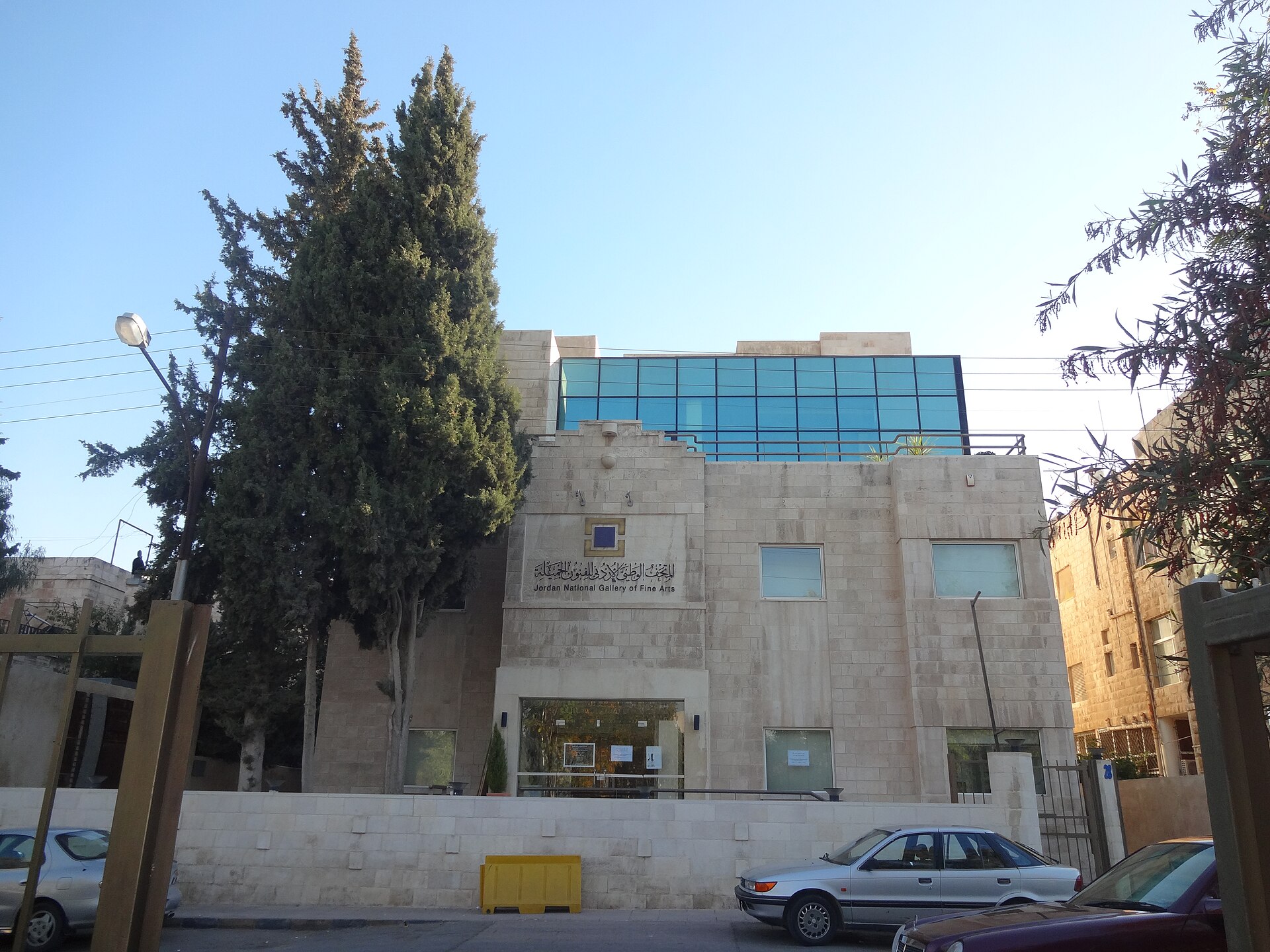
The gallery building in Jabal al-Weibdeh, Amman, with its glazed upper-floor extension; the gallery's own bilingual signage is visible on the facade.
Rami Tarawneh · CC BY-SA 4.0Jordan National Gallery of Fine Arts
Museum · Al-Mathaf al-Watani al-Urduni lil-Funun al-Jamila · Founded 1980
Open, admission and hours confirmed 5 September 2026 · 14 sources
On this page 17 sections
ContentsClose
The gallery's stated strength is breadth rather than depth in any one school: more than 3,000 works by upward of 800 artists from 59 countries, concentrated in Asia and Africa but running to Latin America and Europe as well, spanning painting, sculpture, ceramics, photography, video, installation and graphic art. That breadth is a product of the Royal Society of Fine Arts' founding mission to represent the developing world as a whole rather than to build a national Jordanian canon, and it is also the source of the one consistent visitor complaint recorded here: that a gallery carrying Jordan's name in its title can read as thin on specifically Jordanian work next to its much larger regional and international holdings.
| Local name | Al-Mathaf al-Watani al-Urduni lil-Funun al-Jamila |
|---|---|
| Kind | Museum |
| Founded | 1980 |
| City and country |  Amman, Jordan Amman, Jordan |
| Address | Husi Fareez Street, Al-Luwaibdeh, Amman 11191, Jordan (P.O. Box 9068) |
| Website | nationalgallery.org |
| Status | Open, confirmed |
| Record last verified |
Visiting
- Hours
- Sat-Thu09:00 to 19:00As stated on the gallery homepage. The gallery's own Visit page instead gives 9:00-17:00 with Tuesday and Friday closed, and the gallery's own About/Contact page gives 9:00-17:00 with only Friday closed. All three are live pages on nationalgallery.org and disagree with each other; the homepage figure is used here as the most recently updated of the three (it lists programming dated into 2026) but a visitor should confirm by phone before travelling.
- During Ramadan09:00 to 14:00Homepage-stated Ramadan hours; the park keeps 9:00-14:30 and the cafe 9:00-23:00 year-round per the same page.
- Closed
- Friday. Official holidays.
- Admission
- Jordanians and residentsJOD 1
- Non-JordaniansJOD 7
- Students of Jordanian schools, universities and institutesFreefree, on presentation of a valid student card
- Do I need to book?
- No for individual visitors; group and school tours are booked through an online form on the Visit page
- Address
- Husi Fareez Street, Al-Luwaibdeh, Amman 11191, Jordan (P.O. Box 9068) Map
- Website
- nationalgallery.org
- Telephone
- +962 6 463 0128
- [email protected]
Before you go how long, access, photography, bags, eating, shop
- How long to allow
- Under an hour for the permanent collection by several visitor accounts, longer if the sculpture park and a temporary exhibition are included
- Access
- Ramps for wheelchair access with staff assistance, and elevators operating during gallery hours; printed captions and communication are offered for hearing-impaired visitors; tours for visually-impaired visitors were, as of research, still in development
- Photography
- Not addressed on the gallery's own site; not established
- Bags
- Not addressed on the gallery's own site; not established
- Eating
- Jungle Fever cafe in Building Two, with a terrace overlooking the garden and views toward Jabal al-Weibdeh, serving 9:00 AM to 11:00 PM and offering free internet; Wijdan Artspace also carries a bakery/cafe for trainees and visitors
- Shop
- Mtjr, the gallery gift shop in Building Two, selling books, postcards, photographs and reproductions from the Permanent Collection alongside traditional and modern handicrafts by Jordanian artists
Prices and hours change. We take them from the institution's own pages and print the day we read them, and you can check the current position at the source we used. Confirm before you travel.
What is inside
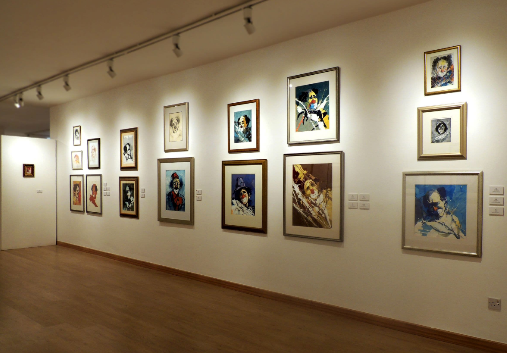
Photograph by Sahar.Ahmed · CC BY-SA 4.0 Building One - Permanent Collection galleries
Four floors dedicated to the Permanent Collection and to visiting and local temporary exhibitions; the gallery's management and information offices sit on the ground floor.
Building Two - Permanent Collection, library, shop and cafe
A further four floors of the Permanent Collection; the top floor holds a specialised reference library of books and periodicals on art, design and architecture in several languages. The same building houses the Mtjr gift shop and the Jungle Fever cafe, whose terrace looks over the garden toward Jabal al-Weibdeh.
Building Three - artist residencies and graphic studio
An upper floor accommodates artists in residence working on their own projects and research. The ground floor holds a Graphic Studio built to international standards with a printing press, used by professional artists and art students for printmaking classes, plus dedicated workshop rooms.
Wijdan Artspace (Building Four)
Studios and mentored courses in drawing, painting, pottery, sculpture, printmaking, graphic design and art appreciation, aimed at students, emerging artists and hobbyists of all ages, with outdoor space for cultural and musical evenings and its own bakery-cafe.
The sculpture park and gardens
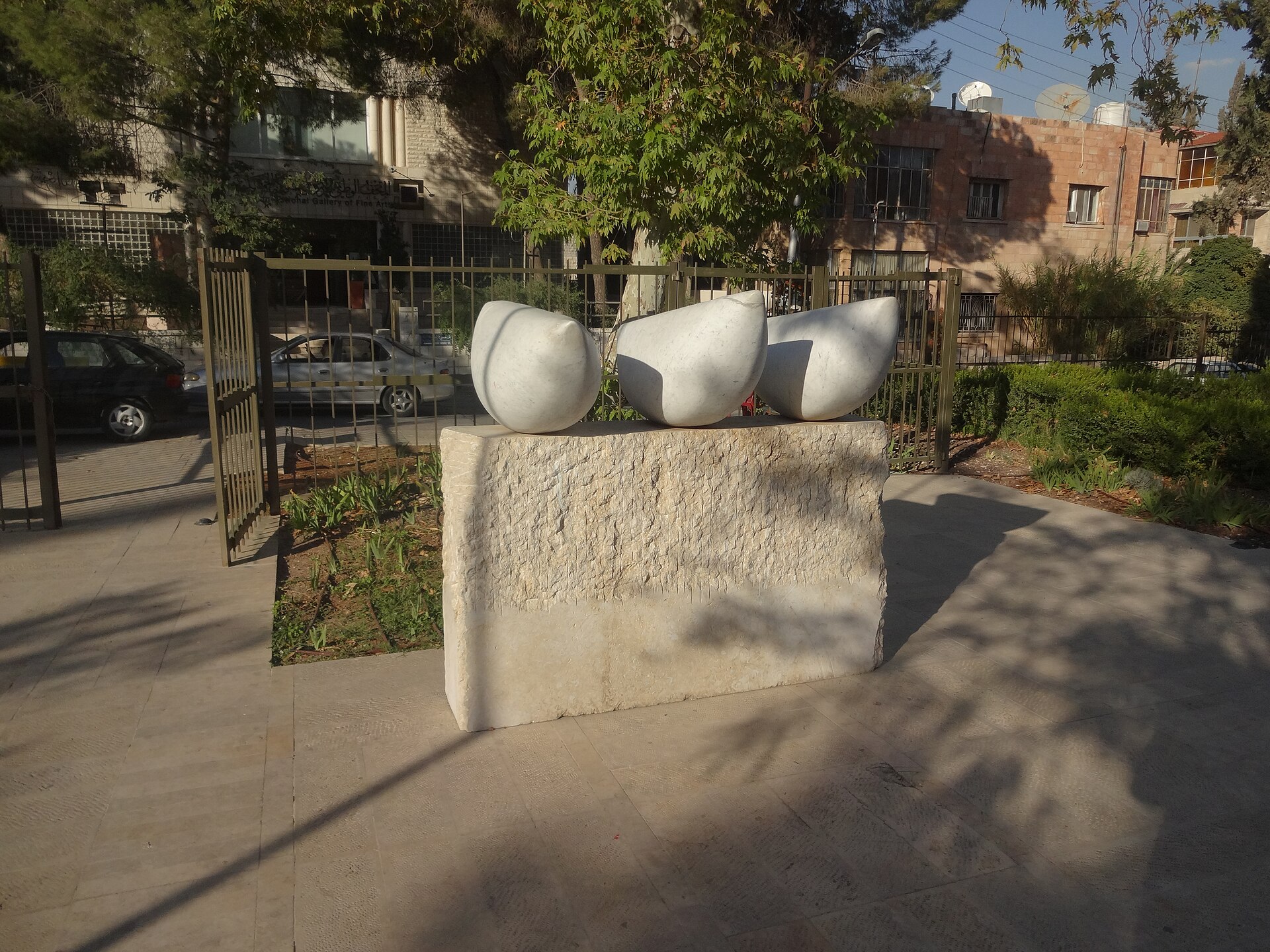
Grounds linking the buildings, holding a children's playground, an open-air stage, a Japanese garden, an Andalusian fountain and a water-conservation garden that won a Global Gold award from the Green World Organization for sustainability in 2016, alongside sculpture on permanent outdoor display.
What to see first
Canangsari 1
Khalil Ibrahim (Malaysia, b. 1934)An acrylic-on-canvas work from 1992 by a Malaysian painter whose pieces the gallery itself singles out to represent the collection on its homepage, evidence of how far the Permanent Collection's Asian holdings reach beyond the Arab world.1
Untitled (calligraphic works on paper)
Hassan Massoudy (Iraq, b. 1944)Massoudy trained as a traditional calligrapher in Baghdad before settling in Paris in 1969, and builds his ink-and-pigment compositions from calligraphic script alone, arranged into figurative and abstract forms; the gallery holds a long run of his dated works from 2010 to 2025.3
Untitled ceramic and bronze pieces
Hazem Al Zubi (Jordan, b. 1957)A ceramist trained at the Academy of Fine Arts in Baghdad, working in brightly glazed pieces with geometric divisions and stylised human, animal and calligraphic forms; represents the Jordanian strand of the collection working in a medium distinct from the gallery's many painters.4
Studies
Ibrahim Najjar (Jordan, b. 1949)A mixed-media work on paper from 1989 by a painter, art historian and teacher who trained at the Academy of Fine Arts in Cairo and took a doctorate in art history at Hulwan University before returning to teach in Amman.5
Untitled, oil on wood
Ghassan Abu Laban (Jordan, b. 1964)Abu Laban studied painting and drawing at Yarmouk University and won the First Prize in the Instituto Cervantes' Don Quixote painting contest in Amman in 1999; he currently teaches drawing and painting at the University of Jordan.6
Faces of the Soul
Mahdi Abu Deeb (Bahrain, b. 1962)A plaster work from 2001 by a Bahraini sculptor, one of the pieces the gallery highlights to show the collection's reach across the Gulf.7
Photographic works, including Metallic Flowers 1
Jan Kassay (Jordan, b. 1950)Kassay studied commercial photography and art history at George Mason University in Virginia and was the first Jordanian photographer to hold a solo exhibition in Washington, D.C., in 1988; her photography sits in the collection alongside the gallery's much larger holdings of painting and sculpture.8
Chorus Group
George Bahgoury (Egypt, b. 1932)A watercolour by the Egyptian artist widely known as the grandfather of Egyptian caricature; Bahgoury worked as a political cartoonist for Sabah Al Khair and Rose El Youssef from 1953 before training at the Faculty of Fine Arts in Cairo and the Academy of Fine Arts in Paris and turning to painting and sculpture full time from 1975.9
Exhibitions on now
- On now5 Oct to 31 Dec 2026Confirmed , 3 weeks ago
Past exhibitions here
A gallery built to represent the developing world, not just Jordan
The Jordan National Gallery of Fine Arts was inaugurated on 19 February 1980 under the patronage of King Hussein and Queen Noor Al Hussein, founded by the Royal Society of Fine Arts, a private non-profit body established in Amman the previous year. From the outset its stated aim was not simply to build a Jordanian collection, but to promote cultural diversity and contemporary art from Jordan and what its own materials call the Arab and developing worlds. That framing is unusual among national galleries, which more often narrate a single national school. The result, more than four decades on, is a Permanent Collection the gallery describes as holding over 3,000 works of drawing, painting, sculpture, ceramics, video art, installation, graphic art and photography, by more than 800 artists from 59 countries, weighted toward Asia and Africa. Wikipedia's own tally of represented countries runs from Algeria and Armenia through Kabardino-Balkaria, Papua New Guinea, Tajikistan and the former Yugoslavia, a spread that reads more like a Non-Aligned Movement roll call than a conventional museum wall list.
The Royal Society of Fine Arts remains the gallery's owner and governs it through a Board of Trustees headed, as of research, by HRH Princess Wijdan Al-Hashemi, with Dr. Khalid Khreis as Director General. The Society funds its work through donations, grants and loans from individuals, institutions and governments in Jordan and abroad rather than through a fixed government budget, which the gallery's own account frames as a condition of its independent administrative, financial and legal status.
Four buildings and a garden between them
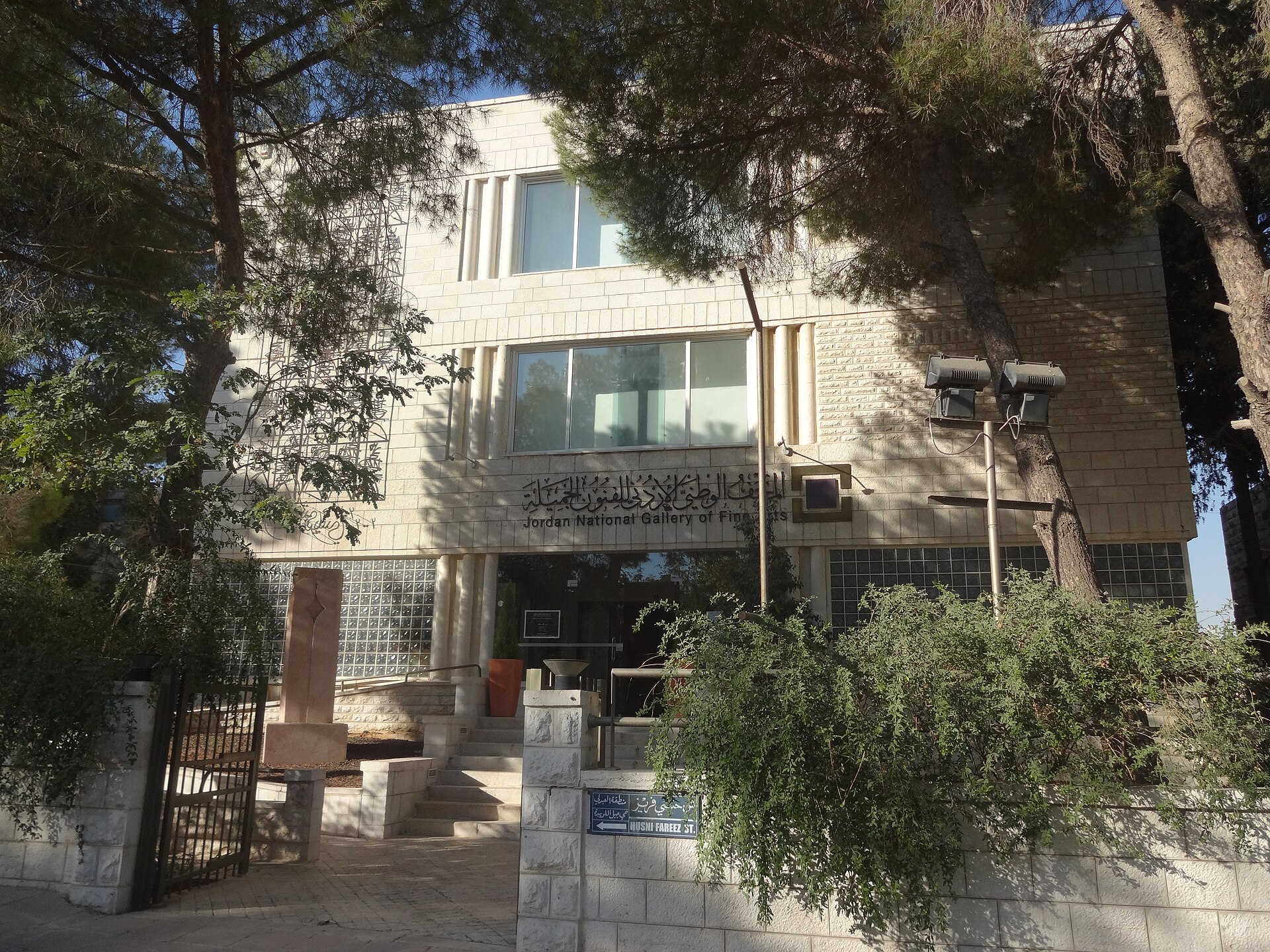
The compound the gallery occupies in Jabal al-Weibdeh has grown by addition rather than by a single plan. Building One holds four floors of Permanent Collection display and rotating exhibitions, with the gallery's management and information offices on its ground floor. Building Two adds a further four floors of Permanent Collection, tops out with a specialised reference library of art, design and architecture books and periodicals in several languages, and also holds the Mtjr gift shop and the Jungle Fever cafe, whose terrace looks out over the garden toward Jabal al-Weibdeh. Building Three is smaller: an upper floor of artist residencies where working artists are given space and time for their own research, and a ground-floor Graphic Studio built to international standards with its own printing press, used for printmaking classes by professionals and students alike. Wijdan Artspace, referred to as Building Four, sits in the garden itself and runs mentored courses in drawing, painting, pottery, sculpture, printmaking and graphic design for students, emerging artists and hobbyists, alongside an outdoor area for cultural and musical evenings and its own bakery-cafe.
Wikipedia credits the building's renovation and expansion, carried out under the architect Mohamed al-Asad, with the Aga Khan Award for Architecture in 2007, citing an Archnet record; Archnet itself throttled every attempt made during this research to confirm the citation directly, and the underlying PDF Wikipedia cites is recorded there as a dead link, so the award is reported here as a Wikipedia claim rather than an independently verified one. Al-Asad does sit on the gallery's own Board of Trustees, which is at least consistent with the claim. Between the buildings runs a sculpture park with a children's playground, an open-air stage, a Japanese garden and an Andalusian fountain; the same grounds include a water-conservation garden that won a Global Gold award from the Green World Organization for sustainability practice in 2016.
What is on the walls
The gallery's own homepage highlights a working cross-section of the Permanent Collection rather than a fixed canon of masterpieces, and that cross-section is itself a useful guide to the collection's character. It includes Khalil Ibrahim, a Malaysian painter born in 1934 whose 1992 acrylic Canangsari 1 sits in the collection; Hassan Massoudy, an Iraqi calligrapher trained in Baghdad who has lived in Paris since 1969 and builds abstract and figurative compositions entirely from calligraphic line, with dated works in the collection running from 2010 to 2025; and Hazem Al Zubi, a Jordanian ceramist trained at the Academy of Fine Arts in Baghdad who works in brightly glazed pieces combining geometric division with stylised human, animal and calligraphic forms.
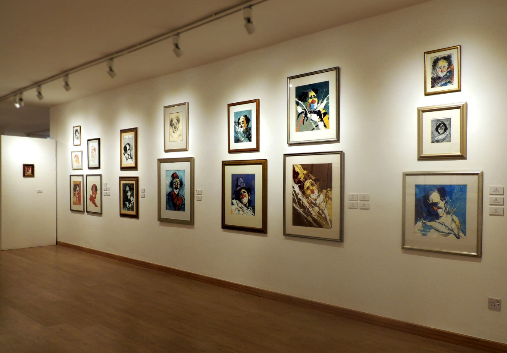
Jordanian painting is represented by artists including Ibrahim Najjar, a painter and art historian trained in Cairo and at Hulwan University who returned to teach studio art and art history at universities in Amman, and Ghassan Abu Laban, a Yarmouk University-trained painter who won the Instituto Cervantes' Don Quixote painting prize in Amman in 1999 and now teaches at the University of Jordan. The Gulf is represented by the Bahraini sculptor Mahdi Abu Deeb, whose 2001 plaster Faces of the Soul is in the collection, and photography by Jan Kassay, the first Jordanian photographer to hold a solo exhibition in Washington, D.C., in 1988. Egypt's contribution includes George Bahgoury, widely called the grandfather of Egyptian caricature, whose watercolour Chorus Group hangs alongside work from his decades as a painter, sculptor and political cartoonist for Sabah Al Khair and Rose El Youssef before he moved into painting and sculpture full time from 1975. A photograph of one gallery wall, framed and hung salon-style with a run of clown and portrait paintings, gives some sense of how densely the walls are used inside the two main buildings.
Reaching past the exhibition halls
Much of what the gallery describes about itself concerns programming that leaves the building entirely. The Touring Museum, launched in 2009, is a van converted into a mobile gallery that makes weekly visits to schools, youth centres and cultural and social development centres in towns and villages around Jordan, each visit combining a presentation of Permanent Collection works with drawing and painting workshops; the gallery states it has reached more than 400 rural communities since the project began. The Hiwar Art Club, supervised by the artist Khaldoun Hijazin, meets to hold lectures, seminars, film screenings and meetings with artists. The gallery also runs an Art and Nature Forum, begun in 2004, that pairs Jordanian artists with the country's natural, historical and touristic sites and closes each edition with an exhibition of work produced on site.
The International Sculpture Symposium ran on a two-year cycle from 2000, beginning as an event for Arab sculptors and expanding to international participation from 2006, before being folded into the newer Factory Platform in 2018. Factory itself, curated by Dr. Rocio Villalonga, is aimed at giving young people a route into collaborative and participatory art projects across visual art, music, theatre, literature, dance and performance, through open calls for emerging art projects, residencies, curatorial projects and public art. The gallery also works with Jordan's Ministry of Education to host school and university visits, and maintains an electronic database of contemporary artists from the Arab, Islamic and developing worlds.
Visiting the gallery today
Admission, as stated on the gallery's own homepage, is 1 JD for Jordanians and residents and 7 JD for non-Jordanians, with free entry for students of Jordanian schools, universities and institutes. The gallery's dedicated Visit page instead states a flat 7 JD for non-Jordanians and residents with no separate Jordanian rate given, which does not square with the homepage figure; a visitor holding Jordanian residency should confirm the applicable rate on arrival rather than assume either page is current. Opening hours carry the same kind of inconsistency across the gallery's own site: the homepage states 9:00 AM to 7:00 PM every day except Friday, with Ramadan hours of 9:00 AM to 2:00 PM; the Visit page states 9:00 AM to 5:00 PM with both Tuesday and Friday closed; and the About and Contact page states 9:00 AM to 5:00 PM with only Friday closed. All three pages were live on the same domain at the time of research. The gallery is closed on official holidays under every version. The attached garden keeps its own hours of 9:00 AM to 2:30 PM, and the Jungle Fever cafe in Building Two runs from 9:00 AM to 11:00 PM with free internet for visitors.
The gallery states that it offers wheelchair ramps with staff assistance and elevators operating through gallery hours, printed captions and communication support for hearing-impaired visitors, and that tours for visually-impaired visitors were still in development at the time the Visit page was written. Group and school tours are arranged through an online booking form rather than on arrival. The Mtjr gift shop, in Building Two, sells books, postcards, photographic reproductions from the Permanent Collection and handicrafts by Jordanian artists.
What visitors say
Aggregated ratings put the gallery at 4.1 from 94 reviews on Tripadvisor and 4.4 from 880 reviews on Google, as reported through Tripexpert's tracking of both platforms; Tripexpert separately places the gallery in the top one percent of attractions in Amman on its own expert-review index, built from two named guidebook reviews. Lonely Planet's entry singles the gallery out as a compact, worthwhile stop for understanding contemporary Jordanian painting, sculpture and pottery. The Michelin Guide awards it two stars in its Green Guide rating system and rates the contemporary art collection among the best in the Middle East, specifically noting the separate building for temporary exhibitions reached by walking through the sculpture garden.
Individual visitor accounts on Tripadvisor converge on the same two poles repeatedly. On the positive side: the sculpture garden between the two main buildings is named again and again as a rare quiet, green space set against Amman's traffic, and the range and quality of the painting, sculpture, ceramics and photography on show, drawn from dozens of countries rather than Jordan alone, is described as unexpectedly strong for a gallery of this size. On the critical side: several visitors report that taxi drivers did not recognise the address, some feel the 7 JD non-Jordanian ticket is high against a visit they completed in under an hour, a number specifically note that the collection is thinner on Jordanian art than the institution's name would suggest, and a few mention limited English among front-of-house staff.
What is unresolved
Three points could not be closed out during this research. First, the gallery's own website carries three different, mutually inconsistent statements of its opening hours and, on admission, two different statements of its pricing, all on live pages at the same time; none could be confirmed as the single current figure, and a phone call ahead of a visit is the safer route. Second, the Aga Khan Award for Architecture credited to the 2007 renovation under architect Mohamed al-Asad rests on a Wikipedia citation to an Archnet PDF that Archnet itself now serves as a dead link, and Archnet's site rate-limited every attempt made here to check the underlying record directly; the award is reported as a secondary claim, not a confirmed one. Third, at least one artist biography consulted during this research describes a work as held by the Museum of Modern Art in Amman rather than by name at the Jordan National Gallery of Fine Arts; whether that is an alternate or older name for this institution, a different collection entirely, or simply loose usage in the source, is not established, and no claim in this record relies on that source for identification.
What visitors say
Visitors consistently describe an unexpectedly deep collection of modern and contemporary art from across Asia, Africa and Latin America, shown in a quiet compound that functions as one of the calmer public spaces in central Amman. Complaint is mostly practical rather than curatorial: the building is hard for a taxi to find, the visit is short set against the non-Jordanian ticket price, and the collection is dominated by artists from outside Jordan even though the institution carries the country's name.
What is praised, what is criticised
- Praised: The sculpture park and garden linking the two main buildings, offered repeatedly as a rare quiet, green space away from Amman's traffic
- Praised: The range and quality of the painting, sculpture, ceramics and photography on the walls, drawn from dozens of countries rather than Jordan alone
- Praised: The Jungle Fever cafe terrace, with its view over the garden toward Jabal al-Weibdeh
- Praised: The low admission price for Jordanian and resident visitors
- Criticised: Difficulty finding the building, with several visitors reporting taxi drivers unfamiliar with the address
- Criticised: The 7 JD non-Jordanian ticket measured against a visit some report finishing in under an hour
- Criticised: A permanent collection some visitors feel is thin on Jordanian-specific work relative to its regional and international holdings
- Criticised: Limited English among some front-of-house staff
Ratings on other platforms
Tripadvisor: 4.1 from 94 ratings, read 5 September 2026
Google: 4.4 from 880 ratings, read 5 September 2026
A platform average is a tertiary source: it moves, it is not audited, and we quote no visitor's words.
Questions about Jordan National Gallery of Fine Arts
Where is Jordan National Gallery of Fine Arts?
Husi Fareez Street, Al-Luwaibdeh, Amman 11191, Jordan (P.O. Box 9068).
How much does it cost to visit?
Jordanians and residents: JOD 1; Non-Jordanians: JOD 7; Students of Jordanian schools, universities and institutes: free. As confirmed 5 September 2026.
When is it open?
Sat-Thu 09:00-19:00; During Ramadan 09:00-14:00. Closed: Friday. Official holidays. As confirmed 5 September 2026.
What should you see first?
Canangsari 1 (Khalil Ibrahim (Malaysia, b. 1934)); Untitled (calligraphic works on paper) (Hassan Massoudy (Iraq, b. 1944)); Untitled ceramic and bronze pieces (Hazem Al Zubi (Jordan, b. 1957)); Studies (Ibrahim Najjar (Jordan, b. 1949)); Untitled, oil on wood (Ghassan Abu Laban (Jordan, b. 1964)); Faces of the Soul (Mahdi Abu Deeb (Bahrain, b. 1962)).
What we could not confirm
- Which single set of opening hours and admission prices is currently correct, given that the gallery's homepage, Visit page and About/Contact page each state different figures.
- Whether the Aga Khan Award for Architecture credited to the 2007 building renovation is confirmed by a source independent of the Wikipedia article, which itself cites an Archnet page now serving a dead PDF link.
- Whether the 'Museum of Modern Art in Amman' named in at least one artist biography as holding that artist's work is this institution under another name, a distinct collection, or an error in that source.
Images
Sources
- 1Jordan National Gallery of Fine Arts, homepage (visit, admission, hours and highlighted collection works) nationalgallery.org/
- 2Jordan National Gallery of Fine Arts, About & Contact page (history, founding, buildings, leadership, contact details) nationalgallery.org/about/
- 3Jordan National Gallery of Fine Arts, artist page: Hassan Massoudy nationalgallery.org/artist/hassan-massoudy/
- 4Jordan National Gallery of Fine Arts, artist page: Hazem Al Zubi nationalgallery.org/artist/hazem-zubi/
- 5Jordan National Gallery of Fine Arts, artist page: Ibrahim Najjar nationalgallery.org/artist/ibrahim-najjar/
- 6Jordan National Gallery of Fine Arts, artist page: Ghassan Abu Laban nationalgallery.org/artist/ghassan-abu-laban/
- 7Jordan National Gallery of Fine Arts, artist page: Mahdi Abu Deeb nationalgallery.org/artist/mahdi-abu-deeb/
- 8Jordan National Gallery of Fine Arts, artist page: Jan Kassay nationalgallery.org/artist/jan-kassay/
- 9Wikipedia, George Bahgoury (, biography only) en.wikipedia.org/wiki/George_Bahgoury
- 10Tripexpert, expert and traveler reviews for Jordan National Gallery of Fine Arts (Lonely Planet and Michelin Guide characterisations, Tripadvisor and Google rating aggregation) tripexpert.com/amman/attractions/jordan-national-gallery-of-fine-arts
- 11Tripadvisor, Jordan National Gallery of Fine Arts reviews (rating and visitor-sentiment consensus) tripadvisor.com/Attraction_Review-g293986-d3673272-Reviews-Jordan_National_Gallery_of_Fine_Arts-Amman_Amman_Governorate.html
- 12Wikipedia, Jordan National Gallery of Fine Arts (: founding date, coordinates, country roster, Aga Khan Award claim) en.wikipedia.org/wiki/Jordan_National_Gallery_of_Fine_Arts
- 13Jordan National Gallery of Fine Arts, Visit page (admission and hours as separately stated there) nationalgallery.org/visit/
- 14Wikimedia Commons, Category:Jordan National Gallery of Fine Arts (image licensing) commons.wikimedia.org/wiki/Category:Jordan_National_Gallery_of_Fine_Arts