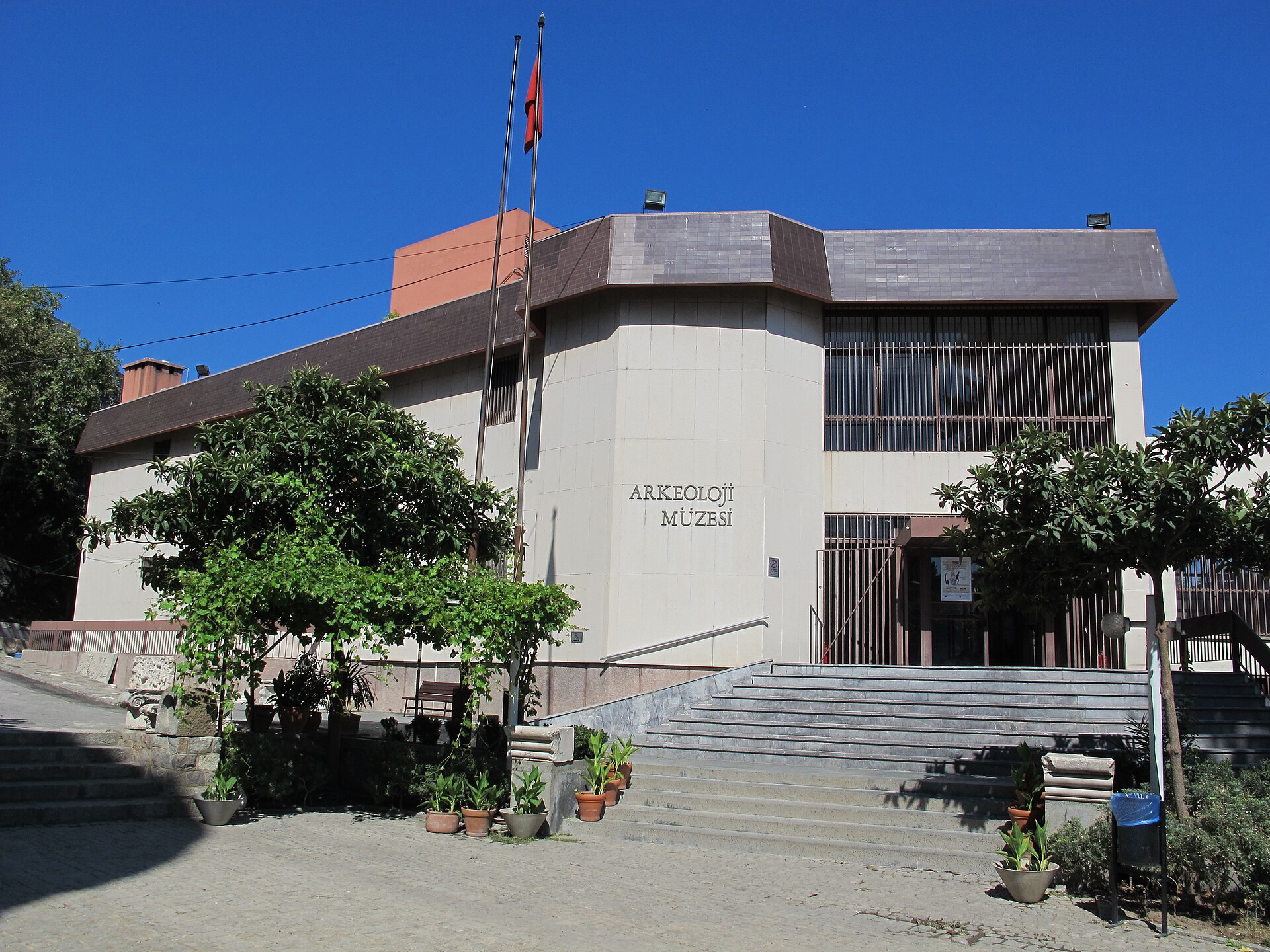
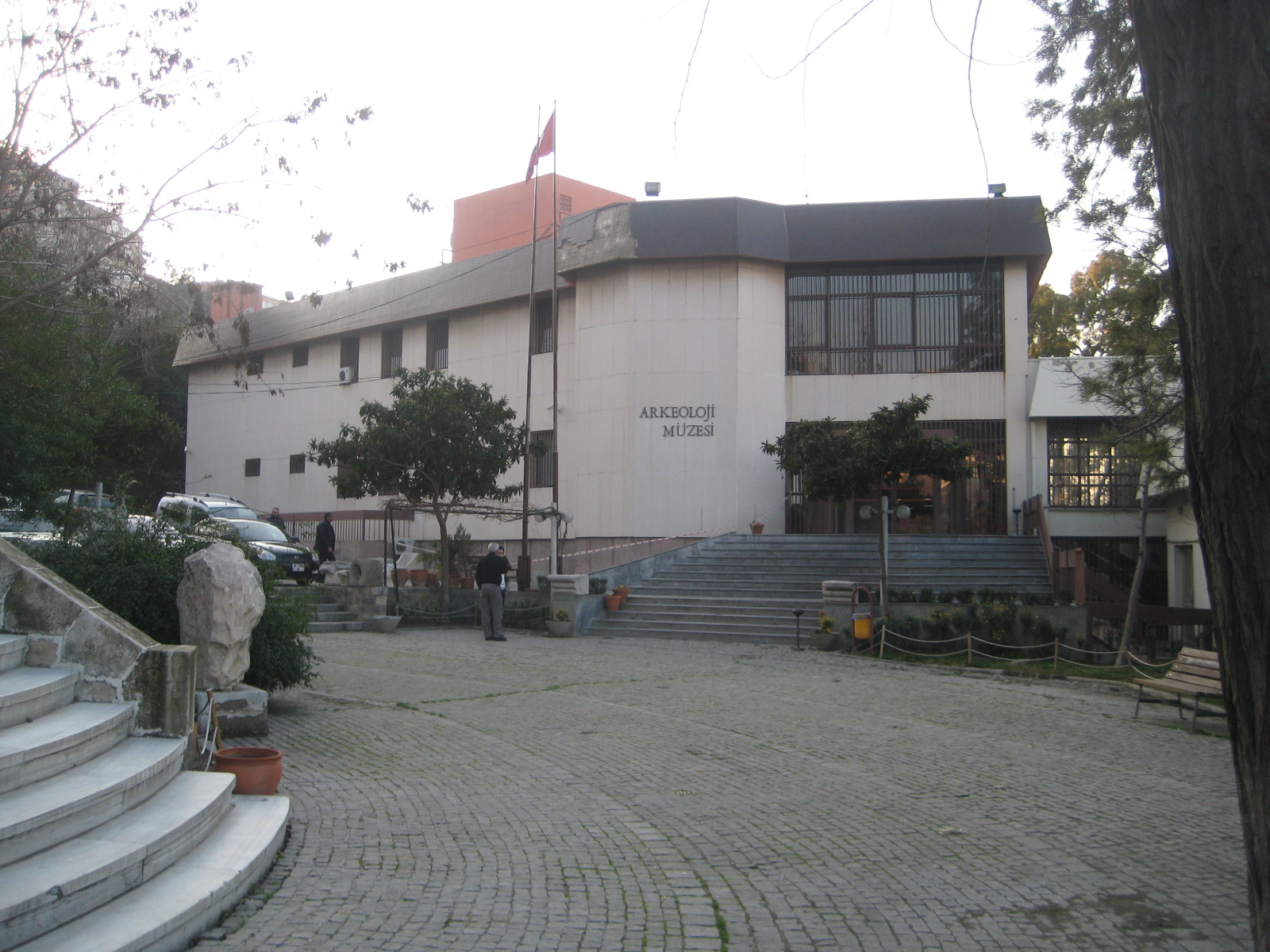
The museum's 1984 building in Bahribaba Park, Konak, seen from the forecourt in clear afternoon light, with ARKEOLOJI MUZESI lettered above the entrance.
Photograph by sailko · CC BY-SA 3.0Izmir Archaeology Museum
Museum · İzmir Arkeoloji Müzesi · Founded 1924
Open, admission and hours confirmed 27 September 2026 · 15 sources
On this page 13 sections
ContentsClose
The museum's real strength is regional depth rather than encyclopedic range. Almost everything on its shelves came out of the ground within roughly a hundred kilometres of the building itself, from Ephesus, Pergamon, Klazomenai, Teos, Miletus and Smyrna's own Agora, which gives the Hellenistic and Roman marble in particular a coherence a museum built by purchase rarely achieves: labels can say not just what a piece is but which excavation it came from and, in cases like the Belevi ceiling panels or the Klazomenai sarcophagi, why that excavation mattered. The weaker side of the same model is coverage outside that window; prehistoric material is present, chiefly through the Limantepe harbour-settlement finds, but thin next to the Hellenistic and Roman galleries, and the museum makes no claim to be encyclopedic beyond its own region.
| Local name | İzmir Arkeoloji Müzesi |
|---|---|
| Kind | Museum |
| Founded | Collecting began in 1924 in the Basmane district of Izmir; the collection first opened to visitors in 1927 in the Aya Vukla (Saint Voukolos) church; a second building opened at Kulturpark in 1951 as the collection outgrew the church; the present building in Bahribaba Park, Konak, opened on 11 February 1984 |
| City and country |  Izmir, Turkey Izmir, Turkey |
| Address | Yesiltepe Mahallesi, Halil Rifat Pasa Caddesi No:4, Bahribaba Parki, Konak, Izmir, Turkey |
| Website | muze.gov.tr/muze-detay?DistId=MRK&SectionId=IZA01 |
| Status | Open, confirmed |
| Record last verified |
Visiting
- Hours
- Every day08:30 to 18:30Ticket office also closes at 18:30.
- Closed
- Closed until midday on the first day of religious (Ramadan and Kurban) holidays, per standard Ministry of Culture and Tourism policy for state museums.
- Admission
- Adult (Turkish citizen, single-visit ticket)TRY 60As posted and reported by Izmir press in 2025; re-fetched today and the article (published 11 May 2025) still reads the same 60 TRY figure, unchanged. The Ministry's own province-wide fee table, re-checked today, again lists Turkish ID holders as admitted with Muzekart, the government's paid annual museum pass, rather than printing a separate walk-up price of its own, so this figure is still a press report rather than an official Ministry price.
- Free (under 18, over 65, teachers, registered disabled visitors, war veterans and relatives of martyrs)FreeWith valid identification. Standing Ministry of Culture and Tourism policy for state museums; not itemised on this museum's own fee-table row, so not independently re-confirmed today -- carried forward from the 13 August 2026 confirmation.
- Foreign visitorEUR 4Ministry of Culture and Tourism province-wide rate for non-citizens. Confirmed unchanged today by reading the live official fee table row for IZMIR / IZMIR ARKEOLOJI MUZESI directly.
- Tickets
- muze.gov.tr/muze-detay?DistId=MRK&SectionId=I... The museum's own ticket page.
- Do I need to book?
- No; tickets and Muzekart are handled at the door
- Address
- Yesiltepe Mahallesi, Halil Rifat Pasa Caddesi No:4, Bahribaba Parki, Konak, Izmir, Turkey MapBus ESHOT city buses serving Konak stop at Bahribaba, a couple of minutes' walk from the museum entrance; a wide set of routes converge on Konak from across the city.
Metro The Izmir Metro's Konak station is a short walk from the park.
Tram The Izmir Tram's Konak stop is the same short walk away.
Ferry Izmir's ferries call at the Konak ferry terminal, reachable on foot through Bahribaba Park. - Website
- muze.gov.tr/muze-detay?DistId=MRK&SectionId=IZA01
- Telephone
- +90 232 489 07 96
- [email protected]
Before you go how long, access, photography, bags, eating, shop
- How long to allow
- About an hour to ninety minutes for the three exhibition floors
- Access
- Visitor reviews repeatedly note limited elevator access to the upper floors; a visit that needs step-free routes is best arranged with the museum in advance.
- Photography
- Not stated on the museum's own visitor pages; check on-site signage on the day.
- Bags
- Not stated on the museum's own visitor pages.
- Eating
- No cafe is listed among the building's own facilities, which the Ministry describes as exhibition halls, laboratories, storage rooms, a photography studio, a library and a conference hall.
- Shop
- No shop is listed among the building's own facilities.
Prices and hours change. We take them from the institution's own pages and print the day we read them, and you can check the current position at the source we used. Confirm before you travel.
What is inside
Ground floor: the funerary hall
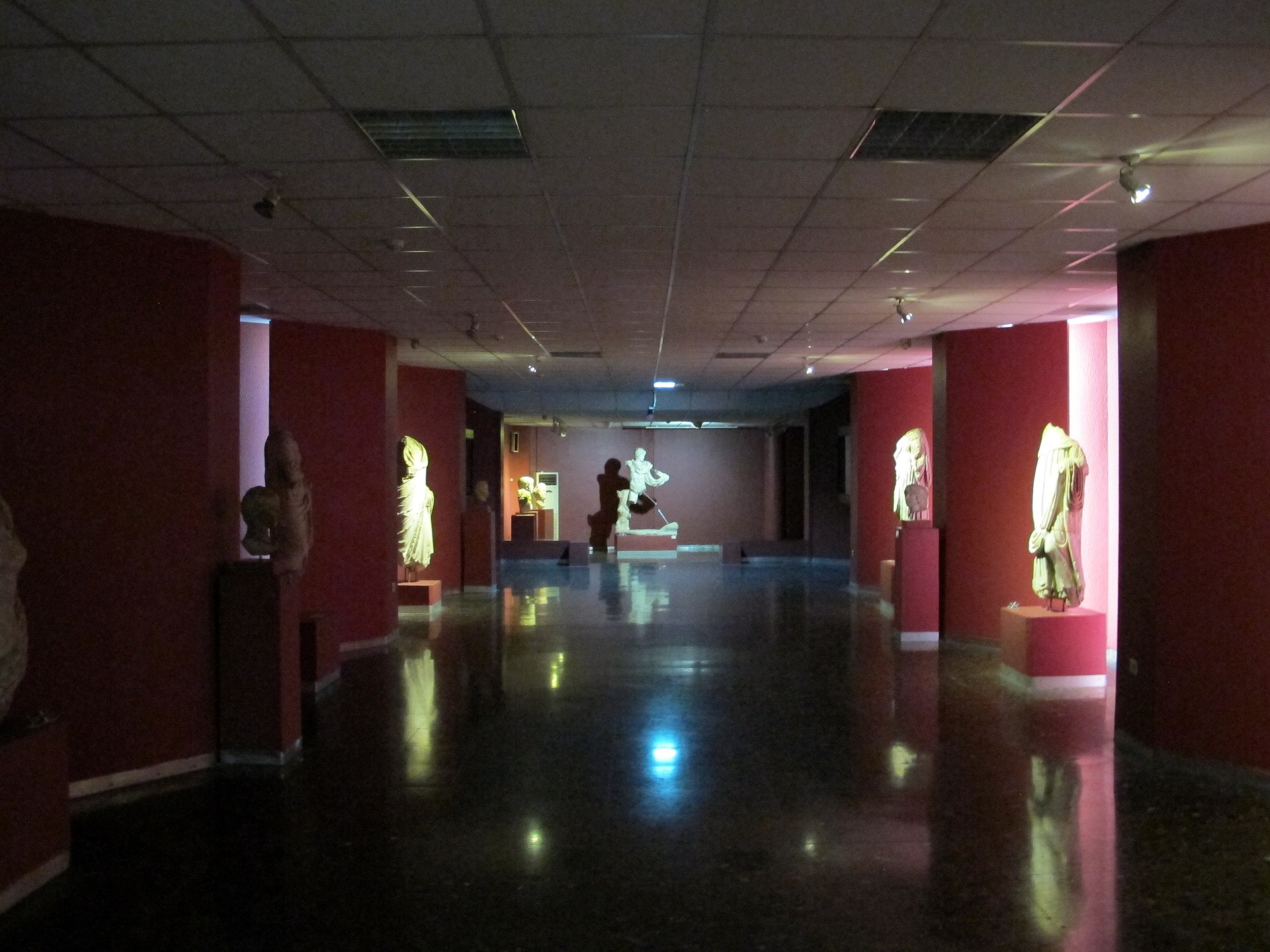
Terracotta and marble sarcophagi and funerary stelae, among them the Klazomenai sarcophagi that were already prized for their painted decoration in antiquity, the coffered ceiling panels lifted from the Late Hellenistic Belevi Mausoleum, and the museum's closing group on this floor, a marble relief of Poseidon, Demeter and Artemis recovered from Izmir's own Smyrna Agora excavations.
Photograph by sailko · CC BY-SA 3.0 Middle floor: the stone works and portrait hall
The entrance-level galleries, arranged chronologically: marble statues, busts and portrait heads in eight display cases, opening with the archaic Kore statue found at Erythrai and including the bronze Athlete of Kyme, one of the few large ancient bronzes from western Anatolia to survive being melted down for scrap.
Photograph by sailko · CC BY-SA 3.0 The Treasury Room
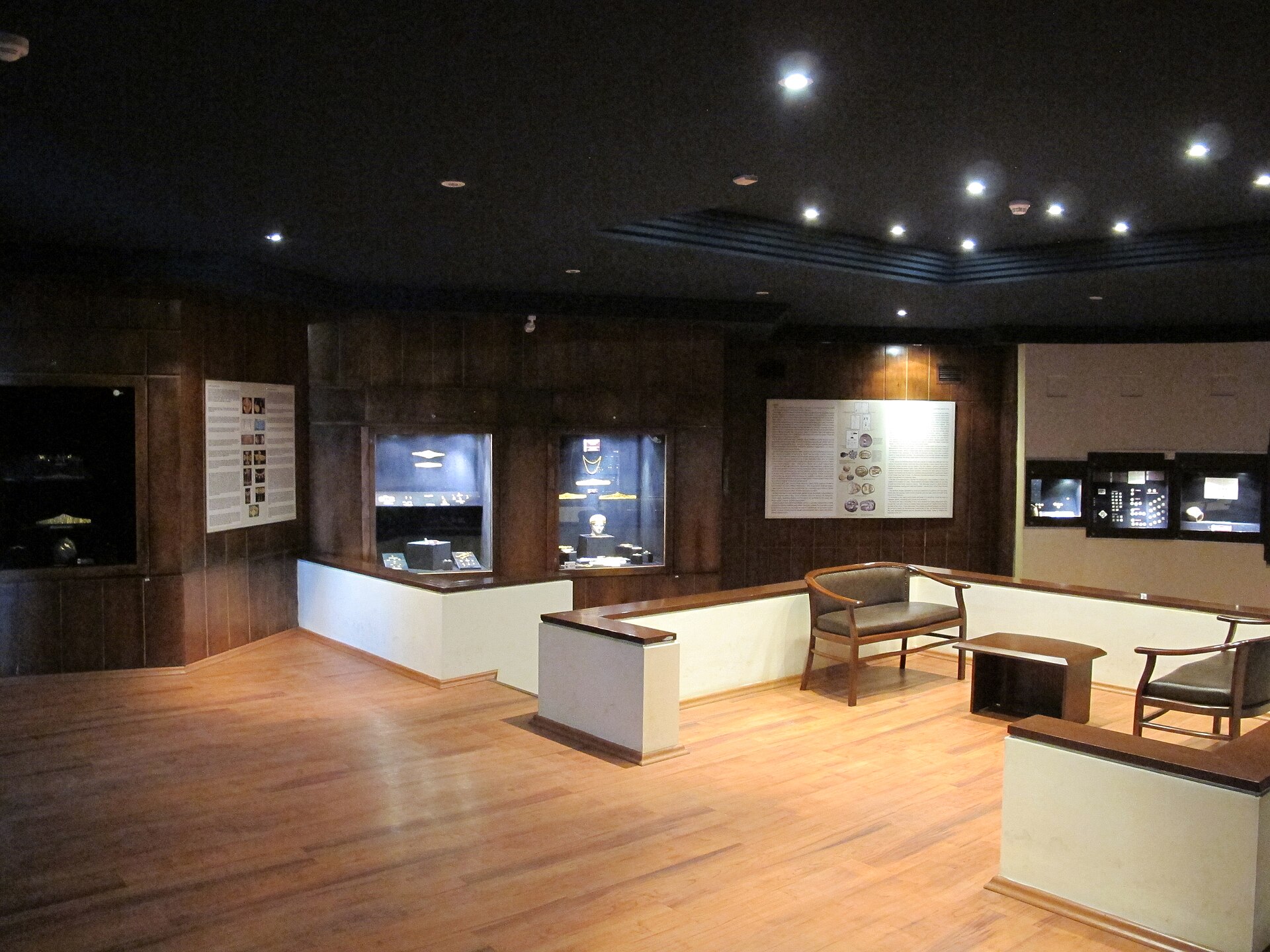
A single wood-panelled room of wall cases holding coins and gold and silver jewellery from the Archaic, Classical, Hellenistic, Roman, Byzantine and Islamic periods in one continuous run, alongside Hellenistic, Roman and Byzantine glassware.
Upper floor: the small finds gallery
Glass, bronze, engraved gemstones, and small terracotta figurines, vessels and lamps arranged in unbroken chronological sequence from the prehistoric period through the end of the Byzantine era, the least crowded floor and the one most visitors leave until last.
The Ekrem Akurgal ceramics hall and the Limantepe room
Pottery arranged chronologically under the name of the archaeologist Ekrem Akurgal, alongside material from the Limantepe excavations near Urla, one of the oldest harbour settlements known on the Aegean coast and a rare source of Bronze Age finds in a museum otherwise dominated by the Hellenistic and Roman periods.
The gardens and the lapidarium
Two garden areas flanking the building hold an outdoor lapidarium of inscriptions, architectural fragments, column capitals and further sarcophagi and steles too large or too numerous for the indoor halls, illustrating the region's history from outside as well as in.
What to see first
The Klazomenai sarcophagi
Klazomenai workshopsPainted terracotta sarcophagi from a production the ancient world itself already rated as the finest of its kind, and one of the collection's signature holdings.5
Coffered ceiling panels from the Belevi Mausoleum
Counted among the richest surviving groups of Late Hellenistic funerary architecture anywhere, lifted from one monumental tomb near Ephesus.5
Poseidon, Demeter and Artemis relief group
Roman-period workshop, SmyrnaA major sculptural group recovered from Izmir's own ancient marketplace, the Smyrna Agora, rather than from a distant excavation.5
The Kore of Erythrai
An archaic large-scale marble figure that opens the museum's chronological portrait sequence at the entrance to the middle floor.5
The Bronze Athlete of Kyme
A rare large-scale ancient bronze that escaped the melting pot most bronze statues met in later centuries, from the west Anatolian city of Kyme.5
The Treasury Room coin and jewellery collection
Coins and gold and silver ornaments running from the Archaic period to the Islamic era in one continuous, well-lit sequence, rare for a mid-sized regional museum.6
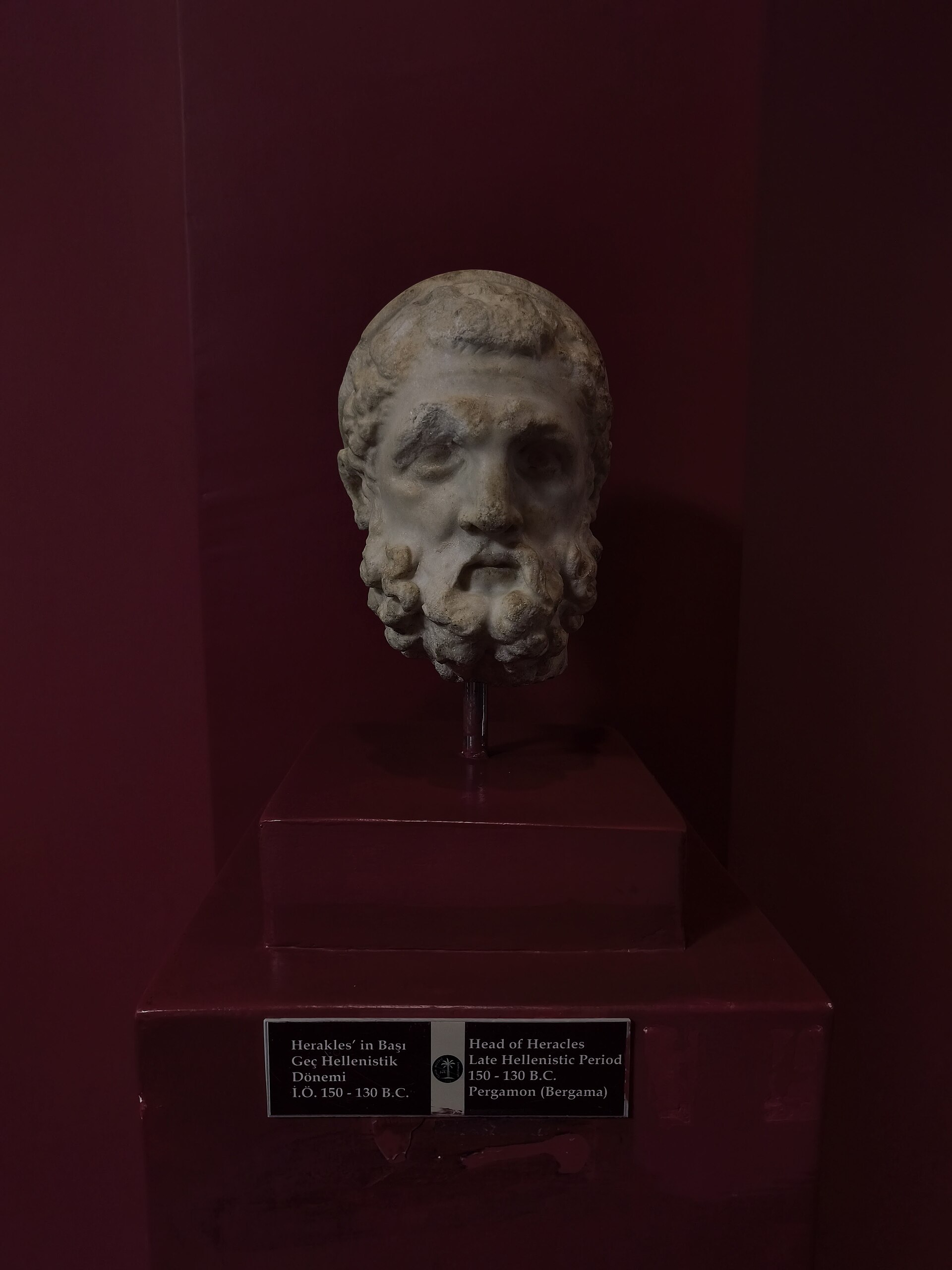
Marble head of Heracles from Pergamon
Late Hellenistic workshop, PergamonA bearded portrait head dated 150 to 130 BC, identified by the museum's own gallery label as coming from Pergamon, one of the great Hellenistic centres of sculpture.12
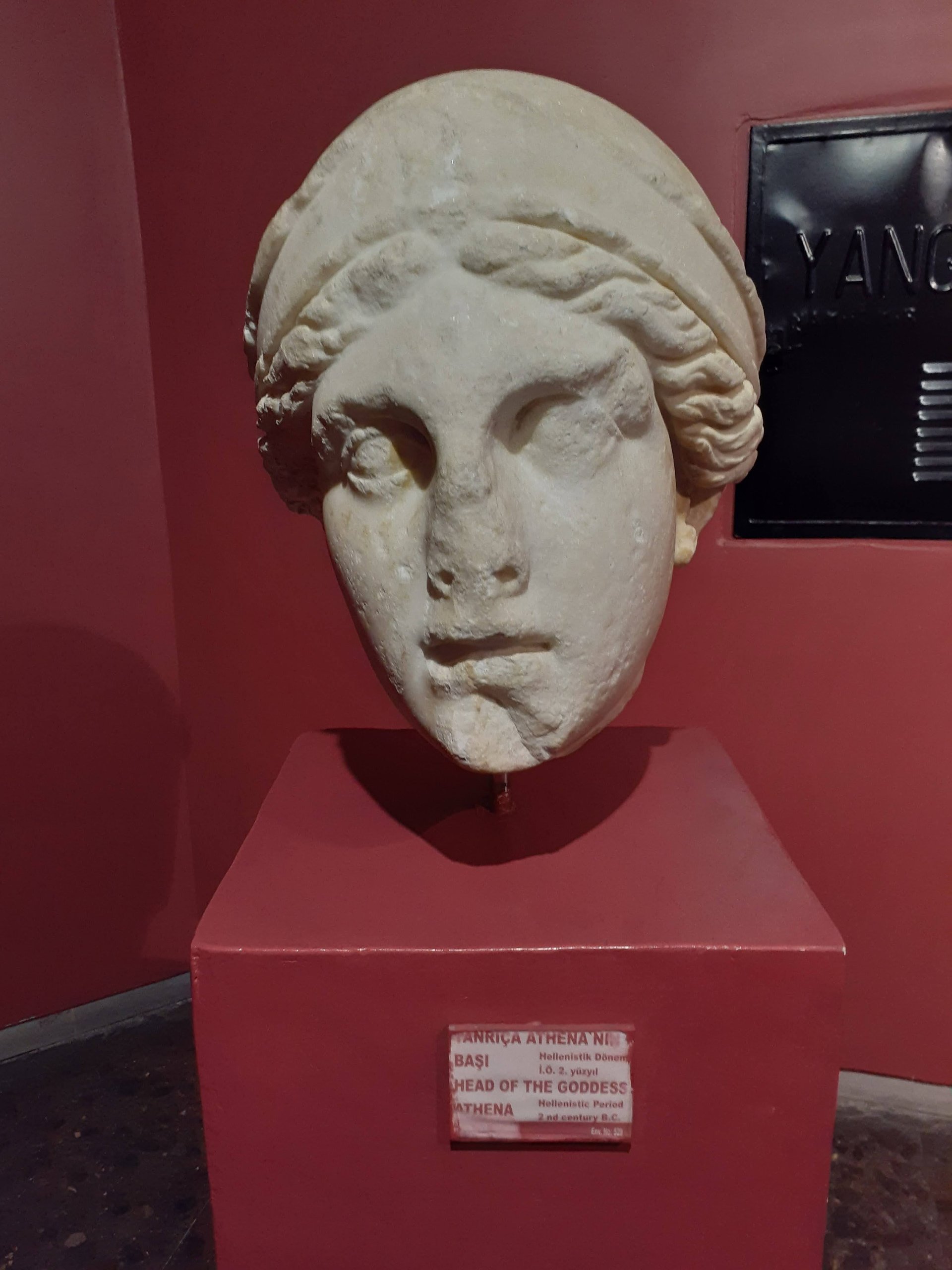
Marble head of Athena
Hellenistic workshopA 2nd-century BC head of the goddess, veiled and diademed, labelled and displayed as part of the permanent collection rather than a temporary loan.13
Limantepe Bronze Age harbour-settlement finds
Material from one of the earliest known harbour towns on the Aegean coast, giving the museum a depth of prehistoric evidence most Roman-heavy regional collections lack.6
From a ruined church to Bahribaba Park
The museum is older than any of the three buildings it has occupied. Collecting began in 1924 in Izmir's Basmane district, three years before there was anywhere proper to put what had been gathered, and the collection first opened to the public in 1927 inside the Aya Vukla (Saint Voukolos) church, a reused rather than a purpose-built home. By 1951 the growing number of finds coming in from excavations across the region had outgrown the church, and the collection moved to the National Education Pavilion at Kulturpark, itself always understood as a second stopgap rather than a destination. The building actually built for the job, a 5,000 square metre structure on a rise inside Bahribaba Park in Konak, opened on 11 February 1984, and everything the museum now shows the public has been assembled there since, floor by floor, around a collection considerably older than the walls around it.
A museum built by its own region's excavators, not by purchase
Almost nothing on display here was bought. The collection is what it is because Izmir sits at the centre of one of the most excavated stretches of coastline in the Mediterranean, and for a century the museum has been the standing repository for what came out of the ground at Ephesus, Pergamon, Miletus, Klazomenai, Teos, Iassos and Aphrodisias, along with the ancient city of Smyrna itself, which underlies part of modern Izmir. That regional, dig-fed model gives the museum a different character from a museum assembled by acquisition: what is missing from its cases usually reflects what a given excavation happened to yield rather than what a curator chose not to buy, and what is strong here, Hellenistic and Roman marble above all, is strong because the excavations around Izmir were themselves unusually productive in exactly that material.
Three floors, arranged around death, portraiture and daily life
The building's layout follows a logic more thematic than strictly chronological. The ground floor is given over to the dead: terracotta and marble sarcophagi and funerary stelae, among them the Klazomenai sarcophagi that were already admired for their painted decoration in antiquity, the coffered ceiling panels taken from the Late Hellenistic Belevi Mausoleum near Ephesus, and a marble relief of Poseidon, Demeter and Artemis recovered from Izmir's own Smyrna Agora excavations. The middle floor, at street entrance level, is arranged as a chronological run of marble statues, busts and portrait heads, opening with the archaic Kore of Erythrai and including the bronze Athlete of Kyme, a rare large ancient bronze that escaped the melting pot most bronze statues met in later centuries. The upper floor turns to daily life: glass, small bronzes, engraved gemstones, and terracotta figurines, vessels and lamps running unbroken from the prehistoric period to the end of the Byzantine era.
The Treasury Room
One room breaks the floor-by-floor logic on purpose. The Treasury Room gathers coins and gold and silver jewellery from the Archaic, Classical, Hellenistic, Roman, Byzantine and Islamic periods into a single wood-panelled space, alongside Hellenistic, Roman and Byzantine glassware, so that a class of object usually scattered across a museum by period instead reads as one continuous sequence. It is also, practically, the one gallery built around security as much as display: coins and jewellery are the objects most likely to leave a museum by theft rather than by scholarship, and the room's separate, more tightly controlled design reflects that. For a visitor, the effect is a rare chance to watch what people wore and carried change, or not change, across two thousand years in one place rather than four.
A portrait head that went to Denver and came home
The collection is not a closed question, and one recent case makes that plain. A marble portrait head, twenty-five centimetres tall, a bearded man with drilled pupils in the Theodosian style of the later 5th century AD, was excavated at the Smyrna Agora and later left Turkey illegally; it entered the Denver Art Museum's collection in 1989 as a donation from the widow of a former United States consul general. Turkish ministry researchers matched the head to 1934 excavation reports from the Agora dig, and after what both sides described as constructive dialogue rather than a legal fight, the Denver Art Museum returned it. It went on display at this museum, reported in the Turkish press in April 2026, a small case that stands for a larger truth about a regional museum built on a century of excavation: some of what belongs in its cases is still finding its way back.
Getting there, what it costs, and what the reviews keep asking for
The museum sits inside Bahribaba Park in Konak, a short walk from Konak Square, its clock tower and the Konak ferry terminal, and is served directly by Izmir's metro and tram stops at Konak as well as by ESHOT city buses. It opens every day of the year except for a half-day closure on the first morning of the two main religious holidays, with a single admission structure: a walk-up ticket for Turkish citizens without the government's Muzekart annual pass, a flat euro rate for foreign visitors, and free entry on production of identification for under-18s, over-65s, teachers, disabled visitors, veterans and the relatives of martyrs. What the published reviews describe once a visitor is inside is consistent across years of comments: a collection that earns its reputation on the strength of the region it was excavated from, shown in a building visitors keep saying is overdue the renovation that collection deserves.
What visitors say
We publish no visitor-review prose, so what follows is our own reading of a large body of published ratings and comments. Visitors consistently rate the collection itself well above the building that houses it: the Hellenistic and Roman marble, built almost entirely from excavations at Ephesus, Pergamon, Klazomenai and other sites in the wider Izmir region rather than assembled by purchase, is repeatedly singled out as stronger than the museum's modest reputation suggests, and the quiet, uncrowded galleries are a recurring point of contrast with more heavily visited sites on the coast. Against that, the same reviews return again and again to the 1984 building itself: dated display cases, inconsistent lighting, thin labelling in some galleries, and a wish, stated plainly and often, for the kind of renovation Izmir's own archaeological importance would seem to justify.
What is praised, what is criticised
- Praised: the range and authenticity of the Hellenistic and Roman marble collection, drawn from Ephesus, Pergamon, Klazomenai and other regional excavations rather than assembled on the art market
- Praised: the calm, uncrowded galleries and climate-controlled halls, which visitors repeatedly compare well against busier sites elsewhere on the Aegean coast
- Praised: the central, walkable location in Bahribaba Park, close to Konak Square and easy to combine with a day spent around the old town
- Criticised: the dated condition of the 1984 building, with old-fashioned display cases and lighting that reviewers say does not do the collection justice, and repeated public calls for a full renovation
- Criticised: thin object labelling in some galleries and limited elevator access to the upper floors, both raised often enough in reviews to count as a consistent pattern rather than isolated complaints
Ratings on other platforms
TripAdvisor: 4 from 198 ratings, read 13 August 2026
A platform average is a tertiary source: it moves, it is not audited, and we quote no visitor's words.
Questions about Izmir Archaeology Museum
Where is Izmir Archaeology Museum?
Yesiltepe Mahallesi, Halil Rifat Pasa Caddesi No:4, Bahribaba Parki, Konak, Izmir, Turkey.
How much does it cost to visit?
Adult (Turkish citizen, single-visit ticket): TRY 60; Free (under 18, over 65, teachers, registered disabled visitors, war veterans and relatives of martyrs): free; Foreign visitor: EUR 4. As confirmed 27 September 2026.
When is it open?
Every day 08:30-18:30. Closed: Closed until midday on the first day of religious (Ramadan and Kurban) holidays, per standard Ministry of Culture and Tourism policy for state museums. As confirmed 27 September 2026.
How do you get there?
Bus: ESHOT city buses serving Konak stop at Bahribaba, a couple of minutes' walk from the museum entrance; a wide set of routes converge on Konak from across the city; Metro: The Izmir Metro's Konak station is a short walk from the park; Tram: The Izmir Tram's Konak stop is the same short walk away; Ferry: Izmir's ferries call at the Konak ferry terminal, reachable on foot through Bahribaba Park.
What should you see first?
The Klazomenai sarcophagi (Klazomenai workshops); Coffered ceiling panels from the Belevi Mausoleum; Poseidon, Demeter and Artemis relief group (Roman-period workshop, Smyrna); The Kore of Erythrai; The Bronze Athlete of Kyme; The Treasury Room coin and jewellery collection.
Images
Sources
- 1Wikidata, item Q6102069, Izmir Archaeological Museum. wikidata.org/wiki/Q6102069
- 2Republic of Turkey Ministry of Culture and Tourism, muze.gov.tr official ticketing portal, Izmir Archaeological Museums detail page (status, hours, address, phone, email), read 13 August 2026 and re-read 27 September 2026. On the 27 September 2026 read the page stated opening time 08:30, closing time 18:30, box office closing time 18:30, and 'Closed Days: Open every day' -- the closing time differs from the 19:00 recorded on 13 August 2026 and is treated as the current figure. muze.gov.tr/muze-detay?DistId=MRK&SectionId=IZA01
- 3Republic of Turkey Ministry of Culture and Tourism, DOSIM, official museum and site fee and status table, read 13 August 2026 and re-read 27 September 2026 (row: IZMIR / IZMIR ARKEOLOJI MUZESI, Muzekart ile Girilebilir / EUR 4, no closure flag). dosim.ktb.gov.tr/TR-218202/muze-ve-oren-yeri-ucretleri.html
- 4Republic of Turkey Ministry of Culture and Tourism, Directorate General of Cultural Heritage and Museums, Izmir Museum Directorate page (address, phone numbers, email), read 13 August 2026 and re-read 27 September 2026. kvmgm.ktb.gov.tr/TR-44102/izmir-muze-mudurlugu.html
- 5Kultur Portali (Republic of Turkey Ministry of Culture and Tourism), Izmir Arkeoloji Muzesi, floor-by-floor gallery description, read 13 August 2026. kulturportali.gov.tr/turkiye/izmir/gezilecekyer/zmir-arkeoloji-muzesi
- 6Izmir Provincial Directorate of Culture and Tourism, Izmir Arkeoloji Muzesi page, building and collection history, read 13 August 2026 and re-read 27 September 2026 (no hours or fee data on this page as of the re-read). izmir.ktb.gov.tr/TR-77099/izmir-arkeoloji-muzesi.html
- 7Wikipedia, "Izmir Archaeology Museum", read 13 August 2026 (). en.wikipedia.org/wiki/%C4%B0zmir_Archaeology_Museum
- 8TripAdvisor, "Archaeological Museum of Izmir" listing and reviews, read 13 August 2026 (). tripadvisor.com/Attraction_Review-g298006-d302534-Reviews-Archaeological_Museum_of_Izmir-Izmir_Izmir_Province_Turkish_Aegean_Coast.html
- 9Iz Gazete, "Tarihle bulusma noktasi: Izmir Arkeoloji Muzesi ziyaret saatleri, 2025 ucretleri ve ulasim rehberi", published 11 May 2025, read 13 August 2026 and re-read 27 September 2026 (still states 60 TRY for Turkish citizens as of the re-read; press report, not the Ministry's own printed price). izgazete.net/tarihle-bulusma-noktasi-izmir-arkeoloji-muzesi-ziyaret-saatleri-2025-ucretleri-ve-ulasim-rehberi
- 10Karar newspaper, report on the return of a Smyrna-origin marble portrait head from the Denver Art Museum to the Izmir Archaeology Museum, published 15 April 2026. karar.com/kultur-sanat-haberleri/abdden-turkiyeye-onemli-iade-smyrna-kokenli-tarihi-eser-yurda-2042471
- 11Izmir Haberleri, directions guide to the Izmir Archaeology Museum (bus, metro, ferry access), read 13 August 2026. izmirhaberleri.com/yerel/izmir-arkeoloji-muzesi-nerede-yer-aliyor-izmir-arkeoloji-muzesine-ziyaret-saatleri-izmir-arkeoloji-muzesine-nasil-gidilir/5626
- 12Wikimedia Commons, File:Izmir Arkeoloji Muzesi - Herakles'in Basi.jpg, photographed gallery label read directly from the image, viewed 13 August 2026. commons.wikimedia.org/wiki/File:%C4%B0zmir_Arkeoloji_M%C3%BCzesi_-_Herakles%27in_Ba%C5%9F%C4%B1.jpg
- 13Wikimedia Commons, File:Head of Athena Izmir Archaeology Museum 2024.jpg, photographed gallery label read directly from the image, viewed 13 August 2026. commons.wikimedia.org/wiki/File:Head_of_Athena_Izmir_Archaeology_Museum_2024.jpg
- 14Izmir Provincial Directorate of Culture and Tourism, province-wide museum and site admission fee tariff table, IZMIR ARKEOLOJI MUZESI row, read 27 September 2026 (Muzekart ile Girilebilir / EUR 4, no free category itemised for this row). izmir.ktb.gov.tr/TR-376139/izmir-ili-muze-ve-oren-yerleri-giris-ucreti-tarifesi.html
- 15Izmir Provincial Directorate of Culture and Tourism, province-wide museum and site visiting-hours table, read 27 September 2026. Consulted as a cross-check on hours; its machine-summarised reading conflated rows across several Izmir venues and could not be used as the primary hours figure, so the live muze.gov.tr detail page (source 2) was used instead. izmir.ktb.gov.tr/TR-77092/izmir-ili-muze-ve-oren-yerleri-ziyaret-saatleri.html

