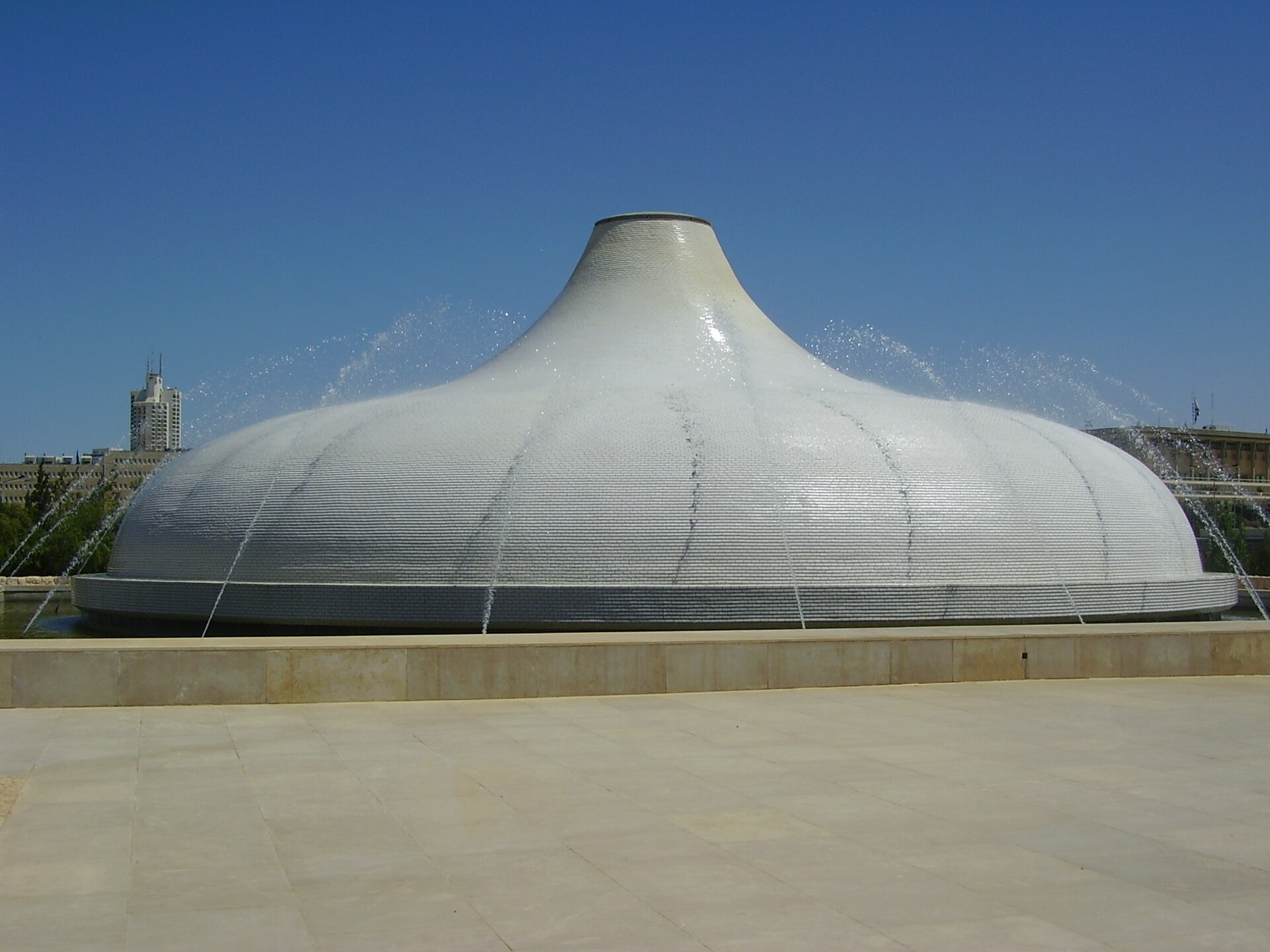
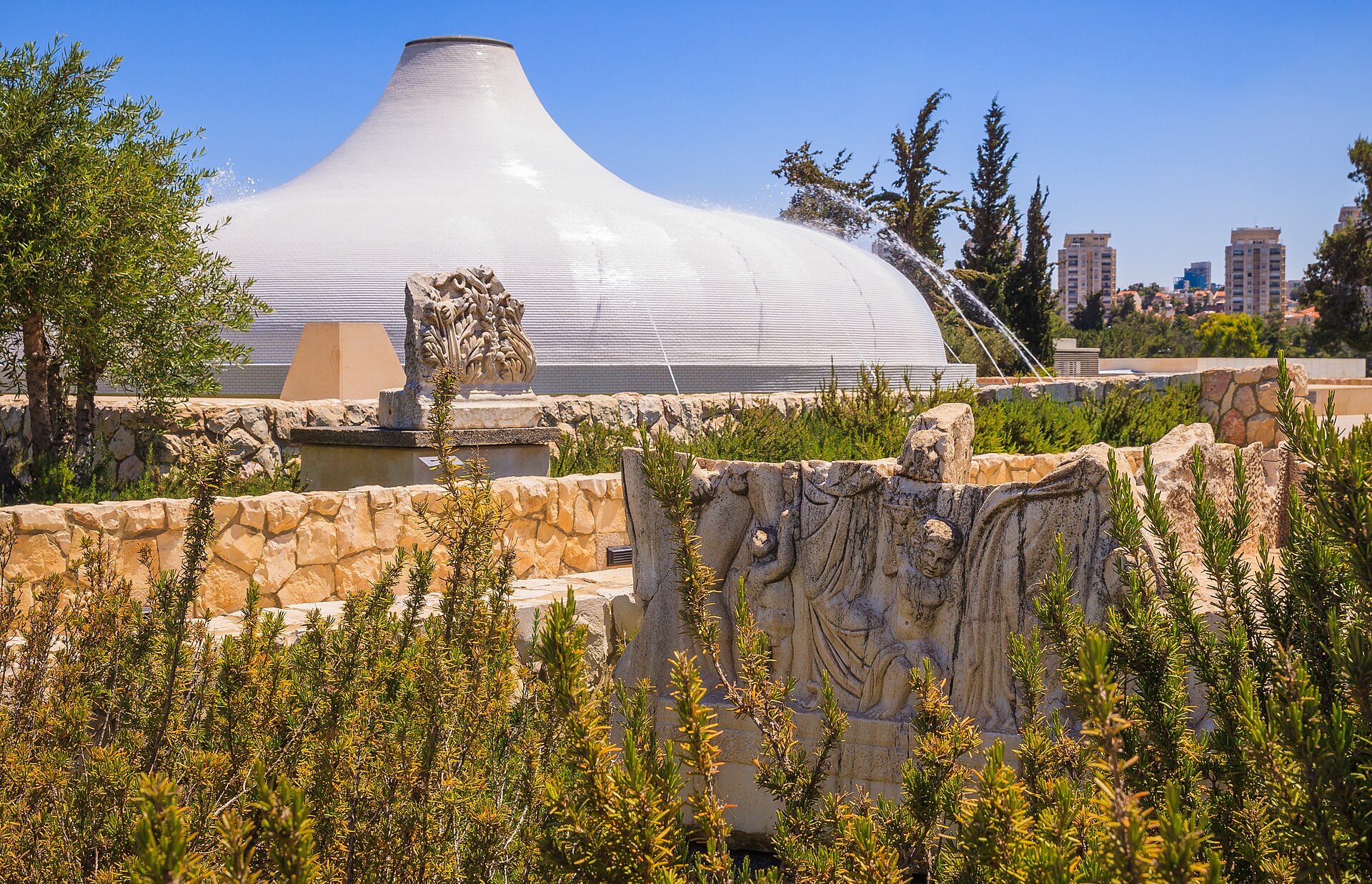
The white tiled dome of the Shrine of the Book, the Israel Museum's pavilion for the Dead Sea Scrolls, with its fountains playing.
Avishai Teicher, CC BY 2.5 · Photograph by ד"ר אבישי טייכרOn this page 15 sections
ContentsClose
The Israel Museum's strength is breadth on a single campus rather than depth in any one department: a national archaeology collection anchored by the Dead Sea Scrolls and the Second Temple city model, an encyclopaedic fine arts wing spanning eleven curatorial departments, one of the world's larger Jewish ceremonial art collections including intact synagogue interiors, and an outdoor sculpture garden that is itself a major work by its designer. That breadth is inherited unevenly - some of it through Sukenik and Yadin's pursuit of the scrolls, some of it through gift and purchase, and some of it, in the case of the Dayan collection, through decades of antiquities removal the museum itself has not fully accounted for in public.
| Kind | Museum |
|---|---|
| Founded | 1965 |
| City and country |  Jerusalem, Israel Jerusalem, Israel |
| Address | 11 Derech Ruppin, Jerusalem 9171002, Israel |
| Website | imj.org.il/en |
| Status | Open, confirmed |
| Record last verified |
Visiting
- Hours
- Sunday, Monday, Wednesday, Thursday10:00 to 17:00
- Tuesday16:00 to 21:00Extended evening hours; free entrance for children under 18
- Friday and holiday eves10:00 to 14:00
- Saturday and holidays10:30 to 16:00Free entrance for children under 18 Two current (2026) third-party listings (touristisrael.com, israeltourismconsultants.com), both fetched fresh 2026-09-06, describe Saturday as a flat 10:00-17:00 matching the main weekday group, not this shortened 10:30-16:00 slot; kept as the museum's own (if dated) figure rather than overwritten on tertiary evidence alone - flagged for direct confirmation once imj.org.il is reachable.
- Admission
- AdultILS 54
- StudentILS 39Valid student ID required
- Child (5-17)ILS 27Free on Tuesdays and Saturdays
- SeniorILS 27
- Visitor with disabilityILS 27
- Soldier / national serviceFreeFree with ID
- Repeat visit within 3 monthsILS 27On presentation of the original ticket
- Jerusalem residentILS 46
Free entry: Children aged 5-17 enter free on Tuesdays and Saturdays- Tickets
- imj.org.il/en/content/tickets The museum's own ticket page.
- Do I need to book?
- Not required for general admission; tickets can be bought on site or in advance online
- Address
- 11 Derech Ruppin, Jerusalem 9171002, Israel MapCar Paid on-site parking; visitor reviews report the lot filling on busy weekdays even shortly after opening
- Website
- imj.org.il/en
- Telephone
- +972-2-670-8811
Before you go how long, access, photography, bags, eating, shop
- How long to allow
- Visitor accounts converge on two to four hours as a minimum, with several reviewers saying a single visit undersells a collection of roughly 500,000 items of which only a fraction is on display at any time
- Access
- Wheelchair accessible, per iTravelJerusalem's visitor listing for the museum
- Photography
- Not detailed on the pages fetched for this record
- Bags
- Backpacks must be checked or stored at lockers at the entrance; visitor reviews describe the bag rule as strictly and, in some accounts, inconsistently enforced by entrance security
- Eating
- A restaurant (the Modern Restaurant) and a museum shop operate on site; one visitor account notes both close at the same time as the museum itself, cutting a late visit short
- Shop
- A museum shop is on site, singled out in visitor accounts as worth the time it gets
Prices and hours change. We take them from the institution's own pages and print the day we read them, and you can check the current position at the source we used. Confirm before you travel.
What is inside
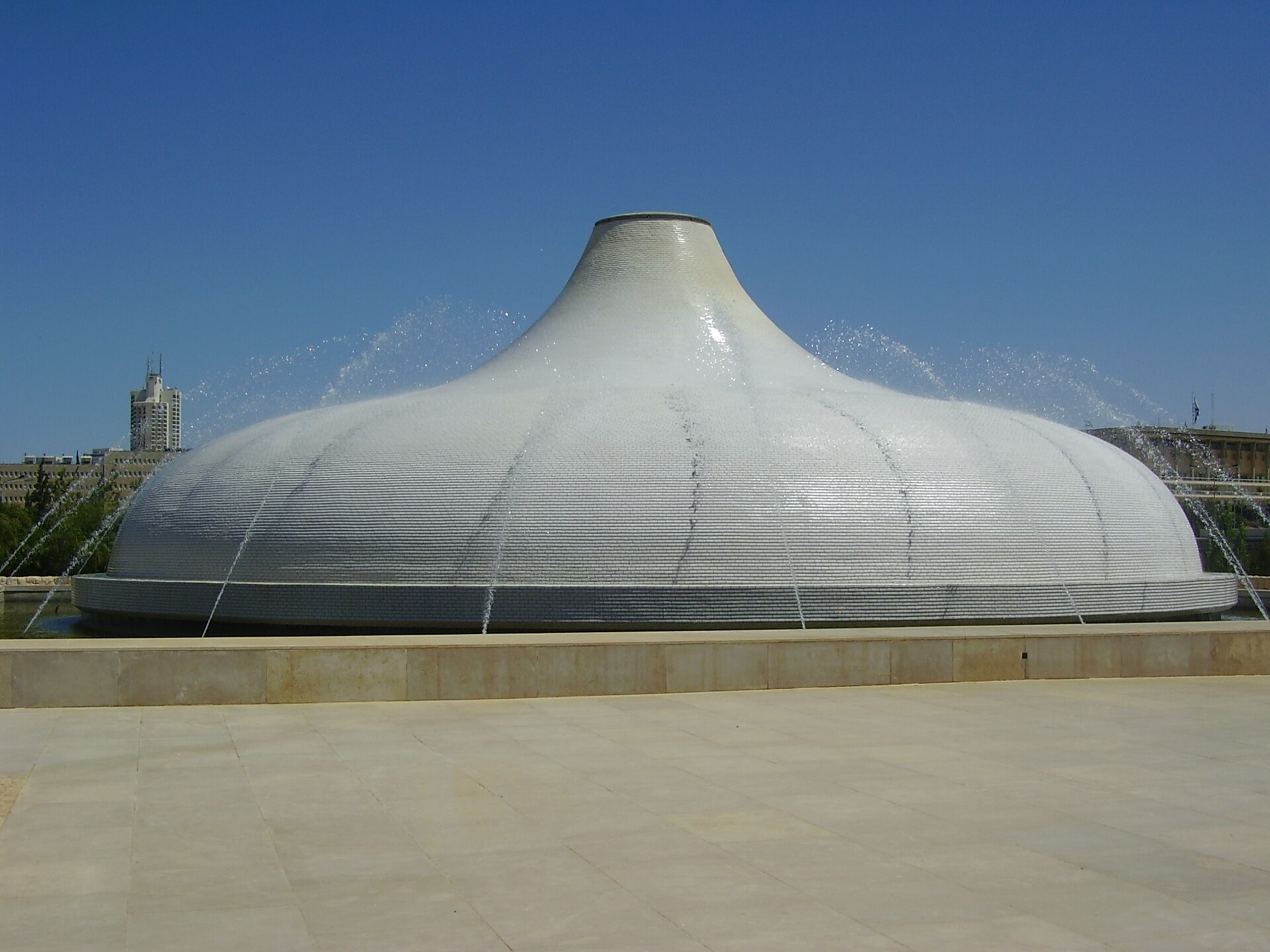
Photograph by ד"ר אבישי טייכר · CC BY 2.5 Shrine of the Book
The purpose-built pavilion holding the Dead Sea Scrolls, including the Great Isaiah Scroll, and the Aleppo Codex, the oldest surviving Hebrew Bible manuscript; scrolls are rotated every three to six months between display and dark storage to limit light exposure, so the object on view varies by visit.
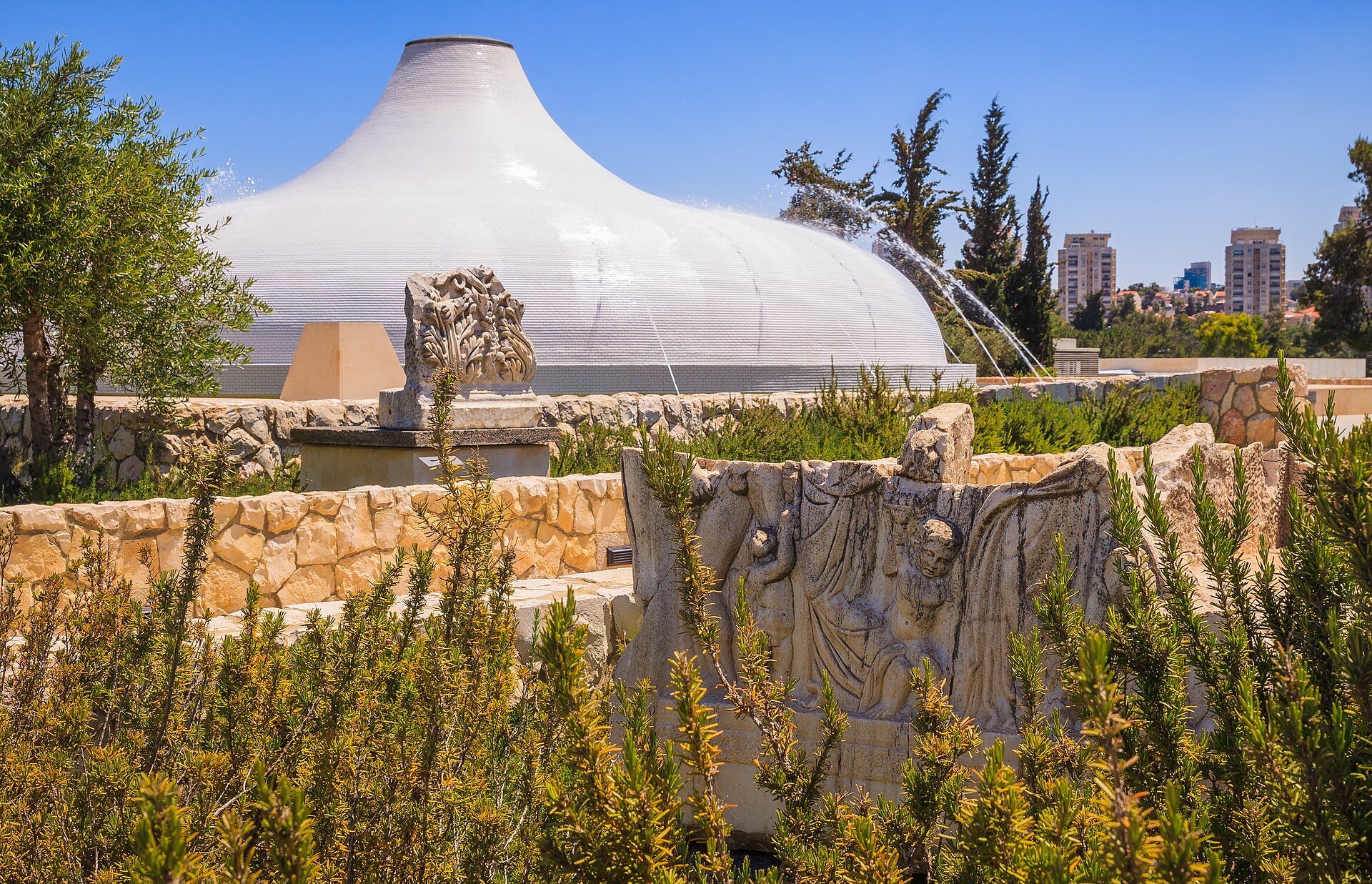
Photograph by Edmund Gall · CC BY-SA 2.0 Billy Rose Art Garden
A five-acre sculpture garden shaped into the hillside by Isamu Noguchi, commissioned by Billy Rose from 1961 and completed for the museum's 1965 opening, combining terraced stone walls with works by sculptors including Rodin, Picasso and Henry Moore.
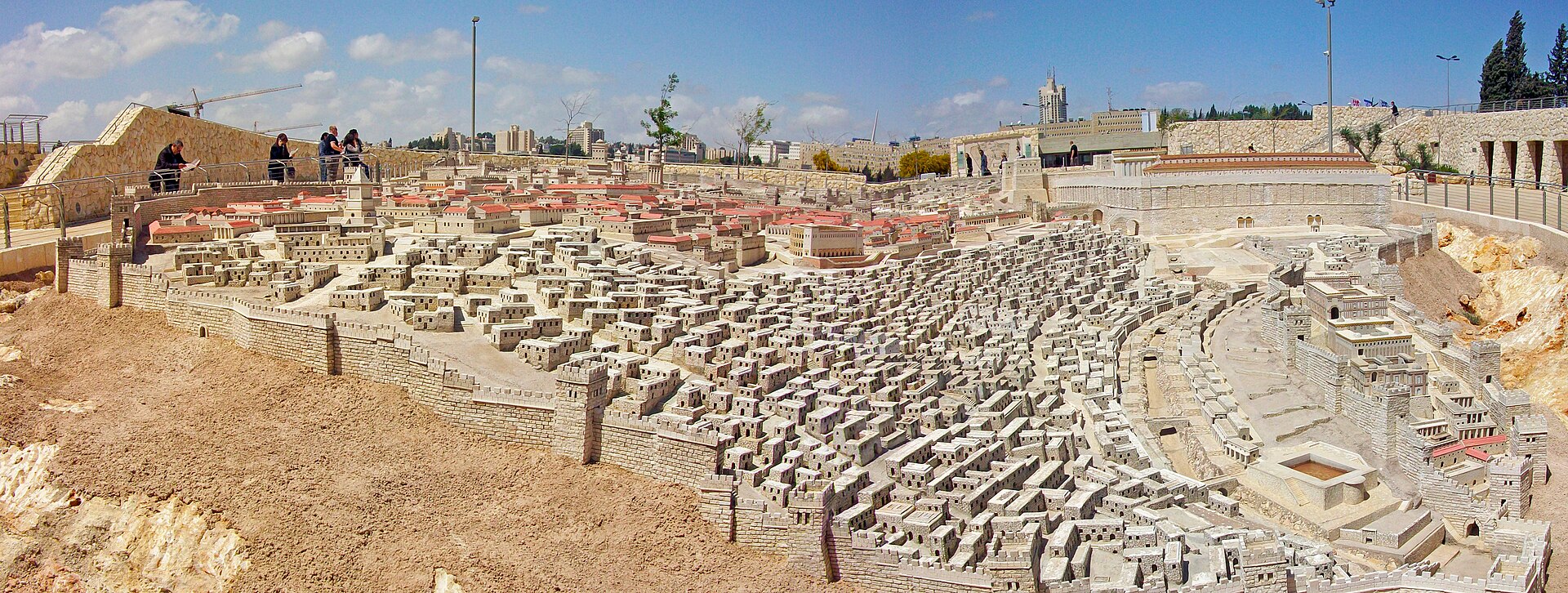
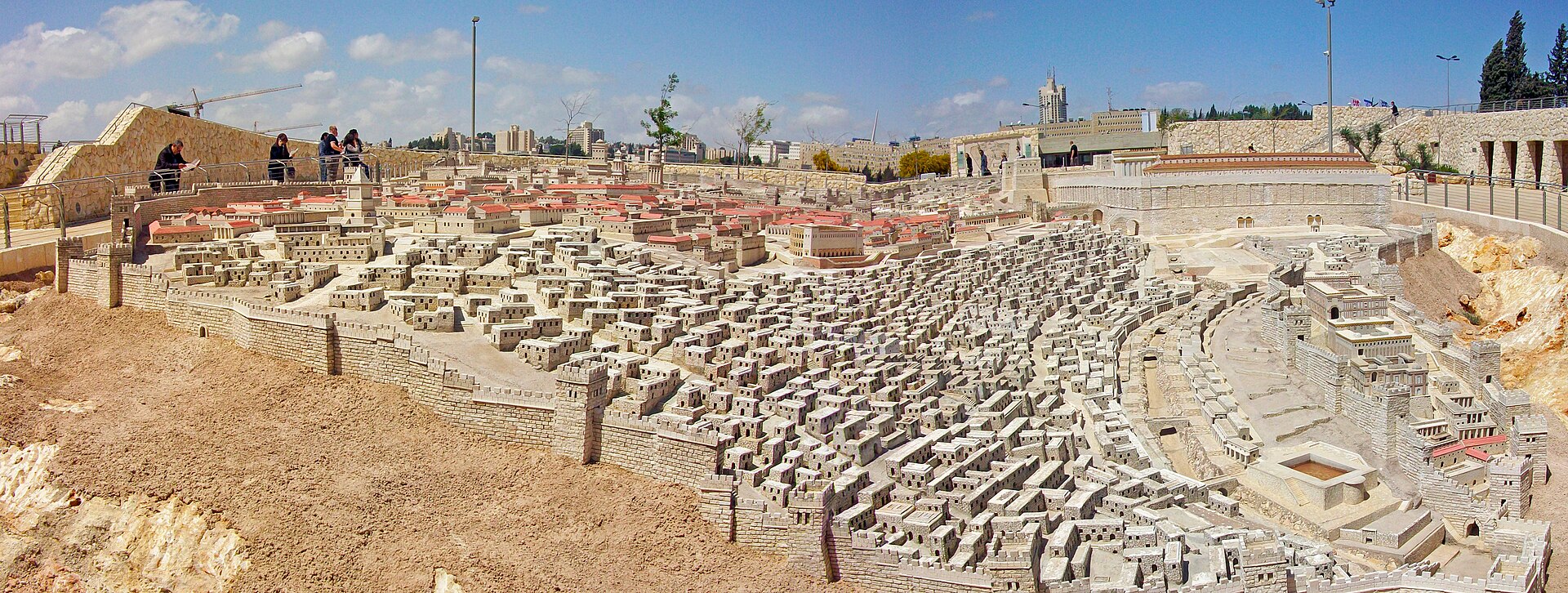
Photograph by Daniel Case · CC BY-SA 3.0 Model of Jerusalem in the Second Temple Period
A large-scale reconstruction of Jerusalem as it stood before its destruction in 70 CE, moved to the museum campus and shown beside the Shrine of the Book.
Samuel and Saidye Bronfman Archaeology Wing
Archaeology of the Land of Israel and neighbouring cultures, including the museum's holdings from the Moshe Dayan collection, bought from his widow after his death; the circumstances of that acquisition are addressed below rather than left as a caption.
Edmond and Lily Safra Fine Arts Wing
Eleven curatorial departments spanning Israeli, European, modern, contemporary, African, Asian and Oceanian art, redoubled in gallery space by the 2010 renovation.
Jack, Joseph and Morton Mandel Wing for Jewish Art and Life
Around 27,000 objects of Jewish ceremonial and secular material culture, including four reconstructed historic synagogue interiors brought from Italy, Germany and India, per the museum's own description to its partner association AEJM.
What to see first
The Great Isaiah Scroll (facsimile on rotating display)
Unknown scribe, Qumran, 2nd century BCEThe most complete of the Dead Sea Scrolls, discovered in the Qumran caves by the Bedouin shepherd Muhammed edh-Dhib between late 1946 and early 1947 and eventually reunited at this museum through Eliezer Sukenik's early purchases and Yigael Yadin's 1954 acquisition of the remaining scrolls via a Wall Street Journal advertisement.4
The Aleppo Codex
Scribe Shlomo ben Buya'a, vocalised by Aaron ben Moses ben Asher, 10th century CEThe oldest surviving codex of the complete Hebrew Bible, housed in the Shrine of the Book.3
Model of Jerusalem in the Second Temple Period
Hans Kroch's original commission, later relocated to the museumA large-scale physical reconstruction of the city before its 70 CE destruction, giving visitors a bird's-eye reading of the Old City before or after they walk it.2
Billy Rose Art Garden sculptures
Various, arranged by Isamu NoguchiWorks by Rodin, Picasso and Henry Moore set into a hillside earthwork that is itself considered one of Noguchi's major designs, commissioned in 1961 for the museum's opening.2
Moshe Dayan collection objects, including Bronze Age sarcophagi
Various ancient workshopsPurchased from Dayan's widow for 1 million US dollars after his death in 1981; the collection is displayed alongside the fact that Dayan assembled much of it through what an academic study describes as large-scale, army-assisted removal of antiquities from sites in Israel and the occupied territories, for which he was reportedly caught in person at least four times and never prosecuted.15
The 2nd-century CE head of Athena and the Nemesis griffin statue
Roman-period workshops, found at Tel Naharon near Beit She'an (1978) and in the northern Negev (1957)Smashed by an American tourist on 5 October 2023, who told police he considered the statues idolatrous; the museum called the damage severe but said its hours and operations would not be affected, and sent the pieces for conservation.16
Orphaned Holocaust-era art, roughly 1,200 works
Various, mostly EuropeanPaintings, works on paper and Judaica received from the Jewish Restitution Successor Organization and Jewish Cultural Reconstruction beginning in 1948, lacking clear prior ownership records; the museum published an online catalogue of the JRSO holdings in 2007 to help surviving claimants, and stated in 2014 that ten works had been returned to their legal owners since 2000.13
Reconstructed synagogue interiors
Various congregations, Italy, Germany and IndiaFour historic synagogue interiors moved into the Mandel Wing for Jewish Art and Life, letting a visitor walk through real prayer spaces from three continents in one building.10
Exhibitions on now
- On now13 Jan to 17 Oct 2026Confirmed · check before you travel
A national museum built for a nine-year-old state
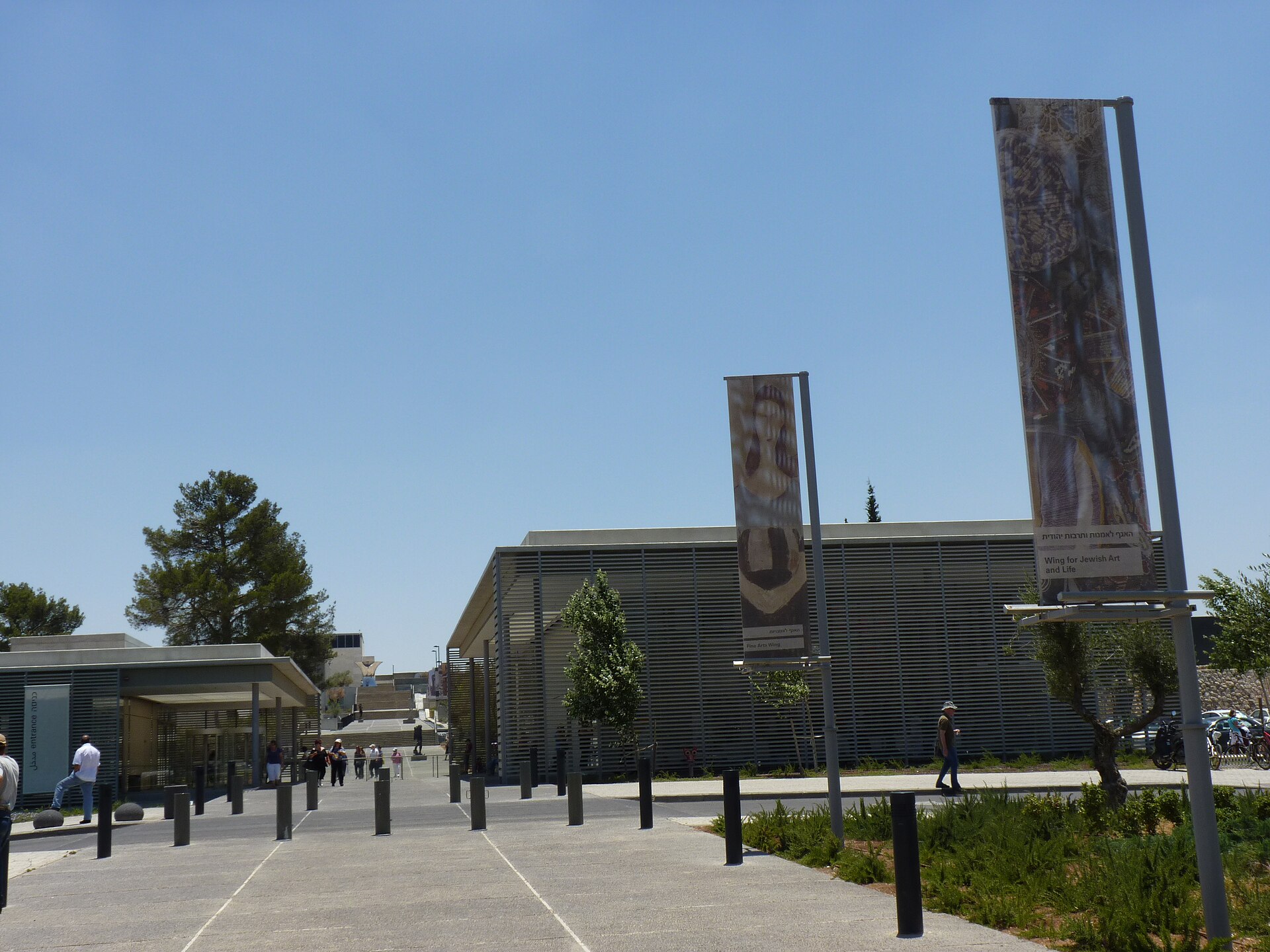
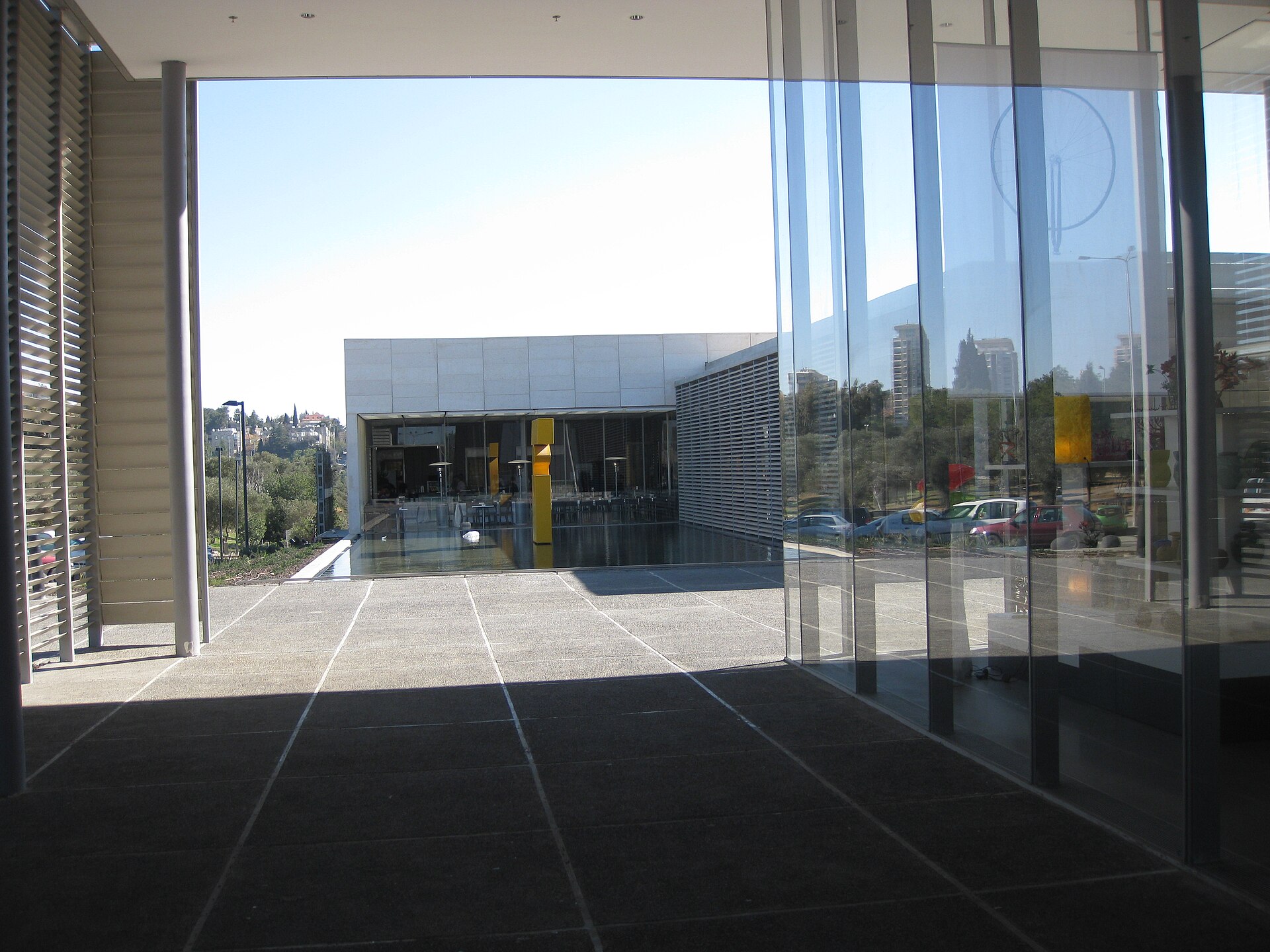
The Israel Museum opened in May 1965, seventeen years after the state it was built to represent. Its original masonry buildings on the Givat Ram campus in Jerusalem were designed by the architect Alfred Mansfeld, and the museum was conceived from the start as an encyclopaedic institution rather than a single-subject collection: archaeology of the land and its neighbours, fine art from Israel and abroad, and Jewish ceremonial and secular material culture were planned as co-equal wings under one roof, alongside a dedicated pavilion for a set of manuscripts that had reached Jerusalem only shortly before the museum itself existed to hold them. A hundred million dollar renovation completed in July 2010, led by Efrat-Kowalsky Architects with the designer James Carpenter, roughly doubled the museum's gallery space and linked its separate wings through a new entrance pavilion, the covered walkway and reflecting pool a visitor now crosses before reaching any collection at all.
The Shrine of the Book and how the scrolls reached it
The scrolls the Shrine of the Book was built to hold were found by chance. Between late 1946 and early 1947, a Bedouin shepherd named Muhammed edh-Dhib followed a stray goat into a cave near Qumran, on the shore of the Dead Sea, and found clay jars holding ancient scrolls, among them the Isaiah Scroll, the Habakkuk Commentary and the Community Rule. The shepherds first offered the scrolls to a dealer in Bethlehem who dismissed them as worthless; they were eventually sold, several of them for a reported seven Jordanian pounds, to a cobbler and antiquities dealer named Khalil Eskander Shahin, known as Kando. From there the scrolls' custody split. Eliezer Sukenik of the Hebrew University recognised their significance early and bought some directly; a further group left the region and surfaced years later, in 1954, in a classified advertisement in the Wall Street Journal, where the archaeologist and former military chief of staff Yigael Yadin identified and purchased them, completing the set that would eventually be reunited in Jerusalem.
The building constructed to hold them took seven years to design, by the architects Armand Phillip Bartos and Frederick Kiesler, and was funded by the family of the Hungarian-Jewish philanthropist David Samuel Gottesman. Its form is deliberately symbolic: a white tiled dome, set two-thirds below ground and reflected in the pool of water around it, faces a black basalt wall across the plaza. The pairing is drawn from a phrase in one of the scrolls housed inside, the War of the Sons of Light Against the Sons of Darkness - the white dome standing for the Sons of Light, the black wall for the Sons of Darkness. Because prolonged light exposure damages parchment this old, the scrolls on view are rotated every three to six months, so the specific manuscript on display changes between visits; the museum also holds the Aleppo Codex, the oldest surviving complete Hebrew Bible manuscript, in the same complex.
An earthwork built for a five-acre hillside
The Billy Rose Art Garden began in 1961, when the entertainment producer and philanthropist Billy Rose approached the sculptor Isamu Noguchi about what would become Noguchi's largest commission by acreage to that point: an outdoor setting for the new museum's sculpture collection, on a hillside the Israeli planners called Neve Shaanan, a phrase from the Book of Isaiah meaning a place of tranquility. Rather than laying sculptures into an existing landscape, Noguchi reshaped the slope itself, cutting five retaining walls from boulders quarried on site and orienting them to frame the horizon to the west, then adding triangular stone backdrops and a large stone fountain. The garden opened with the museum in 1965 and has been read since as one of Noguchi's own most important works as much as a display space for the pieces by Rodin, Picasso and Henry Moore that it holds.
The Moshe Dayan collection, bought from a widow after criticism the museum did not stop
Not every object on the Bronfman Archaeology Wing's walls arrived by conventional excavation or gift. Moshe Dayan, the former Israeli military chief of staff and defence minister, spent decades collecting antiquities from sites across Israel and the occupied territories; an academic study of his activities describes large-scale removal of objects beginning in 1951, at points using army personnel and equipment, and states he was caught in the act by antiquities officials at least four times without ever being prosecuted. After Dayan's death in 1981, his widow sold the collection to the Israel Museum for one million US dollars, and pieces from it, including Bronze Age sarcophagi, are now shown as part of the museum's own archaeology holdings. The museum displays the objects; it has not, on the evidence available for this record, published its own account of how they were originally removed from the ground.
Twelve hundred orphaned works, and a museum that says it has started to answer for them
The Israel Museum's predecessor institution, the Bezalel National Museum, began receiving looted European art and Judaica in 1948 through the Jewish Restitution Successor Organization and Jewish Cultural Reconstruction, bodies set up after the Second World War to distribute cultural property stolen from Jewish owners and communities who had no surviving heirs to claim it directly. Roughly 1,200 such works, including around 250 paintings, 250 works on paper and 700 Judaica objects, entered the museum's custody this way and largely stayed there uncatalogued for decades; claims began arriving as early as 1950, and the museum published an illustrated online catalogue of the JRSO-derived holdings only in August 2007, specifically to make the material findable by potential claimants. A 2008 companion exhibition, Orphaned Art: Looted Art from the Holocaust in the Israel Museum, put more than fifty of these works, including pieces by Marc Chagall, Egon Schiele and Alfred Sisley, in front of the public alongside an explanation of how they had come to Jerusalem without established provenance. In January 2014 the museum publicly rejected a claim that Israeli museums had made no effort to identify Nazi-looted works in their own collections, stating that ten works had been returned to their legal owners since 2000. The 2007 catalogue and the 2014 rejection both amount to the museum stating its own figures; this record has not located an independent audit of either number.
A collection sized for a national museum, shown a fraction at a time
The museum states its total holdings at approximately 500,000 items, spanning prehistoric archaeology to contemporary art across eleven curatorial departments in the Fine Arts wing alone. Visitor accounts consistently note that only a small proportion of that total is on display at any one time, a tension the museum's own renovation architects addressed directly: the doubled gallery space delivered by the 2010 renovation was intended, by the museum's stated design philosophy during that three-year project, to avoid overwhelming visitors with density rather than to maximise the count of objects on view. Whether that philosophy serves the museum's own encyclopaedic ambition or works against it is a live disagreement between the institution and at least some of the people who visit it, discussed further in the reception section below.
What visitors say
The Tripadvisor aggregate (4.8 of 5 from 5,016 ratings, read 10 August 2026) is very high; the review page returned the same bot-mitigation response to this record's own re-check that the museum's primary domain gives, so the detail below is a synthesis attempted at drafting time rather than text this record can independently reproduce evidence for. The Shrine of the Book and the Dead Sea Scrolls are, by the museum's own presentation of itself and wide independent coverage, the institution's signature draw, which the score is consistent with.
What is praised, what is criticised
- Praised: the Shrine of the Book and the experience of seeing the Dead Sea Scrolls in a purpose-built space
- Praised: the range of the collection on one campus - archaeology, Israeli and international art, Judaica including full reconstructed synagogue interiors, and the Billy Rose sculpture garden
- Praised: the museum's family and children's programming, including the Youth Wing
- Criticised: a sense that only a small proportion of the museum's roughly 500,000-object holding is ever on view at once, given the size of the wider collection
- Criticised: hours that can cut a visit short if the shop and restaurant close alongside the museum itself
Ratings on other platforms
Tripadvisor: 4.8 from 5,016 ratings, read 10 August 2026
A platform average is a tertiary source: it moves, it is not audited, and we quote no visitor's words.
Questions about Israel Museum
Where is Israel Museum?
11 Derech Ruppin, Jerusalem 9171002, Israel.
How much does it cost to visit?
Adult: ILS 54; Student: ILS 39; Child (5-17): ILS 27; Senior: ILS 27; Visitor with disability: ILS 27. As confirmed 6 September 2026.
When is it open?
Sunday, Monday, Wednesday, Thursday 10:00-17:00; Tuesday 16:00-21:00; Friday and holiday eves 10:00-14:00; Saturday and holidays 10:30-16:00. As confirmed 6 September 2026.
How do you get there?
Car: Paid on-site parking; visitor reviews report the lot filling on busy weekdays even shortly after opening.
What should you see first?
The Great Isaiah Scroll (facsimile on rotating display) (Unknown scribe, Qumran, 2nd century BCE); The Aleppo Codex (Scribe Shlomo ben Buya'a, vocalised by Aaron ben Moses ben Asher, 10th century CE); Model of Jerusalem in the Second Temple Period (Hans Kroch's original commission, later relocated to the museum); Billy Rose Art Garden sculptures (Various, arranged by Isamu Noguchi); Moshe Dayan collection objects, including Bronze Age sarcophagi (Various ancient workshops); The 2nd-century CE head of Athena and the Nemesis griffin statue (Roman-period workshops, found at Tel Naharon near Beit She'an (1978) and in the northern Negev (1957)).
What we could not confirm
- The museum's primary domain (www.imj.org.il and museum.imj.org.il) returned a Reblaze bot-mitigation JavaScript challenge to every fetch method available for this record - a direct tool fetch, curl with a modern browser user agent, and an in-app Chromium browser with JavaScript execution and waits of up to fifteen seconds - and the Wayback Machine's own crawler appears to have received the same challenge on this URL since at least mid-2022, so no more recent genuine capture of the museum's own visitor-information page could be located. The hours table above is sourced to the last real capture of that page, from 3 August 2021, and is only partly cross-checked against live third-party listings (Tripadvisor showed 10:00-17:00 as the live status on 10 August 2026, consistent with the 2021 Sun/Mon/Wed/Thu slot). A fresh direct read of the museum's own current hours and prices is owed as soon as that domain can be reached.
- Whether the Aleppo Codex is formally held by the Israel Museum's Shrine of the Book or only displayed there under arrangement with its custodian, the Ben-Zvi Institute, is stated as museum custody by both Wikipedia's Shrine of the Book article and this archive's own Codex Sassoon record, but this record has not located a primary statement from either institution resolving the custodial question cleanly.
- The exact year the Israel Museum purchased the Moshe Dayan collection from his widow is not given precisely in either source fetched for this record, only that the sale followed his 1981 death; a figure of 1968 appeared in one secondary summary but predates Dayan's death and is treated here as unreliable rather than repeated.
- This record has not located an independent audit of either of the museum's own restitution figures - the roughly 1,200 JRSO/JCR-derived orphaned works catalogued in 2007, or the ten Nazi-looted works the museum said in 2014 had been returned since 2000 - both of which come from the museum's own public statements rather than a third-party review.
- Re-confirmation attempted 2026-09-05: imj.org.il bot-walls every method tried this run (WebFetch on /en/visit, /en/content/visit, /en/content/visitor-information and /en/content/tickets all returned empty content; curl without a browser user-agent was blocked outright; curl WITH a browser user-agent returned HTTP 200 but the body is an obfuscated bot-detection challenge script, not the page; the in-app browser loaded the domain twice with waits up to 9s and rendered an empty 0x0 body both times; claude-in-chrome was not connected this session). hours_last_confirmed (2021-08-03) and the open_status source (a TripAdvisor listing, not the museum's own site) remain stale/tertiary and could not be corrected on the evidence available this run - flagging for a future run with claude-in-chrome available, or a manual check.
- On 28 February 2026, during the coordinated Israel-Iran military exchange, the museum relocated significant artworks and artifacts to secure storage and closed to the public 'until further notice' per Home Front Command directives (Jerusalem Post, 28 Feb 2026). A Haaretz feature the same week ('Inside the Israel Museum's Crisis', 27 Feb 2026) described wider institutional turmoil beyond the security closure. The museum's own site could not be reached during this re-check (see changelog) to confirm how it now describes that episode; independent tertiary sources read 5 September 2026 (touristisrael.com, funinjerusalem.com, offpeaktrip.com) all describe the museum as currently open on its standard hours. This needs a direct re-read of the museum's own site once it is reachable.
- Re-confirmation attempted 2026-09-06 (the day after the prior 2026-09-05 attempt): imj.org.il and its sibling museum.imj.org.il both still return the same Reblaze bot-mitigation challenge (blank rendered body) to every method tried this run - a direct fetch tool call on /en, /en/content/visitor-information and /en/content/contact; a plain curl GET (HTTP 200 but an obfuscated challenge script, not the page); and the in-app browser on two fresh tabs with waits up to 19 seconds combined. This is the third consecutive day this exact block has been documented against this domain. In its place, hours, admission and phone were cross-checked today directly (raw page fetches, not search-tool summaries) against touristisrael.com, israeltourismconsultants.com and a re-fetch of iTravelJerusalem, all of which matched the record's existing figures for every field except the Saturday hours row (see the note on that row above). TripAdvisor's live listing showed 'Open now, 10:00 AM - 5:00 PM' at the moment of fetch on 2026-09-06, a Sunday, consistent with the Sun/Mon/Wed/Thu slot.
- The 28 February 2026 Haaretz feature on institutional turmoil, flagged as unresolved in the prior 2026-09-05 re-check, has a public resolution this record can now source directly: Haaretz reported on 20 January 2026 that Yasha Grobman, an architect and researcher, was appointed the Israel Museum's director general, succeeding interim director Suzanne Landau and ending a leadership churn that had run since James Snyder's 2016 departure (prior office-holders include Denis Weil, who resigned after 18 months, and a named successor who reportedly withdrew after two months). Note the appointment (20 January) predates the Haaretz crisis feature (27 February) already on record here, so the reporting sequence reads: crisis coverage continued even after a new director was named, not that the appointment answered it. This record has not located a statement from the museum's own site describing this leadership episode, because that site remains unreachable (see above); nothing found this run suggests any operational closure resulted from it.
Images
Sources
- 1Wikidata, Israel Museum (Q46815), read 2026-08-10. wikidata.org/wiki/Q46815
- 2Wikipedia, 'Israel Museum', read 2026-08-10. en.wikipedia.org/wiki/Israel_Museum
- 3Wikipedia, 'Shrine of the Book', read 2026-08-10. en.wikipedia.org/wiki/Shrine_of_the_Book
- 4Wikipedia, 'Dead Sea Scrolls', read 2026-08-10. en.wikipedia.org/wiki/Dead_Sea_Scrolls
- 5Tripadvisor, 'Israel Museum' attraction and reviews page, fetched 2026-08-10. Live open status, rating, address, review material paraphrased in this record's own words. tripadvisor.com/Attraction_Review-g293983-d319065-Reviews-Israel_Museum-Jerusalem_Jerusalem_District.html
- 6iTravelJerusalem, 'The Israel Museum, Jerusalem' visitor page, fetched 2026-08-10. Live open status, admission prices, address. itraveljerusalem.com/attraction/the-israel-museum
- 7iTravelJerusalem, 'Winter Exhibitions 2026 Opening' event listing, fetched 2026-08-10. Current exhibition programme. itraveljerusalem.com/event/winter-exhibitons-at-the-israel-museum
- 9Trip.com, 'The Israel Museum, Jerusalem' travel guide, fetched 2026-08-10. Phone number, partial hours. us.trip.com/travel-guide/attraction/jerusalem/the-israel-museum-jerusalem-80352/
- 10Association of European Jewish Museums, Israel Museum member page, fetched 2026-08-10. Address, phone, Mandel Wing description. aejm.org/members/israel-museum/
- 11Internet Archive Wayback Machine, capture of imj.org.il/en/content/visitor-information dated 3 August 2021, fetched 2026-08-10. The most recent genuine capture of the museum's own hours page located; the live domain is currently blocked by a bot-mitigation challenge, see notes_for_editor. web.archive.org/web/20210803062016/https://www.imj.org.il/en/content/visitor-information
- 12Haaretz, 'Israel Museum Rejects Claims It Neglected to Return Nazi Looted Art', 9 January 2014, fetched 2026-08-10. haaretz.com/2014-01-09/ty-article/.premium/israel-museum-we-return-nazi-art/0000017f-dc89-df62-a9ff-dcdf8cb70000
- 13lootedart.com, listing for 'Orphaned Art: Looted Art from the Holocaust in the Israel Museum', Israel Museum Jerusalem, 19 February - 3 June 2008, fetched 2026-08-10. lootedart.com/N3DUH5568231
- 14Haaretz, 'The Israeli Defense Minister Who Stole Antiquities', fetched 2026-08-10 (partial access, paywalled beyond the opening section). haaretz.com/archaeology/.premium-the-defense-minister-who-stole-antiquities-1.5378810
- 15Journal of Hebrew Scriptures, 'A Very General Archaeologist - Moshe Dayan and Israeli Archaeology', fetched 2026-08-10. jhsonline.org/index.php/jhs/article/view/5856
- 16The Times of Israel, 'US tourist arrested for smashing Roman-era statues at Israel Museum', 6 October 2023, fetched 2026-08-10. timesofisrael.com/us-tourist-arrested-for-smashing-roman-era-statues-at-israel-museum/
- 17Wikimedia Commons, Category:Israel Museum, Jerusalem and subcategories (Exterior of the Israel Museum, Jerusalem; Shrine of the Book; Billy Rose Art Garden; commons.wikimedia.org/wiki/Category:Israel_Museum,_Jerusalem
- 18Live status shown was 'Open now, 10:00 AM - 5:00 PM'; rating 4.8 of 5 from 5,015 reviews. tripadvisor.com/Attraction_Review-g293983-d319065-Reviews-Israel_Museum-Jerusalem_Jerusalem_District.html
- 19Hours by day, admission prices by tier and phone number all cross-checked against this record's existing figures. touristisrael.com/the-israel-museum-jerusalem/411/
- 20Israel Tourism Consultants, Israel Museum listing, fetched 2026-09-06. Cross-check on hours by day, in particular the Saturday slot (see the note on that hours row). israeltourismconsultants.com/Travel/Travel-Guide/Israel/Regions/Jerusalem/israel-museum
- 21Haaretz, 'After Years of Crisis, Yasha Grobman Appointed to Head the Israel Museum in Jerusalem', 20 January 2026, fetched 2026-09-06. Resolves the leadership-crisis open question flagged in this record's prior (2026-09-05) re-check. haaretz.com/israel-news/2026-01-20/ty-article/.premium/after-years-of-crisis-yasha-grobman-appointed-to-head-the-israel-museum-in-jerusalem/0000019b-db4f-d5cc-a9bf-fbcfdb670000
- 22iTravelJerusalem, 'The Israel Museum, Jerusalem' visitor page, re-fetched 2026-09-06 (first used 2026-08-10 as source 6). Confirmed regular admission prices unchanged (54 ILS adult, 27 ILS child 5-17) and phone number unchanged. itraveljerusalem.com/attraction/the-israel-museum