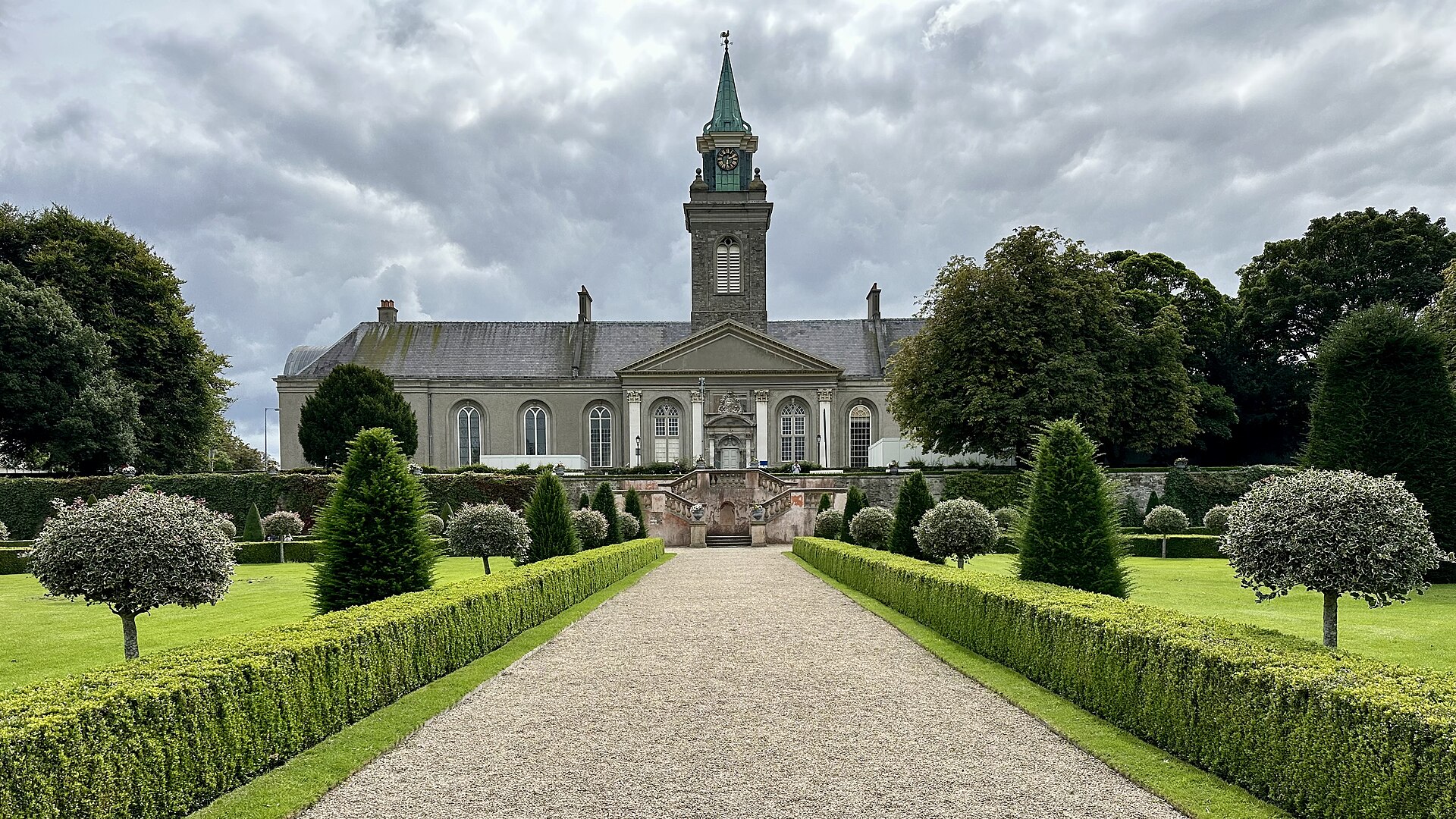
The south front of the Royal Hospital Kilmainham, seen across its formal garden. The building has housed the Irish Museum of Modern Art since 1991.
Thoslee, CC BY-SA 4.0Irish Museum of Modern Art
Museum · Founded 1991
Open, admission and hours confirmed 2 September 2026 · 18 sources
On this page 16 sections
ContentsClose
IMMA's strength is depth in postwar and contemporary practice rather than historical range: the National Collection begins essentially in the 1940s and is heaviest from the 1960s onward, split between an internationally minded founding gift, built around figures from Gordon Lambert's own collecting circle such as Bridget Riley, Victor Vasarely and Joseph Beuys, and three decades of subsequent acquisition weighted toward Irish artists working in the same period, from Sean Scully and Alice Maher to a wider range shown through the National Programme outside Dublin. Its closest comparison in this archive is neither the National Gallery of Ireland, an Old Masters collection with no post-1940 emphasis, nor the Hugh Lane Gallery, Dublin City's own modern collection on a much smaller Georgian-house scale; IMMA is the Irish state's dedicated national institution for modern and contemporary art, housed in a seventeenth-century building that predates almost everything in its collection by close to three hundred years.
| Kind | Museum |
|---|---|
| Founded | 1991 |
| City and country |  Dublin, Ireland Dublin, Ireland |
| Address | IMMA, Royal Hospital, Military Road, Kilmainham, Dublin 8, D08 FW31, Ireland |
| Website | imma.ie |
| Status | Open, confirmed |
| Record last verified |
Visiting
- Hours
- Tue, Thu-Sat10:00 to 17:30Last admission to any individual exhibition gallery is 17:15
- Wed11:30 to 17:30
- Sun and Bank Holidays12:00 to 17:30
- Closed
- Monday, except Bank Holidays.
- Admission
- General admissionFreeFree for the museum and, in the museum's own words, for entrance to most of its exhibitions; the visit page does not name any exhibition currently charging a separate fee, though it does not rule one out for a future show
- Tickets
- imma.ie/visit The museum's own ticket page.
- Do I need to book?
- No for general admission; the museum's visit page directs anyone wanting a guided tour to contact Front of House by email in advance
- Address
- IMMA, Royal Hospital, Military Road, Kilmainham, Dublin 8, D08 FW31, Ireland MapLuas Red Line to Heuston Station, then an 8 minute walk via Military Road
Rail 8 minute walk from Heuston Station, Dublin's main rail terminus
Bus Routes 145 and C1-C4 to Heuston Station; routes 13, 73, G1 and G2 to St James's Hospital; both stops an 8 minute walk from the museum
Bicycle Dublin Bikes stations at Military Road and Kilmainham Lane; on-site bicycle parking at the rear of the building - Website
- imma.ie
- Telephone
- +353 1 612 9900
- [email protected]
Before you go how long, access, photography, bags, eating, shop
- How long to allow
- Not stated by the museum in figures; the building alone covers a former army-pensioner complex of several wings around a large courtyard, plus formal gardens
- Access
- The museum states the site and grounds are fully accessible, with lifts in every building and adapted toilets and baby-changing facilities in the main building and across the campus
- Photography
- Not stated on the museum's visit page at the time of this research
- Bags
- Not stated on the museum's visit page at the time of this research
- Eating
- Fruition, with an outdoor courtyard cafe and an indoor cafe in the original vaulted cellars of the Royal Hospital
- Shop
- The IMMA Shop, first floor of the main building, plus an online shop at theimmashop.com
Prices and hours change. We take them from the institution's own pages and print the day we read them, and you can check the current position at the source we used. Confirm before you travel.
What is inside
Main building galleries (East, West and South ranges, first floor)
Rooms converted in 1990-91 from the pensioners' corridor-accessed quarters into a run of interconnected galleries; they carry rotating displays drawn from the National Collection of Modern and Contemporary Art, including the long-running survey IMMA Collection: Art as Agency, which brings together work by more than 100 artists from the 1960s to the present.
Courtyard Galleries, West Wing (ground floor)
Fitted out in 1988 as the first part of the building given over to modern art, to hold the founding Gordon Lambert gift; the West Wing was named for Lambert in 1999 and its ground-floor rooms remain exhibition space opening onto the courtyard.
New Galleries
The former Deputy Master's House, restored by the Office of Public Works in 2000 into an environmentally controlled space adding 320 square metres of exhibition area, used for major temporary and loan exhibitions distinct from the historic first-floor rooms.
Garden Galleries
Exhibition space in the grounds beyond the main building; it housed the dedicated Freud Centre during the IMMA Collection: Freud Project, a 2016-2021 loan of 50 works by Lucian Freud, and continues to show temporary exhibitions.
The Courtyard
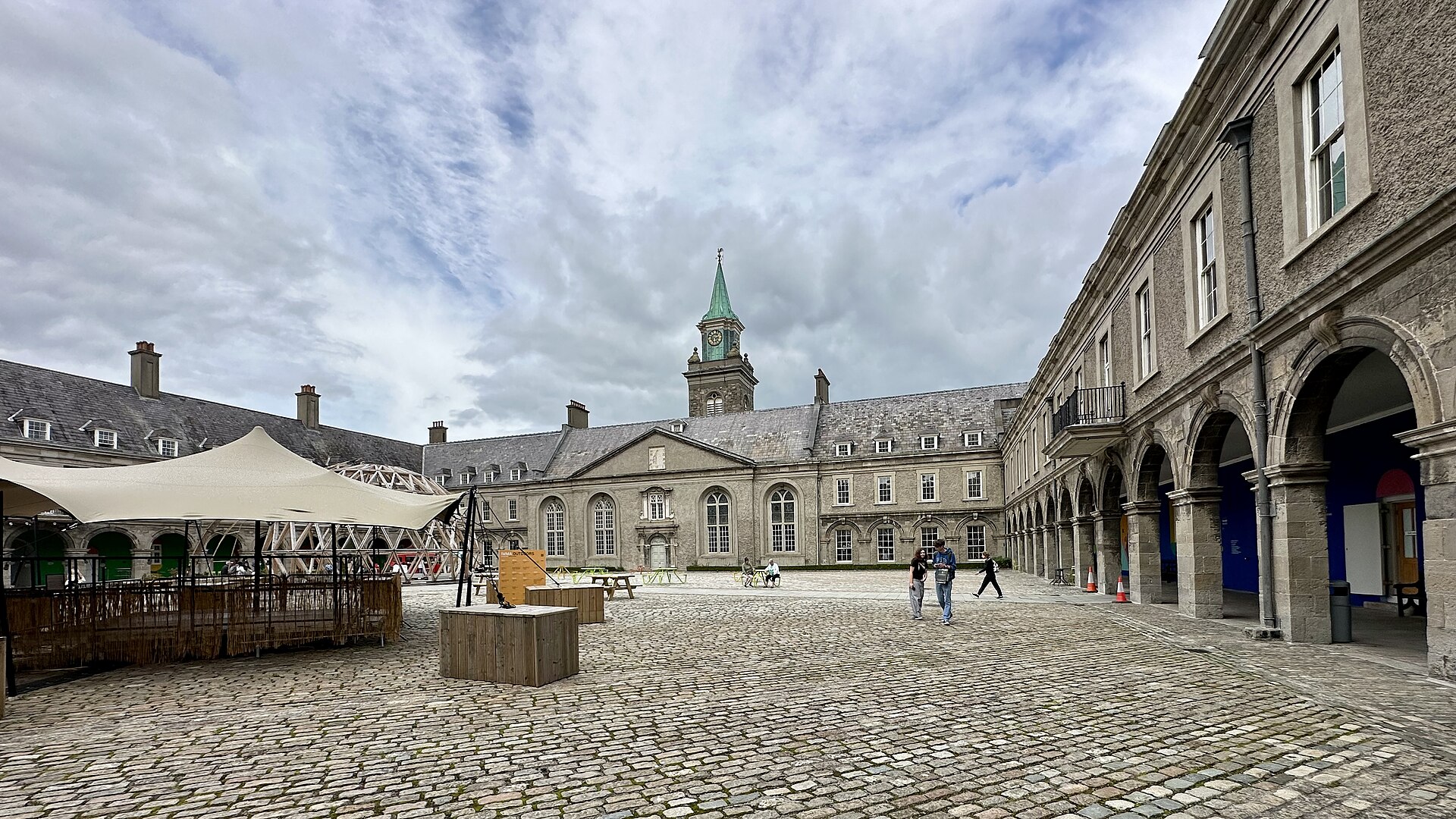
The large paved and cobbled courtyard at the centre of the building, enclosed on four sides by the Baroque facade with its arcaded ground floor; used for outdoor sculpture, installation and public programming, and the site of the building's clock tower.
Robinson's Chapel and the Great Hall (North Wing)
The one range of the building excluded from the 1990s museum conversion. The chapel has a Baroque plaster ceiling dedicated to the memory of King Charles I, carved oak fittings and a stained-glass window; together with the adjoining Great Hall and Master's Quarters it survives as a heritage-trail space used for concerts and events rather than as exhibition galleries.
What to see first
from Nineteen Greys, B
Bridget Riley1968 screenprint from the founding Gordon Lambert gift, representing the Op Art strand Lambert built into the collection from the museum's earliest years7
Lant
Victor Vasarely1968 acrylic on canvas, from the same founding gift and part of the collection's early emphasis on kinetic and optical abstraction7
Poster signed for Gordon Lambert
Joseph Beuys1970 poster inscribed to Lambert, a direct link between the collector whose donation founded IMMA's collection and one of postwar Europe's most influential conceptual artists7
Boy and Seagull
Patrick Hennessy1949 oil on canvas from the Gordon Lambert gift, representing the mid-century Irish realist painting Lambert collected alongside international abstraction7
Portrait of David Hendriks
Robert Ballagh1972 portrait of the Dublin gallerist David Hendriks, from the Gordon Lambert Collection7
7.7.91 in memory of Robin Walker
Sean ScullyPastel on paper donated by Scully to IMMA in 1991, the year of both the work and the museum, made two years after his Turner Prize nomination9
The Painter's Room
Lucian Freud1944 painting from Freud's first solo exhibition; one of 50 Freud works IMMA held on long-term loan for the 2016-2021 Freud Project, which the museum says made Dublin, for the length of the loan, the most comprehensive place to see Freud's work outside a single retrospective8
Exhibitions on now
- On now12 Sep 2026 to 9 May 2027Confirmed , 6 weeks ago
Past exhibitions here
- Closed6 Mar to 13 Sep 2026Confirmed · check before you travel
A hospital before it was a museum
The building the Irish Museum of Modern Art occupies was not built for art. The Royal Hospital Kilmainham was founded by James Butler, Duke of Ormonde and Viceroy to King Charles II, who laid its foundation stone in 1680; construction ran through 1684 under the State Surveyor General, William Robinson, on a site that had earlier held a hospital founded by Strongbow and run by the Knights of St John, demolished in 1670. Robinson modelled the new building on Les Invalides in Paris, then recently built as a home for French army veterans, and the museum's own history describes the result as the first classical and secular building of scale in Ireland: a formal facade wrapped around a large enclosed courtyard, in a Classical and Baroque style.
For more than two centuries the Royal Hospital housed retired soldiers of the Irish Army, on the model of the Royal Hospital Chelsea in London. In the nineteenth century it became the residence and headquarters of the Commander in Chief of the army in Ireland and was visited twice by Queen Victoria. The pensioners' home closed in 1927; the building passed to the Irish Free State in 1922 and was later used by the Garda Siochana as a headquarters, from 1930 to 1950, and by the National Museum of Ireland as a store, holding items including a statue of Queen Victoria and state carriages. By the mid twentieth century one of Dublin's few surviving seventeenth-century buildings of scale was standing largely empty.
From barracks to gallery
The Office of Public Works restored the Royal Hospital between 1980 and 1984, work recognised with a Europa Nostra Award in 1986. Converting the restored building into a museum took place in further stages through the following decade: the basement of the North Wing was fitted out as a restaurant in 1987, and in 1988 the West Wing ground floor was prepared to hold the Gordon Lambert Collection, the first part of the building given over to modern art. The full conversion of the East, West and South ranges into gallery space, designed by architect Shay Cleary, began in October 1990; the North range, which holds the Great Hall, the Master's Quarters and the chapel, was left outside the museum scheme. Cleary's plan added a new entrance hall with a cascading staircase in the South range and turned first-floor rooms that had been reached only by corridor into a sequence of galleries; the courtyard itself was repaved in stone and cobble. The state has put the cost of the adaptation at around 1.39 million euro, funded mainly through the National Lottery.
The Irish Museum of Modern Art opened on 25 May 1991, under the name it still carries, opened by then Taoiseach Charles Haughey. The museum's founding is tied to one collector: Gordon Lambert, a Dublin businessman and long-time patron of contemporary art, offered to donate his collection to the state if a gallery for modern art was established, and the National Collection of Modern and Contemporary Art was begun in 1990 on that basis. Lambert went on to give more than 300 works to IMMA in 1992, and the museum's West Wing was named for him in 1999. In 2000 the Office of Public Works completed a further restoration, of the former Deputy Master's House, converting it into the environmentally controlled New Galleries and adding 320 square metres of exhibition space. IMMA's own published history notes that the adaptation scheme was, at the time, the subject of some controversy among architectural critics, for and against the changes made to a historic building.
The collection
IMMA holds the National Collection of Modern and Contemporary Art on behalf of the Irish state. The museum's own published figure puts the collection at over 4,500 works by Irish and international artists, with a stated emphasis on work made from the 1940s onward and material added most years by donation, purchase or loan. The founding gift, from Gordon Lambert, gave the collection an early character weighted toward Op and kinetic art and international abstraction: it includes Bridget Riley's screenprint from Nineteen Greys, B (1968), Victor Vasarely's Lant (1968, acrylic on canvas), a 1970 poster signed for Lambert by Joseph Beuys, Patrick Hennessy's Boy and Seagull (1949) and Robert Ballagh's Portrait of David Hendriks (1972). Lambert's own archive of letters, photographs and printed ephemera documenting six decades of patronage has been held at IMMA since 2005.
Irish artists remain central to the collection. Sean Scully, who had been nominated for the Turner Prize in 1989, donated the pastel 7.7.91 in memory of Robin Walker to IMMA in 1991, the year both the work and the museum were made. Alice Maher's holdings in the collection include the silk-handkerchief works The Conversation and Leda's Choice, both from 2013, and the two-channel video Cassandra's Necklace (2012). The collection's most publicised international loan was the IMMA Collection: Freud Project, which ran from October 2016 to 2021 and put 50 works by Lucian Freud, 30 paintings and 20 works on paper, on long-term display in a dedicated Freud Centre in the museum's Garden Galleries; the museum has said the arrangement made Dublin, for the length of the loan, the most comprehensive place in the world to see Freud's work outside a single retrospective. Beyond Kilmainham, IMMA also runs a National Programme that circulates works from the collection to venues around Ireland.
Inside the Royal Hospital
Nothing in the building was designed as a gallery, and the museum's spaces still carry the plan of a seventeenth-century soldiers' home. The first floor of the East, West and South wings, originally reached only by corridor, was converted in 1990-91 into a run of interconnected rooms that now carry rotating displays from the National Collection; a long-running example is IMMA Collection: Art as Agency, a survey bringing together more than 100 artists from the 1960s to the present. The ground floor of the West Wing, prepared in 1988 to hold the founding Gordon Lambert gift, remains exhibition space off the courtyard. The New Galleries, in the former Deputy Master's House, were added in 2000 as an environmentally controlled 320 square metre space for major loan and temporary exhibitions, distinct from the older first-floor rooms. The Garden Galleries, on the grounds beyond the main building, housed the Freud Centre during the 2016-2021 loan and continue to show temporary work.
At the centre of the building is the paved and cobbled courtyard, enclosed on four sides by the Baroque facade and used for outdoor sculpture, installation and public programming. The North Wing, excluded from the 1990s conversion, still holds the Great Hall and Robinson's chapel, with its Baroque plaster ceiling dedicated to the memory of King Charles I, carved oak and a stained-glass window; these historic rooms remain part of the site's heritage trail and are used for concerts and events rather than as exhibition galleries. The former stables at the rear of the site have been converted into artists' studios supporting IMMA's residency programme.
A museum arguing with its landlord
IMMA does not own the building it occupies. The Royal Hospital Kilmainham belongs to the state and is managed by the Office of Public Works, which restored and converted it for the museum in the first place, and that arrangement became openly adversarial in 2026. IMMA board member John McLaughlin raised concerns in January that a draft Conservation Management Plan for the site was, in places, at odds with guidance from the International Council on Monuments and Sites. IMMA's board chair, Ali Curran, wrote to the OPW on 18 February asking that the plan be brought in line with international best practice, and separately told the Department of Culture's secretary general, in a letter of 14 January, that the museum's cultural significance and its contribution to Irish life were being entirely overlooked by the draft; IMMA director Annie Fletcher wrote again on 1 April and, according to the museum's own account, engaged legal advice over clauses it read as contradicting the existing management agreement between IMMA and the OPW.
The OPW rejected the criticism in terms as strong as IMMA's own. An internal OPW memo dated 16 April, released under Freedom of Information law, described the Conservation Management Plan as built on best practice and drafted by an internationally recognised architecture firm, and called IMMA's objections wholly incorrect; a further OPW statement characterised IMMA's remarks as disparaging and completely unacceptable. IMMA, for its part, engaged a public relations firm in March to manage communications around the dispute. Representatives of both bodies met in August 2026 and described the meeting as constructive, with a further meeting due in September 2026 to try to finalise the plan; as of this record's last check, the Conservation Management Plan remained in draft, and the underlying disagreement, over how much control of a historic, state-owned building a national museum should be guaranteed, was unresolved.
The dispute is not the only friction the museum's own record acknowledges. IMMA's published history notes that critics were divided over the 1990s adaptation scheme itself, and Irish Times critic Hugh Linehan, reviewing IMMA's thirtieth-anniversary programme in 2021, argued that four themed exhibitions built around queer rights, the environment, textile activism and protest reduced three decades of practice to an instrumental, campaigning view of art, and that the programme sidestepped harder questions about a state-funded institution positioning itself against establishment power.
Visiting
Admission to IMMA is free, and the museum states that entrance to most of its exhibitions is free as well; the museum's own visit information does not name a currently ticketed exhibition. The site is open Tuesday, Thursday, Friday and Saturday from 10.00am to 5.30pm, Wednesday from 11.30am to 5.30pm, and Sunday and Bank Holidays from noon to 5.30pm; it is closed on Mondays except Bank Holidays, and last admission to any individual exhibition gallery is 5.15pm.
The site and grounds are described by the museum as fully accessible, with lifts in every building and adapted toilets and baby-changing facilities in the main building and around the campus. Fruition operates as the on-site cafe, with an outdoor courtyard seating area and an indoor cafe in the original vaulted cellars of the Royal Hospital; the museum shop is on the first floor of the main building, with a separate online shop. On-site parking is paid, from 3 euro for up to three hours to 15 euro for six hours or more, and free WiFi is available for thirty minutes at a time.
The Royal Hospital sits an eight-minute walk from Heuston Station, Dublin's main rail terminus, reached by the Red Line Luas or by bus routes 145 and C1 to C4; bus routes 13, 73, G1 and G2 stop near St James's Hospital, also an eight-minute walk from the museum, and hop-on hop-off tourist buses stop at the Military Road entrance. Dublin Bikes stations sit at Military Road and Kilmainham Lane, and bicycle parking is provided at the rear of the building.
What visitors say
Visitors consistently value that admission is free for the museum and for most exhibitions, and they single out the scale and calm of the Kilmainham building and its formal grounds, along with the on-site cafe, the museum shop and free guided walking tours covering the building's history. Opinion is more divided on the contemporary art itself: some visitors describe galleries that reward a few unhurried hours, while others find the current programme not to their taste, and at least one recent account describes a front-of-house welcome that fell short of the setting. A recurring practical complaint is wayfinding, with more than one visitor describing difficulty locating a map to navigate between the museum's separate exhibition spaces.
What is praised, what is criticised
- Praised: Free admission to the museum and to most exhibitions
- Praised: The seventeenth-century Royal Hospital building and its formal gardens
- Praised: The on-site cafe (Fruition) and the museum shop
- Praised: Free guided walking tours covering the building's history
- Criticised: Wayfinding between galleries: more than one visitor reports difficulty finding a map or working out which exhibitions are on
- Criticised: At least one recent visitor reported an unwelcoming front-of-house desk and no WiFi code offered to access the exhibition map
- Criticised: The contemporary programme divides opinion; some visitors find it less accessible, or less to their taste, than more traditional collections nearby
Ratings on other platforms
Tripadvisor: 3.5 from 589 ratings, read 2 September 2026
A platform average is a tertiary source: it moves, it is not audited, and we quote no visitor's words.
Questions about Irish Museum of Modern Art
Where is Irish Museum of Modern Art?
IMMA, Royal Hospital, Military Road, Kilmainham, Dublin 8, D08 FW31, Ireland.
How much does it cost to visit?
General admission: free. As confirmed 2 September 2026.
When is it open?
Tue, Thu-Sat 10:00-17:30; Wed 11:30-17:30; Sun and Bank Holidays 12:00-17:30. Closed: Monday, except Bank Holidays. As confirmed 2 September 2026.
How do you get there?
Luas: Red Line to Heuston Station, then an 8 minute walk via Military Road; Rail: 8 minute walk from Heuston Station, Dublin's main rail terminus; Bus: Routes 145 and C1-C4 to Heuston Station; routes 13, 73, G1 and G2 to St James's Hospital; both stops an 8 minute walk from the museum; Bicycle: Dublin Bikes stations at Military Road and Kilmainham Lane; on-site bicycle parking at the rear of the building.
What should you see first?
from Nineteen Greys, B (Bridget Riley); Lant (Victor Vasarely); Poster signed for Gordon Lambert (Joseph Beuys); Boy and Seagull (Patrick Hennessy); Portrait of David Hendriks (Robert Ballagh); 7.7.91 in memory of Robin Walker (Sean Scully).
What we could not confirm
- IMMA's own published collection totals vary between roughly 3,500 and 4,900 works depending on the page and the date it was last updated; this record uses the museum's most recently read figure (over 4,500 works) rather than resolving the discrepancy.
- The 2026 dispute between IMMA and the Office of Public Works over the draft Conservation Management Plan for Royal Hospital Kilmainham was unresolved at last check, with a further meeting scheduled for September 2026; the outcome should be re-confirmed before this record is next updated.
Images
Sources
- 1IMMA, Visit page (hours, admission, accessibility, cafe, shop, parking, WiFi) imma.ie/visit/
- 2IMMA, About page (mission, collection size, building address) imma.ie/about/
- 3IMMA, Collection overview page imma.ie/collection/
- 4IMMA, History of the Site (Royal Hospital Kilmainham building history) imma.ie/about/rhk-building-and-site/history-of-the-site/
- 5IMMA, Transformation of the Building for IMMA (restoration and conversion history) imma.ie/about/rhk-building-and-site/transformation-of-the-building-for-imma/
- 6IMMA, Heritage Trail: Royal Hospital (rooms and spaces) imma.ie/heritage-trail/royal-hospital/
- 7IMMA, IMMA Collection: Gordon Lambert Collection (magazine feature) imma.ie/magazine/imma-collection-gordon-lambert-collection/
- 8IMMA, press release: IMMA Collection: Freud Project 2016-2021 imma.ie/about/press-centre/imma-collection-freud-project-2016-2021/
- 9IMMA Collection, 7.7.91 in memory of Robin Walker (Sean Scully) imma.ie/collection/7-7-91-in-memory-of-robin-walker/
- 10IMMA, Directions and public transport page imma.ie/visit/info/directions/?path=subnav_92.htm
- 11IMMA, Contact Us page (phone, postal address) imma.ie/about/overview/contact-us/
- 12Wikipedia, Irish Museum of Modern Art (, identity and history cross-check) en.wikipedia.org/wiki/Irish_Museum_of_Modern_Art
- 13Wikipedia, Royal Hospital Kilmainham (, building history cross-check) en.wikipedia.org/wiki/Royal_Hospital_Kilmainham
- 14Wikidata, Q1538285 (, identity and coordinates confirmation) wikidata.org/wiki/Q1538285
- 15The Irish Times, 'Imma seeks legal advice amid escalating row with OPW over Kilmainham plans', 25 February 2026 irishtimes.com/ireland/2026/02/25/imma-seeks-legal-advice-amid-escalating-row-with-opw-over-kilmainham-plans/
- 16The Irish Times, 'OPW says Imma remarks on Kilmainham plan disparaging and completely unacceptable', 18 August 2026 irishtimes.com/culture/art/2026/08/18/opw-says-imma-remarks-on-kilmainham-plan-disparaging-and-completely-unacceptable/
- 17The Irish Times, Hugh Linehan, 'Imma's relentlessly on-message programme highlights its identity crisis', 31 July 2021 irishtimes.com/culture/art-and-design/visual-art/imma-s-relentlessly-on-message-programme-highlights-its-identity-crisis-1.4633899
- 18Tripadvisor, Irish Museum of Modern Art (IMMA) listing and reviews ( rating and visitor-consensus source) tripadvisor.com/Attraction_Review-g186605-d214986-Reviews-Irish_Museum_of_Modern_Art_IMMA-Dublin_County_Dublin.html