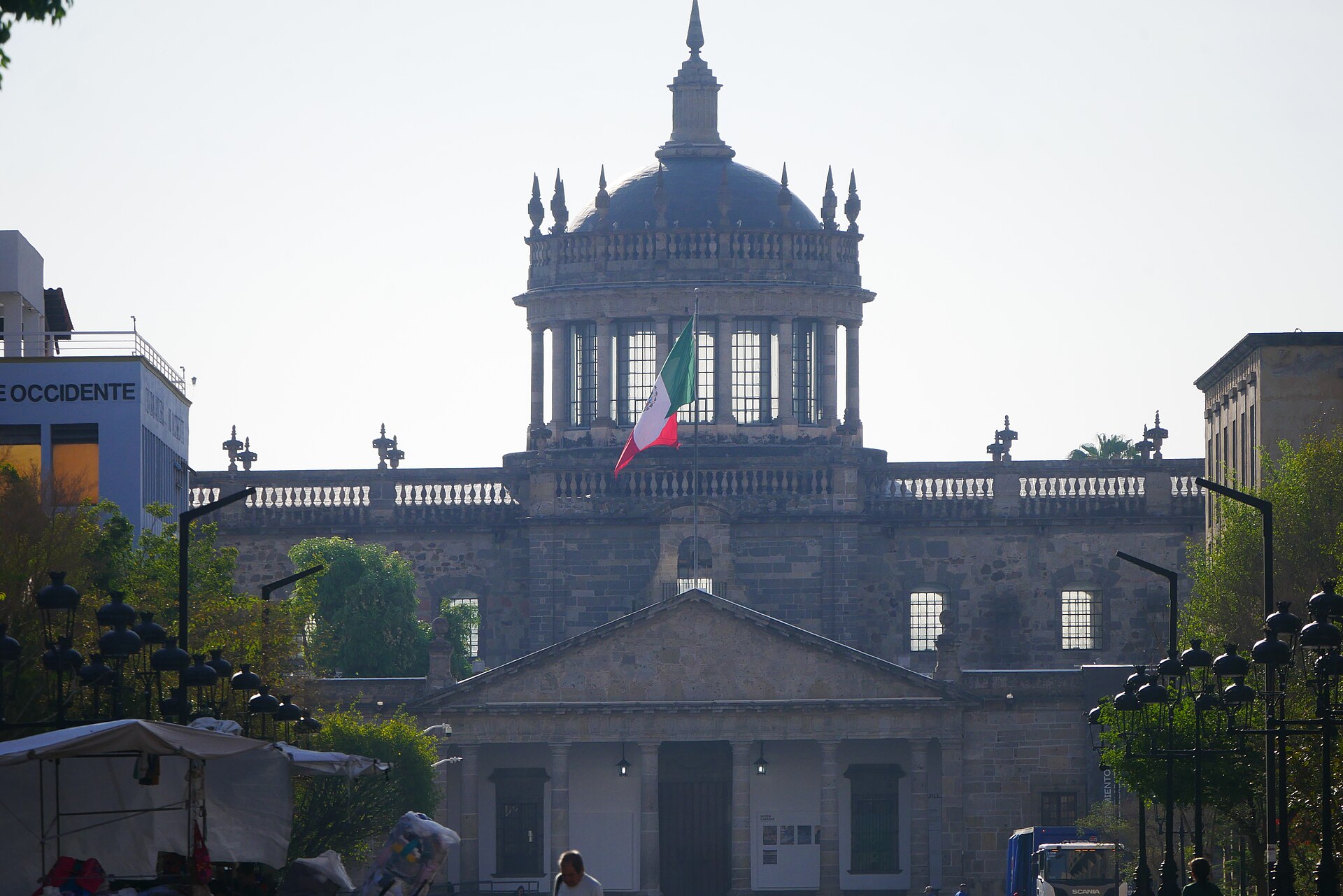
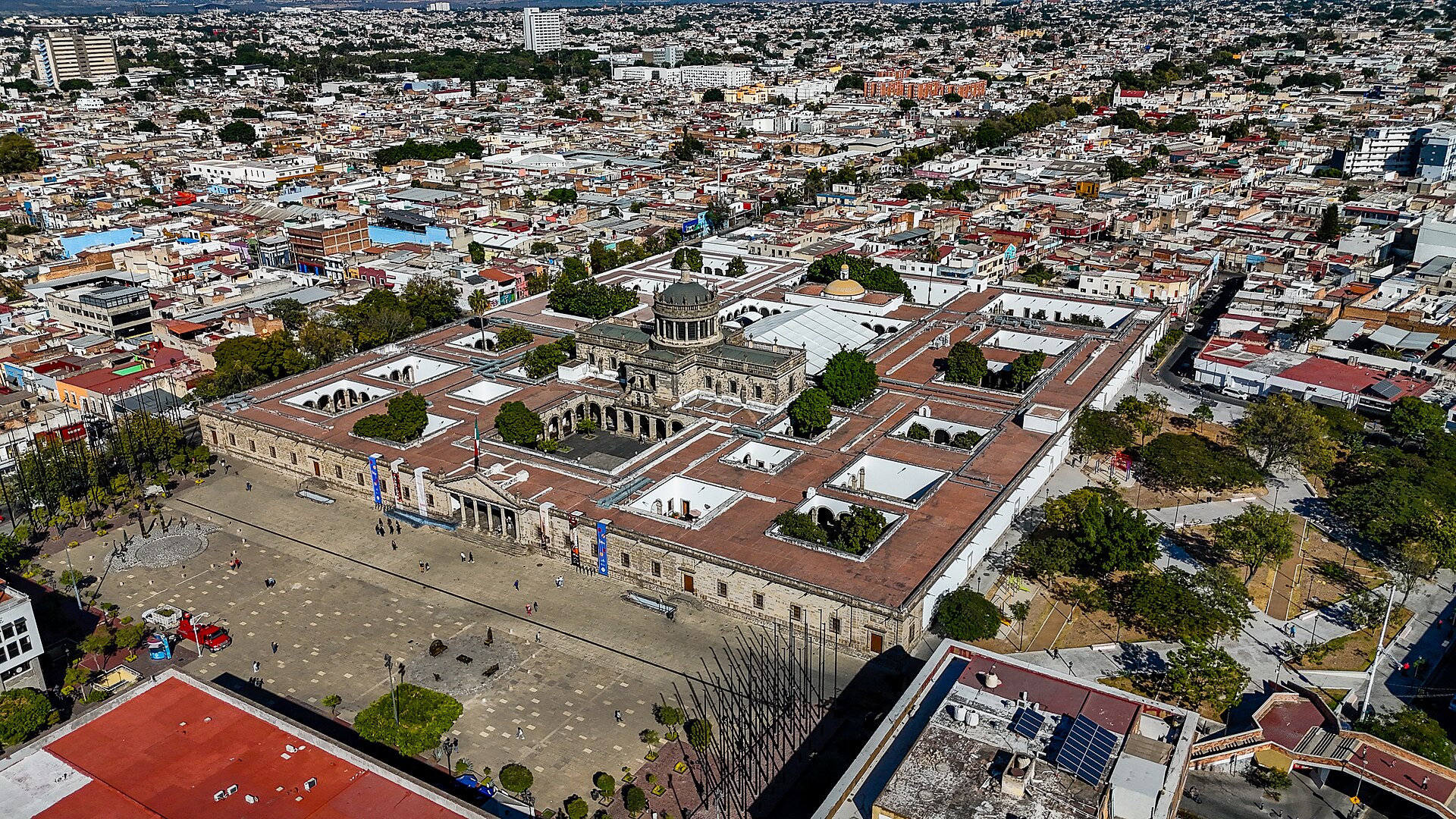
The neoclassical facade and chapel dome of the Hospicio Cabanas, seen from the Plaza Tapatia in Guadalajara, Mexico.
Photograph by Luisalvaz, CC BY-SA 4.0, via Wikimedia CommonsInstituto Cultural Cabanas
Museum · Instituto Cultural Cabañas · Founded 1810
Open, admission and hours confirmed 18 September 2026 · 17 sources
On this page 15 sections
ContentsClose
The museum's core strength is a single unrepeatable one: it holds the building Jose Clemente Orozco painted for, the actual walls, vaults and dome of the Capilla Mayor, rather than a canvas or a print that could in principle hang anywhere else. That is not true of any other Orozco site, including the murals he painted in Mexico City, Orizaba, or at Dartmouth College in the United States, none of which were designed as the artist's own devotional space in the way the chapel's fresco program was. Around that core the institute has built real depth rather than padding: a 340-piece Orozco works-on-paper collection tracing his full career, a viceregal-to-contemporary collection of its own, a dedicated survey of twentieth-century Jalisco art, and close to 1,500 pieces of Mexican folk art across two combined holdings. Few museums anywhere pair a single unmovable masterpiece of this scale with four actively curated collections under the same UNESCO-listed roof.
| Local name | Instituto Cultural Cabañas |
|---|---|
| Kind | Museum |
| Founded | 1810 |
| City and country |  Guadalajara, Mexico Guadalajara, Mexico |
| Address | Calle Cabanas No. 8, Colonia Las Fresas, Plaza Tapatia, CP 44360, Guadalajara, Jalisco, Mexico |
| Website | museocabanas.jalisco.gob.mx/es |
| Status | Open, confirmed |
| Record last verified |
Visiting
- Hours
- Tue-Sun10:00 to 17:00
- MondayClosed
- Closed
- Monday.
- Admission
- GeneralMXN 80
- With valid official ID or national driver's licenseMXN 55
- Teachers, students, seniors and children age 6-12 (valid ID required)MXN 30
Free entry: Tuesday, general public- Do I need to book?
- No advance booking is needed for general admission. Free guided tours of the Capilla Mayor run on a fixed daily timetable, Tuesday to Saturday in Spanish at 11:30, 12:30, 13:30, 14:30 and 15:30, and in English at 12:30 and 15:30; Sunday in Spanish at 11:30, 12:30, 13:30 and 14:30, and in English at 13:00. Tours can be requested at the Visitor Attention desk beside the entrance and are not bookable online
- Address
- Calle Cabanas No. 8, Colonia Las Fresas, Plaza Tapatia, CP 44360, Guadalajara, Jalisco, Mexico Map
- Website
- museocabanas.jalisco.gob.mx/es
- Telephone
- +52 33 3668 16 42 ext. 31014 / +52 33 3668 16 45
Before you go how long, access, photography, bags, eating, shop
- How long to allow
- The guided tour of the frescoes alone is a brief, focused walk through the chapel; visitors commonly spend two to three hours to also take in the four collection rooms and the courtyards
- Access
- Not published in specific terms by the museum at the time of research; its own FAQ page lists a question on access for people with disabilities but had not published an answer
- Photography
- Not confirmed in the source material read for this page
- Bags
- Not confirmed in the source material read for this page
- Eating
- Not confirmed in the source material read for this page; no cafe was mentioned on the museum's own pages consulted
- Shop
- The museum's own FAQ page lists a question on where to buy its publications, but had not published an answer; no shop location or hours could be confirmed
Prices and hours change. We take them from the institution's own pages and print the day we read them, and you can check the current position at the source we used. Confirm before you travel.
What is inside
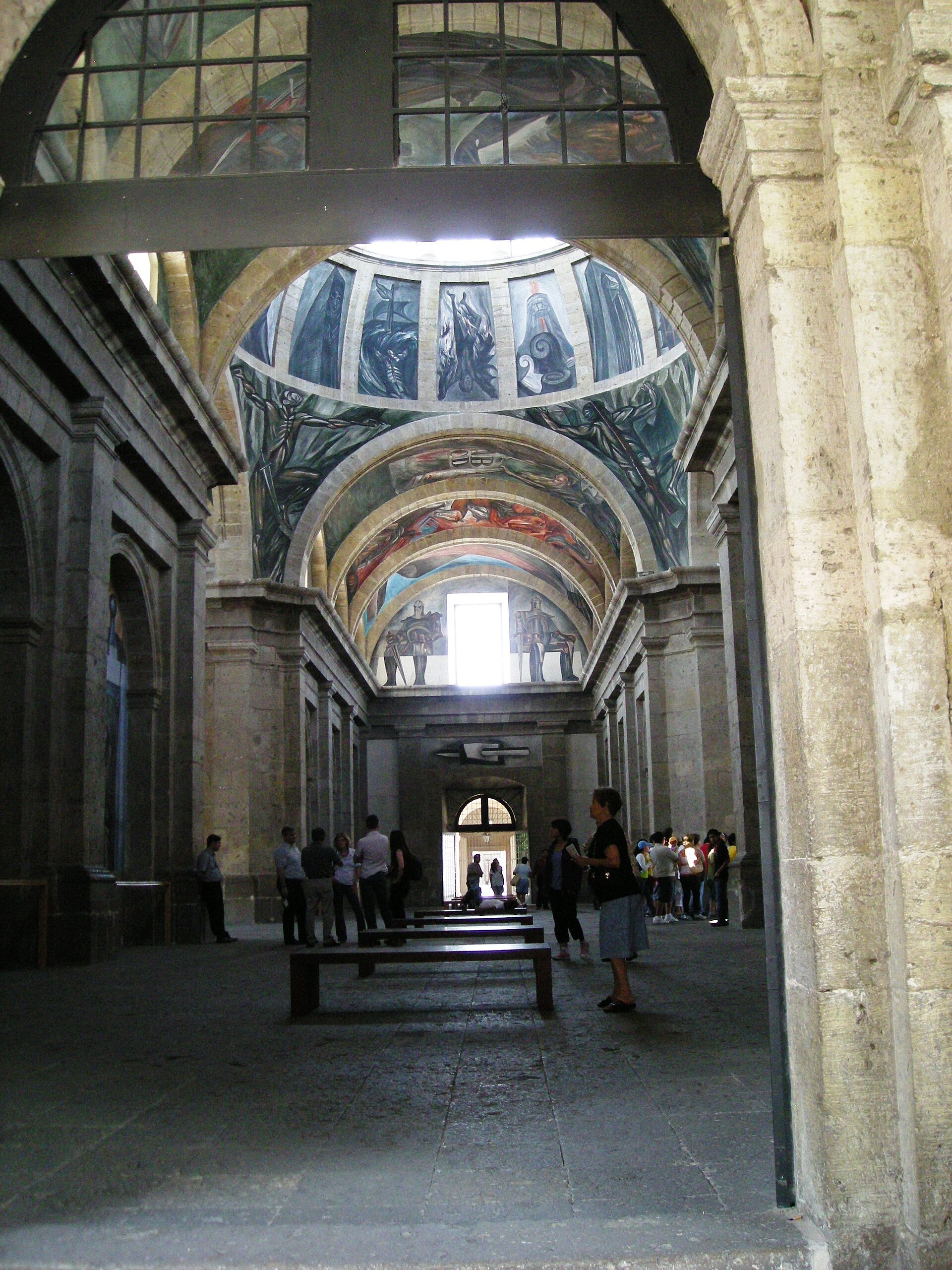
Photograph by AlejandroLinaresGarcia · CC BY-SA 4.0 Capilla Mayor (Main Chapel)
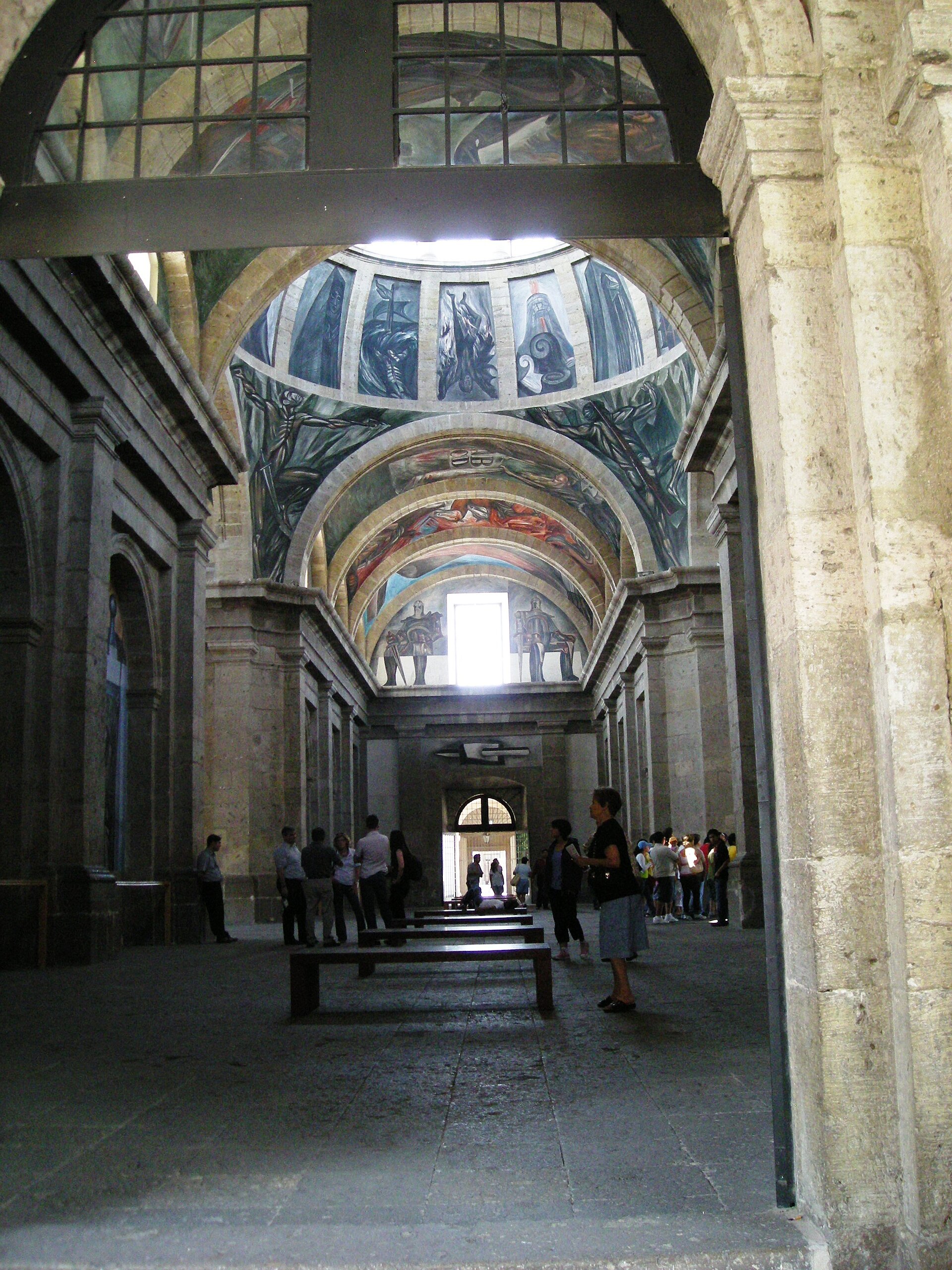
The domed former chapel at the heart of the complex, its walls, vaults and cupola covered by the 57 frescoes Jose Clemente Orozco painted here between 1937 and 1939; the single most-visited space in the building and the reason most visitors come
Coleccion Jose Clemente Orozco (works on paper)
340 pieces held on comodato loan from the national fine arts institute (INBA), spanning Orozco's full mural and graphic career: sketches for his 1920s Mexico City commissions at the Escuela Nacional Preparatoria and the Casa de los Azulejos, studies from his years in the United States, and the pyroxylin-on-masonite panels and charcoal studies he made in his last years, 1945 to 1949
Coleccion Instituto Cultural Cabanas
178 paintings, drawings, prints and sculptures spanning the viceregal period to the present, assembled through donations, legacies from other Jalisco state collections, and visual-arts competitions and grants; the group includes work by Tamara de Lempicka, Gilberto Aceves Navarro, Irma Serna and Gustavo Aranguren
Coleccion del Pueblo de Jalisco
84 paintings, sculptures, drawings and installations tracing modern Jalisco art from the early-20th-century painters Jorge Enciso and Amado de la Cueva through Mexican-school figures such as Dr. Atl, Raul Anguiano and Roberto Montenegro to postwar abstraction and contemporary artists including Jorge Mendez Blake and Jose Davila; assembled for the state from 1964 and moved here permanently in 1983
Coleccion de Artes Populares
Close to 1,500 pieces of Mexican folk art across two combined holdings: the roughly 1,000-piece Roberto Montenegro collection, on comodato loan from the national fine arts institute since 2005, and the museum's own 425-piece collection built by the Jalisco state culture ministry since 1983, spanning ceramics, basketry, stone and bone carving, woodwork and blown glass from the late 19th century onward
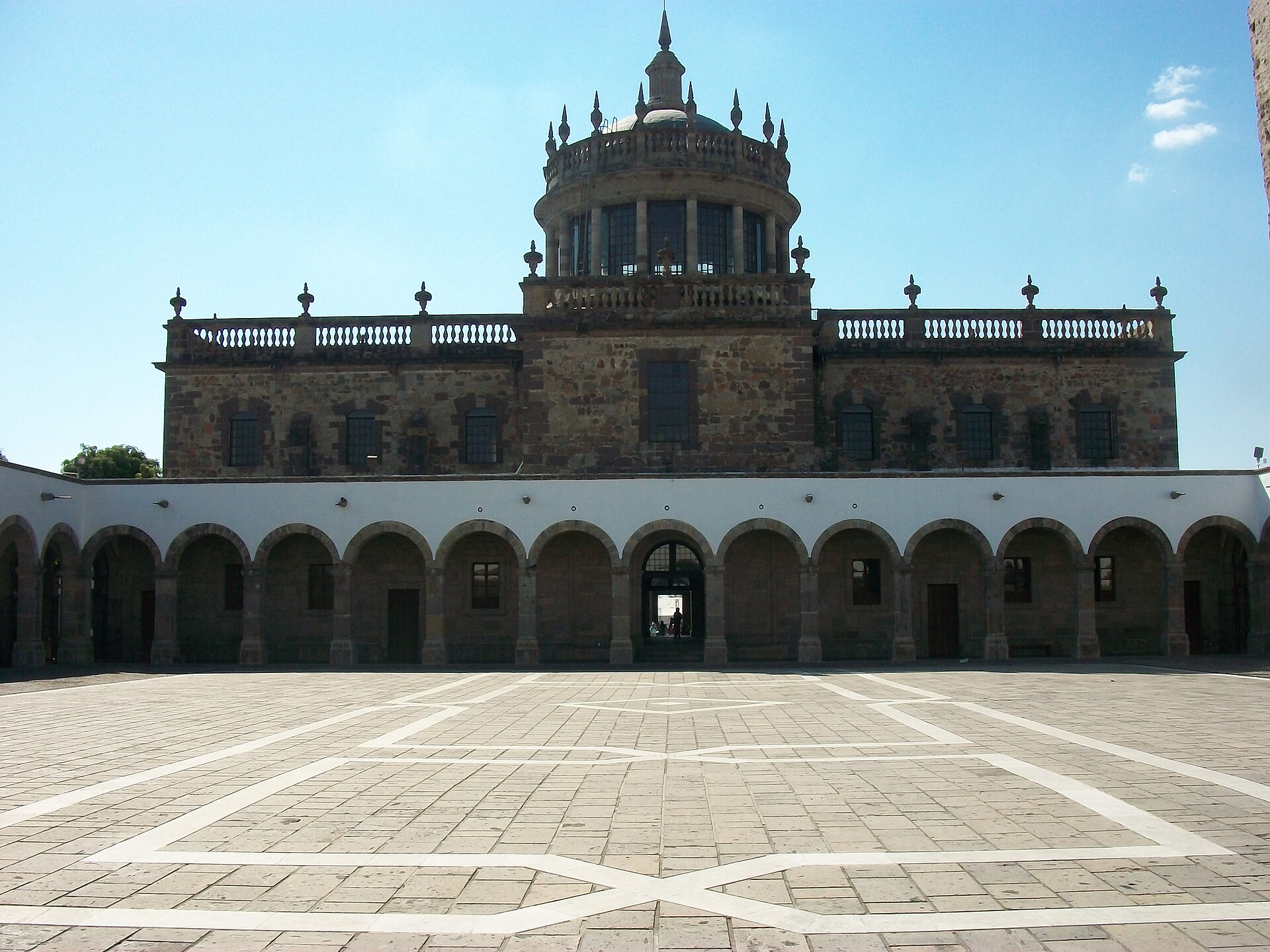
Photograph by Salvador alc · CC BY-SA 3.0 The 23 courtyards and corridors
The building's original single-storey plan, arranged around 23 courtyards of varying sizes linked by covered, arcaded corridors that once carried light and air to the orphanage's wards; in 2014 the French artist Daniel Buren installed site-specific interventions - striped columns, painted vaults and mirrored structures - in 18 of them
What to see first
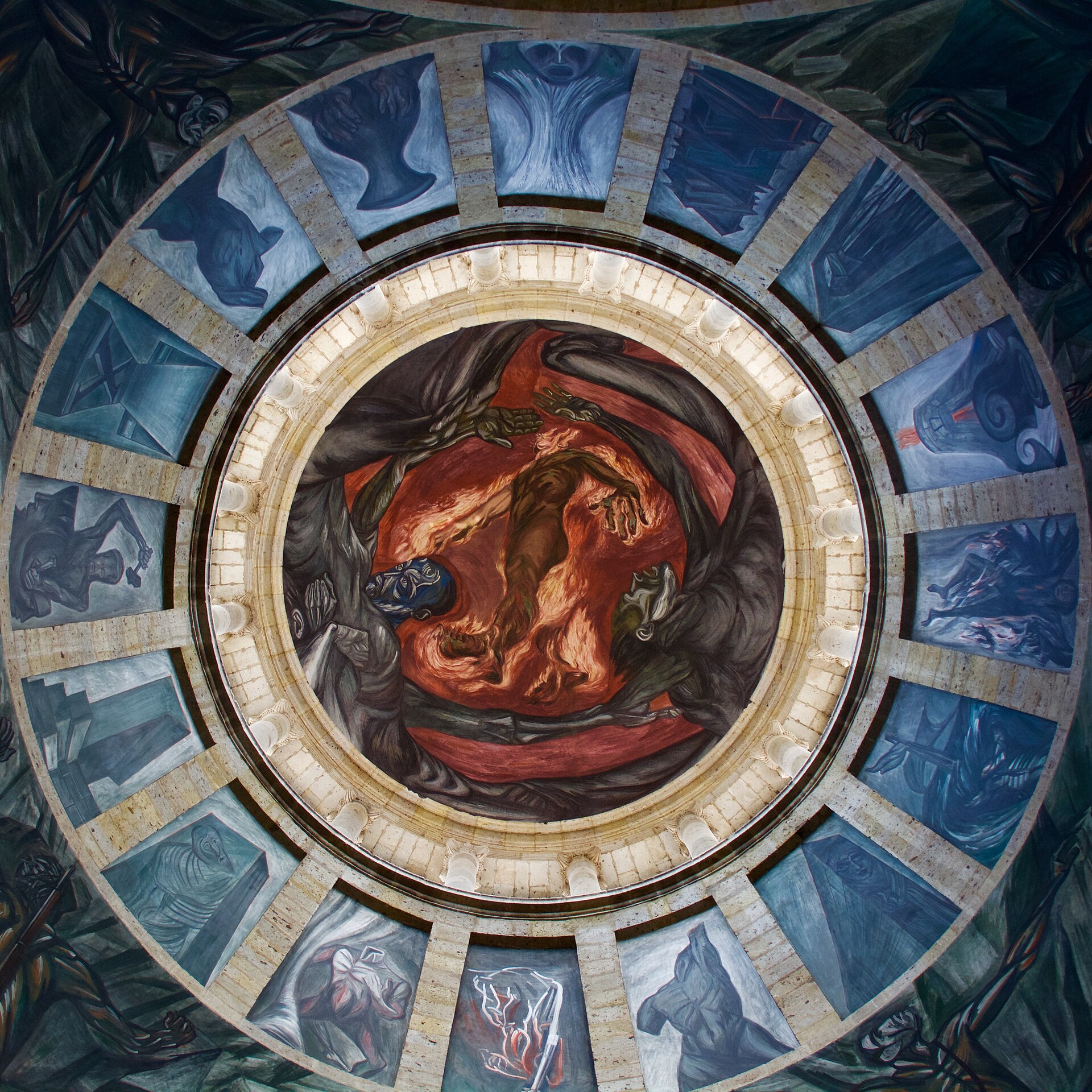
El Hombre de Fuego (The Man of Fire)
Jose Clemente Orozco, 1937-1939Painted directly onto the underside of the chapel's cupola, a figure Orozco had first conceived for an unbuilt Monument to the Revolution before repurposing it here; still called by critics his masterpiece11
Cortes y el Fraile (Cortes and the Friar)
Jose Clemente Orozco, 1937-1939A conquistador's sword paired with a friar's cross-shaped staff in the upper chapel, read as an allegory pairing military and religious power as parallel instruments of control11
El Greco and Cervantes
Jose Clemente Orozco, 1937-1939The painter and the writer seated back to back in matching dress, standing in for the culture Spain exported into the Americas alongside its armies11
The 57-fresco cycle of the Capilla Mayor
Jose Clemente Orozco, 1937-1939Roughly 1,340 square metres of wall, vault and dome painted in under two years, read as running through Mexican history from the conquest to the machinery of the 20th century3
Daniel Buren's 2014 courtyard intervention
Daniel BurenStriped columns, painted vaults and mirrored structures installed in 18 of the building's 23 courtyards, a living contemporary artist set in direct dialogue with Tolsa's architecture and Orozco's frescoes9
Portrait attributed to Tamara de Lempicka
Tamara de LempickaA rare Art Deco presence inside a collection otherwise built from Mexican viceregal, modern and contemporary work, part of the institute's own 178-piece holding5
The Hospicio building itself
Manuel Tolsa (design), executed by Jose GutierrezA 2.34-hectare neoclassical complex built for care rather than display, its 23 courtyards and covered corridors said to draw on Les Invalides in Paris and El Escorial outside Madrid9
Dr. Atl and Juan Soriano works in the Coleccion del Pueblo de Jalisco
Gerardo Murillo (Dr. Atl) and Juan Soriano, among othersPart of a 1964 state initiative to collect modern Jalisco art, moved into the building in 1983 and now running from early-20th-century painters to living artists6
Past exhibitions here
The building and what it was built to hold
The Hospicio Cabanas takes its name from Juan Cruz Ruiz de Cabanas y Crespo, who arrived in Mexico in 1796 as bishop of Guadalajara and set out to build a single institution to house orphaned children, the elderly and the destitute together. He commissioned the Valencian architect Manuel Tolsa, already at work on major commissions in Mexico City, to design it; Tolsa is said to have drawn on Les Invalides in Paris and El Escorial outside Madrid for a plan built for care rather than display, and execution passed to his student Jose Gutierrez. The building opened its doors in 1810 as the Casa de la Caridad y la Misericordia, though construction continued for years afterward, past Cabanas's own death in 1823. The finished complex covers some 2.34 hectares: single-storey wards seven and a half metres high, arranged with clinical regularity around 23 courtyards of different sizes, all linked by covered, arcaded corridors built to bring daylight and moving air to people who could not easily go outside. At the center of the symmetrical plan sits a domed chapel, its cupola rising 32.5 metres, the one part of the building raised for spectacle rather than shelter.
From hospice to barracks to hospital
The building's use shifted with the country around it. It served as barracks during the war for independence from Spain, and its best-documented period of care came between 1859 and 1874, when administration passed to the Hermanas de la Caridad, the Sisters of Charity, who consolidated the hospice project Bishop Cabanas had begun and ran its wards and workshops directly. In 1912 the schooling of the resident children passed from the church to the State of Jalisco's own education authority, a sign of where administrative control was heading. Through the early twentieth century the complex kept functioning as a hospital as much as an orphanage, care and confinement under the same domed roof, until the state government moved its residents and patients out and closed that chapter in 1980.
Orozco's Capilla Mayor: the making of the murals
In 1937 the government of Jalisco invited Jose Clemente Orozco, by then established alongside Diego Rivera and David Alfaro Siqueiros as one of the leading muralists to come out of the Mexican Revolution's cultural program, to paint the interior of the hospice's main chapel. Working across walls, vaults and the underside of the dome, he completed 57 frescoes over roughly 1,340 square metres between 1937 and 1939. The cycle is read as running through Mexican history in three movements: the violence of the Spanish conquest, the weight of colonial religion and bureaucracy, and the promises and machinery of the twentieth century. Individual panels carry names of their own - Cortes y el Fraile pairs the conquistador's sword with a friar's cross-shaped staff as parallel instruments of control, and El Greco and Cervantes sit back to back as an allegory of the culture Spain exported along with its armies. All of it climbs toward the chapel's cupola, where El Hombre de Fuego, the Man of Fire, a figure Orozco had first conceived for an unbuilt Monument to the Revolution, burns and rises at once; critics still call it his masterpiece.
1980: from hospital to museum, and the UNESCO listing
By government decree the Hospicio Cabanas changed function again in 1980: the state intervened in the building to convert it into a venue for the visual arts, and it reopened in 1983 as the Instituto Cultural Cabanas, the name the institution still carries alongside its popular one, Museo Cabanas. UNESCO inscribed the complex as a World Heritage Site in 1997, citing criteria (i) through (iv) - recognizing it, in combination, as a masterpiece of human creative genius and an outstanding example of a building type illustrating a significant stage in history, alongside the exceptional value of Orozco's murals. The building remains state property, protected under Mexican federal heritage law, with conservation overseen by the Jalisco Ministry of Culture with technical support from the national anthropology and history institute (INAH) and the national fine arts institute (INBA), inside a declared urban buffer zone of 37.26 hectares around the complex.
What is inside beyond the frescoes
The murals are the reason most visitors come, but the institute has spent the decades since 1983 building out four further collections around them. The Jose Clemente Orozco collection, held on loan from the national fine arts institute, gathers 340 works on paper and pyroxylin-on-masonite panels spanning the artist's full career, from student sketches for his 1920s Mexico City commissions to the charcoal studies of his last years. The institute's own 178-piece collection runs from the viceregal period to the present and includes a canvas by Tamara de Lempicka. A third collection, assembled for the state from 1964 and moved here in 1983, tracks modern Jalisco painting and sculpture across the twentieth century. A fourth combines two folk-art holdings - one built by the artist Roberto Montenegro himself - into close to 1,500 pieces of ceramics, basketry, carving and glasswork from across Mexico. In 2014 the French artist Daniel Buren added a fifth, temporary layer: striped columns, painted vaults and mirrored structures installed as site-specific interventions in 18 of the building's 23 courtyards, putting a living contemporary artist in direct conversation with Tolsa's architecture and Orozco's frescoes.
Reception, and what a visit actually involves today
Visitor opinion is consistently high and consistently about the same thing: the frescoes, and the building that holds them, rather than the rotating contemporary exhibitions the institute also runs. Complaints, where they appear, tend to cluster around access rather than the art itself - many of the building's 23 courtyards and side rooms are kept locked to the public on any given day, which can leave a visitor who came expecting to explore the whole complex able to see only a fraction of it, and the deeper institutional history, the building's century and a half as a working orphanage and hospital, is often thin or absent in the on-site English-language material, even where the murals themselves are well explained. None of that displaces the murals as the draw: free guided tours in both Spanish and English run on a fixed daily schedule and are, by visitor accounts, the difference between glancing at the ceiling and actually reading it.
What visitors say
Visitor sentiment is high and unusually consistent for a museum this size: a 4.7-of-5 aggregate from 2,573 Tripadvisor reviews places it 2nd of 254 things to do in Guadalajara, and the building and Orozco's frescoes, not the rotating contemporary exhibitions, are what almost every account of a visit centers on.
What is praised, what is criticised
- Praised: The Orozco fresco cycle in the Capilla Mayor, above all El Hombre de Fuego in the dome, described again and again as more overwhelming in person than any photograph conveys
- Praised: The neoclassical building itself - its scale, its 23 courtyards and arcaded corridors, and the daylight moving through them - treated by visitors as a second attraction standing alongside the murals rather than just a container for them
- Praised: The free guided tours offered in both Spanish and English on a fixed daily schedule, credited with turning a glance at the ceiling into an explained reading of the full 57-panel programme
- Criticised: Large parts of the 23-courtyard complex are kept locked on any given day, so a visitor expecting to explore the whole building typically sees only a working fraction of it
- Criticised: The building's own century and a half as a working orphanage and hospital is thinly covered in the on-site English-language material, even where the murals themselves are well explained, leaving international visitors with the art but not the institutional history behind it
Ratings on other platforms
Tripadvisor: 4.7 from 2,573 ratings, read 13 August 2026
A platform average is a tertiary source: it moves, it is not audited, and we quote no visitor's words.
Questions about Instituto Cultural Cabanas
Where is Instituto Cultural Cabanas?
Calle Cabanas No. 8, Colonia Las Fresas, Plaza Tapatia, CP 44360, Guadalajara, Jalisco, Mexico.
How much does it cost to visit?
General: MXN 80; With valid official ID or national driver's license: MXN 55; Teachers, students, seniors and children age 6-12 (valid ID required): MXN 30. As confirmed 18 September 2026.
When is it open?
Tue-Sun 10:00-17:00; Monday closed. Closed: Monday. As confirmed 18 September 2026.
What should you see first?
El Hombre de Fuego (The Man of Fire) (Jose Clemente Orozco, 1937-1939); Cortes y el Fraile (Cortes and the Friar) (Jose Clemente Orozco, 1937-1939); El Greco and Cervantes (Jose Clemente Orozco, 1937-1939); The 57-fresco cycle of the Capilla Mayor (Jose Clemente Orozco, 1937-1939); Daniel Buren's 2014 courtyard intervention (Daniel Buren); Portrait attributed to Tamara de Lempicka (Tamara de Lempicka).
What we could not confirm
- Whether the museum still offers free admission on Tuesdays, reported consistently in 2025 visitor reviews when general admission was 80 pesos, was not confirmed on its current price list, where general admission has since risen to 160 pesos - the practice may have lapsed, or simply gone unmentioned on the pages read for this research
- The museum's own FAQ page lists a question on access for people with disabilities but had not published an answer at the time of research, so specific accessibility provisions (ramps, accessible restrooms, assistance) are not confirmed here
- What the site's separately priced 'Experiencia 1' (180 MXN) and 'Experiencia 2' (130 MXN) tickets actually cover is not explained on the pages read for this research, so they were not added to admission[] as a guessed tier
- The museum's own site (museocabanas.jalisco.gob.mx) has repeatedly refused direct connections during re-confirmation checks (2026-09-18); admission was confirmed instead via Mexico's federal museum registry (sic.cultura.gob.mx). A future desk should re-verify prices directly against the institution's own page once it is reachable.
Images
Sources
- 1Wikidata, Q28416, Hospicio Cabanas. wikidata.org/wiki/Q28416
- 2Museo Cabanas, official site, homepage. Wayback Machine capture dated 2026-08-01 (the live domain was unreachable from this research environment; see notes_for_editor). Used for hours, admission, contact and current exhibition programme. web.archive.org/web/20260801080127/https://museocabanas.jalisco.gob.mx/
- 3Museo Cabanas, official site, 'Historia' page. Wayback Machine capture dated 2025-01-14. Used for the building's founding, architects and institutional history through 1997. web.archive.org/web/20250114235544/https://museocabanas.jalisco.gob.mx/historia/
- 4Museo Cabanas, official site, 'Coleccion Jose Clemente Orozco' page. Wayback Machine capture dated 2025-06-10. Used for the Orozco works-on-paper collection. web.archive.org/web/20250610170333/https://museocabanas.jalisco.gob.mx/coleccion-jose-clemente-orozco/
- 5Museo Cabanas, official site, 'Coleccion Instituto Cultural Cabanas' page. Wayback Machine capture dated 2025-06-19. Used for the institute's own 178-piece collection. web.archive.org/web/20250619091819/https://museocabanas.jalisco.gob.mx/coleccion-instituto-cultural-cabanas/
- 6Museo Cabanas, official site, 'Coleccion del Pueblo de Jalisco' page. Wayback Machine capture dated 2025-06-19. Used for the 84-piece modern Jalisco collection. web.archive.org/web/20250619101313/https://museocabanas.jalisco.gob.mx/coleccion-del-pueblo-de-jalisco/
- 7Museo Cabanas, official site, 'Coleccion de Artes Populares' page. Wayback Machine capture dated 2025-08-08. Used for the folk-art and Roberto Montenegro collections. web.archive.org/web/20250808035730/https://museocabanas.jalisco.gob.mx/coleccion-de-artes-populares/
- 8Museo Cabanas, official site, 'Tours' page. Wayback Machine capture dated 2025-06-19. Used for the guided-tour timetable. web.archive.org/web/20250619100422/https://museocabanas.jalisco.gob.mx/en/tours/
- 9Wikipedia, 'Hospicio Cabanas'. Used for building dimensions, UNESCO criteria and the 2014 Daniel Buren intervention. en.wikipedia.org/wiki/Hospicio_Caba%C3%B1as
- 10Instituto Nacional de Antropologia e Historia (INAH), 'Hospicio Cabanas de Guadalajara'. Mexican federal heritage authority. Used for the building's protected status, buffer zone and conservation oversight. lugares.inah.gob.mx/en/node/6146
- 11Cultura Colectiva, 'Murales de Jose Clemente Orozco en el Hospicio Cabanas'. Named cultural-press source, used for the iconography of individual frescoes (El Hombre de Fuego, Cortes y el Fraile, El Greco and Cervantes). culturacolectiva.com/arte/jose-clemente-orozco-murales-del-hospicio-cabanas-en-guadalajara
- 12Tripadvisor, Instituto Cultural Cabanas listing, aggregate rating and review count, read live 2026-08-13. tripadvisor.com/Attraction_Review-g150798-d152607-Reviews-Instituto_Cultural_Cabanas-Guadalajara_Guadalajara_Metropolitan_Area.html
- 13Wikimedia Commons, File:Fachada del Hospicio Cabanas por la manana 01.jpg, licence and author verified via the Commons API (.LicenseShortName, .Artist). commons.wikimedia.org/wiki/File:Fachada_del_Hospicio_Caba%C3%B1as_por_la_ma%C3%B1ana_01.jpg
- 14Wikimedia Commons, File:Patio principal del Hospicio Cabanas.JPG, licence and author verified via the Commons API. commons.wikimedia.org/wiki/File:Patio_principal_del_Hospicio_Caba%C3%B1as.JPG
- 15Wikimedia Commons, File:CabanasHallwayGDL.JPG, licence and author verified via the Commons API. commons.wikimedia.org/wiki/File:Caba%C3%B1asHallwayGDL.JPG
- 16Wikimedia Commons, File:El Hombre de Fuego.jpg, licence and author verified via the Commons API. commons.wikimedia.org/wiki/File:El_Hombre_de_Fuego.jpg
- 17Wikimedia Commons, File:Hospicio Cabanas, Guadalajara, Jalisco - 01.jpg, licence and author verified via the Commons API. commons.wikimedia.org/wiki/File:Hospicio_Caba%C3%B1as,_Guadalajara,_Jalisco_-_01.jpg


