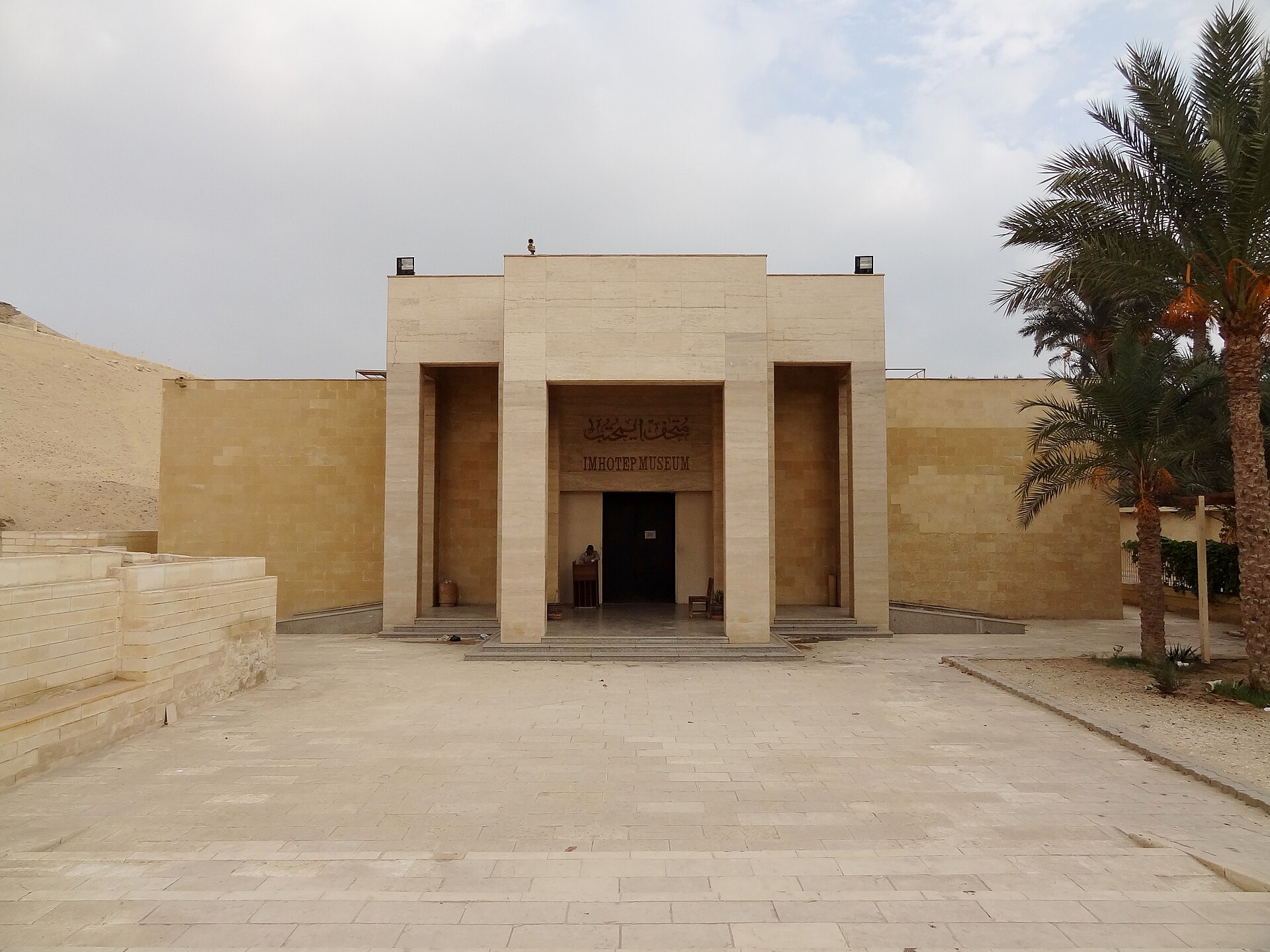
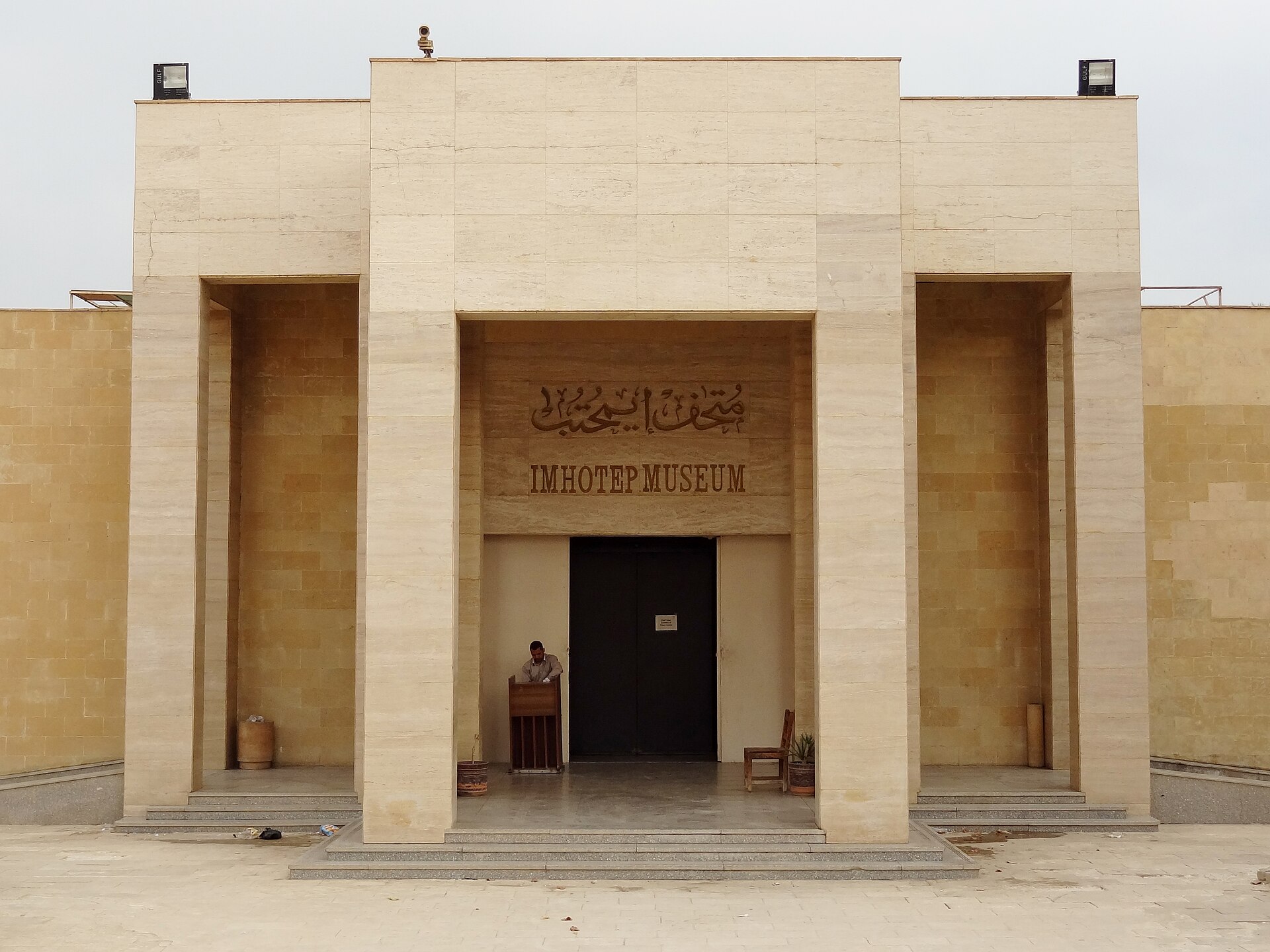
The museum's stone entrance facade at Saqqara, with its Arabic and English name carved above the doorway.
Olaf Tausch · Photograph by Oltau · CC BY 3.0On this page 13 sections
ContentsClose
A small, single-purpose museum built to hold what has been excavated from Saqqara itself rather than to survey Egyptian civilisation broadly: six halls of statues, coffins, architectural fragments, tools and burial goods drawn from the Step Pyramid complex and the wider necropolis around it, anchored by two named set-piece spaces - a simulated tomb, and a gallery devoted to the French Egyptologist who spent 75 years restoring the pyramid the museum stands beside.
| Kind | Museum |
|---|---|
| Founded | Conceived 1990, construction complete 2003, opened 26 April 2006 |
| City and country |  Saqqara, Egypt Saqqara, Egypt |
| Address | Saqqara archaeological site, Pyramid of Djoser Road, Saqqara, Giza Governorate, Egypt |
| Website | egymonuments.gov.eg/en/museums/imhotep-museum |
| Status | Open, confirmed |
| Record last verified |
Visiting
- Hours
- Daily08:00 to 17:00ticket window closes at 16:00
- Daily, during Ramadan09:00 to 15:00ticket window closes at 14:00
- Admission
- Foreign adultEGP 600an inclusive ticket covering both the Saqqara archaeological site and the Imhotep Museum, not a museum-only fee
- Foreign studentEGP 300inclusive Saqqara-and-museum ticket
- Egyptian adultEGP 30inclusive Saqqara-and-museum ticket
- Egyptian studentEGP 10inclusive Saqqara-and-museum ticket
Free entry: Egyptians aged 60 and over. Egyptians with special needs. Orphaned children. Government and Al-Azhar school trips booked in advance through the Rehla platform. Children under 6. All Egyptian visitors on International Museum Day, 18 May each year, at every Supreme Council of Antiquities museum nationwide- Tickets
- egymonuments.gov.eg/en/museums/imhotep-museum The museum's own ticket page.
- Do I need to book?
- No, tickets are sold at the Saqqara site gate and cover both the site and the museum
- Address
- Saqqara archaeological site, Pyramid of Djoser Road, Saqqara, Giza Governorate, Egypt MapOn foot At the entrance to the Saqqara archaeological site, on the approach road to the Step Pyramid of Djoser
- Website
- egymonuments.gov.eg/en/museums/imhotep-museum
- Telephone
- 0-19654 / +20 2 27354532
- [email protected]
Before you go how long, access, photography, bags, eating, shop
- How long to allow
- Most visitors combine it with a walk through the Step Pyramid complex; reviewers describe the museum itself as a short stop, well under an hour, usually at the start or end of a Saqqara visit
- Access
- Not published on the museum's own pages at the time of research
- Photography
- Photography with a mobile phone is free of charge; video recording, tripods and commercial filming require an additional ticket or separate permission
- Bags
- Large bags, backpacks and luggage over 40x40cm are not permitted into the galleries but can be left in the cloakroom
- Eating
- Cafe on site
- Shop
- Not published on the museum's own pages
Prices and hours change. We take them from the institution's own pages and print the day we read them, and you can check the current position at the source we used. Confirm before you travel.
What is inside
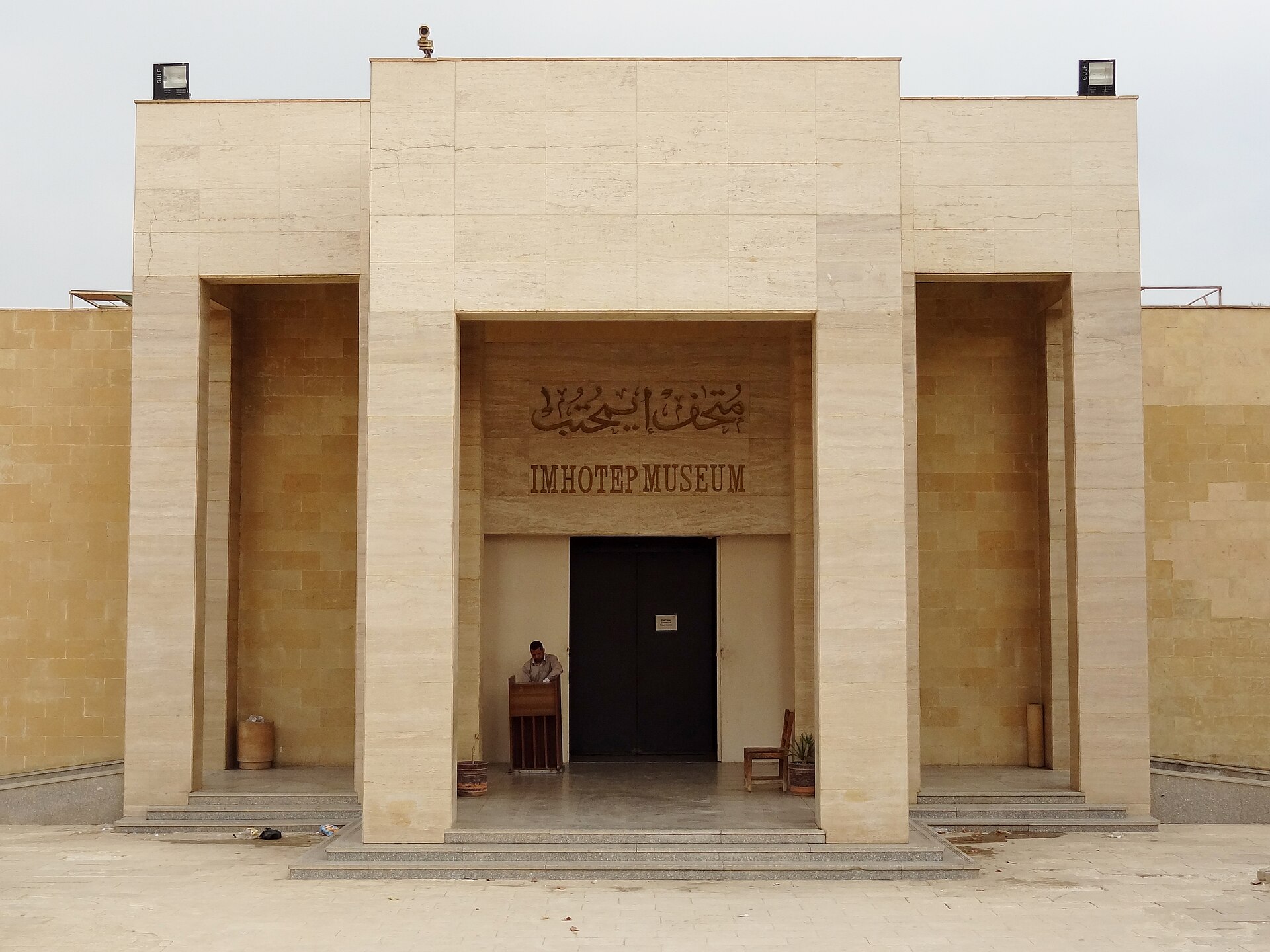
Photograph by Oltau · CC BY 3.0 Hall 1, the entrance hall
Displays a fragment of a statue base of King Djoser, on loan from the Egyptian Museum in Tahrir Square during opening months, carved with the names and titles of both the king and his architect Imhotep - among the earliest surviving evidence that Imhotep was a real, named official rather than a purely legendary figure.
The simulated tomb
One of the museum's own two named highlight spaces: a reconstructed burial chamber displaying a mummy, a wooden coffin and a set of funerary furniture, built to give visitors a sense of an intact Saqqara burial rather than isolated objects in cases.
Hall 4, architectural elements of the Step Pyramid complex
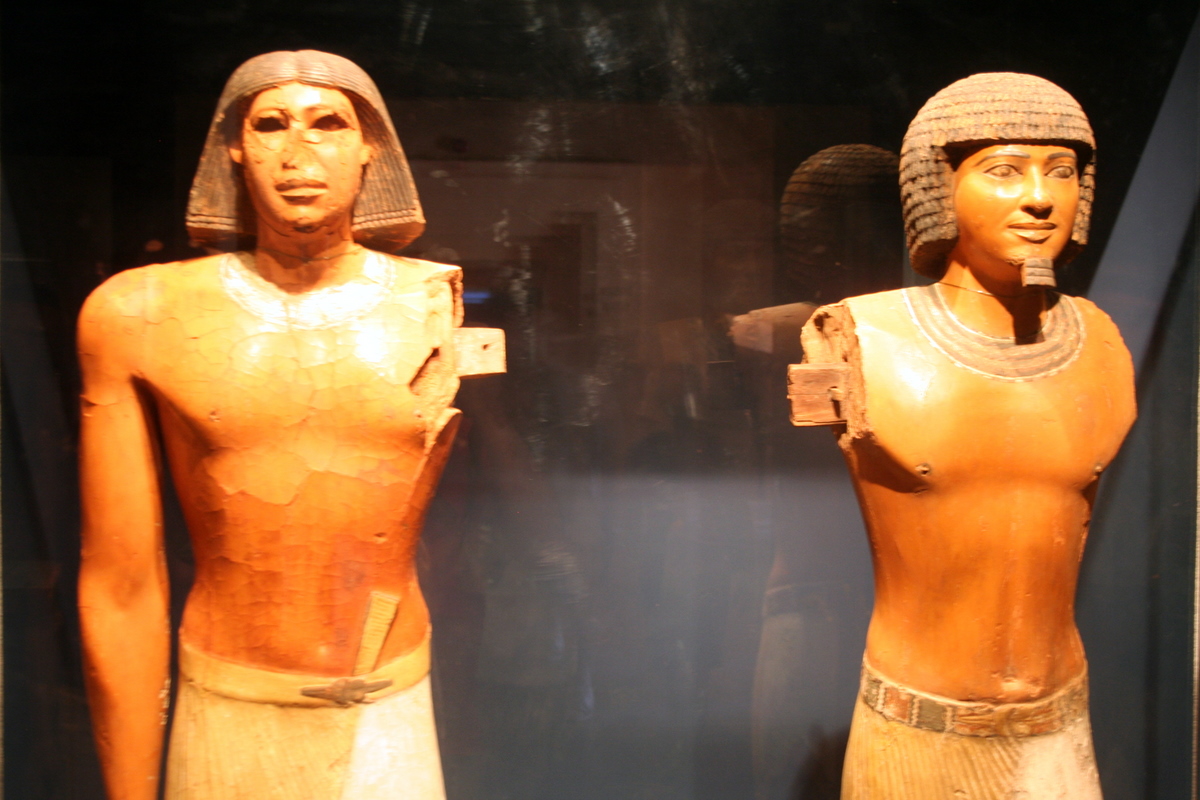
Columns, faience wall tiles from Djoser's mortuary complex and a small statue of Imhotep himself, drawn from the excavation and restoration of the pyramid enclosure a few hundred metres from the museum's own door.
Hall 5, burial objects
Funerary material spanning from the Sixth Dynasty through to the New Kingdom, recovered from tombs across the wider Saqqara necropolis rather than from the Step Pyramid complex alone.
The Jean-Philippe Lauer gallery
The museum's other named highlight space, dedicated to the French architect and Egyptologist who restored Djoser's pyramid complex over some 75 years: his personal effects, photographs of his work on site, and a recreated version of his own library.
What to see first
Statue base of King Djoser, inscribed with Imhotep's titles
Third Dynasty EgyptCarries the names of both the king and his architect on the same stone, the closest thing to a contemporary record that Imhotep existed as a historical official rather than only as the deified figure he later became.3
Small statue of Imhotep
Ancient EgyptThe museum's own namesake object, in Hall 4 alongside the architectural fragments from the pyramid he designed.3
Copper surgical instruments
Ancient Egypt, from Saqqara excavationsNamed in the museum's own gallery listing; Imhotep was venerated in later Egyptian tradition as a god of medicine and healing as well as architecture, and these instruments connect the museum's collection to that second reputation.1
Faience wall tiles from Djoser's mortuary complex
Third Dynasty EgyptArchitectural fittings taken from the Step Pyramid enclosure itself, shown a short walk from the building they once decorated.3
The simulated tomb, with mummy and wooden coffin
Composite installationOne of only two spaces the museum's own materials single out by name, built to show a burial as an assembled scene rather than as separated objects in cases.1
Jean-Philippe Lauer's library and personal effects
20th centuryDocuments the working life of the French Egyptologist who restored the Step Pyramid complex from 1926 until his death in 2001, a 75-year span Egyptian workers on site marked by nicknaming him 'the forgotten of God'.4
Burial objects, Sixth Dynasty to New Kingdom
Old Kingdom to New Kingdom EgyptDraws the museum's chronology out past the Step Pyramid's own Third Dynasty date, using material from later burials across the wider Saqqara necropolis.3
A name that survived on stone before it survived as legend
Imhotep is usually introduced to visitors as the architect who designed the Step Pyramid of Djoser, the first large stone building in history, and that description undersells what is actually unusual about him: he is one of the very few non-royal individuals from Old Kingdom Egypt whose name survives on a contemporary monument at all. A fragment of a statue base of King Djoser, shown in the museum's own entrance hall on loan from the Egyptian Museum in Tahrir Square, carries both the king's name and Imhotep's titles inscribed on the same stone - physical evidence, rather than later legend, that a historical official by that name held real office under Djoser in the Third Dynasty. Centuries later, Egyptian tradition deified him as a god associated with wisdom, architecture and medicine, and by the Ptolemaic period he was worshipped alongside Asclepius by Greek visitors to Egypt. The museum's small statue of Imhotep and its display of copper surgical instruments both trade on that second, later reputation as much as on the first, verifiable one.
A museum built where the pyramid itself is the neighbour
The idea for a museum dedicated to Imhotep was conceived in 1990 by the Supreme Council of Antiquities as part of a wider programme of site-specific museums attached to major excavations rather than concentrated only in Cairo. A location at the entrance to the Saqqara plateau, on the approach road to the Step Pyramid itself, was settled on in 1997; construction was complete by 2003, and the museum opened to the public on 26 April 2006, inaugurated jointly by Suzanne Mubarak and Bernadette Chirac - a French presence at the opening that was not incidental, given how much of the museum's own collection and one of its two named galleries concern French archaeological work at the site. The building holds six halls in total, moving from a rotating display of recent finds from across the Saqqara plateau through Egyptian art in stone and wood, architectural fragments recovered from the pyramid enclosure itself, and burial material spanning from the Sixth Dynasty through the New Kingdom.
Jean-Philippe Lauer: seventy-five years on one site
The museum's second named highlight space is not about Imhotep at all. Jean-Philippe Lauer arrived in Egypt in 1926 as a young French architect to assist Cecil Mallaby Firth on the excavation of Djoser's Step Pyramid complex. When Firth died in 1931 and Lauer's own position was not renewed in 1936, he chose to stay anyway, and went on to spend the rest of his working life restoring the mortuary complex - the serdab, the enclosure wall, and the subterranean chambers where he discovered the complex's blue faience decoration. He co-founded the Mission Archeologique Francaise de Saqqara with Jean Leclant in 1963, an organisation still active at the site today, and he kept working into his nineties; Egyptian workers on the excavation nicknamed him 'the forgotten of God'. He died in 2001, seventy-five years after he first arrived, having spent essentially his entire adult working life on one pyramid. The museum's dedicated gallery for him displays his personal effects, photographs of him at work across those decades, and a recreation of his own library - a museum-within-the-museum for the modern figure most responsible for the state in which Djoser's complex, and by extension Imhotep's reputation as its architect, can be seen at all today.
One ticket, two sites
The museum does not sell its own separate admission. The Ministry's own published tariff - 600 Egyptian pounds for a foreign adult, 300 for a foreign student, 30 and 10 pounds respectively for Egyptian visitors - is explicitly described as an inclusive ticket covering both the wider Saqqara archaeological site and the Imhotep Museum together, not a museum-only fee. That pricing structure, and the museum's position directly on the path into the Step Pyramid complex, both point to the same fact: this is conceived and priced as a component of a Saqqara visit rather than as a stand-alone destination a visitor would travel to on its own.
What visitors actually report
At 4.4 out of 5 across 80 Tripadvisor reviews, the museum reads as a well-liked but minor stop relative to the pyramid it sits beside - a small number of reviews for a major archaeological zone, consistent with a museum most visitors treat as a short addition to a longer site visit rather than a destination in itself. The reviews that exist are specific rather than generic: visitors single out the simulated tomb and the Lauer gallery by name as worth the stop, and describe the museum itself as calm and uncrowded next to the pyramid complex. The recurring complaint is not about the collection but about maintenance of the public facilities - washrooms that more than one reviewer describes as dirty and poorly kept despite the building's relatively recent construction, with unofficial and in at least one account aggressive requests for tips from washroom attendants. That is a specific, repeated enough complaint to record rather than a single visitor's bad day.
What visitors say
We publish no visitor review prose and cite no single platform score as fact; this is our own reading of the pattern in what reviewers report. Visitors who stop here on a Saqqara visit consistently describe a small, uncrowded museum worth the short detour, and just as consistently flag that the building's public facilities have not been kept up to the standard of a relatively new structure - specifically the washrooms, and unofficial demands for tips from attendants there.
What is praised, what is criticised
- Praised: a quiet, uncrowded stop compared with the Step Pyramid site itself, especially on a weekday morning
- Praised: the simulated tomb and the Jean-Philippe Lauer gallery, named specifically by reviewers as worth seeking out
- Criticised: washroom facilities described by more than one reviewer as poorly maintained despite the building being relatively new
- Criticised: aggressive, unofficial requests for tips from washroom attendants, reported specifically enough by more than one reviewer to read as a pattern rather than an isolated complaint
Ratings on other platforms
Tripadvisor: 4.4 from 80 ratings, read 7 August 2026
A platform average is a tertiary source: it moves, it is not audited, and we quote no visitor's words.
Questions about Imhotep Museum
Where is Imhotep Museum?
Saqqara archaeological site, Pyramid of Djoser Road, Saqqara, Giza Governorate, Egypt.
How much does it cost to visit?
Foreign adult: EGP 600; Foreign student: EGP 300; Egyptian adult: EGP 30; Egyptian student: EGP 10. As confirmed 17 August 2026.
When is it open?
Daily 08:00-17:00; Daily, during Ramadan 09:00-15:00. As confirmed 17 August 2026.
How do you get there?
On foot: At the entrance to the Saqqara archaeological site, on the approach road to the Step Pyramid of Djoser.
What should you see first?
Statue base of King Djoser, inscribed with Imhotep's titles (Third Dynasty Egypt); Small statue of Imhotep (Ancient Egypt); Copper surgical instruments (Ancient Egypt, from Saqqara excavations); Faience wall tiles from Djoser's mortuary complex (Third Dynasty Egypt); The simulated tomb, with mummy and wooden coffin (Composite installation); Jean-Philippe Lauer's library and personal effects (20th century).
What we could not confirm
- No accessibility information for visitors with mobility restrictions is published by the museum or the Ministry.
- The exact current display status of the loaned Djoser statue-base fragment in Hall 1 is unclear from the Ministry's own description, which says it is shown 'during opening months' without specifying the present arrangement; this should be re-checked on the ground rather than assumed.
- No named published criticism or restitution question was found for this museum during research beyond the visitor-facility complaints recorded in reception; if a more substantial critical account exists, it was not surfaced by the sources consulted here.
Images
Sources
- 1Ministry of Tourism and Antiquities, Discover Egypt's Monuments: Imhotep Museum - the six halls, the simulated tomb and Jean-Philippe Lauer gallery, hours, the inclusive Saqqara-and-museum ticket prices, free-entry policy, gallery caption list (Imhotep's statue, copper surgical instruments, wall of faience, statue base of King Djoser), photography and bag rules, International Museum Day policy. Read directly in the in-app browser, full page text, on 7 August 2026. egymonuments.gov.eg/en/museums/imhotep-museum/
- 2Ministry of Tourism and Antiquities, Contact Us: the Ministry's central phone, hotline and email used for museums that do not publish a direct line of their own. egymonuments.gov.eg/en/contact-us
- 3Wikipedia, Imhotep Museum: opening date (26 April 2006) and inauguration by Suzanne Mubarak and Bernadette Chirac, project chronology from 1990 conception through 1997 site selection to 2003 construction completion, and a hall-by-hall account of the six galleries' contents. en.wikipedia.org/wiki/Imhotep_Museum
- 4Wikipedia, Jean-Philippe Lauer: his arrival in Egypt in 1926, his career restoring Djoser's mortuary complex over roughly 75 years, his 1963 co-founding of the Mission Archeologique Francaise de Saqqara, the 'forgotten of God' nickname, and his death in 2001. en.wikipedia.org/wiki/Jean-Philippe_Lauer
- 5Tripadvisor, Imhotep Museum - All You Should Know Before Going: current rating and review count, and individual review text on facility maintenance and tipping. Read directly in the in-app browser, including review text, on 7 August 2026. tripadvisor.com/Attraction_Review-g730107-d1150459-Reviews-Imhotep_Museum-Saqqara_Giza_Governorate.html
- 6Wikidata, Imhotep Museum (Q2341403): label, description and coordinates, cross-checked against the Ministry's own location description before use. wikidata.org/wiki/Q2341403