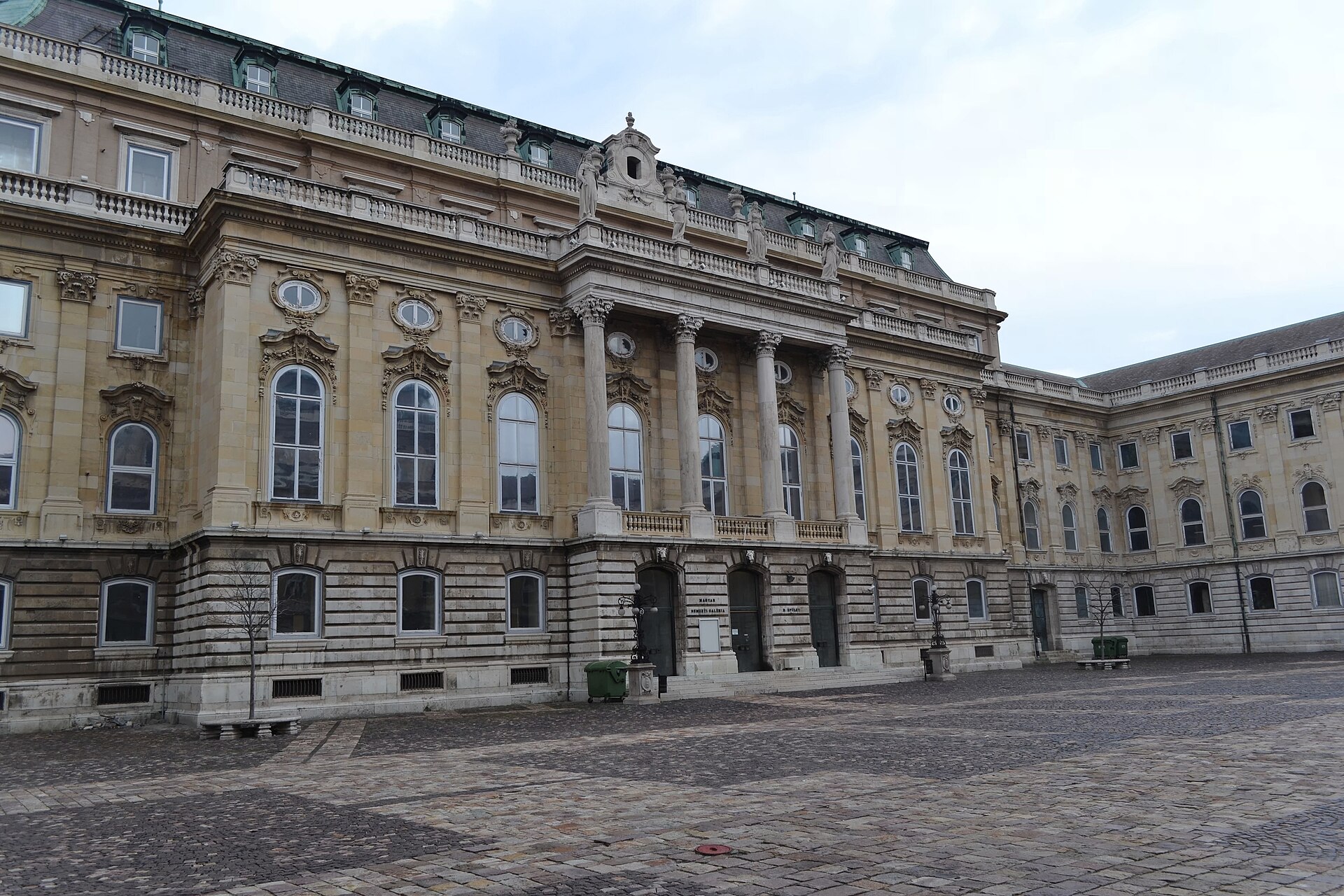
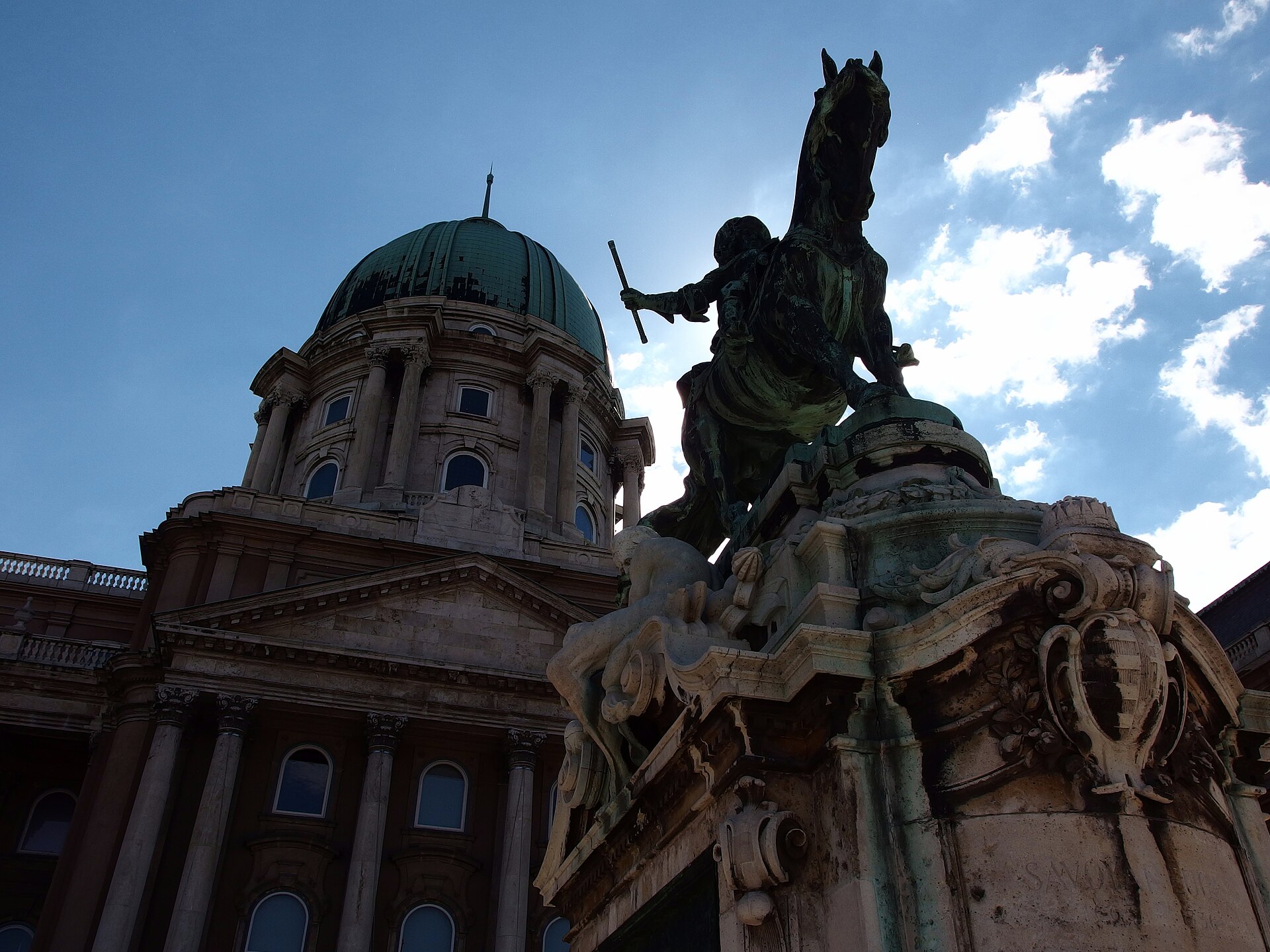
The courtyard facade of the Hungarian National Gallery in Buda Castle, Budapest.
Slyronit, CC BY-SA 4.0Hungarian National Gallery
Museum · Magyar Nemzeti Galeria · Founded 1957
Open, admission and hours confirmed 26 August 2026 · 16 sources
On this page 15 sections
ContentsClose
The museum's own figures put the collection at around 110,000 works, and its actual strength is concentration rather than breadth: it is not trying to be an encyclopaedic museum but a complete record of art made in the Kingdom of Hungary and, later, Hungary itself, from the 11th century to the present. The Old Hungarian Collection's winged altarpieces are, on the museum's own account, the largest such group in Central Europe. The 19th and 20th Century Paintings collection, at roughly 10,000 items, is the deepest holding anywhere of Munkacsy, Szinyei Merse and the Nagybanya and Godollo colony painters, and the Prints and Drawings collection's 81,000 sheets extend that record on paper from the late 18th century to about 1960. What the museum has never held in comparable depth is international art after 1800, which is precisely the department now arriving from the Museum of Fine Arts as the two institutions' 2012 reunification continues.
| Local name | Magyar Nemzeti Galeria |
|---|---|
| Kind | Museum |
| Founded | 1957 |
| City and country |  Budapest, Hungary Budapest, Hungary |
| Address | Szent Gyorgy ter 2, Buda Castle (Buildings A-D), 1014 Budapest, Hungary |
| Website | mng.hu |
| Status | Open, confirmed |
| Record last verified |
Visiting
- Hours
- Monday-Sunday10:00 to 18:00Except the last Monday of every month, when the museum is closed. Ticket office closes at 17:00 and last admission is 17:00, including with pre-purchased or free tickets; exhibition halls on the top floor begin closing from 17:30.
- Closed
- Last Monday of every month.
- Admission
- Full price, permanent exhibitionHUF 5,800A ticket to any temporary exhibition also covers the permanent and cabinet exhibitions on the same day.
- Concession (50 percent)HUF 2,900Eligibility must be proven with ID at the ticket desk; the museum's concessions page lists separate categories for age, groups, teachers, families and visitors with disabilities.
- HNG Annual TicketHUF 9,000Unlimited entry to the permanent exhibitions and cabinet exhibition for one year.
Free entry: Hungarian national holidays: 15 March, 20 August and 23 October, for all visitors- Tickets
- en.mng.hu/tickets-to-the-permanent-exhibition The museum's own ticket page.
- Do I need to book?
- No advance booking is needed for the permanent exhibition. The Habsburg Palatine Crypt can only be visited with the museum's own tour guide and requires arrangement at least one week ahead.
- Address
- Szent Gyorgy ter 2, Buda Castle (Buildings A-D), 1014 Budapest, Hungary MapFunicular The Castle Hill Funicular (Budavari Siklo) climbs from Adam Clark Square at the Buda end of the Szechenyi Chain Bridge to Szent Gyorgy ter, at the museum's own entrance; the 95-metre run takes about 90 seconds and the line runs roughly 07:30 to 22:00 daily.
Bus Bus 16 runs from Deak Ferenc ter in Pest up to Castle Hill; visitors travelling from Szell Kalman ter metro station can also use buses 16, 16A or 116 to Szentharomsag ter, a short walk from the gallery. - Website
- mng.hu
- Telephone
- +36 1 201 9082
- [email protected]
Before you go how long, access, photography, bags, eating, shop
- How long to allow
- The museum's own guidance suggests 1.5 to 3 hours for the permanent collection; visitor accounts on TripAdvisor most often describe 2 to 3 hours, or longer including the Dome.
- Access
- Access for visitors with disabilities is provided through Building B, and elevators serve the main building.
- Photography
- Photography and filming are allowed with any admission ticket, for personal, non-commercial use only. Flash, tripods, monopods and selfie sticks are forbidden, and some temporary exhibitions restrict recording, signed at the entrance.
- Bags
- Use of the ground-floor cloakroom or the lockers by the main-entrance cafe is compulsory for larger items; only shoulder bags up to roughly 30 x 25 x 15 cm may be carried into the exhibition halls. Both are free to use; the lockers take a 100 HUF or 1 euro coin, refunded on collection.
- Eating
- The Museum Cafe near the main entrance keeps the same daily hours as the MuzeumShop, 10:00 to 17:45 (except the last Monday of the month).
- Shop
- The MuzeumShop, open 10:00 to 17:45 daily (except the last Monday of the month), can be visited without an entrance ticket; a TripAdvisor reviewer who described visiting it repeatedly called out its books, its range of items and its staff.
Prices and hours change. We take them from the institution's own pages and print the day we read them, and you can check the current position at the source we used. Confirm before you travel.
What is inside
Old Hungarian Collection
Panel paintings, wooden sculpture, architectural stone carving and tombstones made in Hungary, or on Hungarian commission abroad, from the eleventh century to 1800. Its winged altarpieces are, on the museum's own account, the largest such collection in Central Europe. The baroque portion of this material (Art in Hungary 1600-1800) was moved out to the renovated Museum of Fine Arts building in 2018 as the first stage of a reunification of the two institutions' old-master holdings; the medieval and Renaissance panels, wooden sculpture and winged altarpieces remain on show here, with a further move to the Museum of Fine Arts building announced but, on the evidence available, not yet carried out years after its originally stated 2019 target.
19th and 20th Century Paintings
Around 10,000 Hungarian paintings from 1800 to 1945, built on the mid-19th-century Founding Society of the National Picture Gallery and later expanded with the Municipal Picture Gallery's holdings. Portraitists and landscape painters of the early 1800s (Janos Donat, Karoly Marko) lead into the Biedermeier and history painting of mid-century, the Munich Academy generation, and career-spanning holdings of Mihaly Munkacsy and Pal Szinyei Merse, the pioneer of Hungarian plein-air painting. The Nagybanya and Godollo artists' colonies, the turn-of-the-century modernism of Jozsef Rippl-Ronai and Janos Vaszary, and the individual paths of Laszlo Mednyanszky, Tivadar Csontvary Kosztka and Lajos Gulacsy are all represented, through to the inter-war Gresham group and Szentendre art.
Sculptures and Medals
Around 10,000 items: the museum's most prized 19th- and 20th-century Hungarian sculpture, alongside coins, medals and plaques by Hungarian masters from the 19th to the 21st century, plus wax and plaster casts standing in for originals and coin-work by contemporary artists. Highlights are shown in the permanent exhibition.
Prints and Drawings
Around 81,000 sheets by Hungarian artists from the end of the 18th century to about 1960, split into drawings, prints and posters.
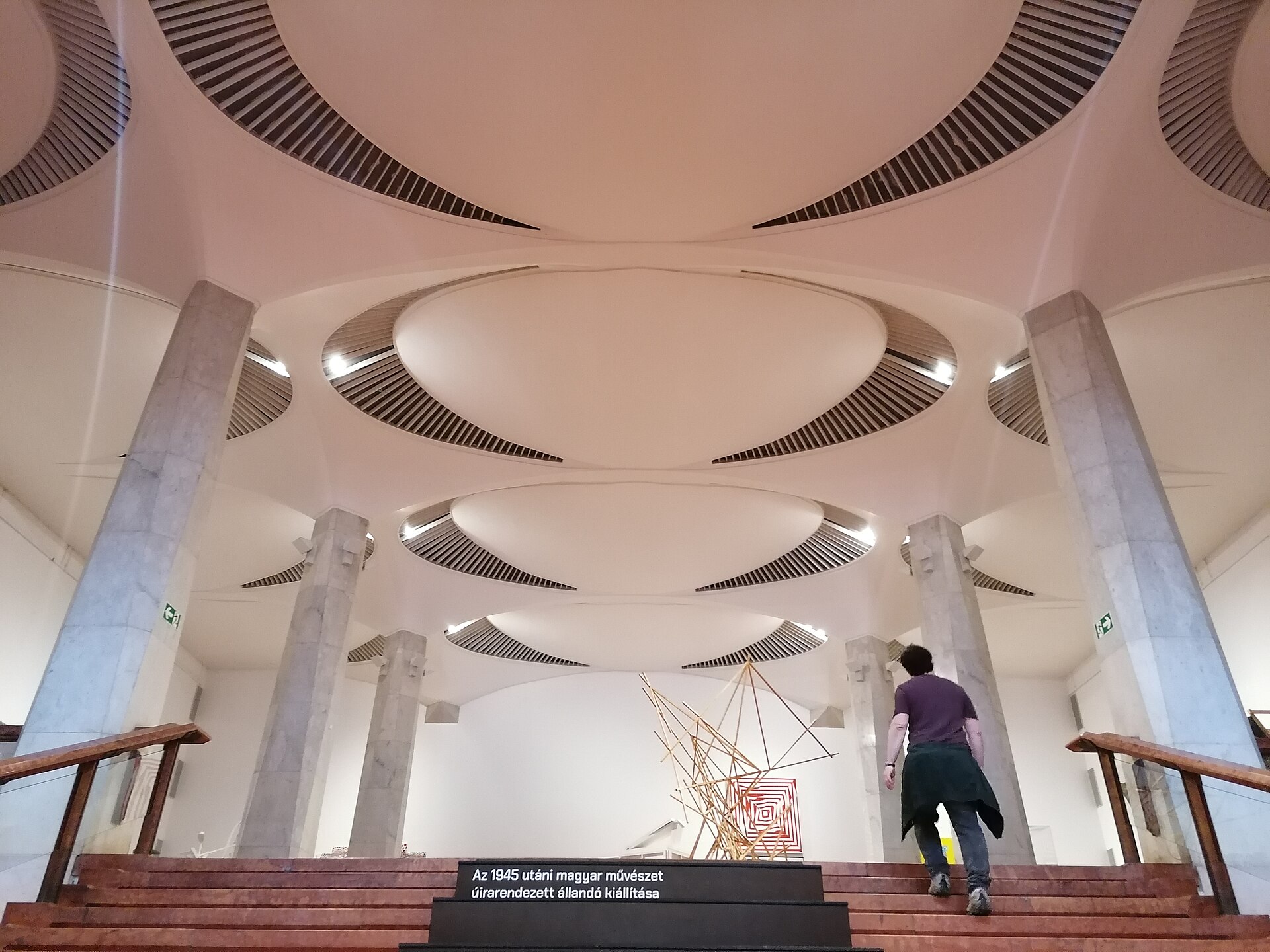
Photograph by KovacsDaniel · CC BY 4.0 Shifts - Hungarian Art After 1945
The permanent exhibition drawing on the museum's Contemporary Collection, which gathers Hungarian art from 1945 to the present and sets out to track both broad tendencies and individual artists across the decades since the Second World War.
International Art after 1800
The Hungarian National Gallery's newest department by location rather than by content: following the 2012 administrative reunification of the museum with the Museum of Fine Arts, this collection is moving out of the Museum of Fine Arts building (now reserved for art from antiquity to 1800) and into the Hungarian National Gallery, the first of what the museum describes as several years of change. Visitors report seeing work by Monet, Manet, Gauguin, Pissarro, Bonnard and Toulouse-Lautrec among it.
Habsburg Palatine Crypt
The burial place, under the site of the demolished Saint Sigismund chapel, of Archduke Joseph, Palatine of Hungary from 1795 to 1847, his wife and their descendants - 24 family members in all. Its sculpture, including a twice-life-size marble figure of the Archduke kneeling before the Hungarian crown and a bronze angel over the tombs of his son Joseph Karl and daughter-in-law Clotilde, is by Gyorgy Zala, with a monument to the young Archduke Ladislaus by Alajos Strobl. The crypt was broken into and the Archduke's mummified remains desecrated in 1973; it was walled up, then restored and reconsecrated in 1987. Visits are only possible with the museum's own guide, booked at least a week ahead.
The Dome
The highest point of the former Royal Palace and one of the skyline markers of Budapest, open to any exhibition ticket-holder, weather permitting, during opening hours, with a panoramic view over the city and the Danube.
What to see first
Career-spanning holdings of Mihaly Munkacsy
Mihaly MunkacsyHigh-quality works from every period of the career of the 19th-century Hungarian realist who built his reputation from Paris and drew crowds there, in Vienna, New York and Budapest, are held here as one of the collection's central strengths.6
Picnic in May (1873) and the wider oeuvre of Pal Szinyei Merse
Pal Szinyei MerseThe museum names Szinyei Merse as the pioneer of modern Hungarian painting; his 1873 plein-air canvas Picnic in May is among the earliest Hungarian responses to the concerns of his French contemporaries.16
The winged altarpiece collection
Various Hungarian and Central European workshops, 15th-16th centuryDescribed by the museum as the largest collection of its kind in Central Europe, these Gothic panel paintings and carved wooden altarpieces are the core of the Old Hungarian Collection.7
Tivadar Csontvary Kosztka's individual path
Tivadar Csontvary KosztkaOne of the turn-of-the-century painters the museum highlights for a distinctly personal style that set him apart from his contemporaries; his work can be followed through the 19th and 20th Century Paintings collection.6
Jozsef Rippl-Ronai and Janos Vaszary at the turn of the century
Jozsef Rippl-Ronai; Janos VaszaryNamed by the museum as the central figures of Hungarian modernism around 1900, bridging Nagybanya-colony naturalism and the newer, internationally engaged painting that followed it.6
The Habsburg Palatine Crypt sculpture group
Gyorgy Zala; Alajos StroblA twice-life-size kneeling marble figure of Archduke Joseph, a bronze angel over the tombs of his son and daughter-in-law, and a monument to the young Archduke Ladislaus who died in a hunting accident in 1895 make up the only part of the palace that still shows something of its original 19th-century decoration.1
The Dome of the Royal Palace
The highest point of the building the gallery occupies, and one of Budapest's skyline landmarks, open on any exhibition ticket for a panoramic view over the city.1
International Art after 1800, newly arrived from the Museum of Fine Arts
Various, including artists visitors name as Monet, Manet, Gauguin, Pissarro, Bonnard and Toulouse-LautrecThe first tranche of a reunification that is moving the two museums' modern international holdings out of the Museum of Fine Arts building and into the Hungarian National Gallery, a change the museum itself describes as the start of a process expected to last several years.6
Past exhibitions here
- Closed8 Apr to 30 Aug 2026Confirmed · check before you travel
- Closed4 Jun to 30 Aug 2026Confirmed · check before you travel
A palace built for kings, now a home for painters
The Royal Palace on Castle Hill has been rebuilt more times than it has been left alone. Its history reaches back to the 14th century and the reigns of Louis the Great, Sigismund and Matthias Corvinus; the Turkish occupation from 1541 and the Battle of Buda in 1686 left it badly damaged, and its Baroque reconstruction began under Maria Theresa in 1749. Miklos Ybl and Alajos Hauszmann expanded it again at the end of the 19th century, and it was damaged once more in the Second World War, with reconstruction beginning only in the 1960s.
The Hungarian National Gallery itself is younger than the building it now occupies. It was established on 5 October 1957 to display Hungarian art on its own terms, built from the New Hungarian Picture Gallery at the Museum of Fine Arts and the Hungarian holdings of that museum's sculpture, medal, and print and drawing collections - roughly 6,000 paintings, 2,100 sculptures, 3,100 medals, 11,000 drawings and 5,000 prints at the outset. It opened in a building that had formerly housed the Supreme Court and today houses the Museum of Ethnography. The Hungarian government designated the Royal Palace of Buda as its permanent home in 1959, but the move did not happen until 1975, into Buildings B, C and D, refurbished for the purpose; the exhibitions that October opened in what the museum's own history calls a provisional form. The Old Hungarian Collection, transferred from the Museum of Fine Arts, followed soon after and only then, after decades in storage, became a public treasure. Building A was added to the museum's exhibition space in 2005.
Eight centuries under one roof
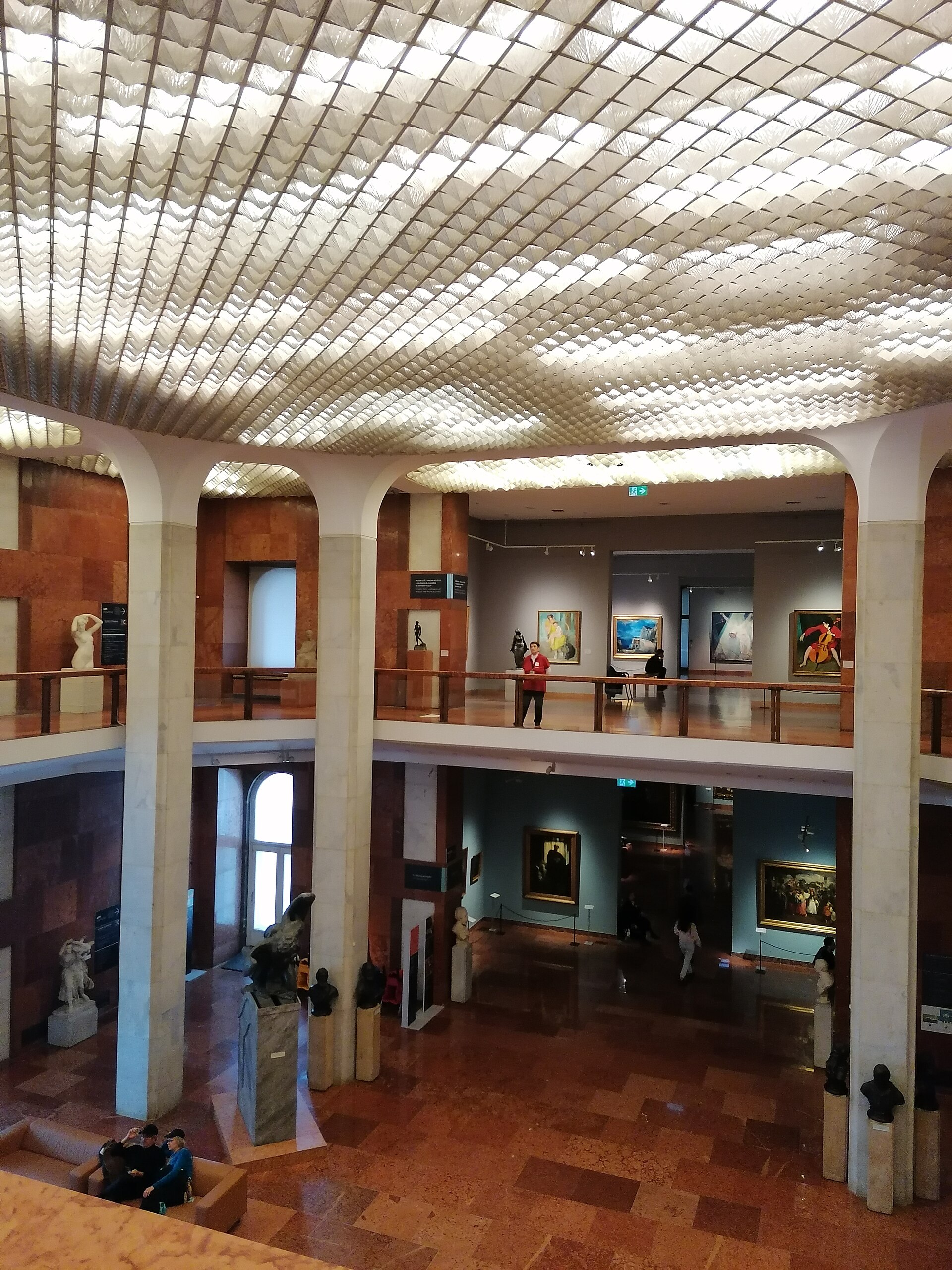
What is inside is not one collection but several, run as separate curatorial departments that only partly line up with the eight permanent exhibitions a visitor actually walks through. The Old Hungarian Collection covers the 11th century to 1800: stone carving salvaged from cathedrals, palaces and monastic buildings; early wooden sculpture and panel paintings that once furnished church interiors, including what the museum describes as the largest collection of winged altarpieces in Central Europe; and, from the late Renaissance and Baroque, large-scale altarpieces, portraits, still lifes and the new secular genres of the later 18th century. The 19th and 20th Century Paintings collection, some 10,000 items, carries the story from Biedermeier portraiture through history painting, the plein-air and naturalist painting of Mihaly Munkacsy and Pal Szinyei Merse, the Nagybanya and Godollo artists' colonies, the individual routes of Tivadar Csontvary Kosztka and Laszlo Mednyanszky, and on to the interwar Gresham group. Alongside the paintings sit some 10,000 items of sculpture, medals and plaques, and a Prints and Drawings collection of around 81,000 sheets running from the late 18th century to about 1960. A Contemporary Collection, shown in the permanent exhibition Shifts - Hungarian Art After 1945, has been gathering work made since the war, and a museum library founded on the old Metropolitan Picture Gallery's books serves all of it.
Two things that are easy to miss sit outside this list of departments entirely. The Habsburg Palatine Crypt, under the site of a chapel demolished in 1961, holds the remains of Archduke Joseph, Palatine of Hungary from 1795 to 1847, and 23 of his descendants, in a chamber whose marble and bronze sculpture by Gyorgy Zala and Alajos Strobl the museum calls the only part of the palace still showing something of its original 19th-century decoration; the crypt was broken into and the Archduke's remains desecrated in 1973, and was walled up before being restored and reconsecrated in 1987. It can only be seen on a guided visit booked at least a week in advance. And the Dome above the palace, the highest point of the building and a fixture of Budapest's skyline, is open to any exhibition ticket-holder for a view over the city and the Danube, weather allowing.
A reunification that started in 2012 and is still running
In 2012 the Hungarian National Gallery and the Museum of Fine Arts were placed under one director, Laszlo Baan, in what the museum now calls a reunification of the two institutions' collections. That decision followed years of open conflict: the Gallery's own director, Ferenc Csak, resigned in December 2011 rather than oversee it, calling the process very unprofessional, anti-democratic and short-sighted, and the museum operated under interim leadership into 2012. Since then the reunification has proceeded piece by piece rather than all at once. In 2018 the Baroque portion of the Old Hungarian Collection, shown as Art in Hungary 1600-1800, moved into the newly renovated Museum of Fine Arts building; a further move of the medieval and Renaissance material to the same building was announced for autumn 2019, but on the evidence gathered for this record it has not happened - the winged altarpieces, Gothic panel paintings and Renaissance stone carvings remain on show at Buda Castle years past that date, and the museum's own collection page still describes the Hungarian National Gallery as continuing to house them 'up until the instalment' of new exhibitions elsewhere. Movement is also happening in the other direction: the Collection of International Art after 1800 is moving out of the Museum of Fine Arts, which now serves only art from antiquity to 1800, and into the Hungarian National Gallery - a change the museum itself describes as the first of several years of steps still to come.
A new building in the park, and an open question for Buda Castle
The reunification has always had a building attached to it. The original 2008 proposal, taken up by Fidesz in its 2010 election campaign, envisaged a new museum quarter on Andrassy ut near City Park, expected at the time to take eight years and 20 billion forints and to begin construction by 2014. What has actually been built, after years of delay, is the New National Gallery: a structure designed by the Pritzker Prize-winning Japanese firm SANAA, planned for the site of the demolished Petofi Csarnok concert hall inside the Liget Budapest cultural park, intended to house the combined modern collections of the Museum of Fine Arts and the Hungarian National Gallery under one roof. Budapest's mayor, Gergely Karacsony, elected in 2019 on an environmental platform, halted construction that December, arguing it would have an enormous impact on one of the city's limited green spaces and suggesting brownfield alternatives instead; the project sat suspended for years while other Liget Budapest buildings, including the House of Hungarian Music and the Museum of Ethnography, went ahead. Reporting from October 2024 describes the procurement process for the New National Gallery as under way again, with construction expected to begin in 2025 and the museum's own director-general quoted as targeting an opening by the end of the decade - realistically, on that timeline, around 2029 or 2030.
What this means for the Buda Castle building the Hungarian National Gallery occupies today is, on the sources gathered here, genuinely unresolved. Earlier reporting from 2019 described a plan under which the existing Buda Castle gallery would close once the new building opened, with its holdings divided between the Museum of Fine Arts and the new gallery so that Hungary's national art collections could be reunited 'as they were before the Communist period'. No source consulted for this record confirms whether that specific plan still holds after the 2019-2024 suspension and restart, what would happen to the medieval and Old Hungarian material that has not moved to the Museum of Fine Arts as planned, or what use Buda Castle's galleries would be put to afterward. What is certain, and directly confirmed on the museum's own site as of the date of this research, is that none of this has happened yet: the Hungarian National Gallery is open at Buda Castle today, selling tickets to eight permanent exhibitions and three temporary ones.
Visiting: tickets, hours and the climb up Castle Hill
The museum keeps long, simple hours - 10:00 to 18:00 every day except the last Monday of each month - with the ticket office closing an hour before the galleries and the top-floor halls beginning to close earlier still. A full-price ticket to the permanent exhibition costs 5,800 forints, with a 50 percent concession on proof of eligibility and a 9,000-forint annual ticket for repeat visitors; entry is free for everyone on Hungary's three national holidays. Reaching the museum means climbing Castle Hill one way or another: the Castle Hill Funicular runs from Adam Clark Square at the Buda end of the Chain Bridge directly to Szent Gyorgy ter at the museum's door, or bus 16 connects from Deak Ferenc ter in Pest. Bags larger than a small shoulder bag have to go into the free ground-floor cloakroom or coin-return lockers, and photography is allowed everywhere for personal use short of flash, tripods and selfie sticks. Wheelchair access runs through Building B, with lifts serving the rest of the complex.
What visitors say
The pattern across independent 2026 reviews is consistent enough to be worth stating plainly: people come away impressed by the art and, often in the same visit, unhappy with how they were treated by staff. Reviewers single out the breadth of the Hungarian painting collection - medieval altarpieces, 19th-century landscape and history painting, Munkacsy and Szinyei Merse, and newly arrived international names including Monet, Manet, Gauguin, Pissarro, Bonnard and Toulouse-Lautrec - and the view from the Dome, generally rating the visit as worth two to three hours or more. Set against that, separate visitors writing in March, July and August 2026 describe reception and gallery staff as rude or excessively rigid: disputes over concession eligibility for EU residents, a coat that had to stay on in a warm gallery despite requests to remove it, and close, uncomfortable monitoring in the exhibition rooms all recur as specific, independently reported complaints rather than a single visitor's bad day. One visitor called the audio guide thin next to the size of the permanent collection; another, more of an outlier among the reviews read, thought the display sequencing was less coherent than at comparable national galleries elsewhere in Europe.
What visitors say
Visitors consistently rate the depth and presentation of the collection well above the experience of dealing with the museum's front-of-house staff and its rules on coats and bags, which draw repeated, specific complaints across independent reviews spread through 2026.
What is praised, what is criticised
- Praised: The range and quality of the Hungarian painting collection, from medieval altarpieces through 19th-century landscape and history painting to Munkacsy, Szinyei Merse and the turn-of-the-century modernists, with labelling in both Hungarian and English
- Praised: The view from the Dome over Budapest and the Danube
- Praised: The building itself and its setting within Buda Castle
- Praised: The MuzeumShop, singled out by name by more than one reviewer for its books and range of items
- Criticised: Multiple independent visitors across March, July and August 2026 describe room stewards and reception staff as rude, aggressive or overly rigid, including disputes over concession eligibility, mandatory cloakroom use and a strictly enforced rule requiring coats to stay on even in warm galleries
- Criticised: The audio guide is described by at least one visitor as incomplete relative to the size of the permanent collection
- Criticised: One long-time visitor found the display sequencing 'haphazardly put together' compared with other national galleries, though this reads as a minority view among the reviews read
Ratings on other platforms
TripAdvisor: 4.2 from 1,389 ratings, read 26 August 2026
A platform average is a tertiary source: it moves, it is not audited, and we quote no visitor's words.
Questions about Hungarian National Gallery
Where is Hungarian National Gallery?
Szent Gyorgy ter 2, Buda Castle (Buildings A-D), 1014 Budapest, Hungary.
How much does it cost to visit?
Full price, permanent exhibition: HUF 5800; Concession (50 percent): HUF 2900; HNG Annual Ticket: HUF 9000. As confirmed 26 August 2026.
When is it open?
Monday-Sunday 10:00-18:00. Closed: Last Monday of every month. As confirmed 26 August 2026.
How do you get there?
Funicular: The Castle Hill Funicular (Budavari Siklo) climbs from Adam Clark Square at the Buda end of the Szechenyi Chain Bridge to Szent Gyorgy ter, at the museum's own entrance; the 95-metre run takes about 90 seconds and the line runs roughly 07:30 to 22:00 daily; Bus: Bus 16 runs from Deak Ferenc ter in Pest up to Castle Hill; visitors travelling from Szell Kalman ter metro station can also use buses 16, 16A or 116 to Szentharomsag ter, a short walk from the gallery.
What should you see first?
Career-spanning holdings of Mihaly Munkacsy (Mihaly Munkacsy); Picnic in May (1873) and the wider oeuvre of Pal Szinyei Merse (Pal Szinyei Merse); The winged altarpiece collection (Various Hungarian and Central European workshops, 15th-16th century); Tivadar Csontvary Kosztka's individual path (Tivadar Csontvary Kosztka); Jozsef Rippl-Ronai and Janos Vaszary at the turn of the century (Jozsef Rippl-Ronai; Janos Vaszary); The Habsburg Palatine Crypt sculpture group (Gyorgy Zala; Alajos Strobl).
What we could not confirm
- Whether the medieval and Renaissance portion of the Old Hungarian Collection will in fact move to the Museum of Fine Arts building, a step the museum's own site describes as pending since an original autumn 2019 target that has, on the evidence gathered here, not been met years later
- Whether the SANAA-designed New National Gallery in Varosliget will open on the 'end of the decade' timeline reported in 2024, given that the project was already suspended for roughly five years after Budapest's mayor blocked construction in December 2019
- What becomes of the Buda Castle building and its eight permanent exhibitions once, or if, the New National Gallery opens - 2019 reporting described a plan to close the Buda Castle gallery and divide its holdings, but no source consulted confirms that plan still stands after the project's multi-year suspension and 2024-2025 restart
- Why room-steward and reception conduct draws specific, independently written complaints from visitors across at least three separate months of 2026, given how consistently the collection itself is praised in the same reviews
Images
Sources
- 1Hungarian National Gallery, 'About the museum' en.mng.hu/about-the-museum/
- 2Hungarian National Gallery, 'Opening hours' en.mng.hu/opening-hours/
- 3Hungarian National Gallery, 'Contact' en.mng.hu/contact/
- 4Hungarian National Gallery, 'Tickets to the permanent exhibition' en.mng.hu/tickets-to-the-permanent-exhibition/
- 5Hungarian National Gallery, 'Details about concessions and eligibility' en.mng.hu/details-about-concessions-and-eligibility/
- 6Hungarian National Gallery, '19th and 20th Century Paintings' collection page en.mng.hu/collections/19th-and-20th-century-paintings/
- 7Hungarian National Gallery, 'Old Hungarian Collection' collection page en.mng.hu/collections/old-hungarian-collection/
- 8Hungarian National Gallery, 'Museum Rules' en.mng.hu/museum-rules/
- 9Wikipedia, 'Hungarian National Gallery' () en.wikipedia.org/wiki/Hungarian_National_Gallery
- 10Wikipedia, 'Budapest Museum Quarter' () en.wikipedia.org/wiki/Budapest_Museum_Quarter
- 11World Architecture Community, 'SANAA-designed Hungary's New National Gallery faces construction block by Budapest's green mayor', 4 December 2019 worldarchitecture.org/architecture-news/eeezf/sanaadesigned-hungary-s-new-national-gallery-faces-construction-block-by-budapest-s-green-mayor.html
- 12Daily News Hungary, 'Stunning VISUALS, VIDEO: New National Gallery's construction starts in Budapest' dailynewshungary.com/new-national-gallery-construction-starts/
- 13TripAdvisor, 'Hungarian National Gallery (Magyar Nemzeti Galeria)' listing and reviews () tripadvisor.com/Attraction_Review-g274887-d276806-Reviews-Hungarian_National_Gallery_Magyar_Nemzeti_Galeria-Budapest_Central_Hungary.html
- 14Wikimedia Commons, 'Category:Hungarian National Gallery' commons.wikimedia.org/wiki/Category:Hungarian_National_Gallery
- 15Wikipedia, 'Castle Hill Funicular (Budapest)' () en.wikipedia.org/wiki/Castle_Hill_Funicular_(Budapest)
- 16Wikipedia, 'Pal Szinyei Merse' () en.wikipedia.org/wiki/P%C3%A1l_Szinyei_Merse