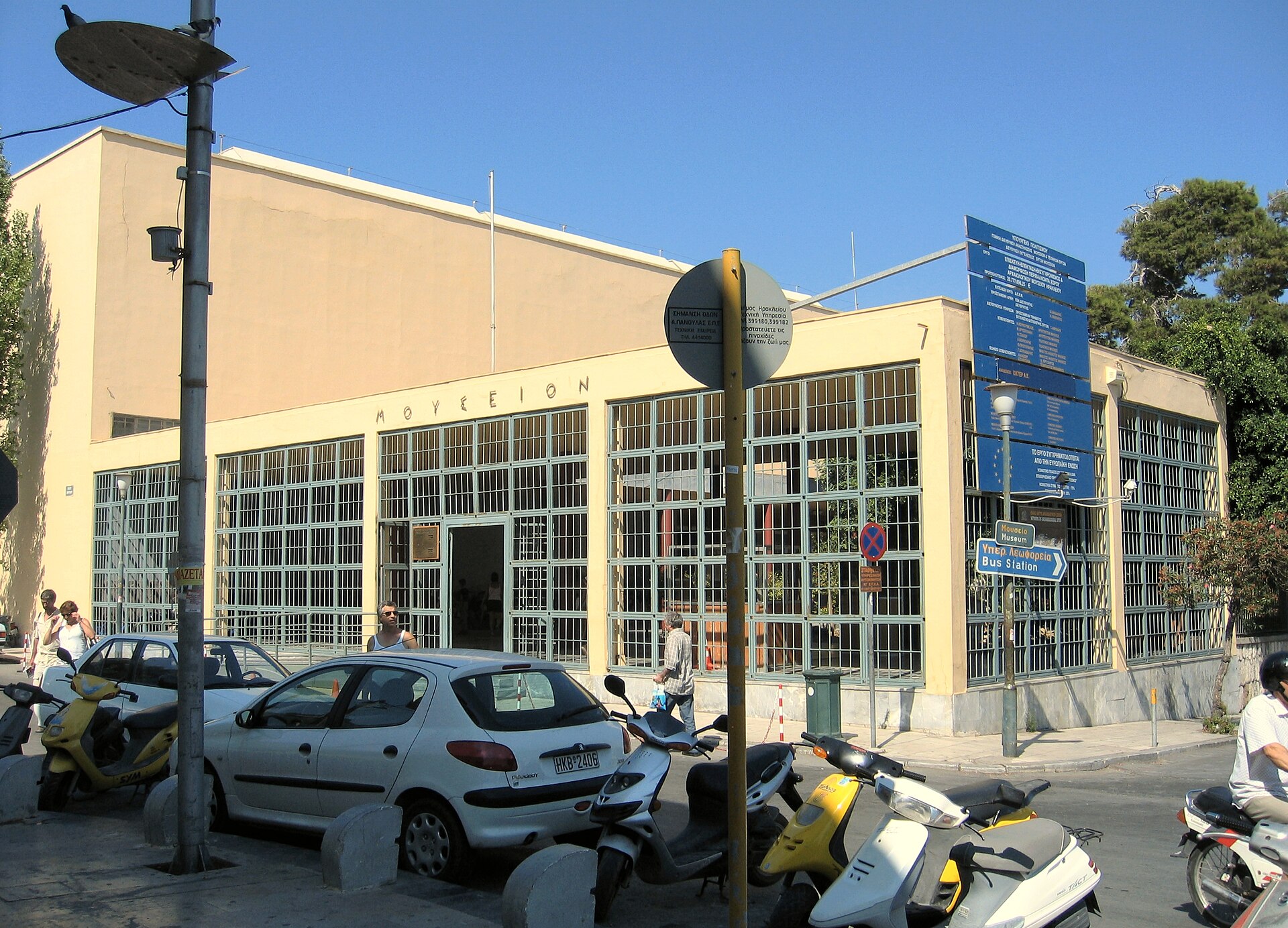
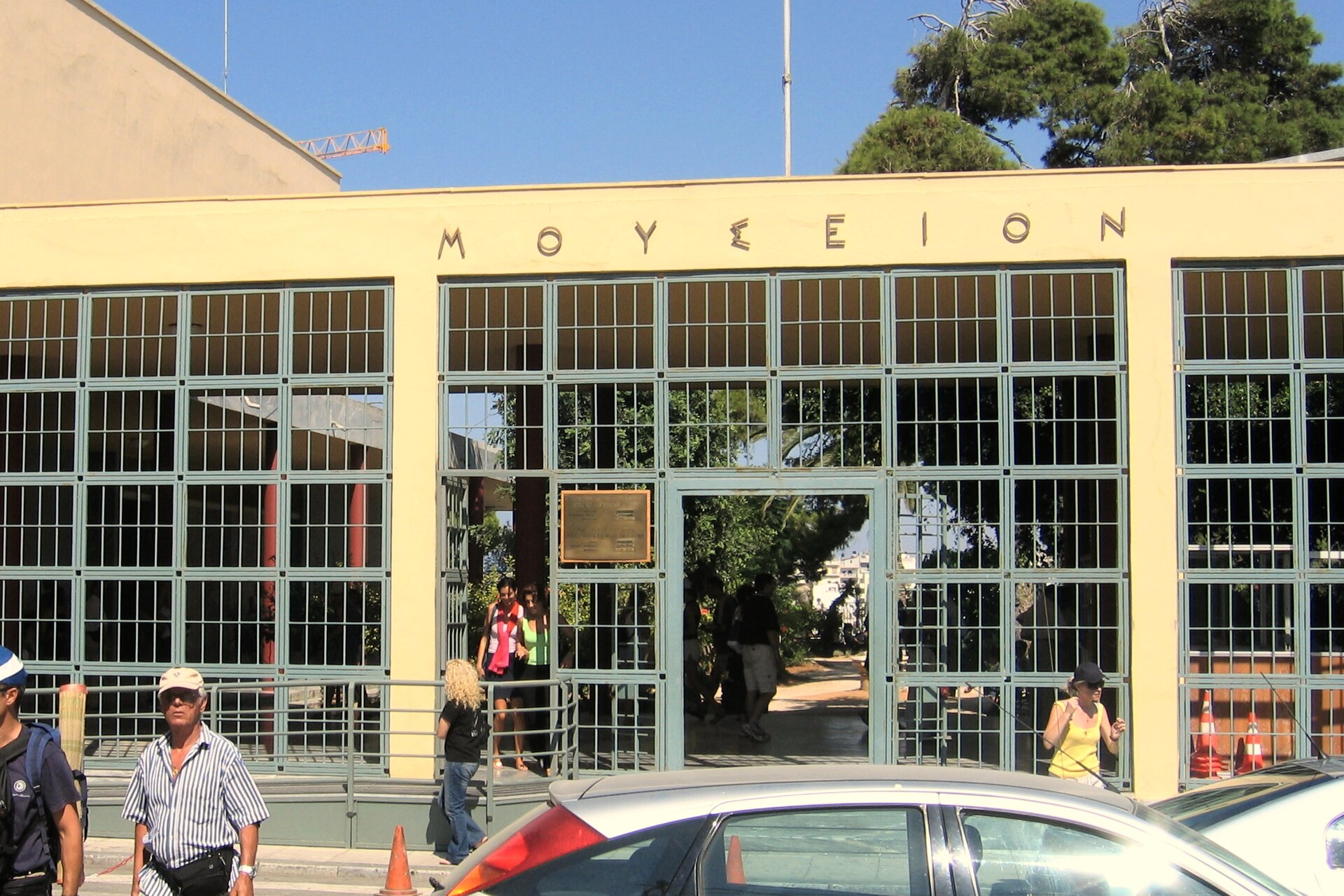
The Heraklion Archaeological Museum's modernist building by Patroklos Karantinos, seen from Xanthoudidou street, with MOYZEION (Museum) lettered above the entrance.
Zde · CC BY-SA 4.0Heraklion Archaeological Museum
Museum · Archaiologiko Mouseio Irakleiou · Founded 1883
Open, admission and hours confirmed 24 September 2026 · 18 sources
On this page 14 sections
ContentsClose
The Heraklion Archaeological Museum is the reference collection for Minoan Crete: because Cretan antiquities law has kept excavated material on the island since the early twentieth century, the finds from Knossos, Phaistos, Malia, Zakros and Hagia Triada sit here rather than in the museums of the foreign expeditions that dug them up, making this the single place to see the primary evidence behind more than a century of Minoan scholarship, alongside a continuous run of later Cretan material through Roman Gortyn.
| Local name | Archaiologiko Mouseio Irakleiou |
|---|---|
| Kind | Museum |
| Founded | 1883 |
| City and country |  Heraklion, Greece Heraklion, Greece |
| Address | Xanthoudidou & Hatzidaki str., 712 02 Heraklion, Crete, Greece |
| Website | heraklionmuseum.gr/en |
| Status | Open, confirmed |
| Record last verified |
Visiting
- Hours
- Mon, Tue, Thu, Fri, Sat, Sun08:30 to 15:30Winter season, 1 Dec 2025 - 31 Mar 2026
- Wed10:00 to 17:00Winter season, 1 Dec 2025 - 31 Mar 2026
- Mon, Tue, Thu, Fri, Sat, Sun08:30 to 15:30April, 1-27 Apr 2026
- Wed10:00 to 17:00April, 1-27 Apr 2026
- Mon, Tue, Thu, Fri, Sat, Sun08:00 to 20:00Summer season, 28 Apr - 31 Oct 2026
- Wed13:00 to 20:00Summer season, 28 Apr - 31 Oct 2026
- Closed
- Last entry 20 minutes before closing. Reduced hours on Christmas Eve and New Year's Eve (07:00-13:00).
- Admission
- Adult (April-October)EUR 20Full price, all seasons
- Reduced (winter, 1 Dec-31 Mar)EUR 12Winter-season table lists a 12 EUR reduced rate alongside the 20 EUR full rate; EU citizens 65+ qualify Nov 1-Mar 31 on ID
- EU citizens 25 and under / non-EU under 18FreeFree on presentation of ID or passport confirming age and nationality
- Disabled visitor + one escortFreeEscort free only where disability is 67% or over, on presentation of ID and an EFKA/KEPA disability certificate (or equivalent for non-Greek citizens)
Free entry: First and third Sunday of every month, 1 November to 31 March. 6 March (Melina Mercouri day). 18 April (International Monuments Day). 18 May (International Museums Day). Last weekend of September (European Heritage Days). 28 October (Oxi Day)- Tickets
- tickets.hh.gr/en/venues/archaeological-museum... The museum's own ticket page.
- Do I need to book?
- No, but timed tickets can be ordered online in advance; the museum's own booking calendar is live through the coming months
- Address
- Xanthoudidou & Hatzidaki str., 712 02 Heraklion, Crete, Greece Map
- Website
- heraklionmuseum.gr/en
- Telephone
- +30 2810 279000
- [email protected]
Before you go how long, access, photography, bags, eating, shop
- How long to allow
- Two to three hours
- Access
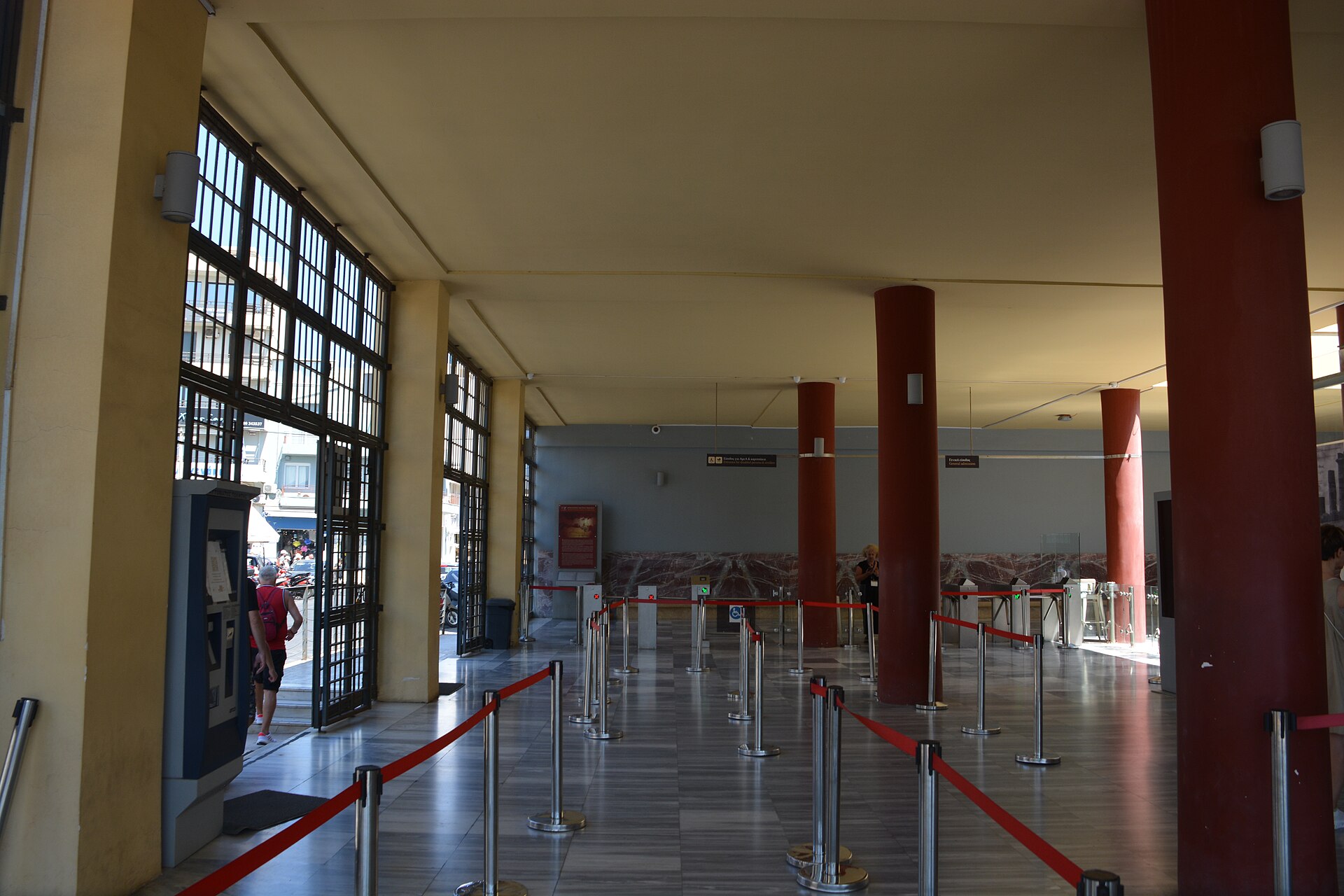
- Public areas are wheelchair accessible; the main entrance on Xanthoudidou has a ramp for wheelchairs and strollers; there is a lift and accessible toilets, and a wheelchair can be borrowed free at the entrance on ID
- Photography
- Amateur photography without flash is permitted in the exhibition areas; professional equipment and filming need a prior application to the museum, and published use of photographs needs museum permission
- Bags
- A ground-floor cloakroom holds backpacks and packages; the museum takes no responsibility for valuables or fragile items left there
- Eating
- A cafeteria operates in the museum garden
- Shop
- A gift shop inside the museum is run under lease by the Hellenic Organization of Cultural Resources Development (TAP)
Prices and hours change. We take them from the institution's own pages and print the day we read them, and you can check the current position at the source we used. Confirm before you travel.
What is inside
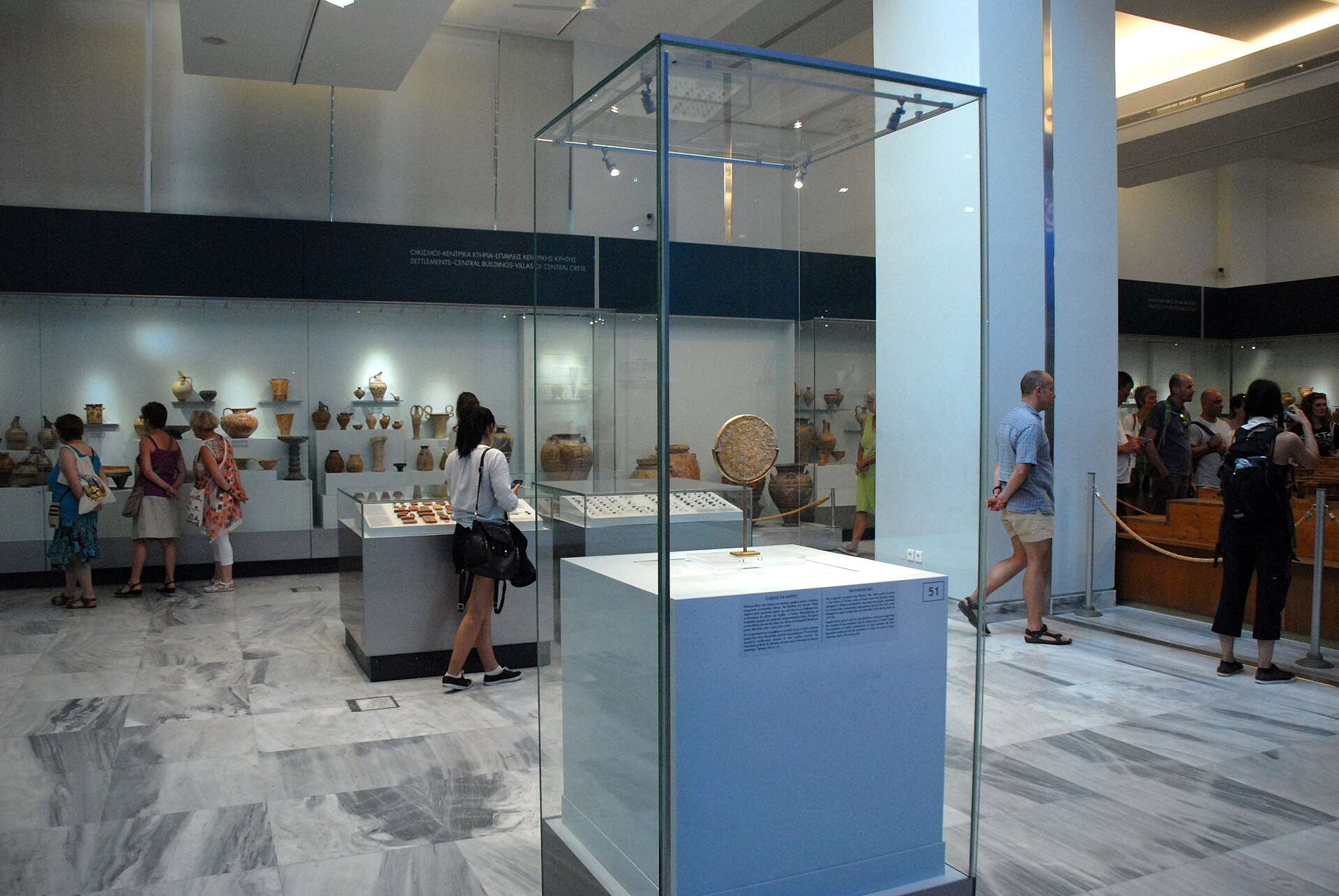
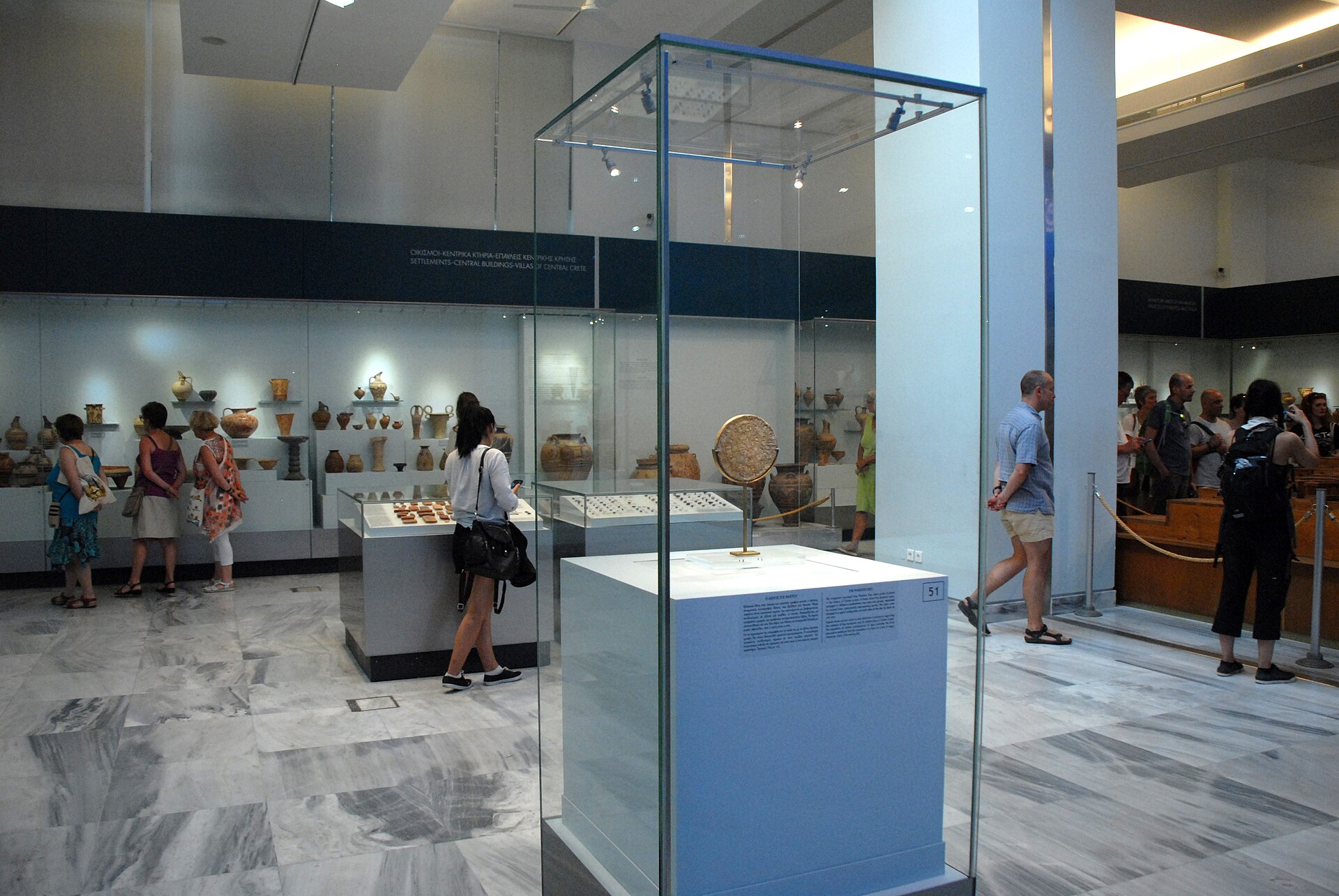
Photograph by K'm · CC BY-SA 4.0 Ground floor - Neolithic to New Palace Minoan galleries
The chronological spine of the museum, from Neolithic Crete (about 7000 BC) through the pre-Palatial, Old Palace and New Palace periods. Pottery, seal stones, religious equipment and everyday objects trace the rise of the Minoan palaces, and this run of rooms holds the Phaistos Disc, the faience Snake Goddess figurines and the Bull's Head rhyton.
First floor - Hall of the Frescoes
A dedicated room for the wall paintings lifted from Knossos and other Minoan sites, restored in the early twentieth century by the Swiss father-and-son artists Emile and Edouard Gillieron. The Prince of the Lilies, the Bull-Leaping fresco and La Parisienne (the Ladies in Blue) hang here.
First floor - post-Minoan chronological galleries
Rooms continuing the island's history past the Bronze Age collapse: Subminoan, Geometric, Archaic and Hellenistic material, much of it, per the museum's own account of the 2014 rehang, shown to the public for the first time.
Sculpture hall / lapidarium
Archaic through Roman-period stone sculpture: votive and funerary reliefs, portrait heads, sarcophagi, and Roman-era statuary from Cretan sites including Gortyn, the island's Roman capital.
Garden and the ruins of the Monastery of St Francis
The museum's garden holds a cafeteria and the visible ruins of the Venetian Monastery of St Francis, destroyed by the earthquake of 1856; the museum building of 1935-1958 was raised on the same plot.
What to see first
The Phaistos Disc
Unknown, Minoan CreteA fired-clay disc stamped on both faces with a spiral of hieroglyphic-like signs, found in 1908 by the Italian archaeologist Luigi Pernier in the Phaistos palace ruins. No comparable object has been found anywhere in the Aegean, and its script has never been agreed-deciphered; it is the museum's single most-asked-about object.9
The Snake Goddess figurines
Unknown, Minoan Crete, New Palace periodFaience figurines of women holding snakes, recovered from the Temple Repositories at Knossos and now the standard visual shorthand for Minoan religion, reproduced on souvenirs across the island; the museum holds the excavated originals rather than the copies that circulate elsewhere.11
The Bull-Leaping fresco (the Toreador Fresco)
Original Minoan wall painting, restoration by Emile Gillieron filsShows a Minoan bull sport or ritual in which figures vault the length of a charging bull; it is the most reproduced image to survive the palace at Knossos, and, per the reconstruction history set out by classicist Mary Beard, a large share of the painting as displayed is early-twentieth-century restoration rather than surviving ancient plaster.18
The Harvester Vase
Unknown, Minoan Crete, about 1500-1450 BCA steatite rhyton from the villa at Hagia Triada, carved in relief with a procession of men singing and carrying agricultural tools; it is among the earliest surviving depictions of ordinary working people, rather than rulers or deities, in Aegean art.16
The Malia gold bee pendant
Unknown, Minoan Crete, about 1800-1700 BCA gold pendant from the Chrysolakkos cemetery near Malia, showing two bees curved around a drop of honey, filigree and granulation intact; it is the standard reference piece for the technical range of Minoan goldsmiths.16
The Bull's Head rhyton
Unknown, Minoan Crete, New Palace periodA libation vessel carved from black steatite in the shape of a bull's head, with gilded horns and rock-crystal eyes; it is the object most often used to illustrate the bull's place in Minoan cult.16
The Ring of Minos
Unknown, Minoan Crete, about 1500-1400 BCA large gold signet ring incised with a tree-cult and epiphany scene, found in a field near the Knossos Royal Temple Tomb in 1928. Its authenticity split the excavators who first saw it, was effectively shelved for decades, and was only settled after the ring itself resurfaced in 2001; see Open questions.6
The Prince of the Lilies fresco
Original Minoan fragments, restoration by Emile Gillieron pere, 1905One of the most reproduced images from Knossos, restored from a handful of surviving pieces, including a crowned head, part of a torso and part of a thigh, with no face ever recovered; scholars including Mary Beard have questioned whether all the fragments used belonged to a single original figure.18
A modernist building on the site of an earthquake ruin
The museum stands in central Heraklion at the junction of Xanthoudidou and Hatzidaki streets, on a plot previously occupied by the Venetian-era Monastery of St Francis, destroyed by an earthquake in 1856; the ruins are still visible in the museum's garden. The present building was designed by the architect Patroklos Karantinos and built in stages between 1935 and 1958, and is counted, on the museum's own account, as an important example of Greek Modernist architecture. Its coloured, veined-marble-effect revetments were chosen to echo the painted imitation-marble finishes of the Minoan palaces the collection describes, and the two-storey plan holds extensive exhibition rooms, laboratories and an audiovisual room in addition to the galleries a visitor sees.
The site had already carried an earlier purpose-built museum, put up in the first decade of the twentieth century, before a run of earthquakes in the 1920s and 1930s damaged it badly enough to force the reconstruction that produced the building standing today. The museum's collection is older still: it dates its own founding to 1883, when Crete's antiquities, then still under Ottoman administration, began to be gathered into a formal public collection rather than dispersed piece by piece to foreign excavators and private buyers, a pattern that had already carried a great deal of Cretan material out of the island before there was anywhere on Crete to keep it.
The Minoan collection, and why this is the museum that owns the story
The Heraklion Archaeological Museum holds artefacts spanning roughly 5,500 years, from the Neolithic period through the Roman era, but it is built, deliberately, around the Minoan Bronze Age, and it is the single largest and most complete collection of Minoan material anywhere. That is a direct consequence of where the excavations happened: Knossos, Phaistos, Malia, Zakros, Hagia Triada and the other major Minoan palace and villa sites are all on Crete, and Cretan antiquities law has, since the early twentieth century, kept excavated finds on the island rather than allowing them to leave for the museums of the excavating nations, unlike the pattern that took so much of Aegean archaeology to London, Berlin and Paris in the same period. The result is that a visitor who wants to see the material culture behind Arthur Evans's reconstruction of Knossos, or the undisturbed grave goods from tombs the passage of a century did not manage to loot, has to come to Heraklion; a great deal of the primary evidence for what is known and disputed about Minoan civilisation simply is not held anywhere else.
The current arrangement of the galleries, unveiled when the museum reopened after a long building renovation in 2014, sets the ground floor aside for the Minoan sequence proper, moving chronologically from Neolithic Crete through the Old and New Palace periods, and reserves the first floor for the material that follows the palaces' end: the frescoes as a themed room in their own right, and then Subminoan, Geometric, Archaic and Hellenistic galleries carrying the story through to Roman Gortyn. A sculpture hall of Hellenistic and Roman work closes the sequence. The museum states that a number of these later-period objects were being shown publicly for the first time when the new galleries opened, material that under the old, more crowded display had simply had nowhere to go.
The Phaistos Disc and the question nobody has answered
Among some 5,800 exhibited objects, the Phaistos Disc is the one visitors ask after by name. It is a disc of fired clay, roughly 16 centimetres across, stamped on both faces, apparently before firing, with a spiral run of pictographic signs unlike the two known Cretan scripts, Linear A and Linear B, or any other writing system from the ancient Aegean. It was found in 1908 by the Italian archaeologist Luigi Pernier during excavation of the palace at Phaistos, in a context generally dated to around 1700 BC. More than a century of proposed decipherments, none of them accepted by the field as a whole, has not settled what the disc says, who made it, or even, given that nothing else like it has surfaced anywhere in the intervening century, whether it was made on Crete at all. The museum displays it in its own case among the ground-floor Old Palace material, unresolved status and all; nothing on the label promises a solution the scholarship does not have.
The frescoes, and how much of what is on the wall is actually ancient
The Hall of the Frescoes gathers the wall paintings lifted from Knossos and other palace sites, and it is where the museum's most photographed images hang: the Prince of the Lilies, the Bull-Leaping fresco, and La Parisienne, sometimes shown as part of the Ladies in Blue group. What the room does not advertise on the wall labels, and what is worth a visitor knowing before they go, is how much of each painting is nineteenth- and twentieth-century restoration rather than surviving ancient plaster. The classicist Mary Beard, writing in the New York Review of Books on the state of Knossos scholarship, put the general pattern plainly: "the more famous the image now is, the less of it is actually ancient." The Prince of the Lilies was restored in 1905 by the Swiss artist Emile Gillieron from a small crowned head, part of a torso and part of a thigh, no face was ever found among the fragments, and Beard and others have questioned whether every piece used even came from the same original figure. The Ladies in Blue survived the 1926 Heraklion earthquake and was restored again afterward by Gillieron's son, Edouard, meaning some of what a visitor sees is a twentieth-century artist's second attempt at a painting already once reconstructed. None of this makes the frescoes fakes; it makes them collaborations between a Bronze Age painter and an Edwardian restorer, and the museum's own presentation, while it does credit the Gillierons as restorers, does not walk a visitor through fragment by fragment how much of each image in front of them is which.
The Ring of Minos: authenticated, lost, and found in a fireplace
The Ring of Minos is displayed, on the museum's own current account, as a straightforward exceptional object: a large gold signet ring found in 1928 near the Royal Temple Tomb at Knossos, examined at the time by the excavator of Knossos, Sir Arthur Evans, and by the archaeologist Nikolaos Platon, neither of whom doubted it was genuine. That account leaves out most of the ring's documented history. A third senior archaeologist, Spyridon Marinatos, the excavator of Thera, judged the ring a modern forgery, and as Marinatos's standing in Greek archaeology grew in the postwar decades, his view prevailed enough that the ring effectively dropped out of the record; the object itself went missing from where it had been kept. It stayed missing for more than seventy years. In 2001, a retired police officer named Georgios Kazantzis found the ring, according to a contemporary account in the archaeology journal Anistoriton, set into the fireplace wall of a house he had inherited in Crete; he handed it to the Greek Archaeological Service, and this time the Central Archaeological Board examined it and pronounced it authentic, on the strength partly of comparable iconography that had turned up at other Minoan sites in the decades since 1928 (Kazantzis received the finder's reward set by Greek law, reported as EUR 400,000). The scene on the ring, a goddess appearing in the air, on land and at sea over a tree-cult ritual, is now treated as one of the clearer statements of Minoan religious iconography to survive; the eighty-year argument over whether it was ancient at all is not part of the story the museum tells about it today.
Visiting today
The museum keeps different hours across the year: a winter timetable from 1 December to 31 March, a short April schedule, and extended summer hours from 28 April to 31 October, with Wednesdays running later than the rest of the week in every season; full admission is EUR 20, with a EUR 12 reduced rate and a substantial list of free-admission categories, including EU citizens 25 and under, disabled visitors and an escort, and free entry on the first and third Sunday of the month from November to March. Photography without flash is allowed in the galleries for personal use; professional shoots and filming need a prior application. Bags go into a ground-floor cloakroom, and mobile phone use is not permitted in the exhibition rooms. Most visitors allow two to three hours, and reviewers consistently suggest combining the visit with the Knossos palace site a short drive away, arguing that each makes more sense once the other has been seen.
What visitors say
Visitors consistently describe the collection as far larger and more important than they expected, and repeatedly recommend pairing the museum with a visit to the Knossos site itself, one to explain the other. The 2014 rehang is credited with a clear, well-labelled, air-conditioned chronological layout that copes with large summer crowds; recent reviewers who also remember the museum from decades ago report it has improved substantially since then.
What is praised, what is criticised
- Praised: The chronological, well-labelled layout, with English-language panels throughout and a model of the Knossos palace that visitors say helps before going to the site itself
- Praised: The range and quality of the finds, including grave goods from unlooted burials that give a fuller picture than the highlight objects alone
- Praised: The building's climate control, repeatedly called a cool, calm break from the heat outside in summer
- Praised: The garden cafeteria as a place to pause partway through a long visit
- Criticised: The EUR 20 admission fee draws recurring comment as steep for a single museum, even from reviewers who go on to say it is worth paying
- Criticised: A minority of long-time visitors who knew the pre-2014 displays say fewer Minoan objects are now on view than they remember from earlier decades, though this reads as a change in curatorial choice (more context, fewer objects per case) rather than a reduction in the collection itself
Ratings on other platforms
Tripadvisor: 4.6 from 7,830 ratings, read 24 September 2026
A platform average is a tertiary source: it moves, it is not audited, and we quote no visitor's words.
Questions about Heraklion Archaeological Museum
Where is Heraklion Archaeological Museum?
Xanthoudidou & Hatzidaki str., 712 02 Heraklion, Crete, Greece.
How much does it cost to visit?
Adult (April-October): EUR 20; Reduced (winter, 1 Dec-31 Mar): EUR 12; EU citizens 25 and under / non-EU under 18: free; Disabled visitor + one escort: free. As confirmed 24 September 2026.
When is it open?
Mon, Tue, Thu, Fri, Sat, Sun 08:30-15:30; Wed 10:00-17:00; Mon, Tue, Thu, Fri, Sat, Sun 08:30-15:30; Wed 10:00-17:00; Mon, Tue, Thu, Fri, Sat, Sun 08:00-20:00; Wed 13:00-20:00. Closed: Last entry 20 minutes before closing. Reduced hours on Christmas Eve and New Year's Eve (07:00-13:00). As confirmed 24 September 2026.
What should you see first?
The Phaistos Disc (Unknown, Minoan Crete); The Snake Goddess figurines (Unknown, Minoan Crete, New Palace period); The Bull-Leaping fresco (the Toreador Fresco) (Original Minoan wall painting, restoration by Emile Gillieron fils); The Harvester Vase (Unknown, Minoan Crete, about 1500-1450 BC); The Malia gold bee pendant (Unknown, Minoan Crete, about 1800-1700 BC); The Bull's Head rhyton (Unknown, Minoan Crete, New Palace period).
What we could not confirm
- The Phaistos Disc's script has never been agreed-deciphered, and no comparable object has been found anywhere else in the Aegean; even whether it was made on Crete remains unresolved.
- How much of the celebrated frescoes (the Prince of the Lilies, the Bull-Leaping fresco, the Ladies in Blue) is surviving ancient plaster versus early-twentieth-century restoration by the Gillierons is not spelled out fragment by fragment on the museum's own labels, even though the scholarship on the point is published and not in serious dispute.
- The Ring of Minos was judged a forgery by the excavator of Thera, Spyridon Marinatos, went missing for over 70 years, and was only re-authenticated after resurfacing in a private house in 2001; the museum's current exhibit text presents the ring's authenticity as settled from the outset in 1928 and omits the Marinatos dispute and the decades the ring spent missing.
- Public sources consulted for this page give differing dates for the museum's earlier, pre-1935 building (sources vary between a 1900s and a 1904-1912 construction) and do not fully agree on how badly the present building was damaged during the Second World War; this page follows the museum's own account of a 1935-1958 construction and does not attempt to adjudicate the earlier building's exact dates.
Images
Sources
- 1Heraklion Archaeological Museum, official homepage heraklionmuseum.gr/en/
- 2Heraklion Archaeological Museum, 'Visit us' (hours, admission table, accessibility, photography, cloakroom, mobile phones) heraklionmuseum.gr/en/visit-us/
- 3Heraklion Archaeological Museum, 'General Information' (address, phone, email) heraklionmuseum.gr/en/information/
- 4Heraklion Archaeological Museum, 'The Museum' (building history, architect Patroklos Karantinos) heraklionmuseum.gr/en/the-museum/
- 5Heraklion Archaeological Museum, 'Reduced Ticket - Free Admission' heraklionmuseum.gr/en/reduced-ticket-free-admission
- 6Heraklion Archaeological Museum, exhibit page, 'The Ring of Minos' heraklionmuseum.gr/en/exhibit/the-ring-of-minos/
- 7Wikimedia Commons, File:Building of the Archaeological Museum of Heraklion, 061381.jpg (licence CC BY-SA 4.0, Zde) commons.wikimedia.org/wiki/File:Building_of_the_Archaeological_Museum_of_Heraklion,_061381.jpg
- 8Wikimedia Commons, File:Entrance in the Archaeological Museum of Heraklion, 06382x.jpg (licence CC BY-SA 4.0, Zde) commons.wikimedia.org/wiki/File:Entrance_in_the_Archaeological_Museum_of_Heraklion,_06382x.jpg
- 9Wikimedia Commons, File:Musee archeologique d'Iraklio - disque de Phaistos.JPG (licence CC BY-SA 4.0, Camille Gevaudan) commons.wikimedia.org/wiki/File:Mus%C3%A9e_arch%C3%A9ologique_d%27Iraklio_-_disque_de_Phaistos.JPG
- 10Wikimedia Commons, File:202610 Archaeological Museum of Heraklion 01.jpg (licence CC BY-SA 4.0, Jonashtand) commons.wikimedia.org/wiki/File:202610_Archaeological_Museum_of_Heraklion_01.jpg
- 11Wikipedia, 'Heraklion Archaeological Museum' (; general history and gallery-layout background) en.wikipedia.org/wiki/Heraklion_Archaeological_Museum
- 12Wikidata, Q636972, Heraklion Archaeological Museum (; inception date 1883, coordinates) wikidata.org/wiki/Q636972
- 13Tripadvisor, 'Heraklion Archaeological Museum' attraction page (; aggregate rating and visitor reviews, read 2026-09-24) tripadvisor.com/Attraction_Review-g189417-d195895-Reviews-Heraklion_Archaeological_Museum-Heraklion_Crete.html
- 14Tripadvisor, review by Lesley B, 'What a disappointment', 30 October 2013 tripadvisor.co.nz/ShowUserReviews-g189417-d195895-r182802067-Heraklion_Archaeological_Museum-Heraklion_Crete.html
- 15Cretazine, 'The NEW Archaeological Museum of Heraklion' (post-2014 gallery organisation by floor) cretazine.com/en/heraklion/city-guide/what-to-see/item/250-archaeological_museum
- 16Hellenic Heritage, 'Archaeological Museum of Heraklion: The priceless heritage of the Minoan civilization' (history and highlight objects) hh.gr/en/destinations/heraklion-museum/
- 17Anistoriton journal, 'Minos's Ring is Finally Accepted as Authentic', Issue A031, 15 March 2003 anistor.gr/english/enback/a031.htm
- 18Mary Beard, 'Knossos: Fakes, Facts, and Mystery', The New York Review of Books, 13 August 2009 nybooks.com/articles/2009/08/13/knossos-fakes-facts-and-mystery/


