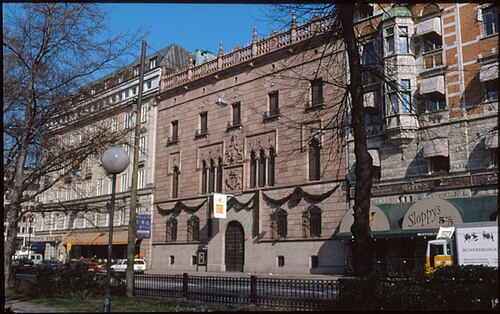
The facade on Hamngatan, Stockholm. Photograph from the Hallwyl Museum's own collection.
Hallwyl Museum / Goran Schmidt / CC BY-SA 3.0 (also marked public domain on Commons)Hallwyl Museum
Museum · Hallwylska museet · Founded 1938
Open, admission and hours confirmed 15 November 2026 · 29 sources
On this page 15 sections
ContentsClose
The Hallwyl Collection is strongest as a documented domestic ensemble: furniture, applied arts, portraits and Wilhelmina's East Indian porcelain, kept in the house for which they were bought and described object by object in a 78 book catalogue. Wikipedia names Jan Griffier, Pieter Aertsen, Pieter Brueghel the Younger and Thomas Wyck among the painters represented, which is tertiary and should be replaced with the museum's own database. The museum's own pages place the collection in the National Historical Museums database, with open licences on most media.
| Local name | Hallwylska museet |
|---|---|
| Kind | Museum |
| Founded | 1938 (opened to the public; house built 1893-1898, donated to the Swedish state 1920) |
| City and country |  Stockholm, Sweden |
| Address | Hamngatan 4, 111 47 Stockholm, Sweden |
| Website | hallwylskamuseet.se/en |
| Status | Open, confirmed |
| Record last verified |
Visiting
- Hours
- Tue12:00 to 16:00
- Wed12:00 to 19:00
- Thu-Fri12:00 to 16:00
- Sat-Sun11:00 to 17:00
- Closed
- Every Monday. 24, 25, 26 and 31 December and 1 January. Monday 11 to Friday 15 January (the page does not state the year). Good Friday 26 March. Midsummer's Eve 25 June and Midsummer's Day 26 June.
- Admission
- Admission ticket only (adult)SEK 150Retirees and students pay the adult rate. Includes the temporary exhibition War of the Corsets.
- Admission with guided tour (adult)SEK 200Admission included in the tour price
- Children and youth up to 18Freefree; guides or assistants also enter free
- Annual pass (National Historical Museums sites)SEK 450Does not cover events or guided tours; not sold online at the time of reading
- Audio guideSEK 20Children up to 18 free; twelve languages
- Digital on-demand tour (Zoom)SEK 50Must be bought in advance on the ticketing site
- Tickets
- hallwylskamuseet.se/en/visit-us/admissions-an... The museum's own ticket page.
- Do I need to book?
- No for the first floor on your own; guided tours are booked through the museum's ticketing partner Tickster, with remaining tickets sold on site
- Address
- Hamngatan 4, 111 47 Stockholm, Sweden MapMetro (Tunnelbana) Ostermalmstorg and Kungstradgarden are the closest stations
Bus SL inner-city lines stop at Nybroplan, Hamngatan and Norrmalmstorg; the museum recommends bus 2, 76 or 69 - Website
- hallwylskamuseet.se/en
- Telephone
- +46 8 402 30 99
- [email protected]
Before you go how long, access, photography, bags, eating, shop
- How long to allow
- The museum does not state a visit length. The English guided tour takes about 50 minutes (about 40 in summer).
- Access
- No lifts and five floors. The museum says the public spaces are not accessible to wheelchair users or walkers. A guided tour involves at least 103 steps. A portable hearing aid guide system, magnifying glasses and torches can be borrowed.
- Photography
- Allowed in the exhibitions and shareable on social media. Tripods and selfie sticks are prohibited. Commercial photography needs the museum's permission.
- Bags
- Bags are not allowed inside and jackets may not be carried on the arm. Lockers on the ground floor need no coins and small bags are allowed. Strollers are not allowed.
- Eating
- Hallwylska Restaurant and Bar in the courtyard is run by an external restaurateur and closes in the fall. Outside food and drink are not allowed in the museum.
- Shop
- The museum shop sells household items inspired by the house, the Hallwylska teacup (SEK 329) and museum books. Entry is free and it keeps the museum's hours.
Prices and hours change. We take them from the institution's own pages and print the day we read them, and you can check the current position at the source we used. Confirm before you travel.
What is inside
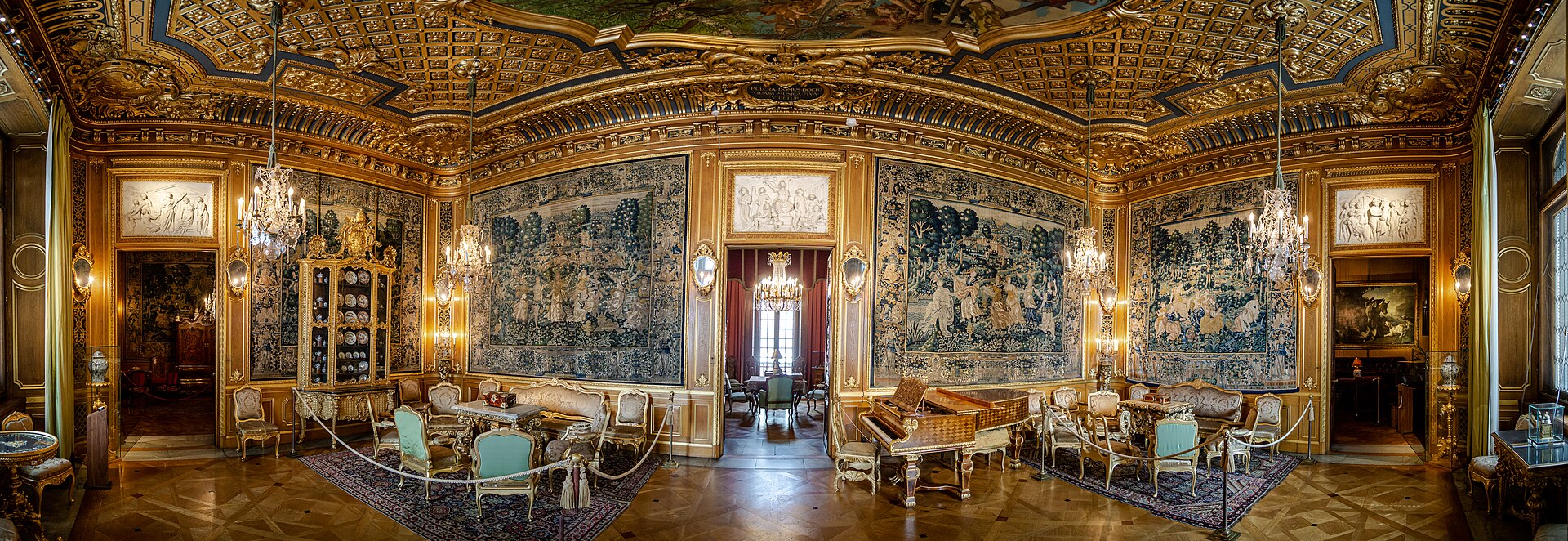
Photograph by Rainer Halama · CC BY-SA 4.0 The Great Drawing Room
The most ornate room on the first floor. Wilhelmina called it my little Klondike. Gusten Lindberg made the marble relief Prometheus Brings the Fire to the People above the fireplace and the door lintels showing Music and Poetry and Visual Arts. A small part of her East Indian porcelain is shown in a 1770s gilded cabinet that once belonged to Pope Pius VI; the bulk is in the China Room on the third floor. A hot air heating system meant the fireplaces were never needed for warmth.
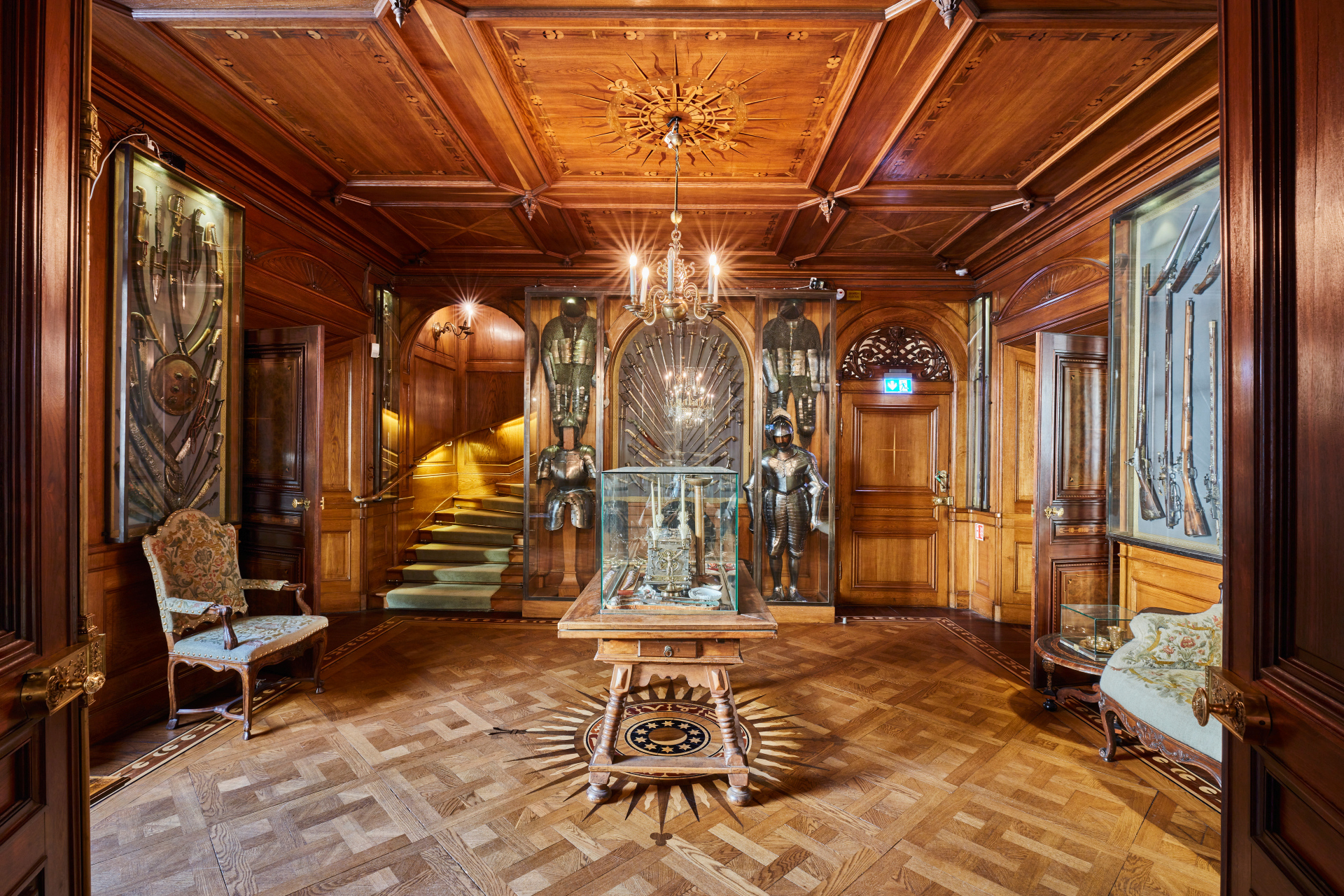
Photograph by Helena Bonnevier · CC BY 4.0 The Armoury
A panelled room with blue-grey wallpaper. The ceiling is oak and maple with ebony and walnut elements and its floor extends the pattern, a compass star set in its correct geographical position with zodiac signs and stars inside. The windows are antique crown glass bought by Wilhelmina in Lucerne (2,500 panes in 1896 and 300 more in 1904) and a stained glass window shows The Last Supper.
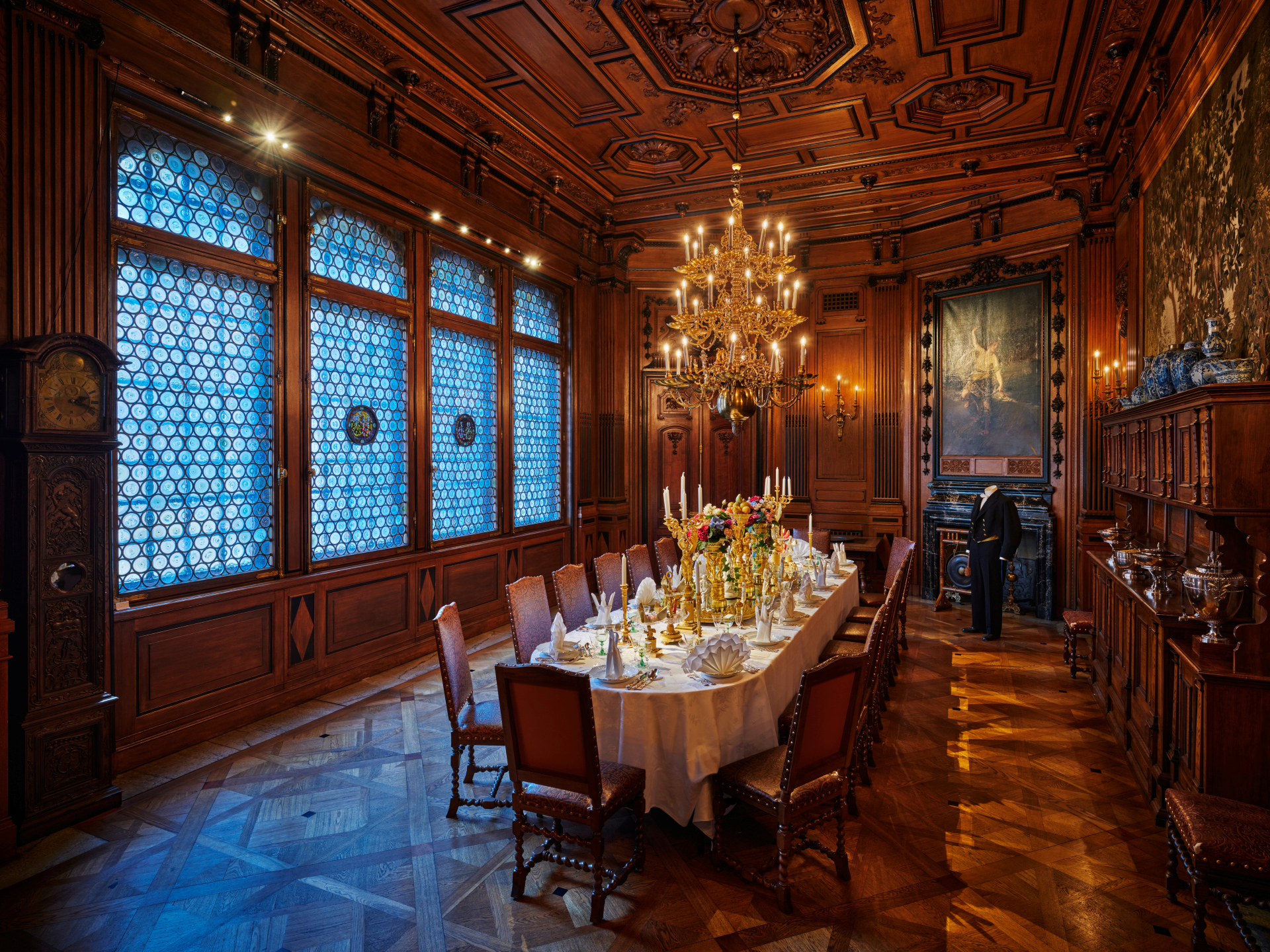
Photograph by Ola Myrin · CC BY 4.0 The Dining Room
One of the nine first-floor rooms open without a tour, with stained glass among its windows according to the museum. The photograph shows the table laid for a dinner party.
The Porcelain Room
Designed by Isak Gustaf Clason as a museum room, with a green ceiling painted by Nils Asplund and walls of polished mahogany and maple. Glass fronted cabinets hold rows of porcelain, and the gilt bronze mouldings and ventilation grilles carry the Hallwyl monogram. The metal details cost SEK 18,453 in total.
The Smoking Room and the Morning Room
Walther's room has his desk with a cigar cutter and a portrait of Wilhelmina by Julius Kronberg from 1895 above the fireplace, and a 17th century hunting scene by Abraham Hondius. Wilhelmina's Morning Room has family portraits and a Kronberg ceiling from 1918 showing Perseus liberating Andromeda.
The Upper Vestibule
Four oval portraits by Charles Edouard Boutibonne from 1865 showing Wilhelm and Johanna Kempe and Walther and Wilhelmina, painted for the couple's honeymoon.
The stables in the courtyard
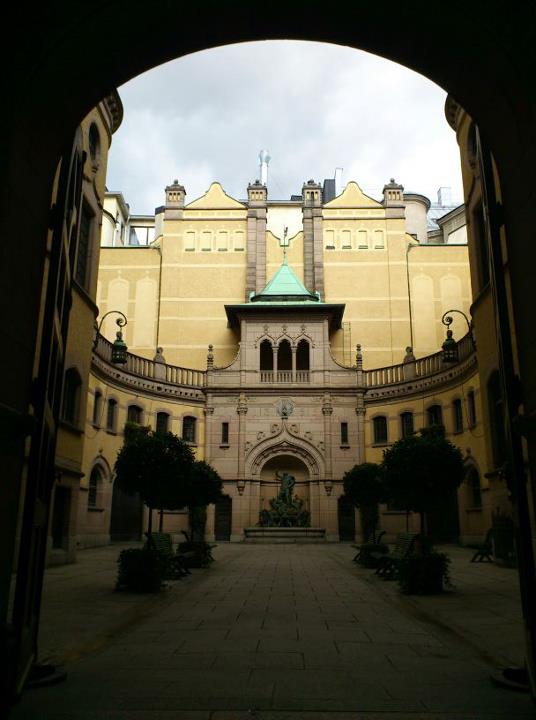
Three stalls and a box, with the nameplates of the family's horses still over the stalls. Carved decorations mark the building: a horse's head for the stables and a wagon wheel for the carriage house. Not an area for independent visits as far as the museum's pages state.
The upper floors (guided tours)
The upper floors, including the bedroom floor and the picture gallery, are reached on a guided tour: the museum counts 40 steps from the first floor to the bedroom floor and 24 more up to the picture gallery. The museum's pages read for this page do not describe those rooms in detail.
What to see first
The Great Drawing Room
Gusten Lindberg (reliefs and lintels)The house's showpiece and Wilhelmina's own little Klondike, with a marble Prometheus relief and a gilded cabinet that once belonged to Pope Pius VI.13
The Armoury ceiling and windows
Neumann & Vogel (windows)A compass star placed in its true geographical position, and windows of antique crown glass with a stained glass Last Supper whose Swiss originals Wilhelmina returned in 1926.14
The Porcelain Room
Isak Gustaf Clason (design); Nils Asplund (ceiling)A purpose built museum room inside a private house, with gilt bronze grilles carrying the Hallwyl monogram.15
Portrait of Wilhelmina von Hallwyl, 1895
Julius KronbergUnusual for its day because it does not show wealth through her clothing; the museum notes an alert gaze and a relaxed pose.16
Ceiling of the Morning Room, Perseus liberates Andromeda
Julius KronbergPainted in 1918 and one of Kronberg's last major works, by the artist who contributed more to the decoration of the house than any other.17
Four oval portraits of the Kempe and Hallwyl families, 1865
Charles Edouard BoutibonnePainted for the couple's honeymoon, they put the founding marriage on the wall of the first-floor vestibule.18
The Hallwyl catalogue, 78 books
Wilhelmina von Hallwyl and her catalogue staffA 1906 to 1956 record describing everything in the house, with each object numbered by group.10
The stables and carriage house
Kept at Wilhelmina's wish as part of her museum, with the horses' nameplates still in place.19
Exhibitions on now
- On now13 Mar 2026 to 10 Jan 2027Confirmed
A Stockholm town palace kept as it was lived in
The Hallwyl Museum occupies the house at Hamngatan 4 in central Stockholm, a few steps from the Royal Dramatic Theatre and across the street from Berzelii Park. It was built for Count Walther von Hallwyl and his wife Wilhelmina, and the couple decided before they moved in that the house and everything in it would one day become a museum. The family gave the house and its contents to the Swedish state in 1920 and the museum opened to the public in 1938. It is run today as one unit of the National Historical Museums, the Swedish government agency that also runs the Royal Armoury and Skokloster Castle.
What the visitor gets is not a gallery of objects hung for effect but a household held in place. The museum describes the house as a time capsule, and the museum's own pages bear that out: portraits hang where the family put them, a desk still carries its inkwell and a cigar cutter sits among Walther's small things. The reason to come is the sense of a real, very rich Stockholm household of the 1890s and early 1900s, seen through the rooms where the family received guests, played billiards and dealt with its letters.
The building and what it was built to hold
The site was not grand when the von Hallwyls found it. The museum says the area was far from exclusive in the 1890s and that the low buildings on the plot were known as Hammer's ramshackle, after the goldsmith and collector Christian Hammer, who had bought the property in the 1870s for SEK 170,000. The von Hallwyls bought it in 1893 for SEK 205,265 and built the present house, which cost just over SEK 1.5 million. Wikipedia, a tertiary source used here for identity facts only, gives the years 1893 to 1898 and names Isak Gustaf Clason as the architect, with an exterior that borrows from medieval models and from Renaissance Venice. The museum's own porcelain room page confirms that Clason designed that room, while its building page speaks only of the architect.
Quality was the brief. The museum says Wilhelmina and the architect insisted on skilled craftsmen and durable materials, and the result is panelled interiors using dozens of kinds of wood, large walls of marble and carefully made doors and windows. The house also had what a Stockholm home of the 1890s rarely had: central heating, an electric lift, bathrooms and a central vacuum cleaner system. The Great Drawing Room shows how the heating worked. Its fireplaces were never used for warmth, because a hot air system sent heated air up from the basement boiler room through channels in the walls. The fireplaces were there to suit the room's historical styles.
The courtyard held the stables and the carriage house. The stables had three stalls and a box, never held more than two horses at once and were closed in 1908 when the family bought a Fiat and the coachman Alfred Bergqvist was trained as a chauffeur. Wilhelmina wanted the stables kept as part of her museum, and they were.
Wilhelmina, Walther and the money behind the house
Wilhelmina von Hallwyl, born Kempe, was the daughter of Wilhelm and Johanna Kempe, two members of wealthy Pomeranian merchant families who moved to Sweden in the 1820s and made their fortune mainly in the forest industry. She married the Swiss nobleman Walther von Hallwyl in Stockholm on 10 June 1865. Walther came from a family first mentioned in writing in 1167, agreed to become Swedish before the wedding and took over the Kempe family business after Wilhelm Kempe died in 1883.
The same year Wilhelmina inherited and, by the museum's account, felt like a real Croesus and expanded her collection of antiques. The museum dates the collection as assembled around 1900 and says she bought art and antiques in large quantities. She lived for years at the Ericslund estate near Vagnharad and found life there lonely, which is the background to the house in town that she later made her life's work. Her own phrase for the Great Drawing Room, my little Klondike, links the room to the gold rush that began in 1896, the year the house was built.
The catalogue: a collection described in 78 books
The most unusual thing about this museum is not an object but the catalogue. Work began in 1906 under Wilhelmina's leadership and the catalogue was printed between 1926 and 1956, in 78 books and 110 copies, describing everything in the house. Objects were sorted into 67 groups by type, following her order, with Group I covering the building and Group II the office furnishings. Each object carries its own number built from Roman numerals and Latin letters, and the museum gives the example XXVII:II:E.09, a mechanical pig and dog.
The aim, in her own words as the museum quotes them, was to gather rich and diverse material for the illumination of her own time and of the culture of old times. The collection is now digitised and searchable in the National Historical Museums database, where most media is under open Creative Commons licences. Wikipedia and History Hit, both tertiary, put the collection at about 50,000 objects, which are approximate figures. The museum's own pages do not give a total, so none is asserted here.
What to see on your own and what needs a tour
Only the first floor is open for independent visits, and the museum lists nine rooms there: the Upper Vestibule, the Dining Room, the Ladies' Drawing Room, the Great Drawing Room, the Armoury, the Morning Room, the Porcelain Room, the Smoking Room and the Billiard Room. The house has five floors and the museum says two of them can be visited without a guided tour. To see more you take a guided tour, which the museum describes as covering the turn of the twentieth century, the history of the house and its collections, the family and the servants who worked there.
Go in knowing that the house has no lift. The museum states that the public spaces are not accessible to wheelchair users or walkers, that a guided tour involves at least 103 steps and that there are 30 steps from the entrance hall to the first floor. Bags are not allowed beyond the lockers on the ground floor, although small bags may be carried, and strollers are not admitted. Photography is allowed in the exhibitions, but tripods and selfie sticks are not.
The tour runs in English on Saturdays at 13:30 and takes about 50 minutes, or about 40 in summer. Swedish tours run Tuesday to Sunday at times listed on the ticketing site. An audio guide in twelve languages costs SEK 20 and covers the rooms. A temporary exhibition called War of the Corsets, about the late nineteenth century Swedish debate over the corset and what it said about gender and class, runs until 10 January 2027 and is included in the ticket.
Where this museum sits in the record
This is a house museum and a published collection, and the more interesting question for readers of an archive is the second one. Wilhelmina's catalogue treated the building itself as Group I of the collection, which makes the house, not only its contents, a documented object. The conditions of the 1920 donation required the house to remain essentially unchanged according to secondary summaries, a point the museum's own pages touched here do not spell out, so it is listed below as an open question rather than a settled fact.
The records that matter for provenance work are the numbered catalogue entries and the open digital database. A reader tracing a Hallwyl object should start there, and should expect the family's own numbering to be the primary document.
What visitors say
Visitor accounts read for this page describe a well preserved, richly furnished house that feels like a time capsule of an early 1900s family home, and many say the guided tour is what turns a pleasant visit into a good one. The complaints are practical: explanations that are thin outside Swedish and English, dim lighting, rooms that can only be seen on a tour and the fact that entry used to be free.
What is praised, what is criticised
- Praised: The house feels preserved as a real family home rather than arranged for display
- Praised: The art, porcelain and furnishings are impressive
- Praised: The guided tours are worth the extra cost and open rooms self-guided visitors cannot see
- Praised: Staff are friendly and helpful and it is a calm option in bad weather
- Criticised: Explanations are limited, especially for the temporary exhibition and in languages other than Swedish or English
- Criticised: Lighting is dim in places and some rooms are hard to enjoy
- Criticised: Some rooms are reachable only on a guided tour, which costs extra
- Criticised: Admission, once free, now carries a fee
- Criticised: Stairs only: the museum itself says it has no lift and is not accessible to wheelchair users
Ratings on other platforms
Google and Tripadvisor combined, as shown by the ticket reseller tours-tickets.com: 4.7 from 45 ratings, read 15 November 2026
A platform average is a tertiary source: it moves, it is not audited, and we quote no visitor's words.
Questions about Hallwyl Museum
Where is Hallwyl Museum?
Hamngatan 4, 111 47 Stockholm, Sweden.
How much does it cost to visit?
Admission ticket only (adult): SEK 150; Admission with guided tour (adult): SEK 200; Children and youth up to 18: free; Annual pass (National Historical Museums sites): SEK 450; Audio guide: SEK 20. As confirmed 15 November 2026.
When is it open?
Tue 12:00-16:00; Wed 12:00-19:00; Thu-Fri 12:00-16:00; Sat-Sun 11:00-17:00. Closed: Every Monday. 24, 25, 26 and 31 December and 1 January. As confirmed 15 November 2026.
How do you get there?
Metro (Tunnelbana): Ostermalmstorg and Kungstradgarden are the closest stations; Bus: SL inner-city lines stop at Nybroplan, Hamngatan and Norrmalmstorg; the museum recommends bus 2, 76 or 69.
What should you see first?
The Great Drawing Room (Gusten Lindberg (reliefs and lintels)); The Armoury ceiling and windows (Neumann & Vogel (windows)); The Porcelain Room (Isak Gustaf Clason (design); Nils Asplund (ceiling)); Portrait of Wilhelmina von Hallwyl, 1895 (Julius Kronberg); Ceiling of the Morning Room, Perseus liberates Andromeda (Julius Kronberg); Four oval portraits of the Kempe and Hallwyl families, 1865 (Charles Edouard Boutibonne).
What we could not confirm
- The 1920 donation reportedly required the house to stay essentially unchanged. The museum's pages read here do not state the terms, so the primary text of the donation deed is still to be found.
- The museum's building page does not name the architect. Clason as architect of the whole house comes from Wikipedia (tertiary); the museum's porcelain room page names him only for that room.
- The museum does not publish a total object count on the pages read. The figure of about 50,000 objects is tertiary.
- How the nature and scale of Wilhelmina's collecting looks beside current provenance standards is not addressed on the museum pages read; no restitution claim was found in the sources fetched.
Images
Sources
- 1Hallwylska museet, home page, read 2026-11-15 hallwylskamuseet.se/en/
- 2Hallwylska museet, Opening hours (updated 2026.11.12 per page), read 2026-11-15 hallwylskamuseet.se/en/visit-us/opening-hours/
- 3Hallwylska museet, Admission and tickets, read 2026-11-15 hallwylskamuseet.se/en/visit-us/admissions-and-tickets/
- 4Hallwylska museet, Contact us, read 2026-11-15 hallwylskamuseet.se/en/about-us/contact-us/
- 5Hallwylska museet, How to find us, read 2026-11-15 hallwylskamuseet.se/en/visit-us/how-to-get-here/
- 6Hallwylska museet, Accessibility, read 2026-11-15 hallwylskamuseet.se/en/visit-us/accessibility/
- 7Hallwylska museet, Plan your visit, read 2026-11-15 hallwylskamuseet.se/en/about-us/plan-your-visit/
- 8Hallwylska museet, Guided tours, read 2026-11-15 hallwylskamuseet.se/en/visit-us/guided-tours/
- 9Hallwylska museet, The building, read 2026-11-15 hallwylskamuseet.se/en/history-of-the-house/the-building/
- 10Hallwylska museet, Wilhelmina's museum, read 2026-11-15 hallwylskamuseet.se/en/history-of-the-house/wilhelminas-museum/
- 11Hallwylska museet, The Hallwyl Collection, read 2026-11-15 hallwylskamuseet.se/en/about-us/the-collections/
- 12Hallwylska museet, The Hallwyl family, read 2026-11-15 hallwylskamuseet.se/en/history-of-the-house/the-hallwyl-family/
- 13Hallwylska museet, The Great Drawing Room, read 2026-11-15 hallwylskamuseet.se/en/visit-us/visit-at-your-own-pace/the-great-drawing-room/
- 14Hallwylska museet, The Armoury, read 2026-11-15 hallwylskamuseet.se/en/visit-us/visit-at-your-own-pace/the-armoury/
- 15Hallwylska museet, The Porcelain Room, read 2026-11-15 hallwylskamuseet.se/en/visit-us/visit-at-your-own-pace/the-porcelain-room/
- 16Hallwylska museet, The Smoking Room, read 2026-11-15 hallwylskamuseet.se/en/visit-us/visit-at-your-own-pace/the-smoking-room/
- 17Hallwylska museet, The Morning Room, read 2026-11-15 hallwylskamuseet.se/en/visit-us/visit-at-your-own-pace/the-morning-room/
- 18Hallwylska museet, The Upper Vestibule, read 2026-11-15 hallwylskamuseet.se/en/visit-us/visit-at-your-own-pace/the-upper-vestibule/
- 19Hallwylska museet, The stables, read 2026-11-15 hallwylskamuseet.se/en/history-of-the-house/the-building/the-stables/
- 20Hallwylska museet, Visit at your own pace, read 2026-11-15 hallwylskamuseet.se/en/visit-us/visit-at-your-own-pace/
- 21Hallwylska museet, A part of National Historical Museums, read 2026-11-15 hallwylskamuseet.se/en/about-us/a-part-of-national-historical-museums/
- 22Hallwylska museet, War of the Corsets, read 2026-11-15 hallwylskamuseet.se/en/exhibitions/war-of-the-corsets/
- 23Hallwylska museet, Audio guide, read 2026-11-15 hallwylskamuseet.se/en/visit-us/audio-guide/
- 24Hallwylska museet, The museum shop, read 2026-11-15 hallwylskamuseet.se/en/visit-us/the-museum-shop/
- 25Hallwylska museet, Restaurant, read 2026-11-15 hallwylskamuseet.se/en/hallwylska-restaurant/
- 26Wikipedia, Hallwyl Museum (, identity facts only), read 2026-11-15 en.wikipedia.org/wiki/Hallwyl_Museum
- 27tours-tickets.com, Hallwyl Museum, aggregate rating (), read 2026-11-15 tours-tickets.com/stockholm/museums/hallwyl-museum/
- 28Wikimedia Commons, File:Fasaden - Hallwylska museet - 73628.tif, read 2026-11-15 commons.wikimedia.org/wiki/File:Fasaden_-_Hallwylska_museet_-_73628.tif
- 29History Hit, Hallwyl Museum (), read 2026-11-15 historyhit.com/locations/hallwyl-museum/