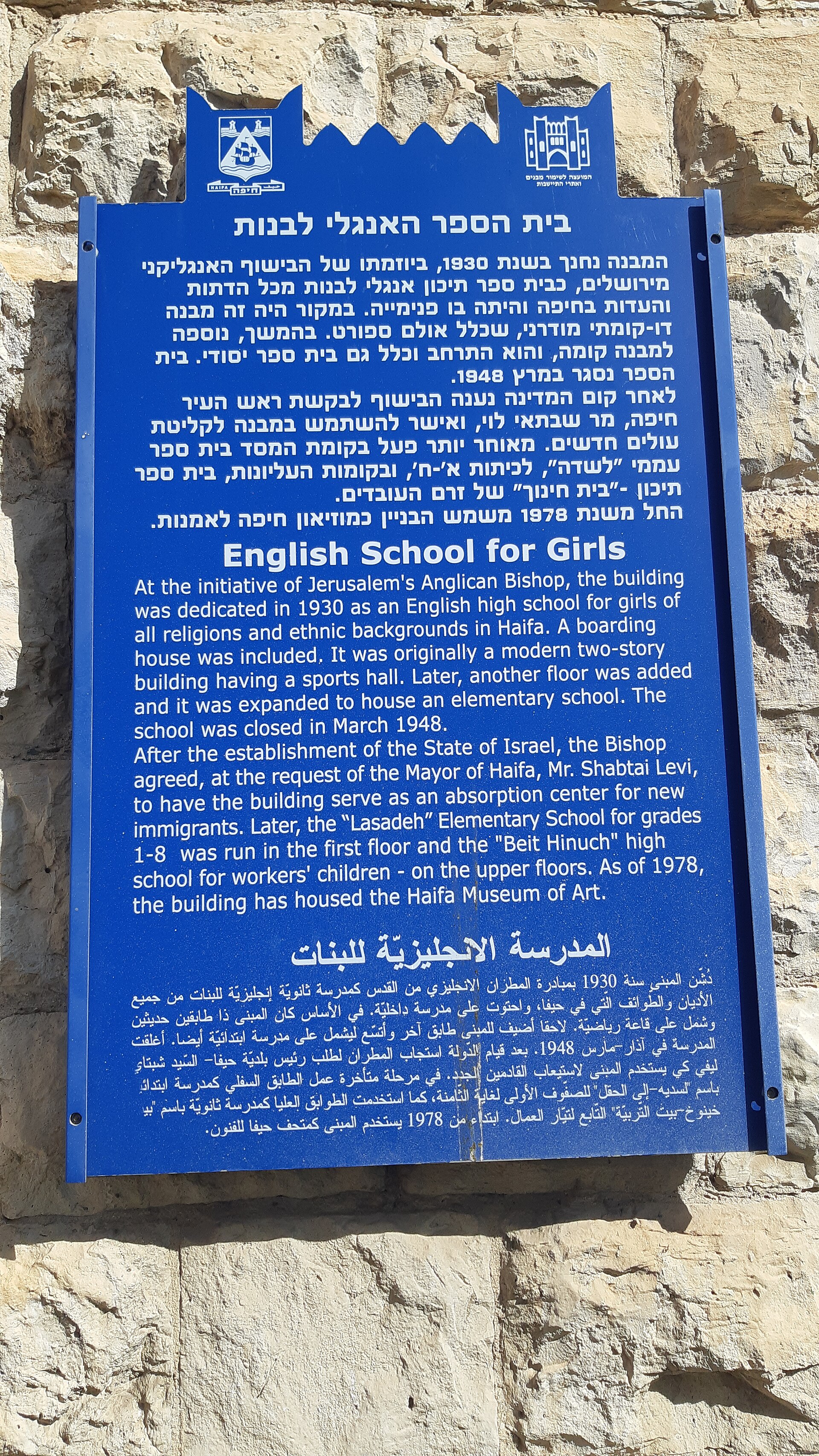
The museum's building on Shabbetai Levi Street, photographed in April 2022, showing the heritage-conservation plaque identifying the structure as the former English school for girls now housing the Haifa Museum of Art.
Danny Gershoni · CC BY-SA 4.0Haifa Museum of Art
Museum · Muzeon Haifa Le'Omanut · Founded 1951
Open, admission and hours confirmed 12 September 2026 · 24 sources
On this page 14 sections
ContentsClose
The Haifa Museum of Art's roughly 8,000-work collection is strongest in Israeli art from the 1950s onward, the core the museum built up over its four decades on Shabbetai Levi Street, and has recently gained real depth at the other end of the century through the 2024 Schusterman gift of early-twentieth-century Bezalel School and interwar material. Its international holding, concentrated in works on paper by figures such as Daumier, Redon, Masson and Chagall, is real but secondary in scale to the Israeli core, and is not the reason a visitor from outside Israel would travel to see it.
| Local name | Muzeon Haifa Le'Omanut |
|---|---|
| Kind | Museum |
| Founded | Founded 1951, for a large loan exhibition of Marc Chagall; moved to its present building in 1977 and reopened to the public in 1978 after renovation |
| City and country |  Haifa, Israel Haifa, Israel |
| Address | 26 Shabbetai Levi Street, Haifa 3304331, Israel |
| Website | hma.org.il/eng |
| Status | Open, confirmed |
| Record last verified |
Visiting
- Hours
- Sunday10:00 to 16:00
- MondayClosed
- Tuesday10:00 to 16:00
- Wednesday10:00 to 16:00
- Thursday10:00 to 18:00
- Friday10:00 to 14:00
- Saturday10:00 to 16:00
- Closed
- Monday, all year, on the schedule read for this record.
- Admission
- AdultILS 40Same entry fee covers the Tikotin Museum of Japanese Art and the National Maritime Museum on the consortium's shared price table; this is not a combined ticket, each museum is entered and priced separately, the three simply share one column on the published table.
- Youth (5-18) / Soldier / Police officer / Student / Handicapped / Haifa resident (with ID)ILS 30
- Senior citizenILS 20
- Family (couple + 2 children)ILS 100
- Additional childILS 17
- Bundle: all six Haifa Museums, 7 days, adultILS 80Senior 40 NIS, family (couple+2) 170 NIS, additional child 17 NIS on the same bundle.
- Reservists and security-forces personnelFreeFree admission to museum exhibitions.
Free entry: No museum-wide free day is published for the Haifa Museum of Art itself; the consortium's free-entry note on the same price page applies to the Hermann Struck Museum and to 'the art center', not to the Haifa Museum of Art.- Tickets
- hms.org.il/eng/Price_List The museum's own ticket page.
- Do I need to book?
- Not stated as required on the sources read; tickets are sold online through the consortium's own booking system and group visits are arranged separately by phone or email.
- Address
- 26 Shabbetai Levi Street, Haifa 3304331, Israel MapCarmelit (underground funicular) The museum sits about 370 metres from the Carmelit's HaNevi'im / downtown station. The Carmelit is Haifa's single-line underground funicular, running six stations between the Carmel Center and the lower city, weekdays roughly 06:00 to midnight; a Rav-Kav card carries a free transfer to city buses within 90 minutes.
Bus City bus routes serve Shabbetai Levi Street and the adjoining Hadar HaCarmel / Wadi Nisnas district directly; the museum's own site provides a Waze link rather than transit-line numbers. - Website
- hma.org.il/eng
- Telephone
- +972-4-6030800
- [email protected]
Before you go how long, access, photography, bags, eating, shop
- How long to allow
- Published visitor accounts read for this record range widely, from about thirty minutes for a visitor who found the galleries small and thin, to a stated one to four hours in aggregator data of unclear provenance; the museum's own site does not publish a suggested duration. Treat the low end and high end both as someone else's experience of a given day's exhibitions rather than a fixed fact about the building.
- Access
- The museum's own page for its current 'Facial Topography' collection exhibition states the show is accessible to visitors with mobility considerations; no general, building-wide accessibility statement was found on hma.org.il or hms.org.il in the sources read for this record.
- Photography
- Not published in the sources read for this record.
- Bags
- Not published in the sources read for this record.
- Eating
- A cafe is listed among consortium-wide visitor facilities on hms.org.il, without a Haifa Museum of Art-specific description; one 2019 published visitor account advised not to expect much of it.
- Shop
- A museum shop is listed among consortium-wide visitor facilities on hms.org.il, without a Haifa Museum of Art-specific description.
Prices and hours change. We take them from the institution's own pages and print the day we read them, and you can check the current position at the source we used. Confirm before you travel.
What is inside
Facial Topography: Israeli Art from the Museum's Collection
The museum's own standing showcase of its roughly 8,000-work collection, running 1 August 2026 to 2 January 2027 under curator Dr. Kobi Ben-Meir, spanning the late nineteenth century to the present and organised around landscape and physiognomy as a politically loaded pairing in Israeli art - asking, in the museum's own framing, whose land is pictured. Artists on the museum's own list include Mordechai Ardon, Yitzhak Danziger, Reuven Rubin, Michael Gross, Marcel Janco, Raffi Lavie, Yehezkel Streichman, Igael Tumarkin, Micha Ullman, Mark Antokolsky, Ron Amir and Farid Abu Shakra, among some thirty others.
A Sun-Kissed Land: the Schusterman Collection
A dedicated gallery for the collection Lynn Schusterman began gifting the museum from 2024, built around the formative first half of the twentieth century in Israeli art: Bezalel School of Arts and Crafts pieces from the school's 1906 founding, and paintings by Nahum Gutman, Reuven Rubin, Anna Ticho, Ephraim Moses Lilien, Mordecai Levanon and Yohanan Simon, set against later work asking the same questions about land and identity. Curated by Limor Alpern; the museum's own chief curator has called the gift a fill of a genuine gap, since the museum's existing strength lay mostly from the 1950s on.
International works on paper
A smaller, standing holding of European works on paper, roughly a third of the museum's paper collection on tertiary description, built around names including Honore Daumier, Odilon Redon and Andre Masson alongside Marc Chagall - the artist whose 1951 loan exhibition gave the museum its start.
Gallery for Families
An interactive, education-department-run space aimed at children and families, currently hosting 'A line that goes on a journey', part of the same August 2026 to January 2027 exhibition cycle as the adult shows; the museum's own material describes the wider education programme as building a multi-sensory visit for younger visitors.
Temporary exhibition galleries
The museum turns over three exhibition cycles a year across group shows, monographic and mini solo presentations, and a library-like space given to artists' books. The current cycle (1 August 2026 to 2 January 2027) includes 'Crossing Lines - From Line to Thread' (a group show on linear motion across media), a Mane-Katz Museum loan show 'Music After the War' of klezmer-themed paintings and sculpture, and solo presentations by Eti Levi and by Lian Sharkia. Earlier cycles have been considerably more contentious, including the 2018-19 'Sacred Goods' show and the 2019 'Fake News' show discussed under Reception below.
What to see first
The Burning Bush
Yitzhak Danziger, 1957An iron sculpture, 129 cm high, taking the biblical burning bush as its subject, by one of the formative figures of Israeli sculpture; held in the permanent collection under the museum's own inventory number and included in the current 'Facial Topography' hang.13
Founding link to Marc Chagall
Marc ChagallThe museum exists because of Chagall: it was established in 1951 to host a major loan exhibition of his work, and Chagall pieces remain part of the international holding today, making the connection between the artist and the institution part of the collection's own origin story rather than an incidental fact.2
Mordechai Ardon paintings
Mordechai ArdonWorks by Ardon, a Bauhaus-trained painter central to twentieth-century Israeli modernism, anchor the museum's Israeli-art holding and appear in the current 'Facial Topography' exhibition.20
Reuven Rubin paintings, old and new gift
Reuven RubinRubin was already represented in the collection before 2024, when the Schusterman gift added further works from the same formative period of Israeli painting; he appears in both the Schusterman gallery and the 'Facial Topography' hang, letting a visitor compare the museum's older and newer Rubin holdings in one visit.21
Nahum Gutman and the Bezalel-era gift
Nahum Gutman, Anna Ticho, Ephraim Moses Lilien and Bezalel School craftspeopleThe 2024 Schusterman gift is the museum's own account of the single largest recent addition to its early-twentieth-century Israeli holdings, filling what its chief curator called a real gap between the Bezalel School's 1906 founding and the museum's existing post-1950s strength.21
International works on paper: Daumier, Redon, Masson
Honore Daumier, Odilon Redon, Andre MassonA smaller international holding of works on paper gives the collection a European counterweight to its Israeli core, tying the museum into wider nineteenth- and twentieth-century print and drawing traditions rather than a purely local one.2
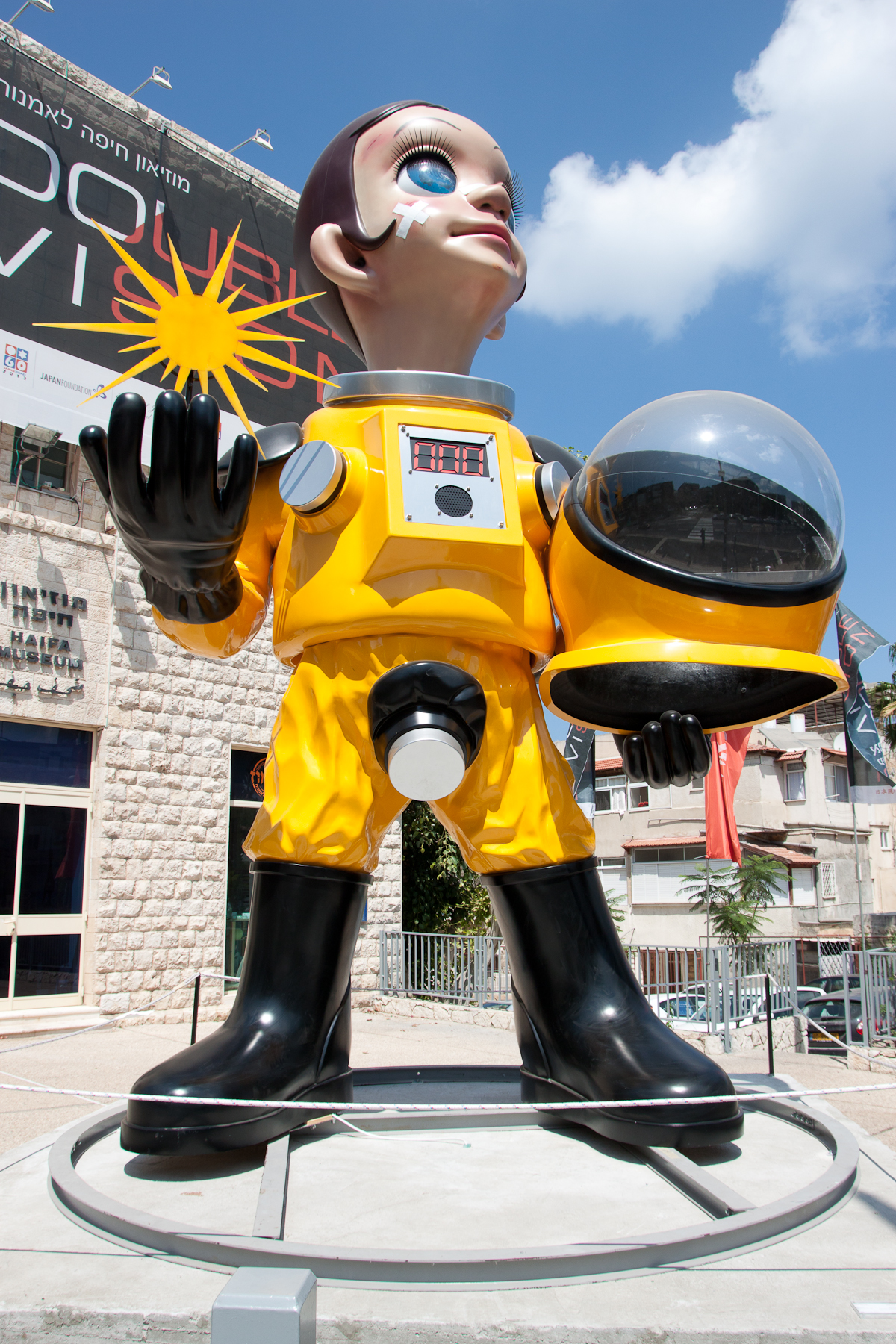
Sun Child
Kenji Yanobe, shown 2012A large contemporary sculpture by the Japanese artist Kenji Yanobe, photographed outside the museum in September 2012 as part of a 'Double Vision' exhibition; evidence the museum's temporary programme has reached well beyond its Israeli core collection into international contemporary work.17
McJesus
Jani Leinonen, shown 2018-19Not a collection piece but a loan, and not praised so much as consequential: a crucified-Ronald-McDonald sculpture in the 2018-19 'Sacred Goods' show triggered the most consequential episode in the museum's recent history, discussed in full under Reception. Recorded here because no account of what this museum is would be honest without it.22
Exhibitions on now
A girls' school becomes a museum
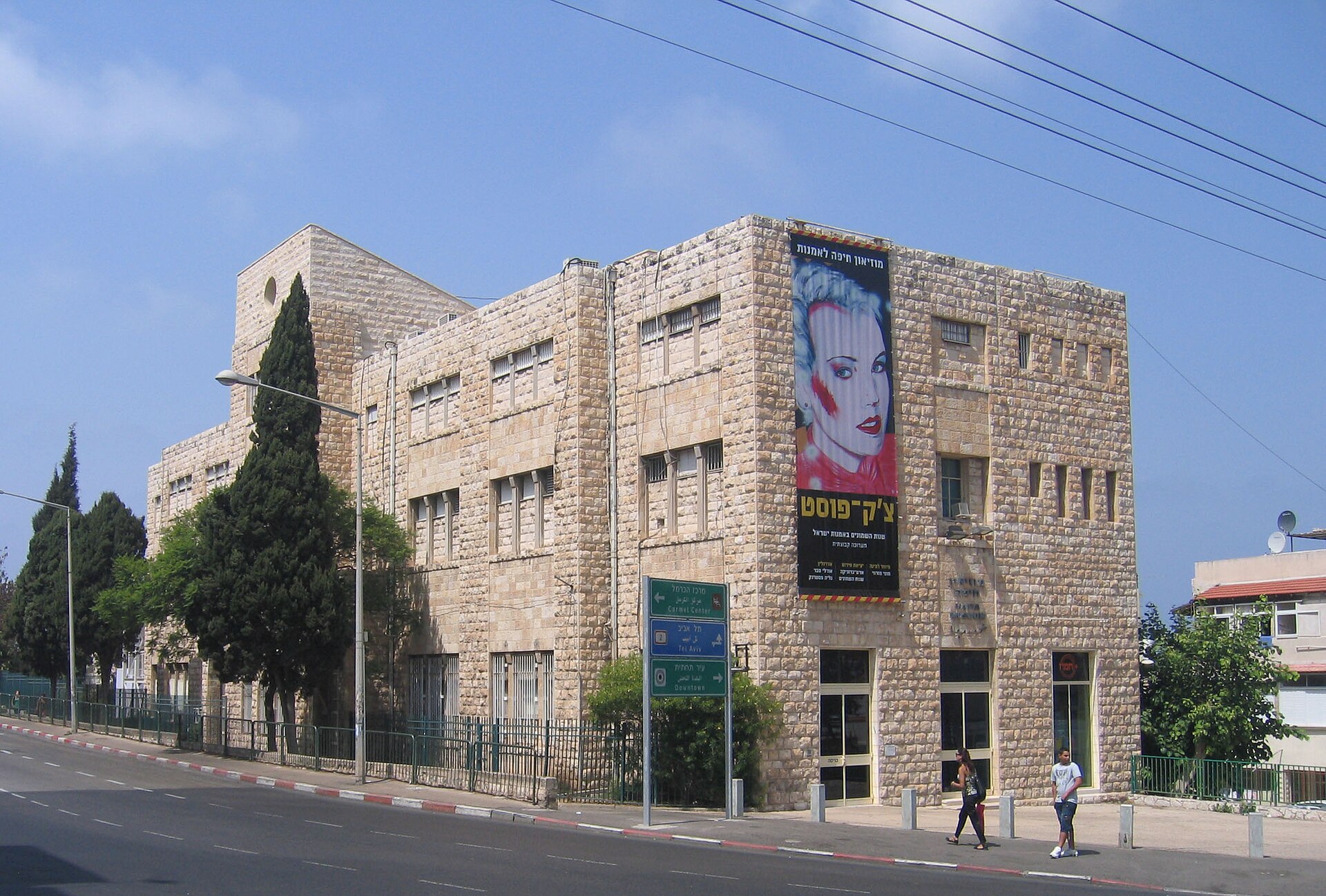
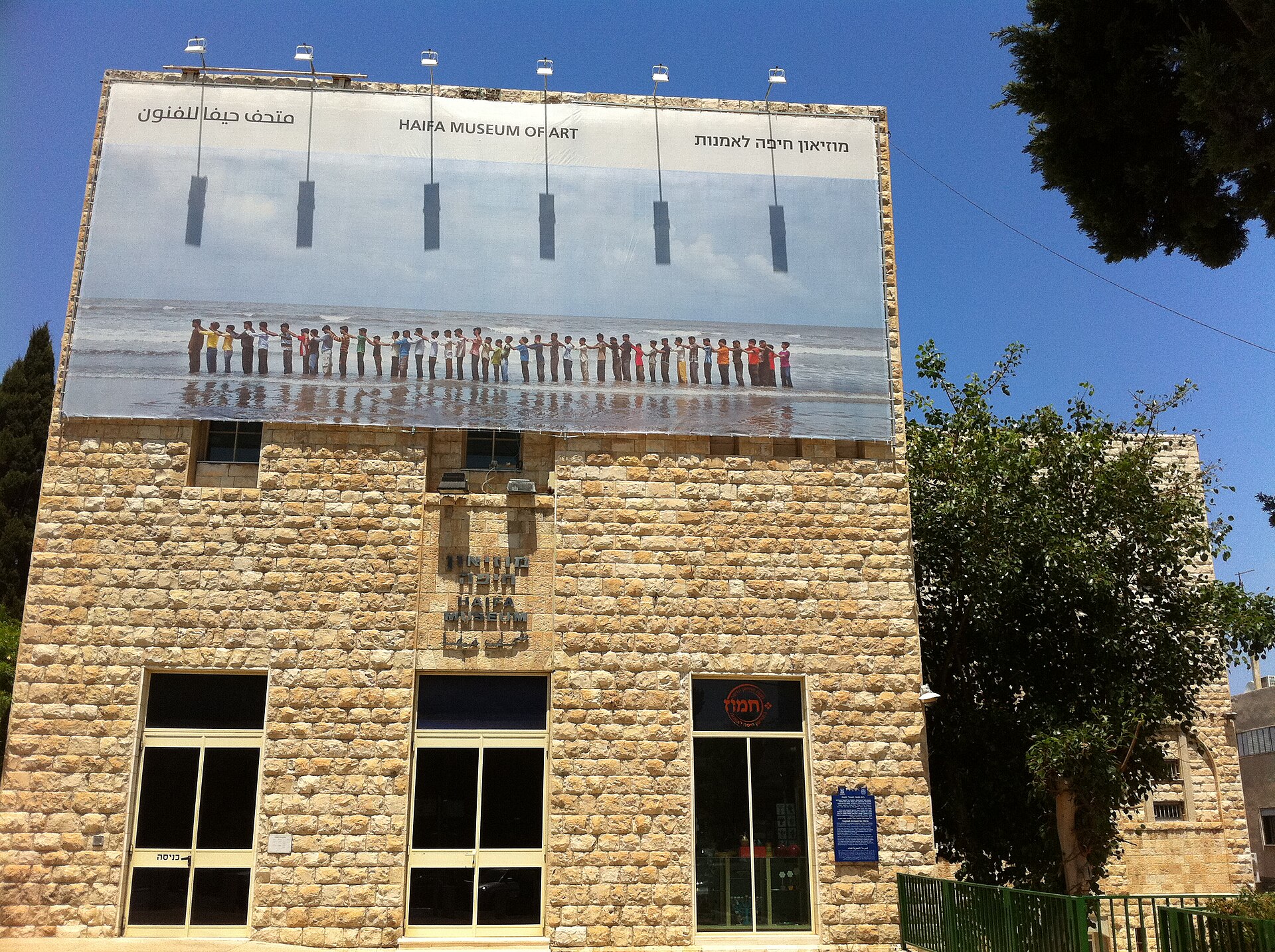
The building the Haifa Museum of Art occupies was not built to hold art. Constructed in the late 1920s and inaugurated in the early 1930s under the British Mandate, it opened as an Anglican school for girls, a three-storey stone structure standing on the seam between the Hadar HaCarmel and Wadi Nisnas neighbourhoods. After Israel's establishment the building took on a series of unrelated civic lives: first as a centre for new immigrants, then from the early 1950s as the home of a workers'-cooperative high school known as the High School for the Children of Workers, run by the labour movement rather than the municipality.
The museum itself began somewhere else entirely and earlier: in 1951, the city of Haifa put on a major loan exhibition of Marc Chagall's work, and the museum grew out of that show rather than out of an existing municipal collection. It took until 1977 for the museum to move into the former school building on Shabbetai Levi Street, and a year of renovation followed to convert a nineteenth-century-style school into galleries before the site reopened to the public as a municipal museum in 1978. The three-storey stone shell, roughly 3,500 square metres, has held the museum ever since, making the building's own biography - school, immigrant reception centre, workers' high school, art museum - as layered as anything inside it.
What is inside: two ways into the same century
The museum's standing collection runs to roughly 8,000 works, weighted heavily toward Israeli art, with the museum itself Israel's third largest art museum by most published counts. Two galleries currently frame that collection from opposite directions. 'Facial Topography: Israeli Art from the Museum's Collection', curated by Dr. Kobi Ben-Meir and running from August 2026 to January 2027, takes the whole collection as its field, pairing landscape and physiognomy as a way of asking whose land Israeli painting has pictured across more than a century, from Mark Antokolsky through Mordechai Ardon, Yitzhak Danziger, Reuven Rubin, Michael Gross, Marcel Janco, Raffi Lavie and some thirty other artists to contemporary figures like Farid Abu Shakra and Ron Amir.
'A Sun-Kissed Land', curated by Limor Alpern, does the opposite: it isolates a single formative period, the first half of the twentieth century, through the collection Lynn Schusterman began gifting the museum in 2024 - Bezalel School of Arts and Crafts pieces from the school's 1906 founding onward, and paintings by Nahum Gutman, Anna Ticho, Ephraim Moses Lilien, Mordecai Levanon and Yohanan Simon alongside Rubin. The museum's own chief curator has described the gift as filling a genuine gap, since the collection's existing depth ran mostly from the 1950s forward; a visitor can now trace the same Rubin, and the same questions about land and Jewish identity, across both galleries in one visit. A smaller international holding of works on paper - Honore Daumier, Odilon Redon, Andre Masson, and Chagall himself - supplies a European counterweight, on a scale the museum's own material puts at roughly a third of the paper collection.
A stage for the arguments art can start
The museum's temporary programme turns over three cycles a year, and its recent history shows that programme has been willing to court real controversy rather than avoid it. The clearest case is the 2018-19 exhibition 'Sacred Goods', which examined religion and consumer society through provocative use of religious imagery, including a Ronald McDonald crucifixion sculpture called 'McJesus' by the Finnish artist Jani Leinonen, on loan from a gallery in Helsinki. In January 2019 hundreds of Christian protesters, mostly from Haifa's Arab Christian community, clashed with police outside the museum; three officers were reported injured after stones and a firebomb were thrown. Haifa's mayor, Einat Kalisch Rotem, ultimately announced the sculpture would be returned to Finland ahead of the loan's natural expiry, a decision one citizens' rights group condemned as a capitulation to violence. Culture Minister Miri Regev separately threatened to cut state funding to the museum over the work, a threat the Deputy Attorney General found the ministry had no legal authority to carry out; Leinonen himself said the piece had been on display against his own wishes, since he had asked for its removal months earlier over his support for the boycott movement targeting Israel. A parallel 2019 programme, remembered by at least one visitor under the theme 'Fake News', drew its own sharply divided reactions.
Set against that, the museum has also used its programming to make gestures of solidarity closer to home: in August 2024, amid the displacement of tens of thousands of residents from Israel's north during cross-border fighting, the museum opened six solo exhibitions by women artists with ties to the region, several of them alumni of the museum's own artist incubator, a move its chief curator framed publicly as institutional support for the north's creative community during wartime.
Visiting: hours, admission and getting there
The museum keeps a six-day week, closed Mondays, open 10:00 to 16:00 on Sunday, Tuesday, Wednesday and Saturday, 10:00 to 18:00 on Thursday and a shorter 10:00 to 14:00 on Friday ahead of the Sabbath - the same weekly pattern the consortium publishes for most of its six sites. Admission for an adult is 40 NIS, the same figure that covers the neighbouring Tikotin Museum of Japanese Art and the National Maritime Museum on the consortium's shared price table, though each museum is ticketed separately rather than through one combined pass; concessions run 30 NIS for youths aged five to eighteen, soldiers, police officers, students, disabled visitors and Haifa residents presenting ID, 20 NIS for seniors, and a family rate of 100 NIS for a couple with two children, plus 17 NIS per additional child. Reservists and security-forces personnel are admitted free. A seven-day bundle ticket covering all six Haifa Museums costs 80 NIS for an adult. The museum sits about 370 metres from the Carmelit, Haifa's single-line underground funicular, with city buses also serving the surrounding Hadar HaCarmel and Wadi Nisnas streets. Beyond that, the practicalities thin out: the museum's own site does not publish a suggested visit length, a photography policy, or a bag policy, and only its current 'Facial Topography' exhibition page specifically notes accessibility for visitors with mobility considerations, rather than a building-wide accessibility statement.
What visitors say
Across 58 TripAdvisor reviews the museum sits at 3.5 out of 5, and a Google aggregate carried by third-party listings puts it at 4.2 from over a thousand reviews - two platforms with different visitor pools telling two different stories, which is itself worth noting rather than averaging away. The praise and the complaints both recur across years rather than clustering around one bad or good season. Visitors consistently single out the museum's taste for socially and politically pointed programming as a strength when it lands, citing a 2020 exhibition on women's history in art as an example carried off with real curatorial care. The same willingness to provoke is exactly what a smaller number of visitors object to on religious or cultural grounds, most sharply around 'McJesus' in 2019. The steadier complaint, though, is about scale: more than one visitor across different years describes the museum as smaller than expected, with the entire building sometimes walkable in half an hour, and wishes for more depth engaging with Israel specifically rather than international contemporary art for its own sake. What a visitor should take from this is that the museum rewards checking the current exhibition cycle before going - the same building has hosted a feted show on women artists and a nationally covered religious controversy within the same decade.
What visitors say
Visitors and critics broadly agree the building and the collection's historical depth are real, and disagree sharply on execution. Praise clusters around the museum's willingness to mount socially and politically pointed exhibitions and around specific historical strengths - the early-twentieth-century Israeli material, now deepened by the 2024 Schusterman gift, and monographic shows on women artists. Complaints cluster around scale and consistency: several visitors describe the museum as smaller than expected, with a given visit's worth depending heavily on which of the three annual exhibition cycles happens to be on. The institution's single most consequential episode was not a curatorial complaint but a five-day confrontation in January 2019, when the 'Sacred Goods' show's 'McJesus' sculpture - a crucified Ronald McDonald by the Finnish artist Jani Leinonen - drew hundreds of Christian protesters, violent clashes with police that left three officers injured, a Culture Ministry funding threat the Deputy Attorney General ruled unlawful, and the sculpture's early return to Finland. A citizens' rights group called the museum and city's decision to remove it a capitulation to violence and a violation of artistic freedom; the artist himself said the piece had been shown against his own wishes after he asked for its removal over his support for the boycott movement.
What is praised, what is criticised
- Praised: the museum's recurring willingness to present socially and politically charged exhibitions under a single annual theme, mixing well-known and unknown artists from Israel and abroad, as opposed to a safer, purely decorative programme
- Praised: the depth of the early-twentieth-century Israeli collection, especially since the 2024 Schusterman gift filled what the museum's own chief curator described as a real gap between the 1906 Bezalel School and the museum's existing 1950s-onward strength
- Praised: a 2020 multi-media exhibition on the history of women in art, praised by name as thoughtfully curated from multiple perspectives and worth more than one visit
- Praised: interactive elements in parts of the programme, including sculpture visitors are invited to touch or draw, and supplementary video material
- Criticised: the museum's small physical size and, on more than one published account, a collection on view that feels thin against expectations - one 2025 visitor reported the entire museum took about thirty minutes to see and wanted more work engaging directly with Israel
- Criticised: inconsistency between exhibition cycles: a 2023 account and a 2019 account both describe individual cycles as lackluster or uneven against the building's own potential, one attributing this partly to past friction between visiting curators and museum leadership
- Criticised: the 2018-19 display of 'McJesus' itself, which a body of Christian visitors and clergy in Haifa found a mockery of the crucifixion serious enough to protest in the hundreds, and which the Culture Minister of the day tried and legally failed to defund the museum over
Ratings on other platforms
TripAdvisor: 3.5 from 58 ratings, read 12 September 2026
Google (via Wanderlog aggregation): 4.2 from 1,163 ratings, read 12 September 2026
A platform average is a tertiary source: it moves, it is not audited, and we quote no visitor's words.
Questions about Haifa Museum of Art
Where is Haifa Museum of Art?
26 Shabbetai Levi Street, Haifa 3304331, Israel.
How much does it cost to visit?
Adult: ILS 40; Youth (5-18) / Soldier / Police officer / Student / Handicapped / Haifa resident (with ID): ILS 30; Senior citizen: ILS 20; Family (couple + 2 children): ILS 100; Additional child: ILS 17. As confirmed 12 September 2026.
When is it open?
Sunday 10:00-16:00; Monday closed; Tuesday 10:00-16:00; Wednesday 10:00-16:00; Thursday 10:00-18:00; Friday 10:00-14:00; Saturday 10:00-16:00. Closed: Monday, all year, on the schedule read for this record. As confirmed 12 September 2026.
How do you get there?
Carmelit (underground funicular): The museum sits about 370 metres from the Carmelit's HaNevi'im / downtown station. The Carmelit is Haifa's single-line underground funicular, running six stations between the Carmel Center and the lower city, weekdays roughly 06:00 to midnight; a Rav-Kav card carries a free transfer to city buses within 90 minutes; Bus: City bus routes serve Shabbetai Levi Street and the adjoining Hadar HaCarmel / Wadi Nisnas district directly; the museum's own site provides a Waze link rather than transit-line numbers.
What should you see first?
The Burning Bush (Yitzhak Danziger, 1957); Founding link to Marc Chagall (Marc Chagall); Mordechai Ardon paintings (Mordechai Ardon); Reuven Rubin paintings, old and new gift (Reuven Rubin); Nahum Gutman and the Bezalel-era gift (Nahum Gutman, Anna Ticho, Ephraim Moses Lilien and Bezalel School craftspeople); International works on paper: Daumier, Redon, Masson (Honore Daumier, Odilon Redon, Andre Masson).
What we could not confirm
- What is the museum's current photography policy for visitors, and does it vary by exhibition (as the religious-imagery controversies suggest curatorial sensitivity sometimes governs display conditions)? Not published on hma.org.il or hms.org.il in the sources read for this record.
- Is there a building-wide accessibility statement beyond the exhibition-specific note found on the current 'Facial Topography' page?
- What became of the three additional Jani Leinonen sculptures a 2019 Haifa District Court petition sought to have removed alongside 'McJesus'? The Times of Israel reported the case was pending an Attorney General opinion in January 2019; no source read for this record reports its outcome.
- Exactly how large is the Schusterman gift in object count, and is it a one-time gift or (as the museum's own language of an 'ongoing' relationship with the donor implies) a continuing arrangement?
- What, if anything, replaced 'McJesus' in the 'Sacred Goods' exhibition after its January 2019 removal, and did the exhibition's run continue to its planned close?
Images
Sources
- 1Wikidata, Haifa Museum of Art (Q597398). Verified by label match: instance of museum, coordinates 32 deg 48min 54sec N 34 deg 59min 33sec E, inception 1951, official website hma.org.il. wikidata.org/wiki/Q597398
- 2Wikipedia, 'Haifa Museum of Art'. en.wikipedia.org/wiki/Haifa_Museum_of_Art
- 3Haifa Museums (hms.org.il), English homepage. The consortium's own listing of its six member museums (Haifa Museum of Art, Tikotin Museum of Japanese Art, National Maritime Museum, Haifa City Museum, Mane-Katz Museum, Hermann Struck Museum) confirming the Hecht Museum is not among them. hms.org.il/eng
- 4Haifa Museums, 'Opening Hours' page, read via in-app browser with full table extraction. The museum's own weekly hours for the Haifa Museum of Art specifically, distinct from its five sister institutions on the same table. Fetched 12 September 2026. hms.org.il/eng/Activity_Time
- 5Haifa Museums, 'Entry Prices' page, read via in-app browser with full table extraction (the summarised fetch of this page initially and incorrectly reported the Haifa Museum of Art's adult price as the six-museum bundle figure; the table itself, read cell by cell, shows the Haifa Museum of Art sharing a lower column with Tikotin and the National Maritime Museum). Fetched 12 September 2026. hms.org.il/eng/Price_List
- 6Haifa Museum of Art (hma.org.il/eng/Map). The museum's own address, phone and contact details. hma.org.il/eng/Map
- 7Haifa Museum of Art, 'Now on View' exhibitions listing, the museum's own current programme for August 2026 to January 2027. hma.org.il/eng/Exhibitions/Now_on_View
- 8Haifa Museum of Art, general English homepage. hma.org.il/eng
- 9Wikimedia Commons, Category:Haifa Museum of Art. Verified the category's file list and confirmed which images are exterior photographs of the building itself as opposed to unrelated historical or artwork photographs. commons.wikimedia.org/wiki/Category:Haifa_Museum_of_Art
- 10Wikimedia Commons, File:English school for girls - Haifa 1.jpg. Licence CC BY-SA 4.0, photographer Danny Gershoni, taken 22 April 2022, confirmed by the file's own description as the former Anglican girls' school now housing the Haifa Museum of Art. commons.wikimedia.org/wiki/File:English_school_for_girls_-_Haifa_1.jpg
- 11Wikimedia Commons, File:Haifa Museum of Art.JPG. Licence CC BY-SA 3.0, photographer Talmoryair, taken 26 August 2008. commons.wikimedia.org/wiki/File:Haifa_Museum_of_Art.JPG
- 12Wikimedia Commons, File:PikiWiki Israel 14127 Haifa Museum of Art.JPG. Licence CC BY 2.5, photographer Shaula Haitner, taken 5 August 2011. commons.wikimedia.org/wiki/File:PikiWiki_Israel_14127_Haifa_Museum_of_Art.JPG
- 13Wikimedia Commons, Category:The Burning Bush (Danziger). Confirms the 1957 iron sculpture by Yitzhak Danziger as a permanent-collection object at the Haifa Museum of Art under inventory number ICMS-HMA-244-7-60. commons.wikimedia.org/wiki/Category:The_Burning_Bush_(Danziger)
- 14Wikimedia Commons, File:Hena Evyatar next to her work Touch at the Haifa Museum of Art.jpg. Licence CC BY-SA 4.0. Read for background on temporary exhibitions but not used as a plate in this record since the specific gallery cannot be confirmed against a current wing. commons.wikimedia.org/wiki/File:Hena_Evyatar_next_to_her_work_Touch_at_the_Haifa_Museum_of_Art.jpg
- 15carmelithaifa.com, public transportation pages, general description of the Carmelit's route, stations and operating hours, used only for transit description rather than any museum-specific fact. carmelithaifa.com/traveling-in-haifa/public-transportation/
- 16Rating 3.5 of 5 from 58 reviews at time of read; review text read to inform a from-scratch consensus paraphrase only, never quoted or reproduced. tripadvisor.com/Attraction_Review-g293982-d320613-Reviews-Haifa_Museum_of_Art-Haifa_Haifa_District.html
- 17Wikimedia Commons, File:Yanobe Sun Child Haifa 090912 01.jpg. Licence CC BY-SA 3.0, photographer Oren Rozen, taken 9 September 2012, description identifies the 'Double Vision' exhibition of contemporary Japanese art at the Haifa Museum of Art. commons.wikimedia.org/wiki/File:Yanobe_Sun_Child_Haifa_090912_01.jpg
- 18wanderlog.com, Haifa Museum of Art listing. wanderlog.com/place/details/247355/haifa-museum-of-art
- 19TripAdvisor visitor account (Dave41707, December 2025) describing a roughly thirty-minute visit, read on the same attraction page as source 16; used only to source the range given for typical visit length, not quoted. tripadvisor.com/Attraction_Review-g293982-d320613-Reviews-Haifa_Museum_of_Art-Haifa_Haifa_District.html
- 20Haifa Museum of Art, 'Facial Topography: Israeli Art from the Museum's Collection', the museum's own exhibition page, curator Dr. Kobi Ben-Meir, running 1 August 2026 to 2 January 2027, with its own artist list and its own accessibility note for the show. hma.org.il/eng/Exhibitions/11333/Facial_Topography:_Israeli_Art_from_the_Museum's_Collection
- 21Haifa Museum of Art, 'A Sun-Kissed Land: Schusterman Collection at the Museum', the museum's own exhibition page, curator Limor Alpern, running 1 February to 29 June 2024, describing the Schusterman gift's contents and its historical framing. hma.org.il/eng/Exhibitions/10664/A_Sun-Kissed_Land:_Schusterman_Collection_at_the_Museum
- 22The Art Newspaper, Anna Sansom, 'Hundreds of Christians protest against McJesus sculpture at Haifa Museum of Art in Israel', 14 January 2019. theartnewspaper.com/2019/01/14/hundreds-of-christians-protest-against-mcjesus-sculpture-at-haifa-museum-of-art-in-israel
- 23The Times of Israel, ToI Staff, 'Haifa mayor: Controversial McJesus sculpture to come down in days', 17 January 2019. Read in full via in-app browser. timesofisrael.com/haifa-mayor-controversial-mcjesus-sculpture-to-come-down-in-days/
- 24The Times of Israel, Jessica Steinberg, 'Art and design on display in Haifa as creativity trumps tensions', 8 August 2024. timesofisrael.com/art-and-design-on-display-in-haifa-as-creativity-trumps-tensions/


