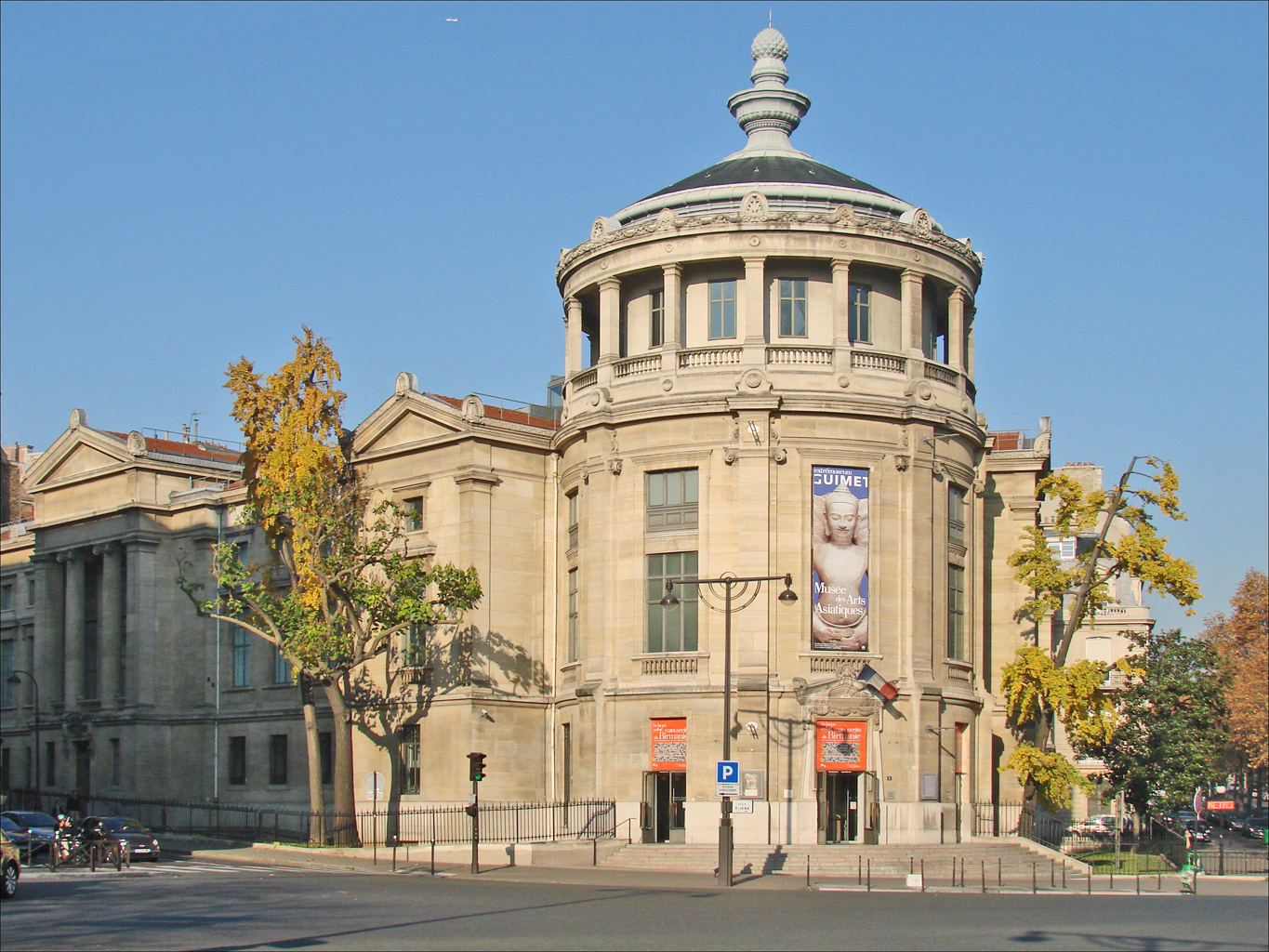
The rotunda and main facade of the museum on place d'Iena, with a banner for the Musee des Arts Asiatiques visible over the entrance.
Photograph by Jean-Pierre Dalbéra · CC BY 2.0Guimet Museum
Museum · Musee national des arts asiatiques - Guimet · Founded 1879
Open, admission and hours confirmed 18 August 2026 · 8 sources
On this page 15 sections
ContentsClose
One of the largest collections of Asian art outside Asia itself, built from Emile Guimet's own nineteenth-century acquisitions and expanded over more than a century into five broad regional holdings: Afghanistan and Pakistan (Gandhara), Southeast Asia (led by an early and historically important Khmer collection), India, China, and Korea and Japan, plus a separate Chinese furniture collection at the Maison Guimet annex and a rare-book Historic Library. Its Khmer holdings in particular predate the existence of any museum in Cambodia itself.
| Local name | Musee national des arts asiatiques - Guimet |
|---|---|
| Kind | Museum |
| Founded | Opened in Lyon 1879; opened at the present Paris building in 1889 |
| City and country |  Paris, France Paris, France |
| Address | 6, place d'Iena, 75116 Paris, France |
| Website | guimet.fr |
| Status | Open, confirmed |
| Record last verified |
Visiting
- Hours
- Wednesday to Monday10:00 to 18:00ticket office closes 17:15, last entry 17:30, rooms cleared from 17:45
- TuesdayClosed
- Closed
- Tuesday, every week. 1 May, 14 July, 25 December, 1 January. Rooms close at 16:45 on 24 and 31 December.
- Admission
- Full priceEUR 15permanent collections and temporary exhibitions
- ReducedEUR 12
- Under 18Freefree
Free entry: First Sunday of the month, permanent collections and temporary exhibitions. Nuit des Musees and other institutional free-entry events- Tickets
- guimet.tickeasy.com The museum's own ticket page.
- Do I need to book?
- No for the permanent collection; the Maison Guimet annex is guided-visit only and needs advance reservation
- Address
- 6, place d'Iena, 75116 Paris, France MapMetro Iena or Boissiere, both on line 9
- Website
- guimet.fr
- Telephone
- 01 56 52 54 33
- [email protected]
Before you go how long, access, photography, bags, eating, shop
- How long to allow
- Not published by the museum in a single figure; the collection spans five main floors across Afghanistan and Pakistan, Southeast Asia, India, the Himalayan world, China, Central Asia, Korea and Japan, which visitor accounts describe as a half-day for a thorough visit
- Access
- Not detailed on the pages consulted for this research
- Photography
- Not detailed on the pages consulted for this research
- Bags
- Vigipirate security measures are in force, restricting certain bags and luggage brought into the museum
- Eating
- Cafe on site at the place d'Iena building
- Shop
- Museum bookshop on site
Prices and hours change. We take them from the institution's own pages and print the day we read them, and you can check the current position at the source we used. Confirm before you travel.
What is inside
The main building, place d'Iena
Five floors organised by region: Afghanistan and Pakistan (Gandhara Greco-Buddhist sculpture), Southeast Asia (the Khmer, Cham and Indonesian collections), India, the Himalayan world, and China, Central Asia, Korea and Japan on the upper floors, with the rotunda under the building's domed roof.
The Pantheon Bouddhique
A separate annex a short walk from the main building, holding Buddhist statuary and ritual objects, mainly from Japan and China, arranged as a devotional space rather than a conventional chronological gallery.
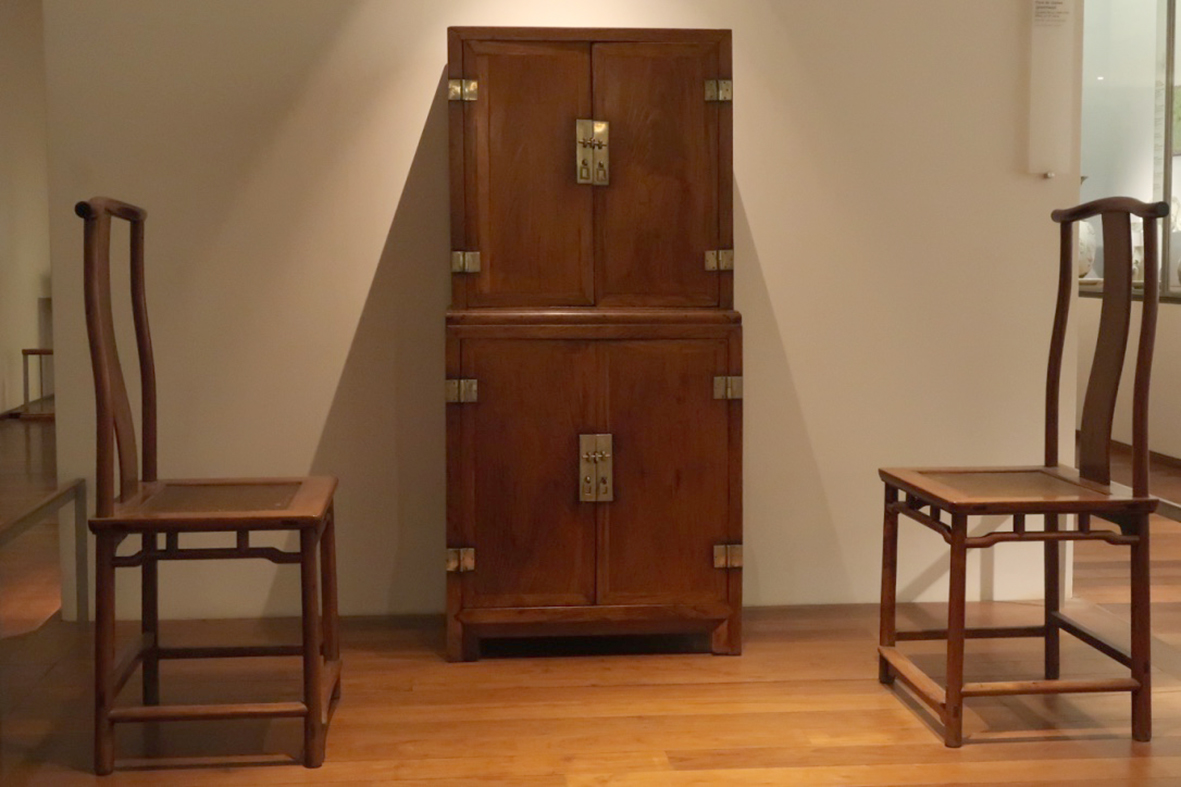
Photograph by Ismoon · CC BY-SA 4.0 Maison Guimet, the Hotel d'Heidelbach
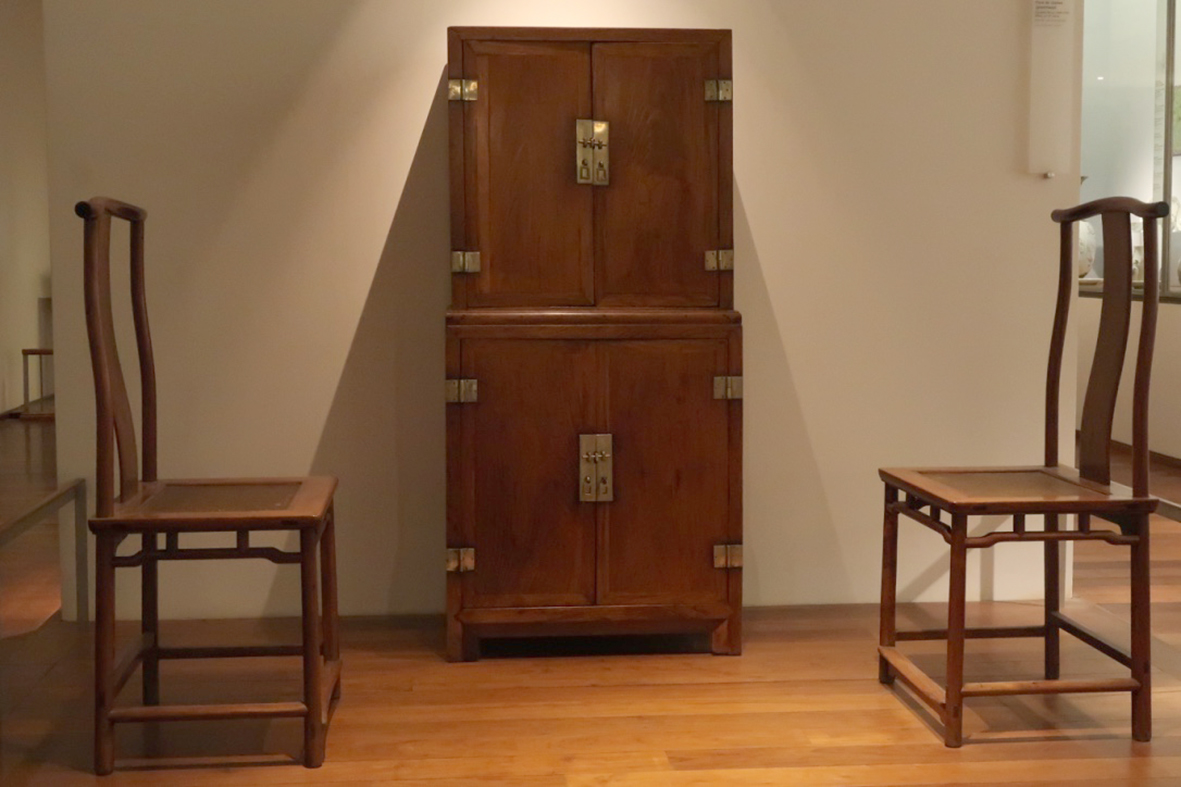
At 19 avenue d'Iena, a separate townhouse holding the museum's Chinese furniture collection and its Asian tea-arts programme; open only for pre-booked guided visits rather than general walk-in admission. Guided visits were paused at the time of this re-check and are scheduled to resume 24 September 2026 (booking opens 31 July 2026); the museum's own site lists Thursday, Saturday and Sunday tours at 11:00, plus Sunday tours at 14:30 from 11 October to 20 December 2026 (except 18 and 25 October and 1 November).
The Historic Library
The museum's rare-book and manuscript holdings, including the illustrated Japanese botanical work Honzo zufu and a Burmese Kammavaca manuscript, shown as part of the collection rather than held apart in a closed research room.
Musee d'Ennery
A further Guimet-administered annex at 59 avenue Foch holding Clemence d'Ennery's collection of Japanese and Chinese decorative art; closed for renovation, with the museum's own site now stating it will reopen in 2028.
What to see first
The Richard Kan Vase
ChinaGiven its own dedicated page in the museum's own presentation of its China collection, a sign of how the museum itself ranks the piece.2
Bodhisattva Maitreya
Gandhara, Afghanistan-Pakistan regionA Greco-Buddhist sculpture from the museum's Afghanistan and Pakistan holdings, the collection area that documents the fusion of Hellenistic sculptural style with Buddhist subject matter after Alexander's campaigns.2
Terracotta statue of a court lady
ChinaNamed directly on the museum's own collections page, described there for its high, elaborate coiffure.2
Honzo zufu
JapanAn illustrated manuscript of medicinal plants, one of two manuscripts the museum singles out from its Historic Library as a treasure rather than a working reference text.2
Kammavaca manuscript
Burma (Myanmar)A Buddhist ordination text from the museum's own named library treasures, extending the collection's geography past the East and South Asian material most visitors come for.2
Avalokiteshvara with a Thousand Arms
KoreaAn iron-cast sculpture of the bodhisattva of compassion, named among the museum's own highlighted Korean holdings.2
The Khmer collection formed by Louis Delaporte and Etienne Aymonier
CambodiaAssembled with the agreement of the Cambodian king specifically to show Khmer civilisation to Europe at a time no museum existed in Southeast Asia to hold it; it remains one of the collection's founding strengths and is directly relevant to the museum's present-day dispute over how it labels the neighbouring Himalayan and Tibetan material.3
Exhibitions on now
- On now16 Sep 2026 to 4 Jan 2027Confirmed , 2 months ago
Past exhibitions here
- Closed20 May to 31 Aug 2026Confirmed · check before you travel
An industrialist's mission to catalogue Asian religion
The museum exists because of a government commission rather than a private hobby that grew large. In 1876 the French minister of public instruction asked Emile Guimet, a Lyon industrialist, to travel to Egypt, Japan, China and India to study their religions. Guimet returned with an extensive collection of religious art and ritual objects and, rather than keep it privately, opened a museum in Lyon in 1879 to hold it. The Paris move followed a decade later: the present building at 6, place d'Iena was constructed specifically to house the growing collection and opened to the public in 1889, the same year as the Eiffel Tower, in the same wave of Parisian civic building. The facade, roofs and library were listed as historic monuments in 1979, a recognition of the building itself rather than only what it holds.
A Khmer collection assembled before Cambodia had a museum of its own
The museum's Southeast Asian holdings carry a specific historical weight. Louis Delaporte and Etienne Aymonier, working with the agreement of the King of Cambodia, sent Khmer material to France specifically to demonstrate the sophistication of Khmer civilisation to a European audience, at a moment when no museum existed in Cambodia or anywhere in Southeast Asia to display such material locally. That collecting history is now inseparable from the colonial context it happened in: French Indochina's administrative presence made this kind of large-scale removal of material possible in a way it would not otherwise have been, even where individual acquisitions were made with local royal consent. The museum does not currently address this history at length in its own public-facing materials, so far as this research could establish.
From Buddhism's Silk Road diffusion to Japanese ceramics
What the collection actually documents, across its five floors, is less a single national school than the spread of Buddhist art and iconography across Asia over two thousand years: Gandharan sculpture from Afghanistan and Pakistan, where Hellenistic modelling techniques introduced after Alexander's campaigns were applied to Buddhist subject matter; Indian sculpture from Mathura, Amaravati and the Gupta period; the Khmer and Cham material from Southeast Asia; and Chinese, Korean and Japanese collections spanning Han-dynasty tomb horses, Tang ceramics, Ming porcelain and Buddhist statuary from the first to the seventeenth centuries. A separate annex, the Pantheon Bouddhique, holds a further, more devotionally arranged set of Buddhist statuary drawn mainly from Japan and China. The Historic Library adds manuscripts and illustrated texts to the object collection, including a Japanese illustrated herbal, the Honzo zufu, and a Burmese Kammavaca ordination manuscript.
A live dispute over what to call the neighbouring region
Since 2024 the museum has used the label 'Himalayan World' in place of 'Tibet' across parts of its galleries and catalogues, and has in some contexts used the Chinese historical term 'Tubo' rather than 'Tibet'. The change did not pass unremarked. The parliament of the Central Tibetan Administration, France's own Senate Tibet Support Group, and Asian-studies scholars criticised the relabelling publicly from early 2024, arguing it was inconsistent with the museum's practice elsewhere, since neighbouring regions of China continue to be labelled by their modern names rather than folded into a broader geographic category. In March 2025, questioned in the Assemblee Nationale by deputy Charles de Courson, Culture Minister Rachida Dati defended the museum, describing 'Himalayan World' as a long-standing curatorial term and comparing the practice to categorisation used at the Metropolitan Museum of Art and the Smithsonian. That defence did not end the matter. In July 2025 four Tibetan advocacy associations filed an administrative court case seeking to compel the museum to restore the word Tibet to its labelling, arguing the relabelling breaches the museum's own statutory mission to disseminate culture accurately; the same month, the museum published its own response in Le Figaro, rejecting the accusations as 'unfounded attacks based on arguments that are more political than cultural and scientific'. In September 2025 a United Nations special rapporteur added her own concern that the change undermines Tibetans' right to their own cultural identity being recognised, and press coverage into November 2025 continued to frame the dispute as one in which observers suspect Chinese political influence over a French national museum, an accusation the museum and the Culture Ministry both reject. The case was still pending at the time of this research.
What a visit costs and how it is organised now
The main building is open every day except Tuesday, from ten until six, with a fifteen-euro full-price ticket covering both the permanent collection and any temporary exhibition; entry is free on the first Sunday of every month and free at any time for anyone under eighteen. Two of the museum's three physical sites are not part of an ordinary walk-in visit: the Maison Guimet, the Hotel d'Heidelbach at 19 avenue d'Iena, holds the Chinese furniture collection and the museum's Asian tea-arts programming but is accessible only through pre-booked guided visits, and the Musee d'Ennery at 59 avenue Foch, the third site under the same administration, was closed for renovation with no published reopening date at the time of this research. A visitor planning around the full Guimet collection, in other words, needs to plan around three separate buildings and two different admission models, not one museum with one door.
What visitors say
We publish no visitor review prose and cite no single platform score as fact. What is documented, and what belongs on this page ahead of a visitor-experience summary, is an active, named dispute over how the museum labels part of its own collection: since 2024 the museum has used the term 'Himalayan World' in place of 'Tibet' in gallery names and catalogues, and has used the Chinese historical term 'Tubo' rather than 'Tibet' in some contexts. The Central Tibetan Administration's parliament, France's own Senate Tibet Support Group, and multiple advocacy organisations have objected publicly; four associations filed an administrative court case in July 2025 seeking to compel the museum to restore the word Tibet, and a United Nations special rapporteur voiced concern about the change in September 2025. The museum's own defence, given by Culture Minister Rachida Dati in March 2025, is that 'Himalayan World' is a long-standing curatorial category comparable to practice at the Metropolitan Museum and the Smithsonian; the museum itself, writing in Le Figaro in July 2025, called the accusations 'unfounded attacks based on arguments that are more political than cultural and scientific'. The dispute was still open, with litigation pending, at the time of this research.
What is praised, what is criticised
- Praised: the breadth of the Asian art collection across a single visit, from Gandhara sculpture to Japanese porcelain to Khmer stone carving
- Praised: named objects the museum itself highlights, such as the Historic Library manuscripts, as more than a general survey collection
- Criticised: the 2024 replacement of 'Tibet' with 'Himalayan World' (and the use of the Chinese term 'Tubo') in gallery names and catalogue language, which Tibetan advocacy groups, French parliamentarians and a UN special rapporteur have all characterised as erasing a contested political identity from a supposedly neutral cultural institution
- Criticised: the pending administrative court case, filed by four associations in July 2025, arguing the relabelling breaches the museum's own statutory mission to disseminate culture accurately
Questions about Guimet Museum
Where is Guimet Museum?
6, place d'Iena, 75116 Paris, France.
How much does it cost to visit?
Full price: EUR 15; Reduced: EUR 12; Under 18: free. As confirmed 18 August 2026.
When is it open?
Wednesday to Monday 10:00-18:00; Tuesday closed. Closed: Tuesday, every week. 1 May, 14 July, 25 December, 1 January. As confirmed 18 August 2026.
How do you get there?
Metro: Iena or Boissiere, both on line 9.
What should you see first?
The Richard Kan Vase (China); Bodhisattva Maitreya (Gandhara, Afghanistan-Pakistan region); Terracotta statue of a court lady (China); Honzo zufu (Japan); Kammavaca manuscript (Burma (Myanmar)); Avalokiteshvara with a Thousand Arms (Korea).
What we could not confirm
- The administrative court case over the Tibet/Himalayan World labelling was still pending at the time of this research; its outcome should be checked and this page updated when it is decided.
- The Musee d'Ennery reopening date is now published as 2028 on the museum's own access page (re-checked 18 August 2026); no month or more specific date is given, so this remains worth re-confirming as 2028 approaches.
- The museum's own public materials do not appear to address the colonial-era circumstances of the Delaporte/Aymonier Khmer acquisitions at length; whether this has changed since research was conducted should be re-checked.
- The Le Figaro opinion piece attributed to the museum in the Tibet dispute was read via Wikipedia's summary of it, not in Le Figaro's own archive directly; the primary text should be sourced directly if this page is revisited.
- As of this re-check (18 August 2026) no ruling in the administrative court case over the Tibet/Himalayan World labelling has been found; the case still appears to be pending.
Images
Sources
- 1guimet.fr, Acces et horaires: current opening days and hours, closed dates, address and phone number, and the homepage's note on the Maison Guimet and Musee d'Ennery annexes and their status. Read directly in the in-app browser on 7 August 2026. guimet.fr/fr/acces-et-horaires
- 2guimet.fr, Collections (English): the museum's own named highlight objects by region (Richard Kan Vase, Bodhisattva Maitreya, terracotta court lady, Honzo zufu, Kammavaca manuscript, Avalokiteshvara with a Thousand Arms). guimet.fr/en/collections
- 3Wikipedia, Guimet Museum: founding by Emile Guimet, the 1876 government commission, the 1879 Lyon opening and 1889 Paris opening, the Khmer collection formed by Louis Delaporte and Etienne Aymonier, and a detailed account of the 2024-2025 Tibet/Himalayan World labelling dispute including the Central Tibetan Administration parliament's criticism, the March 2025 ministerial defence by Rachida Dati, the July 2025 lawsuit by four associations and the museum's Le Figaro response. en.wikipedia.org/wiki/Guimet_Museum
- 4guimet.fr, Tarifs: full and reduced admission prices, under-18 free entry, and first-Sunday-of-the-month free access. guimet.fr/fr/tarifs
- 5Google search results surfacing named press coverage of the Tibet-labelling dispute independently of Wikipedia: Artnet News (3 July 2025, 'Paris Museum Sued for Erasing Tibet from Gallery Name'), Mainland Post (9 July 2025), the Tibet Post reporting a UN special rapporteur's concern (30 September 2025), and ANI News (27 November 2025) reporting suspicion of Chinese political influence. The underlying articles themselves returned bot blocks (403/404) to direct fetching; these citations rest on the publications' own search-result snippet text, read directly, not on an AI-generated summary of their content. news.artnet.com/art-world/french-museums-outrage-erasing-tibet
- 6Wikidata, Guimet Museum (Q860994): label, description and coordinates, cross-checked against the museum's own address before use. wikidata.org/wiki/Q860994
- 7guimet.fr, Contacts (English): confirms the general contact telephone number (+33 (0)1 56 52 54 33, 'during museum opening hours') and adds the general contact email address, [email protected], not previously recorded. Read directly (page text extraction) on 18 August 2026. guimet.fr/en/contacts
- 8guimet.fr, Acces et horaires (French): re-read in full via direct page-text extraction on 18 August 2026, confirming hours, closed dates and address unchanged, and providing the Maison Guimet guided-visit resumption schedule (from 24 September 2026) and the Musee d'Ennery reopening year (2028), both more specific than what was published at the prior check. The 'Actuellement ferme' banner shown on the main museum's own entry on this date is the museum's regular Tuesday closure (18 August 2026 was a Tuesday), not an unplanned or extended closure. guimet.fr/fr/acces-et-horaires