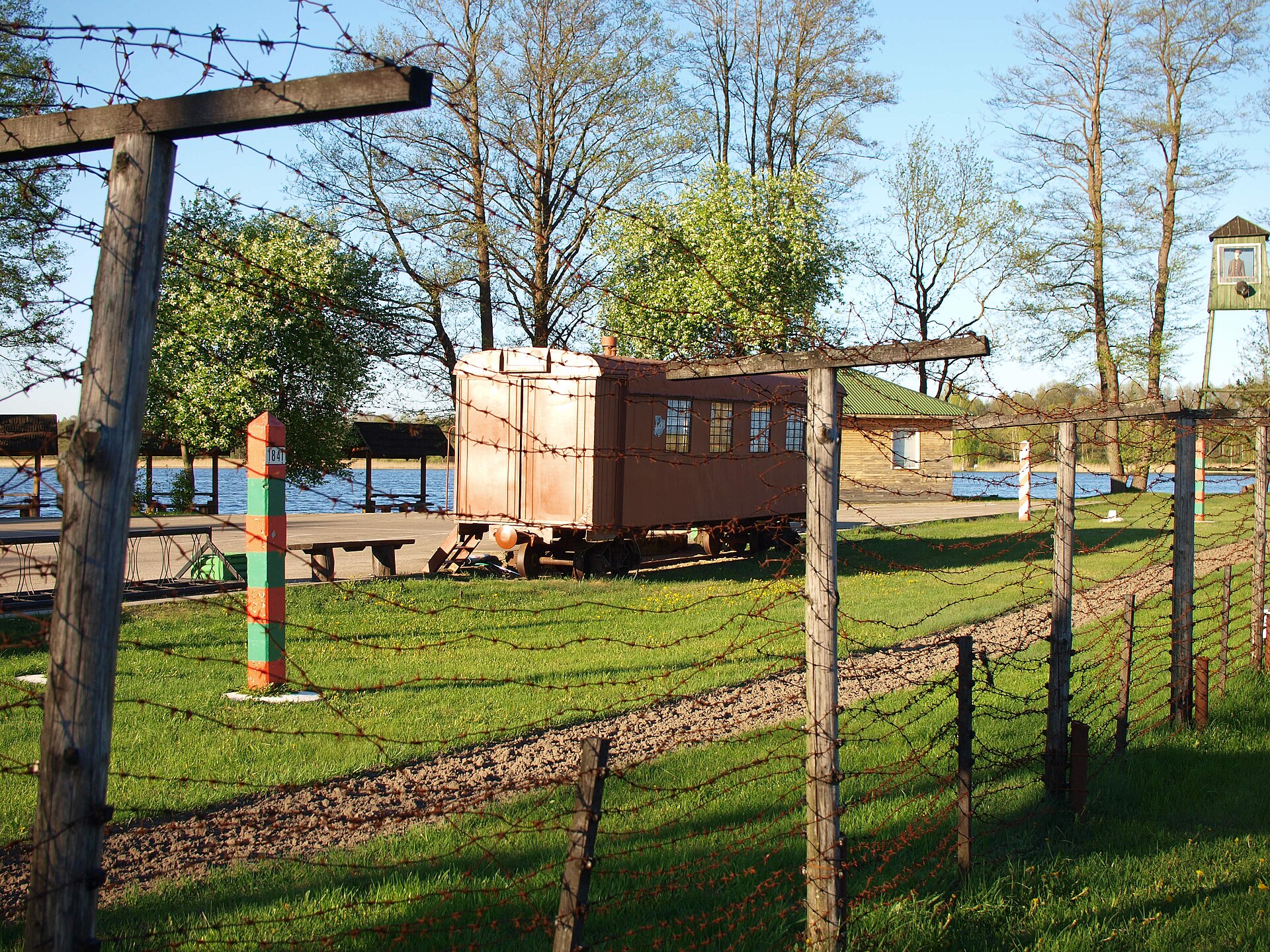
The entrance to Grutas Park near Druskininkai, where the exposition depicting Soviet repression and the Gulag camps begins immediately past the gate.
Photograph by Adriao, CC BY-SA 3.0Grutas Park
Museum · Gruto parkas · Founded 1998
Open, admission and hours confirmed 10 September 2026 · 19 sources
On this page 13 sections
ContentsClose
The park's principal holding is its outdoor sculpture collection: 86 monumental Soviet-era statues by 46 sculptors, almost certainly the largest concentrated collection of dismantled Soviet civic statuary anywhere, organised by theme rather than displayed as a single undifferentiated group. Alongside it, the Picture Gallery holds a smaller collection of Soviet-realist paintings and graphic works, and the Information Centre-Museum holds a documentary archive of Soviet-era sound, film and photography. Together the three form a record of Soviet ideological material culture in Lithuania that, by the park's own account, no other institution has attempted to assemble at this scale.
| Local name | Gruto parkas |
|---|---|
| Kind | Museum |
| Founded | Tender for the exposition awarded to Hesonos klubas in 1998; preparation began in early 1999; officially opened 1 April 2001 |
| City and country |  Druskininkai, Lithuania Druskininkai, Lithuania |
| Address | Grutas, Parko g. 49, 66441 Druskininkai, Lithuania |
| Website | grutoparkas.lt |
| Status | Open, confirmed |
| Record last verified |
Visiting
- Hours
- Daily, January-February09:00 to 17:00
- Daily, March-April09:00 to 19:00
- Daily, May09:00 to 20:00
- Daily, June-August09:00 to 21:00
- Daily, September09:00 to 20:00
- Daily, October09:00 to 18:00
- Daily, November-December09:00 to 17:00
- Admission
- AdultEUR 15
- Children and teenagers under 16EUR 9
- Children under 4FreeFree
- AudioguideEUR 10Optional add-on rental, not required for entry
- Do I need to book?
- No advance booking is stated as required; the park's own site describes on-site ticket prices only, with no separate online ticketing portal found.
- Address
- Grutas, Parko g. 49, 66441 Druskininkai, Lithuania MapCar About 120 km from Vilnius and 120 km from Kaunas, reached via the A4 highway; the park is about 5 km from Druskininkai itself and is signposted, with visitors told to turn off at the 'Grutas parkas' sign and follow the marked route in.
Bus About a 30-minute walk from the Grutas bus stop, following Parko gatve through the village to the signposted entrance; the park's own site does not publish a timetable and directs visitors to check bus schedules at the bus station. - Website
- grutoparkas.lt
- Telephone
- +370 682 42320
- [email protected]
Before you go how long, access, photography, bags, eating, shop
- How long to allow
- The outdoor sculpture exposition alone runs about 2 kilometres, and the park also holds the Information Centre-Museum, the Picture Gallery, a mini zoo, the Luna Park playground and a large cafe, so a full visit covers several distinct areas rather than a single walk.
- Eating
- An on-site cafe serves regional Dzukija dishes built around mushrooms and berries, traditional Lithuanian dishes such as cepelinai, kugelis and saltibarsciai, and a self-consciously Soviet-themed menu section; it seats up to 250, is open the same hours as the park (9:00 to 22:00), and entry to it is free.
Prices and hours change. We take them from the institution's own pages and print the day we read them, and you can check the current position at the source we used. Confirm before you travel.
What is inside
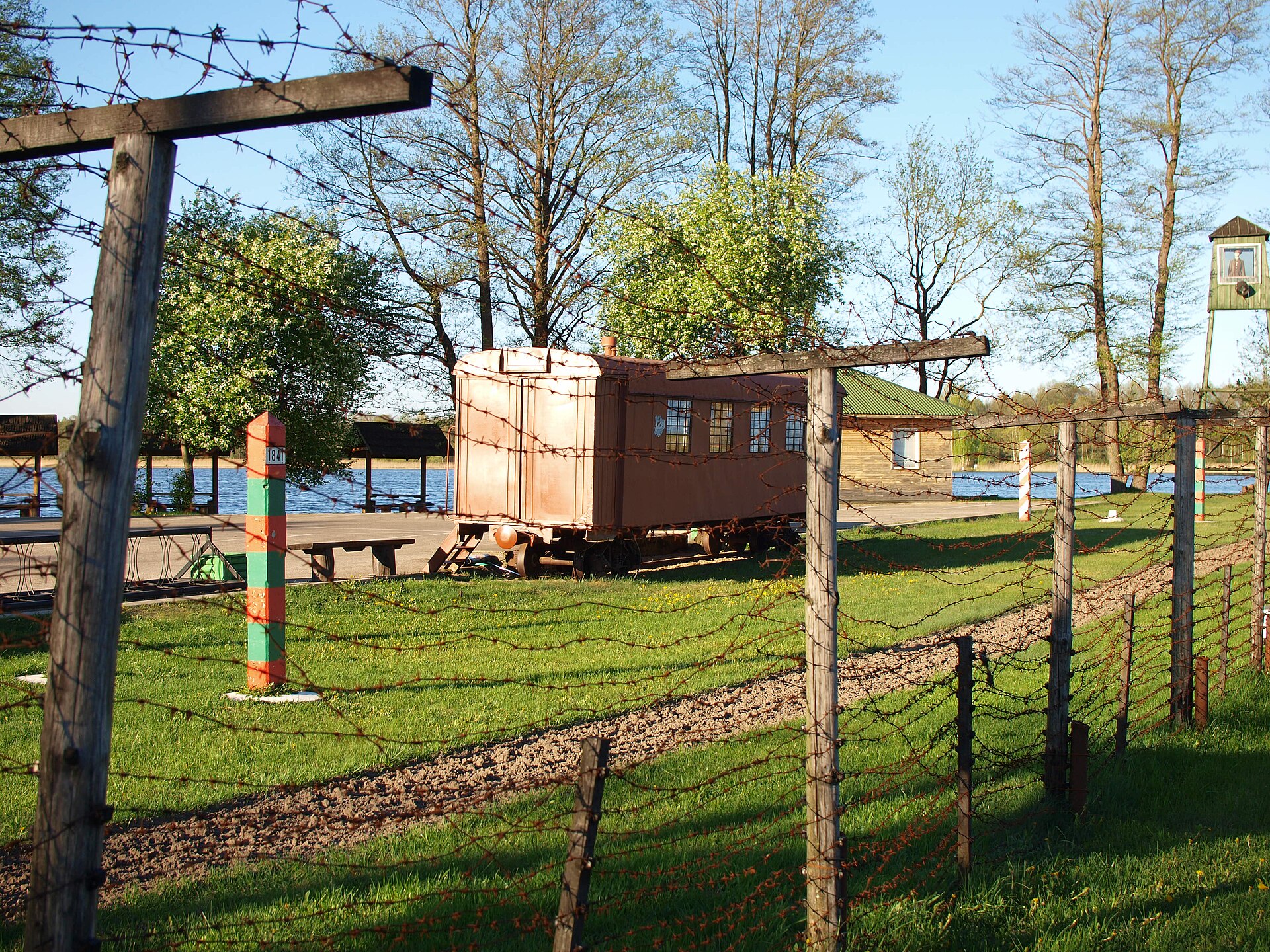
Photograph by Adriao · CC BY-SA 3.0 Outdoor sculpture exposition
The park's core holding: 86 monumental Soviet-era statues by 46 sculptors, removed from Lithuanian town squares and public buildings after 1990 and re-erected along a roughly 2-kilometre route across the park's 20-hectare site. The route recreates elements of a Gulag camp, with wooden walkways, guard towers and barbed-wire fencing meant to evoke Siberian camp conditions. The park's own description organises the statues by period and role rather than as a single undifferentiated collection.
Information Centre - Museum
A wooden building styled on a Soviet cultural house of the 1940s and 1950s, holding sound, film and photo documentaries. The park's own copy says the material is meant to show and denounce the ideologised Soviet propaganda culture and pseudo-science, the aims and mechanisms of Soviet ideology, and the genocide of the Lithuanian nation.
Picture Gallery
A gallery of Soviet-period paintings and graphic works, split by the park's own description into political and economic themes: images in the socialist-realist style depicting the cult of Soviet leaders including Lenin, Stalin and Brezhnev, and scenes of the entrenchment of Soviet rule.
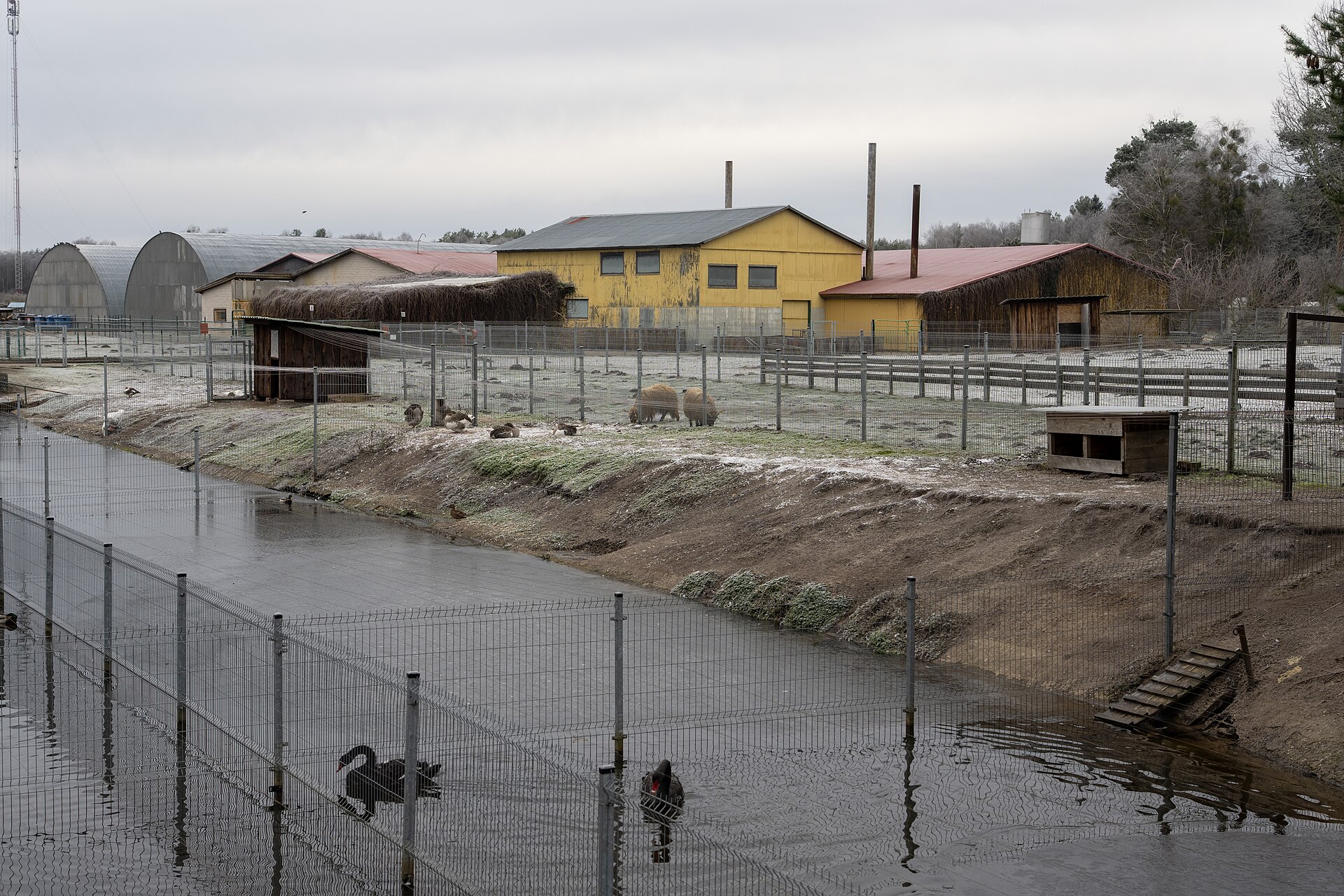
Photograph by Quintin Soloviev · CC BY 4.0 Mini zoo
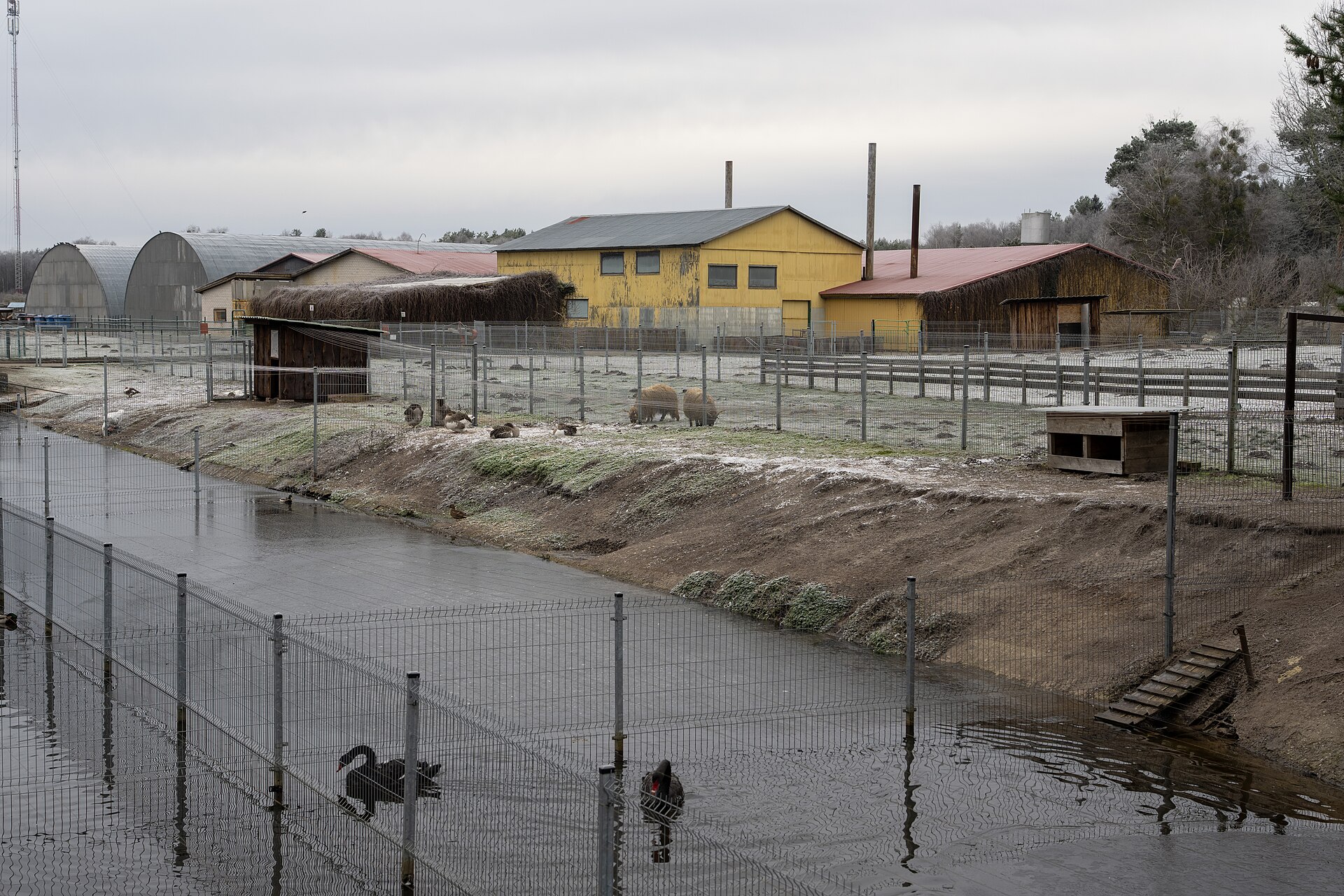
A small zoo of birds and animals aimed at younger visitors, run as part of the park alongside the sculpture exposition. Visitor accounts describe it as a mixed draw: some find it an entertaining addition to the walk, others consider the enclosures poorly suited to the animals kept in them.
Luna Park
A playground styled on a Soviet-era Lunapark, with swings and carousels the park's own copy frames as a chance for children to imagine the rides their parents or grandparents might have used.
Club - Reading room
Listed among the park's indoor spaces on its own site under the Museums section, alongside the Information Centre-Museum and the Picture Gallery. The park has not published a description of what is displayed inside it, so this page does not say more than that it exists.
What to see first
The six-metre Lenin monument at the entrance
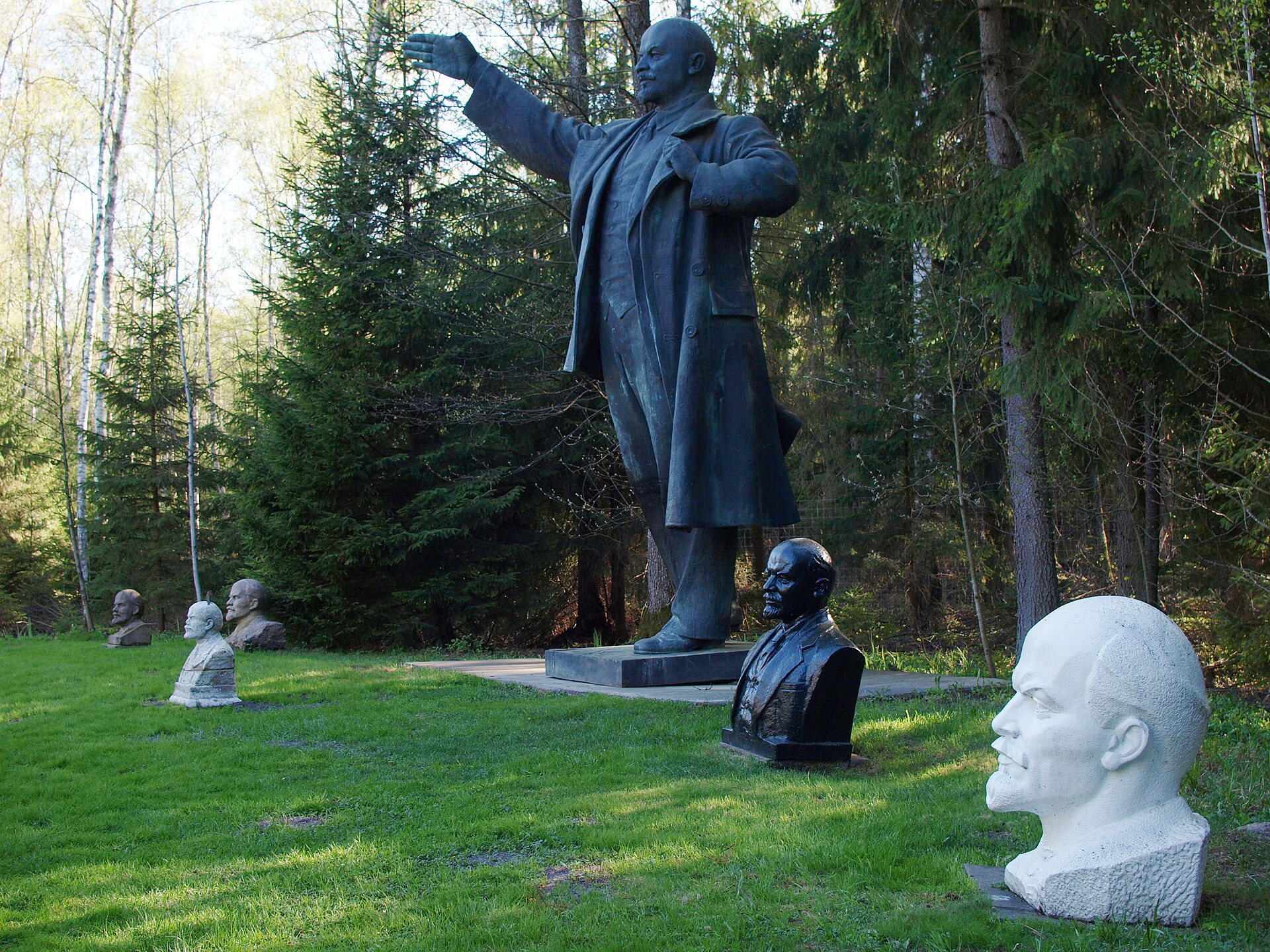
Soviet-era sculptor, original installation in VilniusFormerly stood in Vilnius's main square before being taken down after 1990; at six metres it is the single largest and most-photographed monument now facing visitors at the start of the walk.19
The Stalin statues
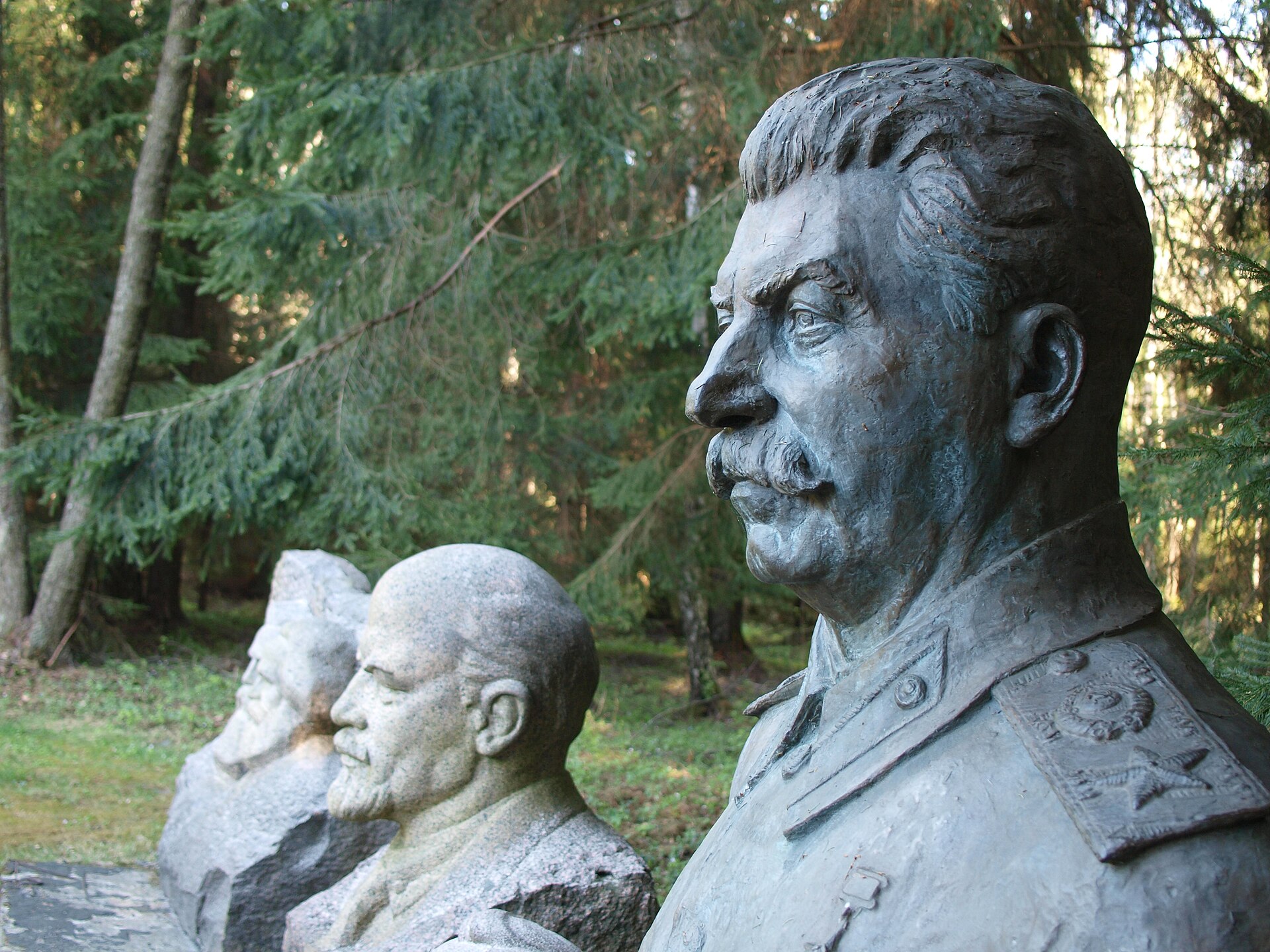
Soviet-era sculptorsMultiple Stalin statues stand in the park, deliberately staged as stern and militaristic; one, shown in the park's own Wikipedia-catalogued photography, originally stood in Vilnius during the Soviet occupation.14
The Karl Marx bust
Soviet-era sculptorA four-metre bust of Marx anchors the Totalitarian Sphere alongside the Lenin and Stalin monuments, the three placed together as the park's core statement on Communist ideology.18
The Felix Dzerzhinsky statue
Soviet-era sculptorA statue of the organiser of the Red Terror and founder of the Cheka stands in the Terror Sphere; both Wikipedia and a 2025 travel feature note the discomfort of walking from it to the park's cafe and small zoo within the same grounds.19
The Gulag-themed entrance walk
Park design, opened 2001Guard towers, wooden walkways and barbed-wire fencing recreate elements of a Soviet prison camp; it is the first thing a visitor passes through and sets the frame for the rest of the exposition.10
The 86-statue outdoor exposition as a single collection
46 different sculptorsThe park's own description calls the concentration of ideological monuments in one outdoor exposition a rare, possibly unique, phenomenon; no other institution has attempted to collect Soviet civic statuary at this scale.10
The Picture Gallery's Soviet-realist paintings
Soviet-period painters and graphic artistsA collection of political and economic-themed socialist-realist works, including depictions of the cult around Lenin, Stalin and Brezhnev, that most visitors to an outdoor statue park would not expect to also find indoors.9
The Information Centre-Museum's documentary archive
Park archiveSound, film and photo material on Soviet propaganda and repression, housed in a building styled on a 1940s-50s Soviet cultural house, giving the statues documentary context rather than leaving them to stand alone.9
A private museum built from what the state chose not to destroy
After Lithuania restored its independence in 1990-91, most Soviet-era monumental statues across the country were taken down from town squares and public buildings. With no agreed procedure for storing them, many were piled in the yards of utility companies and in storehouses, where some were damaged during removal or picked over by metal traders; left that way, they risked the same fate that met comparable monuments in neighbouring former Soviet republics, outright destruction.
In 1998 Lithuania's Ministry of Culture ran a tender for the establishment of an exposition of the dismantled sculptures. It was won by Hesonos klubas, a public-benefit agency based at Grutas near Druskininkai and run by Viliumas Malinauskas, a businessman who had built his fortune in his family's mushroom and berry trade. A central argument for choosing his proposal was that he planned to fund the museum privately rather than ask the state for money, and his submission stressed the project's value for tourism development in southern Lithuania. Preparation began in early 1999, and Grutas Park officially opened on 1 April 2001.
Malinauskas's own father had spent ten years surviving on grain husks in Siberian labour camps and rarely spoke about what happened to him. Malinauskas has said the reason he built the park was that traces of the Soviet regime were disappearing even from history books, and that he did not want future schoolchildren to think life had been better under Stalin or Lenin.
86 statues, one two-kilometre walk through named zones
The park's own description puts the outdoor exposition at 86 works by 46 different sculptors, spread across a 20-hectare site along a route of roughly 2 kilometres, a concentration of ideological monuments the park itself calls a rare, possibly unique, phenomenon: no other museum or cultural institution has attempted to collect and exhibit Soviet civic statuary at this scale in one outdoor exposition.
The statues are organised into named zones rather than displayed as a single undifferentiated collection. A Totalitarian Sphere gathers the main Communist leaders and thinkers, Vladimir Lenin, Joseph Stalin and Karl Marx. A Terror Sphere is dedicated to the founders of the Communist Party of Lithuania, Zigmas Aleksa-Angarietis and Vincas Mickevicius-Kapsukas, to Red Army officers Feliksas Baltusis-Zemaitis and Ieronim Uborevich, and to Felix Dzerzhinsky, organiser of the Red Terror. A Soviet Sphere holds the four leaders of Lithuania's Communists executed after the 1926 coup, along with activists of the 1918-1919 Lithuanian-Soviet War. A Red Sphere is dedicated to Soviet partisans, including Maryte Melnikaite, and Occupation and Death Spheres show the harsher side of the regime: mass deportations and the suppression of Lithuanian partisans.
The route itself recreates elements of a Gulag camp, with wooden walkways, guard towers and barbed-wire fencing meant to evoke Siberian camp conditions. At the entrance, a six-metre Lenin bust moved here from its former plinth in Vilnius's main square is the single largest monument visitors pass; the Stalin figures nearby are staged as deliberately stern and militaristic.
The Information Centre-Museum, the Picture Gallery and the reading room
Two indoor buildings sit alongside the outdoor exposition. The Information Centre-Museum is a wooden building styled on a Soviet cultural house of the 1940s and 1950s. Inside, the park's own copy describes sound, film and photo documentaries meant to show and denounce the ideologised Soviet propaganda culture and pseudo-science, and to disclose the aims, mechanisms and forms of Soviet ideology, including the genocide of the Lithuanian nation.
The Picture Gallery holds Soviet-period paintings and graphic works, split by the park into political and economic themes: images in the socialist-realist style depicting the cult built around Lenin, Stalin and Brezhnev, and scenes of the entrenchment of Soviet rule. A Club-Reading room is also listed among the park's indoor spaces on its own site, though the park has not published a description of what is shown there, so this page does not say more than that it exists.
A mini zoo, a Soviet-era playground and a Dzukija kitchen
The park is not only statues. A mini zoo of birds and animals is aimed at younger visitors, and a Luna Park recreates a Soviet-era-style playground of swings and carousels, framed by the park's own copy as a chance for children to imagine the rides their parents or grandparents might have used.
An on-site cafe serves regional Dzukija dishes built around mushrooms and berries, alongside traditional Lithuanian dishes such as potato dumplings stuffed with meat, baked potato pudding and cold beet soup. A self-consciously Soviet-styled menu section includes items such as sprats served 'po ruski' and cutlets named 'proscaj molodost.' The cafe seats up to 250 people, operates during the same hours as the park, and entry to it is free.
An argument that has run since before the gates opened
Opposition to the park began before it was built and has never fully gone away. The Catholic Church and Lithuanian politicians opposed the project when it was proposed, and gulag survivors and their families argued it capitalised on their suffering; the dispute reached Lithuania's constitutional court, where Malinauskas kept his permission to build.
Newsweek's reporting from the 2001 opening quoted Leonas Kerosierus, leader of the protest group Labora, comparing the park to honouring the people responsible for a village where women were raped and men disappeared, and predicting its neatly tended grounds would only fuel nostalgia for simpler times; Kerosierus called Malinauskas 'our Judas Iscariot.' Malinauskas's original plan to bring visitors in on cattle cars, re-enacting the transport used to deport Lithuanians, was blocked by the Ministry of Culture; a 2025 travel feature in Far Out Magazine confirms the same abandoned plan and records that the Catholic Church signed a petition against the park.
Not every survivor agreed with the opposition. The same Newsweek report quoted gulag survivor Monica Karloniene, who at 16 had been separated from her family and put on a train east to Siberia, saying she supported the park because her daughter had found work there in an area of Lithuania where unemployment was running at 30 percent. Malinauskas and the park went on to win the 2001 Ig Nobel Peace Prize.
A later academic assessment, published in Retrospect Journal in 2024, argues that recontextualising the statues rather than destroying or hiding them helps later generations reckon with the period, citing visitor research at Budapest's comparable Memento Park showing visitors reporting both discomfort and a kind of surprised admiration. The tension has not fully resolved either way: press coverage in late 2025 was still describing the park as 'provocative,' and today's visitor reviews still note it is not really for young children even as they praise its historical value.
What visitors say
Visitors consistently describe Grutas Park as an unusual but worthwhile stop: a walk through genuine Soviet-era statuary set in forest and wetland, combined with documentary displays, a mini zoo and a regional restaurant. It rates well above average on TripAdvisor (4.1 of 5 from 360 reviews, ranked 4th of 19 attractions in Druskininkai as read on 10 September 2026), while remaining one of Lithuania's most argued-over museums: gulag survivors, the Catholic Church and some politicians accused its founder of profiting from Soviet-era suffering when it opened, and that argument has never fully gone away, even as later assessments credit the park with keeping a physical, documented record of a period some other post-Soviet states destroyed outright.
What is praised, what is criticised
- Praised: The scale and completeness of the outdoor collection, 86 original statues by 46 sculptors laid out across a roughly 2-kilometre forest walk, is repeatedly singled out as unlike anything else in the region, with information plaques identifying each figure.
- Praised: The Information Centre-Museum and Picture Gallery are called out for adding documentary and archival depth beyond simply walking past statues, giving visitors historical context for what they are looking at.
- Praised: The on-site restaurant, its Dzukija regional dishes, and the wooded, riverside setting are frequently mentioned as making the visit more than a walk past monuments, with the surrounding nature itself drawing praise.
- Criticised: The mini zoo draws recurring complaints, with visitor accounts describing the animal enclosures as poorly suited to the animals kept in them and calling that part of the park an unnecessary or unwelcome addition to the statue walk.
- Criticised: The park's core premise has been contested since before it opened: gulag survivors, the Catholic Church and Lithuanian politicians accused founder Viliumas Malinauskas of profiting from a period of mass deportation and imprisonment, and Leonas Kerosierus, leader of the protest group Labora, said the tended grounds would fuel nostalgia rather than reckoning and called Malinauskas 'our Judas Iscariot.'
Ratings on other platforms
TripAdvisor: 4.1 from 360 ratings, read 10 September 2026
A platform average is a tertiary source: it moves, it is not audited, and we quote no visitor's words.
Questions about Grutas Park
Where is Grutas Park?
Grutas, Parko g. 49, 66441 Druskininkai, Lithuania.
How much does it cost to visit?
Adult: EUR 15; Children and teenagers under 16: EUR 9; Children under 4: free; Audioguide: EUR 10. As confirmed 10 September 2026.
When is it open?
Daily, January-February 09:00-17:00; Daily, March-April 09:00-19:00; Daily, May 09:00-20:00; Daily, June-August 09:00-21:00; Daily, September 09:00-20:00; Daily, October 09:00-18:00; Daily, November-December 09:00-17:00. As confirmed 10 September 2026.
How do you get there?
Car: About 120 km from Vilnius and 120 km from Kaunas, reached via the A4 highway; the park is about 5 km from Druskininkai itself and is signposted, with visitors told to turn off at the 'Grutas parkas' sign and follow the marked route in; Bus: About a 30-minute walk from the Grutas bus stop, following Parko gatve through the village to the signposted entrance; the park's own site does not publish a timetable and directs visitors to check bus schedules at the bus station.
What should you see first?
The six-metre Lenin monument at the entrance (Soviet-era sculptor, original installation in Vilnius); The Stalin statues (Soviet-era sculptors); The Karl Marx bust (Soviet-era sculptor); The Felix Dzerzhinsky statue (Soviet-era sculptor); The Gulag-themed entrance walk (Park design, opened 2001); The 86-statue outdoor exposition as a single collection (46 different sculptors).
What we could not confirm
- Some secondary sources describe an ongoing dispute since 2007 between the park and a Lithuanian copyright-collecting agency over royalties owed to seven of the sculptors; Wikipedia carries this claim marked as needing its own citation, and no primary source for it could be independently located and fetched for this page, so it is noted here rather than stated as fact.
- Press accounts differ slightly on the exact statue count, most citing the park's own figure of 86 by 46 sculptors, though at least one travel feature rounds this to '80 to 100'; this page follows the park's own published figure.
Images
Sources
- 1Wikidata, item Q1050522, 'Grutas Park' wikidata.org/wiki/Q1050522
- 2Wikimedia Commons, File:Gruto parkas - Entrance.JPG, (licence, author, description) commons.wikimedia.org/wiki/File:Gr%C5%ABto_parkas_-_Entrance.JPG
- 3Wikimedia Commons, File:Gruto parkas - Lenin.JPG, (licence, author, description) commons.wikimedia.org/wiki/File:Gr%C5%ABto_parkas_-_Lenin.JPG
- 4Wikimedia Commons, File:Gruto parkas - Stalin.JPG, (licence, author, description) commons.wikimedia.org/wiki/File:Gr%C5%ABto_parkas_-_Stalin.JPG
- 5Wikimedia Commons, File:Grutas Park zoo.jpg, (licence, author, description) commons.wikimedia.org/wiki/File:Gr%C5%ABtas_Park_zoo.jpg
- 6Gruto parkas official site, Kontaktai (address, phone, email, working hours, directions) grutoparkas.lt/kontaktai/
- 7Gruto parkas official site, Tickets prices (English) grutoparkas.lt/en_US/tickets-prices/
- 8Gruto parkas official site, About us (English) grutoparkas.lt/en_US/about-us/
- 9Gruto parkas official site, Museums (English) grutoparkas.lt/en_US/museums/
- 10Gruto parkas official site, Outdoor exposure (English) grutoparkas.lt/en_US/outdoor-exposure/
- 11Gruto parkas official site, Luna park (English) grutoparkas.lt/en_US/luna-park/
- 12Gruto parkas official site, Zoo (English) grutoparkas.lt/en_US/zoo/
- 13Gruto parkas official site, Cafe (English) grutoparkas.lt/en_US/cafe/
- 14Wikipedia, 'Grutas Park' (, for identity, spheres organisation, visitor and staff counts, Ig Nobel Prize) en.wikipedia.org/wiki/Gr%C5%ABtas_Park
- 15Atlas Obscura, 'Grutas Park' atlasobscura.com/places/grutas-park
- 16TripAdvisor, 'Grutas Park' attraction page and reviews, read 10 September 2026 ( rating) tripadvisor.com/Attraction_Review-g277798-d552802-Reviews-Grutas_Park-Druskininkai_Alytus_County.html
- 17Newsweek Editors, 'Building Stalinworld', Newsweek newsweek.com/building-stalinworld-150485
- 18Darcy Gresham, 'Statues of Soviets: The case of Grutas Park, Lithuania', Retrospect Journal, 10 November 2024 retrospectjournal.com/2024/11/10/statues-of-soviets-the-case-of-grutas-park-lithuania/
- 19Sam Farley, 'Welcome to Stalin World, Lithuania's provocative museum park', Far Out Magazine, 4 December 2025 faroutmagazine.co.uk/welcome-to-stalin-world-lithuanias-provocative-museum/


