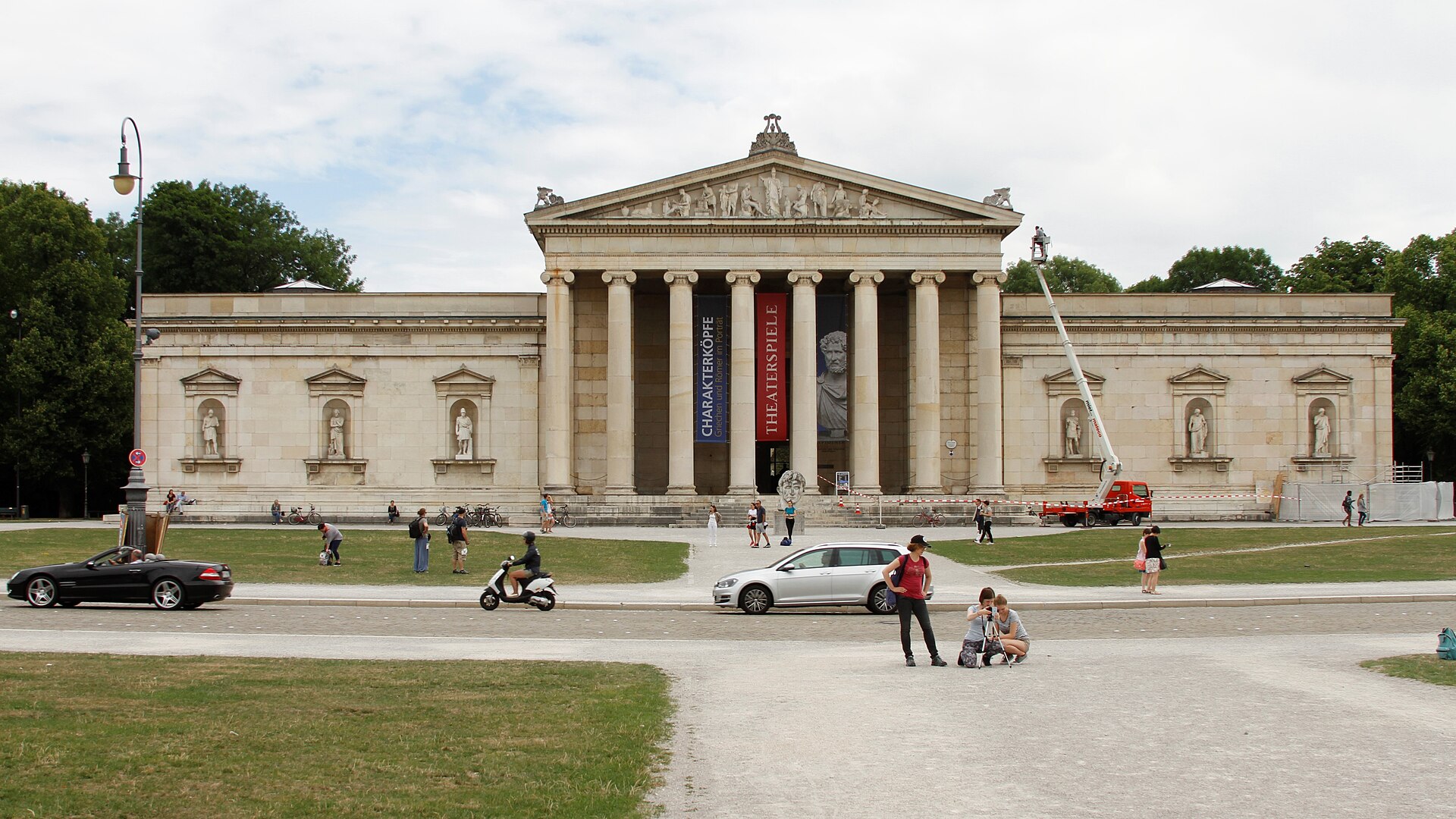
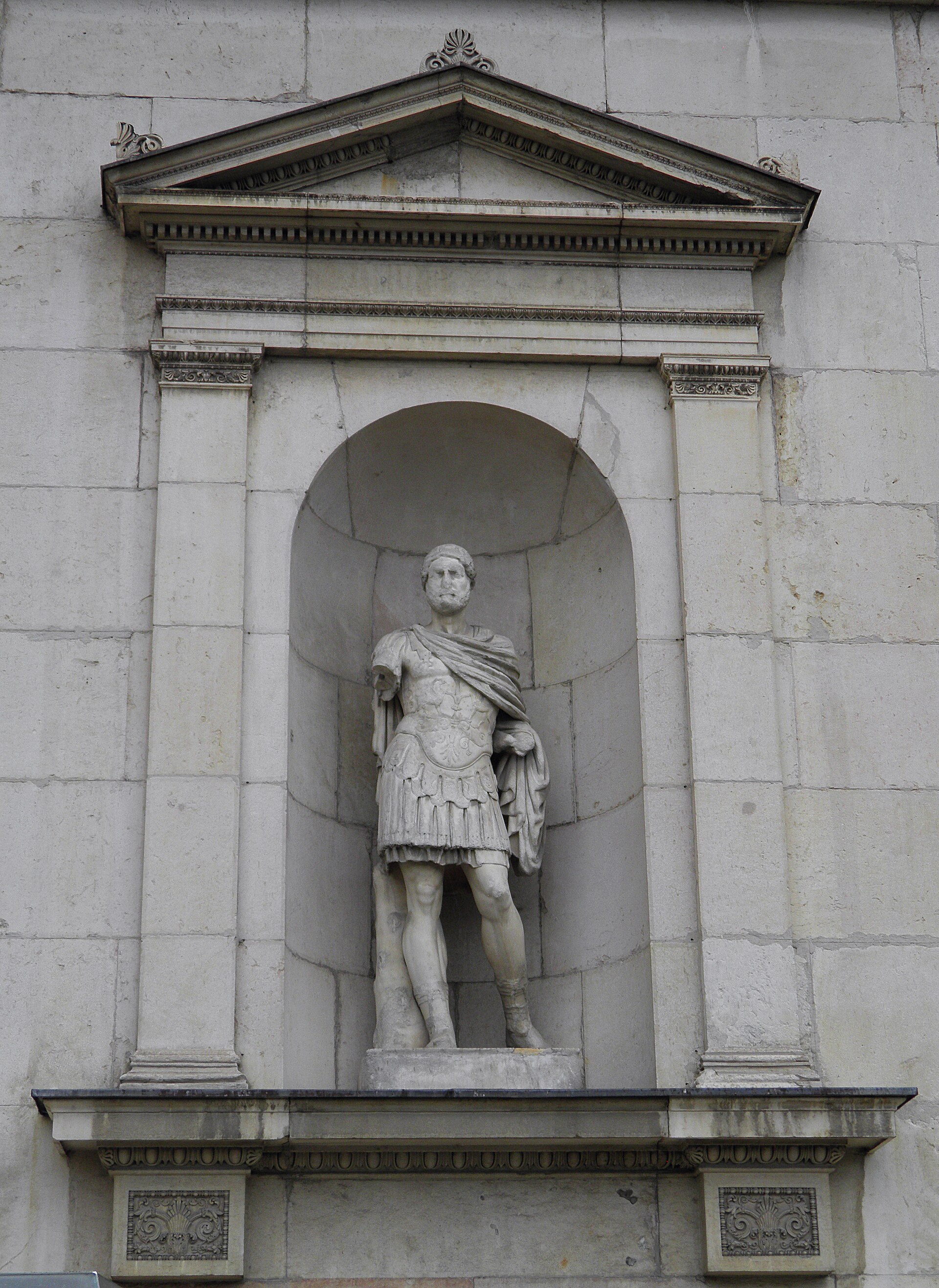
The temple-fronted entrance Leo von Klenze designed, with the CHARAKTERKOEPFE banner over the doorway and sculpture niches along the wings. Vetted by eye before use.
Photograph by José Luiz · CC BY-SA 4.0Glyptothek
Museum · Glyptothek München · Founded 1830
Open, admission and hours confirmed 21 August 2026 · 12 sources
On this page 15 sections
ContentsClose
The Glyptothek is, on its own account, the only museum anywhere dedicated exclusively to ancient sculpture, with nothing else in the building: no painting, no decorative arts, no later period rooms. The chronological run is real, from archaic kouroi of the late 7th century BC through classical, Hellenistic and Roman Imperial work into the 5th century AD, and it was assembled in a single generation, largely between 1810 and 1830, by one collector, Ludwig I of Bavaria, working mostly through one agent, Johann Martin von Wagner. That narrowness is the whole character of the place: a visitor sees one medium built by one eye in one period, rather than an encyclopaedic survey assembled by a committee over centuries.
| Local name | Glyptothek München |
|---|---|
| Kind | Museum |
| Founded | 1830 |
| City and country |  Munich, Germany Munich, Germany |
| Address | Koenigsplatz 3, 80333 Muenchen, Germany |
| Website | antike-am-koenigsplatz.mwn.de/glyptothek |
| Status | Open, confirmed |
| Record last verified |
Visiting
- Hours
- MondayClosed
- Tuesday, Wednesday, Friday to Sunday10:00 to 17:00
- Thursday10:00 to 20:00late opening
- Closed
- Monday. 24 and 31 December, and a published list of additional closures around Bavarian holidays in 2026.
- Admission
- Combined ticket, Glyptothek and Staatliche AntikensammlungenEUR 6one ticket admits to both museums on Koenigsplatz
- Combined ticket, concessionEUR 4
- Under 18Freefree admission
- Sunday rateEUR 1per museum on Sundays
- Annual pass, both museumsEUR 20
- Annual pass, concessionEUR 15
Free entry: Under-18s enter free at any time. 1 EUR per museum on Sundays, in place of the standard combined-ticket price- Tickets
- antike-am-koenigsplatz.mwn.de/besucherinforma... The museum's own ticket page.
- Do I need to book?
- Not stated as required on the museum's own visitor page; the single combined ticket covers the Glyptothek and the Staatliche Antikensammlungen across the square.
- Address
- Koenigsplatz 3, 80333 Muenchen, Germany MapU-Bahn U2 Koenigsplatz
Tram Line 27, Koenigsplatz stop
Bus Line 100 (museum bus), Koenigsplatz stop - Website
- antike-am-koenigsplatz.mwn.de/glyptothek
- Telephone
- +49 89 289 27502
- [email protected]
Before you go how long, access, photography, bags, eating, shop
- How long to allow
- The building holds one medium only, ancient sculpture, in a sequence of top-lit halls around a courtyard, which most visitors clear in one to two hours.
- Access
- The museum states step-free access at the north Koenigsplatz entrance, with wheelchairs available to borrow. The Staatliche Antikensammlungen across the square is harder going: three floors connected by stairs.
- Photography
- Not stated on the fetched visitor page; not published here.
- Bags
- Not stated on the fetched visitor page; not published here.
- Eating
- Cafe Glyptothek, in the museum's courtyard, cash only
- Shop
- Not stated on the fetched visitor page; not published here.
Prices and hours change. We take them from the institution's own pages and print the day we read them, and you can check the current position at the source we used. Confirm before you travel.
What is inside
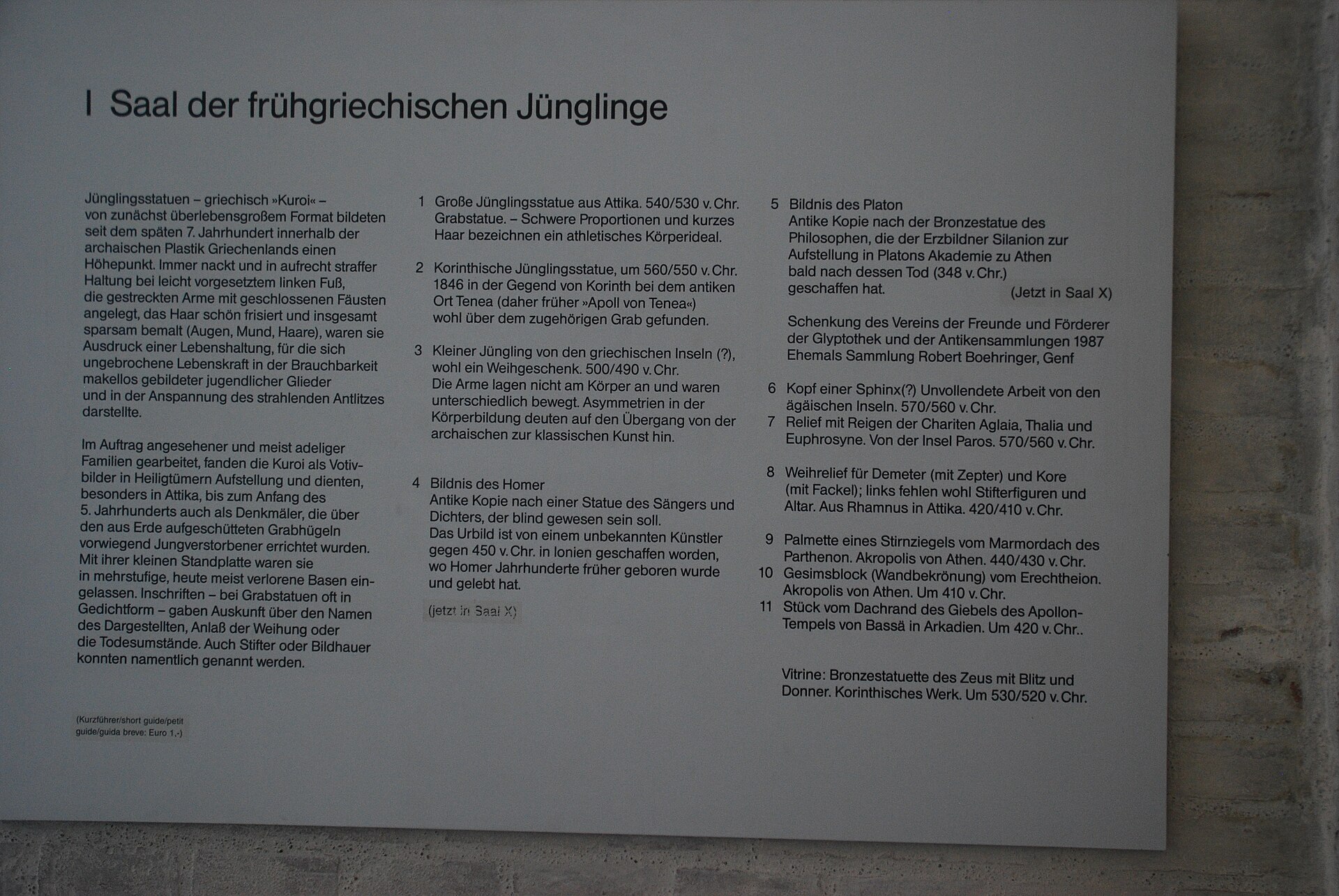
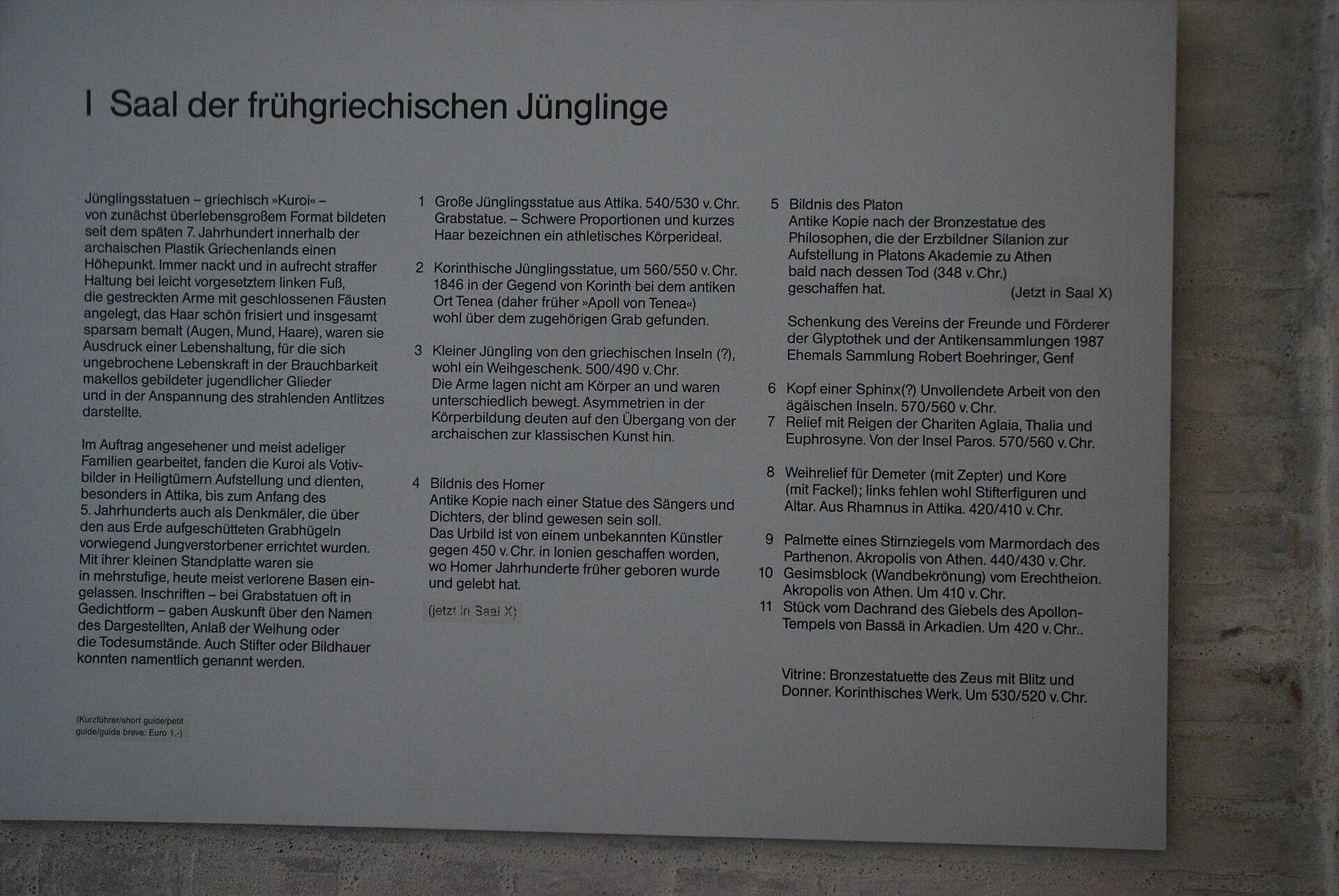
Photograph by Marcus Cyron · CC BY-SA 3.0 Room I, the Hall of the Early Greek Youths
The museum's own wall text in this room, photographed for this archive, describes kouroi: standing youths of greater-than-lifesize format that formed a highpoint of archaic Greek sculpture from the late 7th century BC, nude, hair carefully dressed, standing rigid with fists clenched and the left foot forward. Wealthy families commissioned them as votive images or grave markers, and the text names a large kouros from Attica of about 540 to 530 BC, a Corinthian kouros of about 560 BC found near ancient Tenea, and a small kouros of about 500 to 490 BC, possibly a votive gift, among the pieces on display.
The Aegina Room
The pediment sculptures from the Temple of Aphaia on the island of Aegina, built about 490 to 480 BC: two full pedimental groups of fighting warriors around a central Athena, bought at a Zante auction in 1812 and the single most consequential purchase Ludwig I ever made for this museum. Since 1972 they have been shown de-restored, without the substantial nineteenth-century additions the Danish sculptor Bertel Thorvaldsen once carved onto them, so what is on the wall today is deliberately more fragmentary than the versions reproduced in most older photographs and prints.
The Barberini Faun's own room
A single Hellenistic marble of a sleeping, sprawled satyr, found in the moat of Castel Sant'Angelo in Rome in the 1620s and fought over by the Barberini family, the Papal export authorities and Ludwig's agents for three decades before it reached Munich. It has occupied a room built specifically for it since the museum's completion in 1827, apart from the general run of the collection.
The Roman portrait halls
Roman Imperial portraiture displayed as a continuous run of named and unnamed faces: emperors including Augustus, alongside likenesses the museum's own material identifies as Homer, Plato and Alexander the Great, most of them Roman copies of lost Greek originals rather than the originals themselves, which is the ordinary condition of ancient portrait sculpture and worth saying plainly rather than passing over.
The central courtyard and the flanking halls
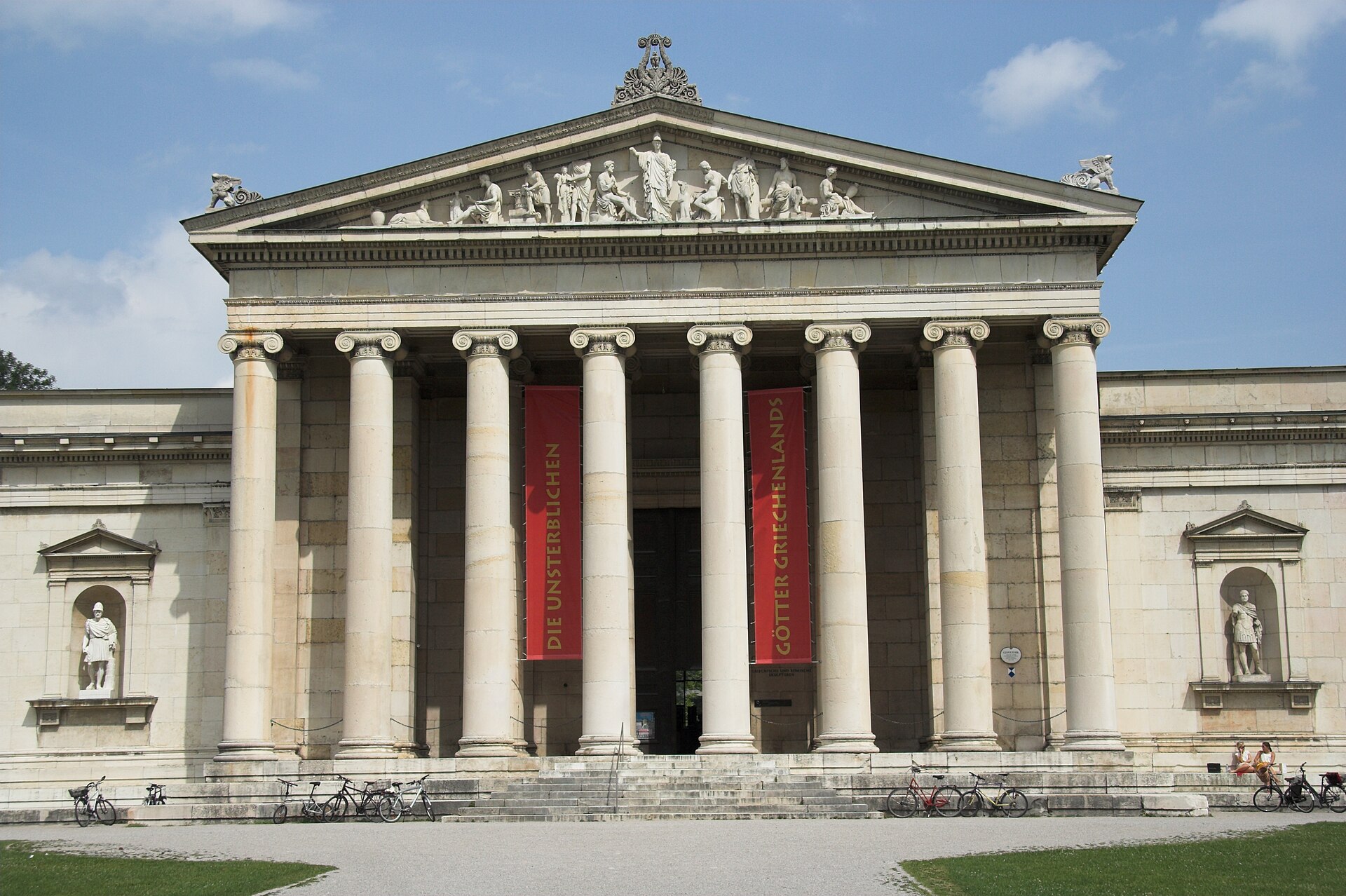
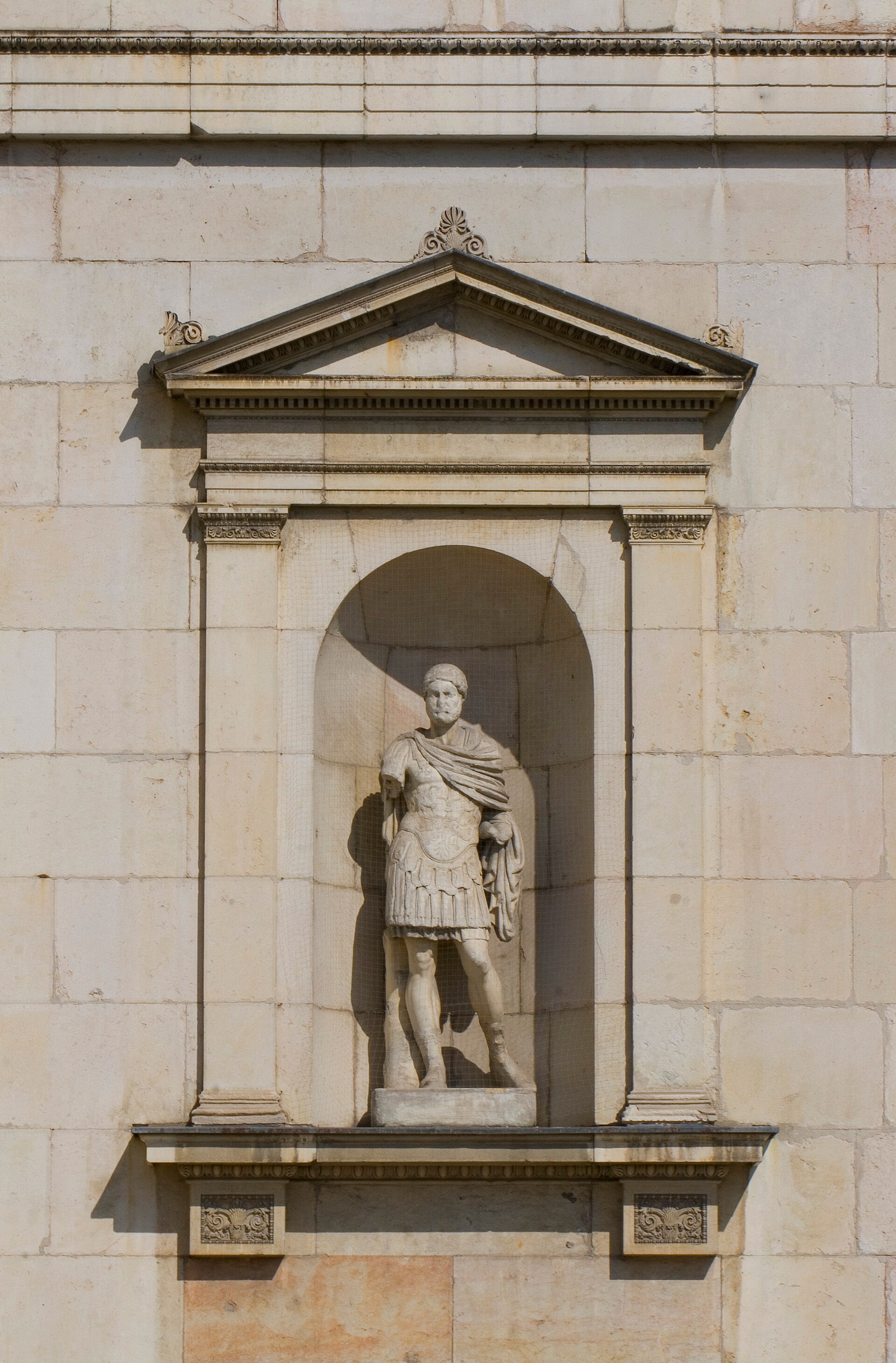
Leo von Klenze's plan sets fourteen top-lit halls around a central courtyard, the exterior built to read as a Greek temple front and the interior vaults modelled on Roman baths; the postwar rebuild deliberately left the walls as plain brick rather than repainting the frescoes the Allied bombing of April 1944 destroyed, so the rooms now read starker than Klenze intended.
What to see first
The Aegina pediments
Workshop active on Aegina, temple built about 490 to 480 BCTwo complete pedimental groups from the Temple of Aphaia, bought at a public auction on Zante in 1812 by Ludwig's agent Johann Martin von Wagner ahead of a British Museum bidder who was, by one account, simply in the wrong place. Thorvaldsen supplemented the fragments extensively for their 1827 installation; the additions were removed between 1962 and 1966 under director Dieter Ohly, and the sculptures have stood de-restored, and visibly more fragmentary, since 1972.6
The Barberini Faun
Hellenistic, late 3rd or early 2nd century BCA life-size sleeping satyr found damaged in a Roman moat in the 1620s, restored for Cardinal Francesco Barberini, then sold out of the family in 1799 only for the Barberini to sue to annul the sale and, after a public export fight the antiquarian Carlo Fea and the sculptor Antonio Canova both joined against Ludwig's purchase, lose. It has had a room of its own since 1827.7
Medusa Rondanini
Roman copy, 1st century BC to 1st century AD, after a Greek originalThe best-known ancient copy of a beautiful rather than grotesque Medusa, a type connected to the lost gorgoneion on Phidias's Athena Parthenos, bought by Ludwig from the Rondanini family's heirs while he was still crown prince on his own Grand Tour.8
The kouroi of Room I
Archaic Greek, late 7th to early 5th century BCStanding votive and grave youths, greater than life size, that the museum's own room text uses to open the whole chronological sequence: a large Attic kouros of about 540 to 530 BC, a Corinthian example from near ancient Tenea of about 560 BC, and a smaller kouros of about 500 to 490 BC.12
The Drunken Old Woman
Roman copy, about 200 BC original typeOne of the very few pieces in the museum that descends from the older Wittelsbach collection rather than from Ludwig's own nineteenth-century purchases, and a rare survival of Hellenistic genre subject matter, an aged street vendor clutching a wine jar, next to a collection otherwise dominated by gods, athletes and rulers.4
Portraits of Homer and Plato
Roman copies after lost Greek originalsNamed likenesses of a poet who left no contemporary image and a philosopher whose surviving portrait type was created after his death, which makes both objects evidence for how later antiquity constructed the faces of its own past rather than records of how either man actually looked.4
Portraits of Alexander the Great and Augustus
Roman-era copies and Imperial portraitureNamed on the museum's own overview as part of the run of portrait sculpture spanning the 6th century BC to the 5th century AD, placing a Hellenistic ruler cult image and Rome's first emperor in the same sequence as the Homer and Plato likenesses.4
A museum built to hold one man's eye
The Glyptothek is Munich's oldest public museum and, on the institution's own description, the only museum anywhere still dedicated exclusively to ancient sculpture. The building is named for that narrowness: glyphein, to carve, and theke, a repository, a storehouse for carved things and nothing else. Crown Prince, later King, Ludwig I of Bavaria began collecting ancient sculpture after an Italian journey in 1804 to 1805, buying deliberately and selectively rather than accumulating broadly, with the declared ambition of making Munich an Isar-Athens, a German Athens on the river Isar. His agent in Rome, Johann Martin von Wagner, combined a connoisseur's eye with the commercial nerve to compete against other courts and against the British Museum for the same objects, and between about 1810 and 1820 the two of them assembled most of what is still on the walls today.
Leo von Klenze, Ludwig's court architect, was commissioned to design a building to hold the collection and built it between 1816 and 1830: a Greek temple front applied to a Roman interior, fourteen halls arranged around a central courtyard, originally frescoed and with limited natural light. The building opened in 1830 as Munich's first public museum, years before most of the great national collections of Europe existed in their present form.
The Aegina pediments: an auction won by being in the right place
The pediment sculptures of the Temple of Aphaia on the island of Aegina, built about 490 to 480 BC, were rediscovered still lying where they had fallen by the English architect Charles Robert Cockerell and the Baltic German scholar Otto Magnus von Stackelberg in 1811, on what was, for Cockerell, a stop on his Grand Tour. Baron Carl Haller von Hallerstein recommended the find to Ludwig, and a public auction was arranged for 1 November 1812, held on Zante rather than where the marbles were actually stored, a detail that mattered: the British Museum's own representative was, by one account of the sale, simply in the wrong place to bid effectively, and Wagner secured the sculptures for Ludwig instead. The museum's own history calls this its single most significant purchase.
The marbles reached Rome fragmentary, and Ludwig had the Danish sculptor Bertel Thorvaldsen supplement the missing sections before they were installed in the newly built Glyptothek in 1827. What visitors saw for the next century and a half was substantially Thorvaldsen's own work standing in for lost antiquity, a fact that was not seriously questioned until 1901, when Adolf Furtwangler, then director of the Glyptothek, excavated the original pediment bases on Aegina itself and found evidence that did not match what was on display in Munich.
The derestoration, and the scholarly argument that has not closed
The Second World War brought the question to a head by other means. Koenigsplatz became part of the Nazi party's own building programme for Munich, and the Glyptothek suffered serious damage in the Allied bombing raids of April 1944. In the rebuilding that followed, director Dieter Ohly made the decision, carried out between 1962 and 1966, to remove Thorvaldsen's nineteenth-century restorations from the Aegina pediments entirely. Ohly argued, in words a 2022 academic thesis on the episode quotes directly, that keeping the additions amounted to a desire to elide temporal differences, an artful but ultimately misleading blending of the past and the present in a hybrid whole. Furtwangler's excavated pediment bases supplied one of the clearest technical justifications: they showed that a warrior Thorvaldsen had restored lying down had originally stood upright, an error baked into a century and a half of photographs and plaster casts before Ohly's team corrected it.
The sculptures went back on display in 1972, in the same reopening that gave the whole museum its present bare brick walls, deliberately unrestored, supported on visible metal rods, with modern casts standing in for fragments that had by then been excavated but stayed in Greece. It is not a settled outcome. The most-cited scholarly account of the episode records that the decision has been received with mixed reviews from the scholarly community ever since: some conservators credit the derestoration with improving historical accuracy, while others argue that both the nineteenth-century restoration and its twentieth-century removal have left irreparable changes, so that neither Thorvaldsen's Munich nor the ancient original can now be fully recovered, and the record of what the restoration itself looked like has been lost along with it. One historian of conservation practice has gone further and named Ohly's Aegina decision as the starting point for a wider cult of the fragment across the field.
A faun Rome tried to keep
The Barberini Faun is the other object visitors are steered toward, and its own provenance argument runs in the opposite direction from the pediments: not a dispute over how much of it is ancient, but over whether it should ever have left Italy. Found badly damaged in the moat below Castel Sant'Angelo in Rome in the 1620s, it was restored for Cardinal Francesco Barberini and stayed with his family for close to two centuries. In 1799 the Barberini sold it to the dealer Vincenzo Pacetti, then went to court to have that sale annulled. What followed was a public fight over export: the papal antiquarian Carlo Fea and the sculptor Antonio Canova both opposed letting the Faun leave Italy, and an export ban was imposed before Ludwig's agents nonetheless secured the sale. The room built to hold it, apart from the rest of the collection, was ready by 1827, three years before the museum itself opened.
A square that was borrowed twice
Koenigsplatz was laid out in the early nineteenth century as a deliberately Athenian composition, the Glyptothek facing the Propylaea gate across a lowered central lawn that Klenze's plan set nearly a metre below street level specifically to make the surrounding buildings read as taller. The Nazi party found the same square useful for the opposite purpose a century later. Nazi book burnings took place on Koenigsplatz on 10 May 1933, and in 1935 the regime paved the square with granite slabs to use it as a rally ground; two Ehrentempel, honor temples built in the same severe neo-Greek idiom as Klenze's own buildings, went up on the square's east side to enshrine the fifteen Nazis killed in the failed 1923 Beer Hall Putsch. Both temples were demolished by the US Army in 1947, though their platforms survive, and the square was restored to something like its prewar appearance. The Glyptothek's own visitor material does not address this history, though the building the museum occupies is the same one that watched it happen.
Bare walls by decision, not by neglect
The plain brick interior a visitor sees today is not the building Klenze designed. His nineteenth-century halls were frescoed, with coloured marble floors and comparatively little daylight; the April 1944 bombing destroyed the frescoes along with much of the roof, and when reconstruction began in earnest under Ohly from 1947, the decision was made not to repaint them. The museum reopened in 1972 with lightly plastered brick walls, plain floors and large windows that put far more daylight on the sculptures than Klenze had ever allowed, a choice that reads today as a considered aesthetic position, sculpture shown against a neutral ground, rather than as an unfinished repair. A further closure ran from October 2018 to January 2021 for structural and services renovation, with exterior work continuing into the summer of that year, after which the museum reopened in its present state.
How to actually use it
The Glyptothek and the Staatliche Antikensammlungen face each other across Koenigsplatz and share a single combined ticket, 6 EUR regular and 4 EUR concession, which is the only sensible way to buy in: the two collections were formed together and are read together, sculpture on one side of the square and painted vases, bronzes and gold jewellery on the other. Under-18s are free at both, and Sunday drops the price to 1 EUR per museum. The Glyptothek itself is a one-to-two-hour visit for most people, smaller and far less crowded than Munich's painting galleries a short walk away, and the museum states step-free access at its north entrance with wheelchairs available to borrow; the Antikensammlungen, by contrast, is three floors connected only by stairs. Cafe Glyptothek sits in the museum's own courtyard and takes cash only. Thursday is the one evening opening, until 20:00; every other open day runs 10:00 to 17:00, and the museum is closed Monday.
What visitors say
The museum publishes no visitor prose and no platform rating, so what follows rests on the institution's own material and on published scholarship about its single most debated act, the 1962 to 1966 removal of Thorvaldsen's restorations from the Aegina pediments. The consistent praise is for the building's plainness: a single-medium collection shown in spacious, top-lit, largely uncluttered rooms at a very low combined entry price, with the front steps doubling as an informal public space for the city around it. The consistent point of dispute is not the building but the pediments themselves, where the museum's own defining act of postwar conservation is still argued over by scholars rather than settled.
What is praised, what is criticised
- Praised: the uncluttered, top-lit galleries, which show the sculptures in the round rather than crowded against a wall, and which the museum's own account attributes to the deliberately spare 1972 postwar rebuild
- Praised: the low combined price, 6 EUR for two museums on the same square, with under-18s free and a 1 EUR Sunday rate
- Praised: the building's exterior steps, which the city of Munich's own tourism page notes are used informally by residents as a place to sit on sunny days, independent of the museum itself
- Praised: a single-medium collection with real depth in one area, ancient sculpture, rather than a shallow spread across many
- Criticised: the 1962 to 1966 removal of Thorvaldsen's restorations from the Aegina pediments remains, on the evidence of the most-cited academic study of it, a decision the scholarly community is still divided over: some conservators credit it with improving accuracy, others argue the nineteenth-century restoration and its later removal have both left irreversible changes, so that neither the original nor Thorvaldsen's version can now be recovered
- Criticised: the museum's neoclassical idiom, and its position on Koenigsplatz, sit uneasily with the square's own history: the Nazi party staged rallies and the 10 May 1933 book burning here, and built two Ehrentempel honor temples in a matching severe neo-Greek style directly across the square, a continuity the museum's own visitor material does not address
- Criticised: published visitor and hours information for the Staatliche Antikensammlungen across the square notes real accessibility limits, three floors linked only by stairs, that do not apply to the Glyptothek itself but affect the combined-ticket visit
Questions about Glyptothek
Where is Glyptothek?
Koenigsplatz 3, 80333 Muenchen, Germany.
How much does it cost to visit?
Combined ticket, Glyptothek and Staatliche Antikensammlungen: EUR 6; Combined ticket, concession: EUR 4; Under 18: free; Sunday rate: EUR 1; Annual pass, both museums: EUR 20. As confirmed 21 August 2026.
When is it open?
Monday closed; Tuesday, Wednesday, Friday to Sunday 10:00-17:00; Thursday 10:00-20:00. Closed: Monday. 24 and 31 December, and a published list of additional closures around Bavarian holidays in 2026. As confirmed 21 August 2026.
How do you get there?
U-Bahn: U2 Koenigsplatz; Tram: Line 27, Koenigsplatz stop; Bus: Line 100 (museum bus), Koenigsplatz stop.
What should you see first?
The Aegina pediments (Workshop active on Aegina, temple built about 490 to 480 BC); The Barberini Faun (Hellenistic, late 3rd or early 2nd century BC); Medusa Rondanini (Roman copy, 1st century BC to 1st century AD, after a Greek original); The kouroi of Room I (Archaic Greek, late 7th to early 5th century BC); The Drunken Old Woman (Roman copy, about 200 BC original type); Portraits of Homer and Plato (Roman copies after lost Greek originals).
What we could not confirm
- Whether any further technical findings from Ohly's 1962 to 1966 excavation of the Aegina pediment bases, beyond the single documented case of a warrior repositioned from lying to standing, have been published in detail. The 2022 thesis used as this page's principal source for the episode names that one case specifically and does not itemise others.
- What the museum's own current visitor materials say, if anything, about Koenigsplatz's Nazi-era use as a rally ground and the site of the 10 May 1933 book burning. The fetched visitor and history pages are silent on it; the connection here is drawn from the Wikipedia article on the square, a tertiary source, and deserves a primary citation from the museum or the NS-Dokumentationszentrum Muenchen.
- The precise current room-by-room layout beyond Room I, which this page can source directly from a photographed wall panel. The Aegina Room, the Barberini Faun room and the Roman portrait halls are described here from general published accounts of the collection rather than from a fetched, current floor plan, and should be checked against one.
- Whether a free-licence photograph exists of the Aegina Room, the Barberini Faun in its own room, or the central courtyard. None could be verified on Wikimedia Commons during this research pass; only exterior views and the one interior wall-panel photograph could be confirmed as this venue.
Images
Sources
- 1Antike am Koenigsplatz, Besucherinformationen (visitor information): opening hours for the Glyptothek and the Staatliche Antikensammlungen, combined ticket prices (6.00 / 4.00 EUR), Sunday 1.00 EUR rate, under-18 free admission, annual pass prices (20.00 / 15.00 EUR), phone, email, transit directions (U2, Tram 27, Bus 100), accessibility notes, and Cafe Glyptothek. Read from the raw HTML on 7 August 2026. antike-am-koenigsplatz.mwn.de/besucherinformationen/
- 2Antike am Koenigsplatz, Glyptothek overview page: founding by Leo von Klenze for Ludwig I, construction 1816 to 1830, the Aegina pediments as the museum's most significant purchase, and the postwar 1972 reopening with plain brick walls. Read from the raw HTML on 7 August 2026. antike-am-koenigsplatz.mwn.de/glyptothek/
- 3Antike am Koenigsplatz (English), 'World-famous originals in timeless halls': the 1812 Aegina purchase described as the museum's most significant, Thorvaldsen's supplementary work in Rome, and the 1827 installation date. Read from the raw HTML on 7 August 2026. antike-am-koenigsplatz.mwn.de/en/world-famous-originals-in-timeless-halls-glyptothek/
- 4Wikipedia, 'Munich Glyptotek': general history, Ludwig I's German-Athens ambition, construction dates, WWII damage, 1972 reopening, and the October 2018 to January 2021 renovation closure. en.wikipedia.org/wiki/Munich_Glyptotek
- 5Wikipedia (German), 'Glyptothek (Muenchen)': Dieter Ohly's directorship 1962 to 1978, bombing damage in April 1944, reconstruction beginning 1947, and the 1972 reopening. de.wikipedia.org/wiki/Glyptothek_(M%C3%BCnchen)
- 6Wikipedia, 'Temple of Aphaea': the 1811 discovery of the pediment fragments by Charles Robert Cockerell and Otto Magnus von Stackelberg, Carl Haller von Hallerstein's recommendation to Ludwig of Bavaria, and Thorvaldsen's restoration of the sculptures now in the Glyptothek. en.wikipedia.org/wiki/Temple_of_Aphaea
- 7Wikipedia, 'Barberini Faun': discovery in the 1620s below Castel Sant'Angelo, Cardinal Francesco Barberini's ownership from 1628, the 1799 sale to Vincenzo Pacetti, the Barberini family's suit to annul that sale, the export ban supported by Carlo Fea and Antonio Canova, and the room completed for the sculpture by 1827. en.wikipedia.org/wiki/Barberini_Faun
- 8Wikipedia, 'Medusa Rondanini': the sculpture's type and dating, its relationship to the lost gorgoneion of Phidias's Athena Parthenos, and Ludwig I's purchase from the heirs of the marchese Rondanini during his own Grand Tour. en.wikipedia.org/wiki/Medusa_Rondanini
- 9muenchen.de (City of Munich tourism), 'Glyptothek' sights page: the four collection periods (Archaic, Classical, Hellenistic, Roman Imperial), the 1830 opening as Munich's oldest public museum, and the note that residents use the exterior steps informally on sunny days. Read from the raw HTML on 7 August 2026. muenchen.de/en/sights/museums/glyptothek
- 10Wikipedia, 'Koenigsplatz, Munich': the square's design with a lowered central lawn, the two Ehrentempel honor temples built in 1933 to 1935 in a matching neoclassical idiom, the 10 May 1933 book burning, the 1935 granite paving for party rallies, and the 1947 demolition of the temples by the US Army. en.wikipedia.org/wiki/K%C3%B6nigsplatz,_Munich
- 11Amelia Griese, 'Evolution of Authenticity: Investigating the (De)Restoration of Ancient Sculpture,' MA thesis, Lindenwood University, 12 December 2022. Read in full from the PDF: director Dieter Ohly's 1962 to 1966 de-restoration of the Aegina pediments, his quoted justification about eliding temporal differences, Adolf Furtwangler's 1901 excavation of the original pediment bases, the specific finding that Warrior O III had been restored lying down where the bases show he stood, the 1972 reopening with the sculptures de-restored and supported on metal rods, the divided scholarly reception of the decision, and the citation of William J. Diebold's 1995 Art Journal article 'The Politics of Derestoration: The Aegina Pediments and the German Confrontation with the Past' as the most-cited account. digitalcommons.lindenwood.edu/cgi/viewcontent.cgi?article=1297&context=theses
- 12Wikimedia Commons, File:Glyptothek Muenchen 102.JPG: the museum's own Room I wall panel, photographed in situ, naming the archaic kouroi on display and their approximate dates. Read directly from the image for this page's Room I description and the kouroi highlight entry. commons.wikimedia.org/wiki/File:Glyptothek_M%C3%BCnchen_102.JPG
