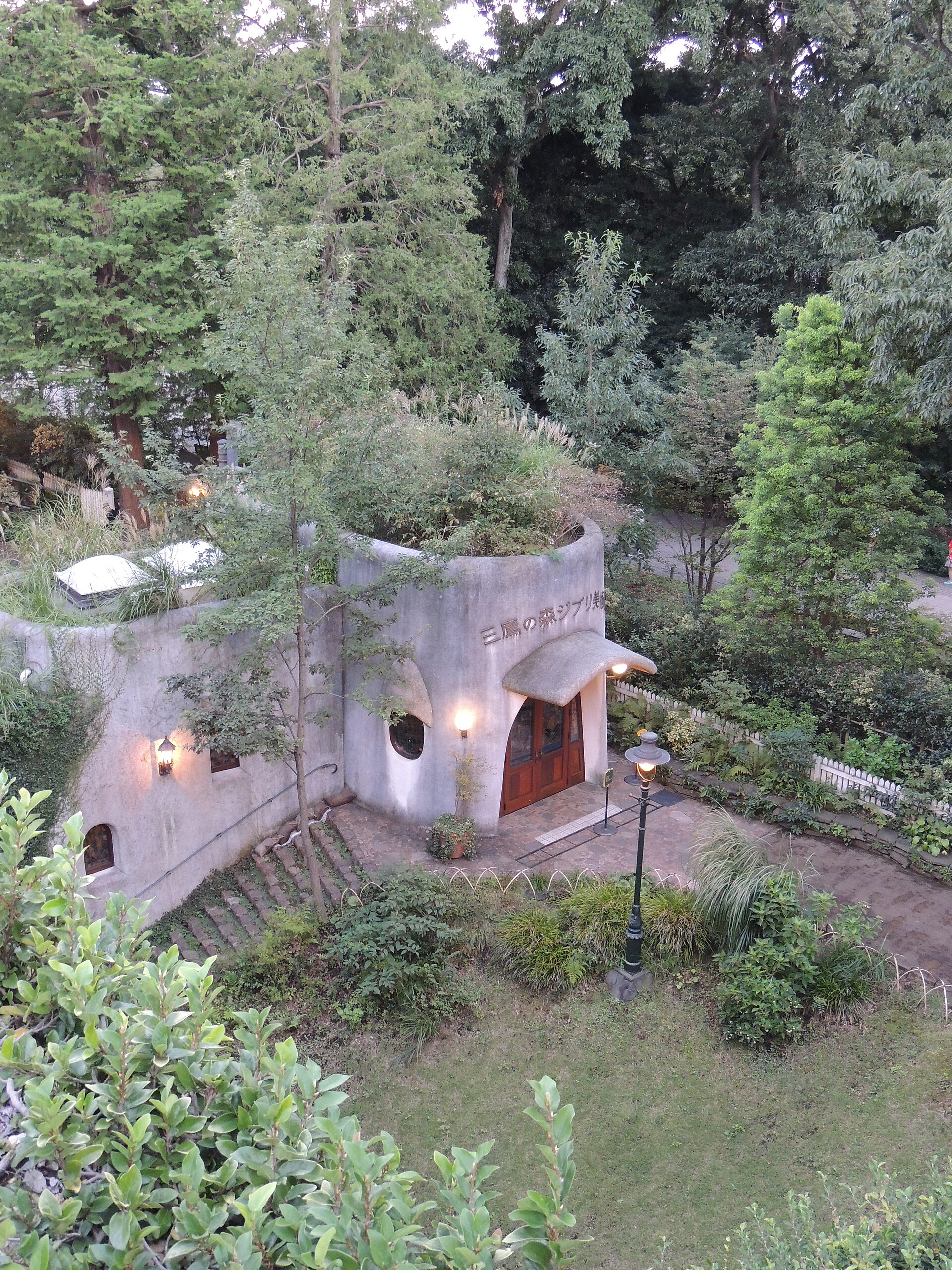
The Ghibli Museum, Mitaka, seen from the terrace above its curved, half-buried entrance facade. The building's Japanese name, Mitaka no Mori Ghibli Bijutsukan, is set into the concrete above the door.
Madame Tatillonne, CC BY-SA 4.0Ghibli Museum
Museum · 三鷹の森ジブリ美術館 · Founded 2001
Open, admission and hours confirmed 7 September 2026 · 13 sources
On this page 16 sections
ContentsClose
The Ghibli Museum does not hold a collection in the acquisitions sense that applies to most institutions in this archive. Almost everything on display - the Central Hall's architecture, the 'Where a Film is Born' exhibit, the Saturn Theater's short films, the special exhibition gallery's rotating shows - was made specifically for the Museum by Studio Ghibli rather than gathered from outside sources, and Miyazaki's stated design brief explicitly rejected building around a static permanent collection. Its holdings, such as they are, are original production and exhibition material tied to Studio Ghibli's own films: storyboards, background art, and material relating to named staff such as background artist Yuriko Yamawaki, the subject of the exhibition running from November 2025. There is, at the time of this research, no free-licence photograph of any of this material, because photography is banned throughout the interior - which is why the images attached to this record are limited to the entrance, the cafe and the one outdoor space, the rooftop garden, where a camera is allowed.
| Local name | 三鷹の森ジブリ美術館 |
|---|---|
| Kind | Museum |
| Founded | 2001 |
| City and country |  Mitaka, Japan Mitaka, Japan |
| Address | 1-1-83 Shimorenjaku, Mitaka, Tokyo 181-0013, Japan |
| Website | ghibli-museum.jp/en |
| Status | Open, confirmed |
| Record last verified |
Visiting
- Hours
- Wed-Mon (see closed days)10:00 to 18:00Entry is by a single fixed timed slot per reserved ticket; once inside, stay is unlimited until closing.
- Closed
- Every Tuesday, as the standing weekly closure. Exception: on a Tuesday that is a Japanese national holiday, Mitaka Citizens' Day, or similar, the Museum opens instead and closes on a different weekday that week - the exact swap is only fixed a few months out on the official opening calendar. Scheduled maintenance closures of about a week, twice a year (for example 12-19 May and 4-18 November 2026). A winter closure around the New Year holiday (27 December 2026 - 2 January 2027).
- Admission
- Ages 19 and overJPY 1,000
- Ages 13-18JPY 700
- Ages 7-12JPY 400
- Ages 4-6JPY 100
- Ages 3 and underFreefree
- Tickets
- ghibli-museum.jp/en/tickets The museum's own ticket page.
- Do I need to book?
- Yes, mandatory. Every admission is a dated, timed-entry ticket bought in advance online (Lawson Ticket for buyers in Japan, an overseas ticket agent such as JTB Sunrise Tours for buyers abroad); nothing is sold at the door. Each month's tickets go on sale at 10:00 JST on the 10th of the preceding month and the popular dates and slots sell out within minutes.
- Address
- 1-1-83 Shimorenjaku, Mitaka, Tokyo 181-0013, Japan MapTrain JR Chuo Line to Mitaka Station, about 20 minutes from Shinjuku; the Museum is a 15-minute walk from the station's south exit
Bus A community minibus runs from JR Mitaka Station to the Museum every 15 minutes during opening hours; 230 yen for an adult (cash or IC card), 120 yen cash or 50 yen IC card for a child aged 7-12 - Website
- ghibli-museum.jp/en
- Telephone
- +81 570-055-777
- [email protected]
Before you go how long, access, photography, bags, eating, shop
- How long to allow
- Two to three hours; there is no set route and no time limit once inside, so the length of a visit is really a visitor's own choice
- Access
- Free wheelchair loan (3 units), multipurpose restrooms, two elevators running ground floor to the second floor, and Japanese-subtitled screenings in the Saturn Theater; service animals are welcome throughout, and pets otherwise are not
- Photography
- No photography or video recording anywhere inside the building - a rule the Museum states plainly and visitor reviews confirm is enforced. The rooftop garden, being outdoors, is the one place a camera is allowed, which is why almost every free-licence interior image of this museum on the record is either the rooftop or the exterior
- Bags
- Large luggage is not accommodated on site; visitors are advised to travel light or use a locker at Mitaka Station
- Eating
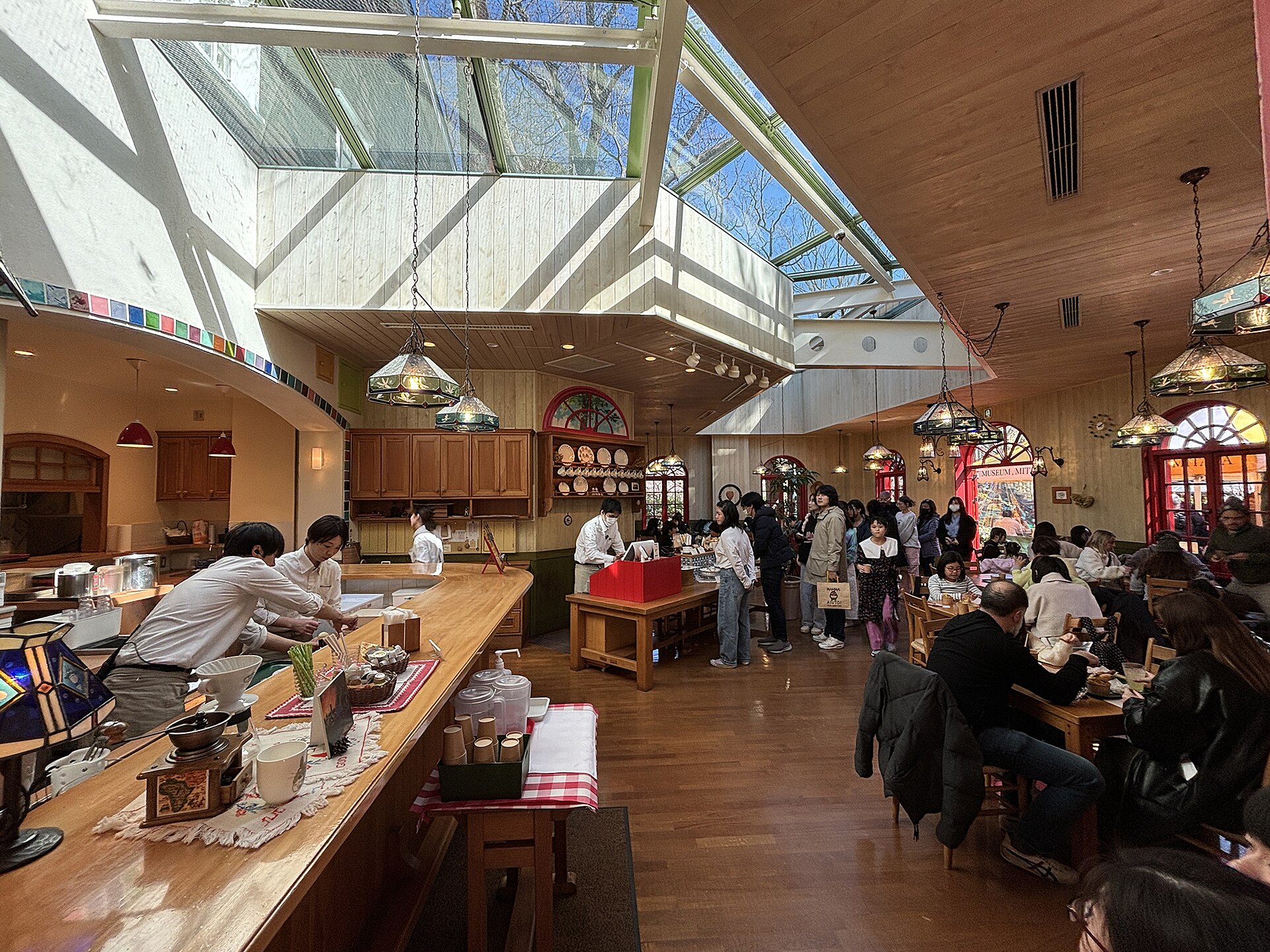
- The Straw Hat Cafe, a sit-down cafe inside the Museum serving home-style dishes and a house beer, 'Valley of the Wind'; queues form at busy times and seating is not guaranteed
- Shop
- Mamma Aiuto!, the Museum's own shop, sells merchandise made specifically for the Museum and not sold at other Ghibli retail outlets
Prices and hours change. We take them from the institution's own pages and print the day we read them, and you can check the current position at the source we used. Confirm before you travel.
What is inside
CC0 Entrance and Central Hall
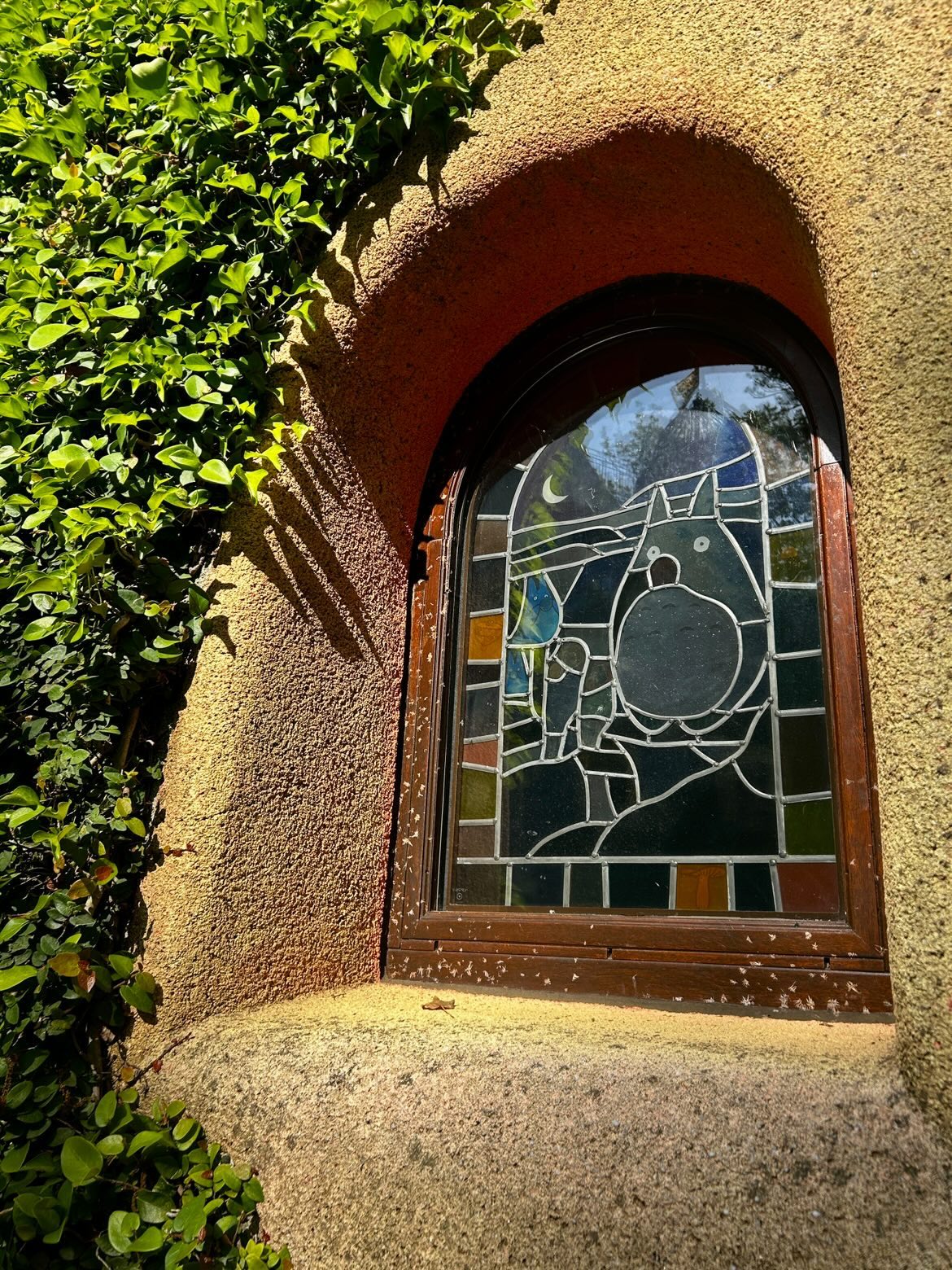
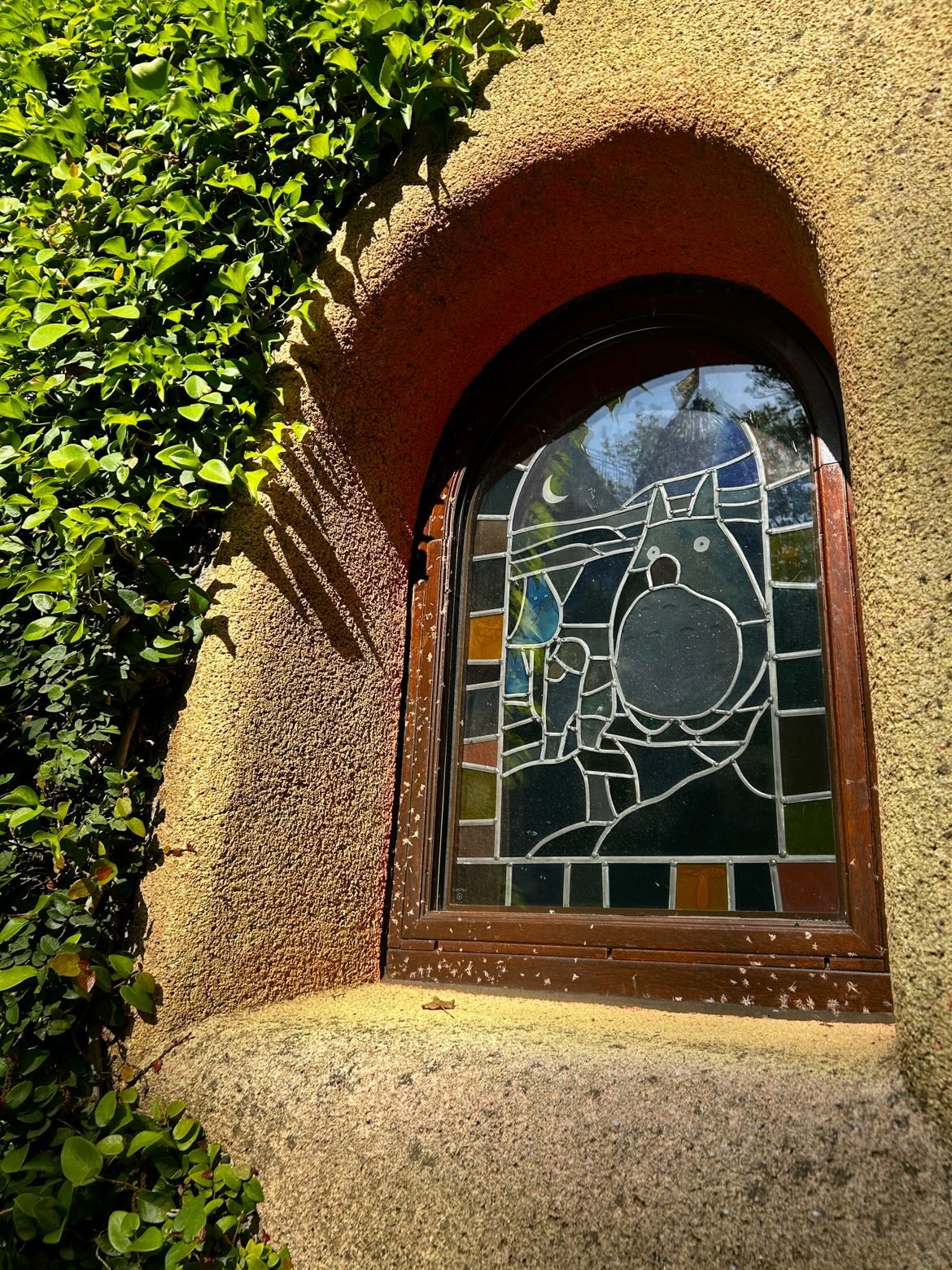
A hand-crafted stained-glass window of Totoro greets visitors at the entrance, where admission tickets are cut from actual frames of 35mm Studio Ghibli film. Inside, a single open well rises through the full height of the building, ringed by iron spiral staircases, bridges and balconies, with a giant model whale suspended in a glass dome and a large fan turning overhead - Miyazaki's intent was for the building itself to be walked through like one of his films.
First floor: Where a Film is Born
A permanent exhibit walking the animation process from first sketch to finished cel, built around 'A Boy's Room - A Gift from Grampa', a fictional animator's workspace filled with reference books, sketches and toys. A separate room traces the mechanics of animation itself, including a zoetrope-style display of figures from My Neighbor Totoro that appear to move under strobe light.
Saturn Theater (basement)
An 80-seat cinema, its ceiling painted with sky and flowers, that shows a rotating programme of short films made by Studio Ghibli exclusively for the Museum and never released commercially or online. A visitor sees one short per visit; the sky-motif shutters open to daylight once the screening ends.
Second floor: the Cat Bus room
A soft, child-scaled walk-in replica of the Catbus from My Neighbor Totoro, reserved for children aged 12 and under. Adults may watch but not enter.
Special exhibition gallery
A changing exhibition space that has run a different themed show roughly every year or two since the Museum opened, most recently 'The Studio of Yuriko Yamawaki' (from 19 November 2025), profiling one of Studio Ghibli's background artists.
Photograph by Kim Ahlström from Tokyo, Japan · CC BY 2.0 Rooftop garden
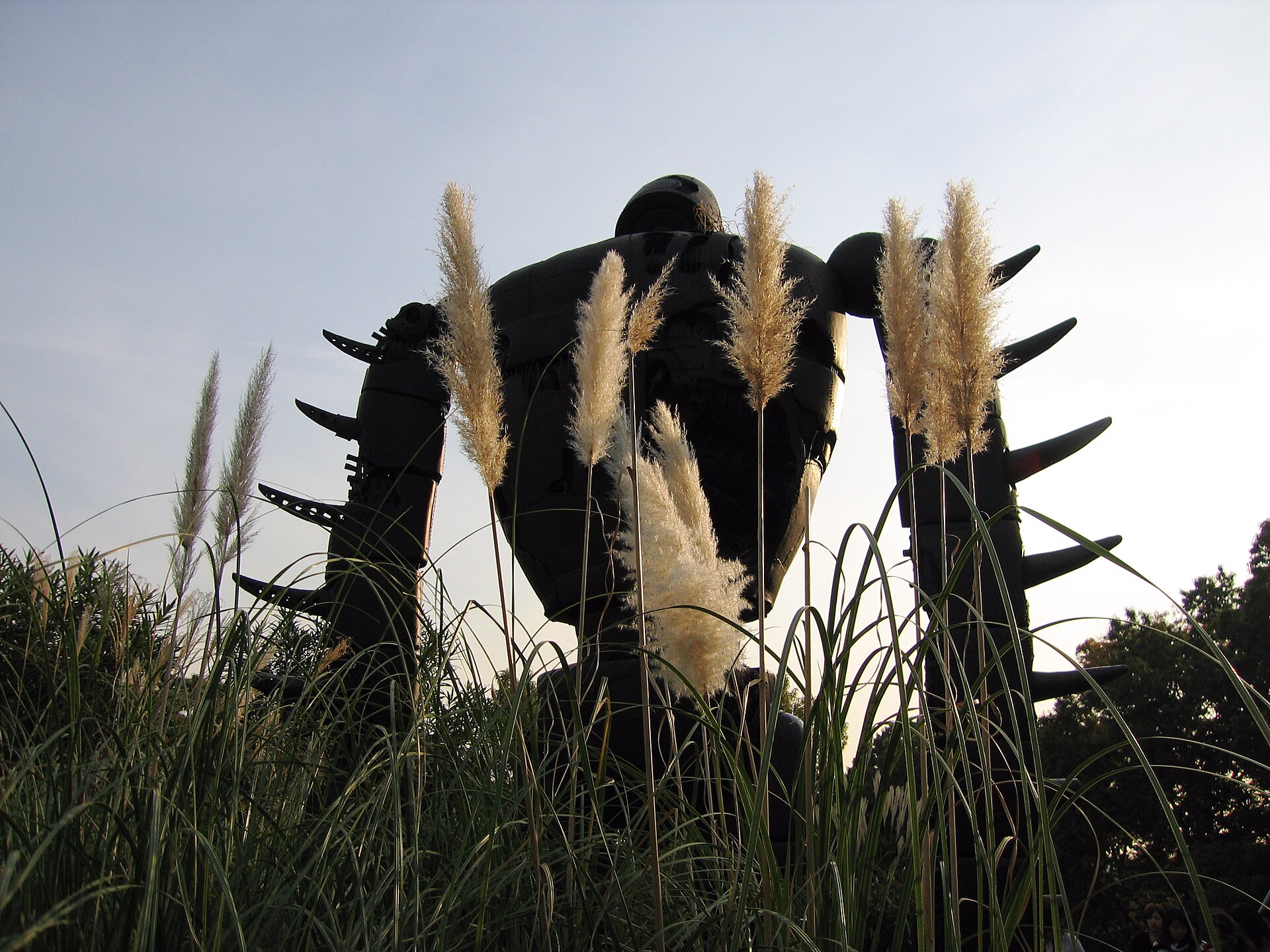
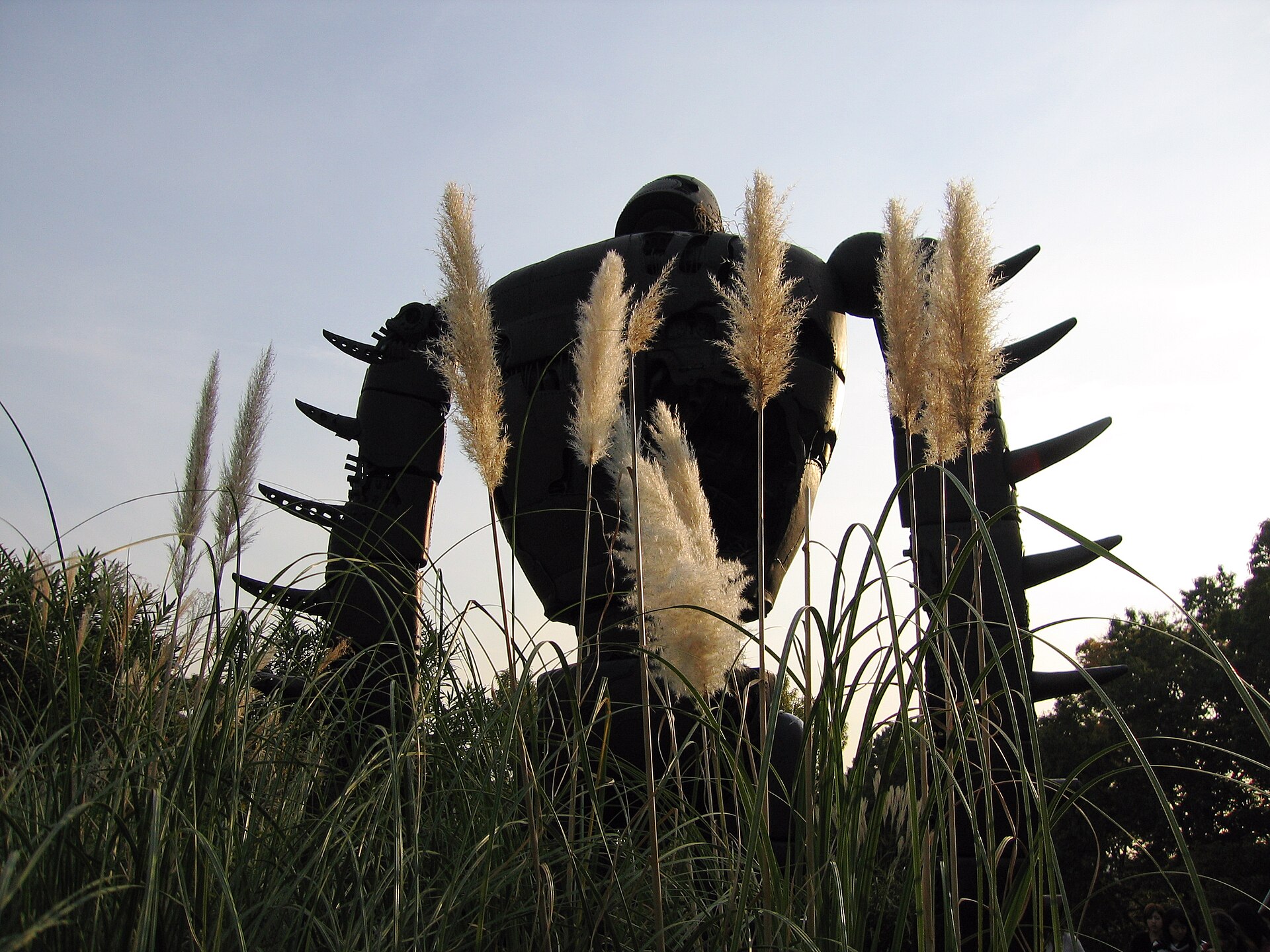
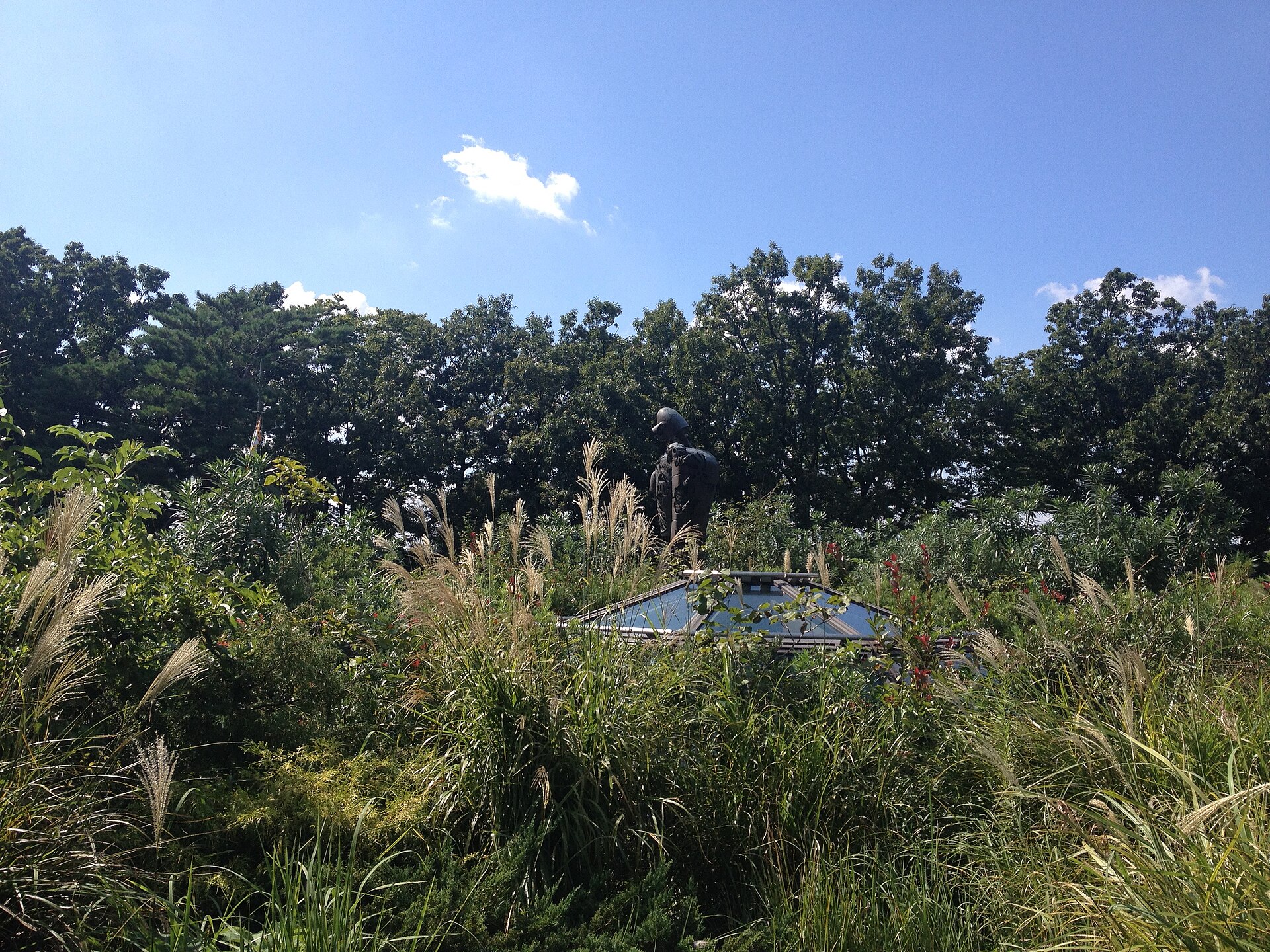
An open-air garden above the Museum, planted with grasses and shrubs, overlooking Inokashira Park. A five-metre bronze Robot Soldier from Laputa: Castle in the Sky stands among the planting - one of the Museum's most photographed features, and one of the very few spots inside the grounds where photography is actually allowed.
Photograph by Fotointheworld · CC BY 4.0 Straw Hat Cafe
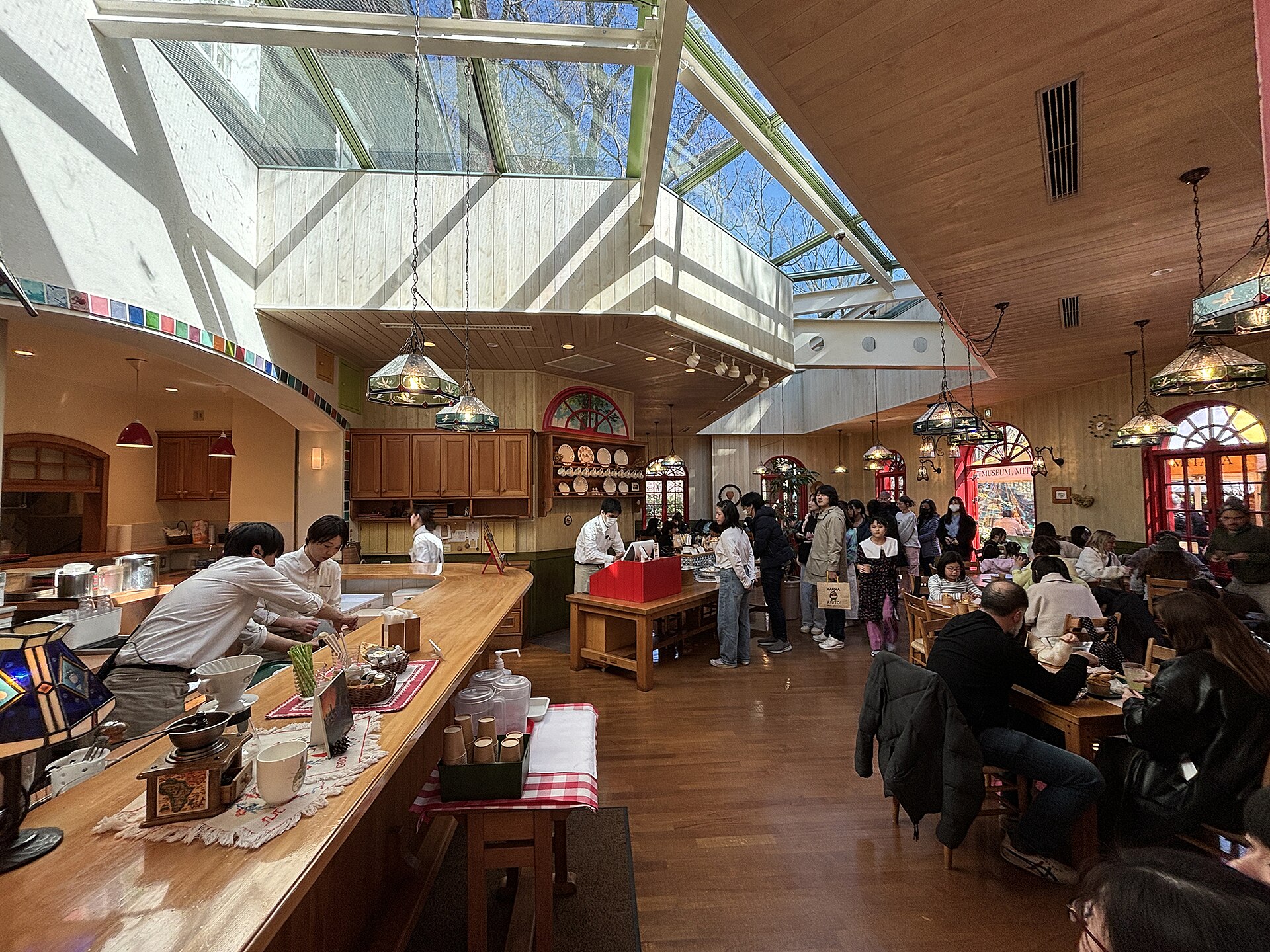
A sit-down cafe inside the Museum grounds serving home-style dishes, cake and a house beer called 'Valley of the Wind', decorated with the same stained-glass lamps and wood panelling as the rest of the building.
Mamma Aiuto! shop and Tri-Hawks reading room
The Museum's own shop sells merchandise made specifically for it and not stocked at other Studio Ghibli retail outlets. A small library and reading corner, the Tri-Hawks Loft, holds picture books that inspired Miyazaki, added the year after the Museum opened.
What to see first
The Robot Soldier of the rooftop garden
Studio GhibliA five-metre bronze figure of the Robot Soldier from Laputa: Castle in the Sky, standing in the planting on the roof - the single most photographed object connected to the Museum, precisely because it is outdoors and the no-photography rule does not reach it6
The Saturn Theater's exclusive short films
Studio GhibliAn 80-seat basement cinema screening short animated films made only for the Museum and never given a commercial or streaming release; the programme rotates every few weeks and a visitor sees exactly one film per visit5
The 35mm film-strip admission ticket
Studio GhibliEvery ticket is cut from an actual frame of 35mm film from a Ghibli production, so no two visitors are guaranteed to hold the same scene - a piece of the Museum's own design that visitors keep as a souvenir4
"Where a Film is Born"
Studio GhibliA first-floor exhibit built around a fictional animator's cluttered workspace, 'A Boy's Room - A Gift from Grampa', tracing the animation process from a first sketch to a finished cel4
The Central Hall
Hayao Miyazaki (design)A single open well running the full height of the building, with iron spiral staircases, bridges, a suspended model whale inside a glass dome and a large turning fan overhead - Miyazaki's own description was that the building should be walked through like a film4
The Cat Bus room
Studio GhibliA soft, walk-in, child-scaled replica of the Catbus from My Neighbor Totoro, open only to children aged 12 and under - one of very few museum exhibits anywhere designed to physically exclude adults5
The Totoro stained glass at the entrance
Studio Ghibli / Museum workshopA hand-made stained-glass window of Totoro set into the entrance facade, the first exhibit a visitor sees and one of the few interior-facing details a free-licence photograph can show, since it sits in a window recess open to the outside2
Straw Hat Cafe and its house beer
A working cafe inside the Museum grounds serving a beer brewed under the name of the fictional 'Valley of the Wind' from Nausicaa, alongside home-style food - reviewers single it out as one of the few sit-down, non-rushed spaces in a Museum built for wandering9
A building designed like a film, not a building that shows films
The Ghibli Museum, Mitaka opened on 1 October 2001 in Inokashira Park on the western edge of Tokyo, and its most unusual fact is who designed it: not an architectural firm working from a brief, but Hayao Miyazaki himself, using storyboards of the kind he draws for his own animated films. The building takes its cues from European village architecture Miyazaki admired, in particular the hill town of Calcata in Italy, filtered through the same hand that drew the floating castles and hillside towns in his films. Render onto concrete and stucco, the result is a low, curved structure half sunk into its own planted roof, with round windows, an arched entrance under a thatch-look canopy, and ivy climbing over walls that curve rather than meet at corners.
Miyazaki's own account of the brief, published on the Museum's own site, is unusually specific for an institution of this kind: he wanted 'a museum that is interesting and which relaxes the soul', built for people who came to enjoy themselves as much as to look at anything, with architecture that felt like a place one could be at home in rather than a hall built to impress. He explicitly rejected building something 'pretentious' or 'arrogant' - a museum organised around a permanent collection of static objects behind glass, prioritising the collection over the people looking at it. What went up instead is a building conceived, in his words, to be experienced 'as if it were a film', with real breeze and real sunlight built into the plan rather than climate-controlled out of it.
No fixed route, and a building meant to be walked through, not around
The Museum has no numbered galleries and no suggested order, a design choice stated on its own promotional material as 'Let's lose our way together'. A single open well - the Central Hall - runs the full height of the building, threaded with iron spiral staircases, bridges and balconies, a giant model whale suspended inside a glass dome, and a large fan turning slowly overhead. Coloured glass marbles are set into the ironwork throughout, catching light as visitors move past. It is less a lobby than the building's spine: nearly every room opens off it, and there is no requirement to see them in any particular sequence.
The first floor holds the closest thing the Museum has to a conventional exhibit: 'Where a Film is Born', which walks through how an animated film gets made, built around a fictional animator's workspace called 'A Boy's Room - A Gift from Grampa' - sketches, reference books and toys arranged as if someone had just stepped out. A second first-floor room is given over to the mechanics of animation itself, including a zoetrope-style display using figures from My Neighbor Totoro that appear to move under strobe lighting, a hands-on explanation of the illusion the rest of the Museum trades on.
The second floor holds the Museum's most famous concession to its youngest visitors: a soft, walk-in, child-scaled replica of the Catbus from My Neighbor Totoro, open only to children twelve and under. Adults may watch from outside it but not climb in - one of the few museum exhibits anywhere built to exclude adults on purpose rather than merely to bore them.
The Saturn Theater and the films that exist only here
In the basement sits the Saturn Theater, an eighty-seat cinema with a ceiling painted with sky and coloured flowers that opens to daylight once a screening ends. It shows short animated films Studio Ghibli makes specifically for this room and releases nowhere else - not in cinemas, not on any streaming service, not on home video. A visitor sees exactly one short per admission, on a programme that rotates every few weeks; as of September 2026 the current film is 'Mr. Dough and the Egg Princess', an eleven-and-a-half-minute piece set to Joe Hisaishi's arrangement of Vivaldi's La Folia, due to be followed in October by 'The Whale Hunt' and in November by 'Treasure Hunting'. Because these films are structurally unavailable anywhere else, the Saturn Theater functions less like an amenity than like a second, much smaller museum inside the Museum, one whose contents change on the studio's own schedule rather than a curator's.
The rooftop, the Robot Soldier, and the one place a camera is allowed
Photography and video recording are banned throughout the interior - the Museum states this plainly on its own visitor-information page, and it is the single most consistently reported rule in visitor accounts of the place. The exception is the roof. An open-air garden above the building, planted with ornamental grasses and shrubs and looking out over the treetops of Inokashira Park, is the one part of the grounds where cameras come out, and it is dominated by a five-metre bronze figure of the Robot Soldier from Laputa: Castle in the Sky, standing quietly in the planting as though it had grown there. Because it is outdoors, and because it is one of the very few pieces of the Museum a visitor is allowed to record, the Robot Soldier has become disproportionately the public face of the place online relative to everything the no-photography rule keeps out of circulation - including, notably, on Wikimedia Commons, where it and the rooftop garden around it account for a large share of the freely licensed photography of the Museum that exists at all.
Getting in: the ticket, not the building, is the hard part
Every admission is a dated, timed-entry ticket, and none are sold at the Museum itself. Tickets for a given month go on sale at exactly 10:00 Japan Standard Time on the 10th of the preceding month, through Lawson Ticket for buyers inside Japan and through an overseas agent (Studio Ghibli currently directs international buyers to JTB's Sunrise Tours channel) for buyers abroad. Demand consistently outstrips the small monthly allocation - the Museum seats and staffs for an intimate visit, not a high-throughput one - and popular dates and time slots are reported gone within minutes of release. Visitor accounts describe refreshing multiple devices at once, being placed thousands of places back in a queue, and losing a place in the checkout process to a payment timeout. Reselling a ticket is explicitly prohibited.
Once inside, the constraint eases: each ticket specifies only an entry window (typically a choice of four slots across the day), and there is no exit time or minimum stay - a visitor who gets in at the first slot may stay until closing if they choose to. Most visitors report spending two to three hours on site.
A permanent home, and a rotating one
Most of what a visitor encounters is effectively permanent: the Central Hall, 'Where a Film is Born', the Cat Bus room and the rooftop Robot Soldier have been fixtures since the Museum opened in 2001. Two elements are deliberately not: the Saturn Theater's short-film programme, on its own rolling schedule, and a special exhibition gallery that has hosted a changing themed show roughly every year or two, most recently 'The Studio of Yuriko Yamawaki', open from 19 November 2025 and profiling one of Studio Ghibli's background artists. Miyazaki's own stated reasoning for building in this kind of turnover was that a museum's exhibits going stale was a fate worth actively working against, not a natural consequence of running one for a long time.
The Museum's shop, Mamma Aiuto!, and its cafe, the Straw Hat Cafe, sit at ground level and are treated by the Museum's own design, and by most visitor accounts, as destinations in their own right rather than an exit corridor: the shop stocks merchandise made specifically for the Museum and not sold through other Studio Ghibli retail channels, and the cafe serves home-style food alongside a house beer named for the fictional Valley of the Wind from Nausicaa of the Valley of the Wind.
Version safety: this is Mitaka, not Ghibli Park
Studio Ghibli operates a second, much larger attraction under its name: Ghibli Park, an outdoor theme park in Nagakute, Aichi Prefecture, that opened in November 2022, more than two decades after the Mitaka Museum. The two are separately run, separately ticketed, and architecturally unrelated beyond sharing an owner and an aesthetic. Ghibli Park permits photography in most of its areas; the Ghibli Museum, Mitaka does not, anywhere indoors. This distinction matters for sourcing as much as for visiting: a number of images circulating under Commons categories nominally labelled for the Ghibli Museum in fact depict Ghibli Park's Grand Warehouse pavilion - a mislabelled 'Garden in the Sky' series showing multiple Robot Soldier figures in a garden-ruin setting was excluded from this record precisely because its own source page traces to Ghibli Park's website, not Mitaka's. Every image and every fact used here has been checked against that distinction and against the Museum's own site rather than against the Commons category label alone.
A museum that is also, quietly, a small publisher and a small library
Two facts sit slightly outside the building itself. The Museum operates the Tri-Hawks Loft, a small reading room and library corner stocked with the picture books and illustrated works Miyazaki has cited as influences, added the year after the Museum opened. And Studio Ghibli separately maintains a publishing arm tied to the Museum's name, the Ghibli Museum Library, which has released short animated works and books under the Museum's branding independent of what plays in the Saturn Theater on any given month. Neither function is why most visitors travel to Mitaka, but both are consistent with Miyazaki's stated view of the place as something closer to a small cultural institution that happens to have a building, rather than a building that happens to hold an institution.
What visitors say
Reviewers and visitors are consistent on two points that pull in opposite directions. Once inside, the Museum is very highly regarded - praised as intimate, inventive and unlike any other Studio Ghibli attraction, including its own larger cousin Ghibli Park in Aichi. Getting inside at all is the part that draws consistent complaint: the monthly ticket release is small, timed to the minute, and widely described as one of the hardest tickets to secure in Tokyo tourism, which colours a portion of the published reviews before a visitor has even walked in.
What is praised, what is criticised
- Praised: The Saturn Theater's short films, unique to the Museum and not available anywhere else
- Praised: The density of hand-made detail throughout the building - stained glass, ironwork, murals - that visitors say rewards deliberately having 'no set path'
- Praised: The rooftop garden and Robot Soldier statue as a genuine photo opportunity in a museum that otherwise bans photography
- Praised: Staff helpfulness, including spot English-language help with exhibits that are labelled only in Japanese
- Praised: The Straw Hat Cafe and the Mamma Aiuto shop, called out repeatedly as worth the extra time rather than a bolt-on
- Criticised: The ticket system itself: fixed to a single sale moment on the 10th of the preceding month, prone to selling out within minutes, and criticised in multiple reviews as harder to navigate than the museum experience it gates
- Criticised: All exhibit text is in Japanese only, which a number of overseas visitors report left them unable to read the captions on display
- Criticised: The gift shop is repeatedly called expensive relative to the rest of the visit
- Criticised: A recurring minority view that the Museum, at two to three hours and a fixed entry fee, does not match the difficulty of getting a ticket for it
Ratings on other platforms
Tripadvisor: 4.3 from 1,995 ratings, read 7 September 2026
Japan Guide: 4.4 from 1,022 ratings, read 7 September 2026
A platform average is a tertiary source: it moves, it is not audited, and we quote no visitor's words.
Questions about Ghibli Museum
Where is Ghibli Museum?
1-1-83 Shimorenjaku, Mitaka, Tokyo 181-0013, Japan.
How much does it cost to visit?
Ages 19 and over: JPY 1000; Ages 13-18: JPY 700; Ages 7-12: JPY 400; Ages 4-6: JPY 100; Ages 3 and under: free. As confirmed 7 September 2026.
When is it open?
Wed-Mon (see closed days) 10:00-18:00. Closed: Every Tuesday, as the standing weekly closure. Exception: on a Tuesday that is a Japanese national holiday, Mitaka Citizens' Day, or similar, the Museum opens instead and closes on a different weekday that week - the exact swap is only fixed a few months out on the official opening calendar. As confirmed 7 September 2026.
How do you get there?
Train: JR Chuo Line to Mitaka Station, about 20 minutes from Shinjuku; the Museum is a 15-minute walk from the station's south exit; Bus: A community minibus runs from JR Mitaka Station to the Museum every 15 minutes during opening hours; 230 yen for an adult (cash or IC card), 120 yen cash or 50 yen IC card for a child aged 7-12.
What should you see first?
The Robot Soldier of the rooftop garden (Studio Ghibli); The Saturn Theater's exclusive short films (Studio Ghibli); The 35mm film-strip admission ticket (Studio Ghibli); "Where a Film is Born" (Studio Ghibli); The Central Hall (Hayao Miyazaki (design)); The Cat Bus room (Studio Ghibli).
What we could not confirm
- The Museum does not publish annual visitor-number or revenue figures on its own site, and none were located from a primary source for this record.
- No free-licence photograph of the Saturn Theater, the Cat Bus room, or 'Where a Film is Born' was located on Wikimedia Commons at the time of this research, consistent with the Museum's interior no-photography rule; the record carries no image for those spaces rather than substitute one from elsewhere.
- Coverage from major English-language newspapers or broadcasters (for example a dedicated feature in the Guardian, the New York Times, the Japan Times or on CNN Travel) was searched for but not located; the named review used here is from Tokyo Cheapo, a Tokyo-focused travel publication, rather than a national newspaper.
Images
Sources
- 1Ghibli Museum, Mitaka - official site, English section, home page ghibli-museum.jp/en/
- 2Ghibli Museum, Mitaka - official site, Hours and Directions ghibli-museum.jp/en/hours-and-directions/
- 3Ghibli Museum, Mitaka - official site, Tickets ghibli-museum.jp/en/tickets/
- 4Ghibli Museum, Mitaka - official site, Welcome (floor guide) ghibli-museum.jp/en/welcome/
- 5Ghibli Museum, Mitaka - official site, Films (Saturn Theater schedule) ghibli-museum.jp/en/films/
- 6Ghibli Museum, Mitaka - official site, 'This Kind of Museum' (Miyazaki's design statement) ghibli-museum.jp/en/kind/
- 7Ghibli Museum, Mitaka - official site, Visitor information (rules, accessibility, phone) ghibli-museum.jp/info/
- 8Lawson Ticket - Ghibli Museum, Mitaka opening calendar (closed days, maintenance and New Year closures, phone) l-tike.com/info/ghibli/
- 9Tokyo Cheapo, 'Ghibli Museum: Tickets, What to Expect, How to Get There', by Maria Danuco tokyocheapo.com/entertainment/museums-and-exhibitions/lose-your-way-at-the-ghibli-museum/
- 10Tripadvisor - Ghibli Museum, Mitaka (aggregate rating and reviews, Travelers' Choice 2026) tripadvisor.com/Attraction_Review-g1060901-d581684-Reviews-Ghibli_Museum_Mitaka-Mitaka_Tokyo_Prefecture_Kanto.html
- 11Japan Guide - Ghibli Museum review and visitor rating japan-guide.com/e/e3041.html
- 12Wikipedia, 'Ghibli Museum' (, background and opening date cross-check) en.wikipedia.org/wiki/Ghibli_Museum
- 13Ghibli Museum, Mitaka - official site, Notice page (closure and reopening notices) ghibli-museum.jp/en/notice/