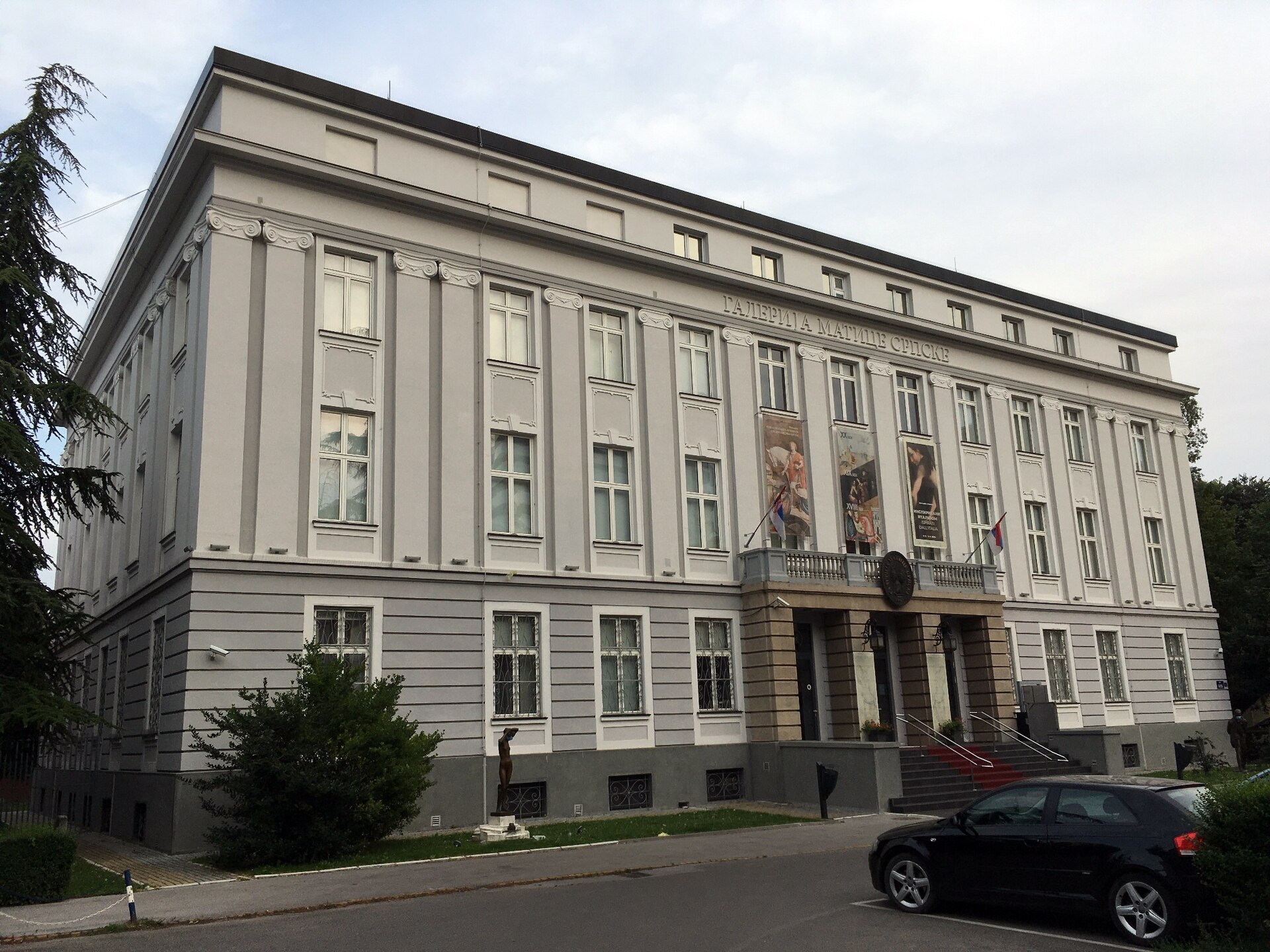
The gallery's main facade on Trg galerija, Novi Sad, with its name inscribed above the columned entrance bay.
Sadko, CC BY-SA 4.0Gallery of Matica Srpska
Museum · Galerija Matice srpske · Founded 1847
Open, admission and hours confirmed 5 September 2026 · 19 sources
On this page 14 sections
ContentsClose
The gallery's strength is depth in a single national tradition rather than breadth across periods or geographies: eighteenth-century Vojvodina icon painting, the nineteenth-century portrait and history-painting generation of Radonic, Predic and Jovanovic, and a twentieth-century run that includes Sumanovic's interwar French period and Lubarda's post-war modernism, all drawn from a collection built substantially on named donor bequests since Sava Tekelija's founding gift.
| Local name | Galerija Matice srpske |
|---|---|
| Kind | Museum |
| Founded | 1847 |
| City and country |  Novi Sad, Serbia Novi Sad, Serbia |
| Address | Trg galerija 1, 21101 Novi Sad, Serbia |
| Website | galerijamaticesrpske.rs |
| Status | Open, confirmed |
| Record last verified |
Visiting
- Hours
- Tue-Thu10:00 to 20:00
- Fri10:00 to 22:00
- Sat-Sun10:00 to 18:00
- Closed
- Monday. 1 and 7 January. 1 and 2 May. Easter holidays (dates vary by year).
- Admission
- RegularRSD 400Standard adult ticket
- DiscountedRSD 200Students and visitors 60 and over
- FamilyRSD 800Three or more family members visiting together
- Group, unguidedRSD 200Per person
- School group with guideRSD 200Per pupil
- Group with guide, Serbian or EnglishRSD 400Per person
- Guided tour supplementRSD 1,200Added to the entry ticket
- Children's Saturday workshopRSD 200Per child
- Annual passRSD 1,999Unlimited entry for one year
- Under 18FreeFree
Free entry: Fridays, for individual visits. Tuesdays, for parents visiting with infants- Tickets
- galerijamaticesrpske.rs/informacije The museum's own ticket page.
- Do I need to book?
- No for individual visits; groups and guided tours are booked in advance through the gallery
- Address
- Trg galerija 1, 21101 Novi Sad, Serbia MapBus City lines 1, 3, 4, 6, 8, 12, 14, 15, 69 and 70 serve the surrounding streets
Bicycle Free bicycle parking at the building
Car Paid on-street parking in the blue and red zones nearby - Website
- galerijamaticesrpske.rs
- Telephone
- +381 21 48 99 000
- [email protected]
Before you go how long, access, photography, bags, eating, shop
- How long to allow
- One to two hours for the permanent exhibition, based on visitor accounts; several reviewers note it can be seen without museum fatigue
- Access
- External lift and ramp at the entrance, an internal lift to the second floor, a wheelchair-accessible restroom, accessible parking, and a sign-language app for deaf visitors
- Photography
- Permitted throughout the permanent exhibition without flash
- Bags
- Not stated on the gallery's own visitor page
- Eating
- Not stated on the gallery's own visitor page
- Shop
- A museum shop selling art books and postcards, mentioned favourably by several visitors
Prices and hours change. We take them from the institution's own pages and print the day we read them, and you can check the current position at the source we used. Confirm before you travel.
What is inside
Identity of Collection
The opening section of the permanent exhibition, built around the gallery's own institutional biography: the benefactors and donors whose gifts and bequests, from Sava Tekelija onward, formed the collection room by room.
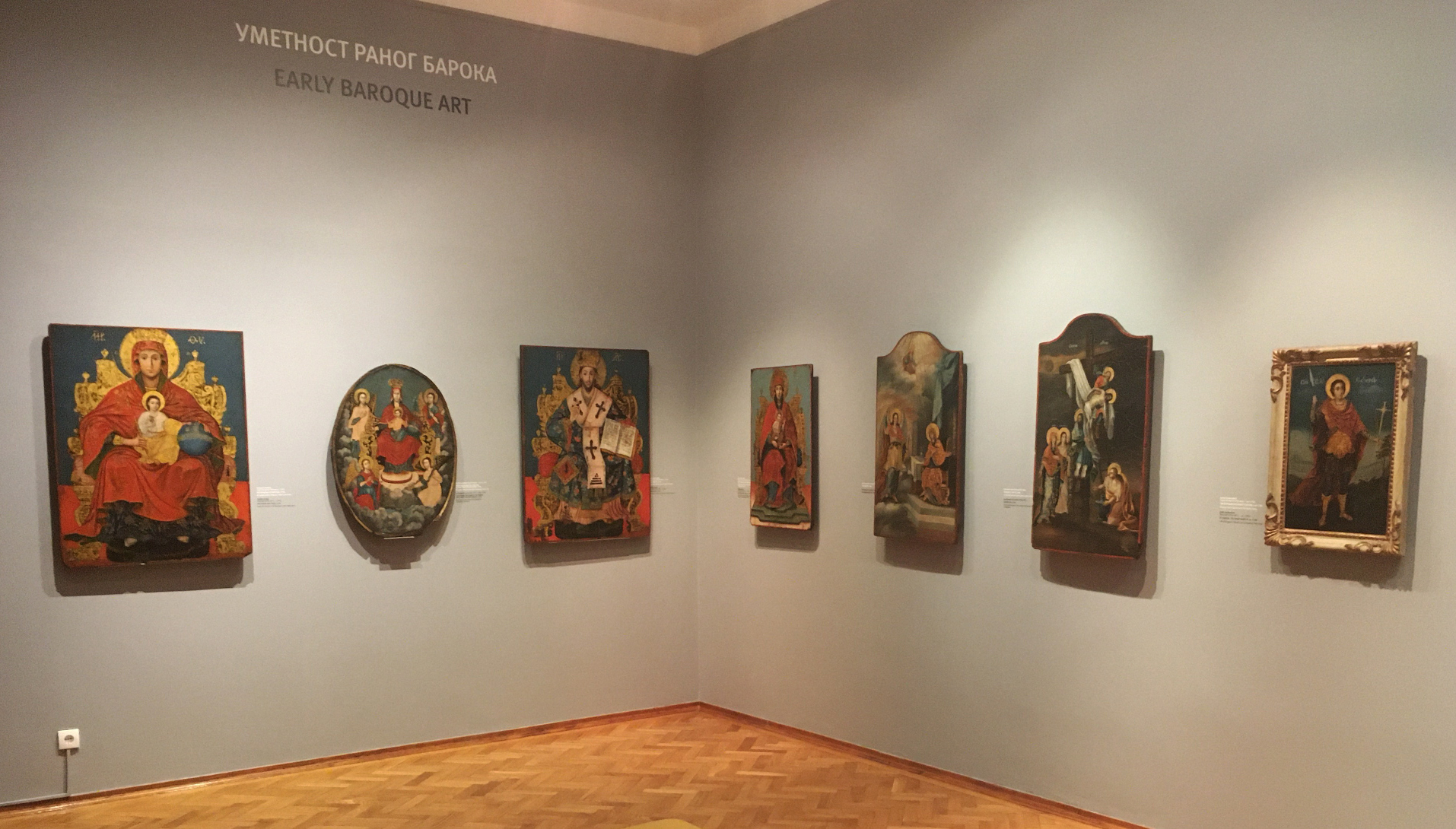
Photograph by Sadko · CC BY-SA 4.0 Chronology of Serbian Art
The core historical run of the collection, tracing Serbian painting and icon art across three centuries from the early Baroque church workshops through nineteenth-century portraiture. One bay is headed, in the gallery's own wall text, Early Baroque Art.
Transformability of Art
A section built around formal elements of painting, colour, line and form, used to show how the same visual vocabulary was reworked across different periods in the collection.
Children's Room
An interactive, family-oriented room using the collection to present the history of childhood in visual art.
Sculptofillia
The gallery's dedicated sculpture room, drawing on its holdings of Serbian sculpture across the same historical span as the paintings.
Refuges: Man and Environment
Domestic interiors and landscape painting, grouped around how the collection depicts shelter and the natural environment.
Taboo: Body and Mind
Works engaging the nude, death and identity, drawn from across the collection and read through a contemporary lens.
Pleasure: Rituals and Habits
Everyday life in the collection: dress, dining and daily ritual as painted subjects from the eighteenth century to the present.
What to see first
The Wounded Montenegrin (Ranjeni Crnogorac)
Paja JovanovicJovanovic's best-known Orientalist canvas, painted in 1882 while he was a student at the Vienna Academy; it took first place in the Academy's annual student exhibition that year and led directly to an Austro-Hungarian government scholarship and, in 1883, a contract with Ernest Gambart's gallery in London for a series of Balkan subjects. Jovanovic painted four versions in total; this, the first and largest, passed through a Vienna dealer and a Budapest casino before the Yugoslav embassy in Budapest, which had held it since the Second World War, gave it to the gallery in 1971.19
Proclamation of Dusan's Code (Proglasenje Dusanovog zakonika)
Paja JovanovicA history painting of the medieval Serbian emperor's law code, painted around 1930 and hung in the gallery's nineteenth-century Serbian art rooms despite its later date; the gallery's own catalogue records it at 125.5 by 189 centimetres, oil on canvas, inventory number GMSU 2476.11
Girl in Blue (The Girl from Morava) (Devojka u plavom (Moravkinja))
Uros PredicA small, tightly worked 1879 portrait head, 51 by 41 centimetres, from Predic's early career; it hangs in the gallery's nineteenth-century rooms alongside his other genre portraits and is one of the works visitors most often single out.12
Girl with a Canary (Devojka sa kanarincem)
Novak RadonicAn 1858 portrait, oil on canvas, 86 by 72 centimetres, by one of the founding generation of nineteenth-century Serbian painters whose work anchors the gallery's earliest secular portrait holdings.15
The Beach (Plaza)
Sava SumanovicA 1929 oil on canvas, 129 by 194 centimetres, from the roughly fifty works by Sumanovic that the gallery holds, spanning his French-influenced interwar period; it is shown in the twentieth-century Serbian art rooms.13
Durmitor
Petar LubardaA 1950 landscape, oil on canvas, 97 by 116 centimetres, by one of the leading Yugoslav modernists of the mid-twentieth century, representing the gallery's move into post-war Serbian painting.14
The Battle of Kosovo (Kosovski boj)
Petar LubardaA large 1953 history subject, oil on canvas, 142.5 by 190 centimetres, reworking the Kosovo legend in Lubarda's post-war modernist idiom rather than the academic manner of the gallery's nineteenth-century history paintings.14
A collection born from a bequest
The gallery traces its founding to a single act of philanthropy. Sava Tekelija, a wealthy Serbian benefactor and the first lifetime president of Matica Srpska, bequeathed his fortune and a collection of family portraits to the society in 1840. Matica Srpska itself, founded in 1826 in Pest, was already the oldest Serbian cultural, literary and scientific society, but it held no art collection of its own until Tekelija's gift gave it one. Teodor Pavlovic proposed turning the gift into a formal Serbian National Collection at a Matica Srpska board meeting, and the museum was established on 14 October 1847, in Pest, under that name.
The collection travelled with its parent society. When Matica Srpska relocated from Pest to Novi Sad in 1864, its art holdings moved too, though the collection was not put on public display until 1933. The decisive institutional break came after the Second World War: in 1947 the art collection was given independent status under the name Gallery of Matica Srpska, separated from the society's other holdings, which were transferred to the newly founded Museum of Vojvodina. The two institutions share a common root in Matica Srpska's nineteenth-century collecting but have been separate museums, with separate collections, since that division, and neither should be confused with the Museum of Contemporary Art of Vojvodina, a distinct and later institution also based in Novi Sad.
From grain exchange to gallery
The building the gallery occupies today was not built as a museum. It went up in 1926 and 1927 in central Novi Sad as a Product Exchange, a trading hall for grain and other agricultural commodities, in the classicising civic style common to interwar Yugoslav commercial architecture. The gallery moved into the building in 1958, opening its first permanent installation of eighteenth- and nineteenth-century Serbian art there the same year. The building was declared a Monument of Culture of Great Importance in 1979, recognising its architectural standing independently of its later use.
The gallery has altered the building twice since. A second floor was added in 1992 specifically to give early twentieth-century Serbian art its own dedicated rooms, separating it from the eighteenth- and nineteenth-century material on the ground floor. A more thorough renovation between 2006 and 2009 modernised the interior and exhibition infrastructure, and the exterior facade was restored to completion in 2017. The result, visible in the gallery's own street-facing exterior today, is a former banking-and-trading hall whose Ionic pilasters and raised entrance portico now frame temporary-exhibition banners rather than commodity prices.
What is inside
The current permanent exhibition, titled by the gallery Revision of the Gallery of Matica Srpska Collection, is organised into eight thematic rooms rather than a single chronological run. Identity of Collection opens the sequence with the gallery's own institutional history, told through its donors. Chronology of Serbian Art carries the historical backbone, from early Baroque icon painting and painted royal doors from eighteenth-century Vojvodina church workshops through to nineteenth-century portraiture; one bay is headed, in the gallery's own wall text, Early Baroque Art. Transformability of Art groups works by formal concerns, colour, line and form, across periods rather than by date. A Children's Room presents the history of childhood in visual art for family visitors, and Sculptofillia is the gallery's dedicated sculpture room.
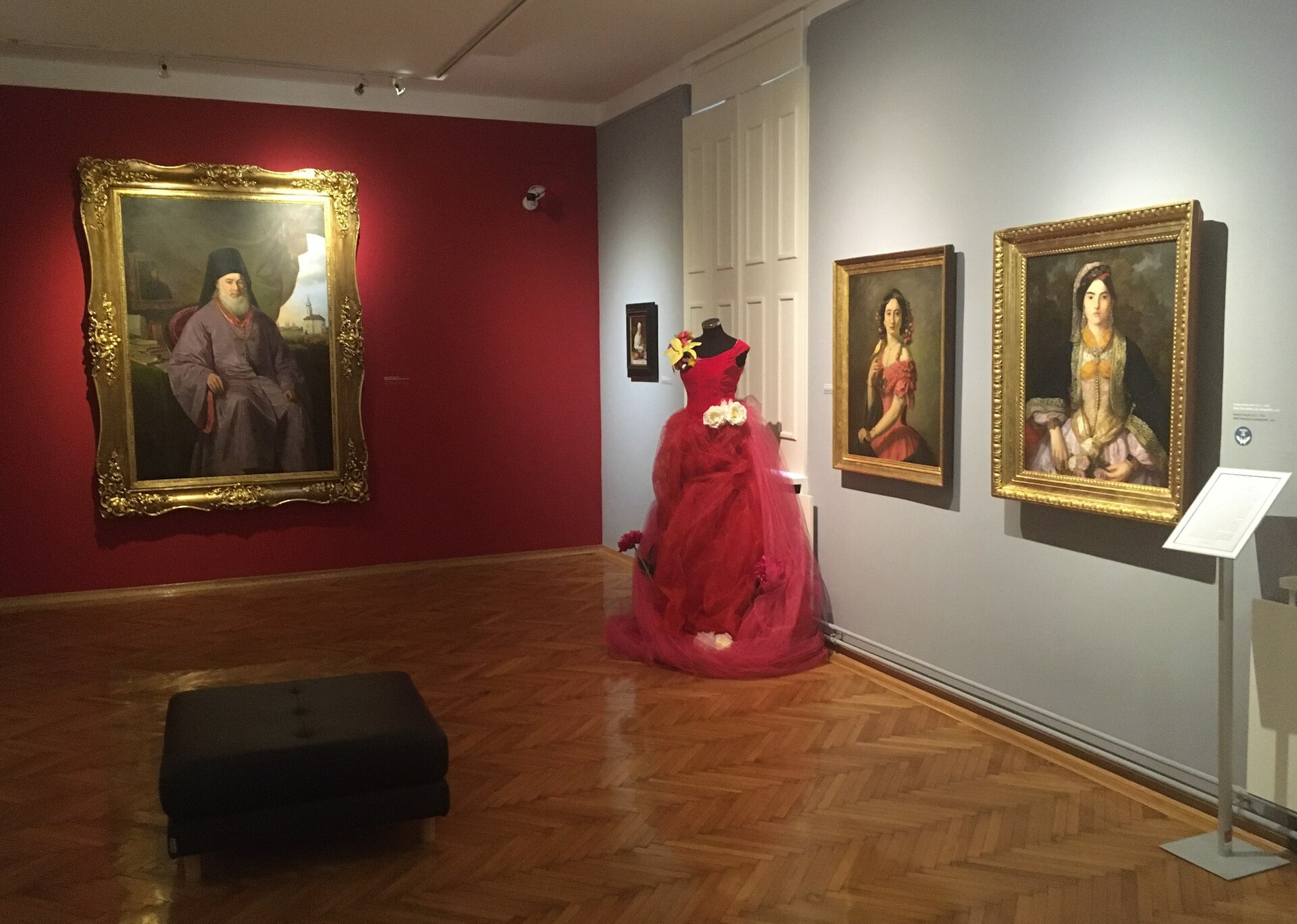
The remaining three rooms read the collection thematically rather than historically. Refuges: Man and Environment gathers domestic interiors and landscape painting. Taboo: Body and Mind groups works engaging the nude, death and identity, read through a contemporary lens rather than the moralising terms in which some of the older works were originally painted. Pleasure: Rituals and Habits closes the sequence with dress, dining and everyday ritual as painted subjects, from eighteenth-century portrait costume to twentieth-century genre scenes. The arrangement means a single room can hold an eighteenth-century icon and a twentieth-century canvas side by side, grouped by subject rather than by century.
The paintings that carry the collection
Paja Jovanovic's Wounded Montenegrin is the gallery's best-documented single object. Jovanovic painted it in 1882 while a student at the Vienna Academy, and its first showing, at the Academy's annual student exhibition, won first place and an Austro-Hungarian government scholarship; the following year he signed a contract with Ernest Gambart's London gallery for a series of Balkan subjects, launching his international career. The gallery's picture is the first and largest of four versions Jovanovic eventually painted. It was sold to a Vienna dealer within months of that first showing, resold to a Budapest casino, and passed through the Yugoslav embassy in Budapest after the Second World War before the embassy gave it to the gallery in 1971. The other three versions are split between private collections and the Museum of Yugoslavia in Belgrade. Jovanovic is also represented by a later history painting, the Proclamation of Dusan's Code, painted around 1930 and hung, despite its date, among the nineteenth-century rooms because of its medieval subject.
The nineteenth-century holdings continue with Uros Predic's Girl in Blue, a small 1879 portrait head widely singled out by visitors, and Novak Radonic's 1858 Girl with a Canary, from the generation of painters who established secular portraiture in Serbian art before Predic and Jovanovic. The twentieth-century rooms hold about fifty works by Sava Sumanovic, including his 1929 canvas The Beach, from the French-influenced interwar period of his career, and two large works by the modernist Petar Lubarda, the 1950 landscape Durmitor and the 1953 history subject The Battle of Kosovo, which reworks a legend the nineteenth-century painters treated academically in a far more gestural, post-war idiom.
Recognition and numbers
The gallery's own historical account credits it with Serbia's Vuk Karadzic Order, First Class, and with the ZIVA award for best Balkan museum in 2014. It marked its 175th anniversary in October 2022, dating itself from the 1847 Pest founding rather than the later 1947 or 1958 milestones. In 2023 its programmes and exhibitions drew roughly 100,000 visitors, on the gallery's own figures.
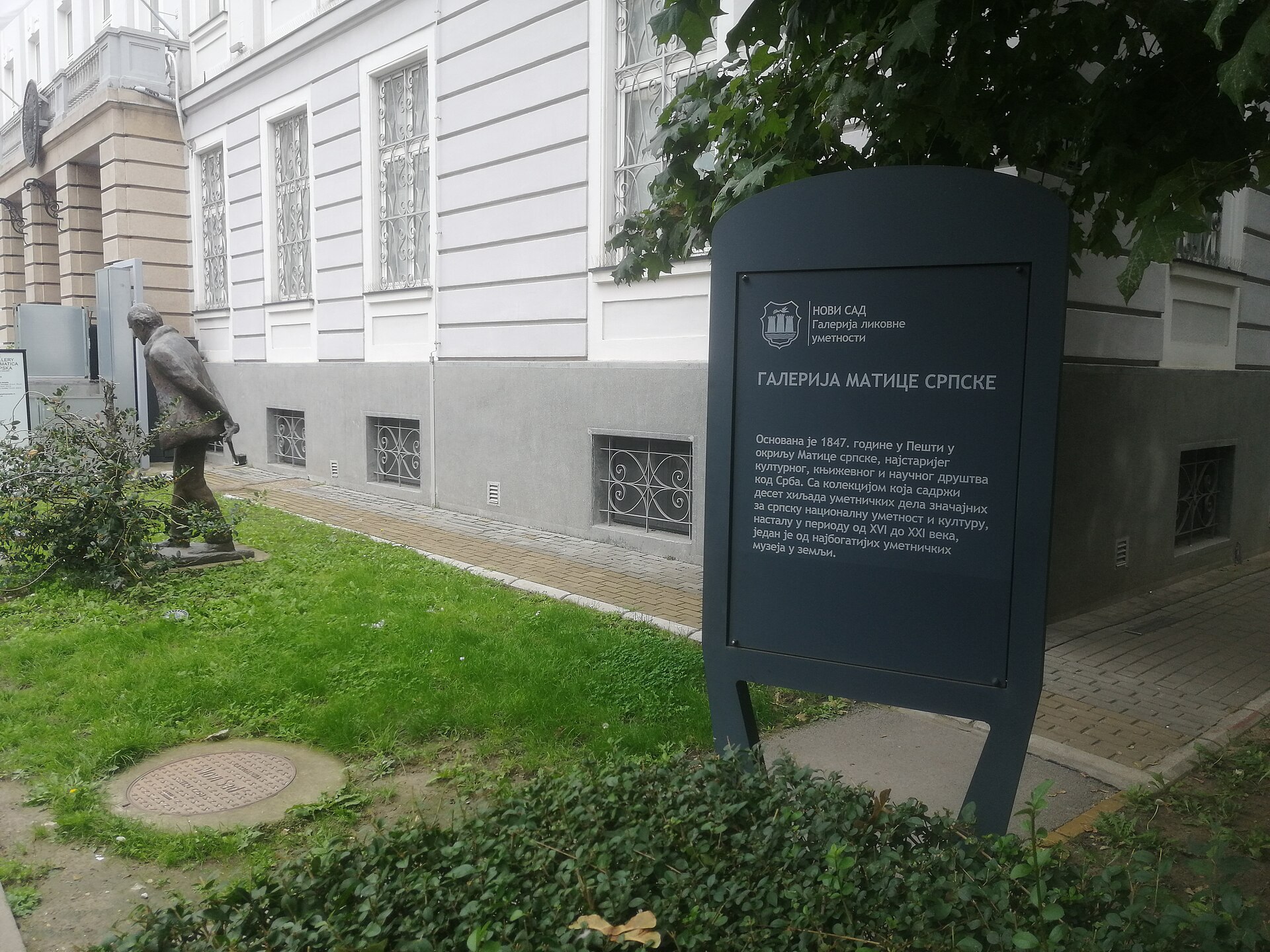
The gallery's published accounts of its own size do not agree with each other. One current page states the collection holds more than 7,000 paintings; another states 12,000 artworks across sixteen sub-collections, spanning the late sixteenth to the twenty-first century; the heritage information panel on the building's own exterior wall states ten thousand works of art, dating the collection from the sixteenth to the twenty-first century. This record does not attempt to resolve which figure is current, since all three come from the institution itself and the discrepancy most likely reflects different counting conventions, paintings alone against the full inventory of drawings, prints, sculpture and applied art.
Visiting today
The gallery is open Tuesday to Sunday, closed Monday, with the longest hours on Friday, when it also waives the entrance fee for individual visitors. A standard adult ticket is 400 dinars, with a discounted 200-dinar rate for students and visitors 60 and over, a family rate for three or more visitors together, and separate group rates depending on language and whether a guide is booked. Entry is free for everyone under 18, for parents visiting with infants on Tuesdays, and for members of the gallery's own Friends Club, ICOM, the Serbian Museum Society and accredited press. The building has an external lift and ramp at the entrance, an internal lift to the second floor, an accessible restroom and parking, and a sign-language app for deaf visitors. Photography without flash is permitted throughout the permanent exhibition.
Visitor accounts on Google and TripAdvisor, both averaging 4.8 out of 5, describe a gallery that rewards an hour or two rather than a full day, with bilingual wall text that visitors repeatedly credit for making an unfamiliar national art history legible on a first visit. The most common practical complaint is not about the collection but about finding the building itself, tucked back from the surrounding streets with, by one account, too few directional signs.
What visitors say
Visitors consistently describe being surprised by the depth of a collection they did not expect to find in Novi Sad, praise the manageable size of the permanent exhibition and the bilingual Serbian and English wall text, and rate the gallery highly on both major review platforms. The most repeated friction point is not the museum itself but finding it, since the building sits back from the street with limited signage.
What is praised, what is criticised
- Praised: Bilingual (Serbian and English) wall text that sets the collection in a wider art-historical context
- Praised: A collection that can be seen thoroughly in one to two hours without museum fatigue, unlike larger national museums
- Praised: Low admission price and a Friday free-entry policy that visitors call out specifically
- Praised: Helpful, friendly ticket and gallery staff
- Praised: Strength of the nineteenth-century portrait and icon holdings, with Jovanovic's Wounded Montenegrin and Predic's portraits named repeatedly as favourites
- Criticised: The building is physically hard to find from the surrounding streets; one reviewer specifically asked for better road signage
- Criticised: At least one visitor rated the collection as narrower in scope than Serbia's National Museum in Belgrade, describing it as a worthwhile but secondary stop
Ratings on other platforms
Google: 4.8 from 698 ratings, read 5 September 2026
TripAdvisor: 4.8 from 32 ratings, read 5 September 2026
A platform average is a tertiary source: it moves, it is not audited, and we quote no visitor's words.
Questions about Gallery of Matica Srpska
Where is Gallery of Matica Srpska?
Trg galerija 1, 21101 Novi Sad, Serbia.
How much does it cost to visit?
Regular: RSD 400; Discounted: RSD 200; Family: RSD 800; Group, unguided: RSD 200; School group with guide: RSD 200. As confirmed 5 September 2026.
When is it open?
Tue-Thu 10:00-20:00; Fri 10:00-22:00; Sat-Sun 10:00-18:00. Closed: Monday. 1 and 7 January. As confirmed 5 September 2026.
How do you get there?
Bus: City lines 1, 3, 4, 6, 8, 12, 14, 15, 69 and 70 serve the surrounding streets; Bicycle: Free bicycle parking at the building; Car: Paid on-street parking in the blue and red zones nearby.
What should you see first?
The Wounded Montenegrin (Ranjeni Crnogorac) (Paja Jovanovic); Proclamation of Dusan's Code (Proglasenje Dusanovog zakonika) (Paja Jovanovic); Girl in Blue (The Girl from Morava) (Devojka u plavom (Moravkinja)) (Uros Predic); Girl with a Canary (Devojka sa kanarincem) (Novak Radonic); The Beach (Plaza) (Sava Sumanovic); Durmitor (Petar Lubarda).
What we could not confirm
- The gallery's own published sources give three different figures for the collection's total size (7,000 paintings, 12,000 items in sixteen sub-collections, and ten thousand works on its own exterior heritage panel); this record does not resolve which is current.
- No source consulted for this record addresses the collection's history during the Second World War or under post-war nationalisation beyond the 1947 separation from Matica Srpska's other holdings; a fuller institutional history would need to establish what happened to the collection, if anything, between 1941 and 1947.
Images
Sources
- 1Galerija Matice srpske, official website, home page galerijamaticesrpske.rs/
- 2Galerija Matice srpske, Informacije (hours, tickets, accessibility, directions) galerijamaticesrpske.rs/informacije/
- 3Galerija Matice srpske, Galerija kroz vreme (institutional history) galerijamaticesrpske.rs/galerija-kroz-vreme/
- 4Galerija Matice srpske, O kolekciji (about the collection) galerijamaticesrpske.rs/o-kolekciji/
- 5Galerija Matice srpske, Stalna postavka GMS (permanent exhibition) galerijamaticesrpske.rs/stalna-postavka-gms/
- 6Wikipedia, Gallery of Matica srpska () en.wikipedia.org/wiki/Gallery_of_Matica_srpska
- 7Wikipedia (Serbian), Galerija Matice srpske () sr.wikipedia.org/wiki/%D0%93%D0%B0%D0%BB%D0%B5%D1%80%D0%B8%D1%98%D0%B0_%D0%9C%D0%B0%D1%82%D0%B8%D1%86%D0%B5_%D1%81%D1%80%D0%BF%D1%81%D0%BA%D0%B5
- 8TripAdvisor, The Gallery of Matica Srpska, reviews and rating tripadvisor.ie/Attraction_Review-g295380-d6701039-Reviews-The_Gallery_of_Matica_srpska-Novi_Sad_Vojvodina.html
- 9Google Search knowledge panel, The Gallery of Matica Srpska (rating and review count, ) google.com/search?q=%22Galerija+Matice+srpske%22+google+reviews
- 10Galerija Matice srpske collection database, Ranjeni Crnogorac, Jovanovic Pavle Paja galerijamaticesrpske.rs/kolekcija/jovanovic-pavle-paja-ranjeni-crnogorac/
- 11Galerija Matice srpske collection database, Proglasenje Dusanovog zakonika, Jovanovic galerijamaticesrpske.rs/kolekcija/jovanovic-paja-proglasenje-dusanovog-zakonika/
- 12Galerija Matice srpske collection database, Devojka u plavom (Moravkinja), Predic Uros galerijamaticesrpske.rs/kolekcija/predic-uros-devojka-u-plavom/
- 13Galerija Matice srpske collection database, Sumanovic Sava (author page) galerijamaticesrpske.rs/autori/sumanovic-sava/
- 14Galerija Matice srpske collection database, Lubarda Petar (author page) galerijamaticesrpske.rs/autori/lubarda-petar/
- 15Galerija Matice srpske collection database, Radonic Novak (author page) galerijamaticesrpske.rs/autori/radonic-novak/
- 16Wikimedia Commons, File:Gallery of Matica Srpska building.jpg (licence and description) commons.wikimedia.org/wiki/File:Gallery_of_Matica_Srpska_building.jpg
- 17Wikimedia Commons, Category:The Gallery of Matica Srpska building commons.wikimedia.org/wiki/Category:The_Gallery_of_Matica_Srpska_building
- 18Wikimedia Commons, Category:Collections of the Gallery of Matica Srpska commons.wikimedia.org/wiki/Category:Collections_of_the_Gallery_of_Matica_Srpska
- 19Wikipedia (Serbian), Ranjeni Crnogorac (detailed provenance and art-historical entry, footnoted to Petrovic 2012 and Filipovitch-Robinson 2007/2008) sr.wikipedia.org/wiki/%D0%A0%D0%B0%D1%9A%D0%B5%D0%BD%D0%B8_%D0%A6%D1%80%D0%BD%D0%BE%D0%B3%D0%BE%D1%80%D0%B0%D1%86
