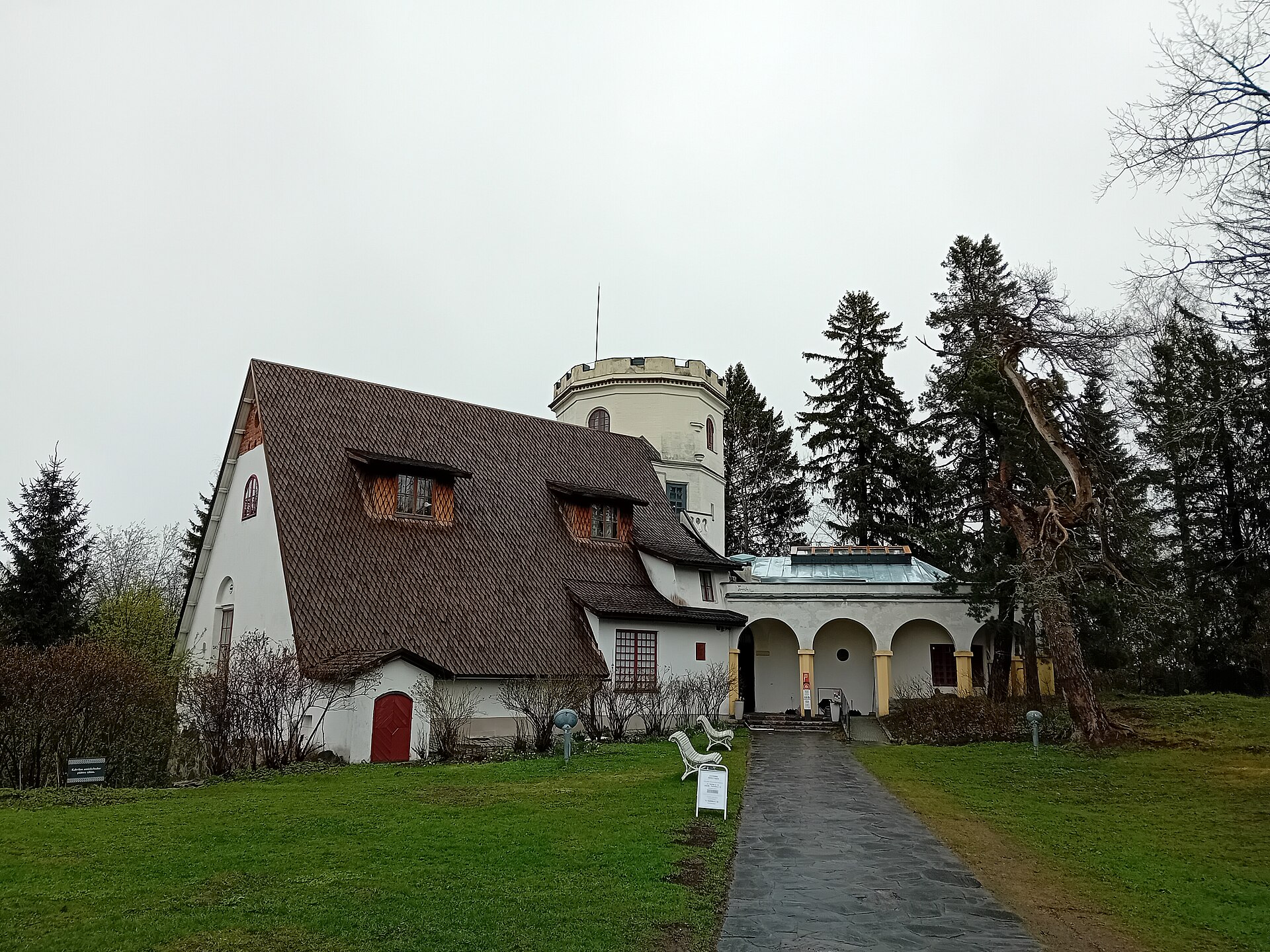
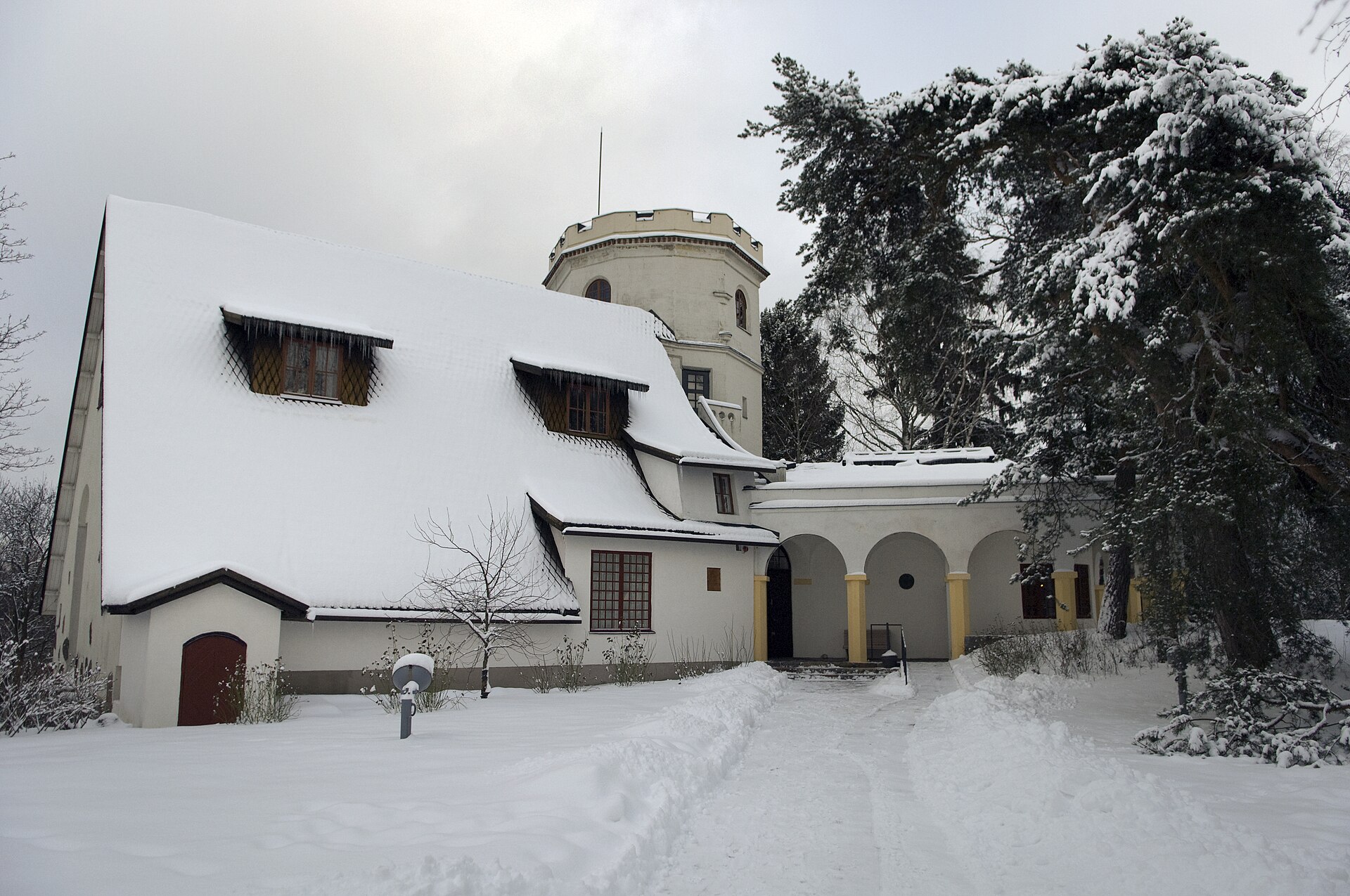
The castle-like studio house on its hillside in spring, with the round tower behind the long roof and the arcaded entrance on the right. Photographed 20 April 2025.
Yalgin, CC0Gallen-Kallela Museum
Museum · Gallen-Kallelan museo · Founded 1961
Open, admission and hours confirmed 24 November 2026 · 14 sources
On this page 15 sections
ContentsClose
This is a studio museum rather than an encyclopaedic art museum. The collections the museum names are works of art, artefacts, archival material and the home library of Akseli and Mary Gallen-Kallela; they are searchable through the Finnish national Finna service and a large part of the artist's photograph collection is published on Flickr. What a visitor sees on a given day is whatever the current exhibition draws from those stores and from loans. For the winter of 2026-27 that is the artist's own collection of curiosities: Japanese objects from Paris, masks, Egyptian souvenirs and East African material. The museum is also where the field goes to ask whether a painting is genuinely by the artist, since it runs an authentication research service. That function matters to this archive, whose records often turn on attribution.
| Local name | Gallen-Kallelan museo |
|---|---|
| Kind | Museum |
| Founded | 1961 as a museum; the studio house was completed in 1913 |
| City and country |  Espoo, Finland |
| Address | Gallen-Kallelan tie 27, 02600 Espoo, Finland |
| Website | gallen-kallela.fi |
| Status | Open, confirmed |
| Record last verified |
Visiting
- Hours
- Tue-Fri11:00 to 16:0031 Oct to 20 Dec 2026 and from 7 Jan 2027
- Sat-Sun11:00 to 17:0031 Oct to 20 Dec 2026 and from 7 Jan 2027
- Tue-Sun11:00 to 18:00holiday period 26 Dec 2026 to 6 Jan 2027
- Daily, summer 202711:00 to 18:00Wednesdays until 20:00; dates of the summer season are not given on the page
- Closed
- Monday is not listed as an opening day on the museum's pages. Closed 21 to 25 December 2026. Closed between exhibitions, 1 to 12 March 2027. Closed on Midsummer Eve, 25 June 2027. On public holidays the museum keeps Sunday hours.
- Admission
- AdultEUR 14
- PensionerEUR 9
- DiscountedEUR 7students, unemployed visitors, members of Ornamo and journalists with a valid press card
- Under 18Freefree; younger children must be accompanied and supervised by an adult
- Guests of a booked group tourEUR 9per participant, for groups of more than six; the tour itself is priced separately (95 EUR weekdays, 105 EUR weekends and public holidays, 45 minutes, up to 25 people)
Free entry: Free: under-18s, assistants to disabled visitors, members of the museum friends association Liekki (plus one guest), conscripts and civilian service personnel, veterans, peacekeepers, members of Lotta Svard, members of the Finnish Art Societies' Union, Ukrainian citizens, asylum seekers and staff of other museums. Free with ICOM and ICOMOS cards. Finnish Museum Card and Kaikukortti are accepted; Epassi and Edenred are valid at the museum. The Saturday 3 pm guided tour in English is included in the ticket price- Tickets
- gallen-kallela.fi/en/visiting-the-museum The museum's own ticket page.
- Do I need to book?
- No booking is needed for the ordinary visit. Open guided tours in English run every Saturday at 3 pm. Private tours in English, Swedish, Ukrainian, German, French and Russian must be requested by email at least a week ahead, and only the museum's own guides may lead groups.
- Address
- Gallen-Kallelan tie 27, 02600 Espoo, Finland MapBus Nearest stop is the Tarvaspaantie roundabout in Perkkaa, 1.2 km from the museum; the museum recommends buses 502 (Kallio - Leppavaara) and 212 (Kamppi - Kauniala)
Light rail Line 15 (Itakeskus - Keilaniemi) to Vermo, then a 1.5 km walk
Tram and on foot From Munkkiniemi in Helsinki, a 2.5 km walk from the tram 4 stop at Laajalahden aukio, across Tarvo island; the museum calls it the best route in good weather
Car Car park at the end of Gallen-Kallelan tie, outside the museum grounds; limited, so roadside parking is also used. Disabled-permit parking next to the cafe building. The road into the grounds is an emergency access road with no parking
Bicycle Bicycle park on the hillside by the road up to the museum; a city bike station beside the car park in summer - Website
- gallen-kallela.fi
- Telephone
- +358 10 406 8840
- [email protected]
Before you go how long, access, photography, bags, eating, shop
- How long to allow
- The museum gives no visit length. It is a small building and it hosts only one group at a time, so an hour for the rooms and the tower plus time at the cafe is a reasonable plan; this is our estimate, not the museum's.
- Access
- Only part of the historic building is accessible. Entry is by a fixed ramp with a handrail over a deep threshold, with portable ramps for wheelchairs; there are a few low thresholds inside and chairs for resting in the rooms. The tower has a steep stone staircase of almost 60 steps with no handrail, and the upper-floor exhibits can be seen in folders on the ground floor. There are no toilets or running water in the museum building; the public toilet, with an accessible room and baby changing table, is in the cafe building opposite. The museum lends baby carriers and hearing protection but has no wheelchairs. An audio guide runs on your own phone, printed house guides are in the rooms, exhibition texts are in Finnish, Swedish and English and the history texts exist in Finnish Braille.
- Photography
- Photography is permitted inside the museum without flash.
- Bags
- Large rucksacks and bags go on the racks by the info desk or in the lockers in the lobby; prams are left on the porch if possible. Only guide and assistance dogs are admitted to the museum.
- Eating
- Cafe Zoceria Tarvaspaa, in the mid-19th-century Villa Linudd on the museum grounds, run by a separate operator; it is generally open during museum hours and expands into the garden in summer.
- Shop
- A small museum shop with books, posters and gifts; tickets are also sold there and card payment is preferred.
Prices and hours change. We take them from the institution's own pages and print the day we read them, and you can check the current position at the source we used. Confirm before you travel.
What is inside
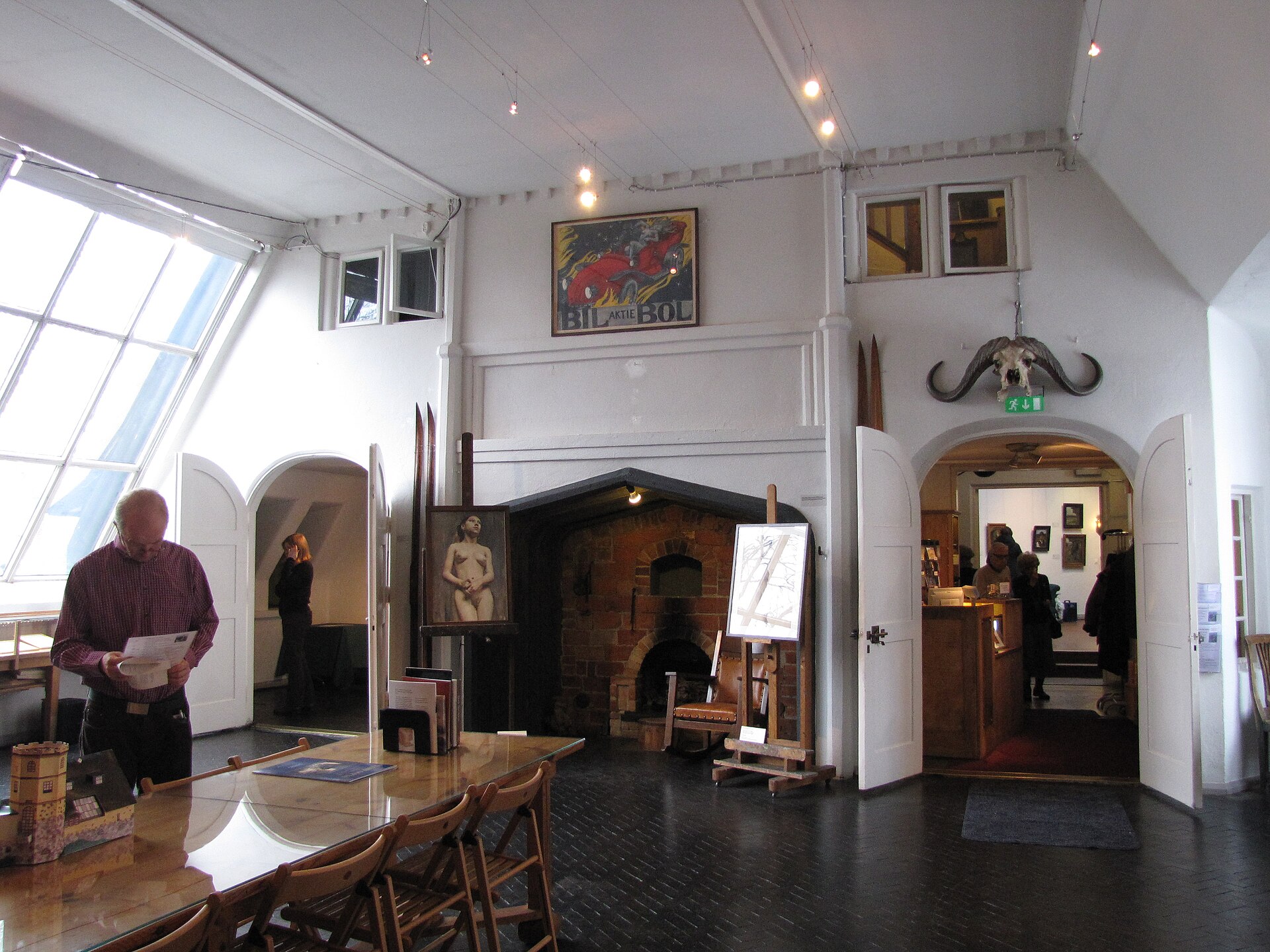
Public domain The atelier hall
The studio proper, built as a working and exhibition room for the artist. The atelier fireplace is one of only a few things the family altered in the 1920s that the museum kept when it returned the building to its original state. The ticket office stands just inside the front door, with lockers for bags in the lobby.
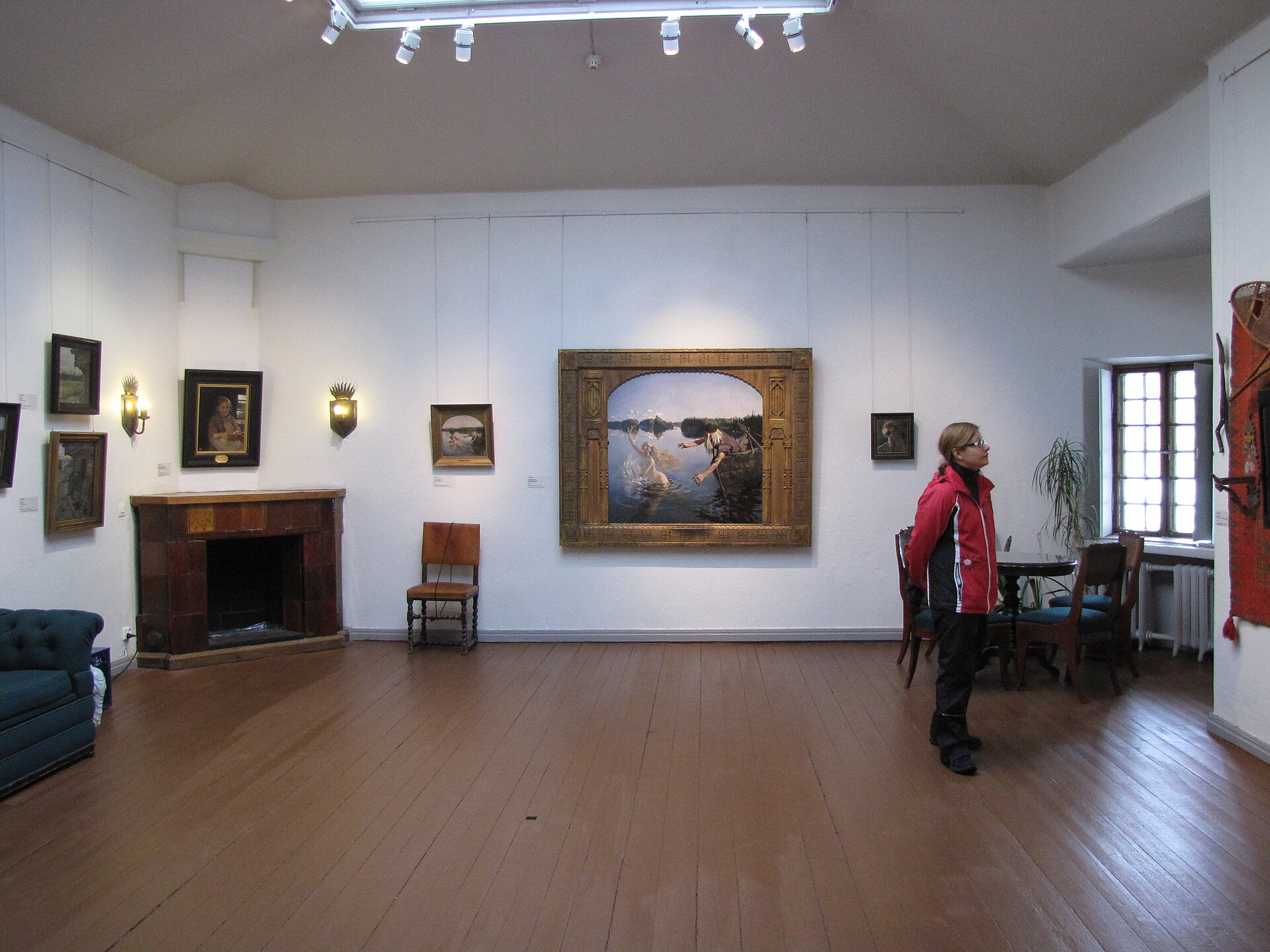
Public domain The gallery rooms
The changing exhibitions hang here, on the art and life of Gallen-Kallela, his contemporaries and contemporary artists. A photograph on Wikimedia Commons from an earlier exhibition shows a room built around a study for the Aino triptych.
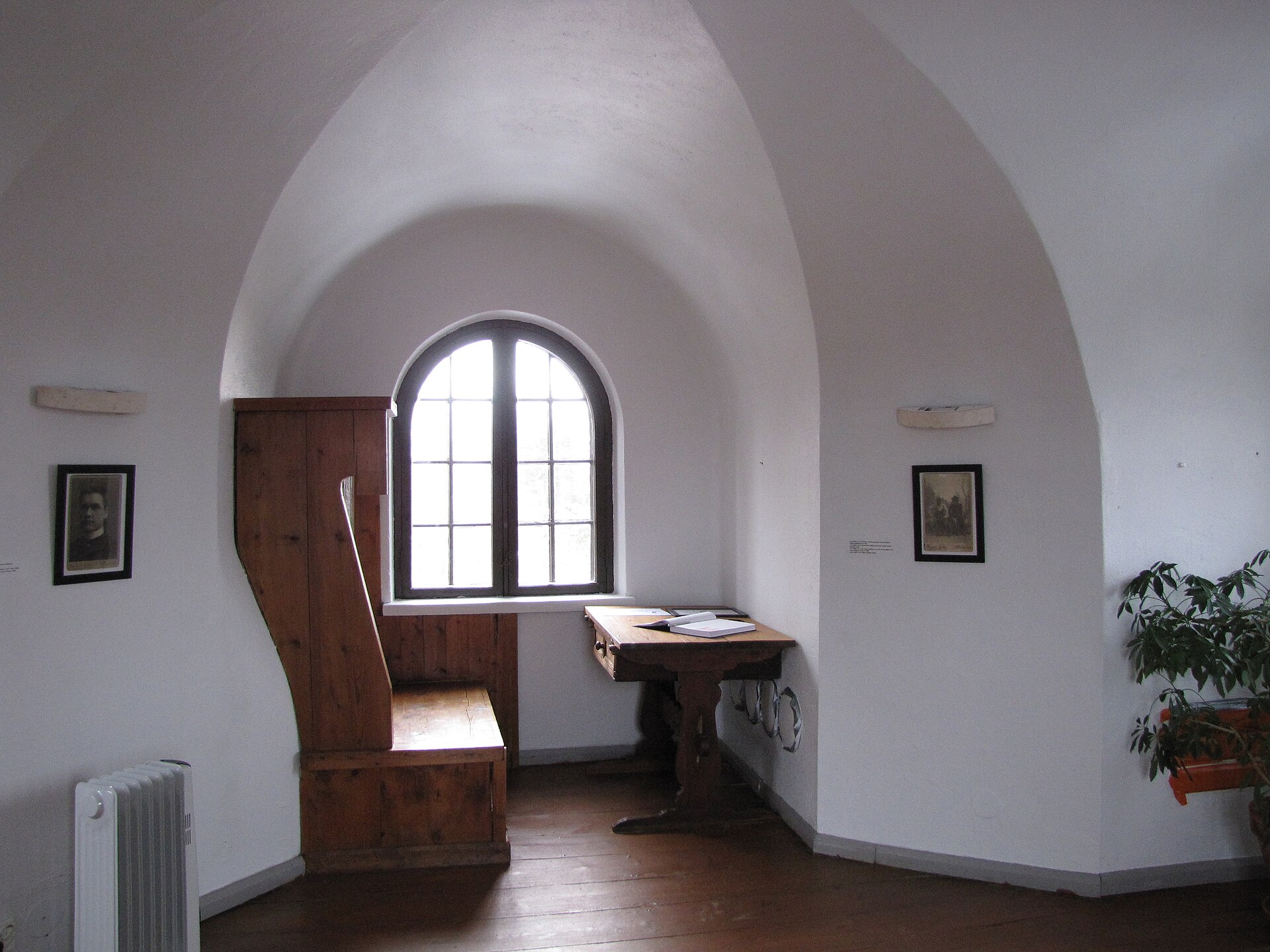
Public domain The tower
The tower rises on the second floor above the hall; the family originally showed the artefacts they brought from British East Africa there. Today it is reached by almost 60 stone steps and carries a view over the cafe villa and the bay.
Villa Linudd and Cafe Zoceria
The historic wooden villa from the mid-19th century, where the family lived during the construction of the studio, now holds the cafe and the public toilets. The cafe serves Finnish salmon soup, cakes and pastries and spills into the garden in summer.
The grounds and smoke sauna
The museum area also includes a traditional Finnish smoke sauna. A path leads on towards Munkkiniemi in Helsinki along the shore.
The museum shop
A small shop in the building with books, posters and gift items, which also sells tickets and the Finnish Museum Card.
What to see first
The studio castle itself
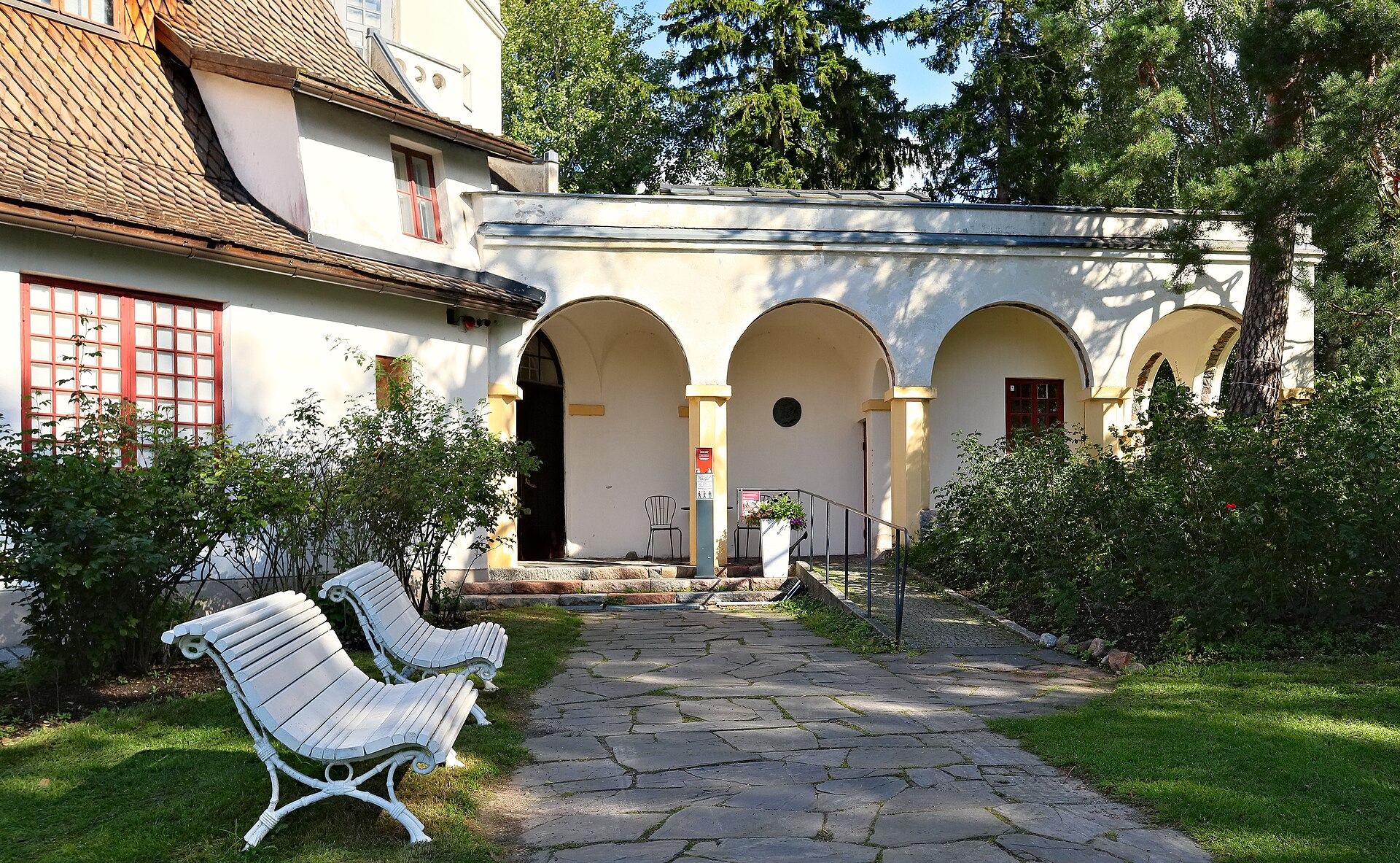
Akseli Gallen-Kallela, 1911-1913The main exhibit. Designed by the artist as a castle-like studio and home, with a tower and a colonnade, and kept by the museum close to its original state. Visitor comments on record return to the building more often than to any single work.3
The tower and its view
Akseli Gallen-KallelaAlmost 60 stone steps up to a room that first held the family's East African artefacts; a visitor in 2025 called the view over the cafe villa and the bay very nice.4
The East African collection
Collected by the Gallen-Kallela family, 1909-1910Ethnographic objects and natural history material gathered during the family's two years near Nairobi; this is the material the 2026-27 exhibition draws on and the material the family first showed on the tower floor.8
The Japanese objects bought in Paris
Collected in the 1880sThe press release notes that Gallen-Kallela never travelled to Japan; these objects tell instead of a young artist living in Paris at the height of the fashion for Japan.8
The mask collection
Collected on his travelsMasks acquired abroad and made by the artist himself, shown beside masked figures in his own work; the museum treats them as the oddities of the collection.6
The Egypt paintings
Akseli Gallen-KallelaPyramids and the Sphinx painted in Cairo during about four weeks on the family's way home from East Africa.8
Lintulan tytar (Girl from Lintula)
Akseli Gallen-Kallela, 1904A small oil from the artist's Konginkangas summer, newly donated to the museum by the Jarvenpaa Art Museum and announced in September 2026; it shows how the collection still grows by gift.9
The atelier fireplace and the American bathroom
The Gallen-Kallela family, 1920sThe two features of the 1920s conversion for living that the museum chose to keep when it restored the building; a rare surviving trace of the house as a family home.3
The collections, library and archive
The museumThe collections hold works of art, artefacts, archives and the couple's home library, with a library catalogue and a photo collection published online; the museum also runs an authentication service for works attributed to Gallen-Kallela.5
A studio built like a castle, 1907 to 1913
The Gallen-Kallela Museum is a house first and a museum second. In 1907 Akseli Gallen-Kallela and his family moved into the old main building of the Alberga Manor in Leppavaara, a house that belonged to the family of his wife Mary, born Sloor, and that was demolished in the 1950s. By then he had already made the first sketches of his future studio, together with his friend the Finnish architect Eliel Saarinen. The museum's own account of the building gives the artist himself as its designer and builder, and the Saarinen sketches as a first stage; how much of the final design came from whom is not something the museum's page settles.
The final design phase and the construction began in 1911, after the family came back from British East Africa. The site was carved out of the manor estate's summer residence on the Laajalahti peninsula, and during the building years the family lived in the older wooden Villa Linudd close by. The castle-like studio was finished in 1913. It was meant as a dedicated space where the artist could work and also show his art and his collection of cultural-historical objects, and on the second floor of its tower he displayed the artefacts the family had carried home from the Nairobi area, where they lived in 1909 and 1910.
War, America and a house made liveable
The family did not stay long at first. In 1915 they were forced to leave Tarvaspaa and the unrest of the First World War and moved back to Ruovesi, to their first studio home, Kalela. During 1915 to 1918 the empty house was looted and sometimes became the scene of local fighting. Gallen-Kallela travelled to the United States in 1923, Mary and their daughter Kirsti following the next year, and relatives lived in the house meanwhile to look after Mary's elderly mother, Aina Sloor.
In 1926 the family returned and settled in for good, and the studio became a dwelling. Electricity and water pipes were laid, a modern American-style bathroom was built, the heating was renewed and a kitchen replaced what the family had called the etching room. Gallen-Kallela died of pneumonia in Stockholm in 1931. Mary and Kirsti stayed on, and in the 1930s his son Jorma and his wife Pirkko lived there too.
A haunted house, then a museum
The Second World War ended the family's life at Tarvaspaa. In 1939 Mary was forced to leave, and the army intelligence department used the studio from time to time as a base. After 1945 the building stood empty for more than ten years, and the museum records that local children remembered it as a haunted house that only the bravest dared to break into.
In 1958 the Akseli Gallen-Kallela Museum Foundation acquired the studio and Villa Linudd. The museum notes that it had been the artist's wish from the very beginning of the planning to turn Tarvaspaa into a museum. The building was renovated for that purpose and returned to its original state; only the atelier fireplace, the American-style bathroom and a few additional walls remain from the family's 1920s alterations. The museum opened to the public in 1961. Wikipedia files the building under National Romantic architecture and Art Nouveau houses in Finland, a classification we cite as tertiary.
What you see: changing exhibitions, not a fixed hang
The first thing a visitor should know is that the museum presents changing exhibitions. It says so itself: temporary shows on the art and life of Gallen-Kallela and his contemporaries, and contemporary art. The recent programme shows the range. The 2025 to 2026 winter show was Primeval Forest, in the footsteps of Pentti Linkola. Before it, in summer 2025, came I Want to Do Everything Myself, on Gallen-Kallela and design, and earlier in 2025 the visions of the spirit world of the Russian-born artist Aleksandra Ionowa. In February to May 2026 the museum showed his graphic art, under the title Con amore, and from June to October 2026 a show of colourist art of the 1910s, called Sunshine and Joy of Life. In 2024 there was a show setting Kimmo Kaivanto beside Gallen-Kallela and another with Sara Moayed and Mia Seppala, and a summer show on his 1890 summer in Kainuu.
This matters to anyone planning a trip on the strength of one painting. The famous Kalevala pictures are not what the museum says it is built around, and a reviewer who arrived expecting a larger display of his work was disappointed. The museum's reply, in public, was that Tarvaspaa is an art and cultural history museum. We think that is the right way to read the place: it is the artist's house, with exhibitions that go through it.
From Wonder to Wonder, October 2026 to February 2027
The show open now, From Wonder to Wonder: Akseli Gallen-Kallela as a Collector, runs from 31 October 2026 to 28 February 2027 and turns to the collector rather than the painter. It is organised in four themes. Japan: objects the young artist bought in Paris in the 1880s, with the museum noting in its press release that he never travelled to Japan. Masks: ones he acquired on his travels and ones he made, shown beside the masked faces and masquerade scenes in his own paintings. Egypt: the family spent about four weeks there on the way home from East Africa, and the paintings made in Cairo show pyramids and the Sphinx. East Africa: the ethnographic objects and natural history material collected on the two-year journey.
The show is complemented by paintings of his travel destinations and by fine and applied art that reflect the influence of other cultures. It sits comfortably in the building: the studio was planned from the start to show the family collection, and the second floor of the tower first held the East African artefacts.
The grounds, the cafe and the walk
The museum area includes more than the studio. Villa Linudd, the historic wooden villa of the mid-19th century, is the cafe, with the public toilets in its lobby, and the grounds include a traditional Finnish smoke sauna. The cafe is run by a separate operator and its summer seating extends into the museum garden. A footpath links the site with Munkkiniemi in Helsinki along the shore across Tarvo island, 2.5 km from the nearest tram stop, and two visitors on Tripadvisor mention the walk from Munkkiniemi as part of the outing. The museum also publishes printed house guides and an audio guide for the building, and the Saturday English tour is included in the ticket, so a first-time visitor has three ways to learn what each room was for.
Practical limits are real and worth stating plainly. The car park is outside the grounds and small. The building has no toilets or running water of its own. Only part of it is accessible, the tower stair is steep and has no handrail, and the building is small enough that it can host only one group at a time. The museum has an accessibility consultant partner and publishes its guidance in detail, which is to its credit.
What is next: the Dream Tarvaspaa project
In 2025 the museum announced what it calls the largest development project in its history, Unelmien Tarvaspaa, aimed at renewing the museum's buildings and services. In its September 2026 press release on two new gifts, the museum says it is still preparing for that project. The pages we read on 24 November 2026 announce no closure for it: the visit page lists closures only for 21 to 25 December 2026, for 1 to 12 March 2027 between exhibitions and for Midsummer Eve 2027. A reader planning a trip beyond summer 2027 should check the museum's page, because a large renewal of a small building could change what can be visited. We have not found a start date or a schedule for it.
What visitors say
Visitors on the one platform we could read consistently like the setting: a castle-like studio house on a hill above a bay, a cafe in a wooden villa next door and a pleasant shoreline walk to Munkkiniemi. The same visitors split on the inside. Several call the exhibitions small, and the recurring disappointment is that the museum is not a permanent hang of the artist's best-known paintings. The museum itself describes its programme as changing exhibitions on Gallen-Kallela and others, and answers that criticism by saying that Tarvaspaa is an art and cultural history museum. The 4.2 from 43 ratings is solid and not exceptional.
What is praised, what is criticised
- Praised: the building and its setting, repeated across reviews from 2017 to 2025
- Praised: the cafe in Villa Linudd and the walk along the shore to Munkkiniemi
- Praised: the view from the tower
- Praised: temporary exhibitions that show rarely seen material, such as the 2026 graphic-art show
- Praised: free entry for under-18s and a long list of free and reduced categories
- Criticised: too little Gallen-Kallela on the walls for some fans of the artist; the museum replied that its exhibitions also include other artists and cultural themes
- Criticised: an interior that one reviewer found less impressive than the exterior, with a wish for more original furniture and more on the use of each room
- Criticised: a small place that one visitor called pleasant but not a must-see
- Criticised: only part of the historic building is accessible and the tower stairs have no handrail, by the museum's own account
- Criticised: no toilets in the museum building; the toilet is in the cafe building across the yard
Ratings on other platforms
Tripadvisor: 4.2 from 43 ratings, read 24 November 2026
A platform average is a tertiary source: it moves, it is not audited, and we quote no visitor's words.
Questions about Gallen-Kallela Museum
Where is Gallen-Kallela Museum?
Gallen-Kallelan tie 27, 02600 Espoo, Finland.
How much does it cost to visit?
Adult: EUR 14; Pensioner: EUR 9; Discounted: EUR 7; Under 18: free; Guests of a booked group tour: EUR 9. As confirmed 24 November 2026.
When is it open?
Tue-Fri 11:00-16:00; Sat-Sun 11:00-17:00; Tue-Sun 11:00-18:00; Daily, summer 2027 11:00-18:00. Closed: Monday is not listed as an opening day on the museum's pages. Closed 21 to 25 December 2026. As confirmed 24 November 2026.
How do you get there?
Bus: Nearest stop is the Tarvaspaantie roundabout in Perkkaa, 1.2 km from the museum; the museum recommends buses 502 (Kallio - Leppavaara) and 212 (Kamppi - Kauniala); Light rail: Line 15 (Itakeskus - Keilaniemi) to Vermo, then a 1.5 km walk; Tram and on foot: From Munkkiniemi in Helsinki, a 2.5 km walk from the tram 4 stop at Laajalahden aukio, across Tarvo island; the museum calls it the best route in good weather; Car: Car park at the end of Gallen-Kallelan tie, outside the museum grounds; limited, so roadside parking is also used. Disabled-permit parking next to the cafe building. The road into the grounds is an emergency access road with no parking.
What should you see first?
The studio castle itself (Akseli Gallen-Kallela, 1911-1913); The tower and its view (Akseli Gallen-Kallela); The East African collection (Collected by the Gallen-Kallela family, 1909-1910); The Japanese objects bought in Paris (Collected in the 1880s); The mask collection (Collected on his travels); The Egypt paintings (Akseli Gallen-Kallela).
What we could not confirm
- How much of the 1911 to 1913 design is Gallen-Kallela's own and how much comes from Eliel Saarinen, whose early sketches the museum mentions. The museum's page credits the artist as designer and builder. An Aalto University thesis on the building history is listed in a search but was blocked to us and not read.
- When Unelmien Tarvaspaa begins and whether the buildings will close for it. No date was found on the museum's pages read for this entry.
- How many objects the collections hold. The museum describes them by type and does not give a count on the pages we read.
- Summer 2027 opening dates. The page says daily 11 to 18 with Wednesdays until 20 and does not give the dates of the season.
Images
Sources
- 1Gallen-Kallela Museum, Museum Visit: opening hours with seasonal dates and closures, prices and free categories, guided tours, transport, parking, WC, shop, photography, bags, cafe. Fetched 24 November 2026. gallen-kallela.fi/en/visiting-the-museum/
- 2Gallen-Kallela Museum, English home page: address, telephone, email, hours, admission, current exhibition. Fetched 24 November 2026. gallen-kallela.fi/en/
- 3Gallen-Kallela Museum, Tarvaspaa Studio Building: the building history from 1907 to the opening in 1961. Fetched 24 November 2026. gallen-kallela.fi/en/studio/
- 4Gallen-Kallela Museum, Accessibility and Information for Your Visit: ramp, tower stairs, toilets, loans, audio guide, Braille. Fetched 24 November 2026. gallen-kallela.fi/en/accessibility/
- 5Gallen-Kallela Museum, Gallen-Kallela Museum and Collections pages: what the collections hold, partner organisations, authentication service. Fetched 24 November 2026. gallen-kallela.fi/en/collections/
- 6Gallen-Kallela Museum, From Wonder to Wonder: Akseli Gallen-Kallela as a Collector, 31.10.2026-28.2.2027: the exhibition text. Fetched 24 November 2026. gallen-kallela.fi/kalenteri/from-wonder-to-wonder/
- 7Gallen-Kallela Museum, Past Exhibitions: the 2023 to 2026 programme. Fetched 24 November 2026. gallen-kallela.fi/en/past-exhibitions/
- 8Gallen-Kallelan Museo, press release (in Finnish) of 14 October 2026 on the From Wonder to Wonder exhibition: the Japan, masks, Egypt and East Africa themes and the remark that the artist never travelled to Japan. Fetched 24 November 2026. sttinfo.fi/tiedote/72403947/ihmeesta-ihmeeseen-akseli-gallen-kallela-kerailijana-31102026-2822027?lang=fi
- 9Gallen-Kallelan Museo, press release (in Finnish) of 22 September 2026 on two donations, Lintulan tytar (1904) and Valkokauluksinen tytto (1883), and on the museum preparing for its largest development project. Fetched 24 November 2026. sttinfo.fi/tiedote/72343664/gallen-kallelan-museo-on-vastaanottanut-kaksi-merkittavaa-teoslahjoitusta?lang=fi
- 10Tripadvisor, Gallen-Kallela Museum, Espoo: 4.2 of 5 from 43 reviews (15 excellent, 21 good, 7 average, 0 poor, 0 terrible), review themes and the museum's published reply of 31 October 2025. Read in the browser on 24 November 2026. tripadvisor.com/Attraction_Review-g189932-d245524-Reviews-Gallen_Kallela_Museum-Espoo_Uusimaa.html
- 11Wikimedia Commons, Category:Tarvaspaa and Category:Gallen-Kallela Museum: the plates on this page, with the licence of each verified from the Commons API on 24 November 2026. commons.wikimedia.org/wiki/Category:Tarvasp%C3%A4%C3%A4
- 12Wikipedia, Gallen-Kallela Museum: building dates of 1911 to 1913, museum since 1961, and the category tags National Romantic architecture and Art Nouveau houses. en.wikipedia.org/wiki/Gallen-Kallela_Museum
- 13Espoo city, Tarvaspaa museum area: planning status of the museum area and its surroundings, which are not part of a local detailed plan. Fetched 24 November 2026. espoo.fi/en/projects/tarvaspaa
- 14MyHelsinki, Gallen-Kallela Museum: the building as a castle-like studio and home opened in 1961, cafe and shop. myhelsinki.fi/en/see-and-do/sights/gallen-kallela-museum