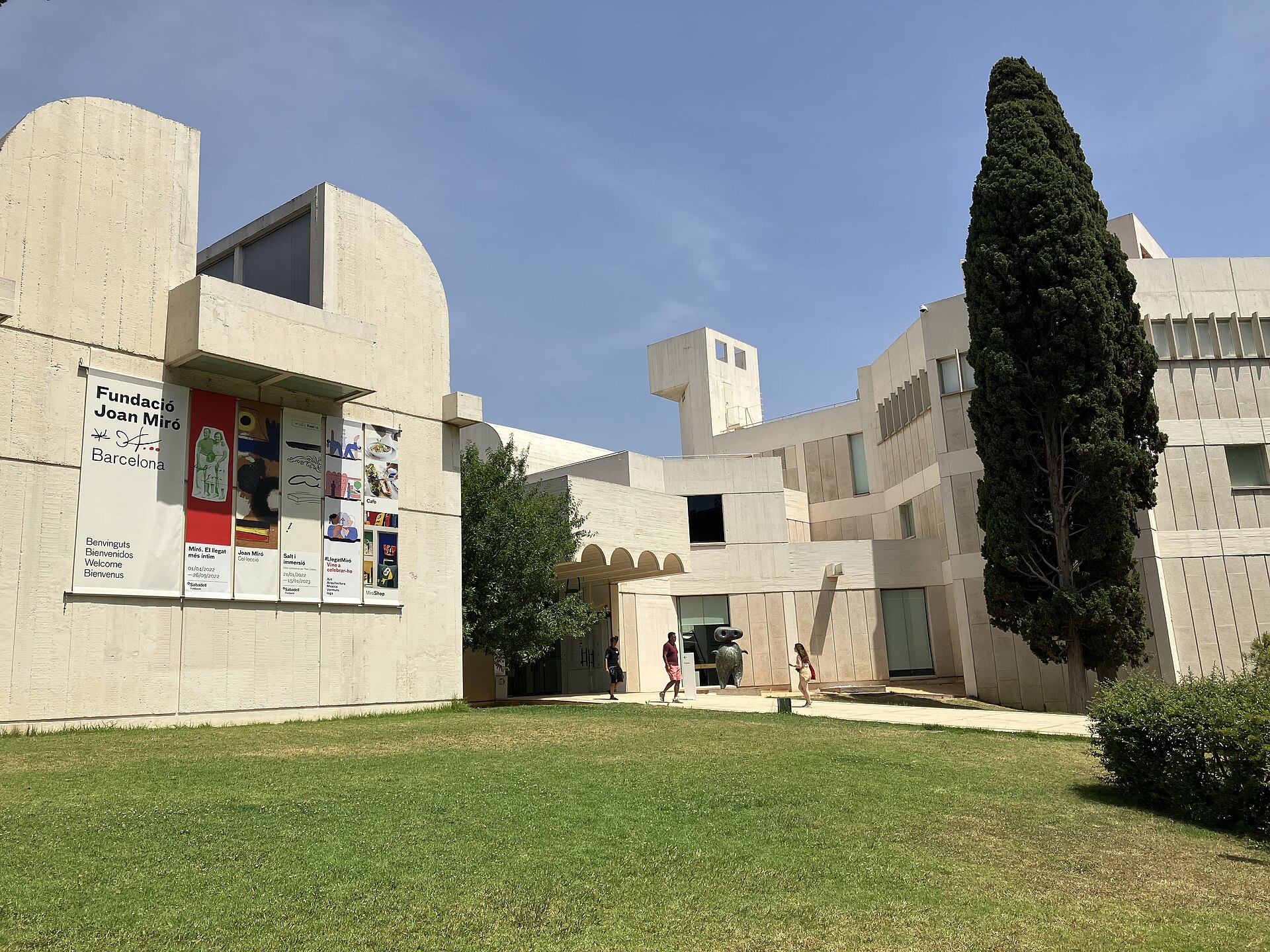
The entrance facade of the Fundacio Joan Miro on Montjuic, photographed June 2022, with the foundation's own banner visible over the doorway.
Mathieu Chollet · Photograph by MChollet · CC BY-SA 4.0Fundacio Joan Miro
Museum · Fundació Joan Miró · Founded 1975
Open, admission and hours confirmed 25 August 2026 · 17 sources
On this page 15 sections
ContentsClose
The Fundacio's advantage over a general museum with a Miro room is depth across a single career rather than breadth across many: it holds work from the 1935 Wild Paintings through the 1940 Constellations to the reduced late canvases and bronzes of the 1960s and 1970s, plus objects, such as the Calder fountain and the Tapestry of the Fundacio, that were made for or given directly to the building rather than acquired on the market afterward.
| Local name | Fundació Joan Miró |
|---|---|
| Kind | Museum |
| Founded | 1975 |
| City and country |  Barcelona, Spain Barcelona, Spain |
| Address | Parc de Montjuic s/n, Jardins de Laribal, 08038 Barcelona, Spain |
| Website | fmirobcn.org/en |
| Status | Open, confirmed |
| Record last verified |
Visiting
- Hours
- 1 November - 31 March, Tuesday-Sunday10:00 to 19:00last admission 30 minutes before closing
- 1 April - 31 October, Tuesday-Saturday10:00 to 20:00last admission 30 minutes before closing
- 1 April - 31 October, Sunday10:00 to 19:00last admission 30 minutes before closing
- MondayClosed, with exceptions on a small number of public holidays that fall on a Monday (in 2026 the site names 6 April, 18 May, 25 May, 12 October and 28 December)
- Closed
- Monday, except a handful of named public holidays.
- Admission
- Adult, onlineEUR 1718 euro bought at the on-site ticket office instead
- Reduced, online (students 13-25, seniors over 65, Barcelona Libraries Card holders)EUR 1112 euro at the on-site ticket office
- Under 12, accompanied by an adultFreefree
- Unemployed visitors, ICOM and CIMAM members, Friends and Benefactors of the FundacioFreefree with valid documentation; a disabled visitor and one companion also enter free
- Espai 13 onlyFreethe project space for younger artists is free to visit on its own, without a ticket to the rest of the collection
- Articket BCN combined pass (six Barcelona museums including the Fundacio)EUR 38sold by the participating museums as a group pass, not a Fundacio-only price
Free entry: No standing free day or free late-opening window is published. The only free admission is by category (under-12s with an adult, unemployed visitors, ICOM/CIMAM members, Friends and Benefactors, and disabled visitors with a companion), and Espai 13 is free to enter on its own year-round- Tickets
- fmirobcn.org/en/visit-us/tickets The museum's own ticket page.
- Do I need to book?
- Not required. The museum recommends buying online in advance (it is 1 euro cheaper per ticket than the on-site office) but sells tickets at the entrance as well
- Address
- Parc de Montjuic s/n, Jardins de Laribal, 08038 Barcelona, Spain MapBus Lines 55 and 150, both of which run through Parc de Montjuic, stop by the Fundacio
Funicular The Montjuic Funicular (FM line) connects to the metro at Paral-lel and climbs the hill to a stop a short walk from the entrance
Bicycle Bicing docking stations 522 and 526 are nearby; the museum's own page states there is no on-site parking and recommends public transport - Website
- fmirobcn.org/en
- Telephone
- +34 934 439 470
- [email protected]
Before you go how long, access, photography, bags, eating, shop
- How long to allow
- Tripadvisor's own listing gives a suggested duration of 1-2 hours. One visitor review flagged the exhibition as long enough that a family with young children might find it too much in one visit
- Access
- A 30-metre ramp reaches the entrance and wheelchairs are available on loan; accessible toilets on the ground and first floors; magnetic hearing loops in the auditorium, library and some galleries, with subtitled videos; relief reproductions of Miro's work and a tactile model of the building for visually impaired visitors, plus large-print and Braille materials; the free Bloomberg Connects app and an easy-read guide with pictograms for cognitive accessibility; admission is free for disabled visitors and their companion travel at the reduced rate
- Photography
- Personal photographs are allowed without flash, a tripod or a selfie stick. Press photography and any commercial use requires prior written approval through the foundation's own form
- Bags
- Bags larger than 30 by 30 centimetres, umbrellas and motorcycle helmets must go into a locker at the entrance (1 euro coin deposit, refunded on return); food and drink are not allowed in the exhibition areas
- Eating
- A bar-restaurant on site, with its own phone line separate from the museum switchboard
- Shop
- MiroShop, both in the building and as a separate online store
Prices and hours change. We take them from the institution's own pages and print the day we read them, and you can check the current position at the source we used. Confirm before you travel.
What is inside
Permanent collection galleries
Sixteen numbered rooms across two floors, designed by Josep Lluis Sert as part of the original building, holding the core of Miro's donation. On 13 March 2026 the foundation reopened these galleries under a new permanent rehang, Joan Miro. Circles, running to 12 March 2028, which replaces the previous chronological and thematic route with a display built around Miro's own working processes rather than biography, moving and reinterpreting works within that framework roughly every six months. This record has not re-verified which room, if any, now shows Man and Woman in Front of a Pile of Excrement under the new hang; the Pilar Juncosa Gallery reference in the narrative below predates the rehang and needs a fresh check.
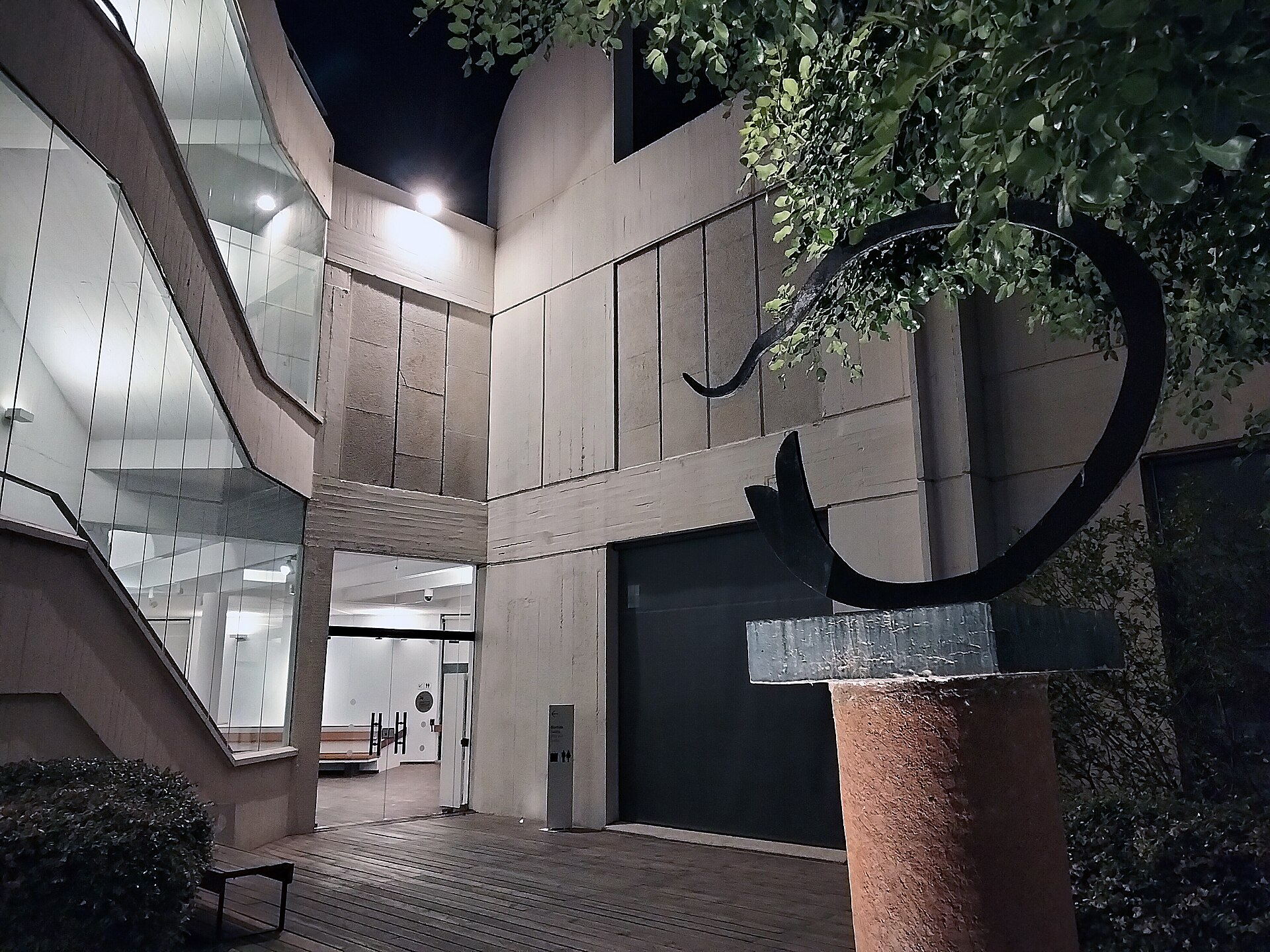
Photograph by Enric · CC BY-SA 4.0 The interior courtyards
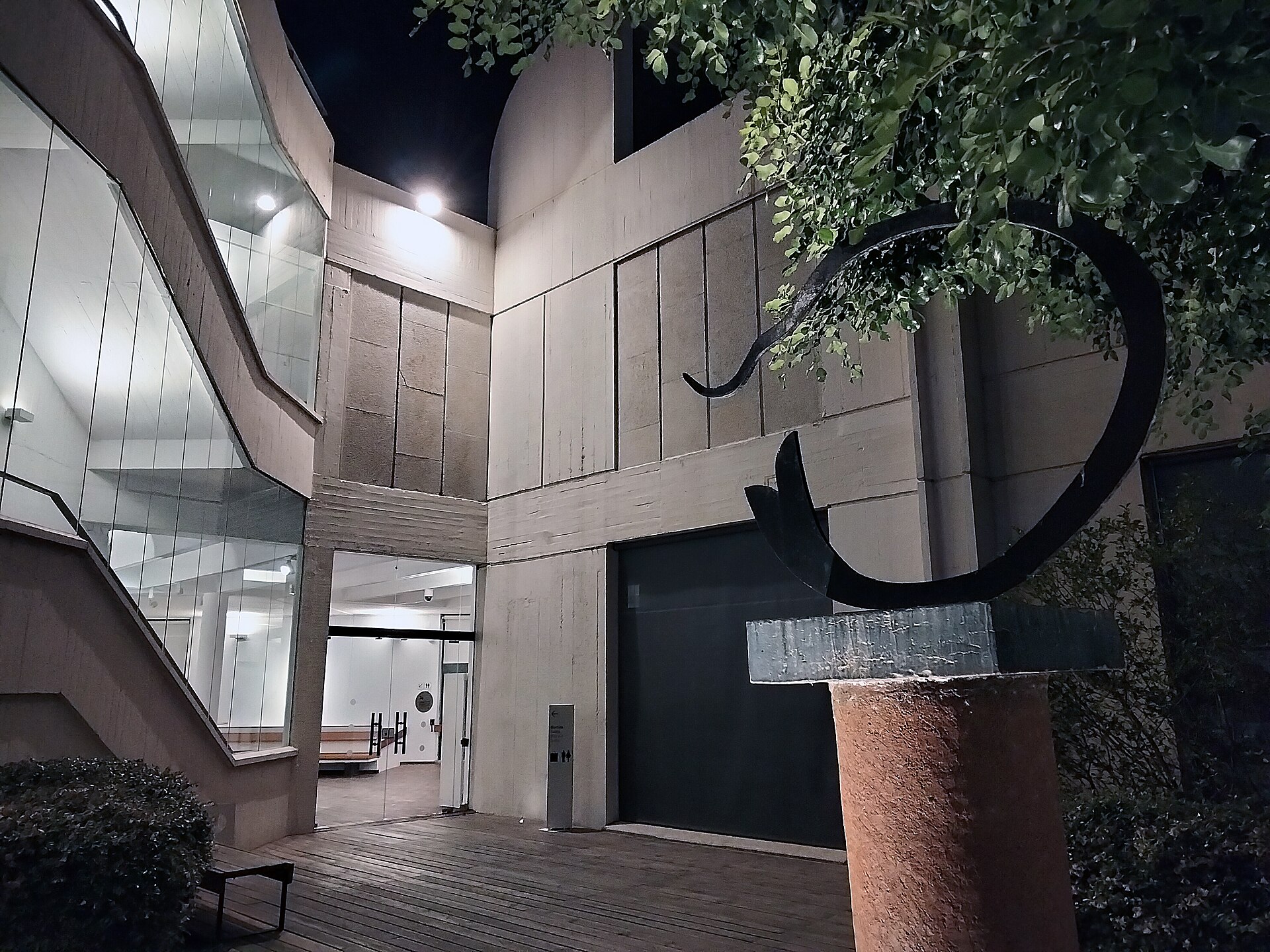
Sert built the collection route around a sequence of courtyards rather than a single continuous corridor. Three are named for what grows or stands in them: an Olive Tree patio, a Carob Tree patio, and a North Patio used for sculpture, including Study for a Monument, a bronze and painted-cement piece originally made for the entrance to Barcelona's Parc Cervantes.
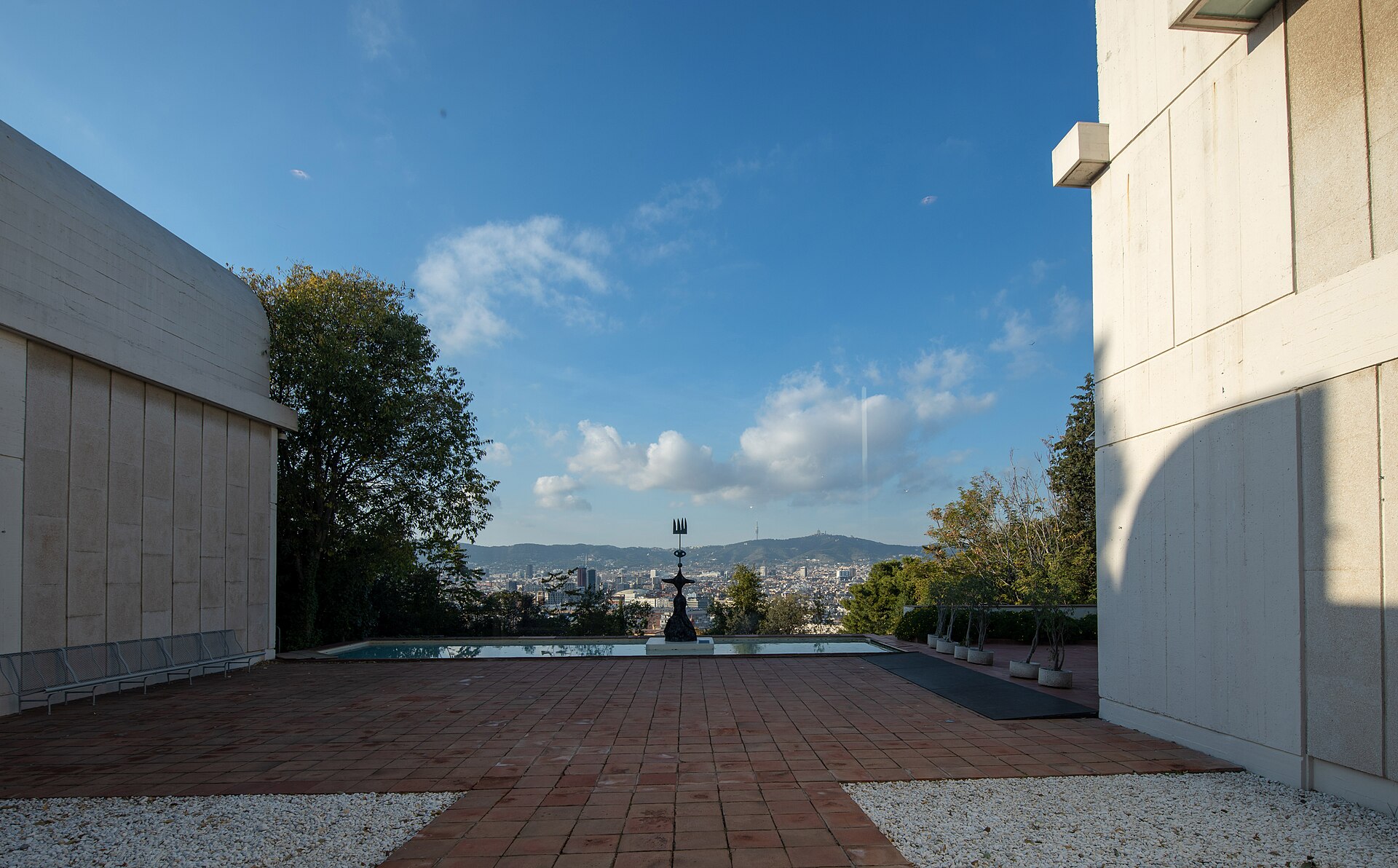
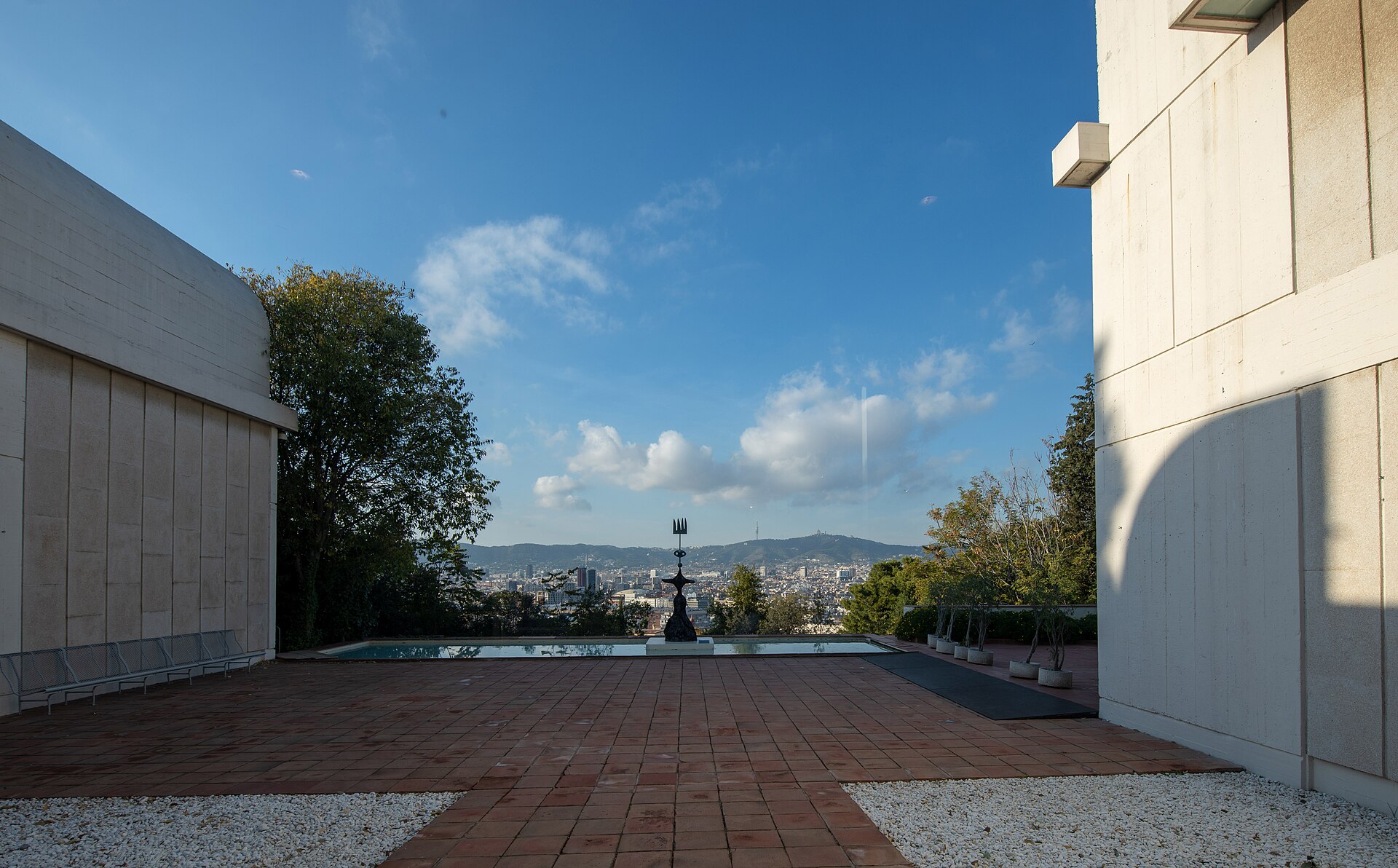
Photograph by Robertgombos · CC BY-SA 4.0 Rooftop sculpture terrace
An open-air terrace over the museum's upper level, used both as an outdoor sculpture ground and as a viewing platform over Montjuic and the city below. The Caress of a Bird, a bronze Miro had recast from a wartime assemblage of an outhouse seat, an ironing board and a straw donkey's hat, stands here.
Espai 13
A project space Miro set aside specifically for younger and more experimental artists rather than for his own work, run with a changing curator rather than the museum's own staff; past curators have included Ferran Barenblit, who later directed MACBA across town. It carries its own free admission, separate from a ticket to the main collection.
Kazumasa Katsuta collection wing
A gallery built around 32 works given to the foundation in 2011 by the Japanese collector Kazumasa Katsuta, shown as a group rather than folded into the chronological run of the main galleries. The foundation and independent sources both cite it as evidence of Miro's following in Japan specifically, distinct from his reputation in Europe and the United States.
Cypress Garden
A historic garden on the site, reopened to visitors on 13 March 2026 as part of the Joan Miro. Circles rehang, its first opening since the foundation's own 1975 debut. The foundation's own press release describes it as extending the visit outdoors and building a dialogue between the art, Sert's architecture and the landscape.
What to see first
Mercury Fountain
Alexander CalderSert commissioned it in 1937 for the Spanish Republican pavilion at the Paris International Exposition, where it stood near Picasso's Guernica as a memorial to Franco's siege of the Almaden mercury mines, which then supplied some 60 percent of the world's mercury. Calder gave it to the foundation in 1973; it runs behind glass because the mercury vapor is toxic.8
Man and Woman in Front of a Pile of Excrement
Joan MiroPainted on copper over eight days in October 1935, one of twelve so-called Wild Paintings Miro made as Spain moved toward civil war. He said the subject was his attempt at the tragedy and torture to come, and that the title drew on a remark attributed to Rembrandt, that rubies and diamonds can be found in a dung heap.10
Constellation: Morning Star
Joan MiroMade at Varengeville-sur-Mer in March 1940 as German forces advanced into France, the sixth of the 23-work Constellations series Miro painted while moving his family south toward Mallorca. His wife Pilar Juncosa kept this one and later gave it to the foundation, while other Constellations ended up at MoMA, the Met and the Art Institute of Chicago.14
The Gold of the Azure
Joan MiroA large 1967 canvas built with grattage, scraping paint back off the surface rather than adding it, so the picture reads as a single dark circle scored into a saturated yellow ground. It is one of the late works the foundation uses to show how far Miro had reduced his own vocabulary by the 1960s.12
The Caress of a Bird (La Caresse d'un Oiseau)
Joan MiroA bronze cast, made under Miro's own supervision by Parisian founders in the 1960s, of an assemblage he had first built at his Mont-roig workshop during the Second World War from an outhouse seat, an ironing board, toy footballs and a straw donkey's hat. Scholars writing on the piece have called it a totem of female sexuality built from junk.13
Tapestry of the Fundacio
Joan Miro, woven with Josep RoyoA large woven textile, roughly seven by five metres, made specifically for the building with the Catalan weaver Josep Royo and hung so it can be seen from two different floor levels of the collection route rather than from one fixed vantage point.9
Exhibitions on now
- On now9 Oct 2026 to 28 Feb 2027Confirmed , 2 months ago
Past exhibitions here
A foundation built while its subject was still working
The Fundacio Joan Miro exists because Miro himself decided it should, which sets it apart from most museums carrying a single artist's name. He worked out the idea in 1968 with his friend Joan Prats, a hatter and collector who had backed him since the 1920s, wanting a Barcelona institution that would study his own work and, just as much, give younger artists room to work with contemporary art rather than simply display a finished career under glass. The building opened on 10 June 1975, eight years before Miro died, built mainly from paintings, drawings and sculpture Miro gave from his own collection at the opening. His wife Pilar Juncosa added further pieces afterward, including one of the Constellations gouaches, and the Japanese collector Kazumasa Katsuta gave 32 more works in 2011, long after Miro's death, so the collection has kept growing under people who knew him rather than being fixed at his death and then managed as an estate.
That original-donor structure matters for how the place reads today. A museum assembled by curators after an artist's death chooses what to show against everyone else's account of the career; a foundation an artist builds and stocks himself chooses what to show against his own account of it, including work as raw as the Wild Paintings series, which is not the material a posthumous retrospective necessarily reaches for first. The foundation's own published figure for the whole collection, works on paper included, runs past 10,000 pieces by its own count and closer to 14,000 by an independent count that treats prints and sketches separately; the two figures have not been reconciled on the pages available, and this page states both rather than picking one.
Sert's building on Montjuic
Josep Lluis Sert designed the Fundacio, and the commission followed a long friendship rather than a competition: Miro had already hired him for his studio house on Mallorca, and the two had worked in overlapping circles since the 1930s. Sert built the museum between 1970 and 1975 on Montjuic, organizing it not as one continuous gallery run but as a sequence of small exhibition rooms strung along a route defined by courtyards, with a ramp carrying visitors up to the rooftop terrace rather than a single formal staircase. The lower building uses white exposed reinforced concrete under barrel-vault ceilings; the Contemporary Art Study Centre, holding the library and auditorium, sits in its own octagonal volume built on a two-directional portico frame.
The building's lighting is a Sert signature rather than something invented for Barcelona. He had already tested quarter-cylinder skylights at the Maeght Foundation in Saint-Paul-de-Vence in the south of France, and reused the same system here to diffuse daylight across the galleries while avoiding both hard shadows and direct sun on the paintings. The museum grew twice after Sert's death: in 1987 and again in 2001, both extensions directed by Jaume Freixa, who had worked as Sert's own collaborator, adding an auditorium and expanding the library to hold roughly 10,000 items connected to the foundation's own archive rather than to Miro's finished work.
A fountain that came out of the Spanish Civil War
The most-cited single object in the building did not start as a Miro commission at all. In May 1937 Sert, then working as one of the architects of the Spanish Republican government's pavilion for the Paris International Exposition, asked Alexander Calder to build a fountain for it, to sit alongside Picasso's Guernica and Miro's own mural-sized Le Faucheur as the pavilion's set of avant-garde centerpieces. Calder built it from sheet metal, rod, wire, pitch and mercury on a working pump and basin, and made the material choice itself the point: the mercury came from Almaden, in southern Spain, then supplying around 60 percent of the world's mercury, and the pavilion opened while Franco's forces were besieging the town. The fountain reads, and was read at the time, as a memorial to that siege standing beside Guernica's larger protest against the same war.
Calder gave the fountain to the Fundacio in 1973, two years before the building opened, and it was installed in June 1975 alongside the museum itself. It still runs on real mercury rather than a safer substitute, which is why it is shown behind a glass enclosure: the metal is toxic to breathe as vapor, so the fountain that visitors watch is protected as much for their sake as for the object's.
Work made with the war already coming
Two of the collection's central paintings were made in the years just before and during the Second World War and the Spanish Civil War, and both carry meanings Miro stated himself rather than meanings later attached by critics. Man and Woman in Front of a Pile of Excrement is a small oil on copper, painted over eight days in October 1935, one of twelve paintings from that year now grouped as the Wild Paintings for their distorted, enlarged figures and lurid color. Miro said directly that the picture was his attempt to represent the tragedy and torture he expected Spain was heading toward, and that its French title, chosen over Spanish, drew on a saying attributed to Rembrandt: that rubies and diamonds could be found in a dung heap. The work stayed with Pilar Juncosa before entering the foundation's own galleries, where it now hangs in the room named for her.
Constellation: Morning Star belongs to a later and calmer body of work made under worse conditions. Miro began the 23-painting Constellations series at Varengeville-sur-Mer, on the Normandy coast, in January 1940, painting on paper at a fixed small size using tempera, gouache, egg, oil and pastel. He finished Morning Star there in March 1940, two months before German forces invaded France and forced his family south through Spain to Mallorca. Pilar Juncosa kept this particular sheet and later gave it to the foundation; other paintings from the same series are now split across the Museum of Modern Art, the Metropolitan Museum and the Art Institute of Chicago, so the series itself is not held in one place and the Fundacio's is one part of a set that was never meant to be reassembled under one roof.
What sits on the roof and in the courtyards
The sculpture on the rooftop terrace and in the courtyards is where the foundation's collection gets least reverent about Miro's own reputation. The Caress of a Bird is a bronze, cast under Miro's own supervision by founders in Paris in the 1960s from an assemblage he had first built during the war at his workshop in Mont-roig del Camp: an outhouse seat and an ironing board forming a body and legs, toy footballs standing in for buttocks, a turtle shell for genitals, and a straw donkey's hat for a head. Miro controlled the bronze's texture and patina personally when the original wood-and-found-object piece deteriorated and needed recasting, which is the kind of late, hands-on decision that separates an artist-run foundation from one assembled after the fact by people guessing at intent.
The Gold of the Azure, from 1967, is a quieter late statement in the same building: a large canvas worked with grattage, paint scraped back off the surface rather than laid on, reducing the picture to one dark circle scored into a flat, saturated yellow field. Between the two, the building shows an artist in his seventies still willing to build a memorial sculpture from a toilet seat and, in the same decade, willing to strip a painting down to almost nothing on the canvas.
What visitors say
Visitors consistently single out the setting over the specific works: a quiet, uncrowded museum on Montjuic away from the crush of central Barcelona, where Sert's building and its courtyards and terraces are treated as being as much the exhibit as the art inside it. Calder's Mercury Fountain is repeatedly named as the single most memorable object, ahead of any individual Miro painting.
What is praised, what is criticised
- Praised: The calm of the site itself, away from the city centre and Barcelona's more crowded attractions
- Praised: Sert's building and how the courtyards, terraces and light work with the collection rather than around it
- Praised: The view over Montjuic park and the city from the rooftop terrace
- Praised: Calder's Mercury Fountain, called out by name in review after review as the thing visitors remember most
- Criticised: Wall labels described as small and hard to read when more than one visitor is trying to read them at once, with several reviews asking for an audio guide
- Criticised: Thin biographical and contextual material on Miro's own life for what several visitors call very abstract work to approach cold
- Criticised: Unannounced partial closures of the permanent collection for exhibition changeovers or private events, which more than one reviewer learned about only after paying to get in
Ratings on other platforms
Tripadvisor: 4.4 from 4,103 ratings, read 7 August 2026
A platform average is a tertiary source: it moves, it is not audited, and we quote no visitor's words.
Questions about Fundacio Joan Miro
Where is Fundacio Joan Miro?
Parc de Montjuic s/n, Jardins de Laribal, 08038 Barcelona, Spain.
How much does it cost to visit?
Adult, online: EUR 17; Reduced, online (students 13-25, seniors over 65, Barcelona Libraries Card holders): EUR 11; Under 12, accompanied by an adult: free; Unemployed visitors, ICOM and CIMAM members, Friends and Benefactors of the Fundacio: free; Espai 13 only: free. As confirmed 25 August 2026.
When is it open?
1 November - 31 March, Tuesday-Sunday 10:00-19:00; 1 April - 31 October, Tuesday-Saturday 10:00-20:00; 1 April - 31 October, Sunday 10:00-19:00; Monday closed. Closed: Monday, except a handful of named public holidays. As confirmed 25 August 2026.
How do you get there?
Bus: Lines 55 and 150, both of which run through Parc de Montjuic, stop by the Fundacio; Funicular: The Montjuic Funicular (FM line) connects to the metro at Paral-lel and climbs the hill to a stop a short walk from the entrance; Bicycle: Bicing docking stations 522 and 526 are nearby; the museum's own page states there is no on-site parking and recommends public transport.
What should you see first?
Mercury Fountain (Alexander Calder); Man and Woman in Front of a Pile of Excrement (Joan Miro); Constellation: Morning Star (Joan Miro); The Gold of the Azure (Joan Miro); The Caress of a Bird (La Caresse d'un Oiseau) (Joan Miro); Tapestry of the Fundacio (Joan Miro, woven with Josep Royo).
What we could not confirm
- The foundation's own pages give the collection's size two different ways in different places, more than 10,000 works by one count and closer to 14,000 by another that appears to count prints and sketches on a different basis. Neither page reconciles the two figures.
- Whether the 1975 opening donation and the later gifts from Pilar Juncosa, Joan Prats and Kazumasa Katsuta have ever been itemized against each other in a single published inventory was not established from the pages read for this record.
Images
Sources
- 1Fundacio Joan Miro, Visit us - Opening hours and prices fmirobcn.org/en/visit-us/opening-hours-and-prices/
- 2Fundacio Joan Miro, homepage (visitor info, exhibitions, shop, cafe) fmirobcn.org/en/
- 3Fundacio Joan Miro, Contact page (phone lines and email addresses) fmirobcn.org/en/contact/
- 4Fundacio Joan Miro, Plan your visit (accessibility, photography, bags, transport) fmirobcn.org/en/visit-us/plan-your-visit/
- 5Wikipedia, Fundacio Joan Miro en.wikipedia.org/wiki/Fundaci%C3%B3_Joan_Mir%C3%B3
- 6Docomomo Iberico, Fundacio Joan Miro building entry docomomoiberico.com/en/buildings/fundacio-joan-miro/
- 7Calder Foundation, Mercury Fountain (1937) calder.org/works/unusual-project/mercury-fountain-1937/
- 8Wikipedia, Mercury fountain en.wikipedia.org/wiki/Mercury_fountain
- 9exp1.com blog, Everything to See at the Joan Miro Foundation in Barcelona exp1.com/blog/everything-to-see-at-the-joan-miro-foundation-in-barcelona/
- 10Wikipedia, Man and Woman in Front of a Pile of Excrement en.wikipedia.org/wiki/Man_and_Woman_in_Front_of_a_Pile_of_Excrement
- 11Tripadvisor, Fundacio Joan Miro attraction page and reviews, read 2026-08-07 tripadvisor.com/Attraction_Review-g187497-d190637-Reviews-Fundacio_Joan_Miro-Barcelona_Catalonia.html
- 12World History Encyclopedia, image note on The Gold of the Azure by Joan Miro worldhistory.org/image/20924/the-gold-of-the-azure-by-joan-miro/
- 13Wikipedia, The Caress of a Bird en.wikipedia.org/wiki/The_Caress_of_a_Bird
- 14Wikipedia, Constellations (Miro) en.wikipedia.org/wiki/Constellations_(Mir%C3%B3)
- 15Fundacio Joan Miro, Joan Miro Collection (old page, donation history) fmirobcn.org/en/joan-miro-collection-old/
- 16barcelona.de, Museum of the Foundation Joan Miro in Barcelona (collection size and donor history) barcelona.de/en/barcelona-museum-foundation-miro.html
- 17Fundacio Joan Miro, press release: The Fundacio Joan Miro presents its newly organised Joan Miro collection (Joan Miro. Circles, 13 March 2026 - 12 March 2028) fmirobcn.org/en/foundation/press/343/the-fundacio-joan-miro-presents-its-newly-organised-joan-miro-collection