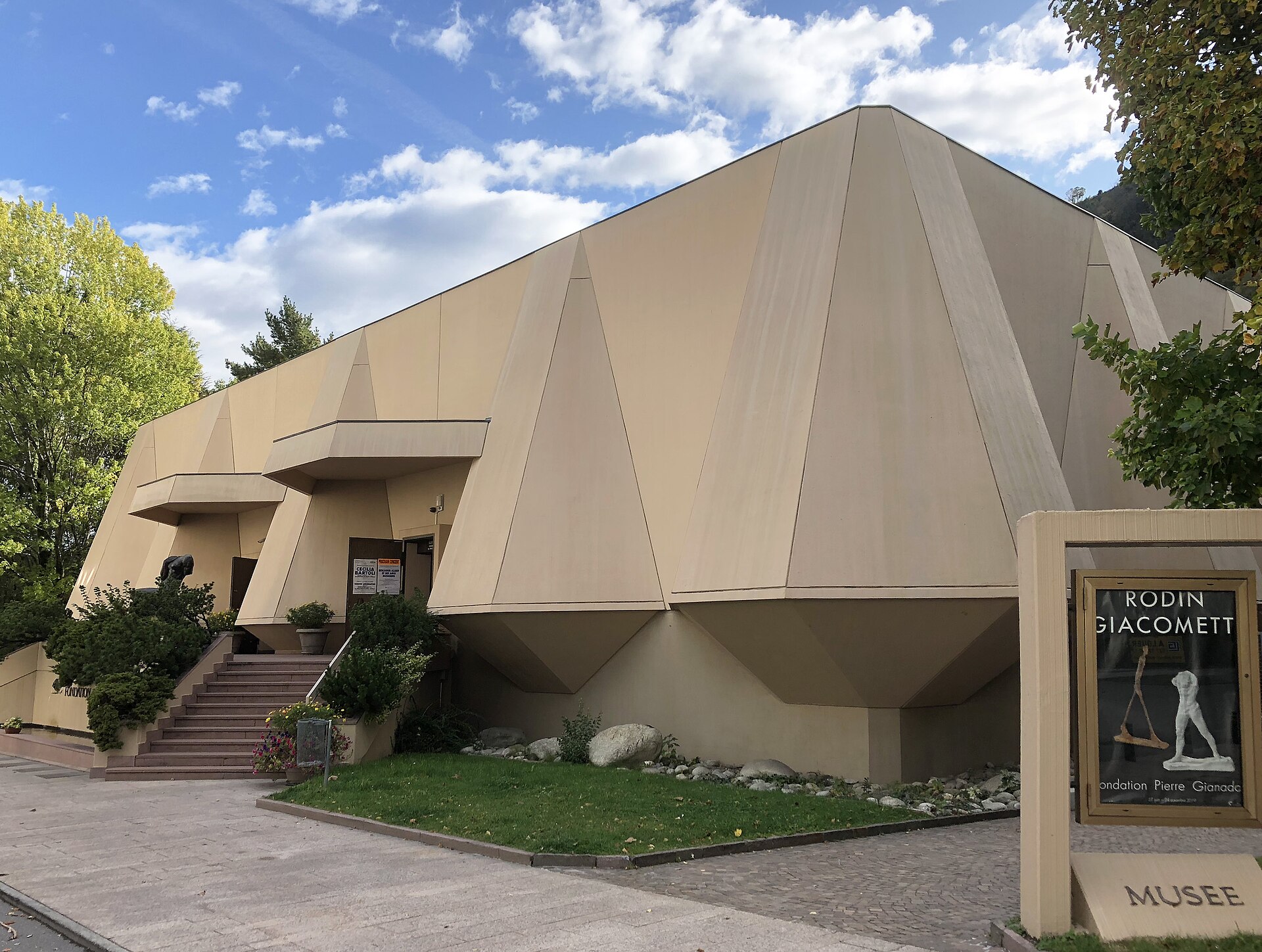
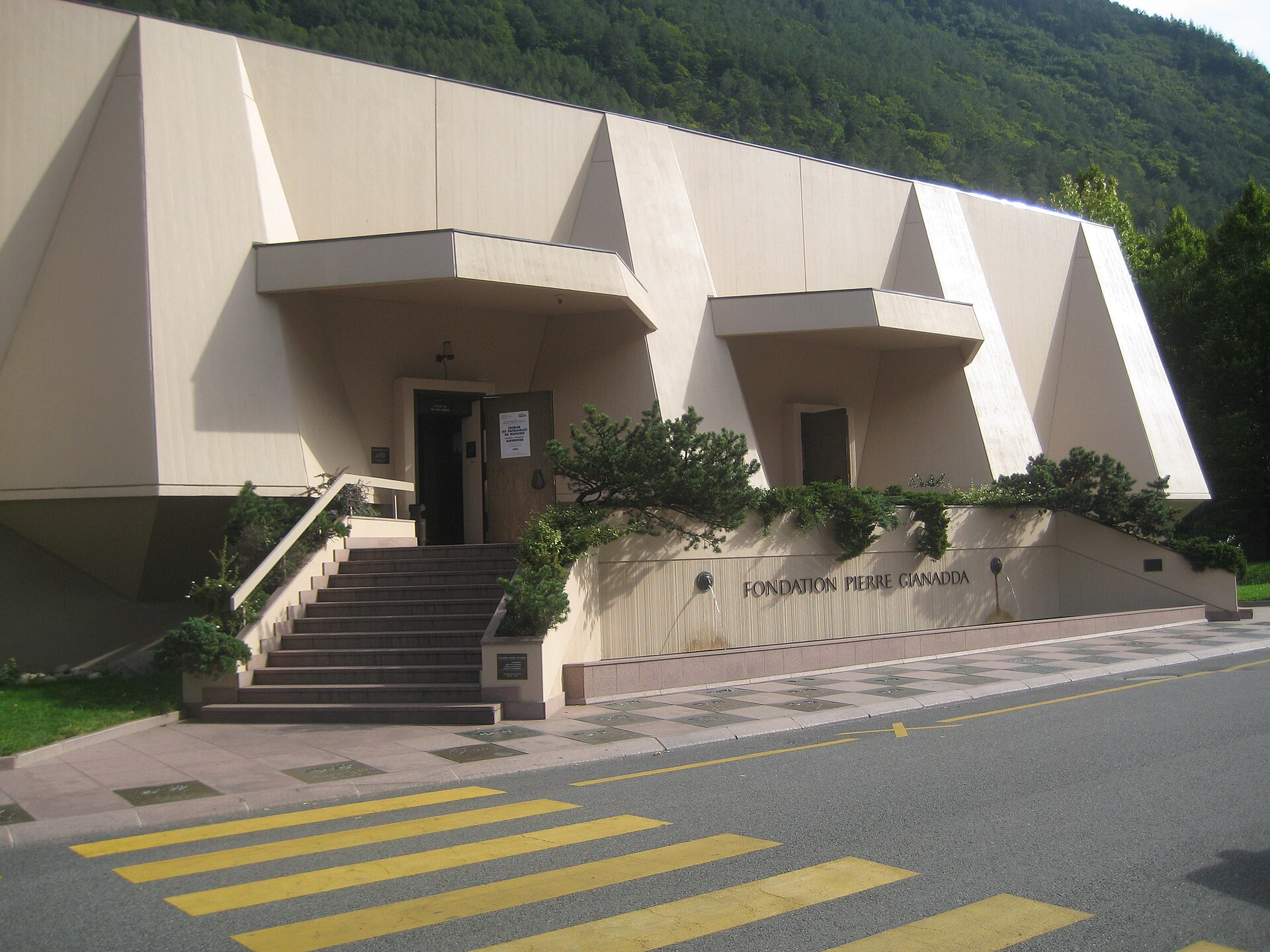
An exterior photograph of the Fondation Pierre Gianadda building in Martigny, Switzerland, taken 10 October 2019.
Arkelin · CC BY 4.0Fondation Pierre Gianadda
Museum · Founded 1977
Open, admission and hours confirmed 31 August 2026 · 12 sources
On this page 15 sections
ContentsClose
Not an encyclopaedic museum built by acquisition, but a single Alpine site running three permanent collections of its own - a Gallo-Roman temple displayed where it was excavated, a working collection of pre-1939 cars weighted toward early Swiss marques, and an outdoor sculpture park of roughly 47 works by more than 40 twentieth-century sculptors including Rodin, Moore, Calder, Brancusi, Miro and Chagall - alongside two loan exhibitions a year that have brought Van Gogh, Picasso, Cezanne, Monet, Gauguin, Klimt, Schiele, Goya and Bacon to a town of under 20,000 people. Its own standing collection has not been static: a ten-painting deposit from the Louis and Evelyn Franck collection, including two Van Goghs, anchored the site's painting galleries from 1998 to 2015 before the family withdrew and sold it.
| Kind | Museum |
|---|---|
| Founded | Constitutional act signed 24 February 1977 at Martigny town hall; the building opened to the public 19 November 1978, on what would have been the 40th birthday of Pierre Gianadda, in whose memory it was founded |
| City and country |  Martigny, Switzerland Martigny, Switzerland |
| Address | Rue du Forum 59, CH-1920 Martigny, Switzerland |
| Website | gianadda.ch |
| Status | Open, confirmed |
| Record last verified |
Visiting
- Hours
- Every day10:00 to 18:00The foundation's own site states this schedule as year-round with no published weekly closing day; a third-party aggregator (WhichMuseum) separately describes a seasonal split of 10:00-18:00 from November to June and 09:00-18:00 in the summer months, which the foundation's own primary pages read for this record do not themselves state, so it is noted here rather than adopted as fact
- Closed
- No weekly closing day is stated on the foundation's own site; it advertises itself as open daily.
- Admission
- AdultCHF 20
- Senior (60+)CHF 18
- Student under 25 (with proof)CHF 12
- Child (10 and over)CHF 12Children under 10 are not charged a listed individual fare on the page read for this record
- Person with a disability (AI card)CHF 18
- Family (parents with children)CHF 42
- Group, 10 or more, adultCHF 18Per person
- Annual pass, adultCHF 48Unlimited admission for one year
- Annual pass, seniorCHF 42Unlimited admission for one year
Free entry: No general public free-admission day is published on the foundation's own tariff page; free entry is instead extended to Valais schools and to holders of specific professional or membership cards (Amis de la Fondation Pierre Gianadda, press cards, ICOM, ICOMOS, Visarte, AMS-VM, the Swiss Museum Passport, and certain Sotheby's Preferred and Raiffeisen Visa/Mastercard Member Plus cards)- Tickets
- booking-corner.com/cmsscripts/bookOnline.aspx... The museum's own ticket page.
- Do I need to book?
- No advance booking is described as required for individual visitors on the sources read for this record; tickets are sold online through the foundation's booking-corner.com portal and, on the evidence of its practical-visits pages, also at the door.
- Address
- Rue du Forum 59, CH-1920 Martigny, Switzerland MapRail Martigny railway station, on the SBB/CFF main line and the Martigny-Chatelard and Saint-Bernard Express narrow-gauge lines, is roughly a 20-25 minute walk or a short bus ride from the foundation.
Bus Local bus line 201, direction Martigny-Croix, from Martigny station to the stop Martigny, Fondation Gianadda, then about 3 minutes on foot, on the foundation's own access page.
Car An adjacent outdoor car park is open around the clock; parking is free from 7am to 7pm (5-hour maximum) and free overnight from 7pm to 7am, with four electric-vehicle charging points and two spaces reserved for visitors with disabilities, on the foundation's own access page. - Website
- gianadda.ch
- Telephone
- +41 27 722 39 78
Before you go how long, access, photography, bags, eating, shop
- How long to allow
- Not stated as a specific duration in the sources read for this record. The site combines a temporary exhibition, a Gallo-Roman museum, an automobile museum, a sculpture park and, seasonally, the Vieil Arsenal, which together suggest at least two to three hours for a visitor wanting to see all of it, though this is this record's own inference rather than a published figure.
- Access
- Described by the foundation's own site as fully accessible: a dedicated accessible entrance, ramps and a lift (rated to 220 kg), wheelchairs, seating chairs and a rollator available on loan, and two reserved parking spaces. Visitors needing assistance are asked to announce themselves at reception. The garden is described as level and barrier-free throughout.
- Photography
- Not addressed in the sources read for this record.
- Bags
- Not addressed in the sources read for this record.
- Eating
- The Patio des Jardins restaurant operates on the grounds, on the foundation's own navigation; during the summer months in 2026 the gardens and this restaurant were advertised as staying open into the evening, with extended hours on Fridays and Saturdays until 9pm through 31 August 2026.
- Shop
- The foundation operates a shop, gianadda-shop.ch, selling exhibition catalogues and related items, on the evidence of that shop's own separate site.
Prices and hours change. We take them from the institution's own pages and print the day we read them, and you can check the current position at the source we used. Confirm before you travel.
What is inside
Musee Gallo-Romain (Gallo-Roman Museum)
A ground-floor museum built directly around the remains of a Gallic and later Gallo-Roman temple, discovered in June 1976 during archaeological survey work required before the tower block Leonard Gianadda had originally planned on the site could be authorised. The display covers the two successive settlements on the site, the Gallic-period Octodurus and the Roman-period Forum Claudii Vallensium, and includes the Grands Bronzes d'Octodure, a group of Gallo-Roman bronzes including a three-horned bull's head first found in 1883 and, on the foundation's own account, only transferred from the cantonal collection in Sion to permanent display in Martigny after decades of negotiation. The room was redesigned in 2008 under the cantonal archaeologist Francois Wible and serves as the start or end point of the Promenade archeologique de Martigny-la-Romaine, a walking route through the town's Roman-era remains.
Musee de l'Automobile (Automobile Museum)
A collection of roughly fifty vintage cars built between 1897 and 1939, kept in running order, established in 1981 under the direction of the mechanic Fortunato Visentini. The oldest cars include an 1897 Benz and an 1897 Jeanperrin; other early models include a 1902 Stanley, a 1902 Oldsmobile Curved Dash, a 1906 De Dion-Bouton and a 1912 Ford Model T. The museum's own emphasis is on Swiss-built marques, above all Martini, built in Saint-Blaise in the canton of Neuchatel from 1903, alongside Swiss makes including Stella, Zedel and Pic-Pic; prestige marques on display include Rolls-Royce, Bugatti, Mercedes-Benz, Alfa Romeo, Isotta-Fraschini and Hispano-Suiza, with several cars described by the foundation as the only surviving example of their model.
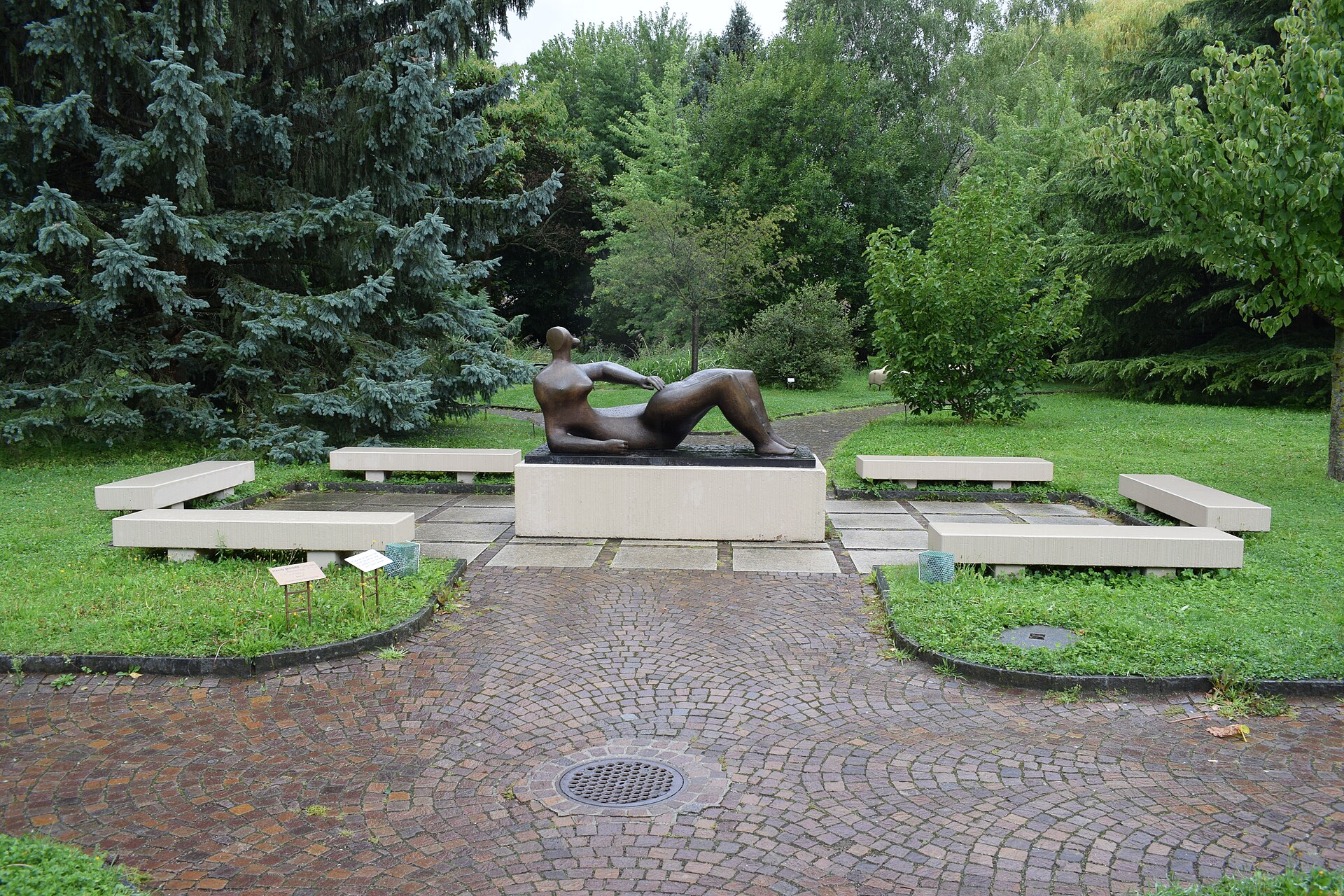
Photograph by Jeanhousen · CC BY-SA 4.0 Parc de sculptures (Sculpture Park)
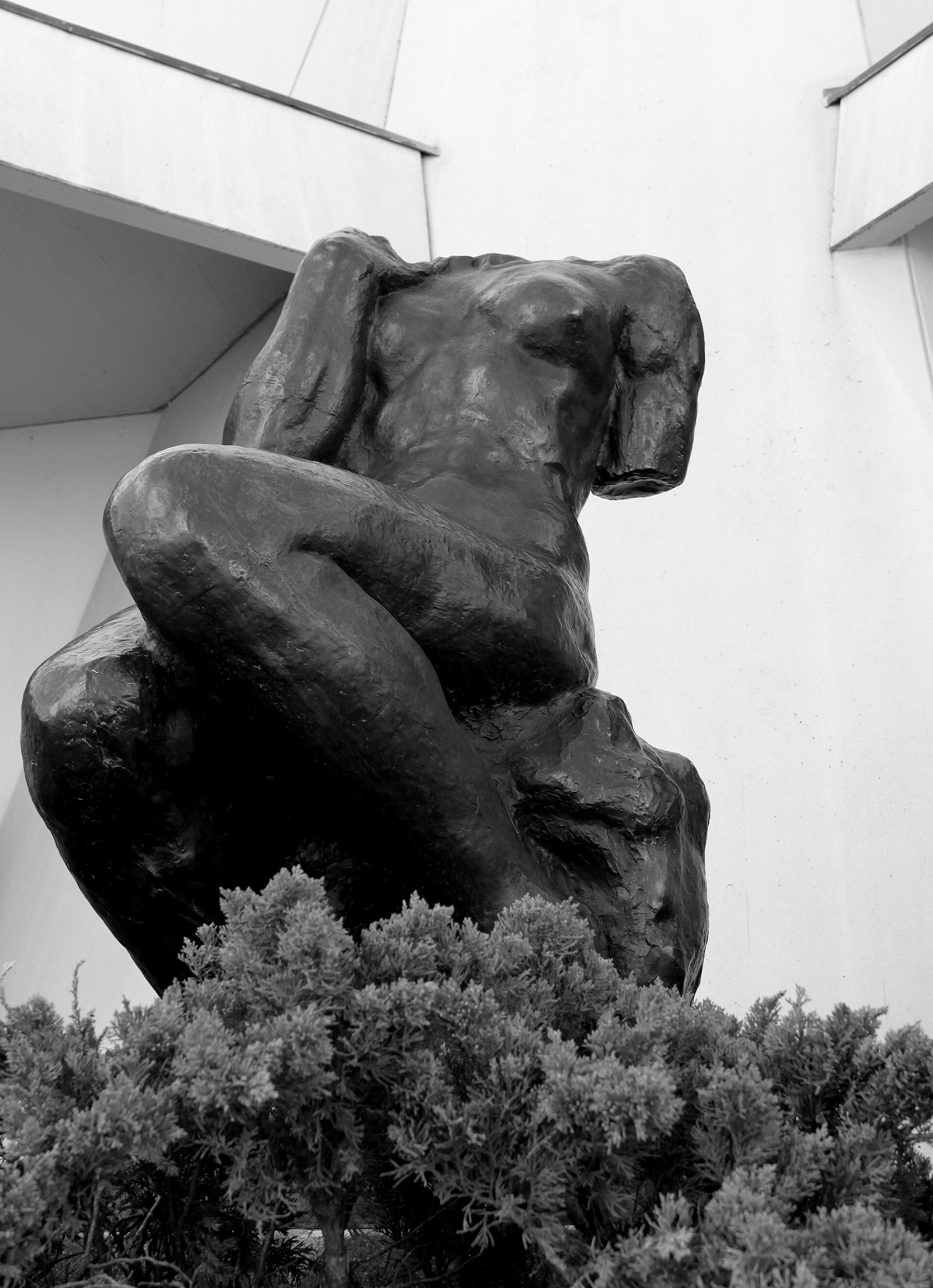
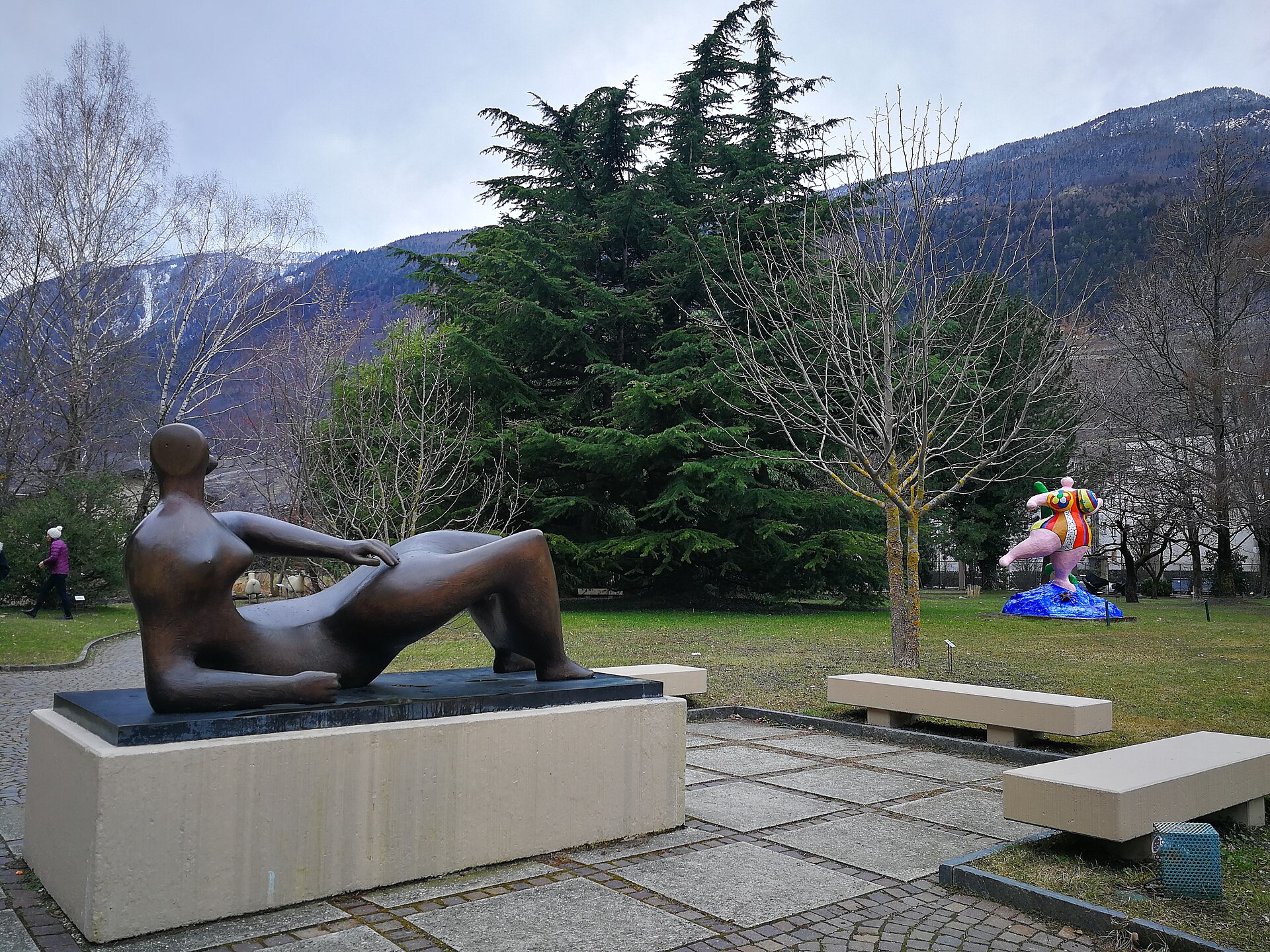
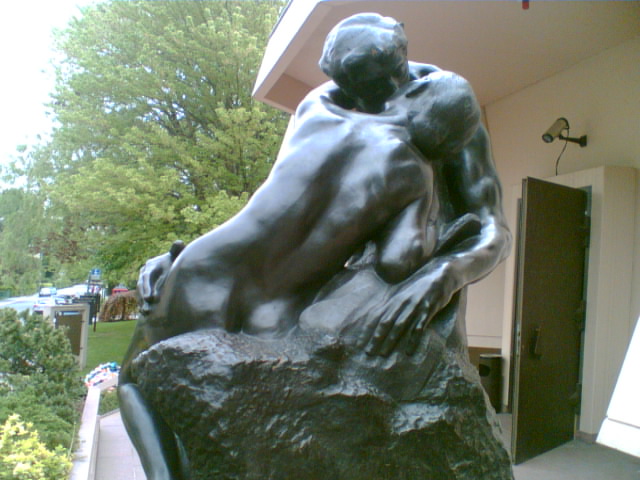
An outdoor sculpture park across the gardens, begun in the 1980s and expanded substantially after a 1989 Henry Moore exhibition, now holding some 47 works by more than 40 sculptors, among them Auguste Rodin (a cast of The Kiss and further works, Meditation with Arms and La Cybele), Henry Moore (Reclining Figure, 1982), Alexander Calder, Constantin Brancusi, Joan Miro, Barbara Hepworth, Jean Arp, Cesar, Niki de Saint Phalle, Aristide Maillol, Eduardo Chillida, Antoni Tapies, Jean Dubuffet, George Segal, Robert Indiana and Marc Chagall among others. It is cited by the Gazette Drouot, on the foundation's own account, as one of the five finest sculpture parks in Europe.
Pavillon Szafran
A dedicated pavilion, seating up to 80 for events and screenings, built around two monumental ceramic murals by the painter Sam Szafran, made in collaboration with the ceramicist Joan Gardy Artigas in workshops at Malakoff and Barcelona: Escalier (2005) on the northwest wall and Philodendrons (2006) on the southeast wall, each 3.35 metres tall by 7.35 metres wide and built from 220 individual 33cm stoneware tiles. A further room in the pavilion, the Salle Szafran, shows other works by Szafran from the foundation's own holdings.
Le Vieil Arsenal
A former militia arsenal on the foundation's grounds, originally built by Leonard Gianadda's grandfather Baptiste Gianadda, which passed to the Commune of Martigny in 1993 before being restored and reopened by the foundation in May 1996. It runs seasonal exhibitions, April to November, on regional Valais artists and local historical themes; recent programming read for this record included a multi-year retrospective on Leonard Gianadda's own life and, planned for 2025, a show on his early work as a photojournalist between 1953 and 1956.
Main exhibition galleries
The foundation's principal indoor galleries stage two major loan exhibitions a year, drawn from public and private collections rarely otherwise seen together; recent examples read for this record include De Rembrandt a Van Gogh, built around the Armand Hammer Collection from Los Angeles (2025), Francis Bacon - Presence humaine (2025) and De Manet a Kelly - L'art de l'empreinte (2025-2026). At the time this record was researched the galleries held Rodin selon Rilke (26 June to 22 November 2026), the fourth time, on the foundation's own account, that Auguste Rodin's work has been the subject of an exhibition here; that exhibition is a separate, dated, touring show and is not part of this venue's own permanent holdings.
What to see first
The Gallo-Roman temple beneath the building
Unknown Gallic and later Gallo-Roman buildersThe reason the foundation exists in this form at all: survey work ahead of a planned residential tower uncovered the temple in June 1976, and Leonard Gianadda built the museum around it rather than over it after his brother Pierre's death the following month. The temple remains are displayed in place in the ground-floor Gallo-Roman museum.9
The Grands Bronzes d'Octodure
Gallo-Roman workshops, findspot MartignyA group of Gallo-Roman bronzes, including a three-horned bull's head first recovered in 1883, that on the foundation's own account only reached permanent display in Martigny after decades of negotiation to bring them from the cantonal collection in Sion.9
The Kiss (Le Baiser), cast of Auguste Rodin's sculpture
Auguste RodinOne of several Rodin works standing permanently in the sculpture park, independent of the foundation's 2026 loan exhibition on Rodin and Rilke; the park also holds Rodin's Meditation with Arms and La Cybele.6
Reclining Figure (1982)
Henry MooreA large bronze that anchors the sculpture park's post-1989 expansion, staged after a dedicated Moore exhibition that year prompted the foundation to grow the park substantially.6
Escalier and Philodendrons, ceramic murals
Sam Szafran, with Joan Gardy ArtigasTwo monumental stoneware murals, each 3.35 by 7.35 metres and built from 220 individual tiles, made specifically for the Pavillon Szafran and unique to this site.10
The Martini collection in the Automobile Museum
Martini, Saint-Blaise, Neuchatel, from 1903The foundation's automobile museum concentrates on early Swiss-built cars rather than an international spread, and Martini, built in the same country the collection sits in, is its central marque, alongside Stella, Zedel and Pic-Pic.11
The Weary Herakles precedent - a foundation that has weathered real controversy
N/ANot an object but a fact about the institution: the foundation's very first exhibition, opening with the building on 19 November 1978, presented supposedly unknown paintings attributed to Durer, Rembrandt and Rubens that were subsequently exposed as forgeries, sold to a novice collector by a dubious dealer - a scandal the foundation only recovered from after Leonard Gianadda brought in the art critic Andre Kuenzi and staged credible Picasso and Klee exhibitions that rebuilt its standing.9
Exhibitions on now
- Opening soon5 Dec 2026 to 13 Jun 2027Confirmed , 6 weeks ago
A memorial that became a museum
The Fondation Pierre Gianadda exists because of a building project that never happened. In the early 1970s the Martigny engineer and property developer Leonard Gianadda planned a sixteen-storey residential tower, the Belvedere, on a plot in the town centre. The canton required archaeological survey work before construction could be authorised, and in June 1976 that survey uncovered the remains of a Gallic and later Gallo-Roman temple several metres under the site. The find alone would have forced a redesign. What actually changed the project's purpose was a second, unrelated event five weeks later: on 31 July 1976 Leonard's younger brother Pierre died in an aeroplane accident. Leonard abandoned the tower and, within weeks, had decided to build a foundation in Pierre's memory on the same ground, over the temple rather than in place of it.
The foundation's constitutional act was signed at Martigny town hall on 24 February 1977; Leonard provided the land and financed almost all of the construction himself. The building opened to the public on 19 November 1978, chosen because it was the date of what would have been Pierre's fortieth birthday. Leonard Gianadda ran the institution personally for the rest of his life, until his death from bone cancer on 3 December 2023 at the age of 88; his nephew Francois Gianadda became president in May 2024.
A rough start: forged Old Masters
The foundation's very first exhibition nearly ended it. The opening show in November 1978 presented paintings attributed to Albrecht Durer, Rembrandt and Peter Paul Rubens, drawn together for a novice collector still new to the art world. The attributions did not hold: the paintings were exposed as forgeries, sold to Gianadda by an unreliable dealer, and the resulting embarrassment threatened to define the young institution before it had properly begun. Gianadda's response was to bring in a professional: he hired the art critic Andre Kuenzi, and the exhibitions that followed, on Pablo Picasso and Paul Klee, were credible enough to rebuild the foundation's reputation. The forged paintings are not part of any collection now on display and this record includes the episode because a museum's early failures, and how it recovered from them, belong on the record as much as its successes.
The temple, the cars, and the garden: three permanent collections in one building
Unusually for a foundation built primarily to host loan exhibitions, the Fondation Pierre Gianadda also runs three genuinely permanent collections of its own, none of them assembled by conventional acquisition. The Gallo-Roman museum on the ground floor is built directly around the temple discovered in 1976, tracing the site through its Gallic-period settlement, Octodurus, and its Roman successor, Forum Claudii Vallensium; its centrepiece bronzes, including a three-horned bull's head first found in 1883, only reached permanent display in Martigny after a long negotiation to bring them from the cantonal collection held in Sion, and the room itself was redesigned in 2008 under the cantonal archaeologist Francois Wible.
The automobile museum, established in 1981 under the mechanic Fortunato Visentini, holds around fifty vehicles built between 1897 and 1939, all kept in running order, with a deliberate emphasis on early Swiss manufacturers - Martini of Saint-Blaise above all, alongside Stella, Zedel and Pic-Pic - set against a scattering of Rolls-Royce, Bugatti, Mercedes-Benz, Alfa Romeo, Isotta-Fraschini and Hispano-Suiza. And the sculpture park, begun in the 1980s and substantially expanded after a 1989 Henry Moore exhibition, now holds some 47 outdoor works by more than 40 sculptors including Auguste Rodin, Moore himself, Alexander Calder, Constantin Brancusi, Joan Miro, Jean Arp and Marc Chagall - a collection the Gazette Drouot has ranked, on the foundation's own account, among the five finest sculpture parks in Europe.
A collection that left: the Louis and Evelyn Franck paintings
For seventeen years the foundation also held a fourth, quieter permanent collection that is no longer there. In 1998 the family of the Belgian-born, London-based collector Louis Franck (1907-1988) and his wife Evelyn placed ten paintings on long-term deposit at the foundation, inaugurated alongside that summer's Gauguin exhibition as Martigny's first standing permanent collection: two paintings by Vincent van Gogh, including the 1889 Paysage sous un ciel mouvemente, a Pablo Picasso, two works by Paul Cezanne, three by James Ensor, a Toulouse-Lautrec and Kees van Dongen's Femme au chapeau vert. In October 2015 the family withdrew the collection, following its own wishes, and the ten paintings were sold at auction in New York the following month for a total Leonard Gianadda himself estimated at over 100 million Swiss francs, with the Van Gogh landscape alone expected to fetch between 50 and 80 million dollars. Gianadda gave an exclusive interview to the regional paper Le Nouvelliste at the time, describing himself as sad at the loss but grateful for what he called the fabuleux privilege of having shown an exceptional collection for so long. The Franck rooms are not currently occupied by a comparable standing collection on the evidence read for this record; the space now supports the foundation's rotating loan exhibitions instead.
Two exhibitions a year, and the current show
Since the Kuenzi-era recovery from the 1978 scandal, the foundation's core public activity has been staging two major loan exhibitions a year in its main galleries, drawing on public and private collections that do not often travel together and, on its own account, partnering at various points with institutions including the Centre Pompidou, the British Museum and the Metropolitan Museum of Art. A 2000 Van Gogh exhibition drew a reported 500,000 visitors, a record for the foundation, and total attendance across its history is put at over 10 million by both the foundation's own account and independent reporting at Leonard Gianadda's death. Recent programming read for this record includes De Rembrandt a Van Gogh, built around the Armand Hammer Collection of Los Angeles, and Francis Bacon - Presence humaine, both in 2025, and De Manet a Kelly - L'art de l'empreinte, running into mid-2026.
At the time this record was researched, the main galleries held Rodin selon Rilke (26 June to 22 November 2026), described by the foundation as the fourth occasion it has devoted an exhibition to Auguste Rodin's work. This is a dated, touring loan exhibition, distinct from the foundation's own permanent Rodin holdings in the sculpture park outside, and nothing in this record attributes facts, objects or photographs belonging to that touring show, or to any lending institution associated with it, to the Fondation Pierre Gianadda's own permanent collection.
Beyond the main building: the Vieil Arsenal and the Pavillon Szafran
Two further spaces round out the site. Le Vieil Arsenal, a former militia arsenal originally built by Leonard Gianadda's own grandfather Baptiste, passed to the Commune of Martigny in 1993 before the foundation restored it and reopened it in May 1996; it now runs seasonal exhibitions, April to November, on regional Valais art and local history, including a multi-year retrospective on Leonard Gianadda's own life and photography. The Pavillon Szafran, added later, was built around two monumental ceramic murals, Escalier and Philodendrons, made specifically for the space by the painter Sam Szafran in collaboration with the ceramicist Joan Gardy Artigas; a further gallery in the same pavilion shows other Szafran works from the foundation's own holdings, and the pavilion itself doubles as an events space seating up to 80.
What visitors say
We publish no visitor-review prose and no unverified numeric aggregate here: attempts to read Google's and TripAdvisor's own review pages for this venue were blocked by both platforms (see notes_for_editor for the methods tried), so this section rests on named published characterisation and on what a genuine TripAdvisor and Google review count and topic pattern surfaced through search summaries, treated as an indication of consensus rather than a quoted or scored source. On that evidence, and on the foundation's own published visitor figures, the Fondation Pierre Gianadda is consistently described as an unusually ambitious cultural institution for a small Alpine town of its size: a single site combining loan exhibitions of international-museum quality, a Roman temple displayed where it was found, one of Europe's more highly regarded outdoor sculpture parks, and a working vintage-car collection, built and largely funded by one man, Leonard Gianadda, over nearly five decades until his death in December 2023. Its history is not spotless: the very first exhibition it staged, in November 1978, turned out to include forged Old Master paintings, and a headline part of its collection, the Louis and Evelyn Franck paintings (Van Gogh, Picasso, Cezanne, Ensor, Toulouse-Lautrec and Van Dongen), which had been on view since 1998, was withdrawn by the family and sold at auction in New York in November 2015 for a sum Gianadda himself estimated at over 100 million Swiss francs, rather than remaining part of the collection permanently.
What is praised, what is criticised
- Praised: the sculpture park, repeatedly singled out by name (the Gazette Drouot ranking cited by the foundation itself places it among Europe's five finest) for the range and quality of the twentieth-century sculptors represented outdoors
- Praised: the ambition and quality of the loan exhibitions the foundation stages twice a year, drawing on public and private collections, including major museums such as the Pompidou, the British Museum and the Metropolitan Museum of Art, rarely otherwise brought together in a town of Martigny's size
- Praised: the Gallo-Roman museum's integration of the actual excavated temple into the building itself, rather than treating the find as a separate archaeological site
- Criticised: the foundation's own inaugural exhibition in November 1978, which included paintings attributed to Durer, Rembrandt and Rubens that were exposed as forgeries sold to Leonard Gianadda, at the time a novice collector, by an unreliable dealer - a scandal from which the institution only recovered by bringing in professional curatorial judgement
- Criticised: the 2015 departure of the Louis and Evelyn Franck collection, on view since 1998 and including two Van Goghs, a Picasso, two Cezannes, three works by Ensor, a Toulouse-Lautrec and Van Dongen's Femme au chapeau vert, withdrawn at the family's wish and sold at auction rather than remaining part of the foundation's permanent display, which Leonard Gianadda himself, in a contemporary interview, described as sad even as he called hosting the collection for seventeen years a privilege
Questions about Fondation Pierre Gianadda
Where is Fondation Pierre Gianadda?
Rue du Forum 59, CH-1920 Martigny, Switzerland.
How much does it cost to visit?
Adult: CHF 20; Senior (60+): CHF 18; Student under 25 (with proof): CHF 12; Child (10 and over): CHF 12; Person with a disability (AI card): CHF 18. As confirmed 31 August 2026.
When is it open?
Every day 10:00-18:00. Closed: No weekly closing day is stated on the foundation's own site; it advertises itself as open daily. As confirmed 31 August 2026.
How do you get there?
Rail: Martigny railway station, on the SBB/CFF main line and the Martigny-Chatelard and Saint-Bernard Express narrow-gauge lines, is roughly a 20-25 minute walk or a short bus ride from the foundation; Bus: Local bus line 201, direction Martigny-Croix, from Martigny station to the stop Martigny, Fondation Gianadda, then about 3 minutes on foot, on the foundation's own access page; Car: An adjacent outdoor car park is open around the clock; parking is free from 7am to 7pm (5-hour maximum) and free overnight from 7pm to 7am, with four electric-vehicle charging points and two spaces reserved for visitors with disabilities, on the foundation's own access page.
What should you see first?
The Gallo-Roman temple beneath the building (Unknown Gallic and later Gallo-Roman builders); The Grands Bronzes d'Octodure (Gallo-Roman workshops, findspot Martigny); The Kiss (Le Baiser), cast of Auguste Rodin's sculpture (Auguste Rodin); Reclining Figure (1982) (Henry Moore); Escalier and Philodendrons, ceramic murals (Sam Szafran, with Joan Gardy Artigas); The Martini collection in the Automobile Museum (Martini, Saint-Blaise, Neuchatel, from 1903).
What we could not confirm
- The foundation's own official history page (gianadda.ch/fondation/historique/) does not mention the 1978 forged Old Masters exhibition at all; the episode is documented only in tertiary sources (French Wikipedia and search-indexed press coverage) rather than the museum's own account, and this record has not located a contemporary 1978-79 news report of the scandal to cite directly.
- Sources disagree on the exact date the alleged forgeries were exhibited: French Wikipedia and the record's own reading of it associate the fraud with the 19 November 1978 opening show, while a separate search-indexed source names an exhibition titled Cinq siecles de peinture and dates it to 1979; this record has not resolved which is correct and states both readings rather than picking one.
- Whether the galleries that held the Franck collection from 1998 to 2015 were given a name of their own, and what if anything permanently replaced that collection rather than rotating loan shows through the space, is not addressed in the sources read for this record.
- No current numeric visitor-review aggregate (Google or TripAdvisor) could be read directly: both platforms' own pages for this venue returned blocked or empty responses to every fetch method tried (see notes_for_editor). This record therefore relies on named published characterisation rather than a scored aggregate.
- Hours: the foundation's own primary pages state a flat daily 10:00-18:00 schedule year-round with no stated seasonal variation or closing day; a third-party aggregator (WhichMuseum) separately describes a seasonal 09:00-18:00 summer schedule that this record could not confirm against a primary source, and is noted rather than adopted.
- No confirmed public email address for the foundation could be read directly; the contact page's address is rendered through client-side script rather than plain text, and a search-engine-suggested address could not be independently verified against a source this record actually fetched, so the email field is left blank rather than populated with an unverified guess.
Images
Sources
- 1Wikidata, Fondation Pierre Gianadda (Q687778). Verified by label match and by claims: P17 Switzerland, P131 Martigny, P625 coordinates 46.09513, 7.0708, P856 official website gianadda.ch. wikidata.org/wiki/Q687778
- 2Fondation Pierre Gianadda, official site, home page and Contactez-nous / access page. Confirms the museum is open, its daily 10:00-18:00 hours, its address, phone numbers (main and administration), parking terms, public transport directions from Martigny station, accessibility provision, and the current headline exhibition Rodin selon Rilke (26 June-22 November 2026). Fetched 31 August 2026. gianadda.ch/contact-acces
- 3Fondation Pierre Gianadda, official site, Historique (history) page. The foundation's own account of its founding: the 1976 Gallo-Roman temple discovery during survey work for the planned Belvedere tower, Pierre Gianadda's death on 31 July 1976, the 24 February 1977 constitutional act, the 19 November 1978 opening, the 1980s-1996 growth of the sculpture park, Vieil Arsenal and Pavillon Szafran, and a total-visitor figure of roughly 10 million across the foundation's first 40 years. Fetched 31 August 2026. gianadda.ch/fondation/historique/
- 4Fondation Pierre Gianadda, official site, Visites & tarifs (visits and admission prices) page. Full current price list by tier in Swiss francs, free-admission categories, and annual pass prices. Fetched 31 August 2026. gianadda.ch/visites_pratiques/billets-tarifs/
- 5Fondation Pierre Gianadda, official site, permanent-space pages for the sculpture park, automobile museum, Gallo-Roman museum, Vieil Arsenal and Pavillon Szafran (under /decouvrir/espaces/). Descriptions of each space's holdings: roughly 50 vintage cars 1897-1939 with a Swiss-marque emphasis (Martini, Stella, Zedel, Pic-Pic); the Gallo-Roman temple and the Grands Bronzes d'Octodure; some 47 sculpture-park works by more than 40 named sculptors; the Vieil Arsenal's history as a former militia arsenal built by Baptiste Gianadda; and the Pavillon Szafran's two Sam Szafran / Joan Gardy Artigas ceramic murals, Escalier and Philodendrons. Fetched 31 August 2026. gianadda.ch/decouvrir/espaces/musee-de-lautomobile
- 6Wikimedia Commons, categories Category:Parc de sculptures de la Fondation Pierre Gianadda (Martigny), Category:RODIN (Fondation Pierre Gianadda), Category:MOORE (Fondation Pierre Gianadda) and Category:The Kiss by Auguste Rodin, Fondation Pierre Gianadda. Confirms Rodin (The Kiss, Meditation with Arms, La Cybele) and Henry Moore's Reclining Figure (1982) stand in the permanent sculpture park, independent of the current touring Rodin exhibition. commons.wikimedia.org/wiki/Category:Parc_de_sculptures_de_la_Fondation_Pierre_Gianadda_(Martigny)
- 7The Art Newspaper (French edition), 'Leonard Gianadda, createur de la Fondation Pierre Gianadda, est mort', by Emmanuel Grandjean, 4 December 2023. Leonard Gianadda's death on 3 December 2023 at 88 from bone cancer; the foundation's 1977 founding; a 2000 Van Gogh exhibition drawing a record 500,000 visitors; total visitors of over 10 million; his positions on the Musee d'Orsay acquisitions commission and as a Phillips Collection administrator; and the note, at the time of writing, that he had named no successor. Fetched directly and read in full via browser, 31 August 2026; content verbatim-verified against the citation. artnewspaper.fr/2023/12/04/leonard-gianadda-createur-de-la-fondation-pierre-gianadda-est-mort
- 8Le Nouvelliste, 'Martigny: la prestigieuse collection Franck quitte la Fondation Pierre Gianadda', by Patrice Genet, 16 October 2015. The Louis and Evelyn Franck collection's departure from Martigny after 17 years on deposit since 1998, the ten works involved (two Van Goghs including Paysage sous un ciel mouvemente, a Picasso, two Cezannes, three Ensors, a Toulouse-Lautrec and Van Dongen's Femme au chapeau vert), the November 2015 New York auction and its estimated total of over 100 million Swiss francs, and Leonard Gianadda's own on-the-record reaction. Fetched directly via browser, raw page text read, 31 August 2026. lenouvelliste.ch/articles/valais/martigny-region/la-collection-franck-quitte-martigny-interview-exclusive-de-leonard-gianadda-449357
- 9French Wikipedia, Fondation Pierre Gianadda. The 1976 Gallo-Roman temple discovery, the building's description as a large blind concrete structure built over the temple, the 19 November 1978 opening and its controversial inaugural exhibition of works attributed to Durer, Rembrandt and Rubens later exposed as forged, the hiring of the critic Andre Kuenzi and subsequent Picasso and Klee exhibitions, the automobile museum's roughly 50 vehicles (1897-1939) including some 15 Swiss makes, the sculpture park's roster of named sculptors, the Sam Szafran pavilion, annual visitor and staffing figures (about 60 staff, an 8 million Swiss franc annual budget), and Francois Gianadda's May 2024 succession as president. fr.wikipedia.org/wiki/Fondation_Pierre_Gianadda
- 10Fondation Pierre Gianadda, official site, Pavillon Szafran page. Dimensions and construction detail (3.35 x 7.35 metres, 220 stoneware tiles per mural) for Escalier (2005) and Philodendrons (2006), and the collaboration between Sam Szafran and the ceramicist Joan Gardy Artigas across workshops in Malakoff and Barcelona. Fetched 31 August 2026. gianadda.ch/decouvrir/espaces/pavillon-szafran
- 11Fondation Pierre Gianadda, official site, Musee de l'automobile page, and independent web search corroboration. The automobile museum's roughly 50 vehicles 1897-1939, its establishment in 1981 under Fortunato Visentini, its Swiss-marque emphasis (Martini of Saint-Blaise, Neuchatel, from 1903; Stella; Zedel; Pic-Pic) and named prestige marques (Rolls-Royce, Bugatti, Mercedes-Benz, Alfa Romeo, Isotta-Fraschini, Hispano-Suiza). Fetched 31 August 2026. gianadda.ch/decouvrir/espaces/musee-de-lautomobile
- 12Fondation Pierre Gianadda, official site, current-exhibitions page (Expositions). Confirms Rodin selon Rilke as the current headline show (26 June-22 November 2026), described by the foundation as its fourth exhibition devoted to Rodin, and lists the recent exhibition sequence: Francis Bacon - Presence humaine (Feb-June 2025), De Rembrandt a Van Gogh with the Armand Hammer Collection (June-Dec 2025), De Manet a Kelly - L'art de l'empreinte (Dec 2025-June 2026) and Leonard Gianadda - Photoreporter (March-Nov 2026). Fetched 31 August 2026. gianadda.ch/expositions/