Finnish National Gallery / Kiasma
Museum · Kansallisgalleria / Nykytaiteen museo Kiasma · Founded 1998
Open, admission and hours confirmed 18 September 2026 · 24 sources
On this page 14 sections
ContentsClose
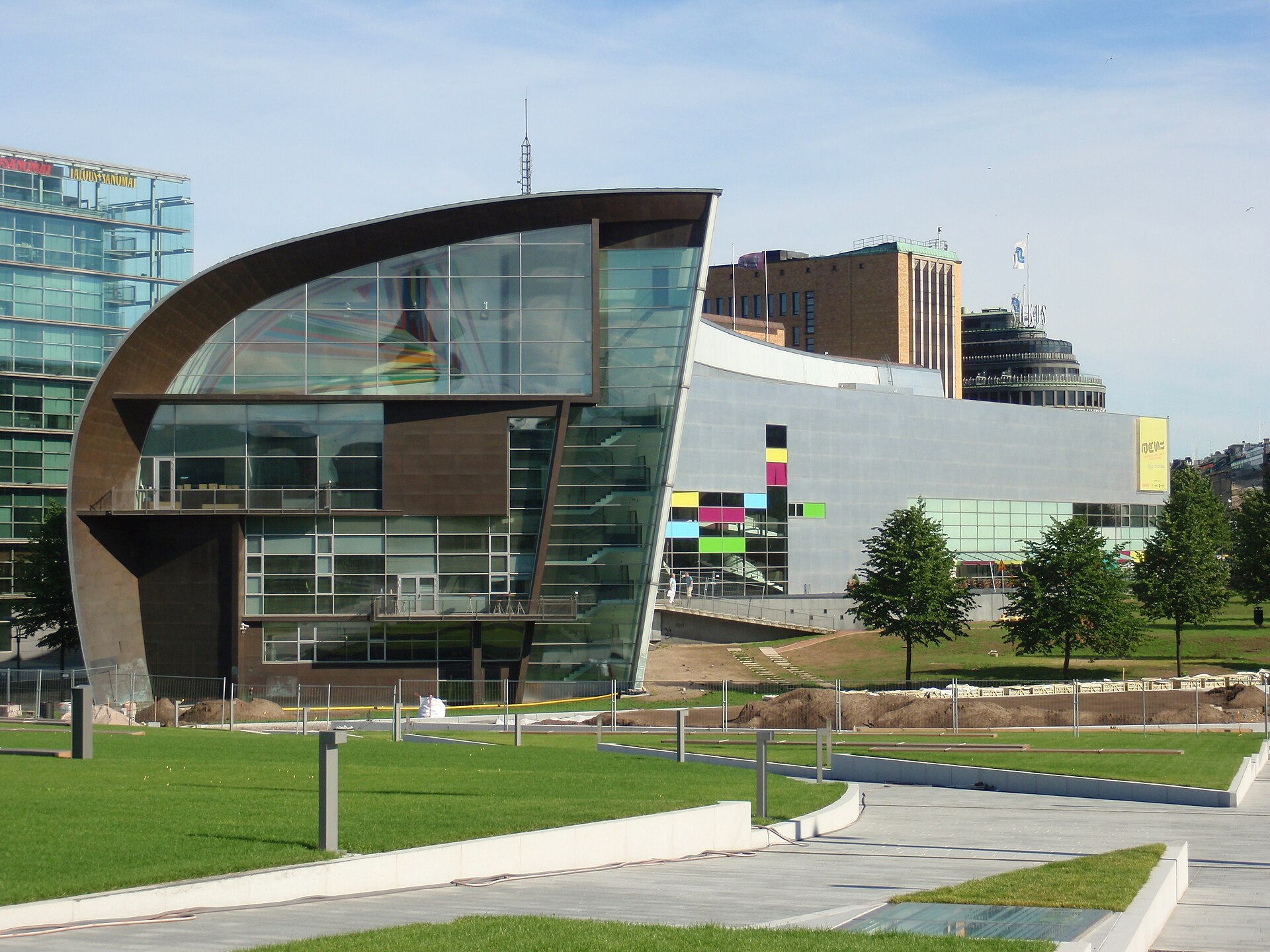
Kiasma is the Finnish National Gallery's contemporary-art unit rather than a museum with an independent collection of its own: it holds roughly 8,800 works within the wider Gallery collection of about 43,000, and adds 40 to 60 pieces most years, so its strength is depth in recent and current Finnish and international practice rather than the breadth of a historical survey. It shows that collection through rotating thematic exhibitions rather than a fixed permanent hang, and has used its scale and its willingness to give a single artist the whole of the fifth floor, Tom of Finland, Sarah Lucas, Antony Gormley, to stage major solo surveys that a smaller institution could not attempt.
| Local name | Kansallisgalleria / Nykytaiteen museo Kiasma |
|---|---|
| Kind | Museum |
| Founded | 1998 |
| City and country |  Helsinki, Finland Helsinki, Finland |
| Address | Mannerheiminaukio 2, FIN-00100 Helsinki, Finland |
| Website | kiasma.fi/en |
| Status | Open, confirmed 18 September 2026 |
| Record last verified | 18 September 2026 |
Visiting
- Hours
- Tuesday10:00 to 20:00
- Wednesday-Thursday10:00 to 18:00
- Friday10:00 to 20:00
- Saturday-Sunday10:00 to 17:00
- Closed
- Monday.
- Admission
- Standard (online)EUR 21
- Standard (ticket office)EUR 23
- DiscountedEUR 13
- Under 18Freefree
- Museum Card holdersFreefree entry with a valid card, shown at the ticket desk before entering the galleries
- Personal assistants of disabled visitorsFreefree
Free entry: First Friday of every month, free admission for all- Tickets
- kiasma.fi/en/visitor-information The museum's own ticket page.
- Do I need to book?
- No advance booking required for the permanent programme; ticket sales at the museum end 30 minutes before closing
- Address
- Mannerheiminaukio 2, FIN-00100 Helsinki, Finland MapMetro Central Railway Station and Kamppi are the two closest metro stops, both about 300 metres away
Tram Lasipalatsi stop, about 150 metres from the museum
Bicycle On the Baana bicycle corridor through central Helsinki; racks between Kiasma and the Postitalo and Sanomatalo buildings
Car No dedicated museum car park; the nearest paid facility is P-Eliel - Website
- kiasma.fi/en
- Telephone
- +358 (0)294 500 501
- [email protected]
Before you go how long, access, photography, bags, eating, shop
- How long to allow
- Most visitor reviews describe one to two hours as the typical stay
- Access
- Kiasma is a designated disability card destination and describes itself as fully accessible: a wall switch opens the front door, a lift reaches every floor, and accessible restrooms sized for children as well as adults sit on the first and fifth floors. An induction loop system covers the information desk, the Kiasma Theatre and the Seminar Room. The cloakroom lends wheelchairs, rollators, walking sticks, crutches, baby strollers, earplugs, folding chairs, flashlights and magnifying glasses, and higher armrest chairs are placed in the galleries on every floor. A tactile floor plan and a printed, glove-touchable list of artworks serve visually impaired visitors, and a resting room sits next to the cloakroom. Guide and assistance dogs are welcome, and personal assistants of disabled visitors enter free.
- Photography
- Personal, non-flash photography and phone photography for social media are allowed throughout the exhibitions; commercial photography or filming requires contacting the museum's communications office in advance
- Bags
- Backpacks, large bags and umbrellas must be left in the free cloakroom or lockers before entering the galleries
- Eating
- Cafe Kiasma on the ground floor, furnished since 2013 with chairs from interior architect Samuli Naamanka's biodegradable Compos Collection
- Shop
- Kiasma Shop on the ground floor, also trading online as museoshop.fi
Prices and hours change. We take them from the institution's own pages and print the day we read them, and you can check the current position at the source we used. Confirm before you travel.
What is inside
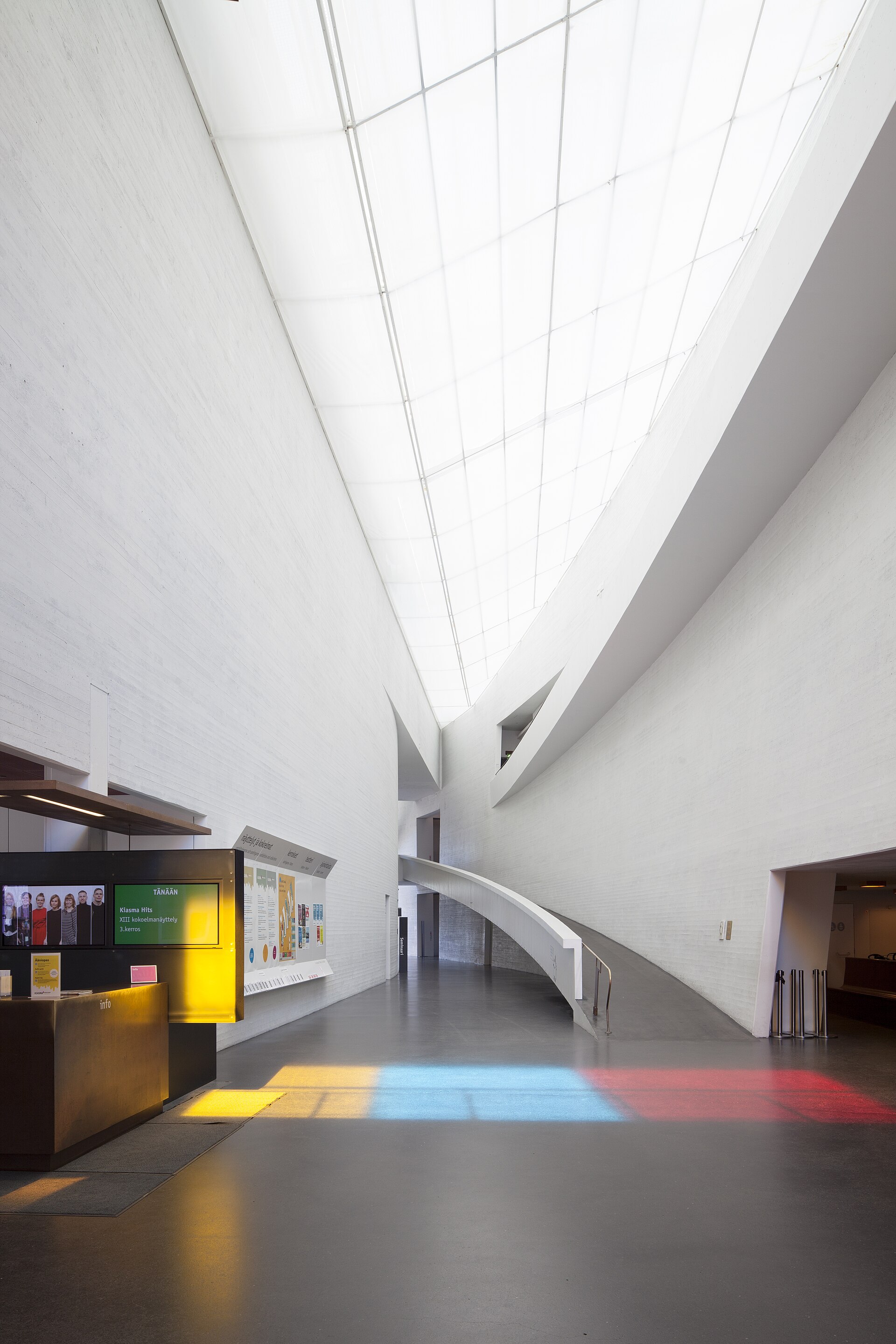
Photograph by Creator:Pirje Mykkänen · CC BY 2.0 Entrance lobby (ground floor)
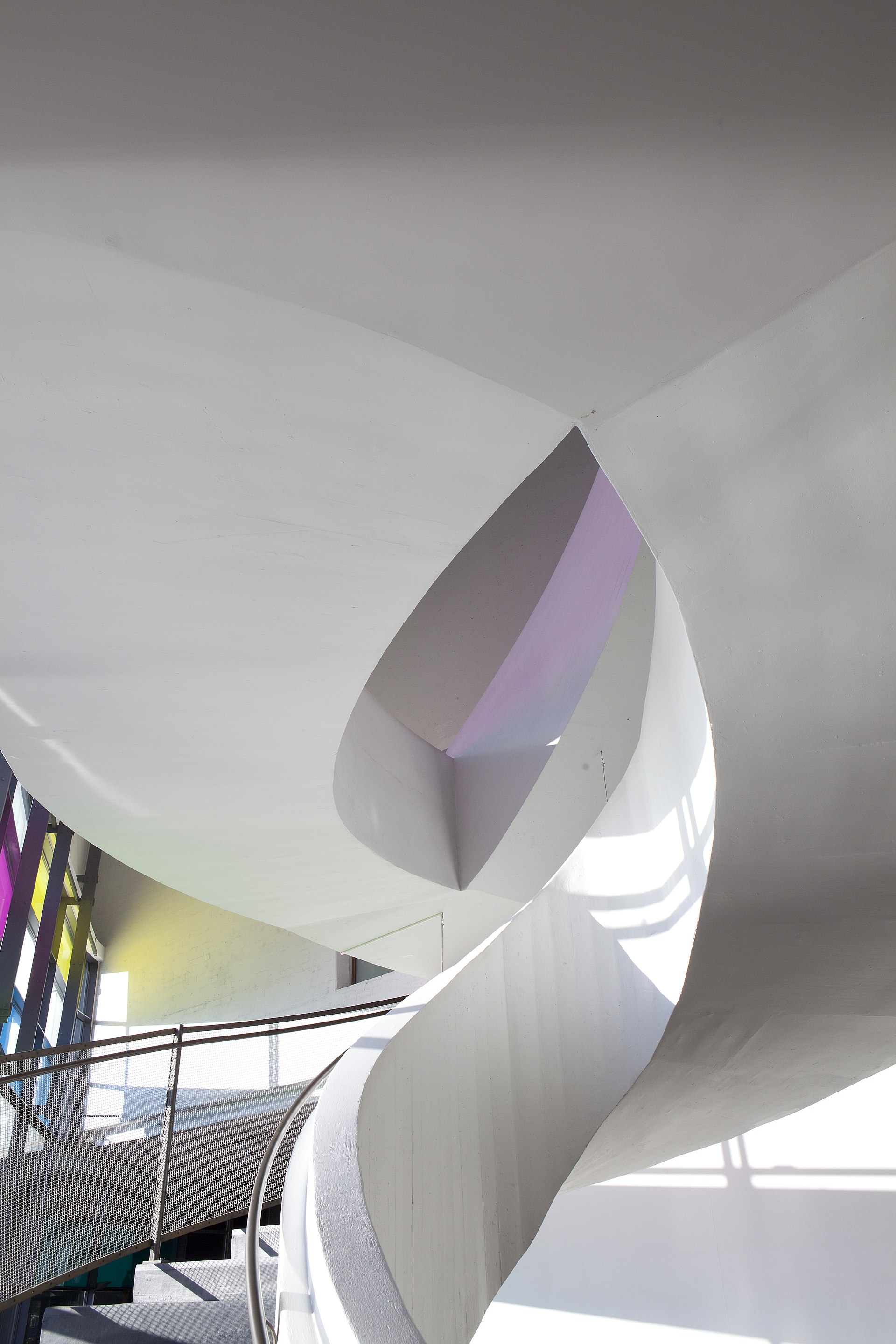
The most photographed interior in the building: two tall, twisting concrete walls cross beneath a long skylight to form the lobby, making the cross-like 'chiasmatic' form that gives the museum its name legible from the inside. Coloured light from a nearby work is often visible projected across the floor.
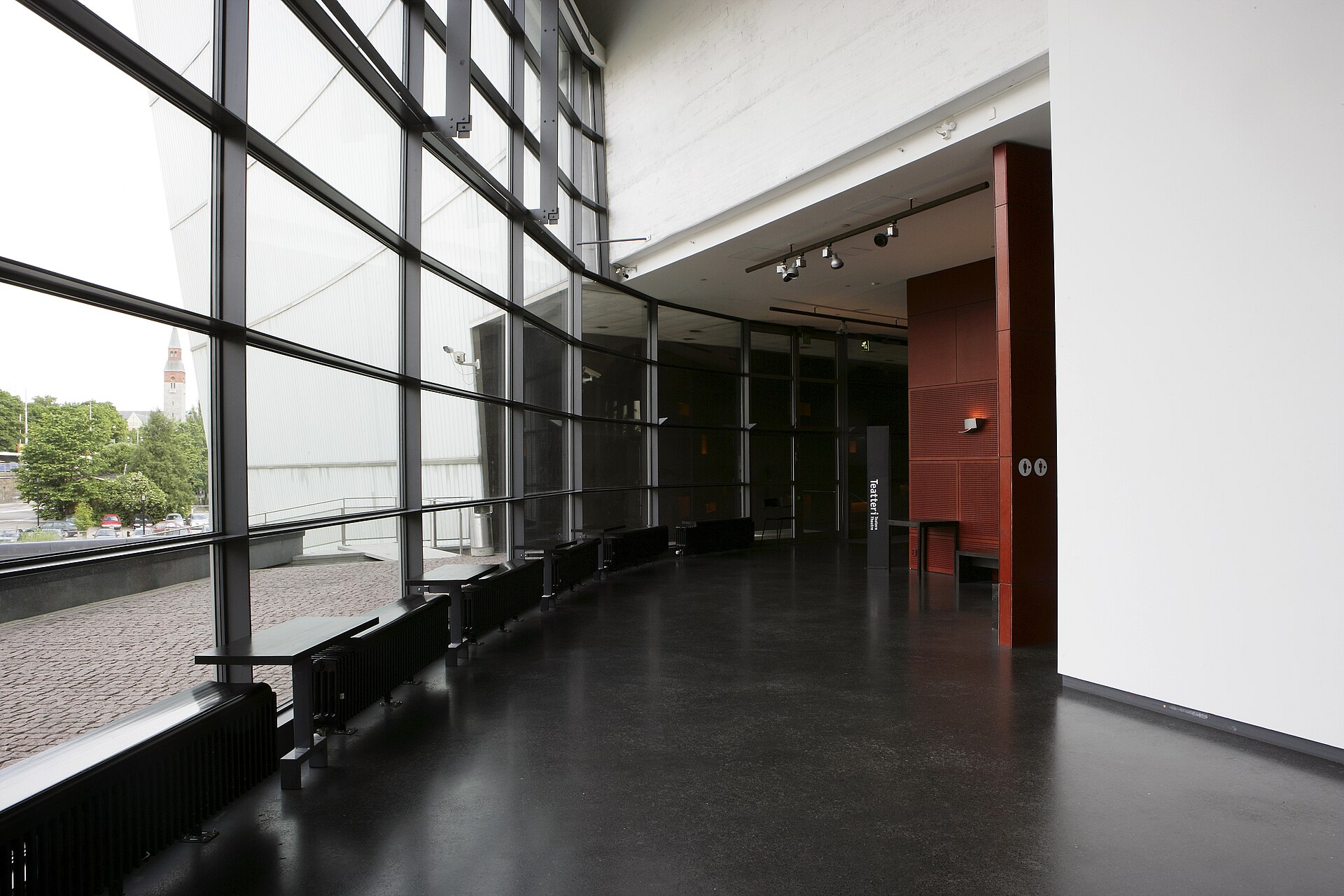
Photograph by Creator:Jenni Nurminen · CC BY 2.0 Kiasma Theatre foyer (ground floor)
A curving glass-walled foyer at the back of the ground floor that steers visitors toward the Kiasma Theatre, the museum's stage for contemporary performance, dance and live art. Programming there is curated separately from the exhibition floors.
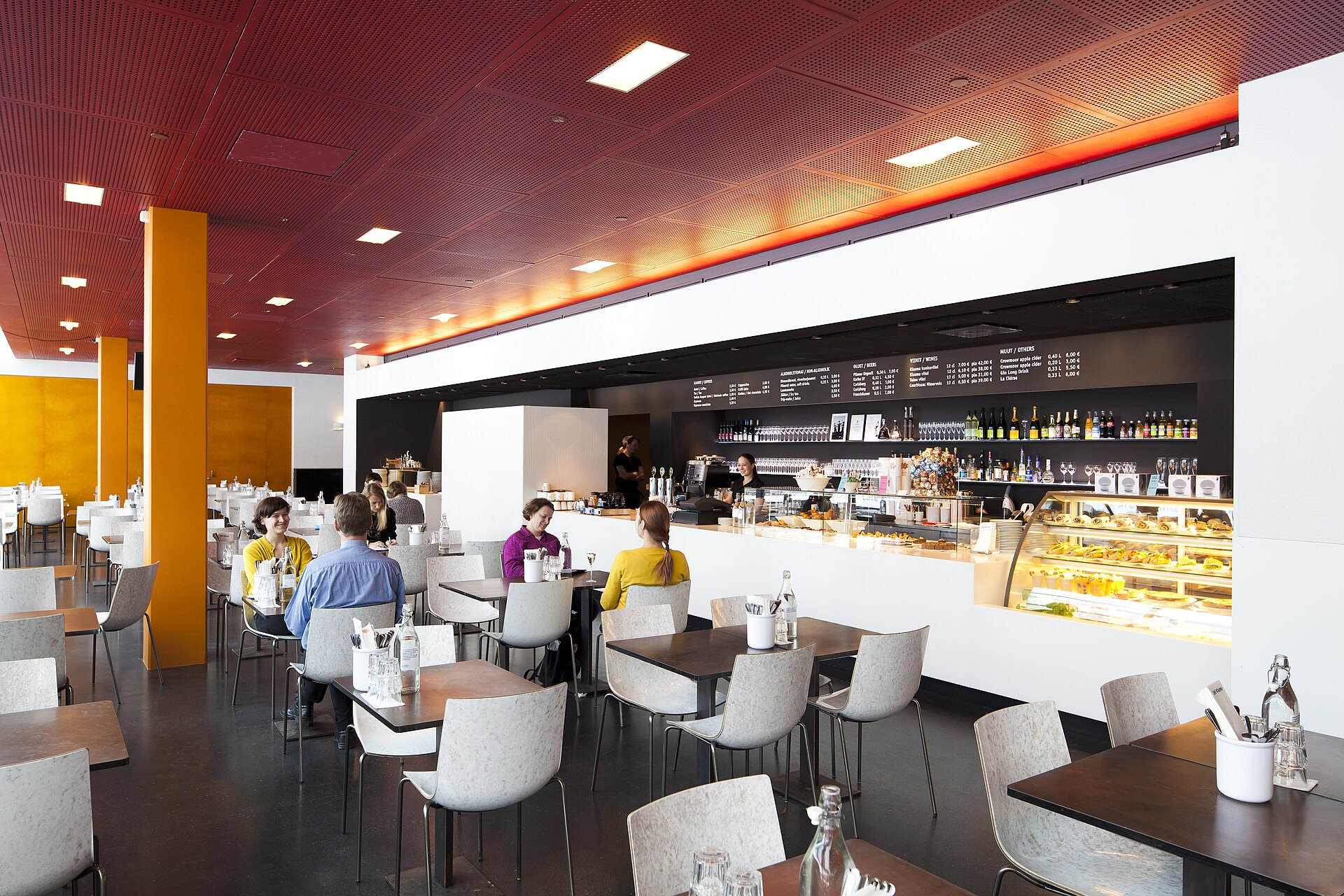
Photograph by Creator:Pirje Mykkänen · CC BY 2.0 Cafe Kiasma (ground floor)
The museum's cafe-restaurant, open independently of a museum ticket, serving light meals and refurnished in 2013 with biodegradable chairs designed by Samuli Naamanka.
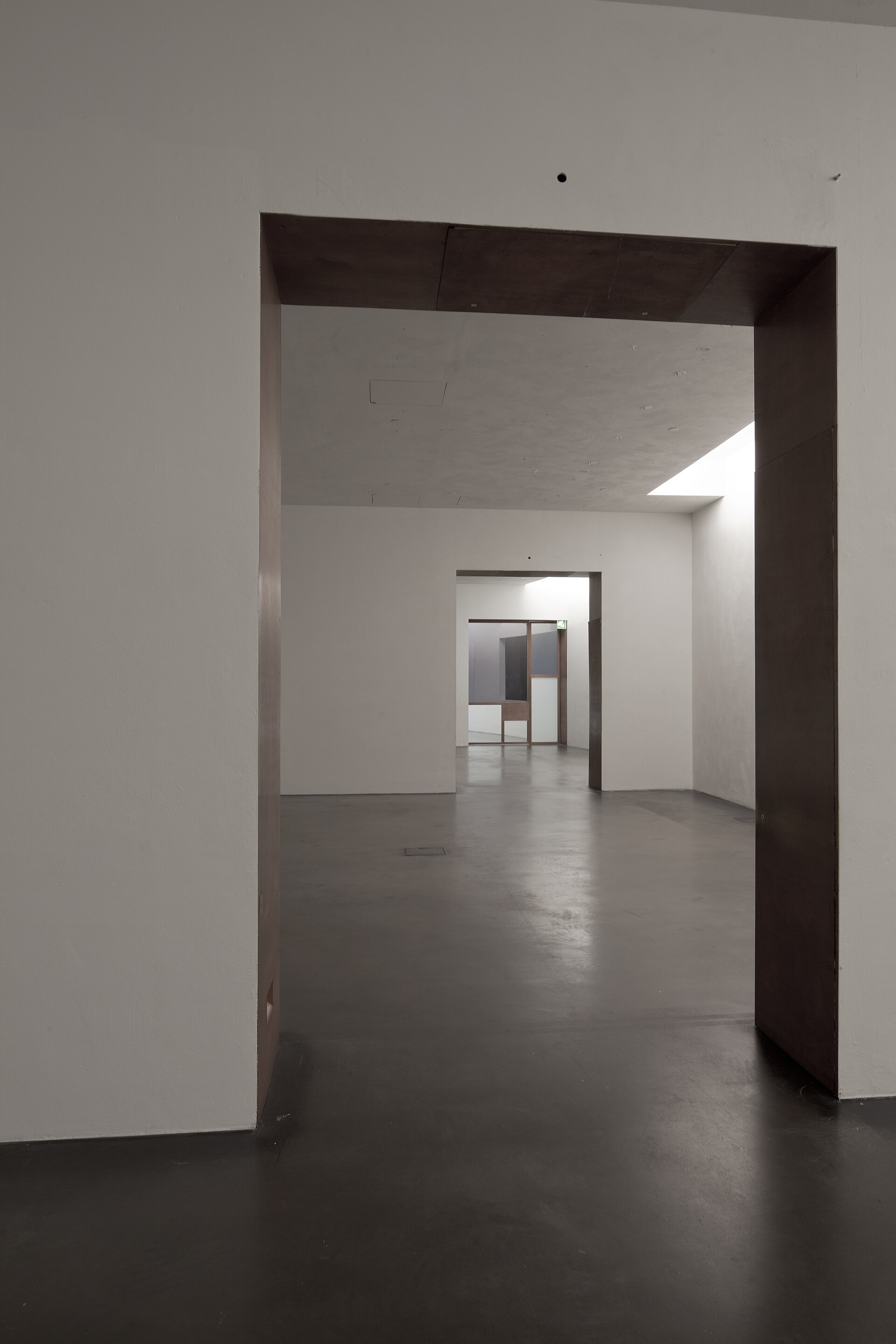
Photograph by Creator:Pirje Mykkänen · CC BY 2.0 Second-floor galleries, 'Printti'
A run of three connected galleries on the second floor, known internally as Printti (the Print), lit specifically for paper-based and light-sensitive works. They have carried recent Finnish National Gallery collection surveys, including part of the 2025-2026 exhibition Rock, Paper, Scissors.
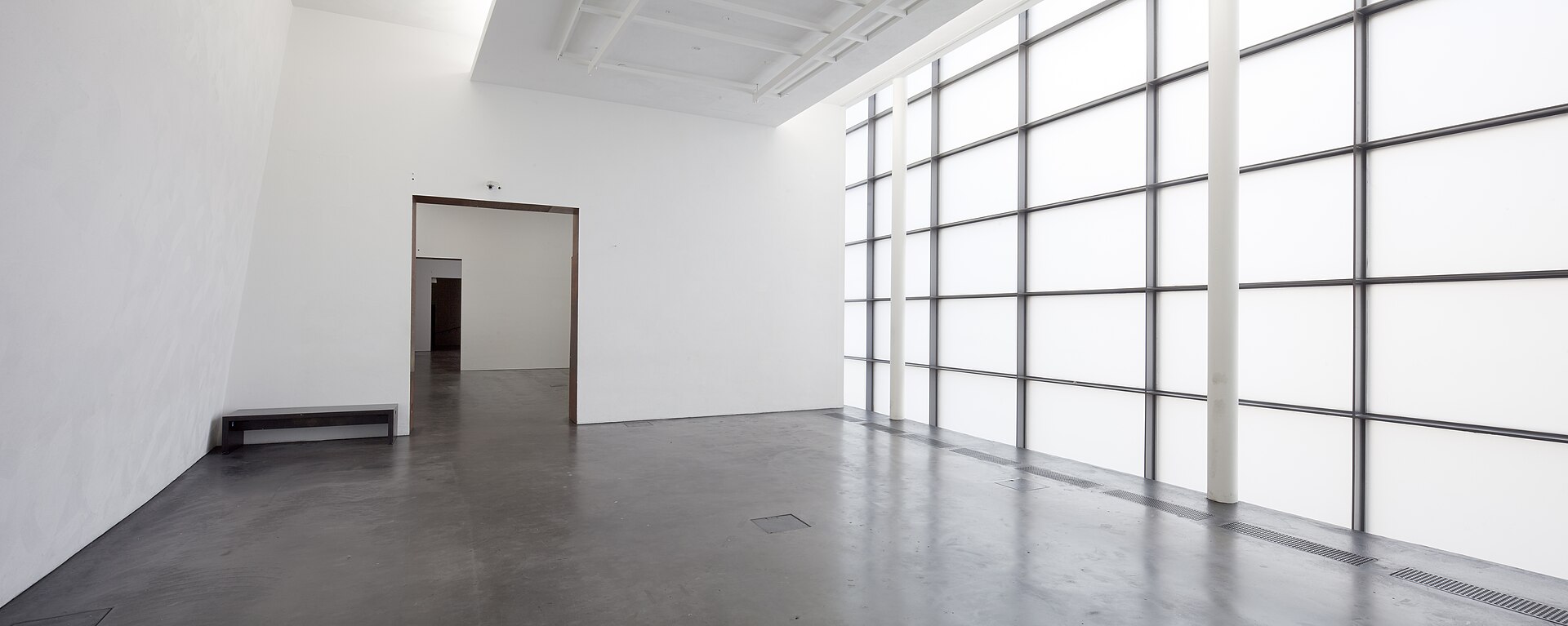
Photograph by Creator:Pirje Mykkänen · CC BY 2.0 Third-floor gallery
The southernmost gallery on the third floor, built for sculpture and lit by sandblasted glazing that softens direct daylight. It shares the Rock, Paper, Scissors and A Dream in Four Colours collection displays with the second floor.
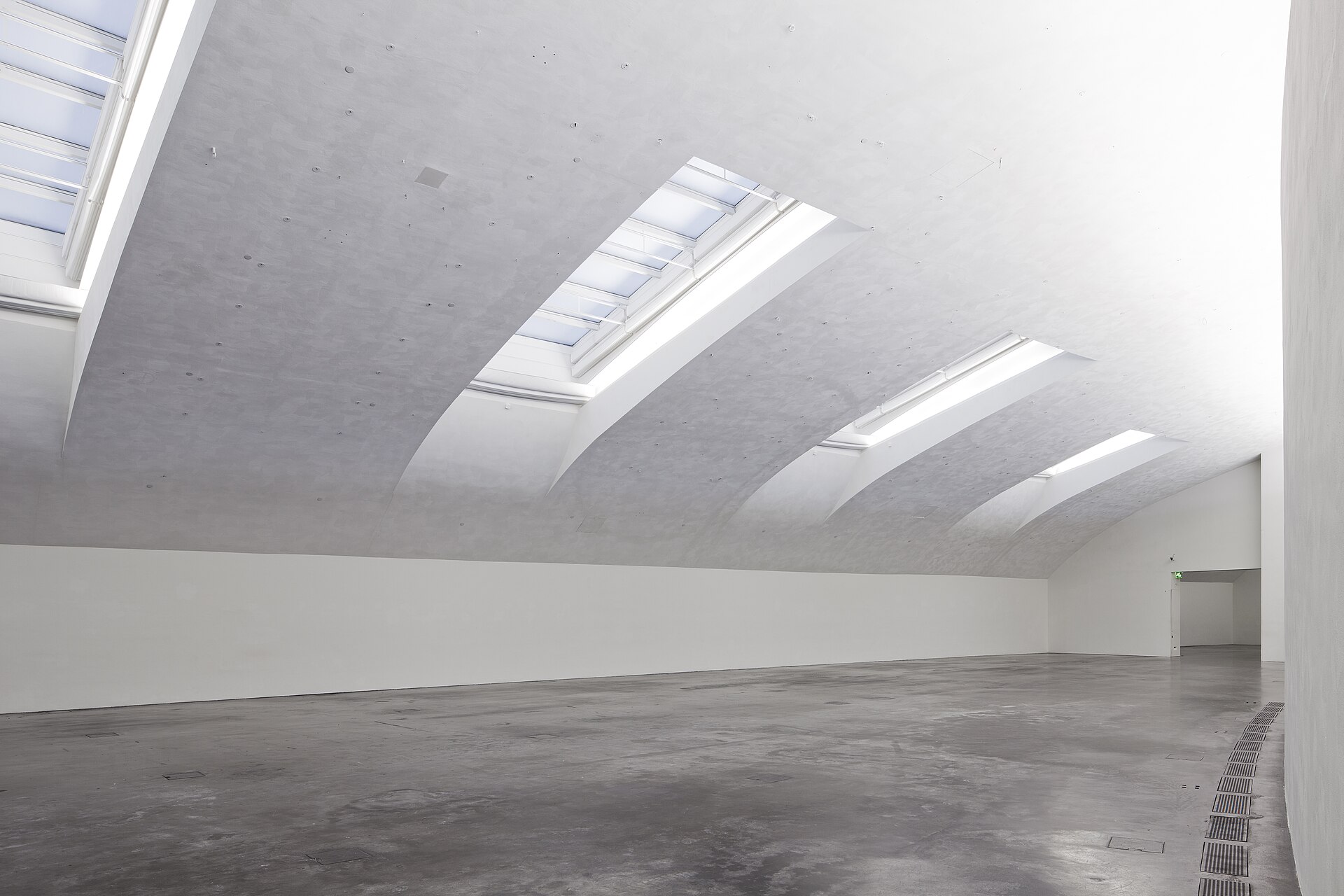
Photograph by Creator:Pirje Mykkänen · CC BY 2.0 Fifth-floor hall
The largest single, unbroken exhibition space in the building, its curved concrete ceiling pierced by a row of skylights whose blinds regulate natural light; partition walls reconfigure it for different shows. It held the 2025-2026 Sarah Lucas retrospective NAKED EYE.
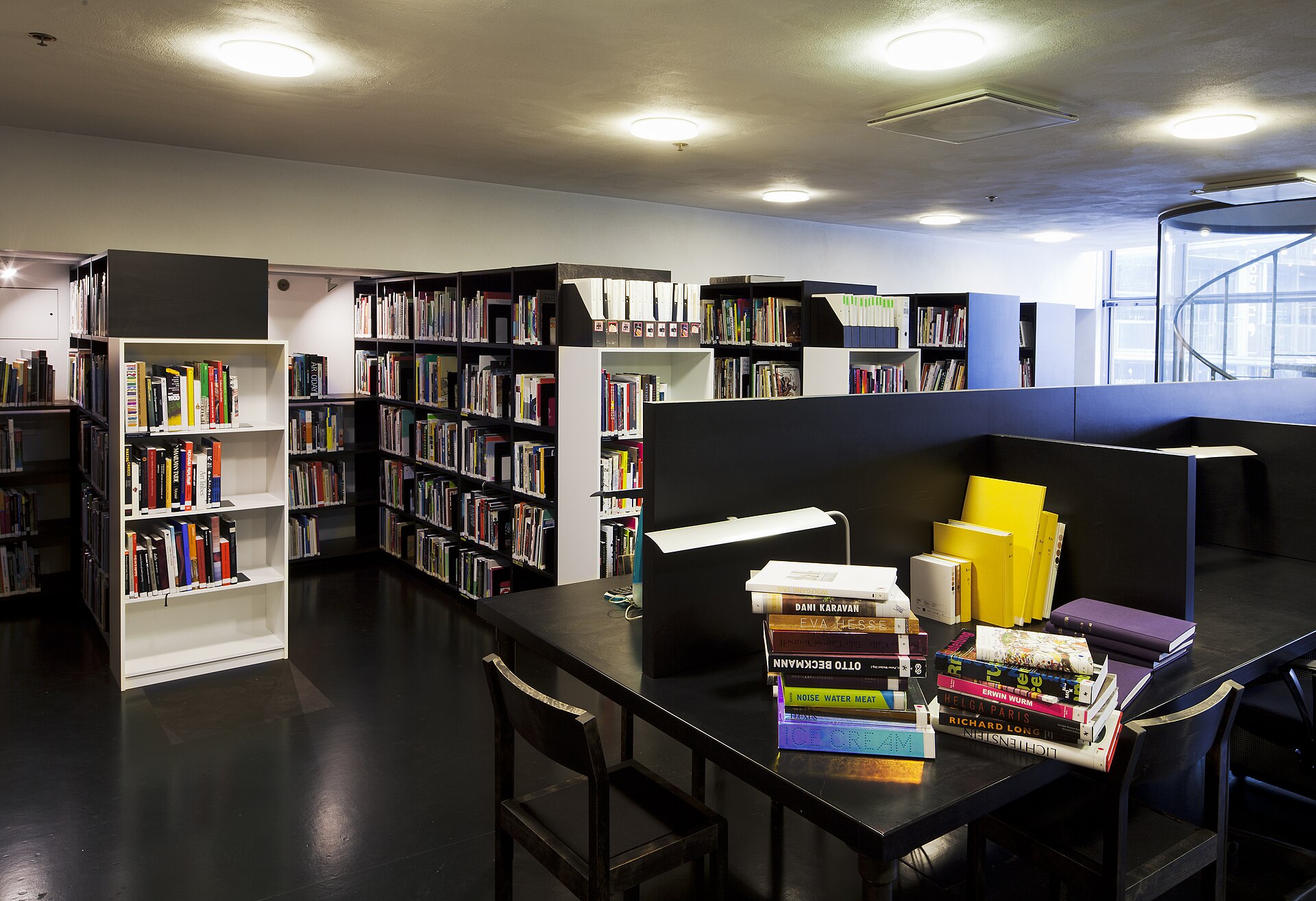
Photograph by Creator:Petri Virtanen · CC BY 2.0 Kiasma Library
The Finnish National Gallery's contemporary-art research library, holding publications on contemporary art and providing reference services alongside its sister libraries at the Ateneum and the Sinebrychoff. The photograph here was taken in 2010; the library's current location is given by the museum as the fifth floor.
What to see first
The 'pasta stairs' spiral staircase
Steven Holl Architects, 1998The building's central circulation piece, a white spiralling staircase visitors nicknamed the pasta or spaghetti stairs for the way it winds like a strand of pasta around a fork. It is the clearest single expression, inside the building, of the twisting geometry the whole design is built from.24
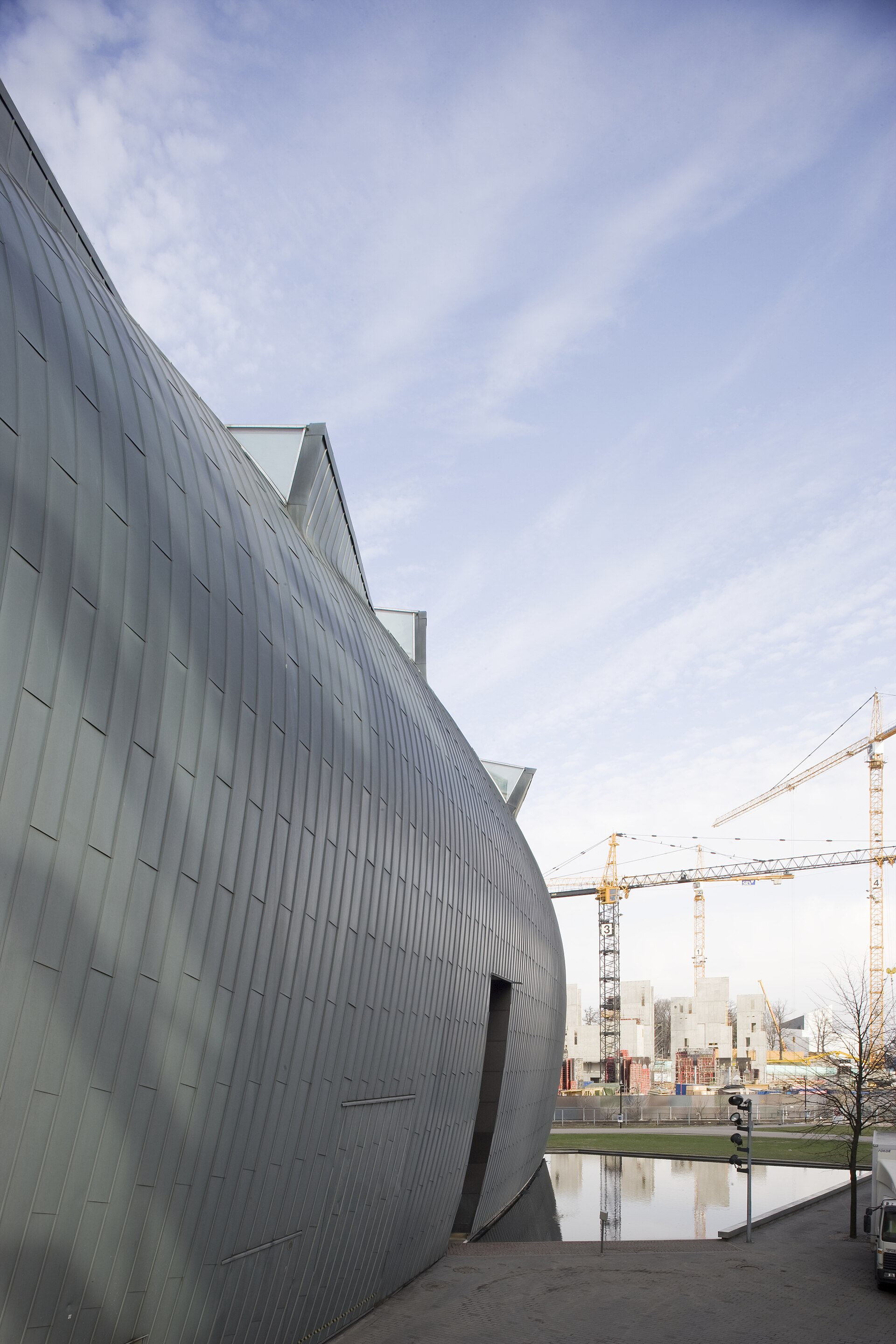
The curved titanium-zinc east facade
Steven Holl Architects, 1998The building's twisting eastern volume is clad in pre-patinated zinc carrying small amounts of copper and titanium, shaped using techniques borrowed from shipbuilding rather than conventional architecture; a bow-tie skylight window is cut into it at the top. The curved lobby wall behind it, poured in 7,000 cubic metres of concrete, won Finland's Concrete Structure of the Year award in 1997.4
The Wonderful World of Abstraction
Jacob Dahlgren, 2009A large abstract installation from the Finnish National Gallery's own contemporary holdings, used as the lead image for the 2025-2026 collection survey Rock, Paper, Scissors, which drew on works by 52 artists to examine how material choice shapes contemporary art from the 1970s onward.14
A Snake Full of Sighs
Elina Merenmies, 2023-2024A recent acquisition shown in A Dream in Four Colours, the collection exhibition on view through January 2027, which draws on the wider Finnish National Gallery collection of roughly 43,000 works and specifically surfaces pieces, including this one, that had not been on display at Kiasma for years.15
Tom of Finland: Bold Journey
Retrospective exhibition, 28 April-29 October 2023The largest museum exhibition ever given to Touko Laaksonen (Tom of Finland), drawing almost 180,000 visitors, the majority from the Finnish National Gallery's own and the Los Angeles Tom of Finland Foundation's collections. Museum director Leevi Haapala called it a project that made the artist 'one of our significant national artists' while the museum built an opt-in adults-only section around the more explicit drawings, a rare case of a national collecting institution staging openly erotic, queer subject matter as heritage rather than as controversy managed at arm's length.11
Sarah Lucas: NAKED EYE
Sarah Lucas, retrospective 10 October 2025-8 March 2026The Young British Artist's first extensive Nordic solo presentation, filling the fifth-floor hall with four decades of sculpture, photography and installation built from readymade materials such as furniture, food and pantyhose, including works drawn from her 2015 British Pavilion presentation at the Venice Biennale.16
Hold
Antony Gormley, announced September 2026A survey exhibition built to engage directly with Steven Holl's building rather than sit inside it neutrally: cardboard 'Body Buildings' visitors crawl through, and sculptures that make visitors bow, step over or circle them, staged under the same skylights Holl designed to flood the galleries with natural light. Kiasma director Kiira Miesmaa framed it as a deliberate return to physical presence against an increasingly digital cultural diet.13
The building and what it was built to hold
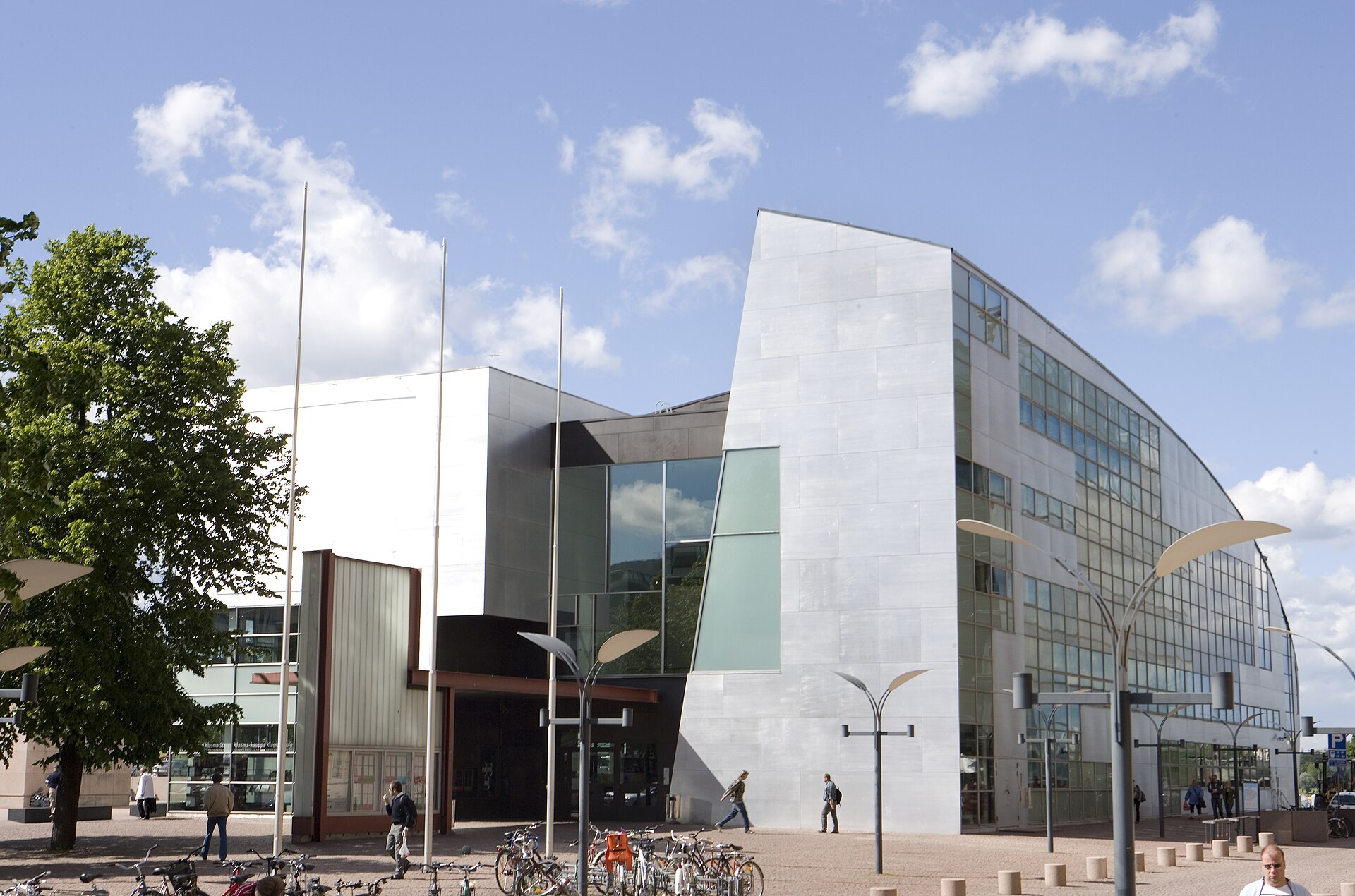
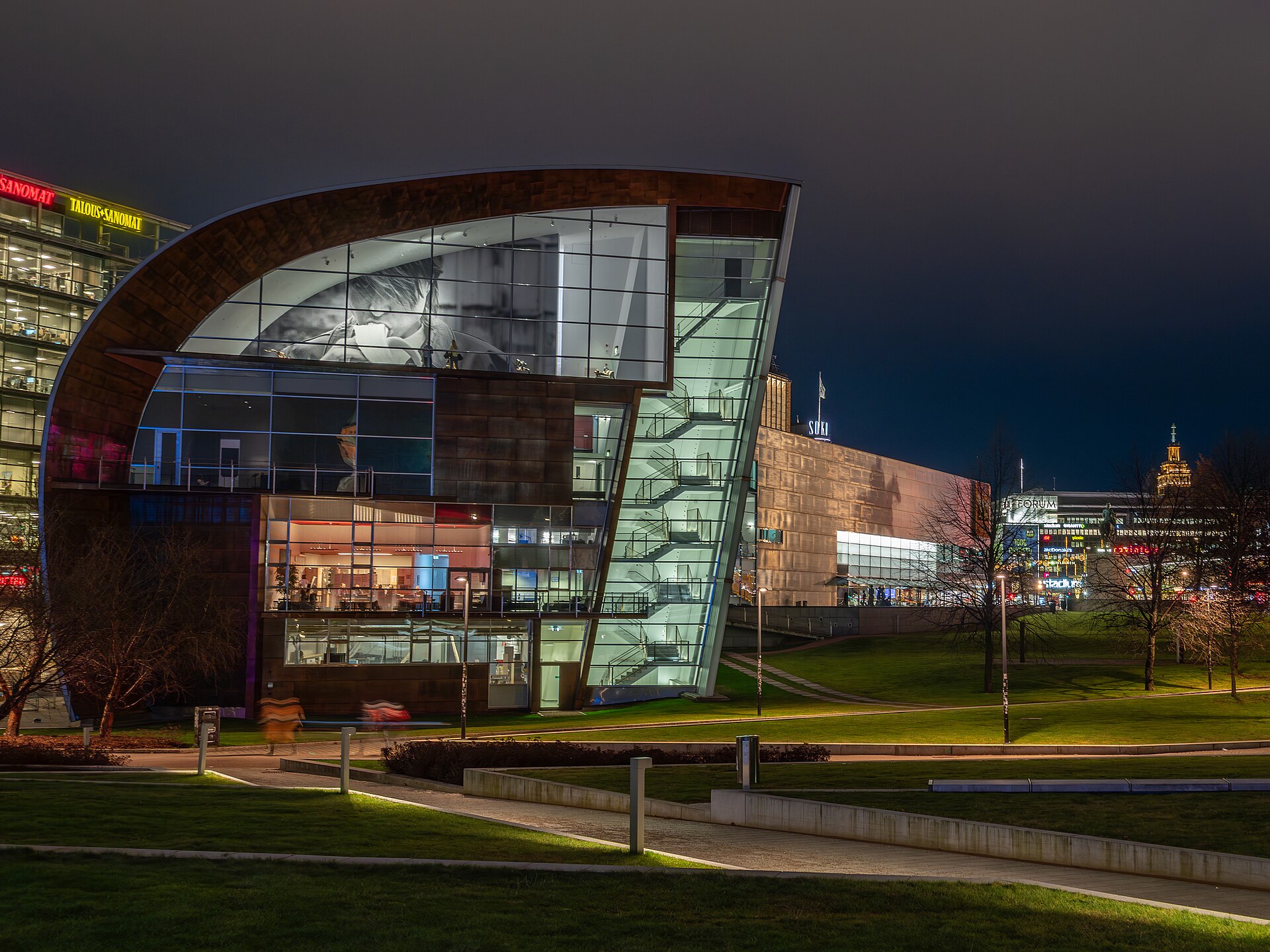
Kiasma stands at Mannerheiminaukio in the centre of Helsinki, between the Parliament building, Alvar Aalto's Finlandia Hall and Eliel Saarinen's railway station, on a site its architect treated as a literal crossing point between them. The American architect Steven Holl won the 1992-93 international design competition, chosen from 516 entries under the title Chiasma, the Greek anatomical term for the point where nerves or chromosomes cross. Holl's winning concept threaded two conceptual lines through the site: a curved 'cultural line' reaching toward Finlandia Hall and a straight 'natural line' running out to the landscape of Toolo Bay. Where the two lines meet, at the building's north end, a reflecting pool extends the bay's water up to the museum's foot.
Construction ran from 1996 to 1998, and the museum opened on 30 May 1998 to 30,000 visitors on its first weekend alone. The 130,000-square-foot building pairs a twisting, titanium-and-copper-flecked zinc-clad volume, shaped using techniques closer to shipbuilding than conventional construction, against a more orthogonal, brass- and aluminium-faced western block. Inside, 3,500 square metres of glazing, including translucent Reglit glass planks, diffuse Helsinki's low northern light through the galleries, and 7,000 cubic metres of poured concrete, including a curved lobby wall that won Finland's 1997 Concrete Structure of the Year award, give the entrance hall its sculpted, cave-like geometry. Gallery interiors were finished by hand, plastered walls and ceilings, and coloured plywood, yellow, red, black and white, with a Pompeii red used in the theatre, so that no two of the building's rooms read quite the same way even though each is close to rectangular with one curved wall.
A contested site: the fight over the Mannerheim statue
Kiasma's arrival in Helsinki was not a quiet one. The site Holl was given sits beside Aimo Tukiainen's 1960 equestrian statue of Marshal Carl Gustaf Emil Mannerheim, Finland's wartime commander and a figure close to sacred in national memory, and Holl's original scheme proposed relocating the statue to make room for the new building's geometry. The backlash was immediate and large: reporting on the dispute puts the resulting demonstration against the museum and its architect at some 12,000 people, and critics argued publicly that a contemporary art museum beside the Marshal would diminish rather than honour him. Tukiainen, the statue's own sculptor, was angry enough to take the matter to court. The dispute was resolved only after further design changes and consultation that extended to Mannerheim's own descendants, and the statue stayed exactly where it was; Holl's final design works around it rather than through it, and the museum's own architecture page today makes no mention of the fight at all. Seen after the fact, the controversy reads differently than it did in the 1990s: where the statue once stood in what one account of the dispute calls 'a concrete wasteland at a busy intersection,' Kiasma gave it, and the square around it, a setting for the first time.
From a students' campaign to a national museum
The institution predates its building by nearly sixty years. Helsinki's Contemporary Art Society was founded in 1939 specifically because the city had nowhere purpose-built to show contemporary work, and the Society ran the first ARS survey exhibition, a recurring large-scale showcase of international contemporary art, jointly with the Finnish Academy of Arts in 1961. A state commission first floated a dedicated museum site at Toolonlahti in 1965; the idea stalled for a decade before the State Art Commission formally backed it in 1975, and it took a further activist push, the Porkkana Association, founded in 1986 by young art historians, critics and artists staging direct actions to force the issue, before a 1988 commission report finally produced a proposal for the enabling legislation. Funding was resolved through a 1989 land deal between the City of Helsinki and the Finnish state, and the Museum of Contemporary Art became formally operational on 1 September 1990, initially in temporary premises and, from May 1991, inside the historic Ateneum building it would eventually become a sibling institution to. The architectural competition for its own building followed in 1992, and the museum moved into the finished Kiasma building in 1998, seven years after it had first opened its doors elsewhere.
Kiasma's institutional identity changed again in 2014, when the Finnish National Gallery was reorganised from a state department into an independent public foundation operating three museum units: the Ateneum, Kiasma and the Sinebrychoff Art Museum. Kiasma is the contemporary-art unit of that foundation, responsible for collecting and preserving contemporary work on the Finnish National Gallery's behalf rather than owning a separate collection of its own.
What is inside: seven floors under one collection
Kiasma describes its own contemporary holdings at roughly 8,800 works, acquiring 40 to 60 new pieces most years; set against the Finnish National Gallery's total collection of around 43,000 works across all three of its museums, that makes Kiasma's slice the newest and the most actively growing rather than the largest. None of it hangs in a fixed permanent display in the way the Ateneum's chronological galleries do. Instead the museum mounts rotating, thematic collection exhibitions across its second and third floors: Rock, Paper, Scissors ran from February 2025 to January 2026 and used the material choices behind 52 artists' work, stone, paper, sound, even the question of what counts as material at all, as its organising idea, while its successor, A Dream in Four Colours, on view from February 2026 through January 2027, deliberately surfaces pieces that had not been shown at Kiasma in years and asks visitors to approach the 49 artists on view intuitively rather than through a single argument.
The building's other floors serve more specific functions. The fifth floor is the largest unbroken gallery in the building and typically carries the single biggest show running at any time; the ground floor carries the entrance lobby, the Kiasma Theatre's foyer and Cafe Kiasma; and the Kiasma Library maintains the Finnish National Gallery's contemporary-art research collection alongside its counterparts at the Ateneum and Sinebrychoff. A conservation-facing room built into Rock, Paper, Scissors let visitors hear directly from Kiasma's conservators about how fragile or one-time-use materials, sound pieces, living plants, digital works, are meant to be kept for future decades at all, a question the museum treats as inseparable from what it chooses to collect in the first place.
The exhibitions that made it
Kiasma's reputation rests less on a fixed set of masterpieces than on the exhibitions it has chosen to stage. The clearest example is Tom of Finland: Bold Journey, which ran from 28 April to 29 October 2023 and became the largest museum exhibition ever given to Touko Laaksonen, drawing close to 180,000 visitors on loans from both the Finnish National Gallery's own collection and the Tom of Finland Foundation in Los Angeles. Homosexuality had been a criminal offence in Finland until 1971 and was classified as an illness until 1981; staging the artist's explicitly erotic drawings inside the national collecting institution, with an opt-in adults-only section rather than a quiet edit, was itself a statement about what a national gallery is for. Director Leevi Haapala described the show as succeeding in making Laaksonen 'one of our significant national artists,' treating the work, in his words, 'with respect, even surprising devotion.'
The fifth-floor hall carried Sarah Lucas's first extensive Nordic solo exhibition, NAKED EYE, from October 2025 to March 2026, drawing on four decades of the Young British Artist's readymade-based sculpture, including pieces from her 2015 British Pavilion presentation at the Venice Biennale. Kiasma announced its next major single-artist survey, Antony Gormley's Hold, in September 2026; rather than simply filling the galleries, Gormley's cardboard 'Body Buildings' and body-scaled sculptures are built to be crawled through, stepped over and circled, staged deliberately under the same skylights Holl designed to flood the building with natural light. Current director Kiira Miesmaa framed the show as a corrective to a culture increasingly mediated through screens: when a visitor crawls inside a sculpture, she said, they become newly aware of their own body.
Visiting
Kiasma sits in the middle of Helsinki, close enough to the Central Railway Station and the Kamppi bus terminal that neither is more than a few minutes' walk away, with the Lasipalatsi tram stop closer still; the museum has no car park of its own and directs drivers to the nearby P-Eliel facility. It closes on Mondays and otherwise opens at 10am, with Tuesdays and Fridays running to 8pm and other days closing earlier; ticket sales stop half an hour before the museum itself does. The museum is a designated disability card destination with a lift to every floor, accessible restrooms on the first and fifth floors, an induction loop at the information desk, theatre and seminar room, and a cloakroom that lends everything from wheelchairs to magnifying glasses at no charge; guide and assistance dogs are welcome throughout. Non-flash personal photography is permitted everywhere for visitors' own use and social media, and large bags, backpacks and umbrellas go into the free cloakroom or lockers before the galleries. Cafe Kiasma and the Kiasma Shop, both on the ground floor, are open without a museum ticket.
What visitors say
Visitors and critics single out the building itself, ahead of any single exhibition, as the reason to come: Steven Holl's architecture is repeatedly called a destination in its own right, and Domus named it one of the fifty museums worth visiting in a lifetime in 2024. The most repeated complaint is value for money, ticket prices weighed against the size of any one temporary show, echoing a debate that goes back to the building's contested arrival in the 1990s.
What is praised, what is criticised
- Praised: The architecture: the curved zinc and glass exterior, the skylit lobby where the building's crossing geometry is most visible, and the spiralling 'pasta stairs' are named specifically, not just the museum as a whole
- Praised: A willingness to give major, sometimes challenging solo surveys to artists a conventional national gallery might hesitate over, Tom of Finland's homecoming retrospective being the clearest case
- Praised: Accessibility provision, including the tactile floor plan, glove-touchable artwork list for visually impaired visitors, and the range of borrowable aids at the cloakroom
- Criticised: Ticket price set against the size of a single temporary exhibition, a recurring theme in visitor reviews even from people who otherwise rate the museum highly
- Criticised: The building's arrival was genuinely contested rather than uniformly welcomed: Steven Holl's original plan to relocate the adjacent equestrian statue of Marshal Carl Gustaf Emil Mannerheim brought a demonstration reported at 12,000 people, and sculptor Aimo Tukiainen took the dispute to court before a compromise, keeping the statue in place, was reached
- Criticised: Some visitor comparisons rank the collection displays as a less essential stop in Helsinki than the Ateneum's historical Finnish painting, even among reviewers who rate Kiasma's architecture highly
Ratings on other platforms
Tripadvisor: 4.1 from 1,149 ratings, read 18 September 2026
A platform average is a tertiary source: it moves, it is not audited, and we quote no visitor's words.
Questions about Finnish National Gallery / Kiasma
Where is Finnish National Gallery / Kiasma?
Mannerheiminaukio 2, FIN-00100 Helsinki, Finland.
How much does it cost to visit?
Standard (online): EUR 21; Standard (ticket office): EUR 23; Discounted: EUR 13; Under 18: free; Museum Card holders: free. As confirmed 18 September 2026.
When is it open?
Tuesday 10:00-20:00; Wednesday-Thursday 10:00-18:00; Friday 10:00-20:00; Saturday-Sunday 10:00-17:00. Closed: Monday. As confirmed 18 September 2026.
How do you get there?
Metro: Central Railway Station and Kamppi are the two closest metro stops, both about 300 metres away; Tram: Lasipalatsi stop, about 150 metres from the museum; Bicycle: On the Baana bicycle corridor through central Helsinki; racks between Kiasma and the Postitalo and Sanomatalo buildings; Car: No dedicated museum car park; the nearest paid facility is P-Eliel.
What should you see first?
The 'pasta stairs' spiral staircase (Steven Holl Architects, 1998); The curved titanium-zinc east facade (Steven Holl Architects, 1998); The Wonderful World of Abstraction (Jacob Dahlgren, 2009); A Snake Full of Sighs (Elina Merenmies, 2023-2024); Tom of Finland: Bold Journey (Retrospective exhibition, 28 April-29 October 2023); Sarah Lucas: NAKED EYE (Sarah Lucas, retrospective 10 October 2025-8 March 2026).
What we could not confirm
- The Rock, Paper, Scissors and A Dream in Four Colours collection exhibitions both describe surfacing works 'not on display at Kiasma for many years'; neither the museum's own pages nor the sources checked for this page give a public, searchable list of what remains in storage and why, so the proportion of the 8,800-work collection actually visible to the public at any time is not established here.
- Coverage of the 1990s Mannerheim statue dispute traces to travel and architecture-history writing rather than a contemporaneous Finnish news account; the approximate demonstration figure of 12,000 and the detail of Tukiainen's court action are reported consistently across the sources checked but neither source is a primary account from the period itself.
Images
Sources
- 1Museum of Contemporary Art Kiasma, official site, Visitor information page (hours, admission, accessibility, photography, bags, cafe/shop) kiasma.fi/en/visitor-information/
- 2Museum of Contemporary Art Kiasma, official site, Contact information page (phone, email, address, departments) kiasma.fi/en/contact-information/
- 3Museum of Contemporary Art Kiasma, official site, About Kiasma page, including the institutional timeline 1939-2021 kiasma.fi/en/about-kiasma/
- 4Museum of Contemporary Art Kiasma, official site, Architecture page (competition, materials, design concept) kiasma.fi/en/architecture/
- 5Wikidata, item Q1633361 (Kiasma) wikidata.org/wiki/Q1633361
- 6Wikipedia, 'Kiasma' article en.wikipedia.org/wiki/Kiasma
- 7Wikipedia, 'Finnish National Gallery' article en.wikipedia.org/wiki/Finnish_National_Gallery
- 8Luke Fiederer, 'AD Classics: Kiasma Museum of Contemporary Art / Steven Holl Architects', ArchDaily, 19 April 2016 archdaily.com/784993/ad-classics-kiasma-museum-of-contemporary-art-steven-holl-architects
- 9Tuljak Travel Blog, 'The New Architecture of Helsinki' (Mannerheim statue dispute, demonstration numbers) tuljak.com/blog/the-new-architecture-of-helsinki
- 10Featuring Finland, '5 Must-See Statues in Helsinki' (Tukiainen court action over the Mannerheim statue) featuringfinland.com/must-see-statues-in-helsinki/
- 11Sam Gaskin, 'Tom of Finland Receives Largest Ever Museum Show', Ocula Magazine, 21 April 2023 ocula.com/magazine/art-news/tom-of-finland-receives-largest-ever-museum-show/
- 12Tom of Finland Foundation, 'Kiasma's Tom of Finland exhibition was a success, attracting 180,000 visitors', 7 November 2023 tomoffinland.org/kiasmas-tom-of-finland-exhibition-was-a-success-attracting-180000-visitors/
- 13Artdaily, 'Kiasma announces the most comprehensive exhibition to date in the Nordic countries by Antony Gormley', 17 September 2026 artdaily.com/news/200298/Kiasma-announces-the-most-comprehensive-exhibition-to-date-in-the-Nordic-countries-by-Antony-Gormley
- 14Museum of Contemporary Art Kiasma, official site, exhibition page 'Rock, Paper, Scissors, Kiasma's Collection Exhibition' kiasma.fi/en/exhibitions/rock-paper-scissors-kiasmas-collection-exhibition/
- 15Museum of Contemporary Art Kiasma, official site, exhibition page 'A Dream in Four Colours' kiasma.fi/en/exhibitions/a-dream-in-four-colours/
- 16Museum of Contemporary Art Kiasma, official site, exhibition page 'Sarah Lucas: NAKED EYE' kiasma.fi/en/exhibitions/sarah-lucas/
- 17Tripadvisor, 'Museum of Contemporary Art Kiasma' listing, rating and review pages, read 18 September 2026 tripadvisor.com/Attraction_Review-g189934-d199909-Reviews-Museum_of_Contemporary_Art_Kiasma-Helsinki_Uusimaa.html
- 18Steven Holl Architects, project page for Kiasma Museum of Contemporary Art stevenholl.com/project/kiasma-museum/
- 19Steven Holl Architects, news item, 'Kiasma Museum one of the top 50 museums to visit in a lifetime' (Domus), 17 May 2024 stevenholl.com/kiasma-museum-one-of-the-top-50-museums-to-visit-in-a-lifetime/
- 20Wikimedia Commons, file page for the lead image commons.wikimedia.org/wiki/File:Kiasmamodernartmuseum.JPG
- 21Wikimedia Commons, file page for the south entrance image, 2007 commons.wikimedia.org/wiki/File:Kiasma_entrance,_2007.jpg
- 22Wikimedia Commons, file page for the November 2025 night image commons.wikimedia.org/wiki/File:Kiasma_November_2025_01.jpg
- 23Wikimedia Commons, file page for the curved zinc facade image, 2009 commons.wikimedia.org/wiki/File:Curved_zinc_fa%C3%A7ade_of_Kiasma,_2009.jpg
- 24Wikimedia Commons, file page for the 'pasta stairs' staircase image, 2011 commons.wikimedia.org/wiki/File:Kiasma_%27pasta_stairs%27_seen_from_ground_floor,_2011.jpg


