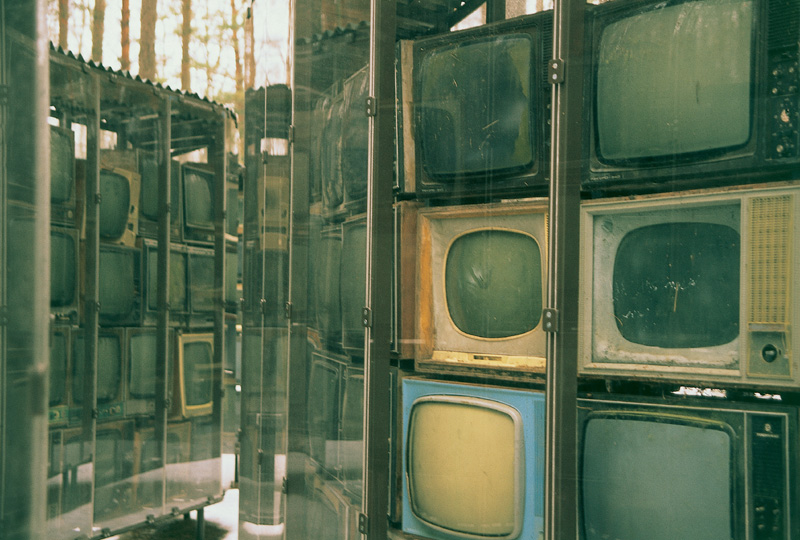
The LNK Infotree, Gintaras Karosas' Guinness-certified sculpture built from about 3,000 television sets, at Europos Parkas.
Gintaras Karosas · CC BY-SA 3.0Europos Parkas
Museum · Europos parkas · Founded 1991
Open, admission and hours confirmed 28 September 2026 · 13 sources
On this page 14 sections
ContentsClose
Europos Parkas' strength is scale and site-specificity rather than depth in any one period or medium: more than 100 large-format outdoor works, most made for their exact spot in the forest during an annual International Sculpture Symposium running since 1993, by artists from close to 30 countries. It holds no comparable indoor collection and makes no claim to historical art; its value is as a working record of international large-scale sculpture practice from the early 1990s onward, anchored by Karosas' own site-wide works and the Guinness-certified LNK Infotree.
| Local name | Europos parkas |
|---|---|
| Kind | Museum |
| Founded | 1991 |
| City and country |  Vilnius, Lithuania Vilnius, Lithuania |
| Address | Europos Parko g. 300, Joneikiskes, Vilniaus r., LT-15143, Lithuania |
| Website | europosparkas.org/en |
| Status | Open, confirmed |
| Record last verified |
Visiting
- Hours
- Daily10:00 to sunsetLast entry at 19:00 during spring and summer; closing time follows sunset the rest of the year. No seasonal closure is stated on the museum's own pages.
- Admission
- AdultEUR 1410 percent discount for families; 15 percent discount for groups over 10
- StudentEUR 11Valid student ID required
- ChildEUR 8
Free entry: Pre-school children accompanied by a parent, every day. Teachers accompanying a school group of up to 10 children, every day. Museum employees of the Republic of Lithuania and accredited journalists, with ID- Tickets
- bilietai.europosparkas.org The museum's own ticket page.
- Do I need to book?
- No. Tickets can be bought online at bilietai.europosparkas.org or at the entrance.
- Address
- Europos Parko g. 300, Joneikiskes, Vilniaus r., LT-15143, Lithuania MapCar About 17-20 km from central Vilnius. From the Santariskes roundabout on Kalvariju street, follow the signs toward the Green Lakes (Zalieji Ezerai) and the museum, roughly 11 km further.
Bus Public bus route Zalgirio - Europos Parkas - Skirgiskes, departing from the Zalgirio stop on Kalvariju street. - Website
- europosparkas.org/en
- Telephone
- +370 5 2377077
- [email protected]
Before you go how long, access, photography, bags, eating, shop
- How long to allow
- Two to three hours for the main forest trail; visitors trying to locate most of the collection report closer to half a day.
- Access
- Not published by the museum in the sources checked. Visitor accounts describe a paved area near the entrance giving way to natural forest track through most of the grounds.
- Photography
- Not published by the museum in the sources checked.
- Bags
- Not published by the museum in the sources checked.
- Eating
- An on-site restaurant is listed among the museum's facilities.
- Shop
- An on-site shop is listed among the museum's facilities, alongside a post office and a conference hall available for rent.
Prices and hours change. We take them from the institution's own pages and print the day we read them, and you can check the current position at the source we used. Confirm before you travel.
What is inside
The forest sculpture trail
The main exposition: more than 100 large-scale works by artists from close to 30 countries, sited through 55 hectares of pine and birch forest and open meadow rather than grouped in galleries.
Monument of the Centre of Europe
Gintaras Karosas' 1996 ground-level work: granite plaques naming Europe's capital cities and their distance from this exact point, marking the geographic centre of the continent as calculated by the Institut Geographique National (France) in 1989.
LNK Infotree
Karosas' own sculpture built from roughly 3,000 decommissioned television sets arranged into a 700-metre tree-shaped labyrinth with a toppled statue of Lenin at its centre. Guinness World Records certified it the largest sculpture of its kind in 2002.
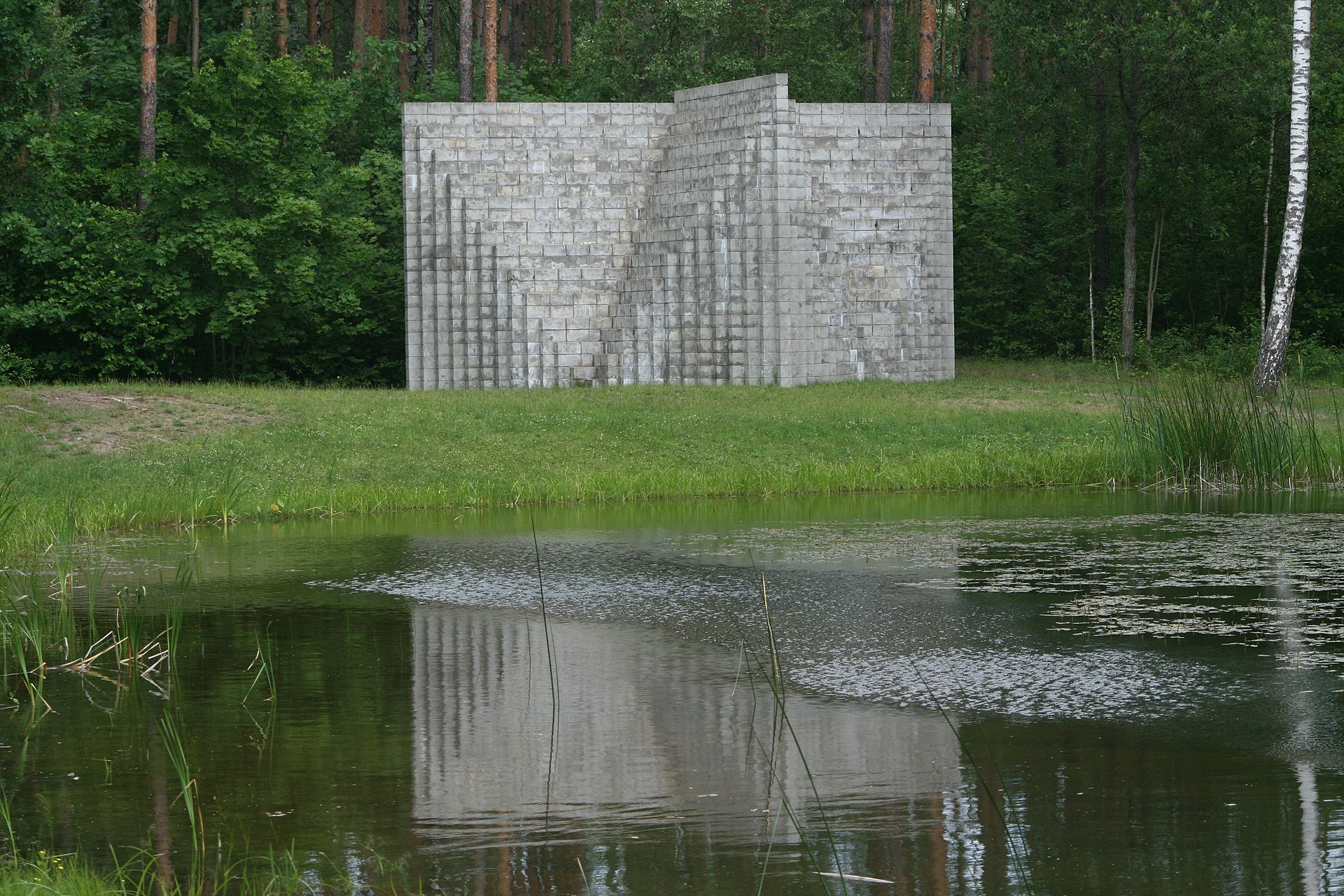
Photograph by Arz · CC BY-SA 4.0 Lakeside sculptures
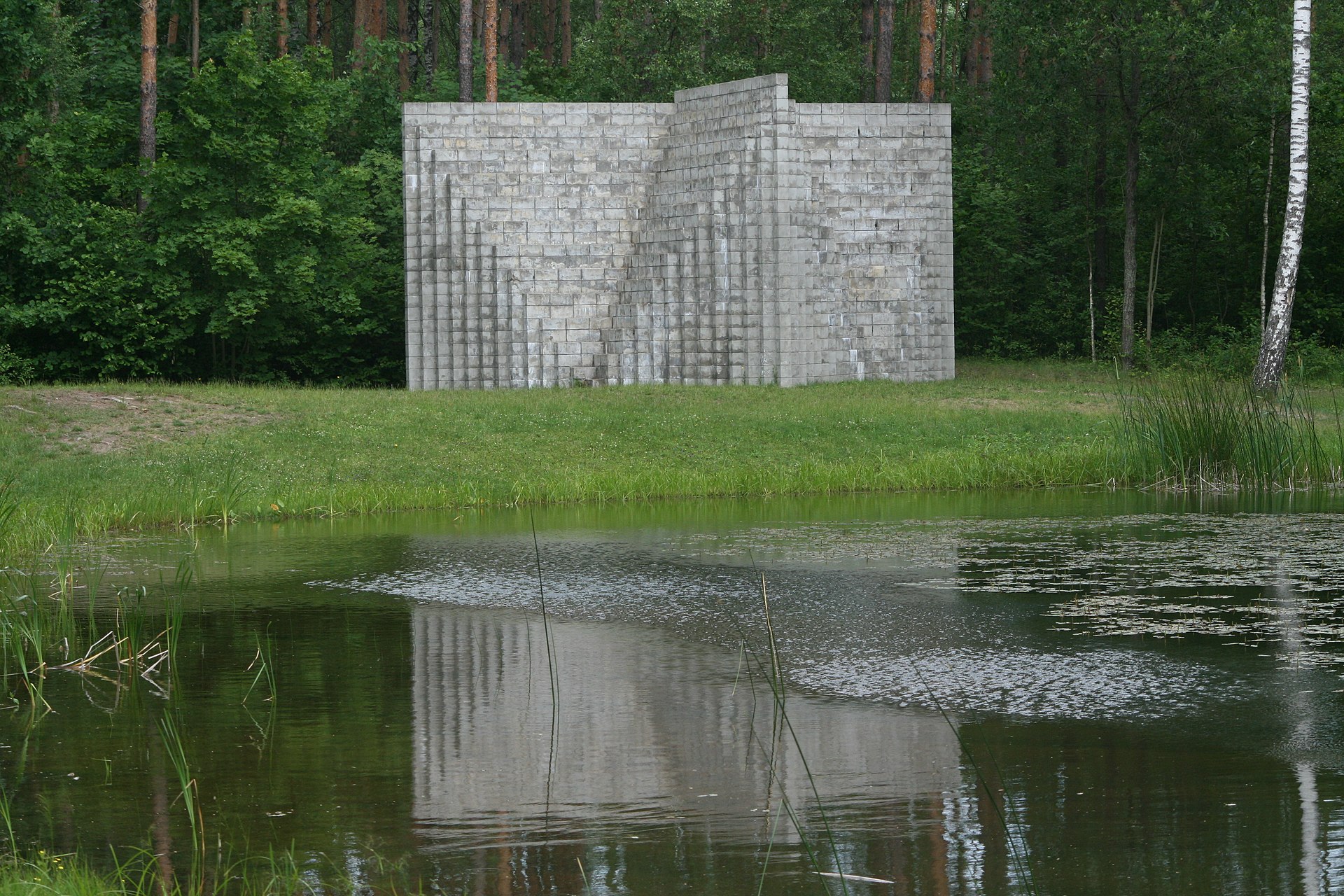
Water-integrated works grouped near the park's ponds, including Sol LeWitt's Double Negative Pyramid, mirrored in the water, and Dennis Oppenheim's Chair/Pool (1996) and Drinking Structure with Exposed Kidney Pool (1998).
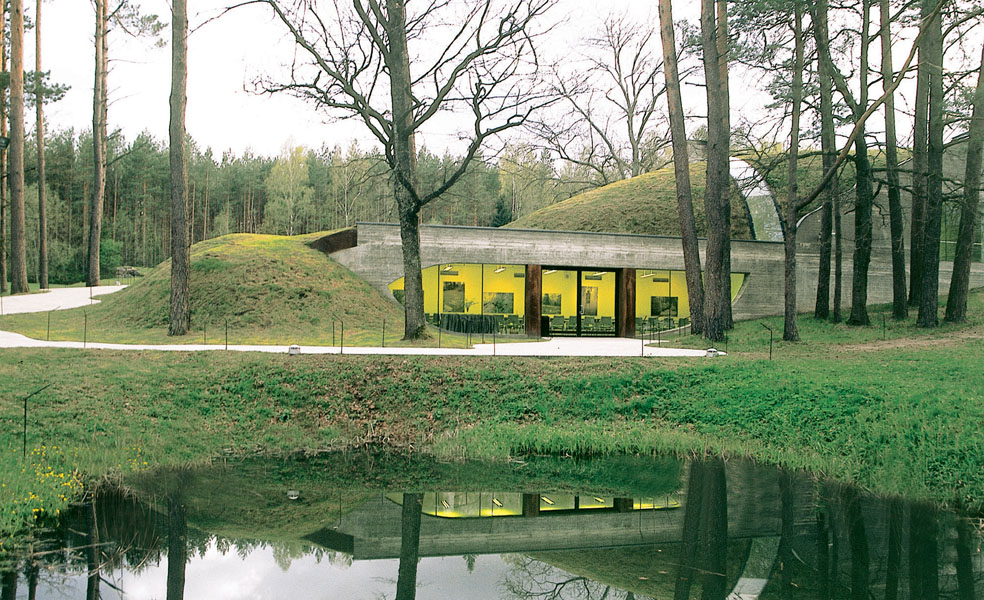
Photograph by Gintaras Karosas · CC BY-SA 3.0 G. Karosas Education Centre
The park's visitor and education building: departure point for guided tours, and the venue for workshops and the museum's education programming.
What to see first
LNK Infotree
Gintaras KarosasGuinness World Records certified it in 2002 as the largest sculpture of its kind: about 3,000 television sets built into a 700-metre labyrinth with a toppled statue of Lenin at its centre. It is the work most identified with the museum in every source checked.10
Monument of the Centre of Europe
Gintaras KarosasMarks, with granite plaques naming Europe's capitals and their distance from the spot, the point the Institut Geographique National calculated as the continent's geographic centre in 1989, the reason the museum exists at this location.7
Space of Unknown Growth
Magdalena AbakanowiczA 2,012 square-metre landscape of boulders and 22 concrete forms by one of the leading Polish sculptors of the late 20th century, among the largest single works on the grounds.7
Double Negative Pyramid
Sol LeWittA symmetrical concrete pyramid continued by its own reflection in water, by one of the founding figures of Conceptual and Minimal art.7
Chair/Pool and Drinking Structure with Exposed Kidney Pool
Dennis OppenheimOppenheim's 1996 and 1998 contributions are credited by the museum's own history as the turning point that drew other internationally established sculptors to the annual symposium.10
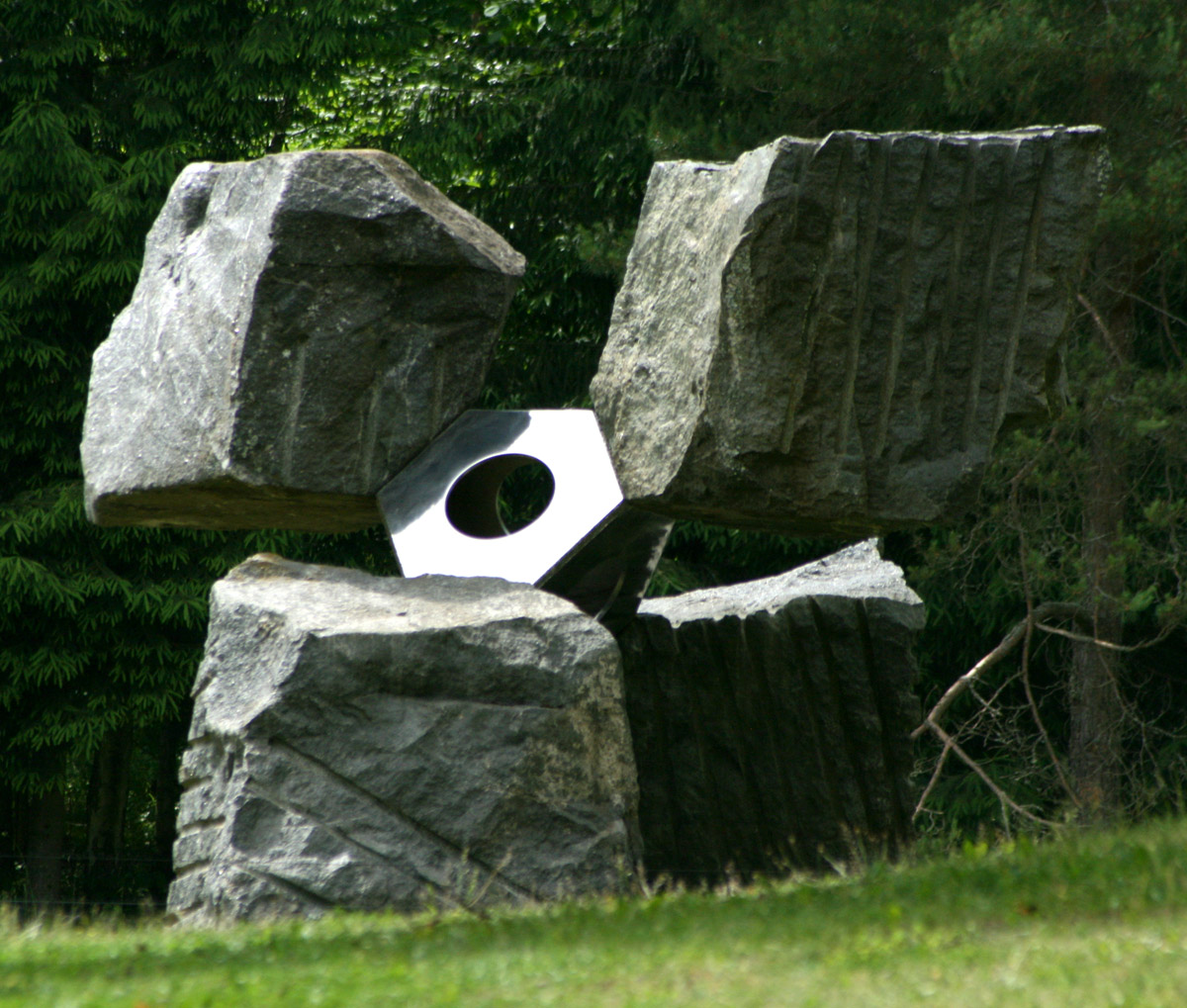
Cloud Hands
Jon Barlow HudsonFour precisely calculated granite blocks engineered to appear weightless.7
Voices Underground
Patricia GoodrichCombines planted bulbs with a buried audio work featuring 44 artists from 15 countries discussing their own creative practice.6
Isvykimas. Mano seneles atminimui (Departure. In memory of my grandmother)
Beverly PepperOne of the collection's few explicitly personal, dedicatory works among mostly abstract or site-general pieces.6
YONI: Homage to Marija Gimbutas
Tei KobayashiDedicated to the Lithuanian-American archaeologist Marija Gimbutas, one of relatively few works on the grounds naming a specific Lithuanian intellectual figure.7
A sculptor clears a forest
Europos Parkas began as an ordinary stretch of overgrown woodland outside Vilnius. In 1987 a 19-year-old sculpture student, Gintaras Karosas, found the site and started clearing it by hand. He placed his first sculpture there in 1991 and, on 5 October that year, led the museum's first guided tour before the institution existed on paper. The non-profit organisation that owns and runs the park, Europos parkas VsI, was formally registered on 9 March 1993, which the museum's own history describes as making it Lithuania's first museum run by a non-governmental organisation rather than the state. Karosas remains the park's founder and its most prolific single sculptor: works credited to him on the grounds include the Monument of the Centre of Europe, the LNK Infotree, For Your Convenience, The Place, Foundations/Window, The Sign, The Wall and The Culture. What began as clearing a single field has grown into 55 hectares carrying more than 100 works, and the museum treats the shaping of the land itself as inseparable from the sculpture placed on it, so the forest, not a building, is the primary architecture.
The centre of Europe, calculated
The park's name and its reason for existing both trace to a 1989 calculation by the Institut Geographique National, France's national mapping agency, which measured the geographic centre of the European continent using the outer points of the land mass then commonly counted as Europe. The point fell in a field a short distance from the ground Karosas was already clearing, near the village of Joneikiskes in the Vilnius district. Karosas built the Monument of the Centre of Europe in 1996 to mark it: granite plaques cut with the names of Europe's capital cities and their distance from that spot, laid into the ground rather than raised on a plinth. Coordinates for the calculated centre, 54.83083 N, 25.35139 E, match the location Wikidata records for the museum under entity Q1265098. The story is retold on the museum's own site as the founding idea behind the whole park: to give an abstract, and in places contested, idea of a geographic centre of Europe a physical, walkable place. Other locations in Europe carry similar centre-of-continent claims by different calculation methods; this is specifically the 1989 French institute's measurement.
The tree built from three thousand screens
The single work most identified with Europos Parkas is Karosas' own LNK Infotree, built from roughly 3,000 decommissioned television sets arranged into a tree-shaped structure that visitors walk through along a path the museum describes as 700 metres long. At its centre sits a toppled statue of Lenin, a deliberate collision of a Soviet-era monument with the mass medium that, in the decades after Lithuanian independence, replaced state broadcasting as the main channel of images entering households. Guinness World Records certified it in 2002 as the largest sculpture of its kind, a claim the museum still leads with in its own materials and one repeated in independent tertiary sources including Wikipedia. The piece reads two ways at once: as a monument to the volume and disposability of broadcast media, screen after screen stacked into a labyrinth nobody can watch all at once, and as a specific Lithuanian reckoning with the ideology the toppled figure represented. It is also, practically, the reason a casual visitor can locate the museum's most famous object without a guide, since unlike much of the collection, which the park's own reviewers describe as tucked into dense forest, the Infotree's scale and its own maintained clearing make it hard to miss.
What the international symposiums brought in
Since 1993 Europos Parkas has run International Sculpture Symposiums, and the museum credits these annual gatherings, not an acquisitions budget, with building most of the collection now on the grounds. The first symposium, in July and August 1993, brought 14 sculptors from six countries and was, by the museum's account, the first event of its kind held in Lithuania. The turning point the museum's own history names is 1996, when the American conceptual artist Dennis Oppenheim completed a work on the grounds; the museum credits that contribution with drawing a wider circle of internationally established sculptors to later symposiums, among them Magdalena Abakanowicz and Sol LeWitt by the end of the decade. The collection the symposiums built now runs past 100 works by artists from close to 30 countries, spanning Armenia, Belarus, Canada, Croatia, Cyprus, Egypt, Finland, France, Germany, Greece, Hungary, Ireland, Japan, Mexico, Moldova, the Netherlands, Peru, Russia, the United States and Venezuela among others, alongside Lithuanian sculptors. It is a working method closer to an artist residency than a conventional museum's acquisitions committee: a symposium sculptor is given a specific site inside the park and makes a work for that site, rather than the park buying finished work and placing it afterward.
A museum with no walls, and what that costs it
The park draws a genuinely divided response, and the division tracks its two defining choices: scale and the near-absence of built infrastructure. On Tripadvisor, Europos Parkas holds an aggregate rating of 3.4 out of 5 from 135 reviews as of late September 2026, split almost evenly between visitors rating it excellent or good and a substantial minority rating it poor or terrible, an unusually wide spread for a museum of its international profile. What visitors consistently praise is the pairing itself: large contemporary sculpture set inside genuine, uncultivated forest rather than a manicured sculpture garden, and the calm of walking 55 hectares that rarely feel crowded even in summer. What they consistently criticise is navigation. The museum issues a map at the entrance and the paved path ends close to the gate, after which the more than 100 works are distributed through dense woodland with limited signage, so a visitor without local knowledge can walk past sculptures without finding them or, having found a handful, conclude the collection is smaller and less consistent than it is. A second recurring complaint sets the combined cost of admission and a separate parking charge against a collection some visitors judge unevenly maintained, with a portion of older wood and stone works from the earlier symposiums showing weathering that newer, better-known pieces such as the LNK Infotree do not.
Visiting the grounds today
Europos Parkas is open every day of the year from 10 am until sunset, with last admission at 7 pm during spring and summer, according to its own current pricing and visitor pages, fetched 28 September 2026; no seasonal closure is stated anywhere in the sources checked. Adult admission is 14 EUR, student 11 EUR and child 8 EUR, with a 10 percent family discount and a 15 percent discount for groups over 10; pre-school children with a parent, teachers accompanying a school group of up to 10 children, and Lithuanian museum staff and accredited journalists are admitted free. The museum's own visiting page lists an on-site restaurant, shop and post office, plus guided tours and audio guides in English, Russian and Lithuanian. It sits roughly 17 to 20 kilometres from central Vilnius; the museum's own directions describe driving out along Kalvariju street toward the Santariskes roundabout and the Green Lakes, and a public bus route running Zalgirio - Europos Parkas - Skirgiskes from the Zalgirio stop on Kalvariju street.
What visitors say
Visitors consistently praise the pairing of large contemporary sculpture with genuine, uncultivated forest rather than a manicured sculpture garden, and the calm of walking 55 hectares that rarely feel crowded. The same qualities generate the main complaint: past the paved area near the entrance the more than 100 works are distributed through dense woodland with limited signage, so a visitor without local knowledge can walk past pieces without finding them, and the combined cost of admission plus a separate parking charge is weighed against a collection some visitors judge unevenly maintained.
What is praised, what is criticised
- Praised: the combination of large-scale contemporary sculpture with an unmanicured forest setting
- Praised: the scale of signature works, especially the LNK Infotree
- Praised: the calm, uncrowded walking experience, including for visitors bringing dogs
- Criticised: wayfinding through the forest is difficult once past the paved area near the entrance, with limited signage to individual works
- Criticised: the combined cost of admission and a separate parking fee, against a collection some visitors find unevenly maintained
- Criticised: a portion of the older works, particularly wood and stone pieces from the earliest symposiums, show weathering
Ratings on other platforms
Tripadvisor: 3.4 from 135 ratings, read 28 September 2026
A platform average is a tertiary source: it moves, it is not audited, and we quote no visitor's words.
Questions about Europos Parkas
Where is Europos Parkas?
Europos Parko g. 300, Joneikiskes, Vilniaus r., LT-15143, Lithuania.
How much does it cost to visit?
Adult: EUR 14; Student: EUR 11; Child: EUR 8. As confirmed 28 September 2026.
When is it open?
Daily 10:00-sunset. As confirmed 28 September 2026.
How do you get there?
Car: About 17-20 km from central Vilnius. From the Santariskes roundabout on Kalvariju street, follow the signs toward the Green Lakes (Zalieji Ezerai) and the museum, roughly 11 km further; Bus: Public bus route Zalgirio - Europos Parkas - Skirgiskes, departing from the Zalgirio stop on Kalvariju street.
What should you see first?
LNK Infotree (Gintaras Karosas); Monument of the Centre of Europe (Gintaras Karosas); Space of Unknown Growth (Magdalena Abakanowicz); Double Negative Pyramid (Sol LeWitt); Chair/Pool and Drinking Structure with Exposed Kidney Pool (Dennis Oppenheim); Cloud Hands (Jon Barlow Hudson).
What we could not confirm
- The museum's own pages give inconsistent figures for collection size across pages fetched in September 2026: some state 90-plus works from 27 countries, others state 100-plus from close to 30 countries. This record uses the higher, more recently worded figure, but the museum has not published one reconciled count.
- No English-language, on-the-record account of funding, governance disputes or acquisition controversy was located in the sources checked for this record.
Images
Sources
- 1Europos Parkas, official site, English homepage europosparkas.org/en/
- 2Europos Parkas, legacy domain homepage europosparkas.lt/
- 3Europos Parkas, Discounts and tickets europosparkas.org/tickets/
- 4Europos Parkas, About us europosparkas.org/about-us/
- 5Europos Parkas, Museum in Nature europosparkas.org/main-meniu-museum-in-nature/
- 6Wikipedia, Europos Parkas () en.wikipedia.org/wiki/Europos_Parkas
- 7Europos Parkas, Exposition europosparkas.org/exposition/
- 8Europos Parkas, About Europos parkas (registration and contact) europosparkas.org/about-europos-parkas/
- 9Europos Parkas, legacy visiting information page europosparkas.lt/English/visiting_m.html
- 10Europos Parkas, legacy History and facts page europosparkas.lt/Straipsniai/history.htm
- 11Tripadvisor, Europos Parkas attraction page ( rating, read via browser 2026-09-28) tripadvisor.com/Attraction_Review-g20999859-d291087-Reviews-Europos_Parkas-Joneikiskes_Vilnius_County.html
- 12Wikidata, Q1265098 (, identity and coordinates) wikidata.org/wiki/Special:EntityData/Q1265098.json
- 13Wikimedia Commons, Category:Europos Parkas (image licence verification via API) commons.wikimedia.org/wiki/Category:Europos_Parkas