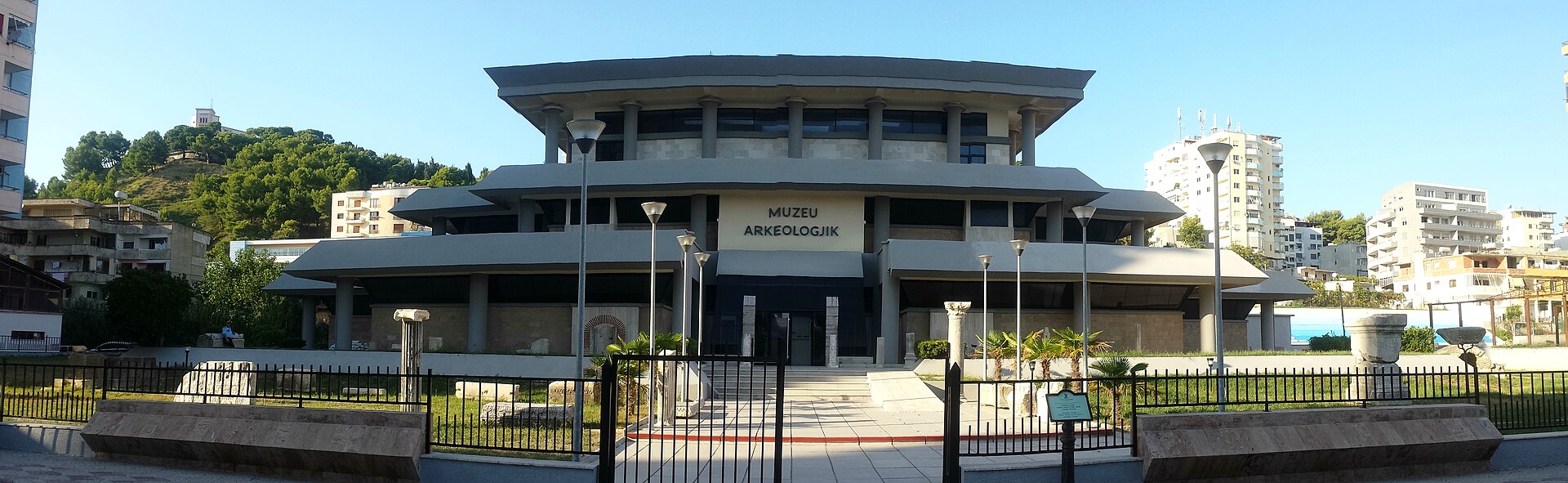
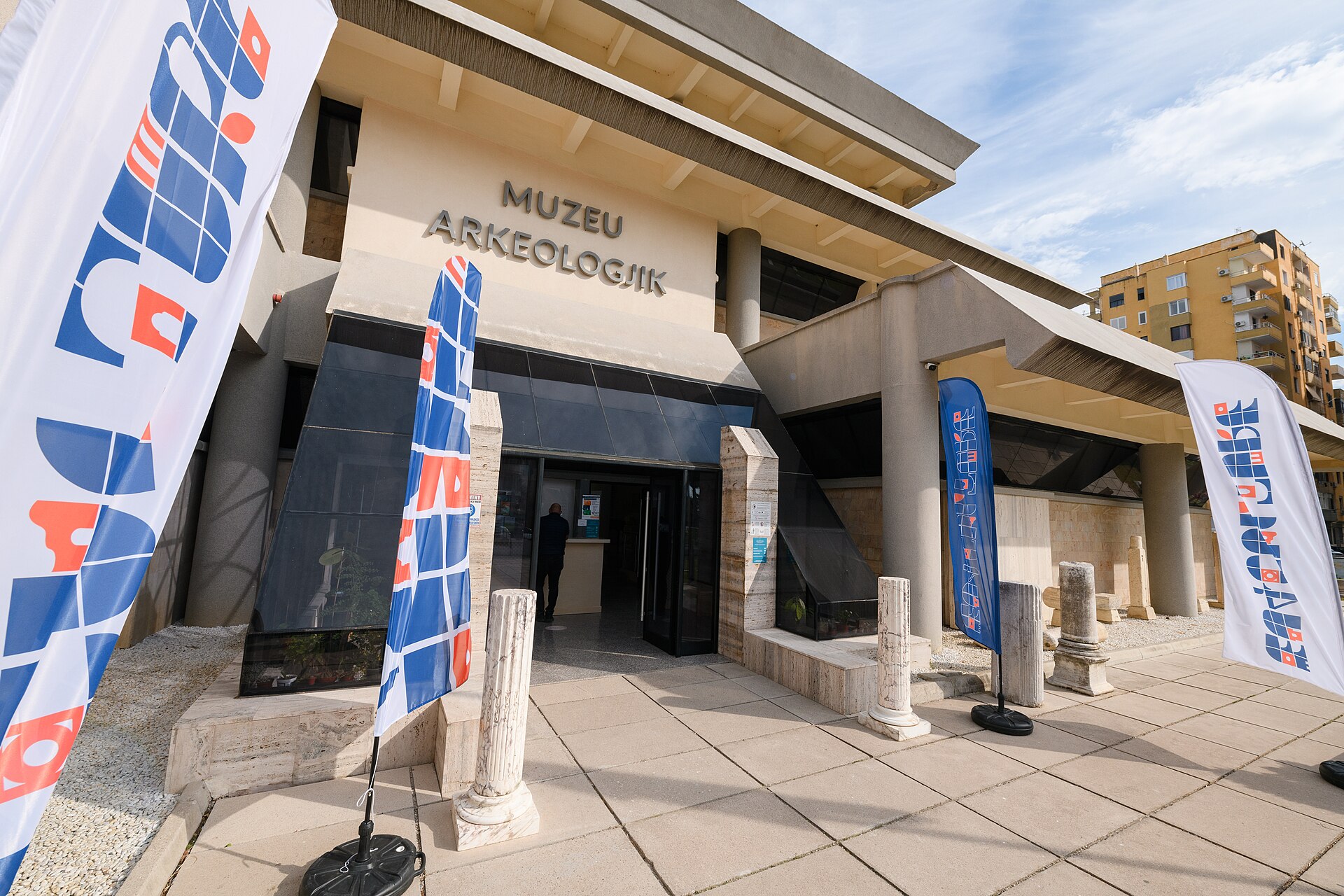
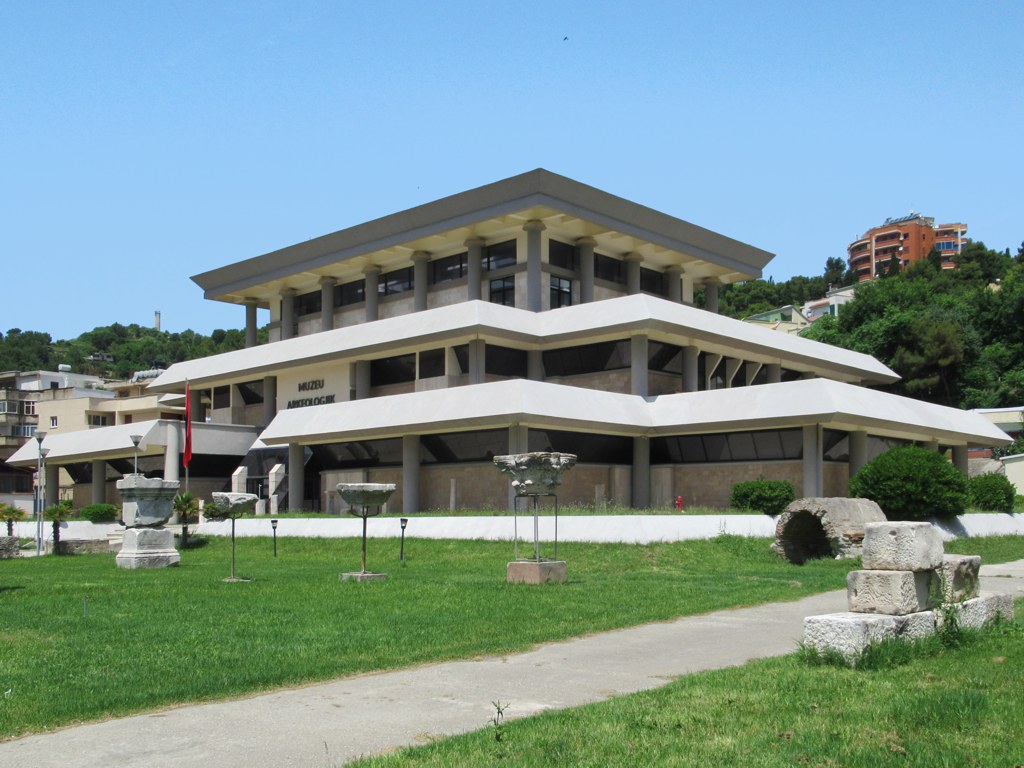
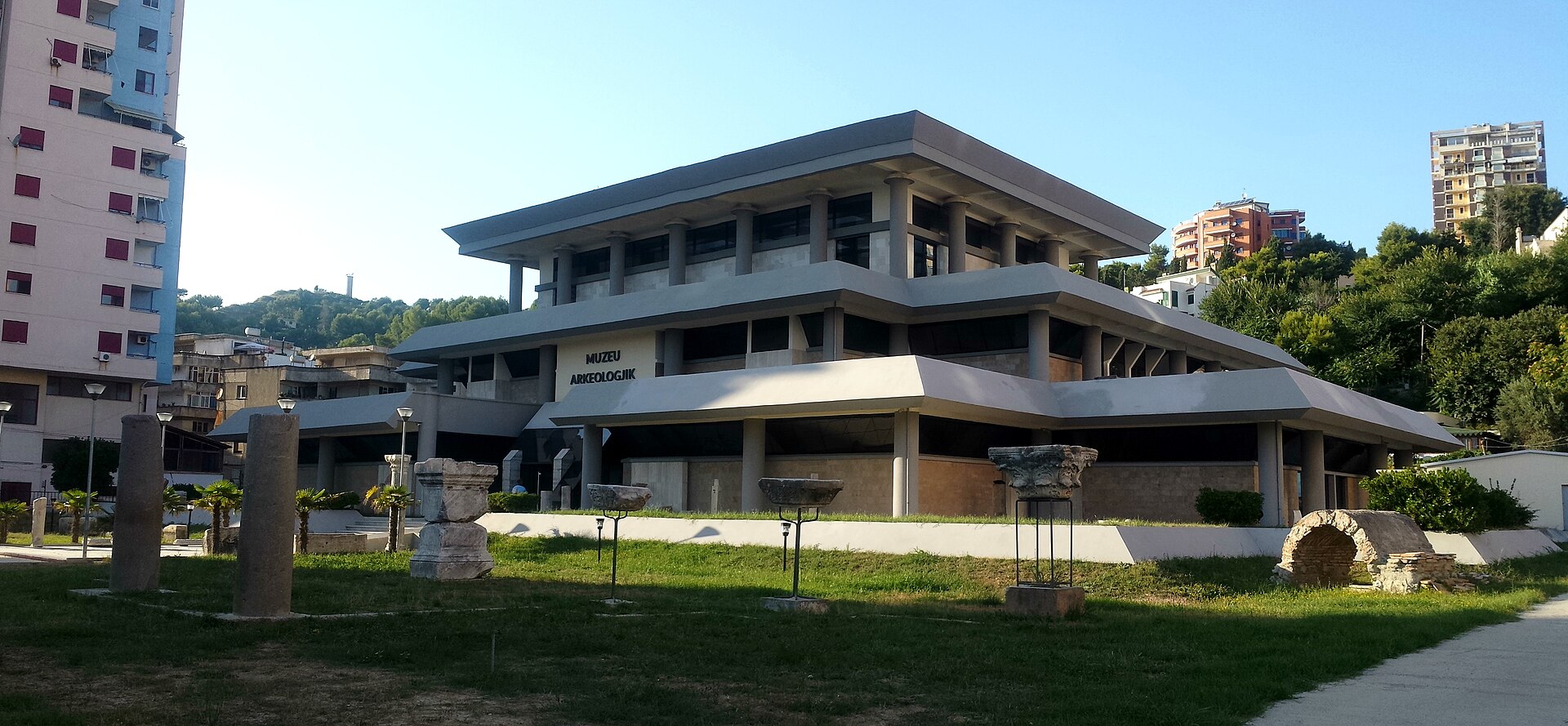
The museum building on Rruga Taulantia, Durres, seen from the seafront garden, with its name in Albanian, Muzeu Arkeologjik, over the entrance
GentiBehramaj, CC BY-SA 4.0, via Wikimedia CommonsDurres Archaeological Museum
Museum · Muzeu Arkeologjik i Durresit · Founded 1951
Open, admission and hours confirmed 28 September 2026 · 14 sources
On this page 14 sections
ContentsClose
The museum's strength is Roman-period material from a single, continuously excavated ancient city: funerary sculpture, mosaic pavements, architectural terracotta and small votive and domestic objects from ancient Dyrrhachium, backed by a chronological hang that (on the evidence of the ground floor, which is what has actually been open for most of the past decade) runs cleanly from the Illyrian and Greek periods through Rome. The 2026 addition of medieval and Byzantine material on the second floor, unseen since 2001, and the pending return of the Beauty of Durres mosaic, extend that strength into the city's post-Roman history for the first time in a generation, though both were still incomplete as of the most recent sources checked for this page.
| Local name | Muzeu Arkeologjik i Durresit |
|---|---|
| Kind | Museum |
| Founded | 1951 |
| City and country |  Durres, Albania Durres, Albania |
| Address | Rruga Taulantia 32, 2001 Durres, Albania |
| Website | daco.al/visitdurres/index.php/atraksione/muzeu-arkeologjik-i-durresit |
| Status | Open, confirmed |
| Record last verified |
Visiting
- Hours
- Tue-Sun09:00 to 16:00Posted municipal hours. As of the July 2026 reopening reporting cited here, the museum was in practice closing around 15:00 and staying shut on both weekend days because of a staff shortage; the director said the museum was awaiting Ministry approval to roughly double its staff. Call ahead.
- Closed
- Monday. Currently also Saturday and Sunday in practice, per the source above, pending new staffing.
- Admission
- All visitorsFreeFree during the 2026 post-restoration reopening. Paid ticketing was announced as planned but had not been reintroduced as of the July 2026 reporting cited here; the pre-closure adult ticket was 400 ALL. Confirm before travel.
- Do I need to book?
- No booking system found; cash-only ticket counter historically (per visitor reports)
- Address
- Rruga Taulantia 32, 2001 Durres, Albania MapOn foot On the seafront promenade (Shetitorja), a few meters from the 6th-century Byzantine wall and next to the Durres Amphitheatre
- Website
- daco.al/visitdurres/index.php/atraksione/muzeu-arkeologjik-i-durresit
- Telephone
- +355 52 222 310
Before you go how long, access, photography, bags, eating, shop
- How long to allow
- 30 to 45 minutes for the ground floor as currently displayed; longer once the upper floors are fully open
- Access
- Not documented in the sources checked for this page
- Photography
- Not documented in the sources checked for this page; some visitor reports from before the 2022 closure describe an indoor photography ban with photography permitted of large pieces displayed outside
- Bags
- Not documented in the sources checked for this page
- Eating
- A cafe and an education corner are planned for the third floor once restoration work there is complete; not open yet as of the sources checked
- Shop
- Not documented in the sources checked for this page
Prices and hours change. We take them from the institution's own pages and print the day we read them, and you can check the current position at the source we used. Confirm before you travel.
What is inside
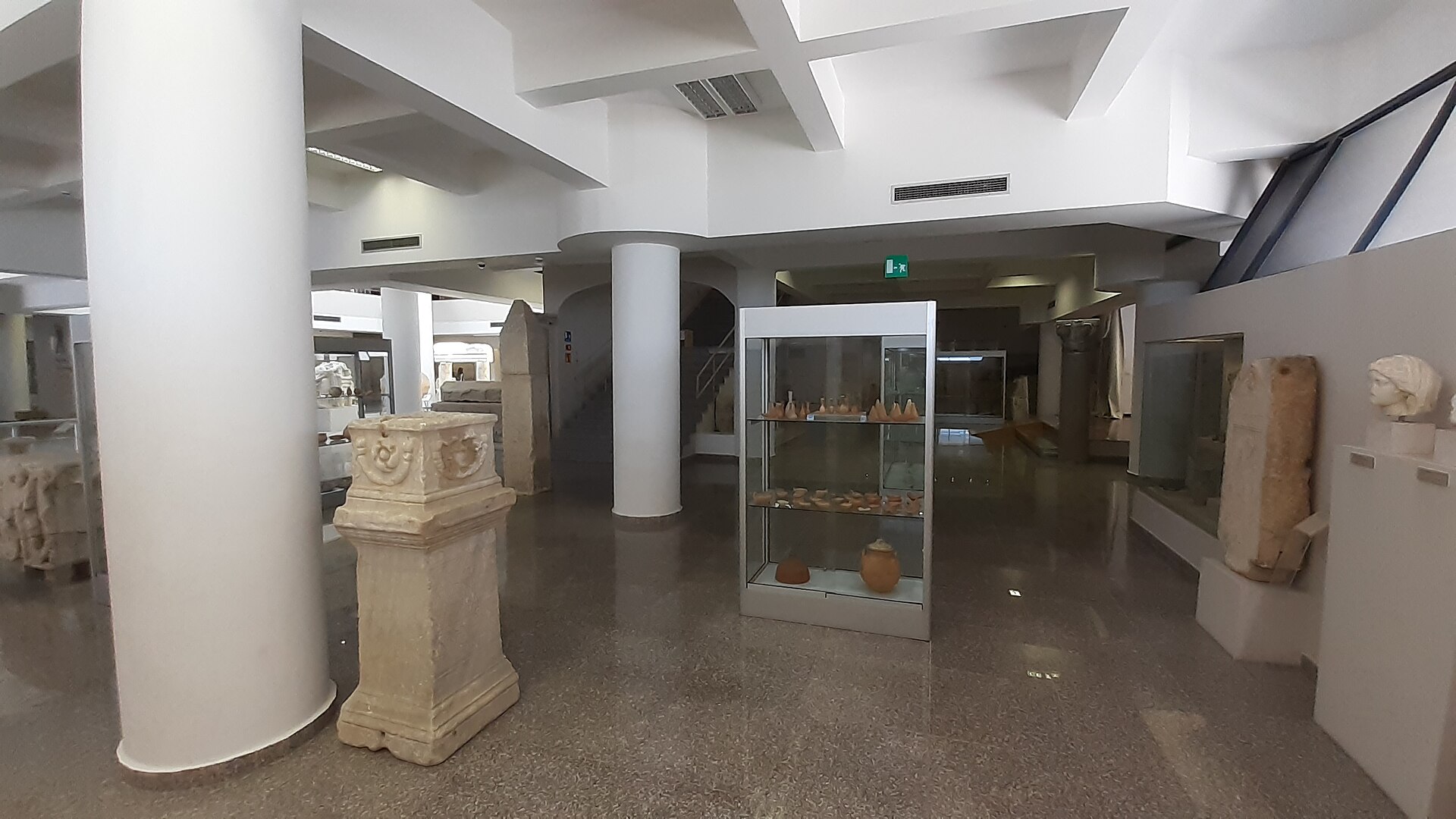
Photograph by Adert · CC BY-SA 4.0 Ground floor entrance hall - Illyrian and Greek antiquity
Roman funerary stelae, stone sarcophagi, marble portrait heads and small votive and grave finds from the earliest, Illyrian and Greek phases of ancient Dyrrhachium/Epidamnos, arranged as a visitor's first chronological stop
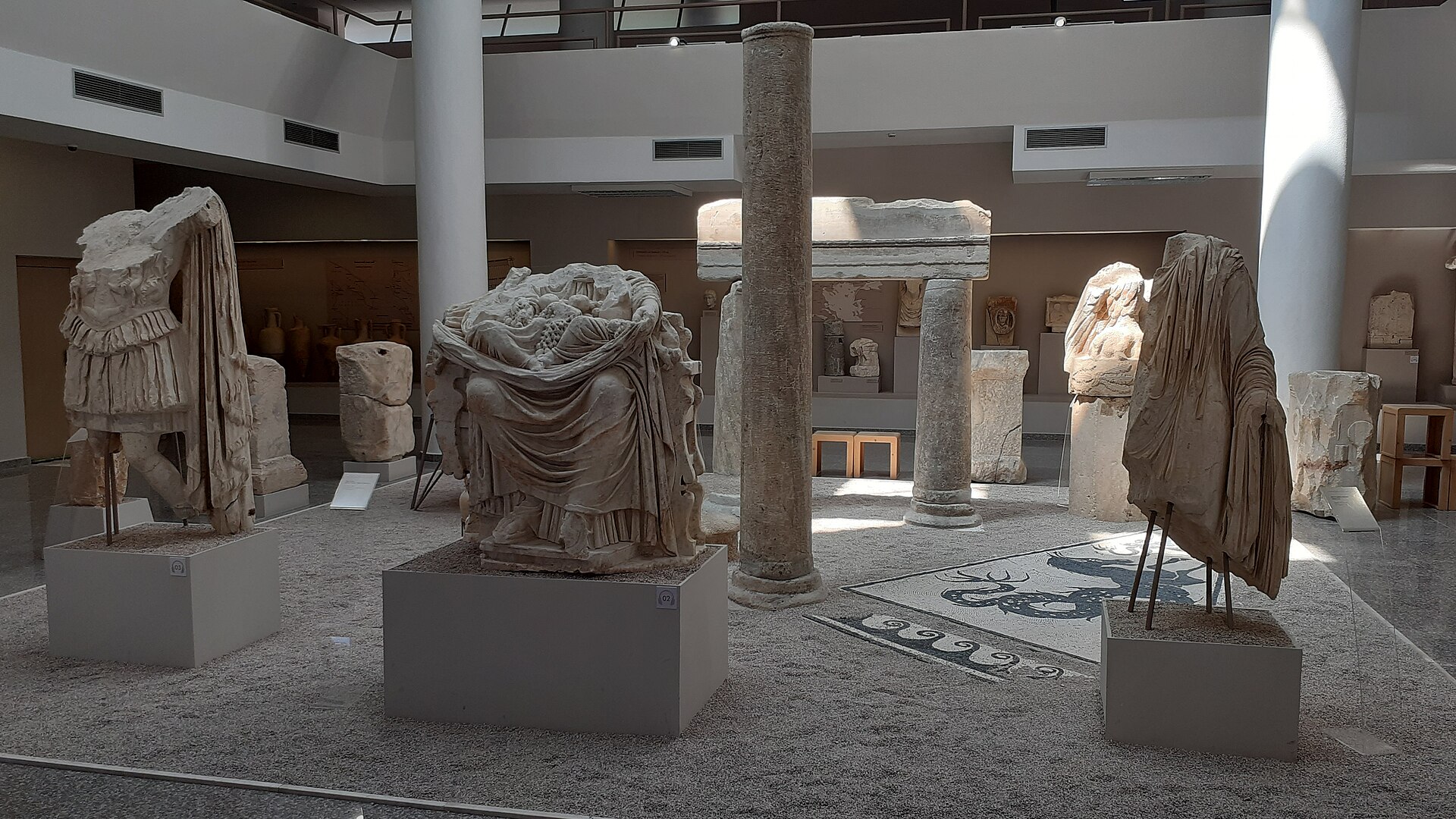
Photograph by Adert · CC BY-SA 4.0 Central hall - Roman sculpture and mosaic pavements
Large-scale Roman marble sculpture, draped funerary and honorific statues, architectural fragments and columns, set around excavated mosaic floor panels laid into the hall floor itself
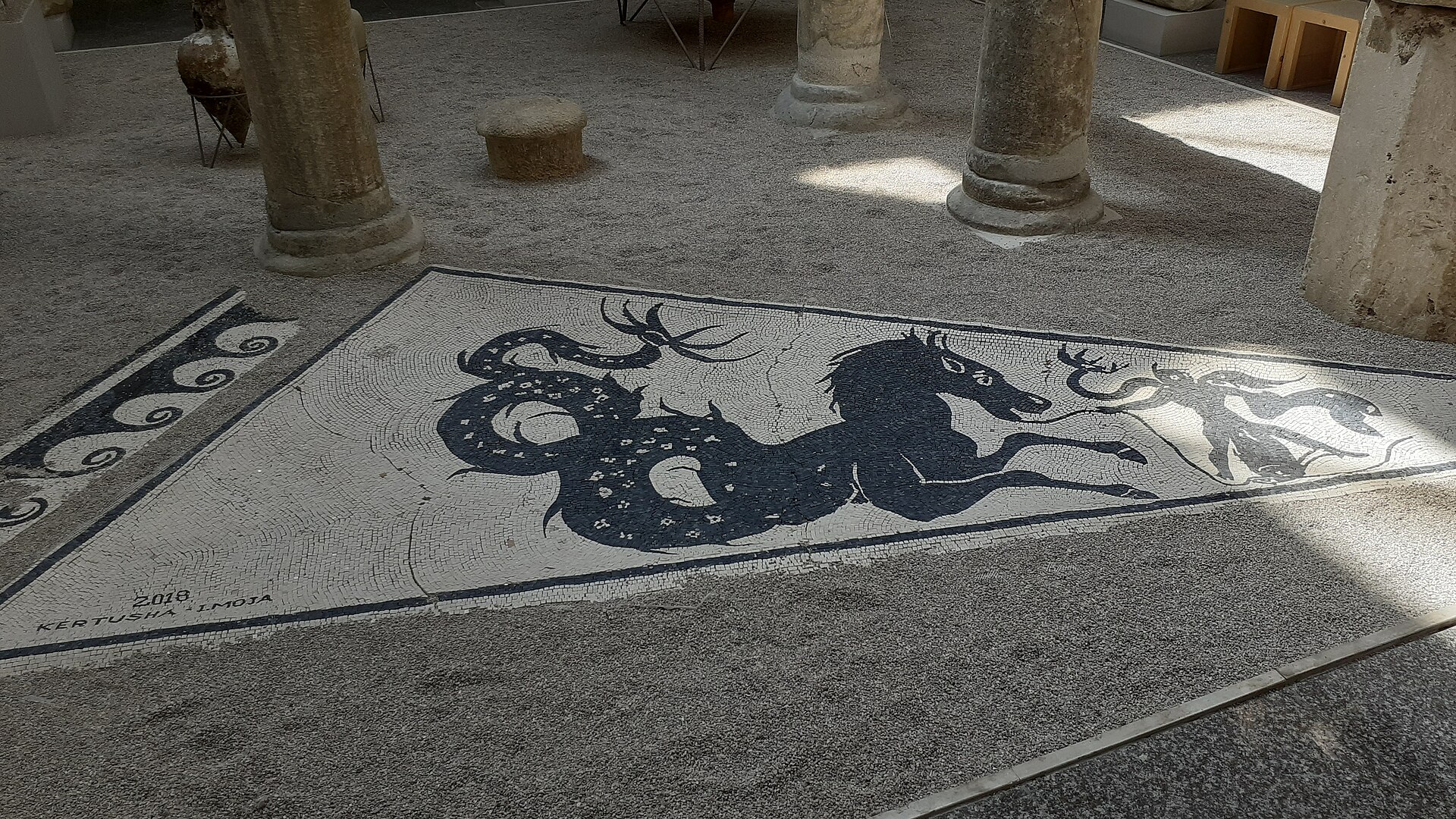
Photograph by Adert · CC BY-SA 4.0 Roman mosaic pavements
In-situ and relaid Roman mosaic floor panels, including a figured black-and-white panel showing a sea creature (a horse-bodied ketos) bordered with a wave pattern, conserved and reset in the modern hall floor
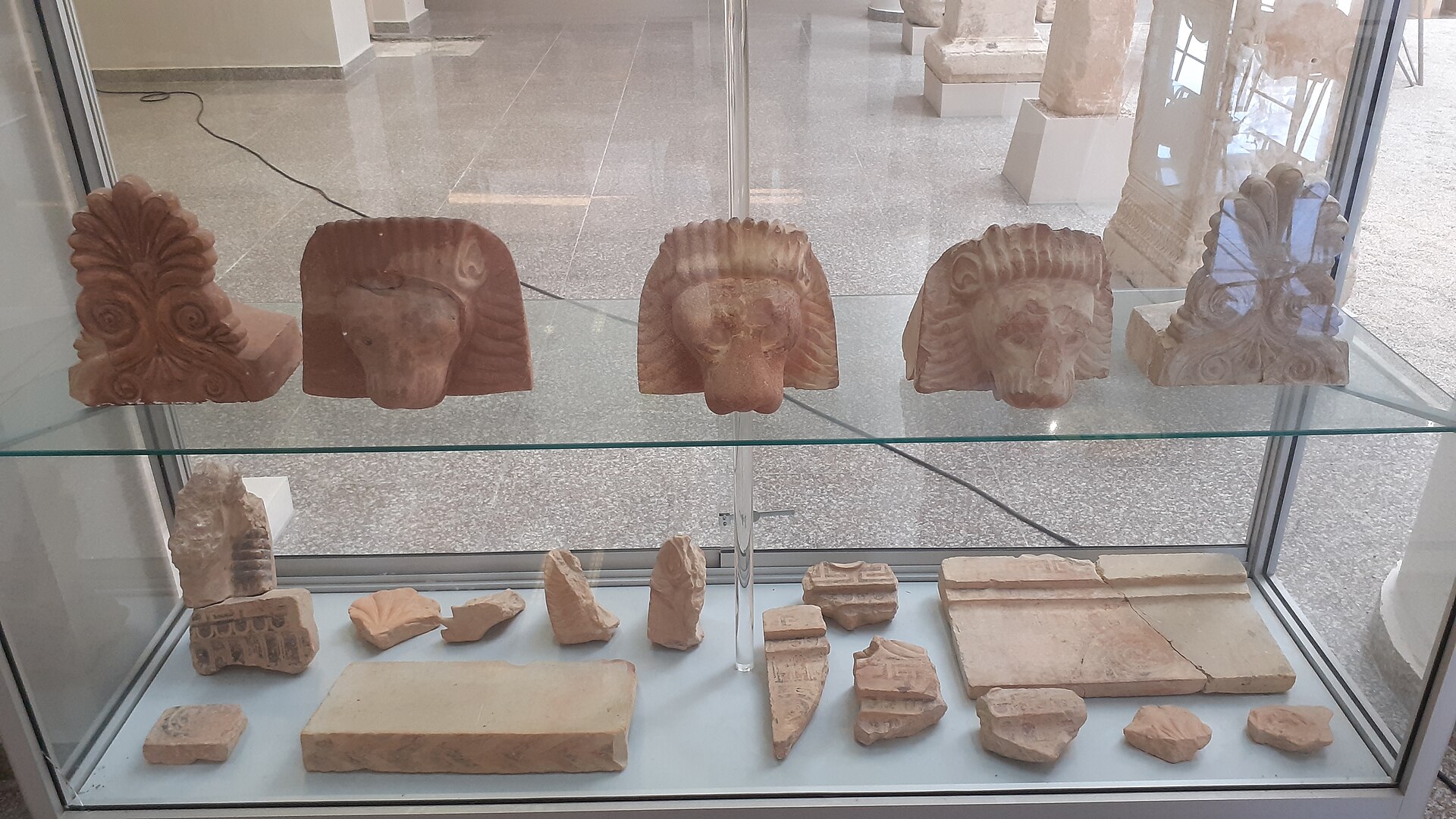
Photograph by Adert · CC BY-SA 4.0 Architectural terracottas and small finds
A case of fired-clay architectural ornament, including antefixes molded with lion and ram heads and acanthus leaf motifs that once finished the eaves of Roman-period buildings in the city, alongside fragments of inscribed and moulded stone and terracotta
Second floor - medieval and Byzantine city, 5th to 15th century
Byzantine, Norman, Angevin and Venetian and Ottoman-period material tracing Durres/Dyrrhachium's ten centuries as a Byzantine provincial city, a Norman and Angevin foothold and later a Venetian and Ottoman port; opened to the public in 2026 for the first time since 2001. No free-licence photograph of this floor has been located; do not substitute another room.
What to see first
The Beauty of Durres (Bukuroshja e Durresit)
Unknown, 4th-3rd century BC workshop of ancient Epidamnos/DyrrhachiumThe most celebrated mosaic found in Albania, an elliptical polychrome floor panel centred on a woman's head amid floral motifs, roughly 14 square meters and over 2,300 years old; discovered in 1916, moved to Tirana in 1981, and returned to Durres in pieces in early 2026 after 45 years away, though as of the reporting used here it was still awaiting final installation at the museum entrance4
Miniature busts of Venus
Unknown, Roman periodA group of small Venus busts from the city's excavations, cited by the museum's own tourism authority as evidence of a cult of Venus in Roman Dyrrhachium, a detail that ties an everyday domestic object type to the city's religious life11
Roman funerary stelae and stone sarcophagi
Unknown, Roman periodGrave monuments from the necropoleis around ancient Dyrrhachium, inscribed and carved, forming the bulk of the ground-floor Roman displays and among the objects visitors most consistently mention as well presented and well labelled6
Roman mosaic floor panels, including the sea-monster (ketos) panel
Unknown, Roman periodIn-situ and relaid mosaic pavements set into the museum's own floor, including a figured panel of a horse-headed sea creature; conserved and reset with a visible 2018 conservator's date at its edge, a rare case where the conservation itself is dated and legible on the object14
Architectural terracotta antefixes
Unknown, Roman periodMolded lion-head, ram-head and acanthus roof antefixes that once finished the eaves of Roman buildings in the city, a class of everyday architectural decoration that is well represented here and rarely seen outside excavation reports14
Rare coins from the Dyrrhachium mint and finds from shipwrecks
Various, Hellenistic to Roman periodThe museum's collection includes rare coinage and material recovered from wrecks off the coast, cited by visitor reports as part of what sets the collection apart from smaller regional museums9
3,200-plus object collection of Dyrrhachium material overall
Various, prehistory to the Roman period, with medieval material added on the reopened second floorThe single largest and, by the Albanian national tourism authority's own description, most important archaeological collection in the country, organized chronologically across the site's Illyrian, Greek, Hellenistic, Roman and (from 2026) medieval and Byzantine phases11
A museum rebuilt more than once
The Archaeological Museum of Durres was established in March 1951 to hold the finds of ancient Dyrrhachium, known in the Greek period as Epidamnos, the city on whose site modern Durres stands. Before 1951 the objects being recovered from the city's excavations were held piecemeal across different institutions; after 1945 a combined Historical and Natural Museum under director Vangjel Toci first gathered them under one roof, and the dedicated archaeological museum grew out of that collection as systematic excavation continued.
The institution has changed buildings more than once. Its original home was returned to a prior private owner under Albania's post-1990 property restitution law in 1999, displacing the museum. A new purpose-built museum on the current waterfront site had already been started in the 1980s but constrution stalled through the political and economic upheaval of the following decade; only one floor of it had opened, in 2002. The building closed again in 2010 for a further round of reconstruction, and Prime Minister Edi Rama reopened its ground floor in March 2015 with new interior display work. Less than five years later the 2019 earthquake forced it shut a third time.
The 2019 earthquake and the EU4Culture restoration
A magnitude 6.3 earthquake struck Albania in November 2019 and did serious structural damage to the museum building: cracked partition walls, cracked masonry joints and upper facade sections, and displaced columns and beams, on top of the coastal site's older, ongoing problem of salt and moisture erosion. The museum closed for restoration in 2022. The work was funded by the European Union and carried out under the EU4Culture programme, implemented by UNOPS in partnership with Albania's Ministry of Tourism, Culture, Youth and Sport, covering structural repair alongside new mechanical, electrical, heating, ventilation, fire and security systems and new educational spaces.
The restoration ran well past its original schedule. Reporting from May 2025 found the museum still closed eighteen months after its stated deadline, with no firm reopening date given and the project at roughly 93 percent physical completion, its remaining work concentrated on the interior fit-out and the reinstallation of the collection. An official inauguration ceremony was held on 29 April 2026, attended by EU and Albanian officials; actual, if partial, public reopening followed in the weeks after.
A reopening with real gaps
The museum that opened its doors in 2026 was not the finished building the restoration had promised. Reporting from July 2026 found it operating on reduced hours, closing at 3pm instead of the planned evening closing time and shut altogether on weekends, because staffing had not caught up with the reopening: the museum's director, Alban Ramohitaj, said the institution was waiting on Ministry approval for a new staffing plan that would roughly double the workforce from about sixteen to thirty-three employees, which he said was needed to run full hours and offer guided tours across the site's monuments. Entry was free during this transitional period, with paid ticketing described as planned for a later date rather than already in force.
An earlier BIRN-affiliated investigation, published in May 2026, was more pointed: it found the reopened museum still missing a completed chronological hang, still without a catalogue for at least one attached collection of donated Italian artworks held in the neighbouring Ethnographic Museum, and without a dedicated space for at least one artist whose work Italian counterparts had specifically asked to see properly presented. The second floor, holding the museum's medieval and Byzantine material, opened to the public in 2026 for the first time since 2001, according to the director, though it was reported to be reachable only by a sealed staircase while final installation work continued. This publication records both the restoration and its unfinished edges; a reader planning a visit should expect a working museum rather than a completed one, and should call ahead.
The Beauty of Durres comes home
The museum's single best-known object is not, strictly, a museum object at all, but a floor: an elliptical polychrome mosaic known as the Beauty of Durres, centered on a woman's head surrounded by floral motifs, dated to the fourth or early third century BC and covering roughly 14 square meters. It was found by chance in 1916, when Austro-Hungarian military engineers digging air-raid shelters in the First World War uncovered it nearly four meters underground; it was documented by the archaeologist Camillo Praschniker and then effectively lost from view until its rediscovery in 1947. In 1981 it was lifted and moved to the National Historical Museum in Tirana, where it stayed on permanent display for 45 years.
Reporting from January 2026 recorded its return: prepared and moved back to Durres in fourteen sections by the same team of specialists who had installed it in Tirana in 1981, intended for display at the entrance to the restored museum. As of the most recent reporting checked for this page, from May and July 2026, installation had begun but was not complete, and the mosaic had been placed in the museum's exit area without yet following a proper chronological placement in the museum's overall hang. This publication will update the page once a source confirms the mosaic is fully and permanently installed.
What is inside
The collection holds more than 3,200 objects recovered from excavations in and around ancient Dyrrhachium, organized chronologically so a visitor moves through the Illyrian, Greek, Hellenistic, Roman and, from 2026, medieval and Byzantine phases of the city's history. The ground floor carries the earlier material: Roman funerary stelae and stone sarcophagi, miniature busts of Venus that the Albanian national tourism authority cites as evidence of a cult of Venus in the Roman city, mosaic floor panels including a figured sea-creature panel conserved and reset into the hall floor itself, and a case of molded terracotta architectural ornament, lion-head and ram-head antefixes that once finished the eaves of Roman buildings in the city. Visitor reports also mention rare Dyrrhachium-mint coinage and material recovered from shipwrecks off the coast among the museum's holdings. The reopened second floor is intended to carry the Byzantine, Norman, Angevin, Venetian and Ottoman-period material, tracing roughly ten centuries of the city's history as a Byzantine province, a medieval port under successive rulers, and an Ottoman territory; a third floor is designated in restoration plans for underwater archaeology finds, with an education corner and a cafe, though neither was reported open as of the sources checked here.
On the walls of ancient Dyrrhachium
The museum stands on Durres's seafront promenade, a short walk from the 6th-century Byzantine defensive wall built after the Visigothic invasions of the late fifth century, and next to the Roman amphitheatre that is the city's other major ancient monument. The setting places the museum inside the same layered urban fabric its own collection documents: a Greek colony founded as Epidamnos, renamed Dyrrhachium under Rome, a major crossing point on the Via Egnatia to Constantinople, and, across the centuries covered by the newly reopened second floor, a Byzantine, Norman, Angevin, Venetian and Ottoman port in turn. That continuity, a functioning coastal city built directly on top of more than two thousand years of itself, is a large part of why the museum's own excavation history and its published collection keep expanding rather than closing.
What visitors say
Visitors consistently call this the best or one of the best archaeological museums in Albania and praise the clarity of the labelling and the quality of the individual pieces, while also consistently noting, across several years of reviews, that only part of the building has been open to view at any one time, first because of the pre-2019 construction phasing and now because of the post-earthquake restoration and reduced 2026 reopening hours.
What is praised, what is criticised
- Praised: Well organized, well lit displays with bilingual Albanian and English labels and short introductory texts for each section
- Praised: The quality and density of the Roman-period finds, said by more than one reviewer to be better presented than the equivalent material in Tirana's National Historical Museum
- Praised: Free or low-cost entry during the periods reviewers visited
- Criticised: Only the ground floor has been open for most of the museum's recent history, with the upper floors closed for years at a stretch and, even after the 2026 reopening, reduced opening hours (closing at 3pm and shut on weekends) because of a staff shortage
- Criticised: Tickets historically cash-only, no card payment
- Criticised: As of investigative reporting from May 2026, the museum's return to service was still missing a completed chronological hang, a catalogue for at least one attached collection, and final installation of its best-known object, the Beauty of Durres mosaic
Ratings on other platforms
Tripadvisor: 4.1 from 180 ratings, read 28 September 2026
A platform average is a tertiary source: it moves, it is not audited, and we quote no visitor's words.
Questions about Durres Archaeological Museum
Where is Durres Archaeological Museum?
Rruga Taulantia 32, 2001 Durres, Albania.
How much does it cost to visit?
All visitors: free. As confirmed 28 September 2026.
When is it open?
Tue-Sun 09:00-16:00. Closed: Monday. Currently also Saturday and Sunday in practice, per the source above, pending new staffing. As confirmed 28 September 2026.
How do you get there?
On foot: On the seafront promenade (Shetitorja), a few meters from the 6th-century Byzantine wall and next to the Durres Amphitheatre.
What should you see first?
The Beauty of Durres (Bukuroshja e Durresit) (Unknown, 4th-3rd century BC workshop of ancient Epidamnos/Dyrrhachium); Miniature busts of Venus (Unknown, Roman period); Roman funerary stelae and stone sarcophagi (Unknown, Roman period); Roman mosaic floor panels, including the sea-monster (ketos) panel (Unknown, Roman period); Architectural terracotta antefixes (Unknown, Roman period); Rare coins from the Dyrrhachium mint and finds from shipwrecks (Various, Hellenistic to Roman period).
What we could not confirm
- Whether and when the Beauty of Durres mosaic reaches a final, chronologically placed installation, rather than its current position in the museum's exit area
- Whether the second-floor medieval and Byzantine galleries are fully open to visitors or still reachable only via the sealed staircase reported in mid-2026
- Whether the Ministry of Tourism, Culture, Youth and Sport has approved the staffing plan the museum's director said was needed to restore full opening hours and guided tours
- Current admission pricing once free entry during the transitional reopening ends
- Whether a catalogue has since been produced for the attached collection of Italian artworks the May 2026 BIRN-affiliated report found undocumented
Images
Sources
- 1Reporter.al, "Muzeu arkeologjik i Durresit i rihap dyert me kufizime", 5 July 2026 reporter.al/2026/07/05/muzeu-arkeologjik-i-durresit-i-rihap-dyert-me-kufizime/
- 2OCNAL, "Durres Archaeological Museum Reopens With Limited Hours Amid Staffing Shortages", July 2026 ocnal.com/2026/07/durres-archaeological-museum-reopens.html
- 3United Nations Albania / UNOPS, "Archaeological Museum of Durres fully restored under EU4Culture programme implemented by UNOPS" albania.un.org/en/314725-archaeological-museum-durr%C3%ABs-fully-restored-under-eu4culture-programme-implemented-unops
- 4Reporter.al, "Bukuroshja e Durresit rikthehet ne qytetin bregdetar pas 45 vitesh", 3 January 2026 reporter.al/2026/01/03/bukuroshja-e-durresit-rikthehet-ne-qytetin-bregdetar-pas-45-vitesh/
- 5Reporter.al / BIRN Albania, "Durresi rihap muzete, por Bukuroshja e Durresit dhe galeria mungojne ende", 2 May 2026 reporter.al/2026/05/02/durresi-rihap-muzete-por-bukuroshja-e-durresit-dhe-galeria-mungojne-ende/
- 6Wikipedia, "Archaeological Museum of Durres" (, for building and collection history) en.wikipedia.org/wiki/Archaeological_Museum_of_Durr%C3%ABs
- 7Albanian-language Wikipedia, "Muzeu Arkeologjik i Durresit" (, for building history detail) sq.wikipedia.org/wiki/Muzeu_Arkeologjik_i_Durr%C3%ABsit
- 8Wikipedia, "The Beauty of Durres" (, for the mosaic's discovery and Tirana display history) en.wikipedia.org/wiki/The_Beauty_of_Durr%C3%ABs
- 9Tripadvisor, Durres Archaeological Museum reviews ( rating and visitor reports), read 28 September 2026 tripadvisor.com/Attraction_Review-g318866-d8807654-Reviews-Durres_Archaeological_Museum-Durres_Durres_County.html
- 10Bashkia Durres (Durres Municipality official tourism site), "Muzeu Arkeologjik i Durresit" daco.al/visitdurres/index.php/atraksione/muzeu-arkeologjik-i-durresit/
- 11Albanian National Tourism Agency (AKT), "Muzeu Arkeologjik i Durresit" akt.gov.al/atraksionet/muzeu-arkeologjik/
- 12Albanian Times, "Durres Archaeological Museum still closed, 18 months past restoration deadline", 26 May 2025 albaniantimes.al/durres-archaeological-museum-still-closed-18-months-past-restoration-deadline/
- 13Ministry of Tourism, Culture, Youth and Sport (Albania), press release on museum and archaeological park ticket pricing, 1 January 2020 mtks.gov.al/newsroom/ndryshojne-cmimet-e-biletave-per-muze-e-parqe-arkeologjike-shtohen-kategorite-perfituese/
- 14Wikimedia Commons, Category:Durres Archaeological Museum (image licensing and file descriptions verified per file via the API) commons.wikimedia.org/wiki/Category:Durr%C3%ABs_Archaeological_Museum