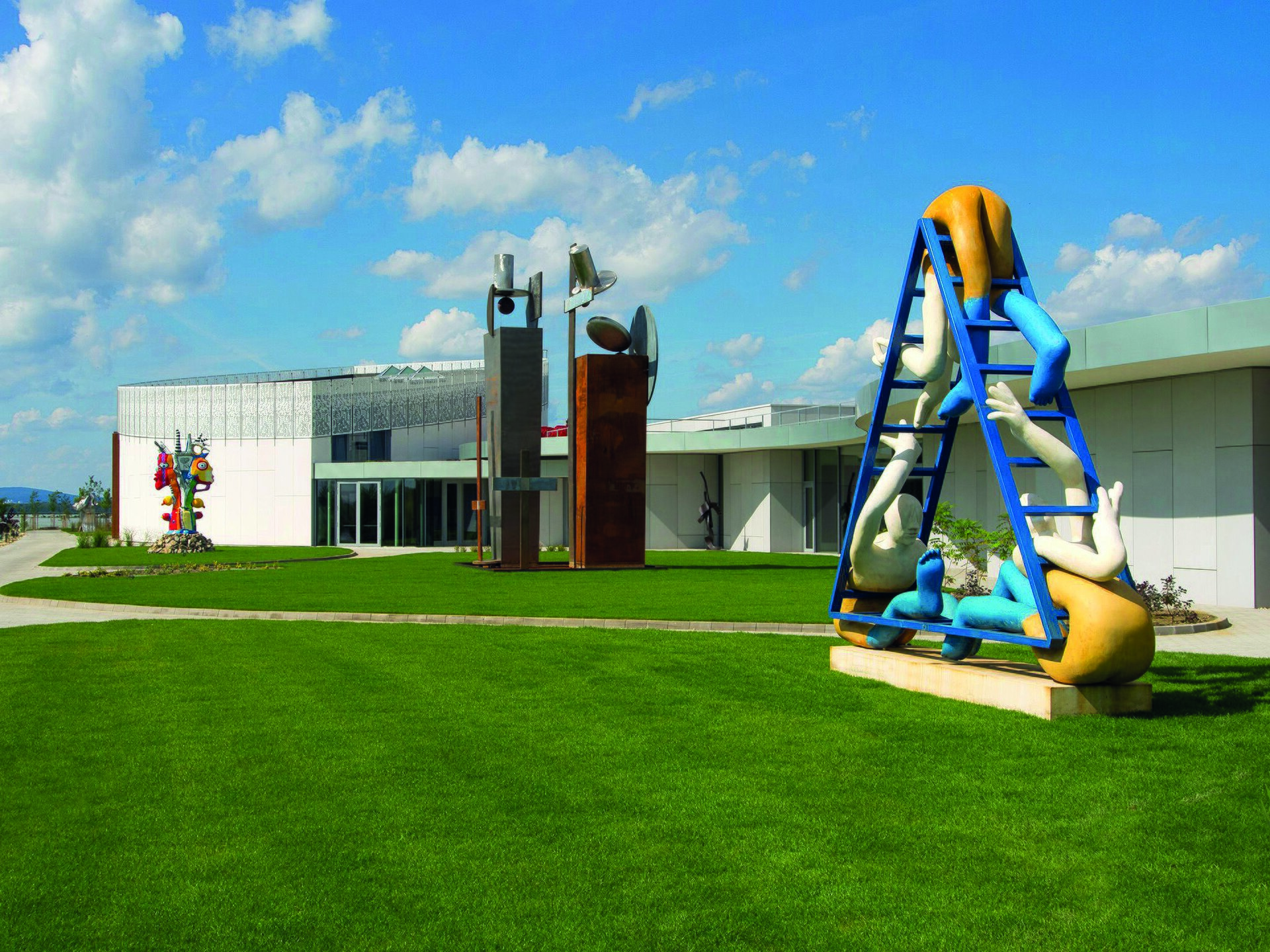
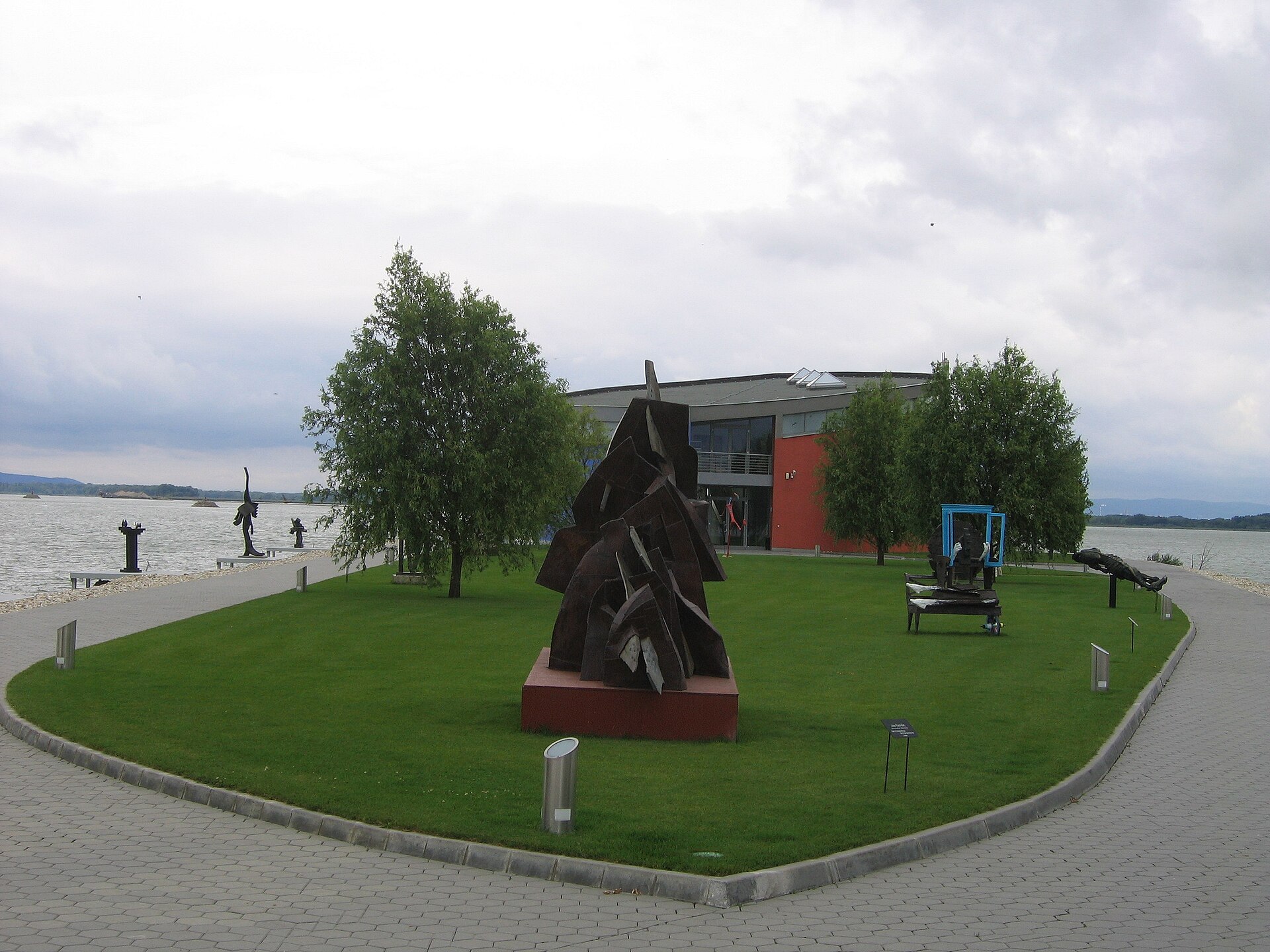
The museum building on its peninsula in the Danube, seen from the sculpture park.
Lenislava · CC BY-SA 4.0Danubiana Meulensteen Art Museum
Museum · Danubiana - Centrum moderneho umenia · Founded 2000
Open, admission and hours confirmed 3 September 2026 · 17 sources
On this page 15 sections
ContentsClose
The museum's strength is postwar and contemporary European painting and sculpture with a CoBrA and Slovak/Central European backbone, built almost entirely from one private collector's holdings rather than institutional acquisition. Its own collection, begun only in 2014 through donation, is still small next to the nearly 200-piece Meulensteen loan that anchors the galleries, and the outdoor sculpture park is, by the museum's own description, unmatched in Slovakia for its combination of setting and the international range of sculptors represented.
| Local name | Danubiana - Centrum moderneho umenia |
|---|---|
| Kind | Museum |
| Founded | 2000 |
| City and country |  Hamuliakovo, Slovakia Hamuliakovo, Slovakia |
| Address | Vodne dielo, P.O. Box 51, 851 10 Bratislava-Rusovce, Slovakia |
| Website | danubiana.sk |
| Status | Open, confirmed |
| Record last verified |
Visiting
- Hours
- Tue-Sun10:00 to 18:00Last entry 5:30 p.m.
- Closed
- Monday.
- Admission
- AdultEUR 12
- Family (2 adults and 2 students)EUR 25
- Senior (62+)EUR 6
- StudentEUR 6
- Members of Danubiana ClubFreefree
- Disabled visitors, children under 6Freefree
- Club CardEUR 50annual membership card, not a single-visit ticket
- Do I need to book?
- Not required for individual visitors; groups are advised to reserve in advance by phone.
- Address
- Vodne dielo, P.O. Box 51, 851 10 Bratislava-Rusovce, Slovakia MapBus Bus route 90 from in front of the new Slovak National Theatre in Bratislava; about 34 minutes, terminating at the Danubiana stop, a 3-minute walk from the museum. No ticket machine at the stop.
- Website
- danubiana.sk
- Telephone
- +421 2 6252 8501
- [email protected]
Before you go how long, access, photography, bags, eating, shop
- How long to allow
- One to two hours, covering the indoor galleries and the outdoor sculpture park.
- Access
- Not stated on the museum's own site.
- Photography
- Not stated on the museum's own site.
- Bags
- Not stated on the museum's own site.
- Eating
- Art Cafe in the southwest corner of the 2014 extension, overlooking the sculpture park and the Danube shipping lane, furnished with chairs by Arne Jacobsen and Charles and Ray Eames.
- Shop
- Art Shop on site selling art books, catalogues and gifts; more than one visitor review describes its prices as high relative to the rest of the visit.
Prices and hours change. We take them from the institution's own pages and print the day we read them, and you can check the current position at the source we used. Confirm before you travel.
What is inside
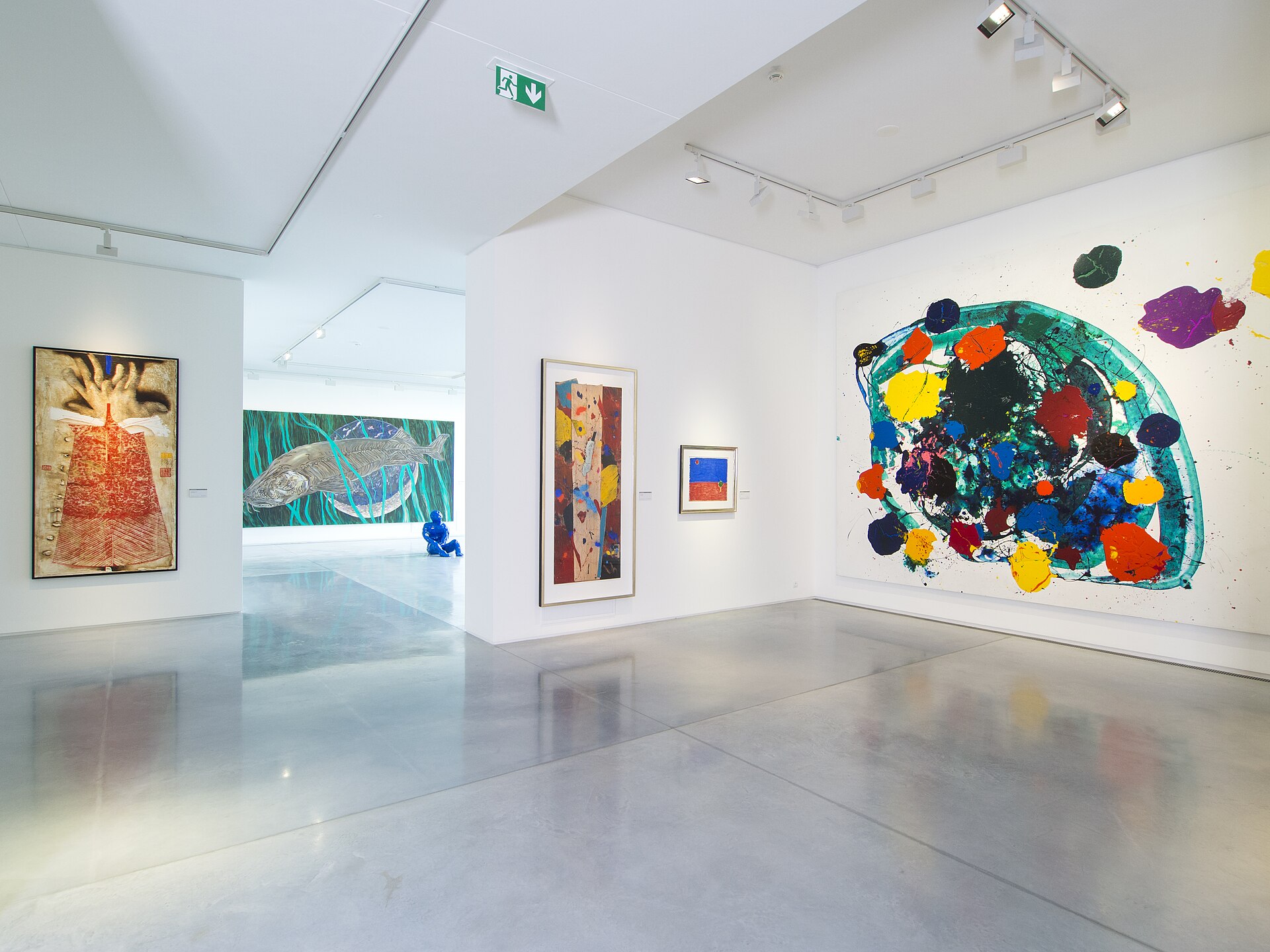
Photograph by Veropol · CC BY-SA 4.0 Meulensteen Collection galleries
The original 2000 building, holding paintings and sculptures from Gerard Meulensteen's own collection on long-term loan to the museum since it opened: CoBrA-era and postwar European work by Karel Appel, Walasse Ting, Pierre Alechinsky and Sam Francis, alongside Slovak artists such as Jozef Jankovic, Peter Pollag and Milan Lukac. Nearly 200 paintings and sculptures from the loan are rotated through the space.
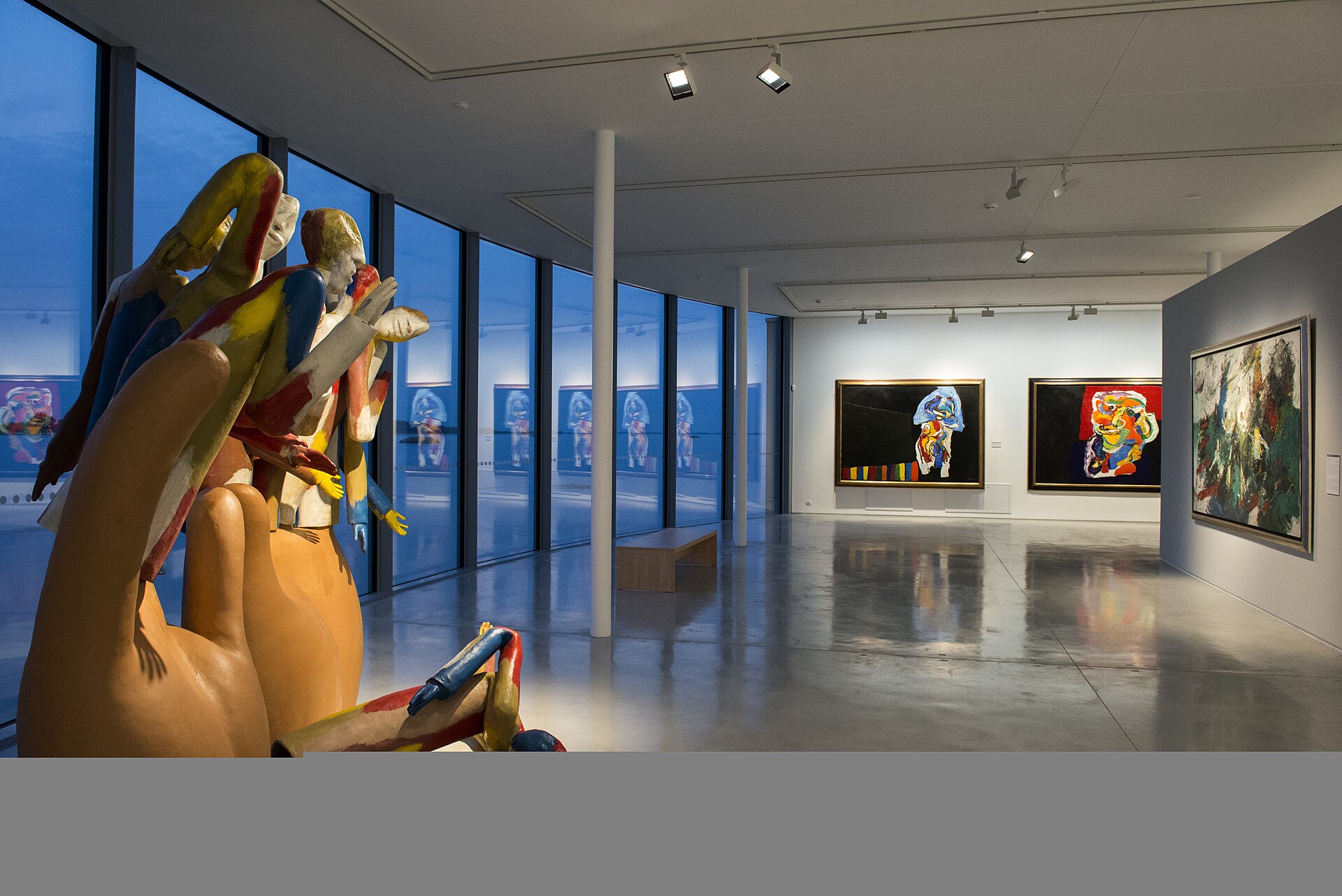
Photograph by Veropol · CC BY-SA 4.0 Danubiana Collection pavilion (2014 extension)
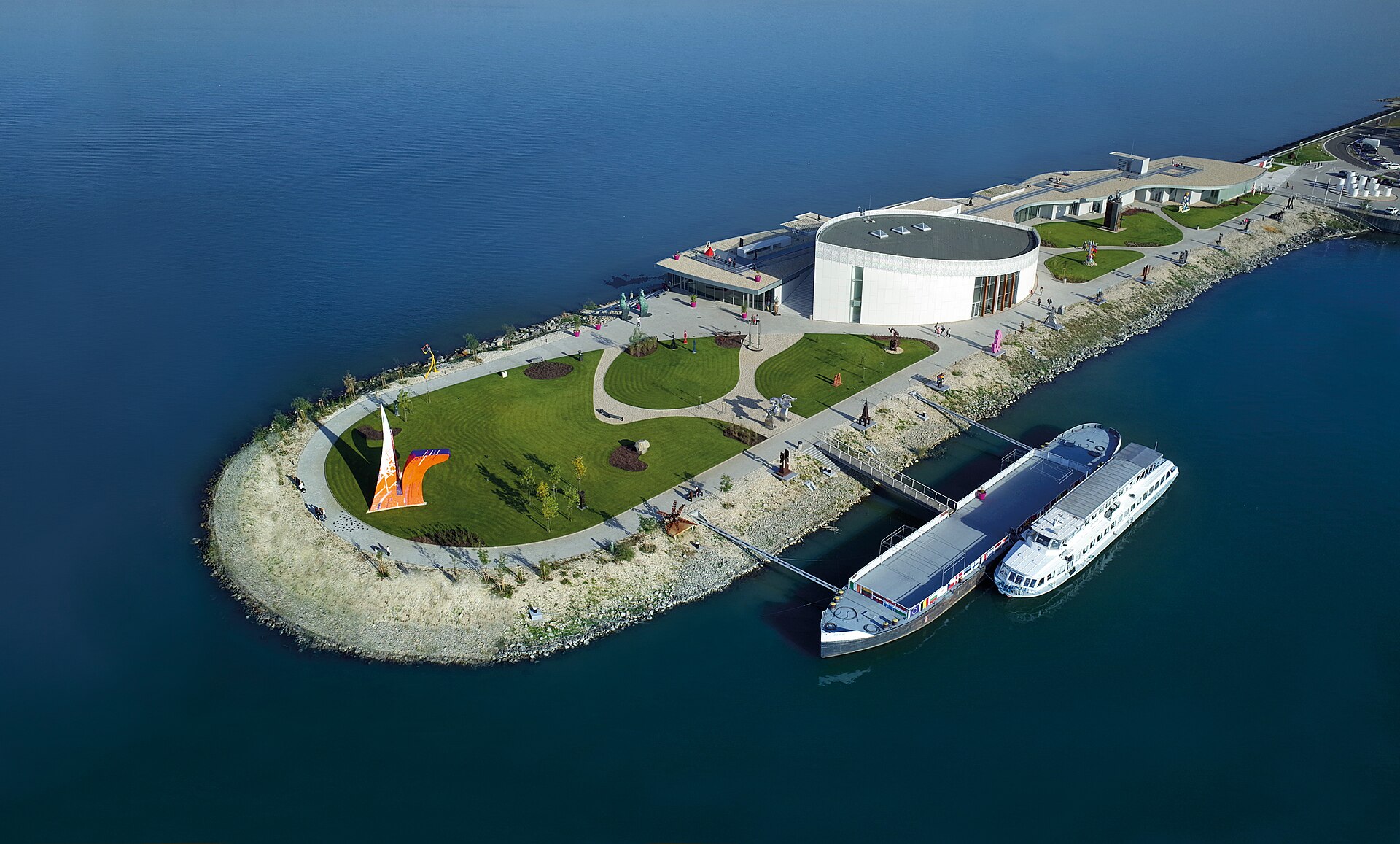
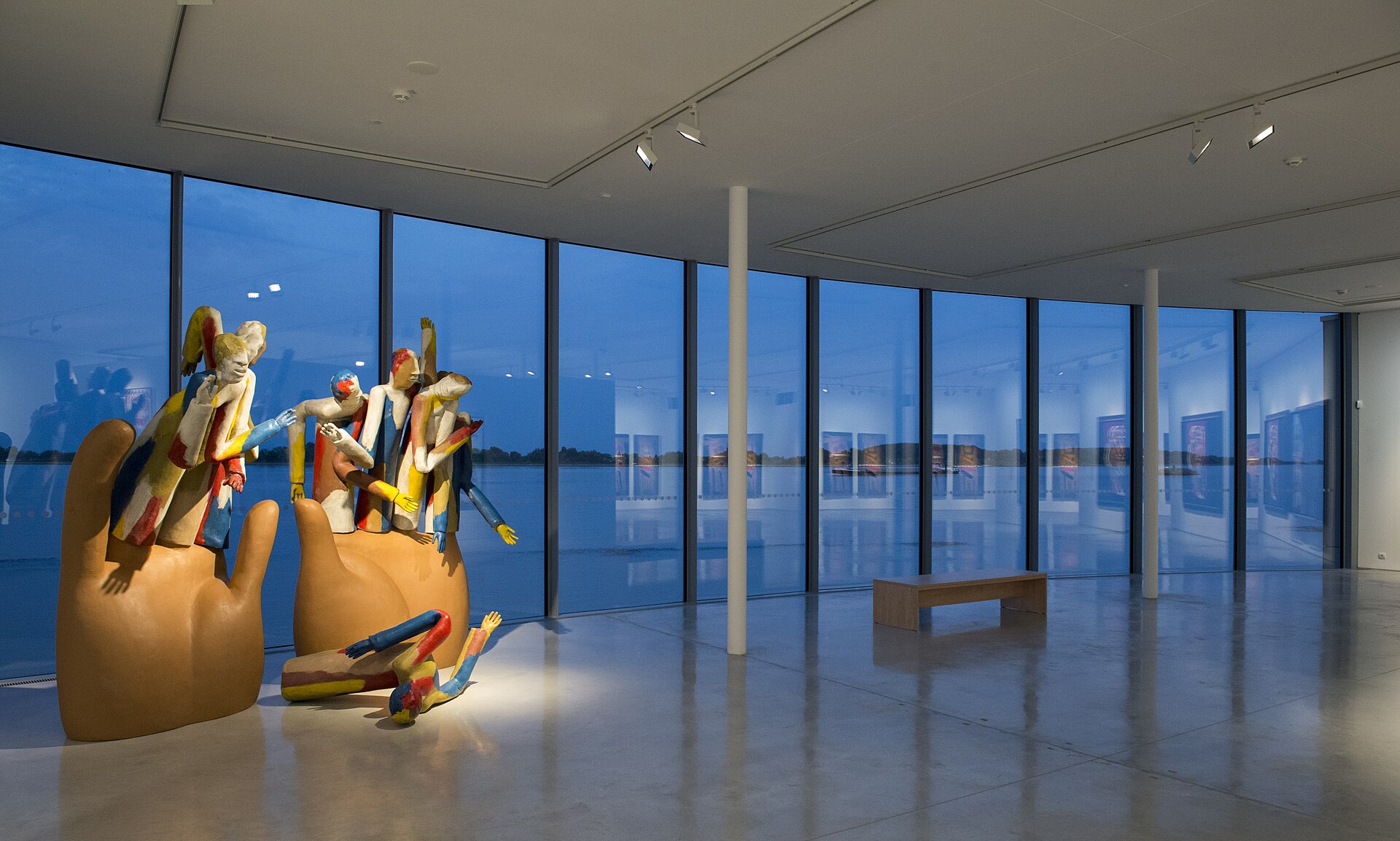
The glass-walled extension built in 2013-2014 to house the museum's own permanent collection, built through donations since 2014 from artists including Jiri Georg Dokoupil, Kiro Urdin, Gerard Rancinan, Jiri Naceradsky, Rudolf Uher, Jan Hlavaty, Peter Pollag, Marek Ormandik and Robert Vano. The pavilion runs linearly along the Danube bank, designed by architect Jan Kukula to keep the proportions of the original building.
Rooftop garden
A viewing terrace on top of the 2014 extension, with sculptures and panoramic views over the museum grounds, the Danube and, on a clear day, Bratislava and the Small Carpathians.
Photograph by Miroslava Fišerová · CC BY-SA 4.0 Sculpture Park
12,000 square metres of outdoor grounds across the peninsula, holding 60 sculptures drawn from the Meulensteen collection, the museum's own collection and long-term loans from artists and other galleries, including Danube Wings by Peter Pollag, stone sculptures by Rudolf Uher, and works by Arman, Magdalena Abakanowicz, Jim Dine, El Lissitzky, Jozef Jankovic, Vladimir Kompanek, Hans van de Bovenkamp, Milan Lukac, Oto Bachorik and Andrej Rudavsky.
Art Cafe
A cafe and patisserie in the southwest section of the extension, on a terrace close enough to the water that river cruise ships passing between Passau and the Black Sea delta go by a few metres away.
What to see first
Danube Wings (Dunajske kridla)
Peter PollagAn eleven-metre glass mosaic sited on the riverbank, named by the museum among the signature installations of its sculpture park.6
Left and Right (Lavica a pravica)
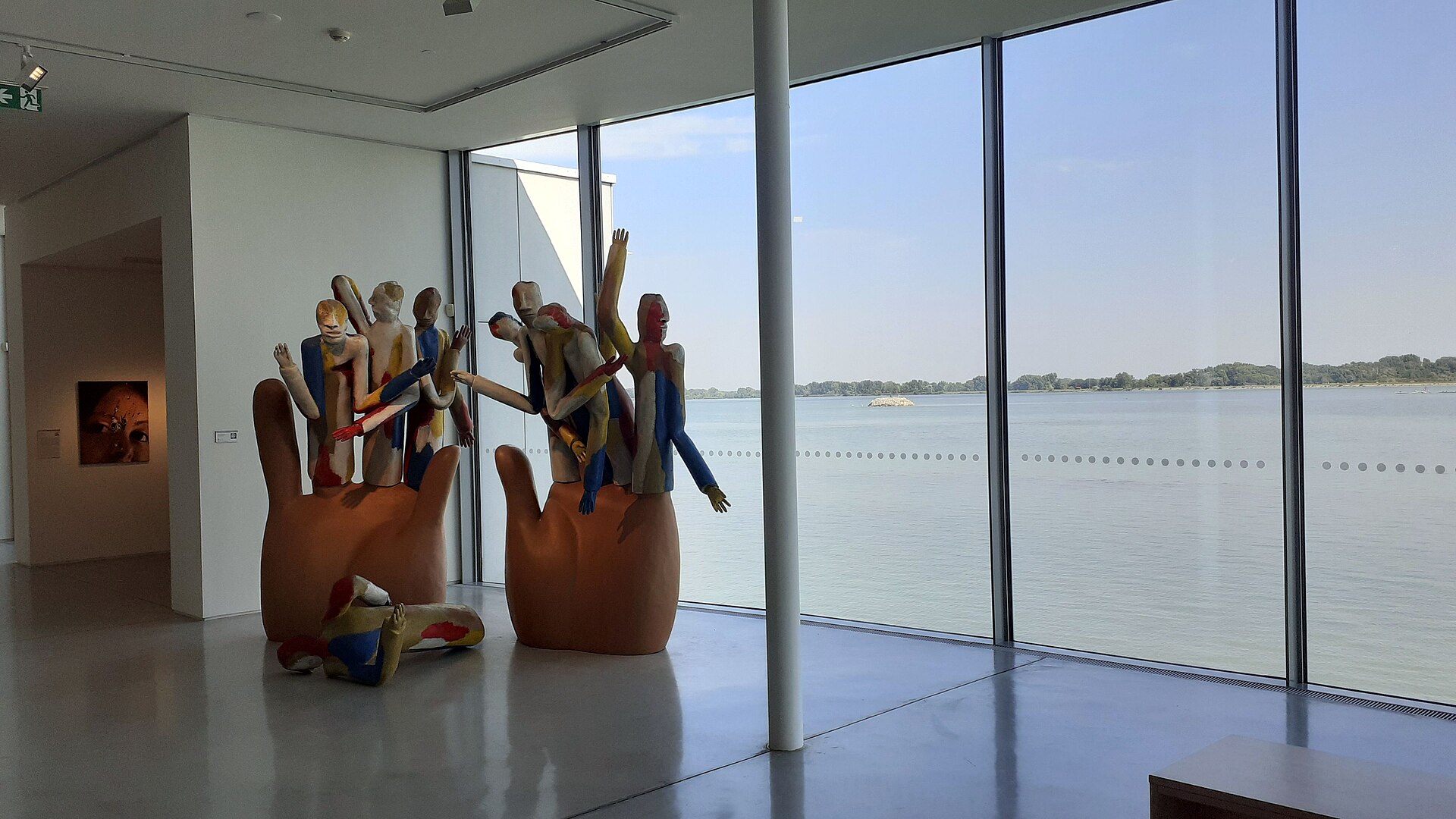
Jozef JankovicTwo oversized painted hands holding a crowd of small figures; one of the works by Jankovic the museum lists among the park's holdings by major Slovak sculptors.6
Stone sculptures
Rudolf UherA group of carved stone works by the Slovak sculptor, sited across the peninsula grounds and named by the museum as part of the park's core holdings.6
Outdoor sculptures
Magdalena AbakanowiczWork by the Polish sculptor is named by the museum among the international figures represented in the sculpture park, alongside Arman, Jim Dine and El Lissitzky.5
Paintings from the 1980s onward
Sam FrancisLarge-scale abstract paintings entered Gerard Meulensteen's collection after he met the Chinese-American painter Walasse Ting, who introduced him to Francis's work; they remain part of the loan collection forming the museum's core.7
Paintings from the CoBrA period onward
Karel AppelAmong the earliest works Meulensteen collected, from the Dutch CoBrA painter, and named by the museum as one of the figures whose work anchors the permanent display.7
Donated works forming the Danubiana Collection
Jiri Georg DokoupilOne of the artists whose donated pieces the museum names as the foundation of its own collection, built since systematic acquisition began in 2014.8
Exhibitions on now
- On now5 Sep to 1 Nov 2026Confirmed · check before you travel
Past exhibitions here
A museum shaped like a ship
The Danubiana Meulensteen Art Museum sits on a peninsula in the Danube about 20 kilometres south of Bratislava, near the Cunovo dam and the point where Slovakia, Hungary and Austria meet. The building's curved, prow-like form was a deliberate choice: the gallerist Vincent Polakovic asked the architect Peter Zalman to design it in the shape of a ship, specifically a Roman galley with wooden oars, and the concept was carried through with the agreement of Gerard Meulensteen and the other people consulted on the setting. The site itself was a piece of ground left behind by the builders of the Cunovo dam; when the company Via Danubia acquired it on a long-term lease in 1999, Meulensteen decided to build the museum there.
Construction ran through 1999 and the museum opened on 9 September 2000. For its first thirteen years the exhibition spaces held a programme of shows that changed roughly every quarter. As the museum's own account puts it, general audiences increasingly expected a permanent collection alongside the temporary programme, and in 2008 Meulensteen organised an international symposium of young architects from Slovakia and the Netherlands to design an extension for that purpose. The commission went to Jan Kukula, recently returned to Slovakia after a period working in Ireland, whose design ran the new spaces linearly along the riverbank while keeping the proportions and character of the original building. Construction began in March 2013 and the extension opened on 9 September 2014, with the Slovak Minister of Culture presiding at the ceremony; an international panel named it Construction of the Year 2014 in Slovakia.
A Van Gogh pilgrimage and a Dutch industrialist
The museum's origin traces to a trip rather than a plan. In the summer of 1990 the Slovak lawyer and gallerist Vincent Polakovic travelled with friends in the footsteps of Vincent van Gogh, visiting the places where the painter had lived and worked. The trip led him to open Slovakia's first private art gallery, the Yellow House of Vincent van Gogh, in Poprad in September 1993, showing van Gogh reproductions alongside contemporary Slovak artists. In 1994 he met Gerard Meulensteen, a Dutch entrepreneur from Eindhoven who had founded the electronics company Neways Electronics International in 1969 and had been collecting modern art since the mid-1980s, beginning with the Dutch CoBrA painters and building outward to Sam Francis, Christo, Claes Oldenburg, Pierre Alechinsky and Magdalena Abakanowicz, among others. Meulensteen financed the Poprad gallery from 1994, and in 1999 the two men began building Slovakia's first private museum of modern art on the Cunovo peninsula. It opened on 9 September 2000, the same day the Poprad gallery formally closed and folded its activities into the new institution. Polakovic became its first director and still holds the post.
Meulensteen continued to finance the museum's activities until 2011, when, according to the museum, he decided out of admiration for the country to donate it to Slovakia and its artists; a non-profit organisation, Danubiana - Centrum moderneho umenia, n.o., was established to run it. The Slovak government then funded the 2013-2014 extension that gave the museum its first dedicated permanent-collection space. Gerard Meulensteen died on 22 January 2026 in Son en Breugel, near Eindhoven, at the age of 82; the museum's own tribute states that his heart remains in the Danubiana. Vincent Polakovic continues as director and, across more than 300 exhibitions organised in his tenure, has shown the work of more than 1,000 artists from over forty countries.
What is inside
The collection on display is built in two layers. The core is the Meulensteen collection itself: close to 200 paintings and sculptures, placed with the museum as a long-term, interest-free loan from 2000 while the institution builds a collection of its own, and rotated through the galleries on a regular basis. It carries the CoBrA-inflected, postwar European character of Meulensteen's own collecting: Karel Appel, Walasse Ting, Sam Francis and Pierre Alechinsky sit alongside the Slovak artists Meulensteen came to collect after meeting Polakovic, among them Jozef Jankovic, Peter Pollag and Milan Lukac. Since 2014 the museum has been building a second, smaller layer of its own: a permanent collection acquired through donation rather than purchase, including work given by Jiri Georg Dokoupil, Kiro Urdin, Gerard Rancinan, Jiri Naceradsky, Rudolf Uher, Jan Hlavaty, Peter Pollag, Marek Ormandik and the photographer Robert Vano. Both layers are shown across the original 2000 building and the 2014 extension, whose glass walls run along the Danube bank and open onto the peninsula and the water on one side.
Above the galleries, a rooftop garden on the extension gives a view back over the grounds to Bratislava, the Small Carpathians and the river, a vantage point the museum singles out as especially striking around sunset. On the ground level of the extension's southwest corner, the Art Cafe looks the same way, close enough to the water that river cruise ships running between Passau and the Danube delta pass within a few metres of the terrace.
The sculpture park
Outside, 12,000 square metres of the peninsula are given over to a sculpture park of 60 works, drawn from the same two sources as the indoor collection plus long-term loans from artists and other galleries. The museum names it as having no parallel in Slovakia for the combination of setting and quality of work. Its signature piece is Danube Wings (Dunajske kridla), an eleven-metre glass mosaic by the Slovak artist Peter Pollag set on the riverbank. Elsewhere in the park are stone sculptures by Rudolf Uher and figurative bronzes and constructions by an international roster the museum lists on its own site: Arman, Magdalena Abakanowicz, Jim Dine, Hans van de Bovenkamp, El Lissitzky, Jozef Jankovic, Vladimir Kompanek, Milan Lukac, Oto Bachorik and Andrej Rudavsky. Jankovic's Left and Right (Lavica a pravica), a pair of oversized painted hands cradling a crowd of small painted figures, stands close to the water's edge and is one of the park's most photographed pieces.
Recognition and visitors
The museum has drawn a run of state visits and honours that a private regional gallery rarely attracts: its own account lists Juan Carlos I and Queen Sofia of Spain, Queen Beatrix of the Netherlands, Queen Sonja of Norway, and Albert II, Prince of Monaco, among its guests. Meulensteen was made a Knight of the Order of Orange-Nassau by the Dutch crown in 1994 and received Slovak, Spanish and Hungarian state honours over the following two decades for his role in founding and funding the museum. Polakovic has been decorated by Austria, Hungary, the Netherlands and Slovakia for the same work, most recently the Order of Ludovit Stur, awarded by the Slovak president in January 2026. The 2014 extension itself won Slovakia's Construction of the Year award the same year it opened.
On the visitor side, Danubiana ranks as the top-rated attraction of its kind around Bratislava on TripAdvisor, with a large volume of reviews concentrated on the setting: the peninsula, the river views, the sculpture park and the rooftop terrace at sunset. The more mixed comments are practical rather than curatorial: getting to the museum requires either the infrequent bus 90 from central Bratislava or a taxi, and more than one visitor has flagged the Art Shop's prices as high set against the rest of the visit.
What visitors say
Visitors consistently describe Danubiana less as a conventional museum visit than as an outing to a striking waterside site: a converted peninsula on the Danube, close to where Slovakia, Hungary and Austria meet, where the sculpture park, the glass-walled galleries and the river itself are as much the draw as any single work inside. The temporary exhibition programme and the on-site shop draw more mixed comment than the setting does.
What is praised, what is criticised
- Praised: The peninsula setting on the Danube and the sculpture park around the building, repeatedly named by visitors as the most memorable part of a visit.
- Praised: The rooftop terrace and the views toward Bratislava, the Small Carpathians and the river, especially near sunset.
- Criticised: The Art Shop's prices, which more than one visitor review called excessive relative to the rest of the visit.
- Criticised: The museum's distance from central Bratislava and its reliance on a single, infrequent bus route or a taxi, which several visitors named as the main friction of getting there.
Ratings on other platforms
TripAdvisor: 4.7 from 559 ratings, read 3 September 2026
A platform average is a tertiary source: it moves, it is not audited, and we quote no visitor's words.
Questions about Danubiana Meulensteen Art Museum
Where is Danubiana Meulensteen Art Museum?
Vodne dielo, P.O. Box 51, 851 10 Bratislava-Rusovce, Slovakia.
How much does it cost to visit?
Adult: EUR 12; Family (2 adults and 2 students): EUR 25; Senior (62+): EUR 6; Student: EUR 6; Members of Danubiana Club: free. As confirmed 3 September 2026.
When is it open?
Tue-Sun 10:00-18:00. Closed: Monday. As confirmed 3 September 2026.
How do you get there?
Bus: Bus route 90 from in front of the new Slovak National Theatre in Bratislava; about 34 minutes, terminating at the Danubiana stop, a 3-minute walk from the museum. No ticket machine at the stop.
What should you see first?
Danube Wings (Dunajske kridla) (Peter Pollag); Left and Right (Lavica a pravica) (Jozef Jankovic); Stone sculptures (Rudolf Uher); Outdoor sculptures (Magdalena Abakanowicz); Paintings from the 1980s onward (Sam Francis); Paintings from the CoBrA period onward (Karel Appel).
What we could not confirm
- The Meulensteen collection was placed with the museum as a free, long-term loan described on the museum's own site as running for 20 years from the 2000 opening. That period had elapsed by around 2020; the museum's current site does not state whether the loan has been renewed, converted to a gift, or continues informally.
- The museum's own account credits the Slovak government with funding the 2013-2014 extension but does not state the amount or the terms of that funding.
- The museum names donors to its own post-2014 collection but does not publish an inventory of what each donor gave, or the current total size of that collection.
Images
Sources
- 1Wikidata, entity Q1165115 (Danubiana, Meulensteen Art Museum) wikidata.org/wiki/Special:EntityData/Q1165115.json
- 2Danubiana Meulensteen Art Museum, official site, homepage danubiana.sk/en
- 3Danubiana, "About Us" danubiana.sk/en/danubiana/o-nas
- 4Danubiana, "History" danubiana.sk/en/danubiana/historia
- 5Danubiana, "Architecture" danubiana.sk/en/danubiana/architektura
- 6Danubiana, "Park" danubiana.sk/en/park
- 7Danubiana, "Meulensteen Collection" danubiana.sk/en/zbierka/meulensteen
- 8Danubiana, "Danubiana Collection" danubiana.sk/en/zbierka/danubiana
- 9Danubiana, "Contacts" danubiana.sk/en/kontakt/kontakt
- 10Danubiana, "Transportation" danubiana.sk/en/kontakt/doprava/autobus
- 11Danubiana, "Admission fee" danubiana.sk/en/kontakt/vstupne
- 12Danubiana, "Art Cafe" danubiana.sk/en/art-cafe
- 13Danubiana, founders page, "G. H. Meulensteen" danubiana.sk/en/danubiana/zakladatelia/meulensteen
- 14Danubiana, founders page, "Vincent Polakovic" danubiana.sk/en/danubiana/zakladatelia/polakovic
- 15Danubiana, "Current Exhibitions" danubiana.sk/en/vystavy/aktualne
- 16Tripadvisor, "Danubiana Meulensteen Art Museum" listing and reviews tripadvisor.com/Attraction_Review-g274924-d2554497-Reviews-Danubiana_Meulensteen_Art_Museum-Bratislava_Bratislava_Region.html
- 17Wikimedia Commons, Category:Danubiana Meulensteen Art Museum commons.wikimedia.org/wiki/Category:Danubiana_Meulensteen_Art_Museum