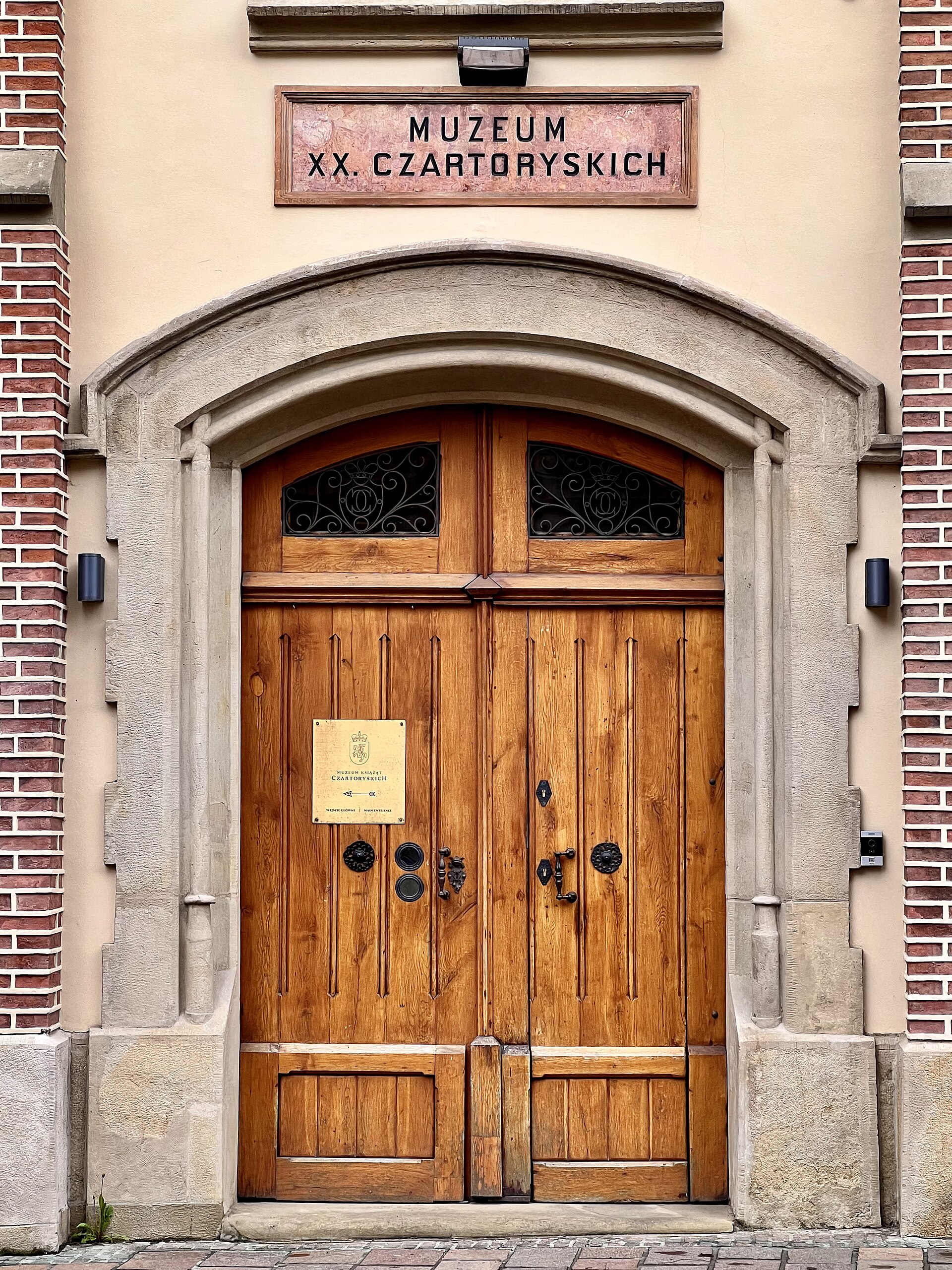
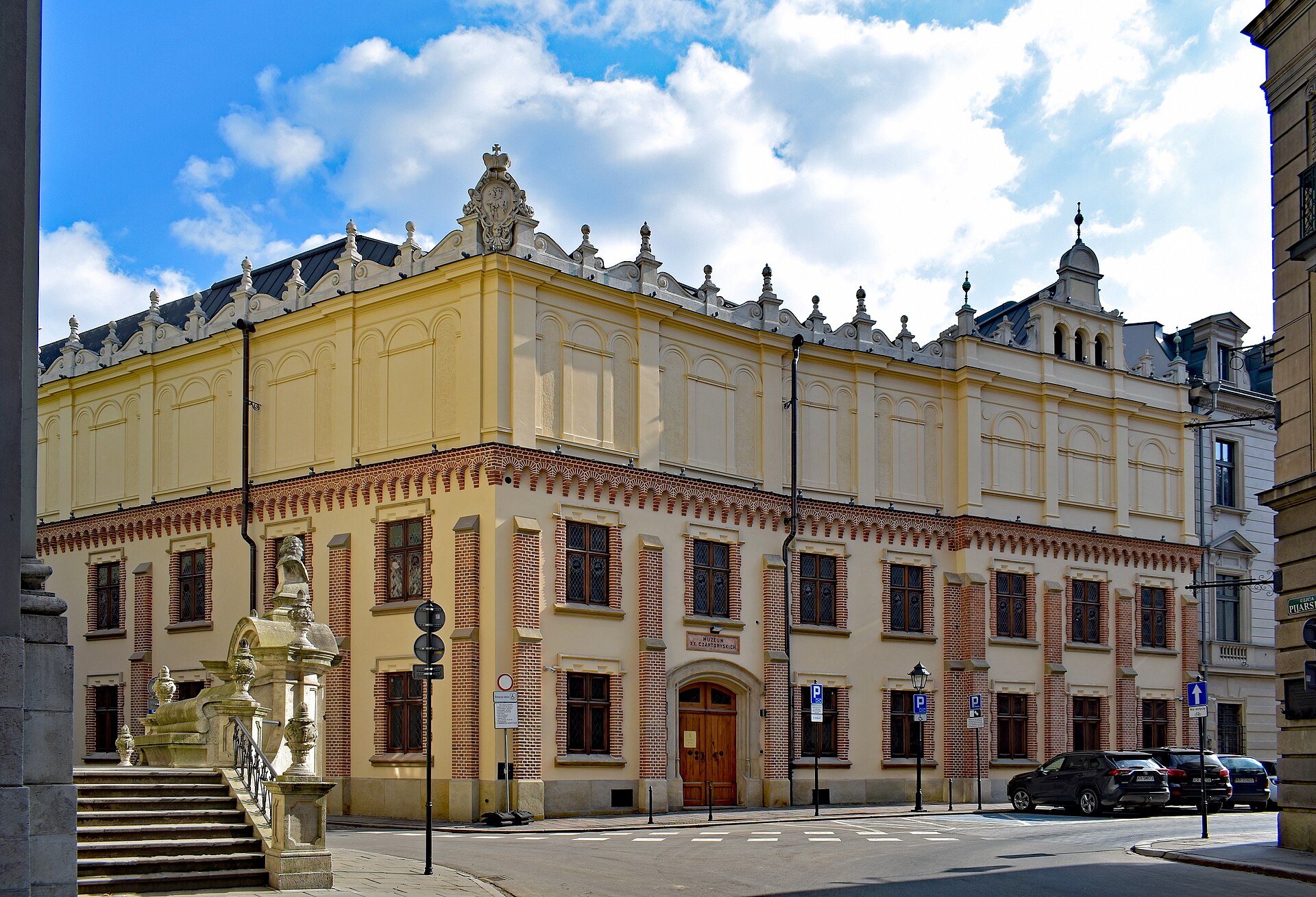
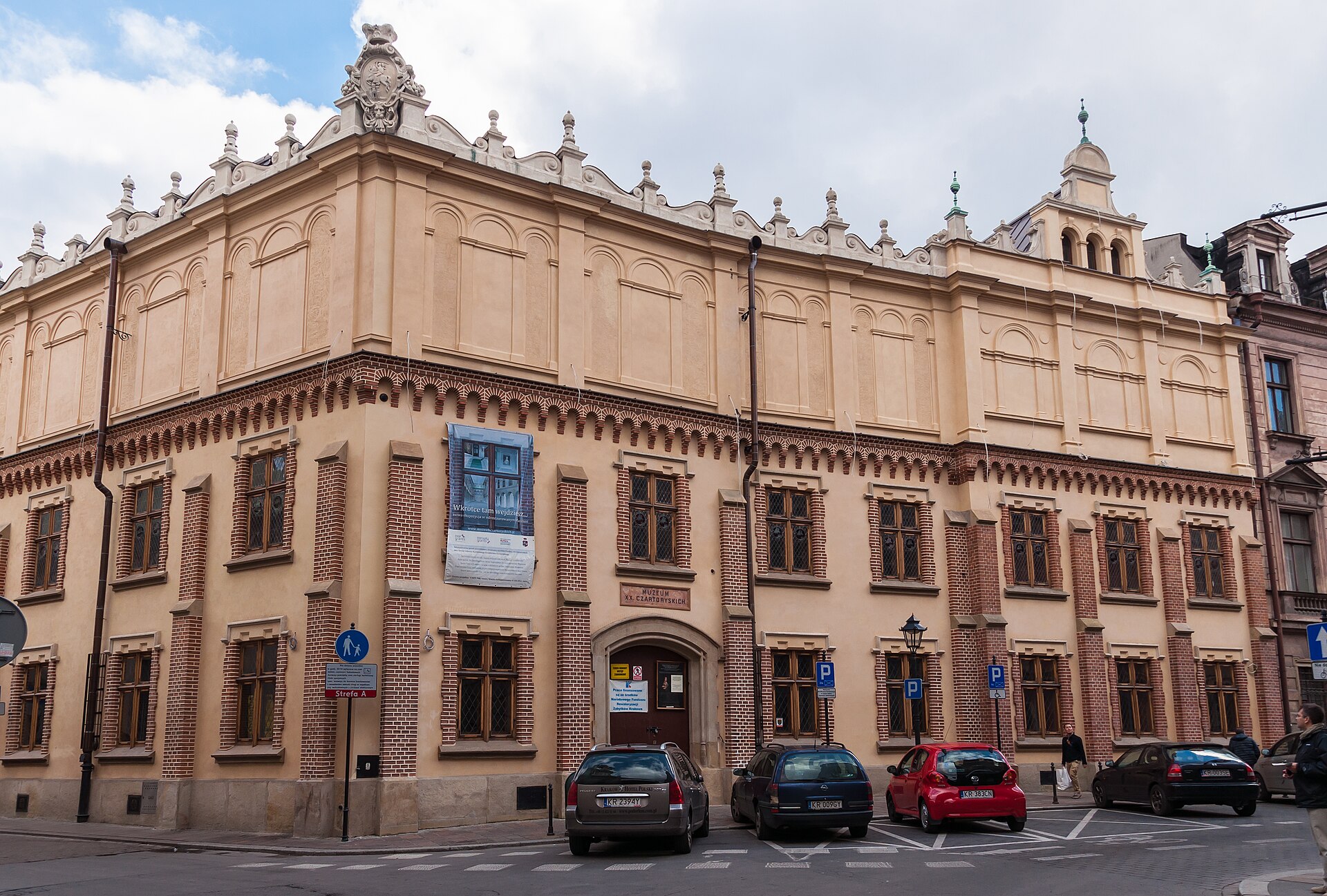
The Czartoryski Palace on ul. Pijarska, Krakow, photographed in 2022 after the 2010-2019 restoration.
Kgbo, CC BY-SA 4.0Czartoryski Museum
Museum · Muzeum Ksiazat Czartoryskich · Founded 1796
Open, admission and hours confirmed 9 September 2026 · 10 sources
On this page 14 sections
ContentsClose
The Czartoryski Museum's strength is its range rather than its depth in any one field. It holds Poland's only painting by Leonardo da Vinci and a Rembrandt landscape that would anchor most European collections on its own, but the bulk of the museum by floor area is the material Izabela Czartoryska's descendants kept adding for a century after her death: Egyptian, Greek, Etruscan and Roman antiquities recovered and catalogued to modern archaeological standards, historic arms and armour, tapestries, ceramics, coins and medals, and the frankly eccentric relics of the founder's own Temple of Memory. That range, spread now across three restored buildings rather than one, is what museum reviewers and ordinary visitors converge on: the Leonardo brings people in, and the rest of the collection is what makes them stay for two hours rather than twenty minutes.
| Local name | Muzeum Ksiazat Czartoryskich |
|---|---|
| Kind | Museum |
| Founded | 1796 |
| City and country |  Krakow, Poland Krakow, Poland |
| Address | ul. Pijarska 15, 31-015 Krakow, Poland |
| Website | mnk.pl/en/branches/czartoryski-museum |
| Status | Open, confirmed |
| Record last verified |
Visiting
- Hours
- Tue-Sun10:00 to 18:00Last admission one hour before closing
- 31 December only10:00 to 14:00Shortened holiday hours; other MNK branches closed that day
- Closed
- Monday.
- Admission
- AdultPLN 65
- ReducedPLN 50Students, seniors and other concession categories per the museum's own list
- FamilyPLN 130Up to 4 people, at least 1 child under 16
- Youth 7-26PLN 1Symbolic PLN 1 ticket for pupils and students aged 7 to 26
- Children under 7FreeFree
Free entry: Tuesday - free admission, timed tickets required, limited availability- Tickets
- bilety.mnk.pl/?lang=en The museum's own ticket page.
- Do I need to book?
- Recommended. Tickets are sold for a specific date and time online or at the ticket office; free Tuesday slots are limited and go quickly
- Address
- ul. Pijarska 15, 31-015 Krakow, Poland MapBus Lines 124, 152, 424 to the Stary Kleparz stop
Tram Lines 4, 14, 18, 20, 52 to the Stary Kleparz stop - Website
- mnk.pl/en/branches/czartoryski-museum
- Telephone
- +48 12 370 54 66
- [email protected]
Before you go how long, access, photography, bags, eating, shop
- How long to allow
- About two hours for the Palace picture galleries alone; visitors who also see the Arsenal and the Monastery report closer to three
- Access
- Elevator access to all levels, audio description, a guide for deaf visitors, a sensory basket, a sensory path and a quiet zone, per the museum's own accessibility information
- Bags
- Backpacks, large bags and coats must be left in the cloakroom before entering; visitors report queues there at busy times
- Eating
- A cafe is on site in the restored complex
- Shop
- A museum shop is on site
Prices and hours change. We take them from the institution's own pages and print the day we read them, and you can check the current position at the source we used. Confirm before you travel.
What is inside
The Palace - Picture Gallery
European paintings from the 15th to 18th centuries, including Leonardo da Vinci's Lady with an Ermine and Rembrandt's Landscape with the Good Samaritan, shown in the light-filled atrium created by joining two townhouses with a glazed courtyard and a footbridge during the 2010-2019 restoration.
The Palace - National Memorabilia and Decorative Arts
Polish national relics, tapestries, ceramics, coins and medals, and sacred objects assembled by the Czartoryski family since the collection's founding at Pulawy, displayed alongside portraits of Polish kings and nobles.
The Arsenal - Gallery of Ancient Art
Egyptian, Greek, Etruscan and Roman antiquities spanning the third millennium BC to the seventh century AD: Egyptian sarcophagi and mummy cartonnages, the stela of the nomarch Merer, a set of Book of the Dead papyrus scrolls, a mural fragment from the tomb chamber of pharaoh Seti I, and a collection of Greek vases, glass and bronze.
The Arsenal - Arms and Armour
Historic weapons and armour from the Czartoryski collection, shown in the former city arsenal building on ul. Pijarska, built into the Old Town's medieval defensive walls in the mid-15th century to store the city's munitions and cannon.
The Monastery (Klasztorek) - Izabela Czartoryska's Cabinet of Curiosities
A reconstruction of the display Princess Izabela Czartoryska assembled at Pulawy from 1796: relics and curiosities including a cast of Frederic Chopin's hand, a quill pen said to have belonged to Voltaire, and objects linked to Shakespeare, shown in restored 19th-century glass cases since the wing reopened in 2023.
What to see first
Lady with an Ermine
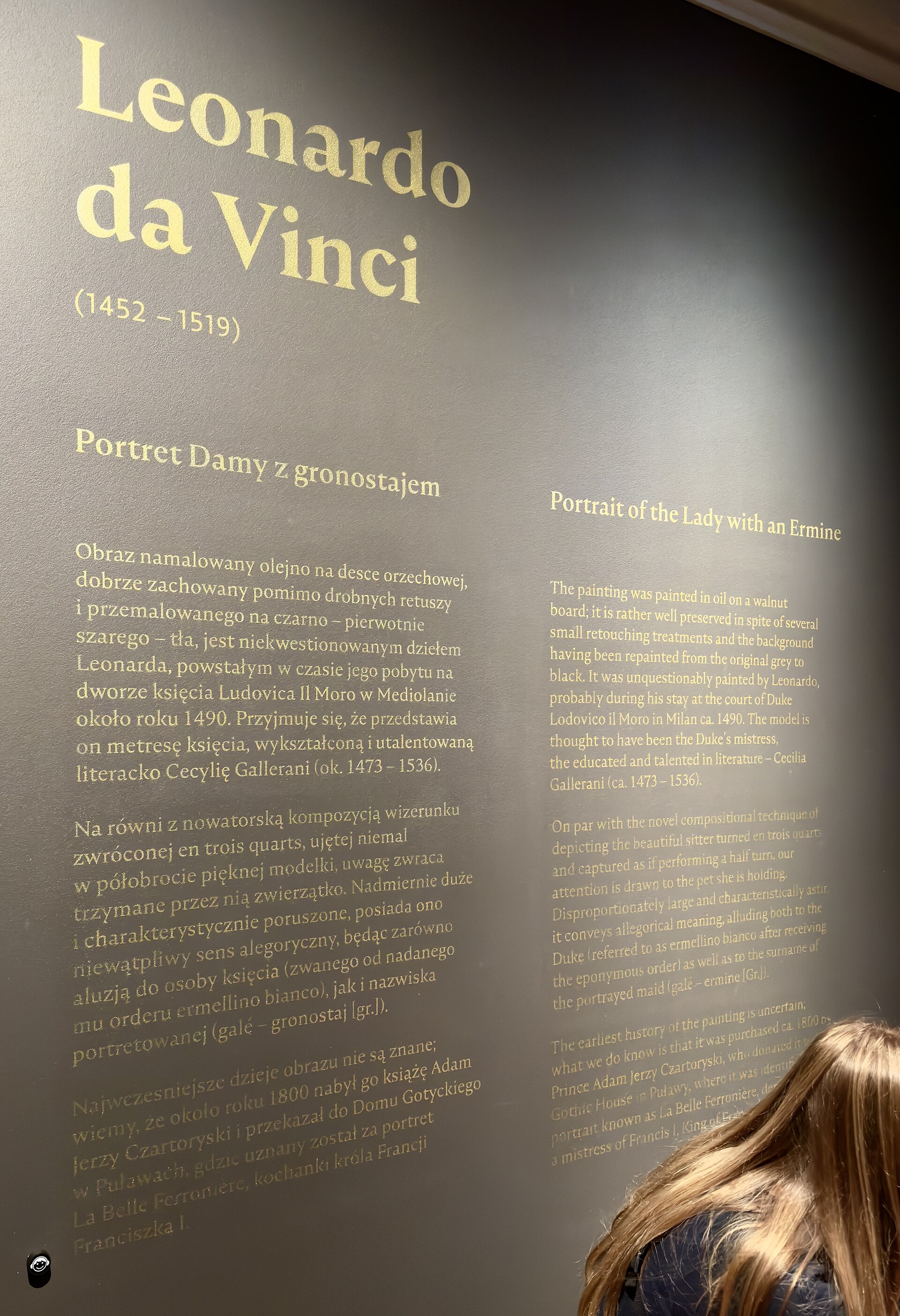
Leonardo da Vinci, c. 1489-1490The only painting by Leonardo da Vinci in Poland and one of only four surviving portraits of women attributed to him; bought in Italy in 1798 by Prince Adam Jerzy Czartoryski and the museum's signature work.1
Landscape with the Good Samaritan
Rembrandt van Rijn, 1638The collection's other old-master anchor, hung on the same visitor route as the Leonardo and named alongside it by reviewers and by the museum's own account of its holdings.1
The Book of the Dead papyrus scrolls
Ancient Egyptian, late 14th to late 4th century BCPart of the Egyptian collection built up from the 1890s by Prince Wladyslaw Czartoryski and singled out by the museum's own curators as among the most important objects in the Gallery of Ancient Art.10
Sarcophagus and mummy of the priestess Tachenemti
Ancient Egyptian, second half of the 8th century BCA named individual whose mummy has since been examined by X-ray and computer tomography, giving the object a documented modern research history on top of its ancient one.10
The glazed courtyard and footbridge
Restoration by Lewicki Latak Design Bureau, completed 2019The architectural centrepiece of the reopening, uniting three formerly separate courtyards under a glass and steel roof and linking two townhouses with a footbridge; praised in Apollo Magazine's review of the rehang.7
Izabela Czartoryska's cabinet of curiosities
Assembled by Princess Izabela Czartoryska from 1796The direct physical link to the founding of the collection at Pulawy in 1796, usually described as Poland's first museum, reconstructed in the Klasztorek wing that reopened in 2023.9
Portrait of a Young Man
Raphael, c. 1513-1514Taken by German occupying authorities during the Second World War, per the museum's own published history, and missing since 1945 along with more than 840 other objects from the collection; its absence from the galleries is itself part of what the museum's own history discloses.5
Exhibitions on now
- On now14 Apr to 25 Oct 2026Confirmed · check before you travel
Palace, Arsenal and Monastery: the buildings behind the museum
The Czartoryski Museum occupies three linked historic buildings on and around ul. Pijarska in Krakow's Old Town: the Czartoryski Palace itself, a former monastery known as the Klasztorek, and the city's medieval Arsenal, built into the Old Town defensive walls in the mid-15th century to store munitions and cannon. Prince Wladyslaw Czartoryski was given the Arsenal building by the city in the 1870s and commissioned Eugene Viollet-le-Duc's firm to adapt it for the collection his family had spent most of a century assembling; the museum opened on the site in 1878, a hundred years after his grandmother Izabela had first put objects on public display at Pulawy.
The complex closed for a decade-long restoration and modernisation programme that began in 2010, with parts of the collection shown at other Krakow venues in the meantime. The Palace reopened first, on 19 December 2019; the Arsenal followed in 2021 and the Klasztorek in 2023. The most visible change is the treatment of the Palace's Renaissance courtyard, previously visible only through first-floor windows: it now sits under a glass and steel roof, and a footbridge across it links what had been two separate townhouses into a single visitor route. The Association of Polish Architects gave the renovation its Award of the Year in 2020.
Izabela Czartoryska and the founding of a Polish national museum
The collection's origin point is 1796, when Princess Izabela Czartoryska began assembling what she called a Temple of Memory at the family estate in Pulawy, built around trophies from the 1683 relief of Vienna and growing to include objects from Wawel Cathedral, items associated with Polish noble families, and curiosities of the kind that filled Klasztorek display cases two centuries later, among them a cast of Frederic Chopin's hand and a pen said to have belonged to Voltaire. The venture is usually described as the first museum in Poland to be conceived for public visiting rather than as a private cabinet.
Her son, Prince Adam Jerzy Czartoryski, extended the collection in a different direction. During travels in Italy in 1798 he acquired two Renaissance paintings that would come to define the museum: Leonardo da Vinci's Lady with an Ermine and Raphael's Portrait of a Young Man. After the failed November Uprising of 1830 against Russian rule, Adam Jerzy was exiled and moved the family's collections to Paris, where the Hotel Lambert, bought in 1843, became both the political headquarters of the Polish emigration and what the family called a Living Museum of Poland. Adam Jerzy's son Wladyslaw brought the collection back to Polish territory after the Franco-Prussian War, securing the Krakow site and continuing to acquire major works, including the Egyptian, Greek and Roman antiquities that now form the core of the Gallery of Ancient Art, until his death in 1894.
War, exile and the objects that never came back
The collection had already survived one forced move to Dresden, when Wladyslaw's daughter-in-law sent the most important paintings there for safekeeping during the First World War through her Saxon royal connections; they were returned to Poland under the terms of the 1921 Treaty of Riga. The Second World War was worse. As German forces approached in 1939 the museum sent sixteen cases of objects to the family estate at Sieniawa, where, in the museum's own published history, occupying authorities found the cases and looted the tradable items. On 25 January 1940 the eighty-five most valuable pieces, including the Leonardo and the Raphael, were sent to Dresden on the orders of Hans Posse, the art historian charged with assembling the collection for Hitler's planned museum at Linz.
The paintings were moved again in the final months of the war, first to Berlin and then, under the German governor of occupied Poland Hans Frank, to Wawel Castle and finally to Frank's own villa in Bavaria. American forces arrested Frank in May 1945 and Polish representatives recovered most of the major works, including the Lady with an Ermine, but the Raphael and more than eight hundred other objects from the collection were never found. Poland's Foreign Ministry has said the painting is known to have survived the war; where it is now has not been established, and it remains one of the most significant unresolved losses from any European museum collection.
From private foundation to state museum: the disputed 2016 transfer
Poland's post-war communist government ran the museum as a state institution until 1991, when the country's High Court restored ownership to Prince Adam Karol Czartoryski. From 1991 to 2016 the Princes Czartoryski Foundation administered the collection, lending extensively for international exhibitions, including a showing of the Lady with an Ermine at the Milwaukee Art Museum in 2002. In 2016 Adam Karol donated the collection to Poland's State Treasury; the Ministry of Culture paid the Foundation 105 million US dollars, reported at the time as under five percent of the collection's estimated three billion euro market value; the agreement also transferred to the Polish state any future claims to restitution of the objects still missing from the Second World War. Adam Karol's daughter Tamara challenged the transfer, and litigation over the disposition of the collection between family members began in 2018. The museum has operated as a branch of the National Museum in Krakow since the transfer, and the ownership dispute sits alongside the unresolved wartime losses as part of the collection's documented history rather than a settled matter.
What the restoration actually changed
The renovation added roughly a third more exhibition space, letting parts of the collection go on public display for the first time, including the Far Eastern holdings assembled by Prince Adam Ludwik Czartoryski from his own travels in Japan around the turn of the 20th century. It also brought the complex up to current accessibility standards: elevator access to every level, audio description, a sensory basket and sensory path, a designated quiet zone, and provision for deaf visitors, all listed on the museum's own visitor information. A cafe, shop and cloakroom were added inside the complex; the cloakroom is now mandatory for bags and coats, which visitor reviews cite as the main source of queuing at busy times. Specialist critics welcomed the technical execution of the rehang while noting that some of the new object labels are placed so discreetly that a visitor relying on wall text alone can miss them, an argument for taking the audio guide rather than a reason to skip a room.
What visitors say
Visitors consistently come for the Leonardo and stay for the range of the wider collection: the Czartoryski family's eclectic holdings of antiquities, arms and decorative art spread across the restored Palace, Arsenal and Monastery buildings. The 2019 renovation reads as a success in both visitor reviews and specialist criticism, though the mandatory cloakroom and the volume of tour groups around the Leonardo room are recurring points of friction.
What is praised, what is criticised
- Praised: The scale and variety of the collection beyond the single famous painting - antiquities, armour and decorative arts are repeatedly named by visitors alongside the Leonardo and the Rembrandt.
- Praised: The 2010-2019 restoration of the Palace, Arsenal and Monastery buildings, including the glazed courtyard and the footbridge linking the two townhouses.
- Praised: The value of the combined ticket, which also admits to several other National Museum in Krakow branches within three months of the visit date.
- Criticised: A mandatory cloakroom for bags and coats that visitors say creates queues at the entrance and exit, especially on free-admission Tuesdays.
- Criticised: Uneven lighting and small, crowded object labels in some rooms, with a visit route some reviewers find hard to follow.
- Criticised: Large tour groups around the Lady with an Ermine room, which visitors say can disrupt an audio-guided visit.
Ratings on other platforms
Tripadvisor: 4.2 from 239 ratings, read 9 September 2026
GetYourGuide: 4.1 from 235 ratings, read 9 September 2026
A platform average is a tertiary source: it moves, it is not audited, and we quote no visitor's words.
Questions about Czartoryski Museum
Where is Czartoryski Museum?
ul. Pijarska 15, 31-015 Krakow, Poland.
How much does it cost to visit?
Adult: PLN 65; Reduced: PLN 50; Family: PLN 130; Youth 7-26: PLN 1; Children under 7: free. As confirmed 9 September 2026.
When is it open?
Tue-Sun 10:00-18:00; 31 December only 10:00-14:00. Closed: Monday. As confirmed 9 September 2026.
How do you get there?
Bus: Lines 124, 152, 424 to the Stary Kleparz stop; Tram: Lines 4, 14, 18, 20, 52 to the Stary Kleparz stop.
What should you see first?
Lady with an Ermine (Leonardo da Vinci, c. 1489-1490); Landscape with the Good Samaritan (Rembrandt van Rijn, 1638); The Book of the Dead papyrus scrolls (Ancient Egyptian, late 14th to late 4th century BC); Sarcophagus and mummy of the priestess Tachenemti (Ancient Egyptian, second half of the 8th century BC); The glazed courtyard and footbridge (Restoration by Lewicki Latak Design Bureau, completed 2019); Izabela Czartoryska's cabinet of curiosities (Assembled by Princess Izabela Czartoryska from 1796).
What we could not confirm
- Raphael's Portrait of a Young Man has been missing since 1945; Poland's Foreign Ministry has said it is known to have survived the war, but its current location has not been established.
- More than 840 other objects looted during the Second World War remain unaccounted for.
- Litigation among members of the Czartoryski family over the 2016 transfer of the collection to the Polish State Treasury began in 2018 and its outcome is not established in the sources used here.
Images
Sources
- 1MNK Czartoryski Museum, National Museum in Krakow (own site, branch page) mnk.pl/en/branches/czartoryski-museum/
- 2MNK Czartoryski Museum, tickets and visitor information (own site) mnk.pl/en/branch/mnk-czartoryski-museum/tickets-information
- 3National Museum in Krakow, price list and tickets (own site) mnk.pl/en/practical-information/price-list-and-tickets/
- 4National Museum in Krakow, opening hours in 2026 (own site) mnk.pl/en/events/opening-hours-of-the-national-museum-in-krakow-in-2026/
- 5Wikipedia, Czartoryski Museum (, for history and detail not on the museum's own site) en.wikipedia.org/wiki/Czartoryski_Museum
- 6Wikidata, Q1450630, Czartoryski Museum (, identity and coordinates) wikidata.org/wiki/Q1450630
- 7Nicholas Hodge, 'A new look for the princely collection that now belongs to the Polish state', Apollo Magazine, 30 January 2020 apollo-magazine.com/princes-czartoryski-museum-krakow/
- 8Tripadvisor, Muzeum Ksiazat Czartoryskich listing ( rating aggregate, read 9 September 2026) tripadvisor.com/Attraction_Review-g274772-d276737-Reviews-Muzeum_Ksiazat_Czartoryskich-Krakow_Lesser_Poland_Province_Southern_Poland.html
- 9MNK Czartoryski Museum, Klasztorek permanent exhibition (own site, Polish) mnk.pl/oddzial/muzeum-ksiazat-czartoryskich
- 10Karnet Krakow (Krakow Festival Office), Ancient Art Gallery, permanent exhibition listing karnet.krakowculture.pl/en/1080-krakow-ancient-art-gallery