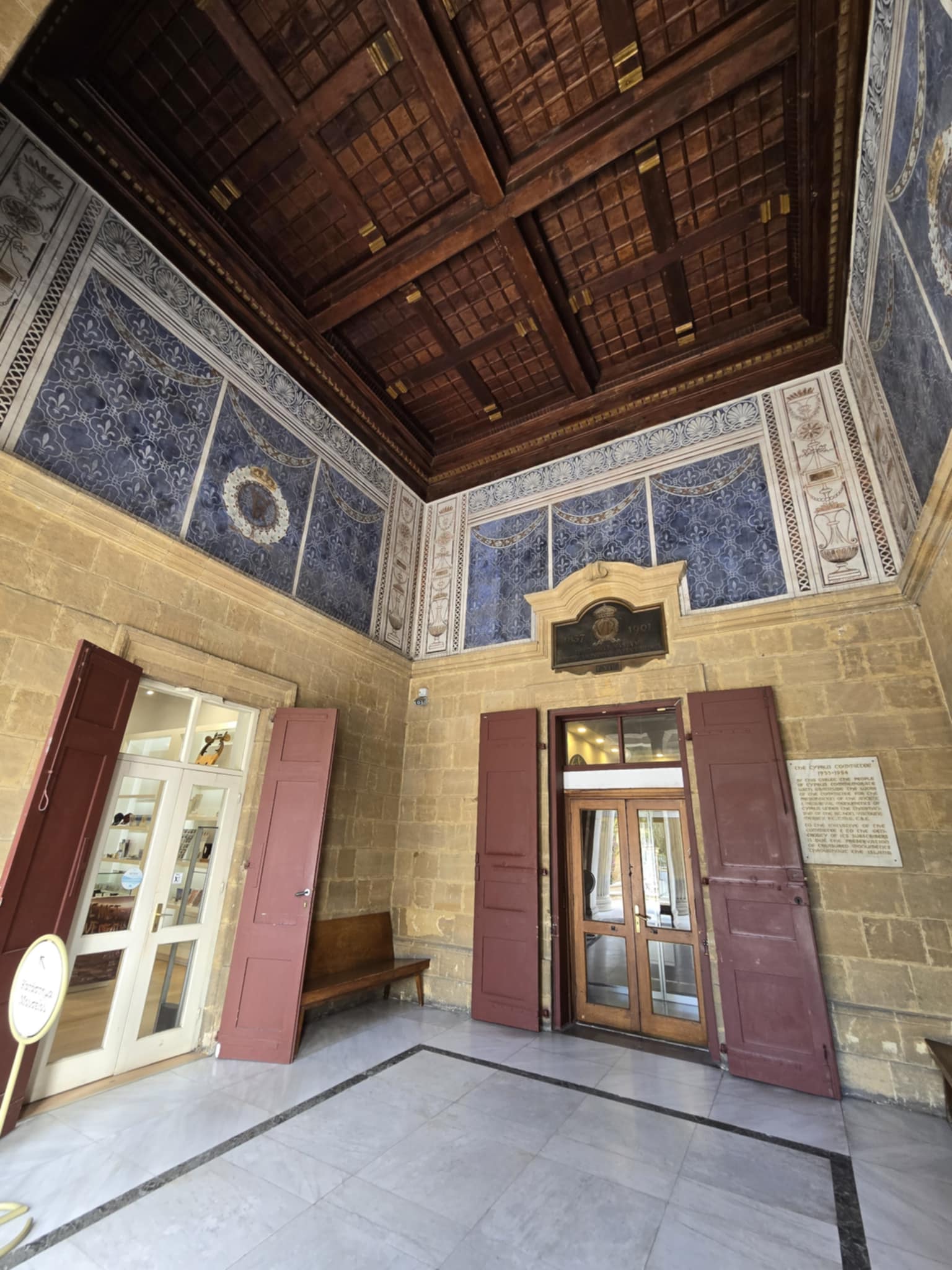
The entrance of the Cyprus Museum on Mouseiou Street, Nicosia, photographed 22 February 2025.
CC0Cyprus Museum
Museum · Kypriako Mouseio · Founded 1882
Open, admission and hours confirmed 31 August 2026 · 16 sources
On this page 13 sections
ContentsClose
The Cyprus Museum's advantage is retention as much as discovery: Cypriot antiquities law has kept the great majority of the island's excavated finds on Cyprus rather than letting them disperse into the international art market, so the museum functions as a near-complete, single-site record of the island's material culture from the Neolithic through the Roman and early Byzantine periods, in a way few national archaeological museums elsewhere can match after a century and a half of export. Its clearest strengths are Late Bronze Age and Cypro-Archaic material, where imported Mycenaean, Phoenician and Attic pottery sits beside distinctive local wares and sculpture found nowhere else, and the two set-piece excavation groups, the Royal Tombs of Salamis and the Agia Irini terracotta votive figures, that no other museum in the world can show in comparable depth. Its clearest gap is the pre-1882 export record: the Cesnola material now in New York, and comparable material in other foreign collections built before the museum and its protective law existed, sit permanently outside its walls.
| Local name | Kypriako Mouseio |
|---|---|
| Kind | Museum |
| Founded | 1882 |
| City and country |  Nicosia, Cyprus Nicosia, Cyprus |
| Address | 1 Mouseiou Street, Nicosia 1097, Cyprus |
| Website | culture.gov.cy |
| Status | Open, confirmed |
| Record last verified |
Visiting
- Hours
- Tuesday-Friday08:00 to 18:00
- Saturday09:00 to 17:00
- Sunday10:00 to 13:00
- First Wednesday of the month08:00 to 20:00Extended evening hours that replace the museum's normal hours for that single day each month.
- Closed
- Monday.
- Admission
- General admissionFreeFree entrance, per the Department of Antiquities own visitor page. This is distinct from the combined one, three or seven day tourist cards (EUR 8.50 to EUR 25.00) the department sells for its OTHER, paid, state museums and sites; those cards are not needed here.
- Do I need to book?
- No. Entry is free and walk-in; the department's own visitor page describes no advance booking or timed-entry system.
- Address
- 1 Mouseiou Street, Nicosia 1097, Cyprus Map
- Website
- culture.gov.cy
- Telephone
- +357 22 865854
- [email protected]
Before you go how long, access, photography, bags, eating, shop
- How long to allow
- About an hour for a brisk visit, longer for the Salamis and Agia Irini rooms; most 2025-2026 visitor accounts describe the museum as small enough to see in a single sitting rather than a half-day destination.
- Access
- An entrance ramp, chair lifts to reach the museum rooms, and a reserved parking space, per the department's own accessibility notice for the museum.
- Photography
- Not stated on the department's own visitor page in the material gathered for this record; check gallery signage on arrival rather than assume a rule either way.
- Bags
- Not stated on the department's own visitor page in the material gathered for this record.
- Eating
- None is listed on the department's own page, and none is mentioned in the visitor accounts gathered for this record.
- Shop
- Yes. The department lists a separate telephone line for the museum shop, and 2025 visitor accounts describe buying items there.
Prices and hours change. We take them from the institution's own pages and print the day we read them, and you can check the current position at the source we used. Confirm before you travel.
What is inside
Neolithic and Chalcolithic Cyprus
Stone tools and stone vessels, and the picrolite cruciform figurines characteristic of prehistoric Cyprus, including the Chalcolithic limestone figure known as the Lady of Lemba.
The Bronze Age and the trade routes
Local Bronze Age pottery shown alongside imported Mycenaean, Phoenician and Attic wares that record Cyprus's position on Mediterranean trade routes, together with bronze work such as the Horned God figure from Enkomi.
The sanctuary at Agia Irini
Around 500 of the roughly 2,000 terracotta votive figurines recovered in 1929 from the rural sanctuary at Agia Irini, ranging from miniature to near life size and arranged in ranks. The remainder of the find is held by the Medelhavsmuseet in Stockholm.
The Royal Tombs of Salamis
Chariots, bronze cauldrons of Near Eastern type, horse bridles and furniture inlaid with carved ivory, including the wooden bed and throne from tomb 79, recovered from the built chamber tombs used by Salamis's ruling families between the late 8th and early 6th century BC.
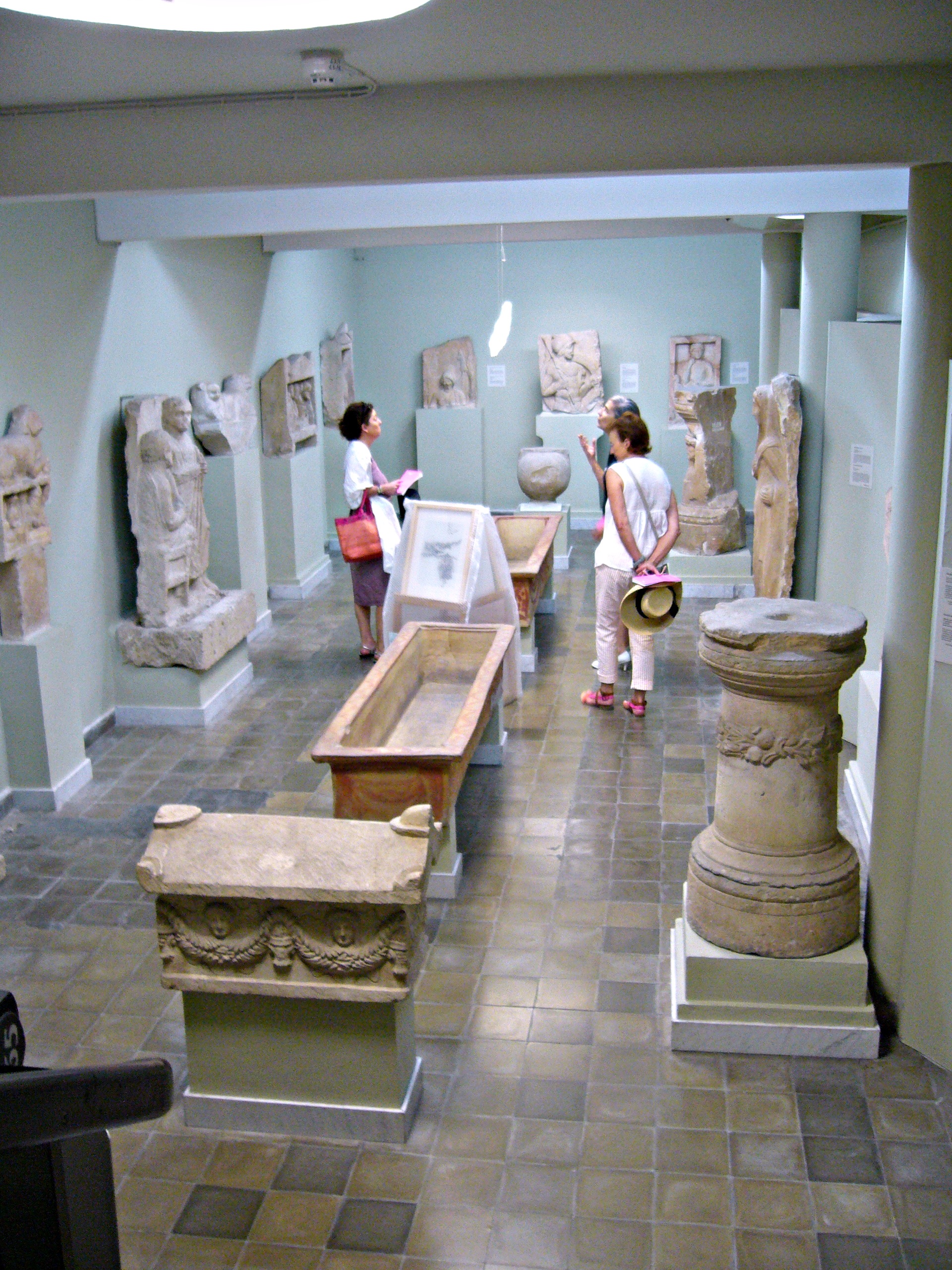
Photograph by Молли · CC BY-SA 4.0 Grave monuments: Room 9
Carved grave stelae and painted clay sarcophagi shown as reconstructed funerary settings rather than as isolated objects on plinths.
Hellenistic and Roman Cyprus
Marble and bronze statuary including the Aphrodite of Soloi and the over-life-size bronze statue of the emperor Septimius Severus, together with glass, mosaic fragments and coinage running to the early Byzantine period.
What to see first
The Lady of Lemba
Unknown Chalcolithic Cypriot workshopA limestone cruciform figurine roughly 35cm tall, one of the largest prehistoric anthropomorphic figures found on the island, and one of the earliest objects the museum can put a human face to.9
The terracotta votive army of Agia Irini
Unknown Cypro-Archaic Cypriot workshopAbout 2,000 terracotta figures were recovered from a single rural sanctuary in 1929; roughly 500 stayed in Cyprus and are shown here, the rest went to Stockholm, so the group is now split between two countries and can only be seen whole by visiting both.9
The ivory bed and throne from tomb 79, Royal Tombs of Salamis
Unknown Cypriot workshop, end of the 8th century BCWooden furniture inlaid with carved ivory plaques in Egyptian style, buried with a member of Salamis's ruling elite; among the best-preserved furniture to survive from the ancient eastern Mediterranean.11
The Horned God of Enkomi
Unknown Late Bronze Age Cypriot workshop, 12th century BCA bronze figure wearing horns, from the important Late Bronze Age trading city of Enkomi; among the museum's earliest surviving bronze figural work.11
Bronze statue of the emperor Septimius Severus
Unknown Roman-period workshopAn over-life-size bronze portrait, 2.08 metres tall, of the first African-born Roman emperor, found by a farmer near Kythrea in 1928; one of relatively few large-scale bronze imperial portraits to survive from antiquity anywhere.11
Marble statue of the Aphrodite of Soloi
Unknown Hellenistic-period workshopA Hellenistic marble statue in the manner of the Alexandrian sculpture school, and one of the museum's most reproduced single objects; Aphrodite is the goddess most closely associated with Cyprus in ancient tradition.11
Funerary statues from Marion
Unknown Cypro-Classical Cypriot workshop, 4th century BCA group of funerary statues from the northwestern city of Marion, singled out by specialist accounts as among the most important examples of Classical-period sculpture found on Cyprus.11
A museum founded to stop a theft
The Cyprus Museum exists because of a scandal. Between 1865 and 1876 the American consul at Larnaca, Luigi Palma di Cesnola, used his diplomatic position to excavate and remove an estimated 35,000 antiquities from the island, most of them without any archaeological record kept, and shipped them out through Alexandria after Ottoman officials tried to stop him. The Metropolitan Museum of Art in New York bought the bulk of the haul in 1872; Cesnola went on to become the Met's first director and held the post until his death in 1904. His own 1877 account of the digs drew scholarly attacks on his methods, and on Cyprus itself the losses were the immediate reason a delegation of Christian and Muslim religious leaders petitioned the British administration to stop further export of antiquities from the island.
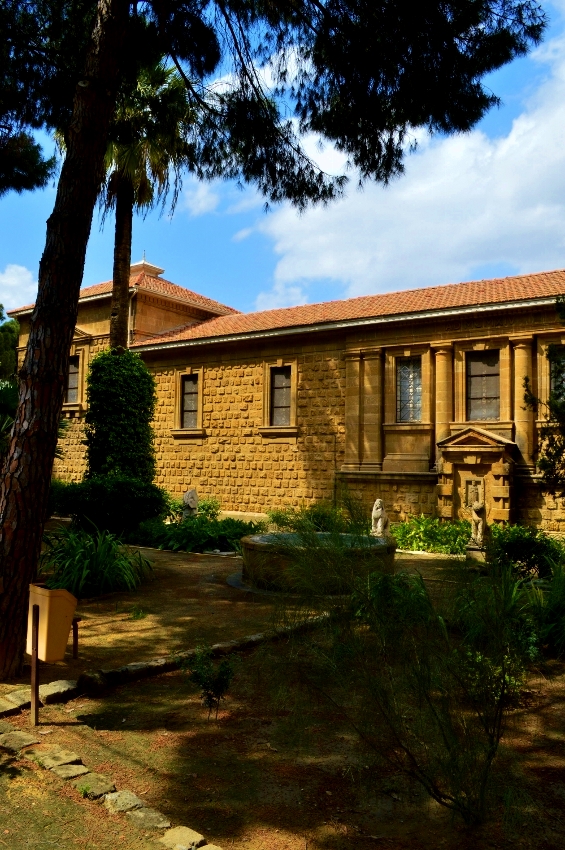
That petition was approved by the British High Commissioner, Sir Robert Biddulph, on 15 June 1882, and the resulting Committee of the Cyprus Museum is the institution's formal starting point on most modern accounts, Wikidata among them. The Department of Antiquities' own current visitor material instead dates the museum's founding to 1888, when the young collection first became, in the department's own words, a privately run institution with its own premises. Both dates describe real steps in the same process and this record does not treat either as settling the question. The collection outgrew two rooms of a government building within a few years, moved to its own premises on Victoria Street in 1889, and in 1908 began construction of the building it still occupies, on Mouseiou Street just outside Nicosia's old city walls. Funded by public subscription and public money and designed by the architect N. Balanos with George Everett Jeffery supervising construction, the building was dedicated to the memory of Queen Victoria and completed in 1924; a second wing of galleries, storerooms and offices was added in 1961, and the museum has occupied the combined building ever since.
Fourteen rooms, nine thousand years
The museum is built around a square central courtyard, with fourteen numbered rooms running around it in a chronological and thematic sequence that the Department of Antiquities' own guide still uses today. The earliest rooms hold Neolithic and Chalcolithic material: stone tools, stone vessels, and the picrolite cruciform figurines that are one of prehistoric Cyprus's most distinctive object types, among them the Lady of Lemba. From there the sequence runs through the Bronze Age, where local wares sit beside imported Mycenaean, Phoenician and Attic pottery recording the island's place on Mediterranean trade routes centuries before Rome; through the Cypro-Geometric, Cypro-Archaic and Cypro-Classical periods, when local sculpture in limestone and terracotta developed its own regional style distinct from mainland Greece; and into the Hellenistic and Roman rooms, where marble and bronze statuary, glass, mosaic fragments and coinage carry the story to the early Byzantine period. A separate sequence traces the evolution of writing on the island, from the still only partly deciphered Cypro-Minoan script, through the later Cypriot syllabic script, to the Greek alphabet that eventually replaced both.
Room 9 is given over to funerary material: carved grave stelae and painted clay sarcophagi, arranged as reconstructed burial settings rather than shown as isolated objects on plinths, a presentation choice that photographs of the room bear out. Independent visitors and at least one specialist reference site make the same complaint about the museum's arrangement as a whole: the objects are excellent, but the captions are sparse and the thematic grouping, which can span many centuries within a single room, gives a newcomer little sense of when anything actually happened without outside help from a guidebook or an audio tour.
The royal dead of Salamis and the buried army of Agia Irini
Two finds define what the museum is actually known for beyond its general survey of Cypriot antiquity. The first is the material from the Royal Tombs of Salamis, a group of built chamber tombs on Cyprus's east coast used by the city's ruling families and elite between the late 8th and early 6th century BC, and excavated under the Cypriot archaeologist Vassos Karageorghis, who ran the island's Department of Antiquities for twenty-six years and published the tombs in print before the island's 1974 division made further fieldwork there impossible. The tombs were furnished for the next world with chariots, bronze cauldrons of Near Eastern type, horse bridles, and furniture inlaid with carved ivory. A wooden bed and a throne from tomb 79, both decorated with ivory plaques carved in Egyptian style and dated to the end of the 8th century BC, are now set-piece exhibits of the museum and among the best-preserved furniture to survive from the ancient eastern Mediterranean.
The second find is of a very different kind. In 1929 the Swedish Cyprus Expedition recovered roughly 2,000 terracotta votive figurines from a rural sanctuary at Agia Irini in the island's north, ranging in size from miniatures to near life size and originally arranged, ring upon ring, around an open-air altar. Under the export terms of the day the Swedish excavators split the find down the middle: about 500 pieces stayed in Cyprus and are on permanent display here, arranged in ranks that still read like a small buried army, while roughly 1,500 went to the Medelhavsmuseet in Stockholm. Seeing the whole find therefore means visiting two museums in two countries. Between them, Salamis and Agia Irini are the reason the Cyprus Museum's galleries, however sparsely labelled in places, reward the detour: both groups are unique finds that cannot be seen, even in part, anywhere else on the island.
Visiting today: free, small, and quietly overwhelmed
Entry to the Cyprus Museum is free, a fact several 2026 visitors single out for comment, and the department's own current visitor information confirms it: there is no adult ticket price to record here, unlike at some of the department's other sites, where a combined one, three or seven day card is sold for EUR 8.50 to EUR 25.00. Most accounts from the last two years describe the museum as small enough to see properly in an hour, or two if a visitor slows down for the Salamis and Agia Irini rooms, and several visitors note that this makes it an easy addition to a walk through central Nicosia rather than a destination that needs a half day set aside. One April 2026 visitor wrote of not having enough time to do the museum justice in an hour; another, visiting in March 2026, called the collection far beyond expectations and said the highlights kept coming one after another.
The recurring complaint, made independently by a visitor writing in December 2025 and by a specialist classical-history reference site reviewing the museum in 2020, is the same one aimed at the room layout: exhibits are grouped by type and period rather than walked through as a single chronological story, captions are few, and a visitor with no background in Cypriot archaeology can come away admiring the objects without following the history that connects them. The December 2025 account went further, writing that since the building opened under British administration the exhibition itself has not been meaningfully updated. The department's own accessibility notice lists an entrance ramp, chair lifts to the upper rooms, and a reserved parking space; it does not, in the material gathered for this record, state a photography or bag policy, so a visitor planning to photograph the galleries should check signage on arrival rather than assume a rule either way.
A museum outgrowing its own building
The Department of Antiquities has said for years that the existing building cannot hold what it has: only a fraction of the department's Cypriot finds can be shown in fourteen rooms at any one time, and the rest sit in storage, largely unseen. The state's answer, under construction since January 2023 on the site of the former Nicosia Old General Hospital, is a new Archaeological Museum budgeted at EUR 144 million and described in Cypriot reporting as the country's largest single investment in cultural infrastructure to date. The project has slipped badly. It was due to finish on 9 July 2026; reporting in mid-2026 recorded only about EUR 30 million of the budget spent and put the revised completion date back to the end of 2027, citing extreme summer heat in 2024, a strike among concrete workers, and changes made to the architectural plan along the way as the causes.
None of the reporting gathered for this record states what becomes of the historic Mouseiou Street building once the new museum opens, or whether the present museum will close before then. A Cyprus Mail feature published on 30 August 2026 urged readers to see the current museum before it closes, without naming a date, language this record treats as a signal worth tracking rather than as a scheduled closure. As of the last check for this record the Museum Street building remains open on its normal hours and charges no admission, and nothing found in the course of this research states or implies that it is closed, closing imminently, or permanently shut.
What visitors say
Recent visitors and independent reference sources agree on both halves of the same judgement: the objects are exceptional and the museum is free, compact and easy to fit into a walk through central Nicosia, but the display itself has not been substantially modernised. Cases are grouped by type and period rather than walked through as a single chronological story, and captions throughout the museum are sparse, so a visitor without background in Cypriot archaeology can come away admiring individual pieces without following the history that connects them.
What is praised, what is criticised
- Praised: Free admission and the quality and density of the finds, especially the gold, ivory and bronze work from the Royal Tombs of Salamis.
- Praised: A compact, walkable layout that lets a visitor cover the whole span of Cypriot antiquity, Neolithic to early Byzantine, in an hour or two.
- Praised: Friendly, welcoming museum staff, mentioned specifically in several 2026 visitor accounts.
- Criticised: The galleries are grouped thematically rather than chronologically, which a specialist classical-history reference site and visitors writing as recently as December 2025 both describe as hard to follow without prior knowledge or a guide.
- Criticised: Labelling throughout the museum is sparse; the same December 2025 visitor account states plainly that the exhibition has not been meaningfully updated since the building opened under British administration.
- Criticised: Only a fraction of the Department of Antiquities' Cypriot holdings can be shown in the museum's fourteen rooms at any one time; the department cites this directly as the reason for the new museum now under construction elsewhere in Nicosia.
Ratings on other platforms
Tripadvisor: 4.5 from 734 ratings, read 31 August 2026
A platform average is a tertiary source: it moves, it is not audited, and we quote no visitor's words.
Questions about Cyprus Museum
Where is Cyprus Museum?
1 Mouseiou Street, Nicosia 1097, Cyprus.
How much does it cost to visit?
General admission: free. As confirmed 31 August 2026.
When is it open?
Tuesday-Friday 08:00-18:00; Saturday 09:00-17:00; Sunday 10:00-13:00; First Wednesday of the month 08:00-20:00. Closed: Monday. As confirmed 31 August 2026.
What should you see first?
The Lady of Lemba (Unknown Chalcolithic Cypriot workshop); The terracotta votive army of Agia Irini (Unknown Cypro-Archaic Cypriot workshop); The ivory bed and throne from tomb 79, Royal Tombs of Salamis (Unknown Cypriot workshop, end of the 8th century BC); The Horned God of Enkomi (Unknown Late Bronze Age Cypriot workshop, 12th century BC); Bronze statue of the emperor Septimius Severus (Unknown Roman-period workshop); Marble statue of the Aphrodite of Soloi (Unknown Hellenistic-period workshop).
What we could not confirm
- Whether the Department of Antiquities' own dating of the museum's founding to 1888 or the widely cited petition date of 15 June 1882 should be treated as definitive. Wikidata and several tertiary histories date formal establishment to the petition; the department's own current visitor page instead describes 1888 as when the collection became a privately run institution with its own premises. Both are real steps in the same institutional history and this record does not resolve which one counts as the founding.
- Whether or when the historic Museum Street building will close, and what becomes of it, once the new EUR 144 million Archaeological Museum on the former Nicosia Old General Hospital site opens. That project's own completion date has already slipped from 9 July 2026 to an expected end of 2027, and none of the sources gathered for this record states a closure date for the present museum or what its building will be used for afterward.
- Whether the informal, sporadic Cypriot calls for the return of Cesnola-era material now held by the Metropolitan Museum of Art in New York amount to an active claim. The sources found for this record describe the calls as occasional rather than a filed restitution case, and note that Cypriot officials themselves regard a legal challenge to the Ottoman-era export permit as unlikely to succeed against the Met.
Images
Sources
- 1Department of Antiquities, Republic of Cyprus - Cyprus Museum, Lefkosia (official visitor page: history, hours, admission, contact, accessibility) culture.gov.cy/dmculture/DA/DA.nsf/All/67084F17382CF201C2257199001FE4AD?OpenDocument
- 2Department of Antiquities, Republic of Cyprus - Opening Hours 2024, state museums and monuments (spreadsheet) culture.gov.cy/dmculture/da/da.nsf/all/B6F524F5CA7E1F19C2258B5B003E730B/$file/OPENING%20HOURS_2024.xls?openelement
- 3Department of Antiquities, Republic of Cyprus - English-language homepage culture.gov.cy/dmculture/da/da.nsf/dmlindex_en/dmlindex_en?OpenDocument
- 4Department of Antiquities, Republic of Cyprus - State museums list and combined-ticket pricing culture.gov.cy/dmculture/da/da.nsf/dmlmuseums_en/dmlmuseums_en?OpenDocument
- 5Department of Antiquities, Republic of Cyprus - Contact Us page (email, phone, fax, address) culture.gov.cy/dmculture/da/da.nsf/dmlcontactus_en/dmlcontactus_en?OpenDocument
- 6Wikidata - Cyprus Museum (Q1148462) wikidata.org/wiki/Q1148462
- 7Wikipedia - Cyprus Museum en.wikipedia.org/wiki/Cyprus_Museum
- 8Livius.org - Nicosia, Cyprus Museum livius.org/museum/nicosia-cyprus-museum/
- 9Cyprus Mail, 30 August 2026 - We may be seeing more of ancient Cyprus than we think cyprus-mail.com/2026/08/30/we-may-be-seeing-more-of-ancient-cyprus-than-we-think
- 10DOM LiVE - Construction timeline for the new Archaeological Museum in Nicosia significantly delayed dom.com.cy/en/live/digest/the-construction-dates-of-the-new-archaeological-museum-in-nicosia-have-shifted-significantly/
- 11GreeceWithin - Archaeological Museum in Nicosia: Cyprus's indisputable Greek roots greecewithin.com/articles/627-archaeological-museum-in-nicosia-cyprus-indisputable-greek-roots
- 12Cyprus Highlights - Cyprus Museum, Nicosia cyprushighlights.com/en/cyprus-archaeological-museum-nicosia/
- 13Tripadvisor - Cyprus Museum, Nicosia (rating and visitor reviews, read 31 August 2026) tripadvisor.com/Attraction_Review-g190383-d313651-Reviews-Cyprus_Museum-Nicosia_Nicosia_District.html
- 14New York Almanack, May 2026 - Museums, Diplomats and Art Thieves newyorkalmanack.com/2026/05/met-museums-diplomats-art-thieves/
- 15Visit Cyprus (Cyprus Tourism Organisation) - Cyprus Museum visitcyprus.com/discover-cyprus/culture/museums-galleries/cyprus-museum/
- 16Municipality of Nicosia - Cyprus Museum nicosia.org.cy/en-GB/discover/museums/cyprus-museum/