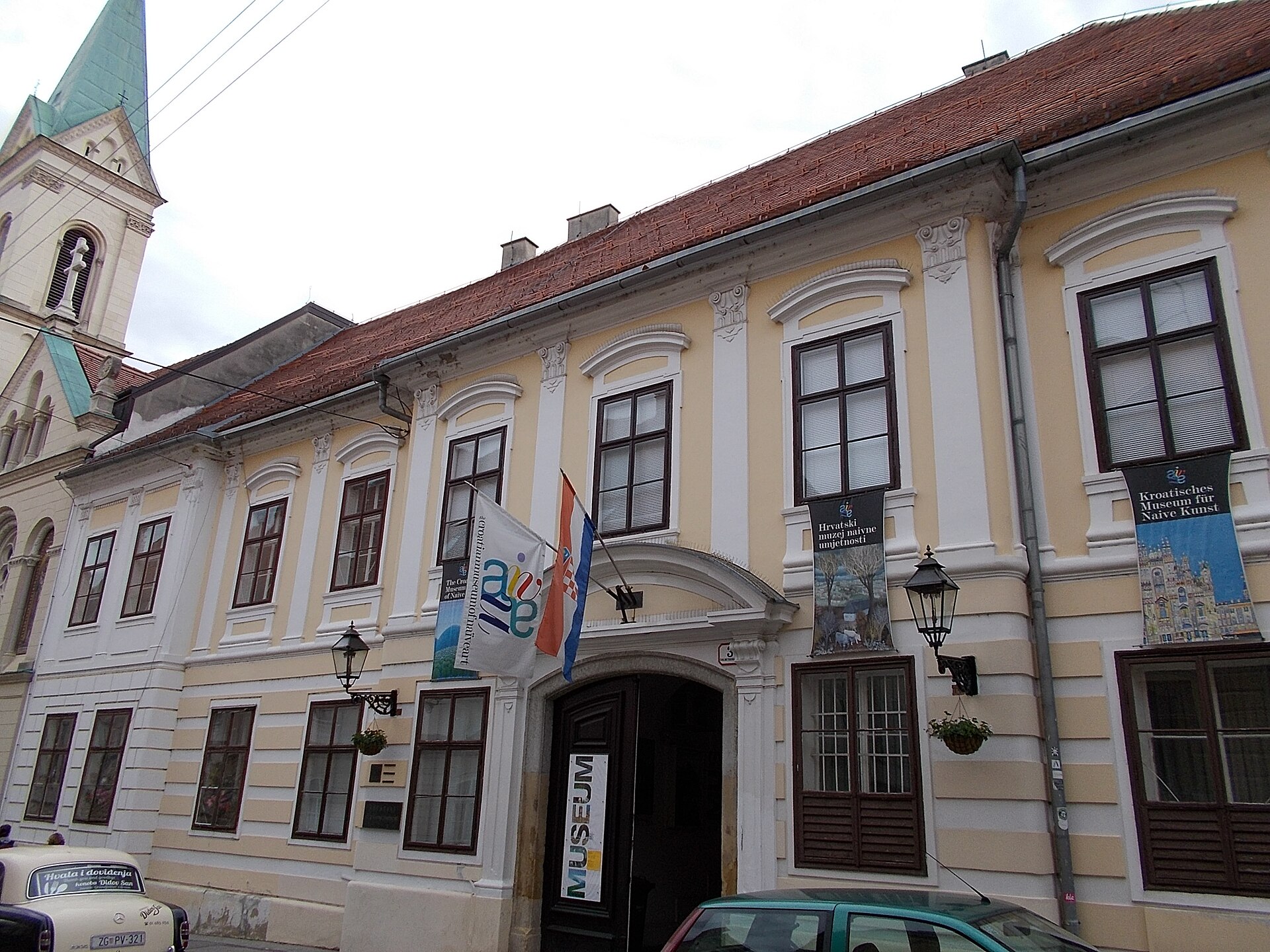
The Croatian Museum of Naive Art on Sv. Cirila i Metoda Street, Gornji Grad, Zagreb, photographed in 2016
Szeder Laszlo · Photograph by Szeder László · CC BY-SA 4.0Croatian Museum of Naive Art
Museum · Hrvatski muzej naivne umjetnosti · Founded 1952
Open, admission and hours confirmed 26 August 2026 · 14 sources
On this page 14 sections
ContentsClose
The museum's real strength is depth in a single, narrow field rather than breadth: it is built almost entirely around Croatian naive art from the Hlebine School onward, holding the founding painters, the sculptors who gave the movement a three-dimensional counterpart, and a deliberately curated set of international self-taught artists, all under 2,000 objects in total. That focus, kept to a single small floor of an 18th-century palace, is the museum's identity and its limitation at once: unmatched specificity in Croatian naive and outsider art, shown in a space too small to keep more than a small fraction of its own holdings on view at any time.
| Local name | Hrvatski muzej naivne umjetnosti |
|---|---|
| Kind | Museum |
| Founded | 1952 |
| City and country |  Zagreb, Croatia Zagreb, Croatia |
| Address | Ul. sv. Cirila i Metoda 3, 10000 Zagreb, Croatia |
| Website | hmnu.hr |
| Status | Open, confirmed |
| Record last verified |
Visiting
- Hours
- Mon-Fri09:00 to 17:00last entrance 16:30
- Sat10:00 to 14:00last entrance 13:30
- Closed
- Sunday. national holidays.
- Admission
- AdultEUR 5.50
- Students and pupilsEUR 3
- Family (parents with children)EUR 10
- Groups, 10 to 25 personsEUR 4per person
- Free admissionFreewith a valid document: members of ICOM, AICA, NEMO, CIMAM, the European Outsider Art Association, HMD or DPUH; press card holders; Fine Arts, Art History and Museology students; persons with disabilities and their accompanying person; Croatian Homeland War veterans; the unemployed
- Do I need to book?
- Not stated as required on the museum's own information page; no timed-entry system is described
- Address
- Ul. sv. Cirila i Metoda 3, 10000 Zagreb, Croatia Map
- Website
- hmnu.hr
- Telephone
- +385 1 4851911
- [email protected]
Before you go how long, access, photography, bags, eating, shop
- How long to allow
- Visitor reviews describe the museum as small enough to see in twenty to thirty minutes, with only around 80 of the roughly 1,900 to 1,936 held objects on view at any one time
- Access
- The museum's own visitor information page states plainly that the building has no access for people with disabilities and no parking for visitors' vehicles
- Photography
- Not stated in the sources consulted for this page
- Bags
- Not stated in the sources consulted for this page
- Eating
- Not stated in the sources consulted for this page; no cafe is mentioned on the museum's own site
- Shop
- Visitor reviews describe an on-site gift shop selling postcards and printed material
Prices and hours change. We take them from the institution's own pages and print the day we read them, and you can check the current position at the source we used. Confirm before you travel.
What is inside
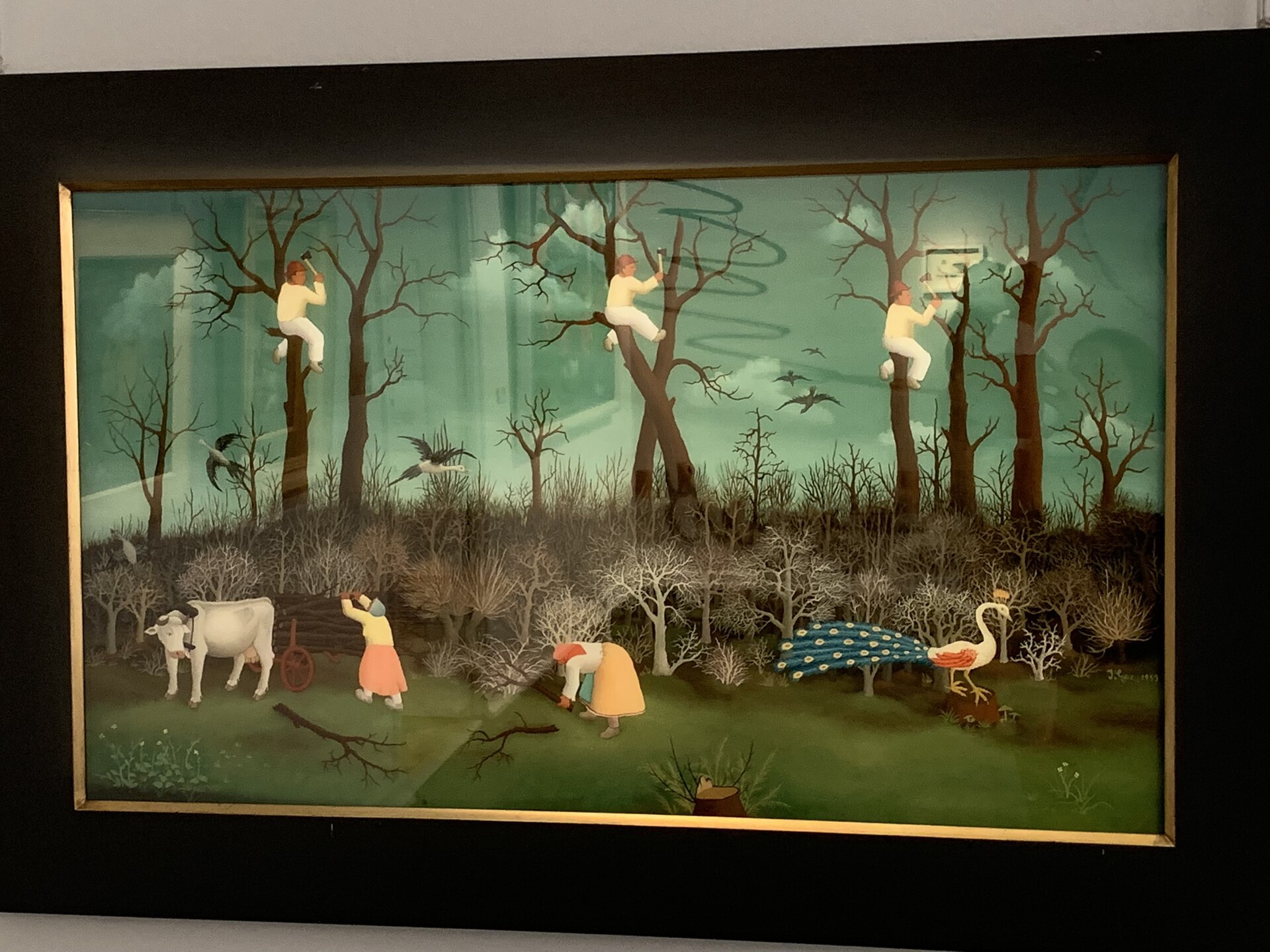
Photograph by Gveret Tered · CC BY-SA 4.0 Painting collection: the Hlebine School and its successors
The core of the museum's holdings, built around the peasant painters of Hlebine who worked in oil on the reverse of glass panes: Ivan Generalic, discovered as a teenager by the artist Krsto Hegedusic and given his first public showing at Zagreb's Art Pavilion in 1931, together with his contemporaries Franjo Mraz and Mirko Virius. Later generations represented in the painting collection include Ivan Rabuzin, Ivan Lackovic Croata, Mijo Kovacic, Emerik Fejes and Josip Generalic, whose work runs from the social realism of the 1930s through idealised landscapes, biblical and burlesque subjects, to later abstraction and urban and fantasy scenes.
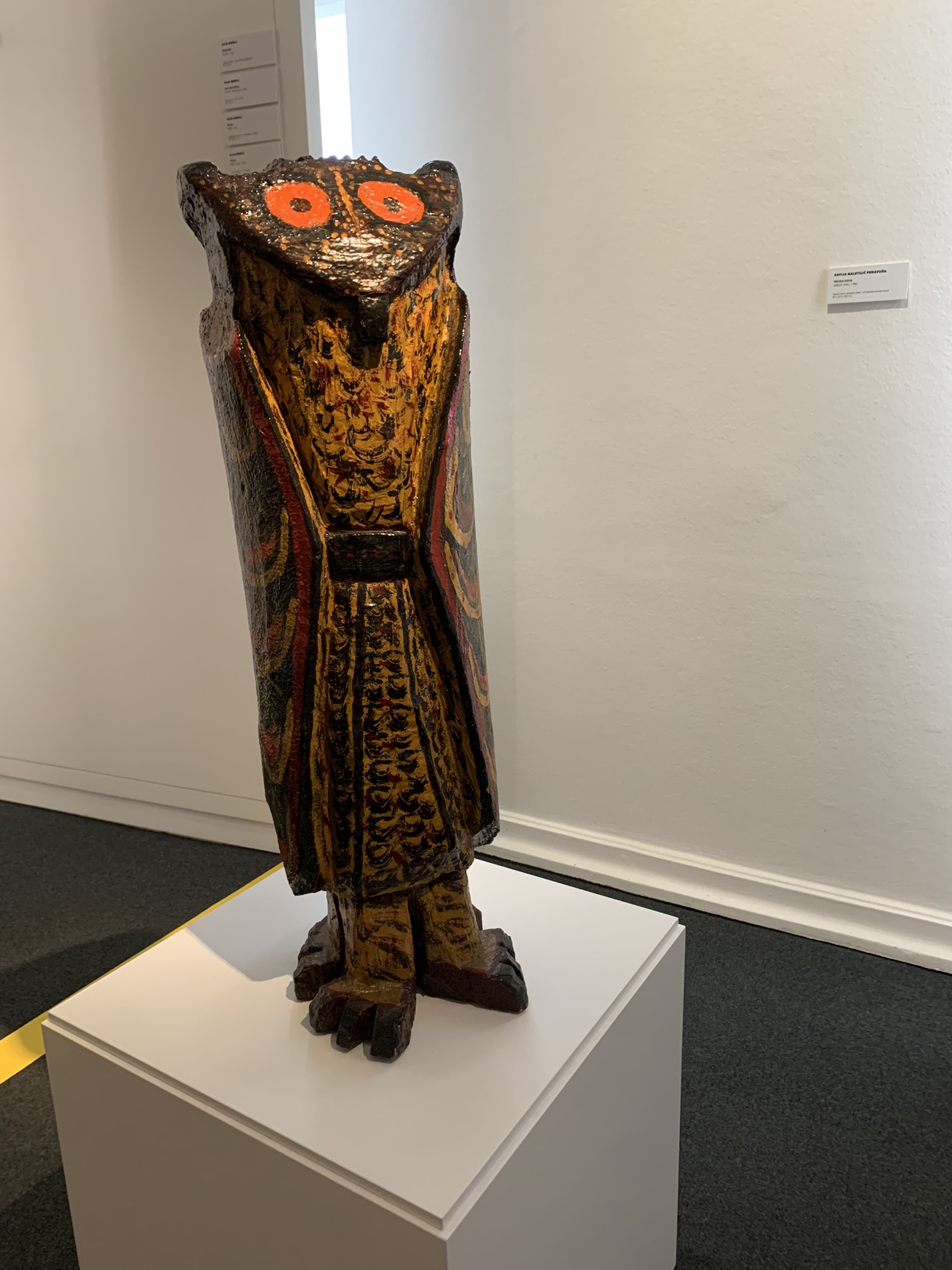
Photograph by Gveret Tered · CC BY-SA 4.0 Sculpture collection
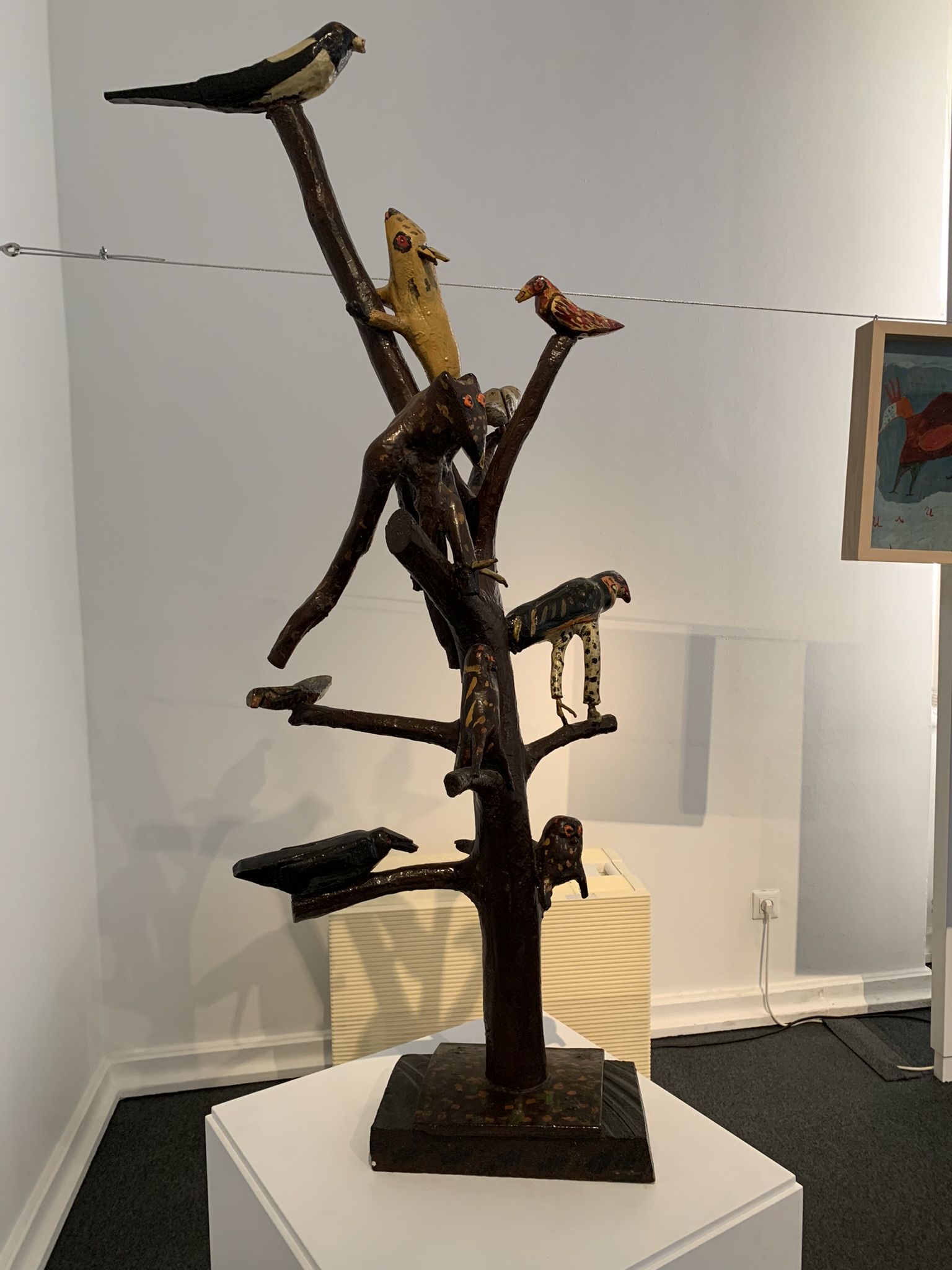
Stone and wood figures by the two artists credited with founding Croatian naive sculpture: Lavoslav Torti, who worked in stone, and Petar Smajic, who worked in wood. Their pieces sit alongside painting from the same period as the collection's three-dimensional counterpart to the Hlebine glass paintings.
Drawings, prints and graphic portfolios
Works on paper forming three of the museum's eight catalogued collections, drawn from the same core of Croatian naive and outsider artists as the paintings, shown in rotation because of the light sensitivity of works on paper.
International naive and outsider art
A smaller, deliberately balanced holding of non-Croatian self-taught artists alongside the Croatian core, including the Polish-Ukrainian painter Nikifor, the Russian artist Pavel Leonov, the Dutch outsider artist Willem Van Genk, the Macedonian painter Vangel Naumovski and the German artist Erik Bodeker.
Applied art, bibliophile editions and photography collection
The three smallest of the museum's eight catalogued collections, covering applied art objects, illustrated and bibliophile book editions connected to naive and outsider artists, and photography; the least often rotated into the roughly 80-piece permanent display.
What to see first
On the Hills - Virgin Forest
Ivan RabuzinA 1960 oil on canvas, 69.2 by 116.7 cm, built from Rabuzin's signature sequence of rounded, cloud-like hill forms; documented as held by the Croatian Museum of Naive Art and one of the works most identified with the museum's later, more abstracted generation of naive painting8
Untitled wood sculpture
Petar SmajicRepresentative of the wood-carved figures that, with Lavoslav Torti's stone work, the museum credits as the first examples of Croatian naive sculpture, giving the painting-dominated collection a three-dimensional counterpart11
Untitled stone sculpture
Lavoslav TortiTorti's stone carving is named by reference sources as the companion body of work to Smajic's wood sculpture at the founding of Croatian naive sculpture, and the museum holds examples of both10
Eclipse of the Sun
Ivan GeneralicA 1961 painting by the Hlebine School's founding figure, named in published visitor guides among the museum's highlighted works13
Cows are Returning
Slavko StolnikA 1957 painting named in published visitor guides among the museum's highlighted works, representing the rural genre scenes that define the museum's founding collection13
Blooming Roses
Vangel NaumovskiA 1969 painting by the Macedonian self-taught artist, named in published visitor guides among the museum's highlighted works and part of the smaller international strand of the collection13
Luxurious Ship
Drago JurakA 1974 painting named in published visitor guides among the museum's highlighted works, from the later generation of Croatian naive painters the museum collects alongside the founding Hlebine figures13
A palace in Zagreb's Upper Town
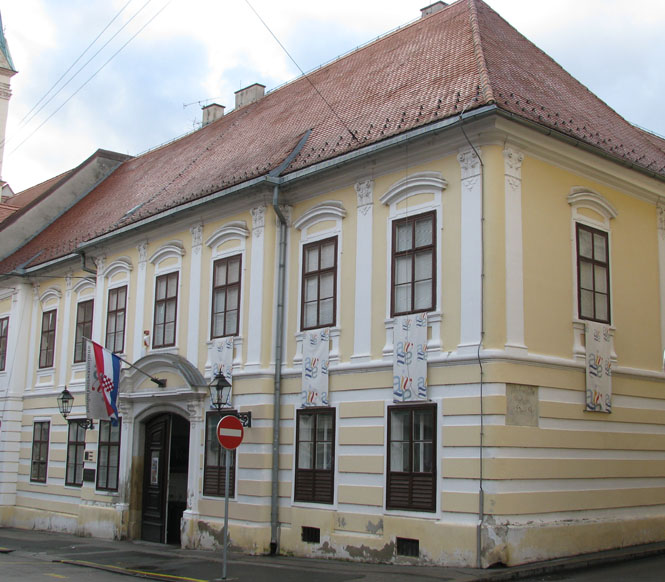
The Croatian Museum of Naive Art occupies the first floor of an 18th-century building known as the Raffay Palace, on Sv. Cirila i Metoda Street in Gornji Grad, the old upper town at the historic heart of Zagreb, a short walk from St Mark's Church. The museum's exhibition space runs to roughly 350 square metres, a single modest floor that visitor reviews consistently describe as compact rather than grand: a museum built around the strength of what it holds rather than the size of the building that holds it.
The museum's own visitor information is direct about the limits of the building: it states plainly that there is no access for people with disabilities and no parking for visitors' vehicles. Nothing in the sources consulted for this page describes plans to change that, and it is recorded here as the museum states it, not as a criticism invented for this page.
From a peasant art gallery to a national museum
The institution now called the Croatian Museum of Naive Art did not start under that name or in this building. It began at a board meeting of the Peasant Union on 7 April 1952, which founded the Peasant Art Gallery; the gallery opened to the public on 1 November 1952 at 17 Socijalisticke revolucije Street in Zagreb. In 1956 it was renamed the Gallery of Primitive Art, and on 17 February 1959 it became a specialist unit of the City Gallery of Contemporary Art, which was itself renamed the Galleries of the City of Zagreb in 1961. In February 1964 the Gallery of Primitive Art moved into its present premises at 3 Sv. Cirila i Metoda Street, where it has operated ever since.
The Croatian Museum of Naive Art in its current form and name was established by an Act of the Croatian Parliament on 25 February 1994, and is the legal successor to the Gallery of Primitive Art. Its equipment, museum objects and other holdings remain the property of the Republic of Croatia. On its own account, the museum was organised according to strict museological principles from the outset, and it presents itself as the world's first museum built specifically for naive art.
The Hlebine School and painting on glass
The collection's founding strength is the group of painters who came out of the village of Hlebine in the 1930s, working under the encouragement of the academically trained artist Krsto Hegedusic, who was then a member of the left-leaning Zemlja Association of Artists. Hegedusic discovered the teenage Ivan Generalic drawing on paper bags and arranged his first public exhibition at Zagreb's Art Pavilion in 1931, alongside his contemporaries Franjo Mraz and Mirko Virius. All three are collected in depth at the museum and are treated by it as the founding generation of Croatian naive art.
Generalic in particular is identified with a distinctive technique: painting in oil on the reverse side of a pane of glass rather than on canvas, a method that gives the finished, glass-fronted work an unusual reflective quality. The earliest works from this circle, made in the 1930s, lean toward the social realism and rural subject matter that connected them to the Zemlja Association's wider concerns; later works by the same painters and their followers move toward more idealised village scenes, biblical and folkloric subjects, and eventually toward burlesque and fantastical imagery, a progression the museum's own displays are organised to show.
Later generations and the world beyond Hlebine
The museum's holdings do not stop with the founding generation. Ivan Rabuzin, working from the 1950s onward, developed a signature style of lyrical, idealised landscapes built from repeated rounded hill and cloud forms; his 1960 painting On the Hills - Virgin Forest, held by the museum, is one of the clearest examples of Croatian naive painting moving away from village genre scenes toward abstraction. Ivan Lackovic Croata became known for melancholic, elongated twilight landscapes; Mijo Kovacic and Josip Generalic, the latter the son of Ivan Generalic, carried the Hlebine painting-on-glass tradition into later decades; and Emerik Fejes worked in an intricate, densely patterned architectural style.
The collection also holds a deliberately balanced selection of self-taught artists from outside Croatia, kept small by design but chosen to represent the wider naive and outsider art movement: the Polish-Ukrainian painter Nikifor, the Russian artist Pavel Leonov, the Dutch outsider artist Willem Van Genk, the Macedonian painter Vangel Naumovski and the German artist Erik Bodeker among them. The presence of this international strand is part of what the museum's own mission statement describes as positioning naive and outsider art as a meaningful part of both Croatian and international artistic heritage, not a purely local curiosity.
Eight collections, under two thousand objects, eighty on view
By the museum's own current count, its holdings comprise 1,936 catalogued museum objects, organised into eight distinct collections: painting, sculpture, drawings, prints, graphic portfolios, applied art, bibliophile editions and photography. Painting and sculpture carry the museum's reputation; the other six collections are smaller and rotate through the museum's roughly 80-piece permanent display far less often, which is one reason repeat visitors are told to expect a different selection of works on a return trip.
Sculpture is represented above all by Lavoslav Torti, working in stone, and Petar Smajic, working in wood, credited as the pair who established Croatian naive sculpture as a discipline in its own right alongside the better-known painting tradition. The museum has also built a record of touring its collection internationally, with exhibitions that the museum's own account credits with drawing more than 200,000 visitors combined in Japan in 2006, Italy in 2002, and the United States and Slovakia both in 2000 - a reach well beyond what the museum's single, small Zagreb floor could host on its own.
Visiting: a small museum, a short visit, and what it costs
The museum's own current information states adult admission at 5.50 EUR, a reduced rate of 3 EUR for students and pupils, a 10 EUR family ticket for parents visiting with children, and a group rate of 4 EUR per person for parties of ten to twenty-five. It lists free admission, on presentation of a valid document, for members of the museum organisations ICOM, AICA, NEMO and CIMAM, the European Outsider Art Association, and the Croatian museum bodies HMD and DPUH, for press card holders, for Fine Arts, Art History and Museology students, for persons with disabilities and their accompanying person, for Croatian Homeland War veterans, and for the unemployed. The museum opens Monday to Friday from 9:00 to 17:00, with last entry at 16:30, and Saturday from 10:00 to 14:00, with last entry at 13:30; it is closed on Sundays and national holidays.
The current temporary exhibition, titled The Way You See and Feel on the museum's own site, is presented as tracing Croatian naive art from its pioneering beginnings in the 1930s through to the bolder expressions of outsider art in the late 20th century, run alongside the permanent display rather than replacing it. Visitor reviews are frank that the whole visit, permanent collection included, runs to twenty or thirty minutes for most people, a function of the roughly 80 objects on view against the almost 1,900 the museum actually holds; set against that, reviewers still rate the museum highly for the quality of what is shown and treat the short visit as the price of seeing a collection this specific rather than as a flaw in the collection itself.
What visitors say
Visitor reviews are consistently positive about the quality and specificity of the collection and just as consistently note that the museum is very small: most visits are finished in twenty to thirty minutes, since only a fraction of the roughly 1,900 held objects is on view at any time. The historic Upper Town setting, a short walk from St Mark's Church, and the low admission price relative to Zagreb's larger museums are recurring points in its favour; the brevity of the visit against the ticket price, and the complete absence of disabled access and parking that the museum states about itself, are the recurring complaints.
What is praised, what is criticised
- Praised: the depth and specificity of the Hlebine School holdings, with reviewers naming Ivan Generalic's glass paintings as the reason to visit
- Praised: helpful and knowledgeable front-of-house staff
- Praised: the on-site gift shop, with reviewers singling out its postcards and printed material
- Praised: the setting itself, an 18th-century palace a short walk from St Mark's Church in Zagreb's Upper Town
- Criticised: the very short visit, with several reviewers reporting they were finished in ten to twenty minutes because only about 80 of the roughly 1,900 held objects are on display at once
- Criticised: an admission price some reviewers feel is not justified by how little of the collection is shown
- Criticised: the complete absence of step-free access or on-site parking, which the museum's own visitor information confirms rather than disputes
Ratings on other platforms
TripAdvisor: 4.4 from 723 ratings, read 26 August 2026
A platform average is a tertiary source: it moves, it is not audited, and we quote no visitor's words.
Questions about Croatian Museum of Naive Art
Where is Croatian Museum of Naive Art?
Ul. sv. Cirila i Metoda 3, 10000 Zagreb, Croatia.
How much does it cost to visit?
Adult: EUR 5.5; Students and pupils: EUR 3; Family (parents with children): EUR 10; Groups, 10 to 25 persons: EUR 4; Free admission: free. As confirmed 26 August 2026.
When is it open?
Mon-Fri 09:00-17:00; Sat 10:00-14:00. Closed: Sunday. national holidays. As confirmed 26 August 2026.
What should you see first?
On the Hills - Virgin Forest (Ivan Rabuzin); Untitled wood sculpture (Petar Smajic); Untitled stone sculpture (Lavoslav Torti); Eclipse of the Sun (Ivan Generalic); Cows are Returning (Slavko Stolnik); Blooming Roses (Vangel Naumovski).
What we could not confirm
- Published figures for the size of the collection vary by source and by date: the museum's own about-us page currently states 1,936 catalogued objects, while Wikipedia and several press and travel sources round to 1,900-plus and at least one travel guide states 1,850-plus; the museum's own current figure is treated as authoritative on this page.
- The building's history between 1964, when the Gallery of Primitive Art moved into 3 Sv. Cirila i Metoda Street, and the museum's 1994 renaming, is not covered in the sources consulted here beyond the institutional name changes; nothing was found describing renovation or structural work to the Raffay Palace itself in that period.
Images
Sources
- 1Croatian Museum of Naive Art, Visitors Information (opening hours, admission, accessibility notice) hmnu.hr/en/info
- 2Croatian Museum of Naive Art, About Us (mission, collection scope, brief history) hmnu.hr/en/about-us
- 3Croatian Museum of Naive Art, News (current exhibition, The Way You See and Feel) hmnu.hr/en/news
- 4Croatian Museum of Naive Art, home page (contact, current opening status) hmnu.hr/
- 5Wikimedia Commons, Category:Croatian Museum of Naive Art commons.wikimedia.org/wiki/Category:Croatian_Museum_of_Na%C3%AFve_Art
- 6Wikimedia Commons, File:HR-ZG-Zagreb128.jpg (lead image, licence and metadata) commons.wikimedia.org/wiki/File:HR-ZG-Zagreb128.jpg
- 7Wikipedia, Croatian Museum of Naive Art (, identity and history) en.wikipedia.org/wiki/Croatian_Museum_of_Na%C3%AFve_Art
- 8Wikipedia, On the Hills - Virgin Forest (Ivan Rabuzin painting, held by the museum) en.wikipedia.org/wiki/On_the_Hills_-_Virgin_Forest
- 9Wikipedia, Ivan Generalic (biography, Hlebine School, painting-on-glass technique) en.wikipedia.org/wiki/Ivan_Generali%C4%87
- 10Wikipedia, Lavoslav Torti (sculptor, works held by the museum) en.wikipedia.org/wiki/Lavoslav_Torti
- 11Wikipedia, Petar Smajic (sculptor, works held by the museum) en.wikipedia.org/wiki/Petar_Smaji%C4%87
- 12TripAdvisor, Croatian Museum of Naive Art reviews tripadvisor.com/Attraction_Review-g294454-d2236328-Reviews-Croatian_Museum_of_Naive_Art-Zagreb_Central_Croatia.html
- 13Time Out Croatia, The Croatian Museum of Naive Art timeout.com/croatia/museums/the-croatian-museum-of-naive-art
- 14Visit Zagreb, Croatian Museum of Naive Art visitzagreb.hr/zagreb/croatian-museum-naive-art/
