Museum of Contemporary Art
Museum · Muzej suvremene umjetnosti · Founded 1954
Open, admission and hours confirmed 15 September 2026 · 13 sources
On this page 14 sections
MSU's strength is Croatian postwar avant-garde in depth: the Gorgona circle, the New Tendencies movement the museum's predecessor helped organize and its wide correspondence with contemporaneous kinetic and conceptual art abroad, and the New Art Practice generation that followed it through the 1970s and 1980s. Its named single-artist archives, the Kozaric Studio and the Toso Dabac Archive, are Croatian holdings without an equivalent elsewhere.
| Local name | Muzej suvremene umjetnosti |
|---|---|
| Kind | Museum |
| Founded | 1954 |
| City and country |  Zagreb, Croatia Zagreb, Croatia |
| Address | Avenija Dubrovnik 17, 10000 Zagreb, Croatia |
| Website | msu.hr |
| Status | Open, confirmed 15 September 2026 |
| Record last verified | 15 September 2026 |
Visiting
- Hours
- Tue-Fri11:00 to 19:00
- Sat-Sun11:00 to 18:00
- Closed
- Monday. Public holidays.
- Admission
- Adult, permanent collection (three floors and ground floor)EUR 11Includes the standing display Zbirka kao glagol, one descent on Carsten Holler's Double Slide from the second floor, and current exhibitions in the Black Box and Situacije spaces
- Pupil, student or pensioner, permanent collectionEUR 7
- Adult, temporary exhibition space (two floors)EUR 9
- Pupil, student or pensioner, temporary exhibition spaceEUR 7
- Adult, combined permanent and temporary exhibition ticketEUR 19
- Pupil, student or pensioner, combined ticketEUR 13
- Six-month pass to all exhibitions and programmes, adultEUR 30Valid six months from date of purchase
- Six-month pass, pupil, student or pensionerEUR 17
- Family ticket, one visit (family with children under 15)EUR 12
- Group visit, 10 to 30 people, one exhibition spaceEUR 9Per person; must be booked a week ahead by email
- Visitor with a disability, plus one companionFreeFree entry
Free entry: First Wednesday of every month, free entry to all individual visitors on the exhibition programme. Tuesdays, free entry for University of Zagreb students under the standing Kulturni utorak (Culture Tuesday) agreement- Tickets
- ulaznice.hr/web/regular/28373923 The museum's own ticket page.
- Do I need to book?
- Not required; desk tickets sell until 30 minutes before closing and online tickets admit until 30 minutes before closing
- Address
- Avenija Dubrovnik 17, 10000 Zagreb, Croatia MapTram Lines 6 and 7 stop at Muzej suvremene umjetnosti; line 14 also serves the area
Bus Routes 166, 219, 220, 221, 229, 268, 310, 311, 313, and the east-west routes 109 and 222
From Zagreb Airport Airport bus to the Av. Dubrovnik - Sopot 1 stop
From the main train station Tram 6 toward Sopot, or bus routes 166, 219, 220, 221, 268, 310, 311, 313
From the bus station Tram 7 toward Savski most, stop Muzej suvremene umjetnosti
Car Parking is available east and north of the building; motorway access via the A1 Lucko exit or the A3 east exit onto Slavonska avenija - Website
- msu.hr
- Telephone
- +385 1 60 52 700
- [email protected]
Before you go how long, access, photography, bags, eating, shop
- How long to allow
- Two to three hours for the permanent collection across the ground floor and three upper floors, longer if a temporary exhibition is also open
- Access
- The museum states that wheelchair access is provided throughout the building; a visitor with a disability and one companion enter free
- Photography
- The museum's own terms do not address personal photography; commercial filming of the building, its interior and exterior spaces, or the artworks requires the museum's written permission, arranged through its marketing or press departments
- Bags
- Backpacks and bags must be left in lockers before entering the collection
- Eating
- The building includes a bookshop and a cafe alongside its library and multimedia hall
- Shop
- The museum shop keeps the same hours as the museum, Tuesday to Friday 11:00 to 19:00, Saturday and Sunday 11:00 to 18:00, closed on public holidays
Prices and hours change. We take them from the institution's own pages and print the day we read them, and you can check the current position at the source we used. Confirm before you travel.
What is inside
Permanent display: Zbirka kao glagol (Collection as a Verb)
The standing display occupies the ground floor and three floors above it, about 3,500 square meters in total, and rotates roughly 600 works out of the museum's full holdings under the title Zbirka kao glagol, Collection as a Verb. A standard ticket to this display includes one descent on Carsten Holler's Double Slide, a permanent site-specific installation that carries a visitor down from an upper floor past the galleries to the car park outside, built for this building rather than adapted from elsewhere.
Photograph by Thyes · CC BY-SA 3.0 Collection of Paintings
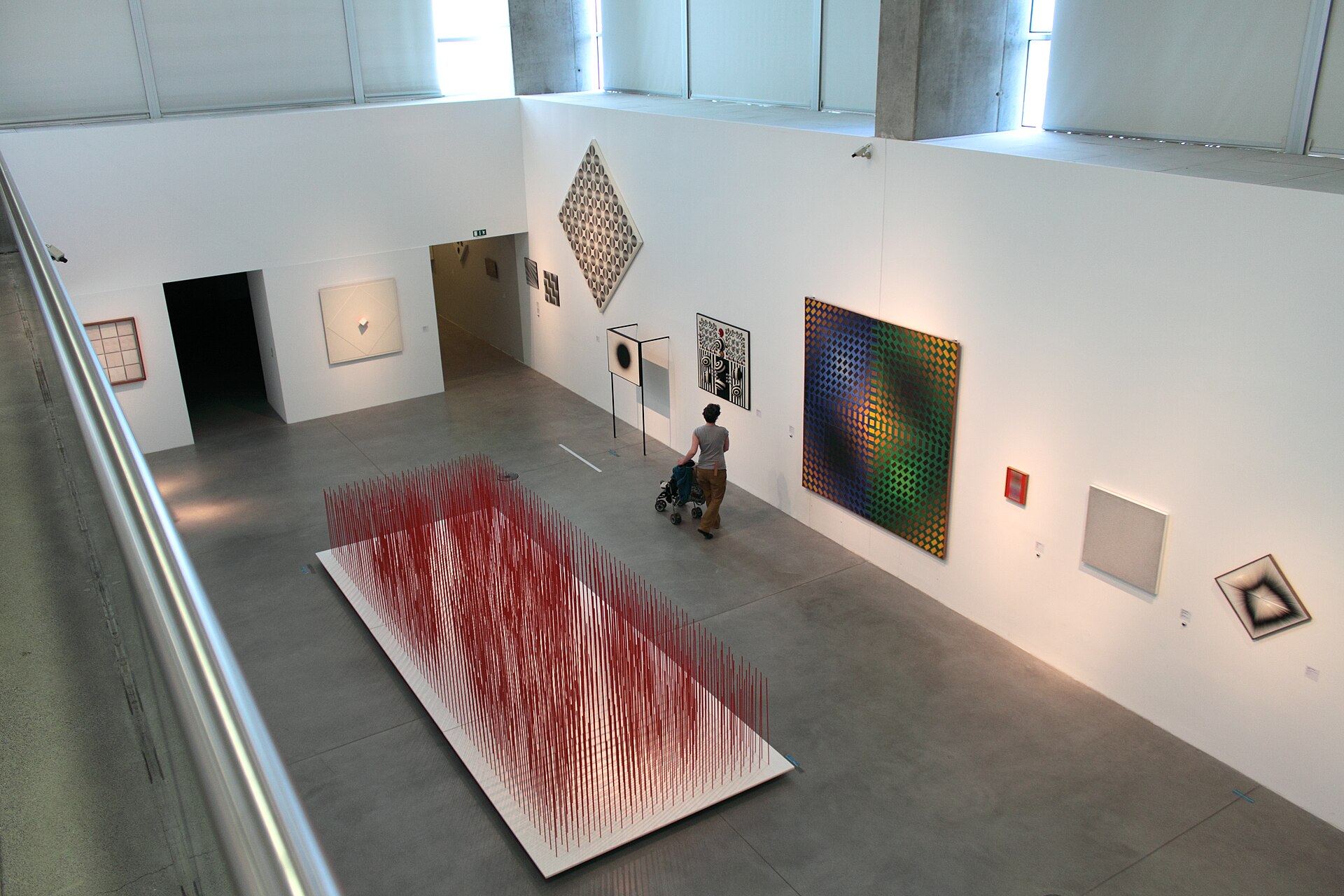
More than 1,200 works from the early 20th century onward. The museum names Josip Seissel's Pafama and Marino Tartaglia's Self-Portrait as the most significant survivors of its small pre-war holding, alongside portraits by Nasta Rojc, Zlatko Sulentic, Sava Sumanovic, Leo Junek and Vilko Gecan. Later painting runs through the geometric abstraction of the Exat 51 group and the Informel surfaces of Ivo Gattin, Eugen Feller and Edo Murtic, the Gorgona-period painting of Marijan Jevsovar, Josip Vanista and Dimitrije Basicevic, and the New Tendencies period of Vlado Kristl, Aleksandar Srnec, Julije Knifer and Ivan Picelj alongside international participants Almir Mavignier, Otto Piene, Victor Vasarely, Piero Dorazio and Piero Manzoni.
Photograph by Thyes · CC BY-SA 3.0 Sculpture Collection
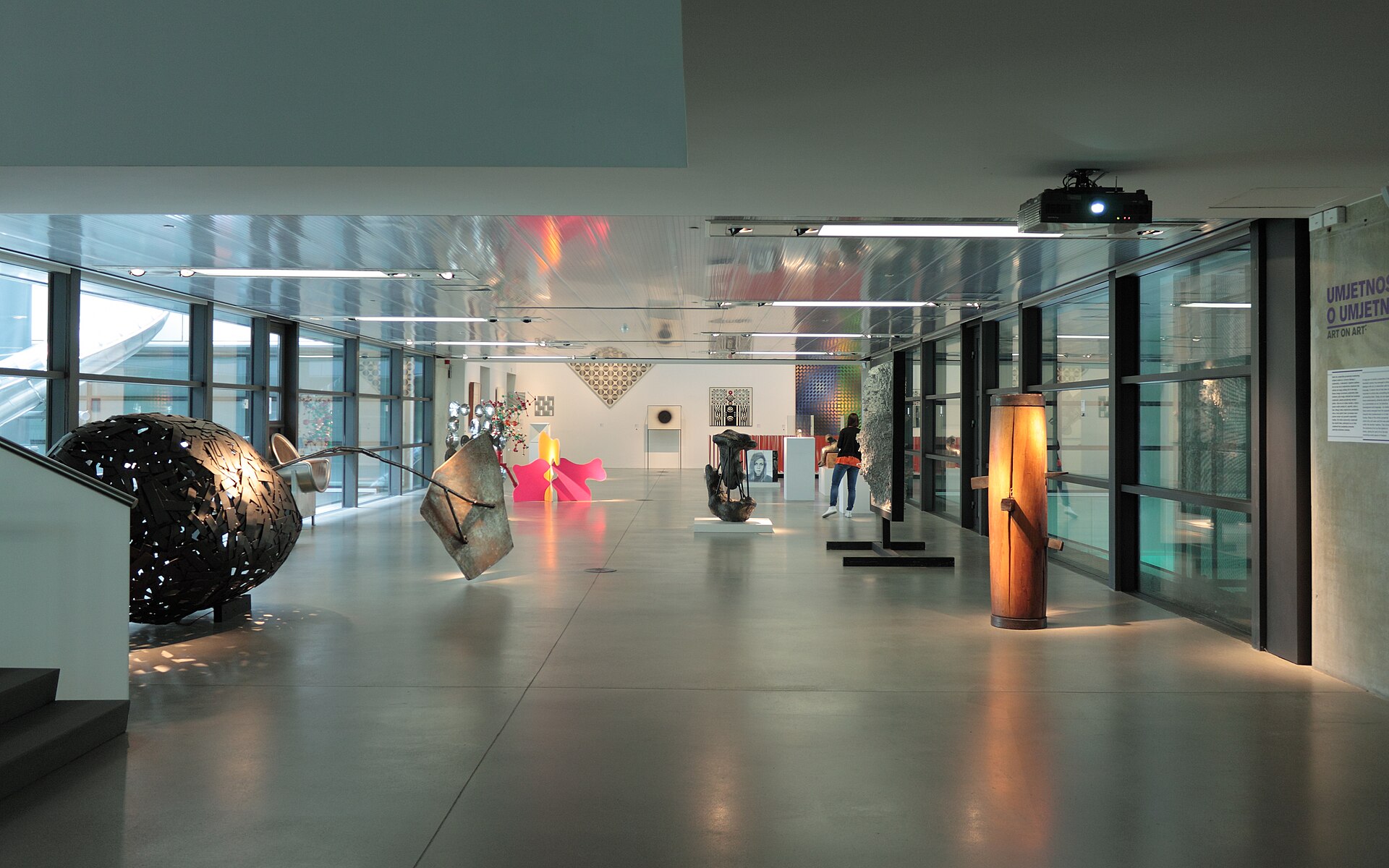
Close to 1,000 works, built around the artists who took part in the New Tendencies exhibitions the museum's predecessor organized between 1961 and 1973, among them Vojin Bakic, Vladimir Bonacic, Julije Knifer, Vlado Kristl, Ivan Kozaric, Ivan Picelj, Vjenceslav Richter, Aleksandar Srnec, Ljerka Sibenik and Miroslav Sutej, complemented by international New Tendencies participants Getulio Alviani, Alberto Biasi, Julio Le Parc, Bruno Munari, Soto and Vasarely. Later additions cover the analytical and primary sculpture of Ladislav Galeta, Vladimir Gudac and Tomislav Gotovac, the post-conceptual installations of Mladen Stilinovic, Damir Sokic and Edita Schubert, and a 2007 donation of 15 war-themed sculptural installations by Duba Sambolec.
Photograph by Thyes · CC BY-SA 3.0 Collection of Drawings, Graphics, Prints and Art on Paper
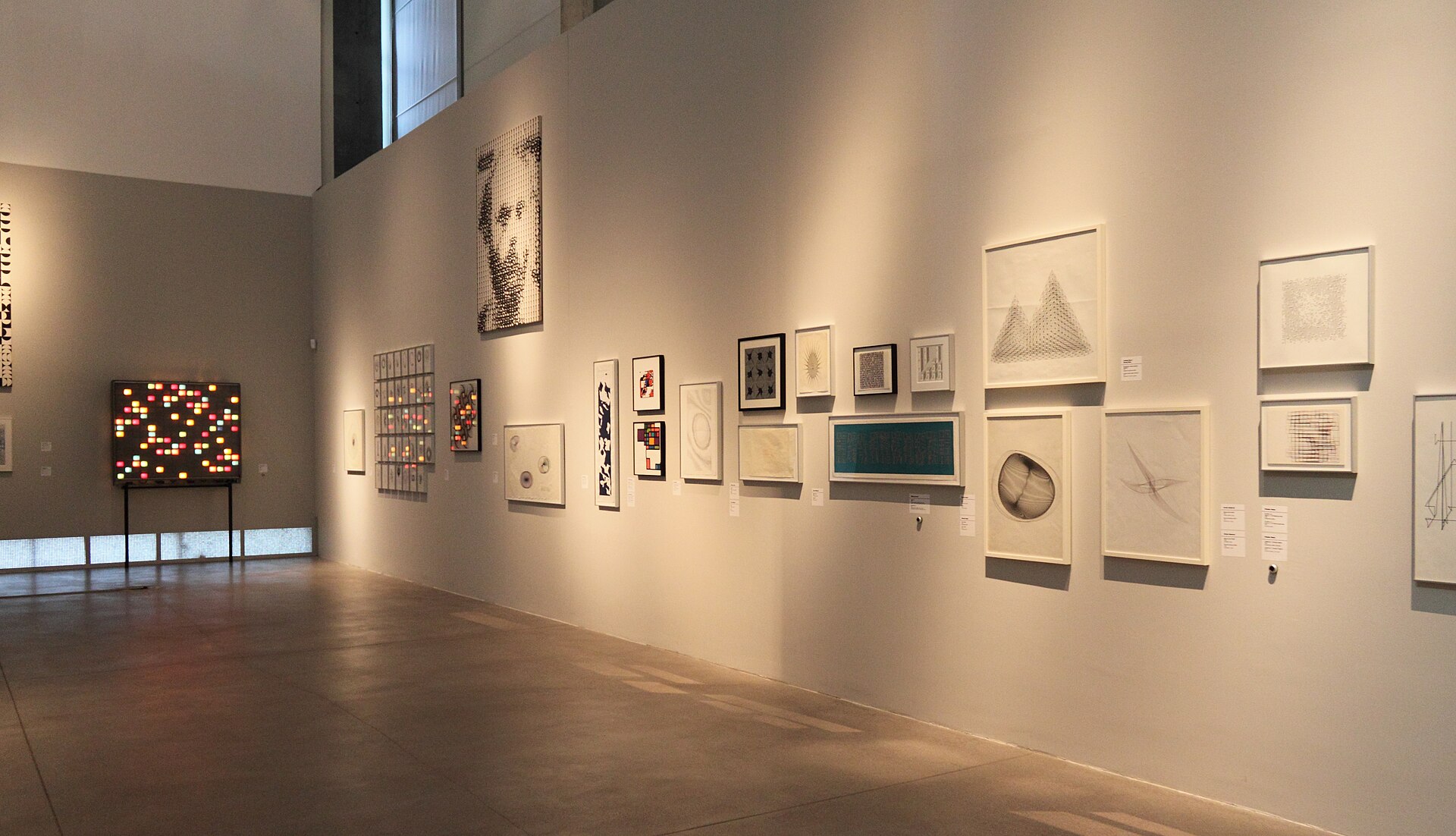
The largest MSU collection by object count, 6,360 works dating from the early 20th century, covering the same span of movements as the Painting and Sculpture collections in works on paper.
Photography Collection
Grown out of the Centre for Photography, Film and Television founded at the museum in the early 1970s, the collection mainly covers photography since the 1950s but reaches back to the 1920s and 1930s through Bauhaus-trained photographer Ivana Tomljenovic Meller. It documents 1950s-60s photography by Mladen Grcevic, Milan Pavic, and Ante and Zvonimir Brkan, the conceptual and performance-adjacent photography of the 1970s by Ivan Ladislav Galeta, Tomislav Gotovac, Petar Dabac, Goran Trbuljak, Marina Abramovic, Christian Boltanski and John Baldessari, and later work by Mladen Stilinovic, Braco Dimitrijevic, Vlasta Delimar, Ana Opalic, Boris Cvjetanovic and Igor Eskinja, alongside Andres Serrano and Ulrika Rosenbach.
Collection of Outsider Art
Formed in 2016 and already holding 639 works, the museum's newest named collection.
The Kozaric Studio
More than 6,000 objects from the working life of Ivan Kozaric: sculptures, reliefs, assemblages, objects, installations, ready-mades, paintings, prints, drawings and sketches, kept together as the intact studio of one of the most important Croatian sculptors of the second half of the 20th century rather than dispersed into the general Sculpture Collection.
The Toso Dabac Archive
Roughly 160,000 negatives, about 2,000 artistic enlargements, Toso Dabac's photographic equipment, his library and a collection of newspaper clippings, the archive of one of Zagreb's most important 20th-century photographers.
What to see first
Double Slide
Carsten Holler, 2009A permanent, site-specific double-helix slide built for this building, carrying visitors from an upper floor of the permanent collection down past the galleries to the car park; it is included in the standard permanent-collection ticket and is the single feature almost every account of a visit to MSU mentions first.7
Pafama
Josip SeisselNamed by the museum itself as one of the two most significant paintings surviving from its small pre-World War II holding.4
Self-Portrait
Marino TartagliaThe other painting MSU names as central to its pre-war holding, alongside Seissel's Pafama.4
Gorgona-period and anthology works
Ivan KozaricMSU holds both his early and Gorgona-period sculpture in the general Sculpture Collection and his entire working studio as a separate named collection, an unusually complete record of one of Croatia's most important postwar sculptors.5
New Tendencies holdings
Victor Vasarely, Julio Le Parc, Bruno Munari and Soto, together with Vojin Bakic, Julije Knifer and Ivan PiceljMSU's predecessor organized the New Tendencies exhibitions and symposia of 1961 to 1973, an international hub for kinetic and programmed art, and the museum still holds work by the movement's Croatian and international participants together.5
Toso Dabac Archive
Toso DabacAt roughly 160,000 negatives, the largest single-photographer archive MSU holds, documenting Zagreb through the work of one of its most important 20th-century photographers.3
New Art Practice sculpture and installation
Mladen Stilinovic, Braco Dimitrijevic, Damir Sokic and othersThe post-conceptual generation of the late 1970s and 1980s that connected Zagreb's conceptual art scene to an international audience, represented across the Sculpture and Photography collections.6
From the Kulmer Palace to Novi Zagreb
The Museum of Contemporary Art in Zagreb traces its origin to 21 December 1954, when the City of Zagreb founded the City Gallery of Contemporary Art (Gradska galerija suvremene umjetnosti) inside the Kulmer Palace in the city's Upper Town. The new gallery set out to collect and show the work of the younger generation working in Croatia, and it did so almost immediately by hosting the Exat 51 group, among them Ivan Picelj, Vjenceslav Richter, Aleksandar Srnec, Bozidar Rasica and Vlado Kristl, who were pushing Croatian art toward geometric abstraction at a time when Yugoslav cultural policy was still working out how much abstraction it would tolerate. In the 1950s the gallery organized some of the first travelling exhibitions of abstract art anywhere in the region, and by the end of the decade it had become the institutional home of Gorgona, the loose circle of artists and writers around Josip Vanista, Ivan Kozaric, Julije Knifer, Marijan Jevsovar and Duro Seder that international critics later called the last European avant-garde group.
What the Kulmer Palace never gave the gallery was room. The museum's own account of its history says plainly that the collection grew through five decades of acquisitions and donations while the institution never had a proper permanent display, because there was nowhere in the palace to put one. The city government decided in 1998 to build a purpose-made museum rather than keep expanding into borrowed rooms, and it opened a design competition that drew 85 entries. Architect Igor Franic won it. The site chosen was not in the historic centre at all: a plot in Novi Zagreb, on the south bank of the Sava, at the junction of Avenija Vecheslava Holjevca and Avenija Dubrovnik, a route that functions as one of the main links between old Zagreb and the newer districts across the river. The cornerstone was laid in November 2003. The building that resulted opened to the public on 11 December 2009, fifty-five years after the institution it housed was founded.
The building Igor Franic built
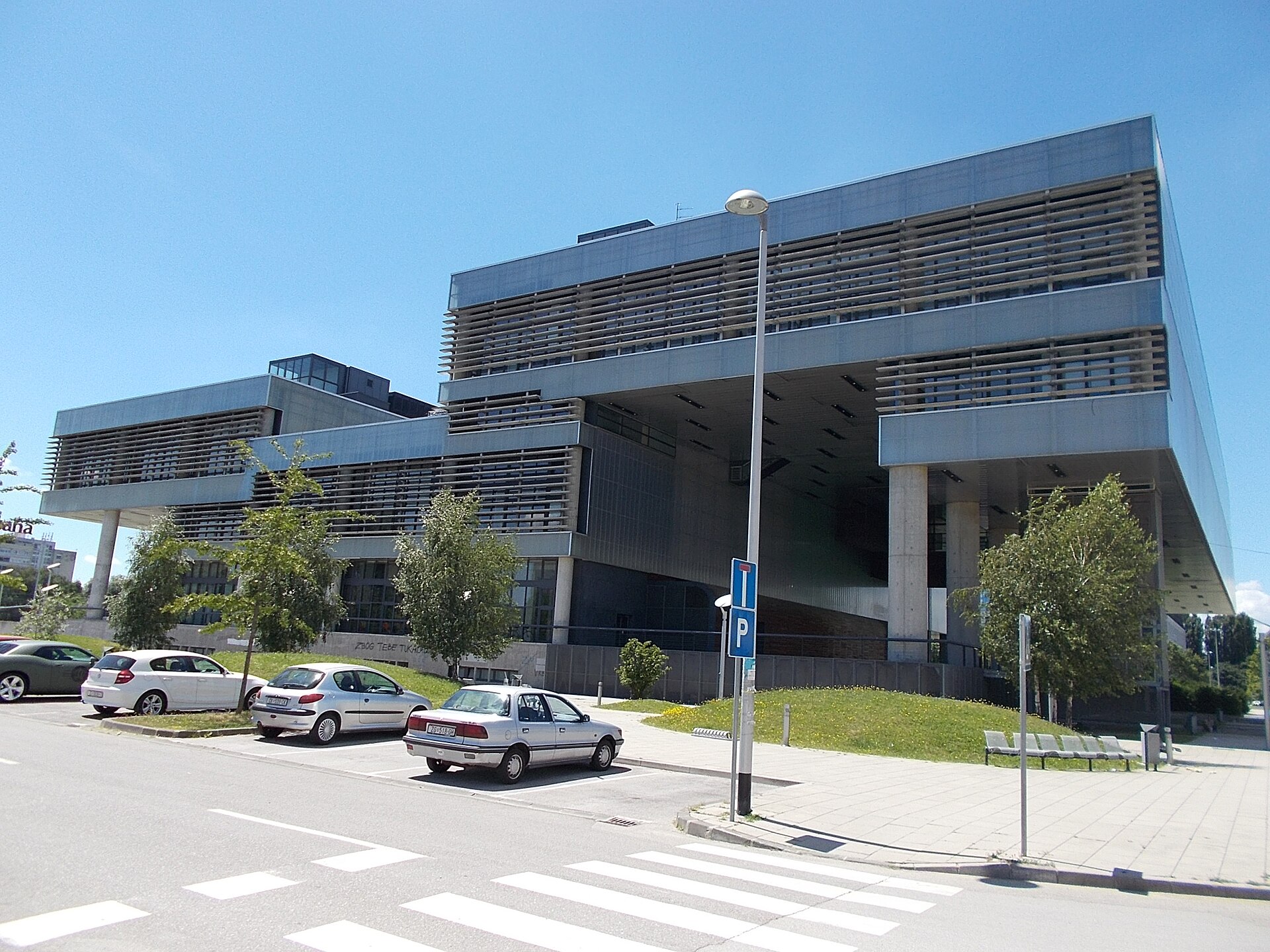
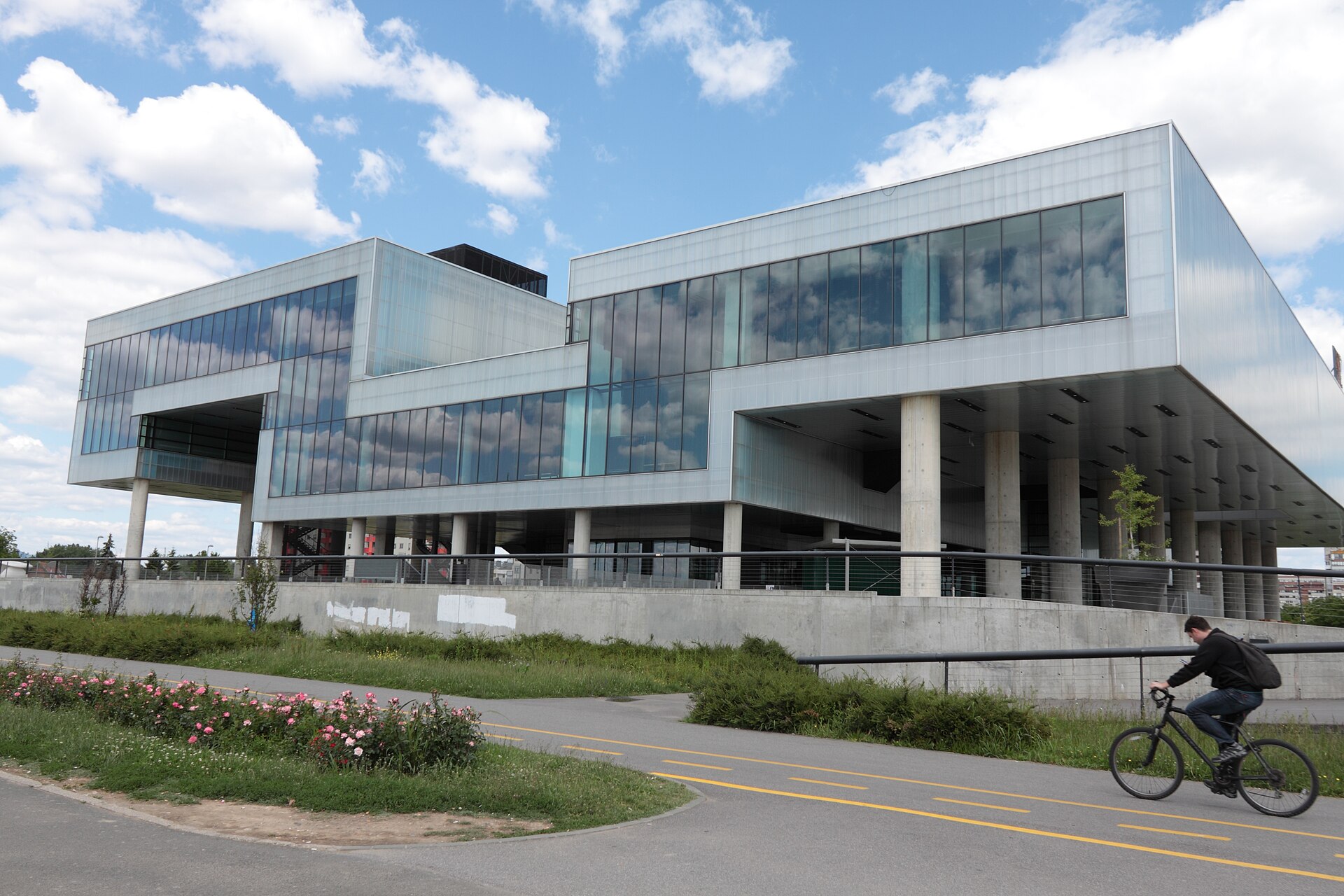
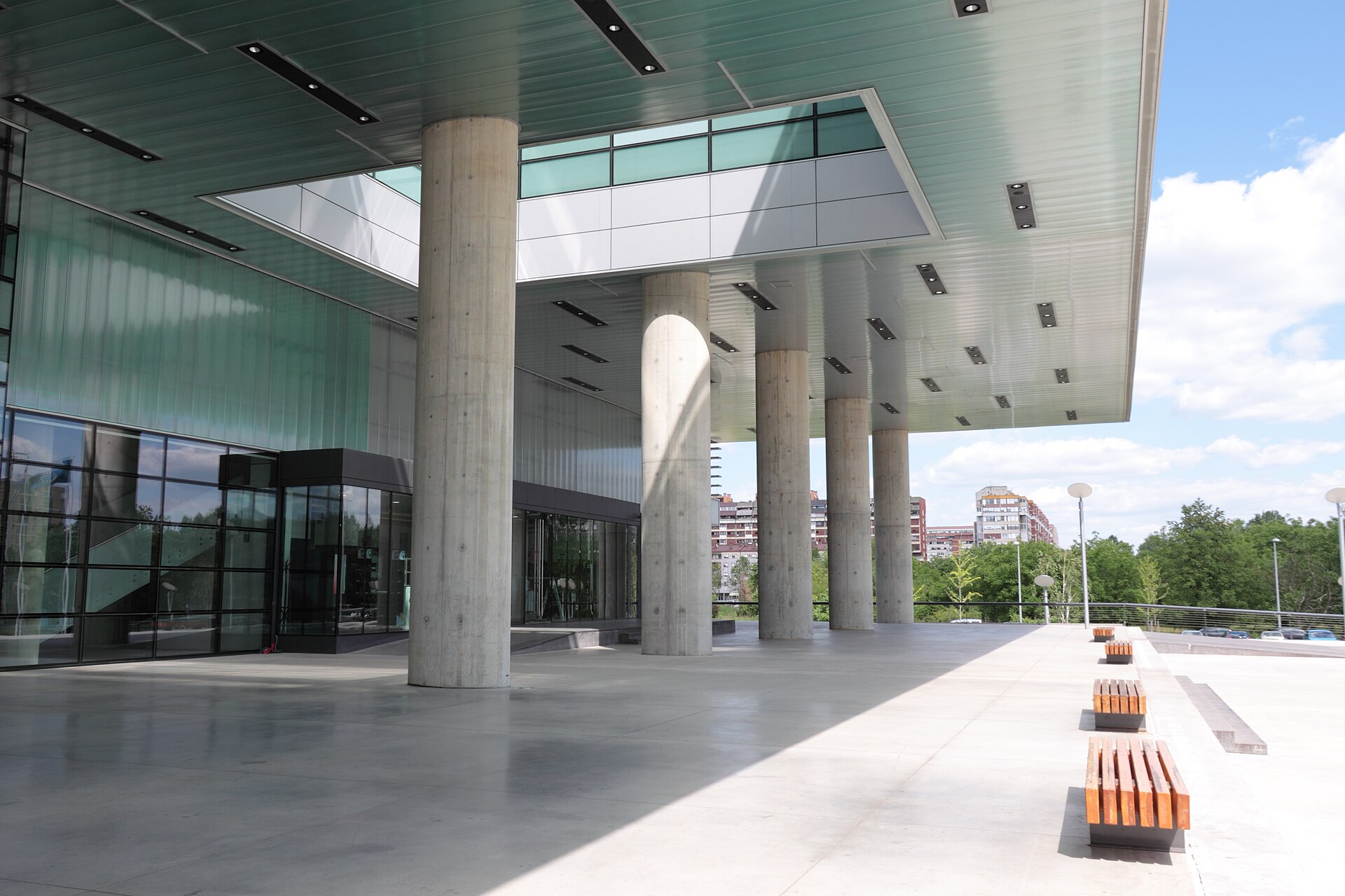
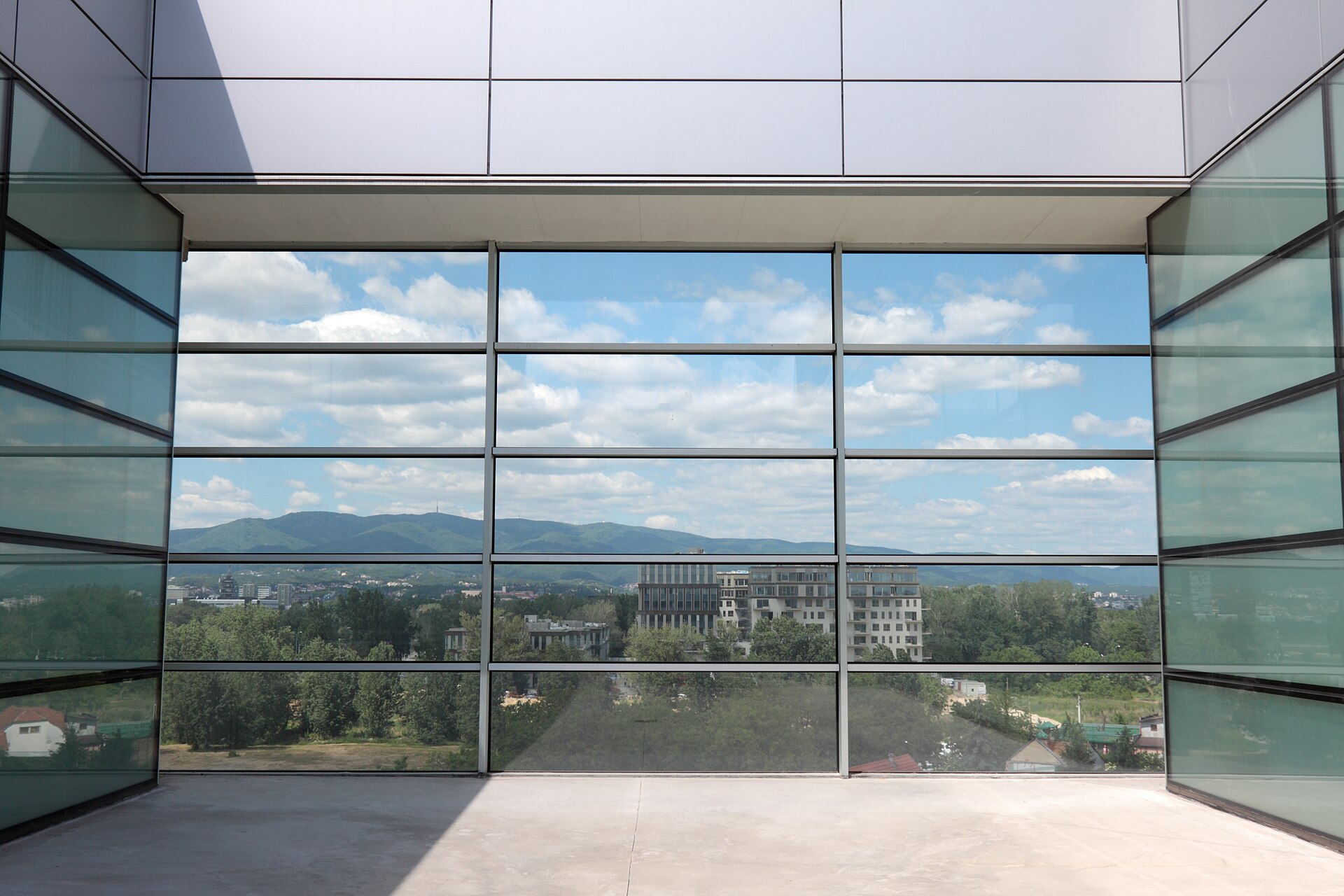
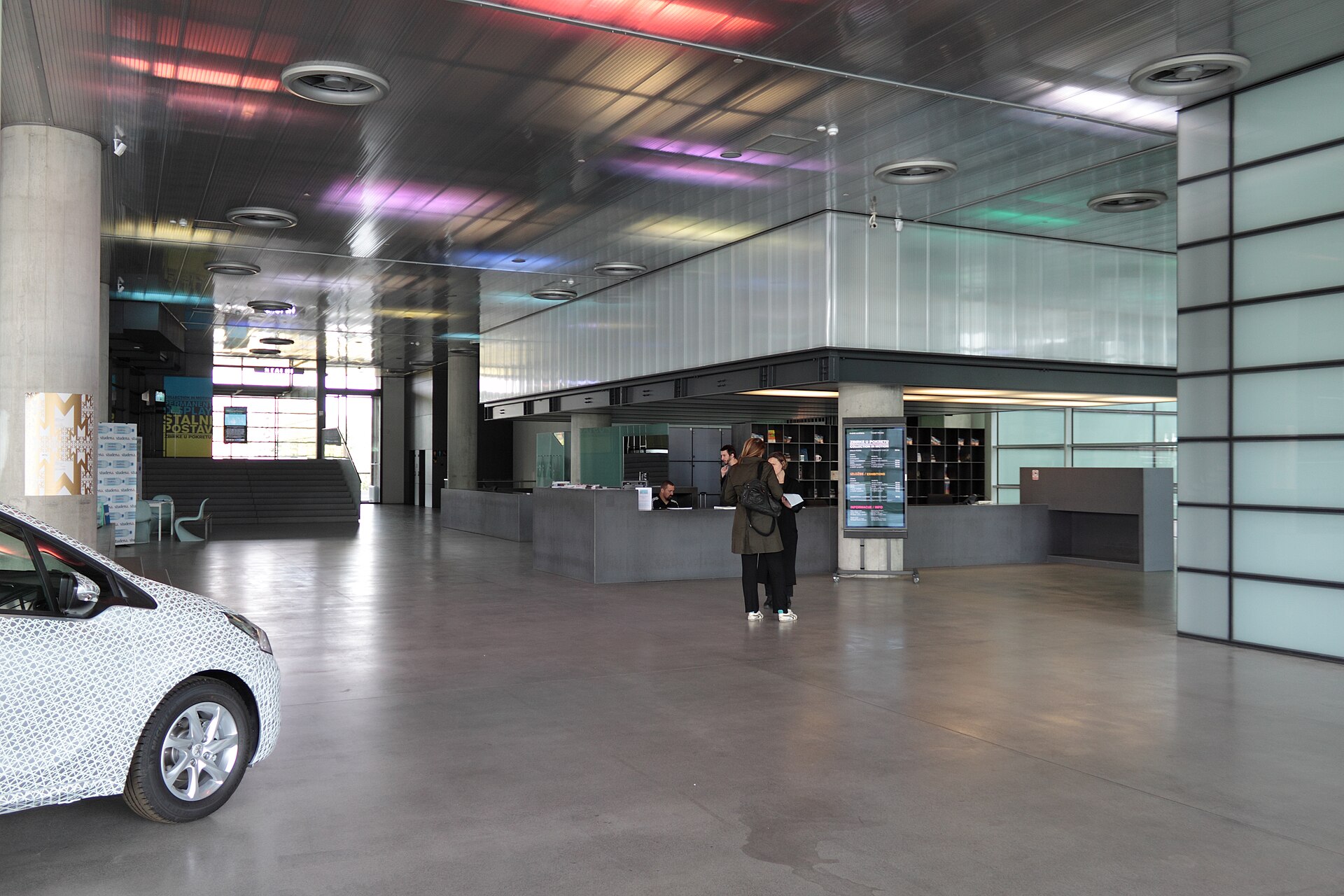
Franic designed a building that refers to the mid-century functionalist tradition rather than to any monumental museum type: a low, layered concrete block, wrapped in places with a polycarbonate skin meant to catch and diffuse light rather than simply glaze the facade. At just over 14,600 square meters it is the largest purpose-built museum in Croatia. Roughly 3,500 square meters on the ground floor and three floors above it are given over to the permanent collection, with a further 1,500 square meters on two floors set aside for temporary exhibitions, and the rest of the building holds a library, a multimedia hall, an education wing, a bookshop and a cafe.
The building's best-known feature is not a room but a ride. Carsten Holler built a permanent, site-specific version of his double-helix slide for the museum: two intertwined tubes that carry a visitor from an upper floor of the permanent collection down past the galleries to the car park outside, the same idea he had built for Tate Modern's Turbine Hall but reworked for this specific building rather than shipped in. It is a genuine part of the museum's identity: the standard ticket for the permanent collection includes one descent, and it is one of the first things almost any account of a visit to MSU mentions.
The construction itself became a story in its own right. The project had originally been budgeted at around 200 million kuna; by completion it had cost about 450 million kuna, close to 84 million US dollars at the time, split between the Ministry of Culture and the City of Zagreb. Within months of the December 2009 opening, the exterior cladding and the building's climate control were already being singled out as problems, a dispute covered in more detail below.
What the collection actually holds
MSU's holdings are organized into named collections rather than one undifferentiated store, and the split matters because each collection has its own logic and its own gaps. The Collection of Paintings holds more than 1,200 works spanning from a small pre-war group, including Josip Seissel's Pafama and Marino Tartaglia's Self-Portrait, which the museum itself names as the most significant survivors from that period, through the geometric abstraction of Exat 51 and the Informel experiments of Ivo Gattin, Eugen Feller and Edo Murtic, into the New Tendencies period and the New Art Practice of the 1970s. The Sculpture Collection holds close to 1,000 works on the same arc, expanded by the New Tendencies movement's turn toward kinetic and programmed art between 1961 and 1973, when the gallery hosted the exhibitions and symposia that gave the movement its name and drew in international figures such as Victor Vasarely, Getulio Alviani, Julio Le Parc, Bruno Munari and the kinetic artist Soto alongside Croatian participants including Vojin Bakic, Vladimir Bonacic and Ivan Kozaric.
The Collection of Drawings, Graphics, Prints and Art on Paper is the largest by object count, numbering 6,360 works from the early 20th century onward. The Photography Collection grew out of the Centre for Photography, Film and Television, founded at the museum in the early 1970s, and now runs from 1920s Bauhaus-trained photographer Ivana Tomljenovic Meller through the documentary photography of the 1950s and 1960s into conceptual and performance-adjacent photography by Marina Abramovic, Braco Dimitrijevic, Mladen Stilinovic and Goran Trbuljak, work made in the same Zagreb circles the museum's painting and sculpture collections also document. A Collection of Outsider Art, formed only in 2016, already holds 639 works. Two further collections are effectively single-artist archives rather than survey holdings: the Kozaric Studio, more than 6,000 objects covering the working life of sculptor Ivan Kozaric, and the Toso Dabac Archive, roughly 160,000 negatives plus prints, equipment and the working library of the Zagreb photographer Toso Dabac. None of this is displayed all at once; the standing display, titled Zbirka kao glagol, Collection as a Verb, rotates roughly 600 works at a time out of holdings the museum itself does not total in a single public figure.
A costly opening and a management dispute
The museum's opening was not free of controversy. Radio Slobodna Evropa, the Balkan service of Radio Free Europe/Radio Liberty, reported on 8 September 2012 that the building had already run into trouble within months of its December 2009 opening. Journalist Ankica Barbir-Mladinovic wrote that the art historian Zvonko Makovic had warned publicly about poor climate control, faulty ventilation and a polycarbonate exterior cladding, with a stated working life of about ten years, that was already showing wear. Makovic is quoted in that reporting saying the museum is valuable for Croatia and for Zagreb but poorly run, on a bad strategy, after a construction that came in at close to double its original budget.
The same reporting carried criticism of how the permanent collection was displayed, from Damir Sokic, a painter represented in the museum's own Sculpture and Painting collections who had also served as president of the museum's governing council. Sokic said the display of an artist as important as Vojin Bakic was inadequate, that Ljube Ivancic was missing from the display altogether, and that the hang was, in his words, wrong both technically and conceptually. The same article reported that Makovic had been sued by the museum over his public warnings, with the case still pending when the article was published. MSU's own visitor-facing pages make no reference to this dispute, and no later published account of how the disagreement over the collection's display, or the legal action, was ultimately resolved could be found for this record.
Planning a visit
MSU is open Tuesday to Friday from 11:00 to 19:00 and Saturday and Sunday from 11:00 to 18:00, closed on Mondays and on public holidays. Standard admission to the permanent collection, across the ground floor and three upper floors, is 11 euros, 7 euros for pupils, students and pensioners, and includes one descent on Holler's slide along with whatever is currently showing in the Black Box and Situacije spaces. A separate ticket covers the temporary exhibition space on its own two floors, and a combined ticket covers both. Tickets can be bought at the museum desk up to 30 minutes before closing, or online in advance through the national ticketing platform ulaznice.hr, with online tickets valid for entry up to 30 minutes before closing.
Entry is free on the first Wednesday of every month for individual visitors, and free on Tuesdays for students of the University of Zagreb under a standing Kulturni utorak, Culture Tuesday, agreement, along with a longer list of free-entry categories covering museum professionals, journalists, art and design students, refugees and people with international protection, and visitors with a disability, who bring one companion in free. Backpacks and bags must go into lockers before entering the galleries. The museum states that wheelchair access is provided throughout. It sits on Avenija Dubrovnik in Novi Zagreb, on tram lines 6 and 7 and several bus routes, with parking to the east and north of the building.
What visitors and critics say
On Google, MSU carries a rating of 4.4 out of 5 from more than 4,200 ratings, read on 15 September 2026, a figure that sits well above what the 2012 governance criticism above might suggest. Visitors who leave reviews consistently single out the scale of Franic's building and Holler's slide as reasons the visit is memorable, and several describe the collection itself as underrated for what it actually holds, calling the choices on display careful rather than overwhelming. The same visitors, though, keep returning to two linked complaints: the museum's location on the far side of the Sava from the old town, reachable only by tram or bus rather than on foot from where most visitors to Zagreb are based, and how few other people they find in a building this size on an average day, which some read less as a peaceful visit and more as evidence the museum is overlooked. That combination, a building and a collection reviewers rate highly sitting inside an institution that outside criticism has called poorly managed and under-visited, is close to the whole story of MSU since 2009.
What visitors say
MSU rates well overall and reviewers who make the trip to Novi Zagreb consistently call the building and the collection worth it, especially Carsten Holler's slide and the depth of the Gorgona and New Tendencies holdings. The recurring complaint is not about what is inside but about how few people come to see it: visitors and critics alike describe a large, well-regarded museum that stands mostly empty on an ordinary day.
What is praised, what is criticised
- Praised: the scale and architectural ambition of Igor Franic's 2009 building, anchored by Carsten Holler's Double Slide that carries a visitor from an upper floor to the car park
- Praised: the depth of the permanent collection, particularly the Gorgona and New Tendencies holdings from the 1960s that few museums outside Croatia can match
- Praised: visitors who make the trip consistently call the museum underrated for what it holds, describing the works on show as carefully chosen rather than overstuffed
- Criticised: the location in Novi Zagreb, across the Sava from the historic centre where most visitors are based, reachable only by tram or bus rather than on foot from the old town
- Criticised: how few people move through such a large building on an average day, which several visitors read as the museum being overlooked rather than a sign of a peaceful visit
Ratings on other platforms
Google: 4.4 from 4,222 ratings, read 15 September 2026
A platform average is a tertiary source: it moves, it is not audited, and we quote no visitor's words.
Questions about Museum of Contemporary Art
Where is Museum of Contemporary Art?
Avenija Dubrovnik 17, 10000 Zagreb, Croatia.
How much does it cost to visit Museum of Contemporary Art?
Adult, permanent collection (three floors and ground floor): EUR 11; Pupil, student or pensioner, permanent collection: EUR 7; Adult, temporary exhibition space (two floors): EUR 9; Pupil, student or pensioner, temporary exhibition space: EUR 7; Adult, combined permanent and temporary exhibition ticket: EUR 19. As confirmed 15 September 2026.
When is Museum of Contemporary Art open?
Tue-Fri 11:00-19:00; Sat-Sun 11:00-18:00. Closed: Monday. Public holidays. As confirmed 15 September 2026.
How do you get to Museum of Contemporary Art?
Tram: Lines 6 and 7 stop at Muzej suvremene umjetnosti; line 14 also serves the area; Bus: Routes 166, 219, 220, 221, 229, 268, 310, 311, 313, and the east-west routes 109 and 222; From Zagreb Airport: Airport bus to the Av. Dubrovnik - Sopot 1 stop; From the main train station: Tram 6 toward Sopot, or bus routes 166, 219, 220, 221, 268, 310, 311, 313.
What should you see at Museum of Contemporary Art?
Double Slide (Carsten Holler, 2009); Pafama (Josip Seissel); Self-Portrait (Marino Tartaglia); Gorgona-period and anthology works (Ivan Kozaric); New Tendencies holdings (Victor Vasarely, Julio Le Parc, Bruno Munari and Soto, together with Vojin Bakic, Julije Knifer and Ivan Picelj); Toso Dabac Archive (Toso Dabac).
What we could not confirm
- MSU's own site does not publish one total figure for everything the museum holds; the department totals on its collection pages (more than 1,200 paintings, almost 1,000 sculptures, 6,360 works on paper, plus photography, outsider art and two large single-artist archives) do not resolve to a single number the museum itself cites.
- Whether the 2012 criticism of the building's cladding, ventilation and climate control, reported by Radio Slobodna Evropa, was addressed, and how the defamation action against art historian Zvonko Makovic that the same report described as pending was resolved, could not be confirmed from any source found for this record.
- No MSU-published visitor count more recent than the 77,998 recorded for 2017 was found; a current annual attendance figure was not located.
Images
Sources
- 1Muzej suvremene umjetnosti, Informacije za posjetitelje (Visitor Information) msu.hr/stranice/informacije-za-posjetitelje/10.html
- 2Muzej suvremene umjetnosti, About us msu.hr/stranice/About%20us/1/en.html
- 3Muzej suvremene umjetnosti, Collections msu.hr/stranice/Collections/4/en.html
- 4Muzej suvremene umjetnosti, Collection of Paintings msu.hr/zbirke/Collection%20of%20Paintings/24/en.html
- 5Muzej suvremene umjetnosti, Sculpture Collection msu.hr/zbirke/Sculpture%20Collection/23/en.html
- 6Muzej suvremene umjetnosti, Photography Collection msu.hr/zbirke/Photography%20Collection/22/en.html
- 7Wikipedia, Museum of Contemporary Art, Zagreb en.wikipedia.org/wiki/Museum_of_Contemporary_Art,_Zagreb
- 8Radio Slobodna Evropa (RFE/RL Balkan Service), Ankica Barbir-Mladinovic, 'Muzej suvremene umjetnosti - jedinstven po fundusu', 8 September 2012 slobodnaevropa.org/a/muzej-suvremene-umjetnosti-jedinstven-po-fundusu/24701718.html
- 9Wikidata, Q3503103 wikidata.org/wiki/Q3503103
- 10Wikimedia Commons, Category:Building of the Museum of Contemporary Art in Zagreb commons.wikimedia.org/wiki/Category:Building_of_the_Museum_of_Contemporary_Art_in_Zagreb
- 11Wikimedia Commons, Category:Museum of Contemporary Art in Zagreb commons.wikimedia.org/wiki/Category:Museum_of_Contemporary_Art_in_Zagreb
- 12Google Maps listing, Museum of Contemporary Art, Zagreb (rating read 15 September 2026) google.com/maps/search/Museum+of+Contemporary+Art+Zagreb
- 13Ulaznice.hr, Muzej suvremene umjetnosti Zagreb ticket page ulaznice.hr/web/regular/28373923