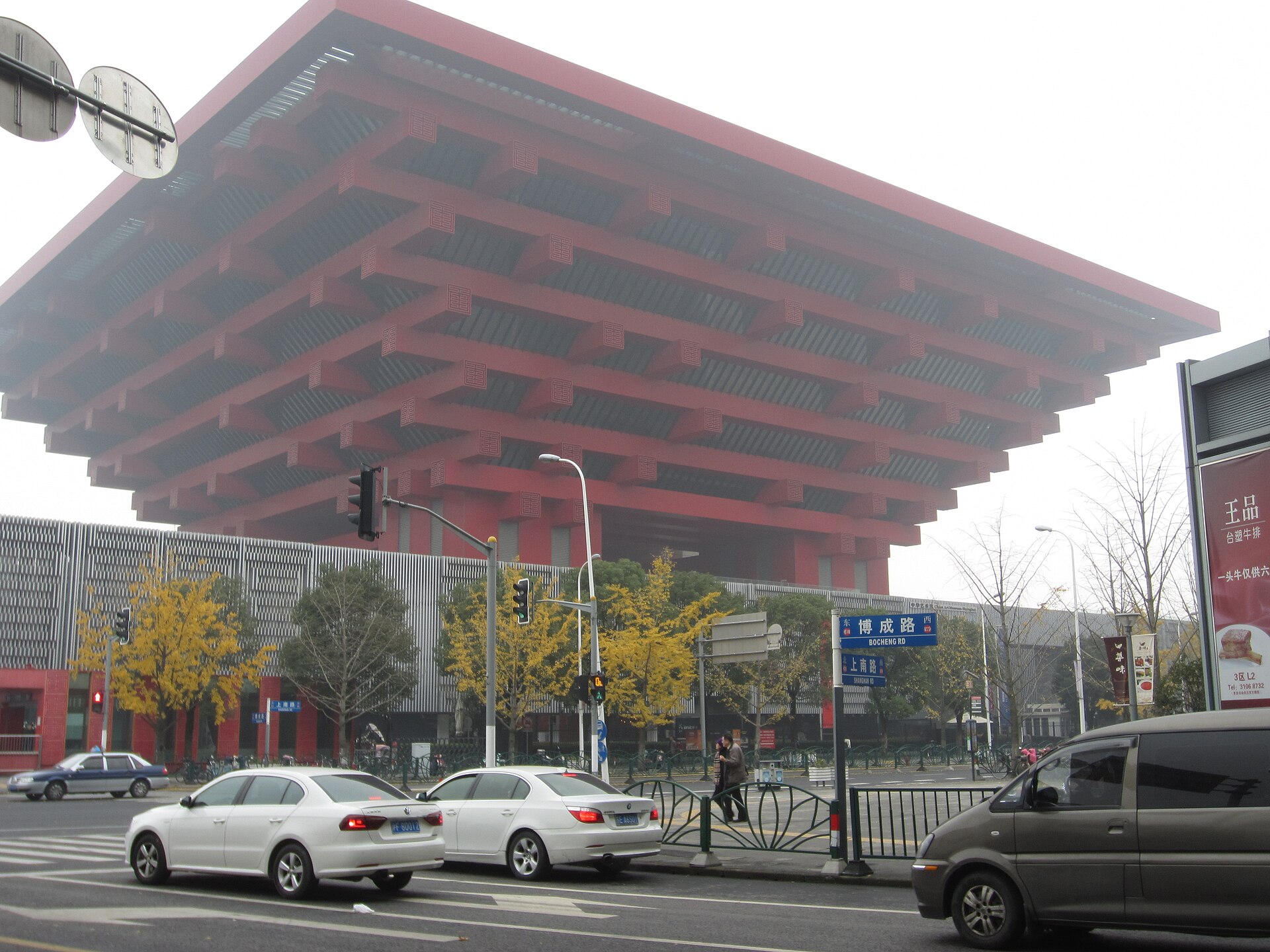
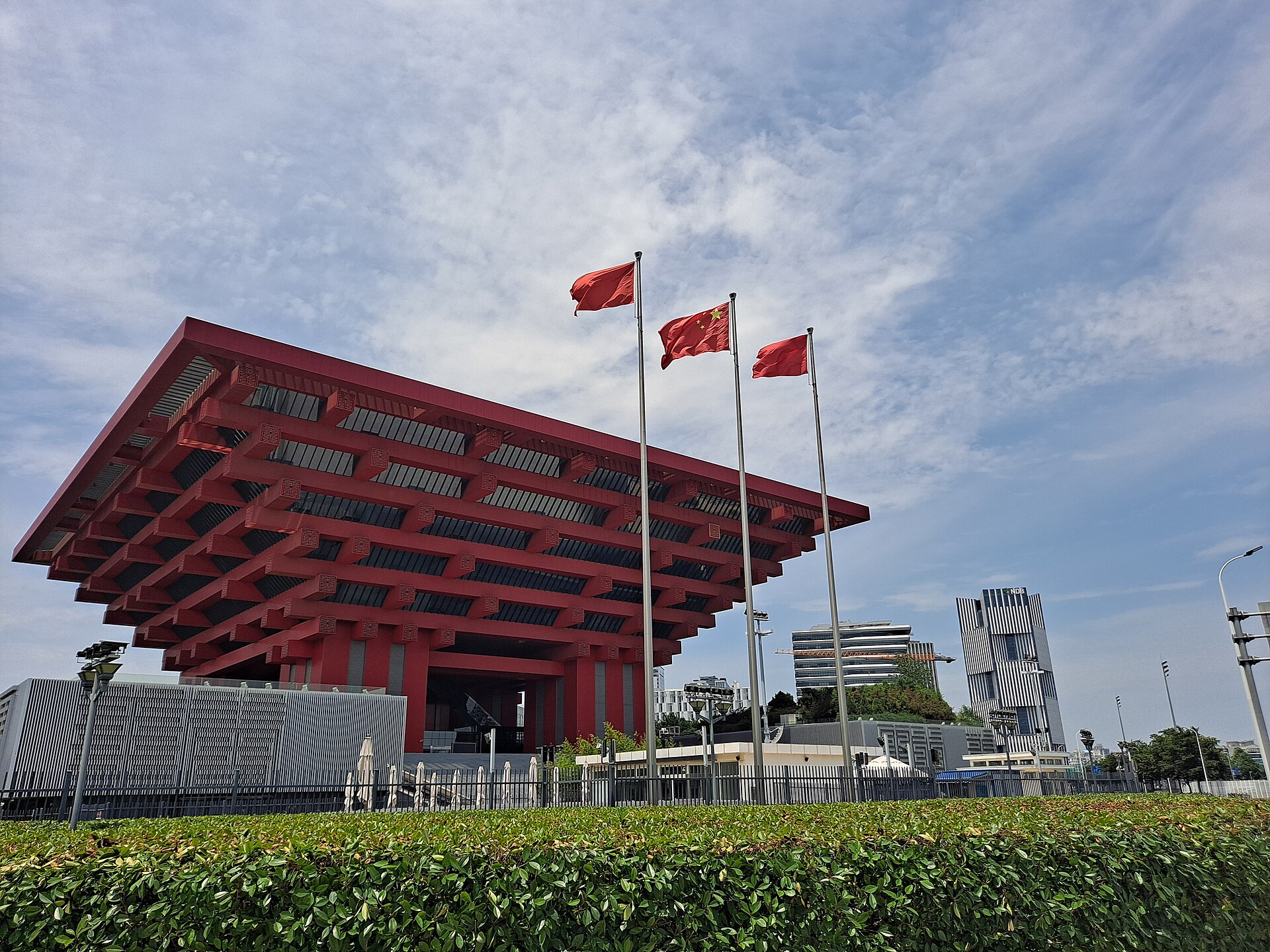
The China Art Museum, Shanghai, seen from street level: the inverted, cantilevered red form of the former China Pavilion of Expo 2010.
Photograph by Another Believer, CC BY-SA 4.0China Art Museum
Museum · Zhongguo Yishu Gong (Shanghai Art Museum) · Founded 1956
Open, admission and hours confirmed 28 September 2026 · 12 sources
On this page 14 sections
ContentsClose
The museum's strength is a documented, roomed-out account of Chinese painting's own passage into modernity: the late Qing Shanghai School through to Republican-era and post-1949 art, with the Noted Painters gallery giving individual space to the artists most credited with either continuing that school (He Tianjian, Xie Zhiliu, Cheng Shifa) or breaking from it by fusing it with European modernism (Lin Fengmian, Guan Liang, Wu Guanzhong), plus the sculptor Hua Tianyou. It is a museum of modern and contemporary Chinese art specifically, not of Chinese antiquities (that is the Shanghai Museum, a different institution on People's Square) and not of purely contemporary art without the historical throughline (that is the Power Station of Art). Its single best-known holding is not, in the ordinary sense, an original object at all, but a large multimedia animation of a canonical Song-dynasty scroll, built for the building's earlier life as a world's fair pavilion.
| Local name | Zhongguo Yishu Gong (Shanghai Art Museum) |
|---|---|
| Kind | Museum |
| Founded | 1956 |
| City and country |  Shanghai, China Shanghai, China |
| Address | 153 Shangnan Road, Pudong New Area, Shanghai, China (the museum's own site gives 153; the Shanghai municipal government's tourism page and Google Maps both give 205 Shangnan Road - see notes_for_editor) |
| Website | artmuseumonline.org |
| Status | Open, confirmed |
| Record last verified |
Visiting
- Hours
- Tue-Sun10:00 to 18:00Last admission 17:00
- Closed
- Monday, except national public holidays.
- Admission
- Permanent collection, all visitorsFreeFree; a valid ID is shown at the visitor entrance to collect a ticket. No online booking is required for individuals; groups of 30 or more must apply 7 days ahead.
- Special/temporary exhibitionsCNY 20Typical charge for a ticketed temporary or loan exhibition (for example the digital Riverside Scene at Qingming Festival installation); the price and which shows carry it vary by exhibition and are posted at the museum.
- Do I need to book?
- No advance booking for individual visitors; tickets (free for the permanent collection) are collected on arrival with a valid ID. Groups of 30 or more must apply at least 7 days ahead.
- Address
- 153 Shangnan Road, Pudong New Area, Shanghai, China (the museum's own site gives 153; the Shanghai municipal government's tourism page and Google Maps both give 205 Shangnan Road - see notes_for_editor) MapMetro Line 7 to Yaohua Road station, exit 1
Metro Line 8 to China Art Museum (Shanghai Art Museum) station, exit 3 - Website
- artmuseumonline.org
- Telephone
- +86 400 921 9021
Before you go how long, access, photography, bags, eating, shop
- How long to allow
- A brisk walk through all 27 exhibition halls takes about two hours; visitors who want to see the collection in depth, rather than skim it, allow half a day or more.
- Access
- Wheelchairs are lent free at the service points on the ground floor and the 49-metre floor against a valid ID and a refundable deposit (200 yuan, or 400 yuan without ID).
- Photography
- General photography in the galleries is allowed for personal use, but the museum's visitor rules state that photographing, filming or copying exhibits without permission is not allowed, and selfie sticks, tour flags and promotional flags are barred.
- Bags
- Free item storage is offered to same-day ticket holders. Prohibited items, pets, liquids, cash and fragile valuables are not accepted for storage; stored items must be collected before closing.
- Eating
- The museum has an on-site cafe; a 2026 visitor review was sharply critical of it (see reception).
- Shop
- Gift shops are placed through the building and near the exit, selling museum-branded stationery and souvenirs.
Prices and hours change. We take them from the institution's own pages and print the day we read them, and you can check the current position at the source we used. Confirm before you travel.
What is inside
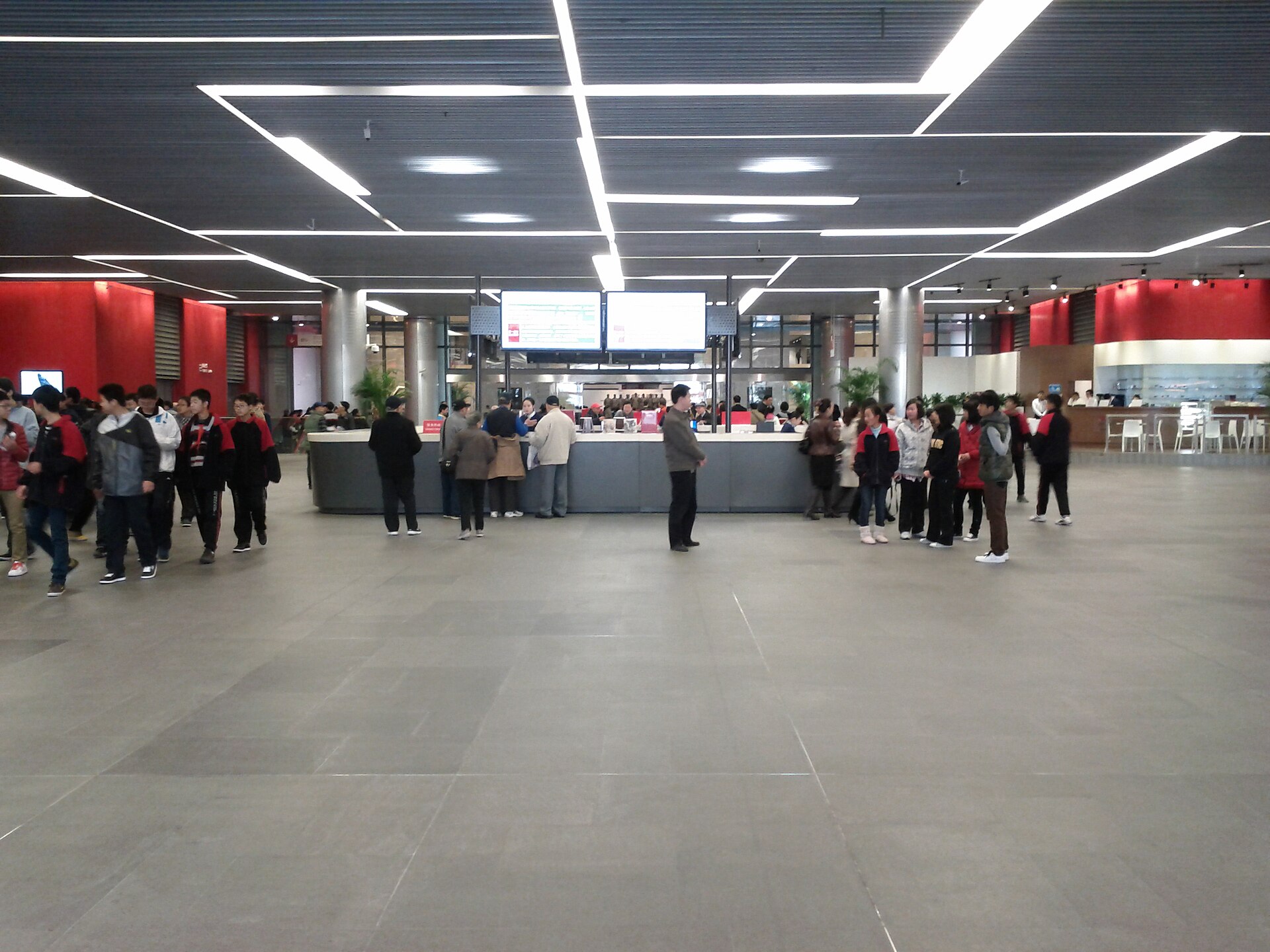
Photograph by DavidXiaoDaShan · CC BY-SA 3.0 0-metre floor: entrance, Shanghai's cultural history and the Noted Painters gallery
The ground-floor atrium and visitor entrance, with the main service desk. From here, halls 15-16 trace Shanghai's own modern cultural development; halls 22-24 hold the museum's Exhibition for Noted Painters, devoted to seven modern masters (He Tianjian, Xie Zhiliu and Cheng Shifa of the Shanghai School; Lin Fengmian, Guan Liang and Wu Guanzhong, pioneers of fusing Chinese and Western painting; and the sculptor Hua Tianyou); halls 20-21 show contemporary work.
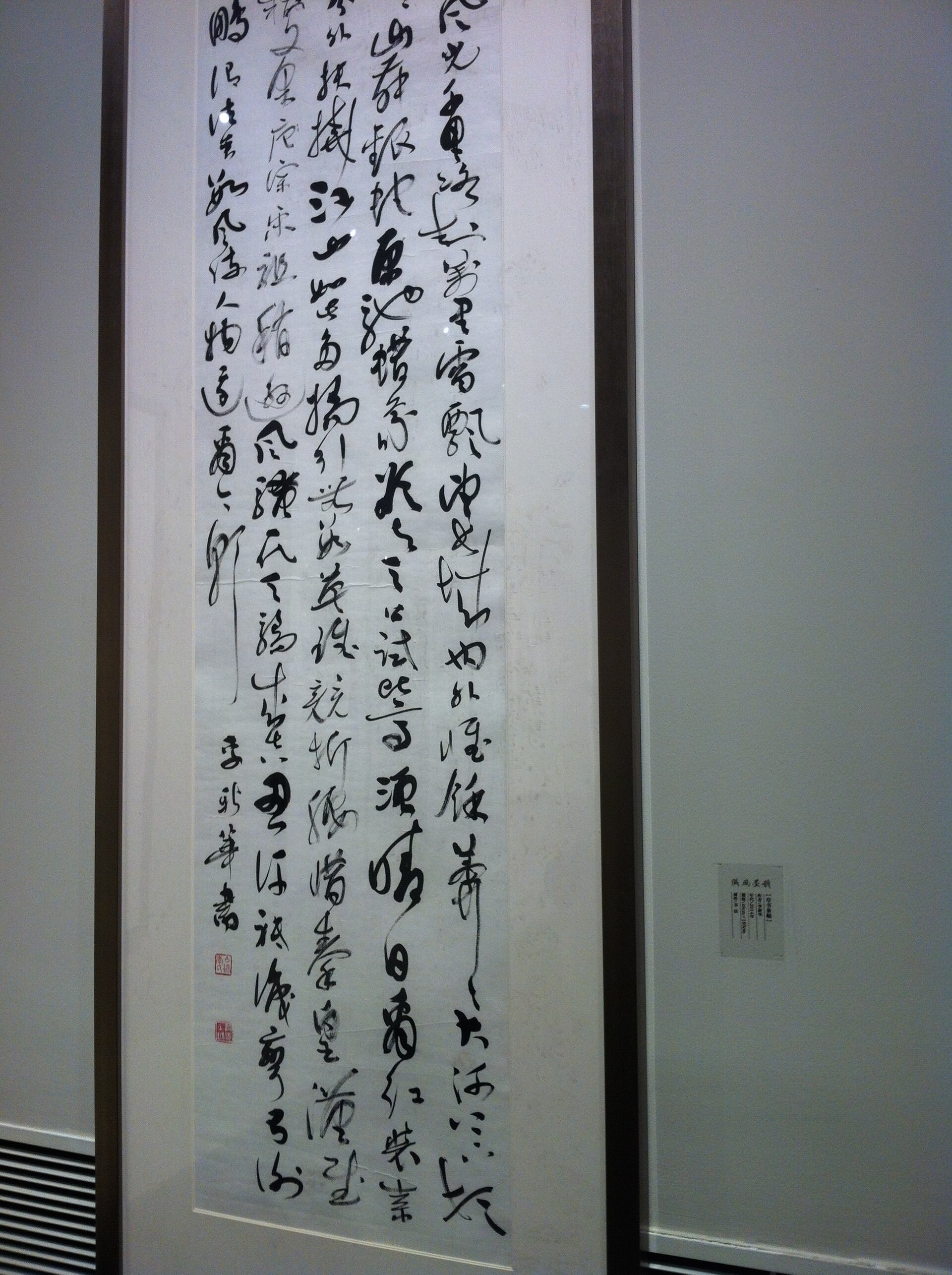
Photograph by Shwangtianyuan · CC BY-SA 4.0 33-metre floor: scroll and paper painting galleries
Three halls given over to hanging scrolls and works on paper, both from the museum's own holdings and as a venue for scholarly loan exhibitions surveying named schools of twentieth-century Chinese painting (a 2024 run, Historical Starlight, gathered nearly 90 works by masters including Zhao Zhiqian, Ren Bonian, Wu Changshuo, Qi Baishi, Huang Binhong, Lin Fengmian, Zhang Daqian and Xu Beihong to trace the Beijing-Tianjin and Shanghai painting schools). What hangs here rotates; the floor's standing purpose is paper and scroll work.
41-metre floor: The Origin of Chinese Modern and Contemporary Art, continued
Halls 7-10 continue the museum's core historical survey exhibition, The Bright Moon Rises from the Sea - Origin of Chinese Modern and Contemporary Art, which spans two floors and about 1,200 works across ten units organised into three periods: the late Qing dynasty Shanghai School, the Republican era, and the People's Republic.
49-metre floor: The Origin of Chinese Modern and Contemporary Art, and the digital Riverside Scene
Halls 1-10 open the museum's flagship historical survey. Hall 4 holds a Qing-dynasty highlight, Ren Bonian's Immortals Toasting the Birthday of the Queen Mother of Heaven; hall 5 houses the museum's best-known single attraction, a large-scale animated, multimedia adaptation of the Song-dynasty scroll Riverside Scene at Qingming Festival, commissioned for the China Pavilion at Expo 2010 and carried over when the building became a museum.
What to see first
Riverside Scene at Qingming Festival (animated multimedia version)
Commissioned adaptation of Zhang Zeduan's Song-dynasty scrollThe single most-visited attraction in the museum: a large moving, lit and scored digital animation of the twelfth-century handscroll of daily life in the Song capital Kaifeng, built for the China Pavilion at Expo 2010 and kept when the pavilion became this museum. Visitors describe spending up to two hours in front of it; it usually carries its own ticket even though general admission is free.8
Immortals Toasting the Birthday of the Queen Mother of Heaven
Ren Bonian (Ren Yi), Qing dynastyA large hanging scroll by one of the most influential precursors of the Shanghai School of painting, shown in hall 4 of the 49-metre floor as the anchor of the museum's historical survey.7
Works by He Tianjian
He Tianjian (1891-1977)A leading Shanghai School guohua landscape painter, one of the seven masters given a dedicated room in the museum's Exhibition for Noted Painters.4
Works by Xie Zhiliu
Xie Zhiliu (1910-1997)Shanghai School painter and connoisseur, part of the museum's seven-artist Noted Painters gallery representing the school's twentieth-century continuation.4
Works by Cheng Shifa
Cheng Shifa (1921-2007)Figure and bird-and-flower painter of the Shanghai School, the third of the school's three representatives in the Noted Painters gallery.4
Works by Lin Fengmian
Lin Fengmian (1900-1991)A founding figure of Chinese artistic modernism, who studied in Paris and spent his career fusing Chinese ink traditions with European modernist form; one of three East-West fusion painters given a room in the Noted Painters gallery.4
Works by Guan Liang
Guan Liang (1900-1986)Painter and printmaker known for reducing Chinese opera figures to a spare, expressive line, shown alongside Lin Fengmian and Wu Guanzhong as one of the museum's East-West fusion masters.4
Works by Wu Guanzhong
Wu Guanzhong (1919-2010)One of the most consequential Chinese painters of the twentieth century, who combined oil painting with Chinese pictorial genres to open what critics call a new chapter for Chinese oil painting; a room in the Noted Painters gallery is given to his work.4
Works by Hua Tianyou
Hua Tianyou (1901-1986)Regarded as a founder of modern Chinese sculpture; the sole sculptor among the museum's seven Noted Painters, representing the medium alongside the six painters.4
A pavilion built for a six-month fair, kept for good
The building that now holds the China Art Museum was not built to be a museum. It was raised as the China Pavilion of Expo 2010, the Shanghai World's Fair that ran from May to October 2010, and it was designed to be the largest national pavilion on the site and, by cost, the most expensive: construction ran from 18 December 2007 to inauguration on 8 February 2010, at an estimated cost of about 220 million US dollars. When the fair closed, the pavilion did not close with it. It reopened for a further six months from December 2010, and then, on 1 October 2012, China's National Day, it reopened permanently as the China Art Museum, with the collection of the former Shanghai Art Museum installed inside it. Nothing about the building was altered to disguise its origin: the plaza in front of it, the scale of its halls and the crowds it was built to move all still read as a fairground pavilion, because that is what it is.
The Oriental Crown: architecture and design
The architect was He Jingtang, then director of the Architectural Academy at South China University of Technology, whose design was chosen from more than 300 entries submitted by Chinese architects for the pavilion commission. He Jingtang has described the building as an attempt at 'an abstract expression of China's 5,000 years of history and the culture of 56 ethnic groups', built from two much older forms: the dougong, the interlocking wooden roof bracket used in Chinese timber architecture for close to two thousand years, and the ding, the three- or four-legged bronze ceremonial vessel used by ancient rulers. The result is an inverted, stepped pyramid in seven distinct shades of red, cantilevered out over a lower base so that the building appears to widen as it rises; at 63 metres it was the tallest structure at the Expo, with a roof measuring 139.8 by 139.8 metres, and it earned the nickname 'the Crown of the East' or 'Oriental Crown' for its resemblance to an ancient ceremonial headdress. The whole structure has a gross floor area of 160,126 square metres, of which 43,904 square metres sit above ground and 2,553 square metres below it. Visitors reliably name the building itself, rather than any single object inside it, as the most memorable part of a visit.
From a Nanjing Road restaurant to the largest art museum in Asia
The institution now housed in the former China Pavilion traces its own history back much further than the building does, to 1956, when it was founded as the Shanghai Art Museum, one of the first museums of any kind established in the People's Republic. Its first home was a converted restaurant, the 'Kang Le' establishment on Nanjing Xi Road, rebuilt as an exhibition hall on the same site in 1986. In 2000 the museum moved into a very different building at 325 Nanjing Xi Road: a former racecourse clubhouse designed in 1926 and completed in 1933 in an English classical style with eclectic touches, by the British firm Moorhead and Halse, and built by the Yu Hongji construction company. That building had already served, after 1949, as the premises of the Shanghai Museum and then the Shanghai Library before the art museum took it over in 2000, more than doubling its exhibition space to over 5,800 square metres. The museum stayed there for twelve years. Its move to the former China Pavilion in October 2012 was, by its own account, a move of a different order of magnitude: exhibition space grew again, by more than ten times, and the museum took a new name, China Art Museum, to go with its new building, while continuing to describe itself in Chinese as 'Shanghai Art Museum (China Art Museum)', the older and newer names run together.
What is inside: a three-period survey of modern Chinese art
The museum's core exhibition, The Bright Moon Rises from the Sea - Origin of Chinese Modern and Contemporary Art, occupies the 41-metre and 49-metre floors and runs to roughly 1,200 works across ten thematic units, organised into three historical periods: the late Qing dynasty and the rise of the Shanghai School of painting, the Republican era, and the People's Republic. Alongside it, a dedicated Exhibition for Noted Painters on the ground floor gives a room each to seven artists chosen to represent two strands of twentieth-century Chinese art: He Tianjian, Xie Zhiliu and Cheng Shifa for the continuation of the Shanghai School, Lin Fengmian, Guan Liang and Wu Guanzhong for the generation that deliberately fused Chinese ink painting with European modernism, and the sculptor Hua Tianyou as the collection's sole representative of modern Chinese sculpture. A further set of halls on the 33-metre floor is set aside for scroll and paper-based work, some of it the museum's own holdings and some of it loan exhibitions surveying named schools and generations of Chinese painting; what hangs there changes on its own schedule. The museum states its overall holdings at around 14,000 works, weighted toward Chinese art of the modern period; it does not hold, and does not present itself as holding, the antiquities collection of the unrelated Shanghai Museum across town, or the strictly contemporary programme of the Power Station of Art, a different institution again, on the opposite bank of the Huangpu.
The digital Riverside Scene at Qingming Festival
The single work visitors mention most is not, strictly, a historical object at all. Hall 5 of the 49-metre floor houses a large-scale animated and lit adaptation of Riverside Scene at Qingming Festival, the Song-dynasty handscroll traditionally attributed to Zhang Zeduan depicting a day in the life of the Song capital, Kaifeng. The moving version was commissioned for the China Pavilion during Expo 2010, where it was one of the fair's most visited single exhibits, and it was kept in place when the building became a museum. Visitors describe watching the full day-to-night cycle, which can run close to two hours, as the centrepiece of a visit; unlike the museum's general collection, this installation typically carries its own separate ticket.
Visiting today: scale, crowds and the language gap
The museum's own account of a visit is blunt about its own size: a brisk pass through all 27 exhibition halls takes about two hours, and seeing the collection properly takes considerably longer. Visitor accounts bear this out and add two consistent complaints of their own. First, most wall text, object labels and gallery introductions are in Chinese only; some recent visitors note that QR codes at individual works link to translated text, but this is not universal. Second, while the permanent collection is free to enter, several of the museum's most talked-about attractions, including the digital Qingming scroll and major touring or loan exhibitions, are ticketed separately, which a number of visitors say was not made clear before they arrived expecting a fully free museum. Weekends are repeatedly described as very crowded, and more than one visitor recommends arriving on a weekday or securing tickets to popular temporary shows in advance.
What visitors say
Visitors are consistently struck by the building itself: even reviewers who found the art underwhelming call the red, cantilevered Oriental Crown one of the most memorable structures they saw in Shanghai. The animated Riverside Scene at Qingming Festival is named again and again as the one thing not to miss. Against that, the same visitors repeatedly flag that most labels and wall text are in Chinese only, that the building's real showpieces often carry a separate paid ticket even though general admission is free, that the museum is large enough to be genuinely tiring to cover in one visit, and that weekends bring crowds the museum's own reviewers call overwhelming.
What is praised, what is criticised
- Praised: The Oriental Crown building itself: its scale, colour and construction are called out as worth the trip even by visitors unimpressed by the collection inside.
- Praised: The animated, multimedia version of Riverside Scene at Qingming Festival, repeatedly singled out as the highlight of a visit and worth a long stay in front of it.
- Praised: Free general admission and easy access by metro (two lines serve the museum directly).
- Praised: The sheer scale and variety of the collection for visitors who do engage with it: multiple floors of painting, sculpture, prints and textiles spanning the late Qing dynasty to the present.
- Criticised: Most explanatory text and object labels are in Chinese only, which several visitors, including some assisted by QR-code translations, found limiting.
- Criticised: The museum's standout attractions, including the digital Qingming scroll and major loan exhibitions, commonly carry their own paid ticket on top of 'free' general admission, which a number of visitors felt was not made clear going in.
- Criticised: Weekend crowds are repeatedly described as very heavy; several reviewers recommend booking ahead and avoiding weekends.
- Criticised: In June 2024 one visitor described part of the collection as disjointed and noted that reproductions resembling the Mona Lisa and a Van Gogh were displayed without signage explaining they were not the originals; a July 2026 visitor separately gave a sharply negative account of the on-site cafe and its staff.
Ratings on other platforms
Tripadvisor: 4.1 from 380 ratings, read 28 September 2026
Google: 4.4 from 405 ratings, read 28 September 2026
A platform average is a tertiary source: it moves, it is not audited, and we quote no visitor's words.
Questions about China Art Museum
Where is China Art Museum?
153 Shangnan Road, Pudong New Area, Shanghai, China (the museum's own site gives 153; the Shanghai municipal government's tourism page and Google Maps both give 205 Shangnan Road - see notes_for_editor).
How much does it cost to visit?
Permanent collection, all visitors: free; Special/temporary exhibitions: CNY 20. As confirmed 28 September 2026.
When is it open?
Tue-Sun 10:00-18:00. Closed: Monday, except national public holidays. As confirmed 28 September 2026.
How do you get there?
Metro: Line 7 to Yaohua Road station, exit 1; Metro: Line 8 to China Art Museum (Shanghai Art Museum) station, exit 3.
What should you see first?
Riverside Scene at Qingming Festival (animated multimedia version) (Commissioned adaptation of Zhang Zeduan's Song-dynasty scroll); Immortals Toasting the Birthday of the Queen Mother of Heaven (Ren Bonian (Ren Yi), Qing dynasty); Works by He Tianjian (He Tianjian (1891-1977)); Works by Xie Zhiliu (Xie Zhiliu (1910-1997)); Works by Cheng Shifa (Cheng Shifa (1921-2007)); Works by Lin Fengmian (Lin Fengmian (1900-1991)).
What we could not confirm
- The museum's own website states its address as 153 Shangnan Road, while the Shanghai municipal government's English tourism page and Google Maps both independently give 205 Shangnan Road. This record follows the museum's own site per house sourcing order but flags the conflict; it should be re-checked against a current on-site sign or postal record.
- Sources describing the 33-metre floor's standing curatorial purpose date mostly to the museum's 2012 opening; whether that floor's designated use (paper and scroll work) has been formally revised since is not established here.
- No named review from an architecture or art publication (as opposed to visitor-review platforms) was located in this research pass; one may exist and simply not have surfaced in this search.
Images
Sources
- 1China Art Museum (Shanghai Art Museum), official site, homepage artmuseumonline.org/art/art/index.html
- 2China Art Museum (Shanghai Art Museum), official site, visitor service information (hours, admission, phone, transport, storage, wheelchair loan, visitor rules) artmuseumonline.org/art/art/visitGuide/fwxx/index.html
- 3China Art Museum (Shanghai Art Museum), official site, institutional history artmuseumonline.org/art/art/gywm/lsyg/index.html
- 4Wikipedia, 'China Art Museum, Shanghai' () en.wikipedia.org/wiki/China_Art_Museum,_Shanghai
- 5Wikipedia, 'China pavilion at Expo 2010' () en.wikipedia.org/wiki/China_pavilion_at_Expo_2010
- 6Shanghai Municipal Government, International Services Shanghai, 'China Art Museum, Shanghai' (Museums & Galleries) english.shanghai.gov.cn/en-MuseumsGalleries/20241018/dfda779aa5f644f48f99e89ffb745703.html
- 7TravelChinaGuide, 'China Art Museum, Shanghai' travelchinaguide.com/attraction/shanghai/art-museum.htm
- 8Tripadvisor, 'China Art Museum' attraction page, rating and visitor reviews (), read 2026-09-28 tripadvisor.com/Attraction_Review-g308272-d5114484-Reviews-China_Art_Museum-Shanghai.html
- 9Google Maps business listing, 'China Art Museum' ( rating), read 2026-09-28 google.com/maps/search/China+Art+Museum+Shanghai
- 10Wikidata, Q5099572 'China Art Museum' ( - identity, coordinates, inception date, official website) wikidata.org/wiki/Q5099572
- 11Wikimedia Commons, Category:Exterior of the China Art Museum commons.wikimedia.org/wiki/Category:Exterior_of_the_China_Art_Museum
- 12Sina News, 'Touring the Art Palace: 27 exhibition halls cannot be seen in one day' (2012-08-31) news.sina.com.cn/o/2012-08-31/074025073749.shtml