Chateau de Montsoreau-Museum of Contemporary Art
Museum · Chateau de Montsoreau-Musee d'art contemporain · Founded 2016
Open, admission and hours confirmed 17 September 2026 · 10 sources
On this page 14 sections
ContentsClose
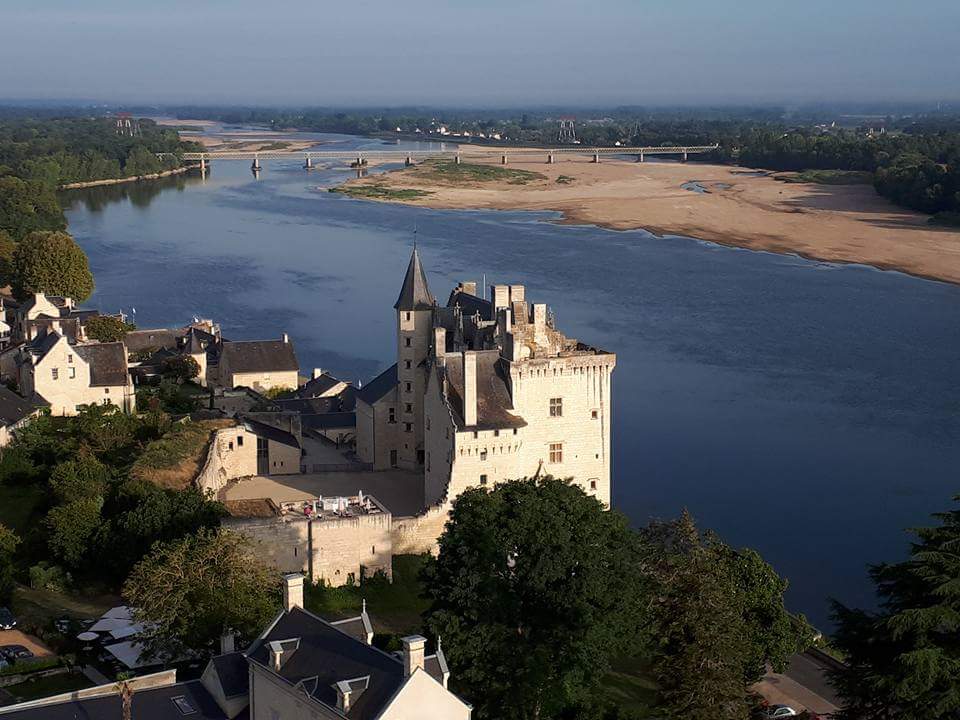
The museum holds no encyclopaedic collection: everything on view belongs to a single private holding, the Philippe Meaille collection, dedicated exclusively to the British-founded conceptual art collective Art & Language. At roughly 800 works, with about 80 on rotating display, it is generally described as the largest such holding of the group's output anywhere, spanning the collective's founding period in the late 1960s through paintings, installations, publications and performance documentation into the 2010s. That depth on a single, deliberately anti-visual movement is the collection's distinguishing feature and also its limitation: a visitor looking for a conventional survey of painting or sculpture, or for the furnished interior of a historic chateau, will not find either here.
| Local name | Chateau de Montsoreau-Musee d'art contemporain |
|---|---|
| Kind | Museum |
| Founded | 2016 |
| City and country |  Montsoreau, France Montsoreau, France |
| Address | Passage du Marquis de Geoffre, 49730 Montsoreau, France |
| Website | chateau-montsoreau.com/wordpress/fr |
| Status | Open, confirmed 17 September 2026 |
| Record last verified | 17 September 2026 |
Visiting
- Hours
- Feb, Mar, Oct, Nov, Dec12:00 to 18:00
- Apr, May, Jun, Jul, Aug, Sep10:00 to 19:00Last entry 45 minutes before closing
- Closed
- January is not listed on the museum's own hours page as of the last check; confirm directly before a January visit.
- Admission
- Adult (18+)EUR 12
- Child (5-18)EUR 8
- Student / job seekerEUR 10
- Family package (2 adults, 2 children)EUR 29
- Annual pass, individualEUR 30
- Annual pass, duoEUR 47
Free entry: Children under 5. Visitors with reduced mobility. Press- Tickets
- chateau-montsoreau.com/wordpress/fr/informati... The museum's own ticket page.
- Do I need to book?
- Not stated as required on the official visit page; last entry is 45 minutes before closing
- Address
- Passage du Marquis de Geoffre, 49730 Montsoreau, France Map
- Website
- chateau-montsoreau.com/wordpress/fr
- Telephone
- +33 2 41 67 12 60
- [email protected]
Before you go how long, access, photography, bags, eating, shop
- How long to allow
- 2 to 3 hours
- Access
- Only the ground floor of the museum is wheelchair accessible; visitors with reduced mobility are admitted free
- Photography
- Not addressed on the official visit page
- Bags
- Not addressed on the official visit page
- Eating
- No on-site cafe is listed on the official site
- Shop
- A shop section is listed in the official site's navigation
Prices and hours change. We take them from the institution's own pages and print the day we read them, and you can check the current position at the source we used. Confirm before you travel.
What is inside
Grande Salle d'apparat (Great Hall)
The castle's formal reception room, seventeen meters long, lit by five windows and heated originally by two monumental fireplaces; now used as one of the principal exhibition rooms for the permanent Art & Language collection.
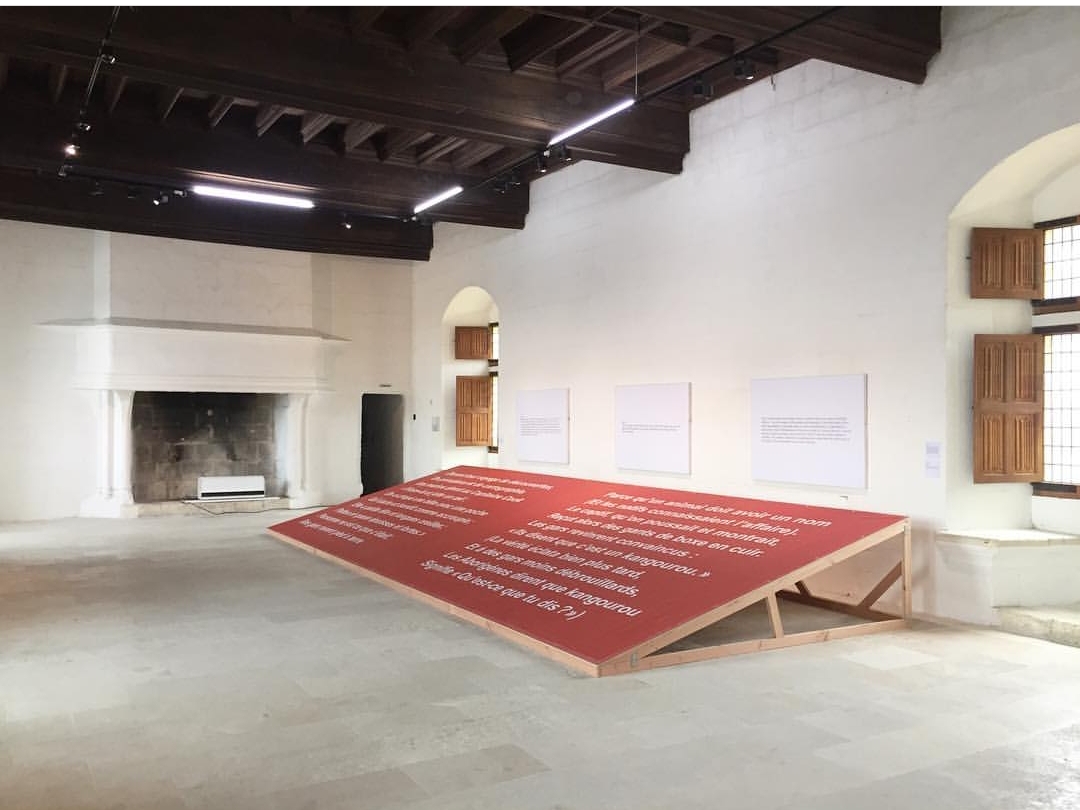
Photograph by Suavemarimagno · CC BY-SA 4.0 Ground-floor and first-floor exhibition galleries
Around 2,000 square meters of former residential and administrative rooms, stripped of their prior museum scenography in 2015-2016, re-rendered in traditional lime wash and refitted with museum-standard lighting and electrics; they now carry the bulk of the roughly 80 Art & Language works on permanent display, including installations, text works, paintings and the Victorine opera manuscript.
The Renaissance staircase tower
A polygonal stair tower added by Jean III de Chambes after he succeeded his father in 1473, decorated with pilasters, classical medallions, Italianate putti and lion-pawed candelabra motifs, and covered by a vault the museum's own material describes as palm-tree shaped; it is one of the building's principal Renaissance set-pieces rather than an exhibition space.
The terraces (chemin de ronde)
The castle's former fortified walkway, roughly 35 meters above the Loire, converted into a viewing terrace over the confluence of the Loire and the Vienne; visitor reviews describe it as smaller than the word rampart suggests, but it is the highest public vantage point in the building.
The riverside gardens and port
A hectare of grounds beside the Loire, redesigned in 2017 as a tribute to the naturalist Miriam Rothschild and planted as a deliberately wild, low-intervention ecosystem rather than an ornamental garden; the museum restored its historic river port the same year to run river-based programming with local Loire boatmen. Access to the gardens is free to visitors and residents alike.
What to see first
Mirror Piece
Michael Baldwin / Art & Language, 1965An installation of variable size made of mirrors of different dimensions and both regular and distorting glass, first shown in Coventry in 1966 and absorbed into the Art & Language corpus after the group's founding in 1968; related versions are held by Tate and the National Gallery of Victoria, and it is one of the works that established the group's method of turning the exhibition space itself into the subject.6
The Air-Conditioning Show
Michael Baldwin / Art & Language, 1966-67, installed 1972First existed only as text, placed in Arts Magazine in New York in 1967 with Robert Smithson's help; first installed in 1972 in a Joseph Kosuth-organized show at the School of Visual Arts Gallery, New York. Critic Charles Darwent, writing in The Independent, dated it as the moment British visual art began to turn away from being visual at all; the manuscripts are at Tate, the installation is at Montsoreau.6
Manuscript of the opera Victorine
Art & Language, libretto; Mayo Thompson, music, 1981-1983An unfinished opera begun for a planned West German television broadcast tied to the opening of Documenta 7 in 1982; the plan collapsed, the libretto was finished in 1983 and first published in the journal Art-Language in 1984. It was performed at the Whitney Biennial in 2012, and the museum holds the original manuscript.6
Index series paintings
Art & Language, 1986-1992Including Index: Now They Are and Index: Incident in a Museum XXII, these are glass-surfaced paintings that reflect the viewer's own image while obscuring the picture beneath it, part of the collection's holdings from the group's more explicitly painted period.4
The Renaissance staircase tower
Built for Jean III de Chambes after 1473A polygonal tower with a sculpted vault, classical medallions and Italianate ornament, among the earliest Italian Renaissance-influenced additions to a French chateau and a direct result of the family's connections in Venice.6
Grande Salle d'apparat (Great Hall)
15th-century core of the chateauThe castle's principal formal room, seventeen meters long with two monumental fireplaces, now doubling as one of the main permanent-collection exhibition spaces.3
A chateau built directly into the Loire riverbed
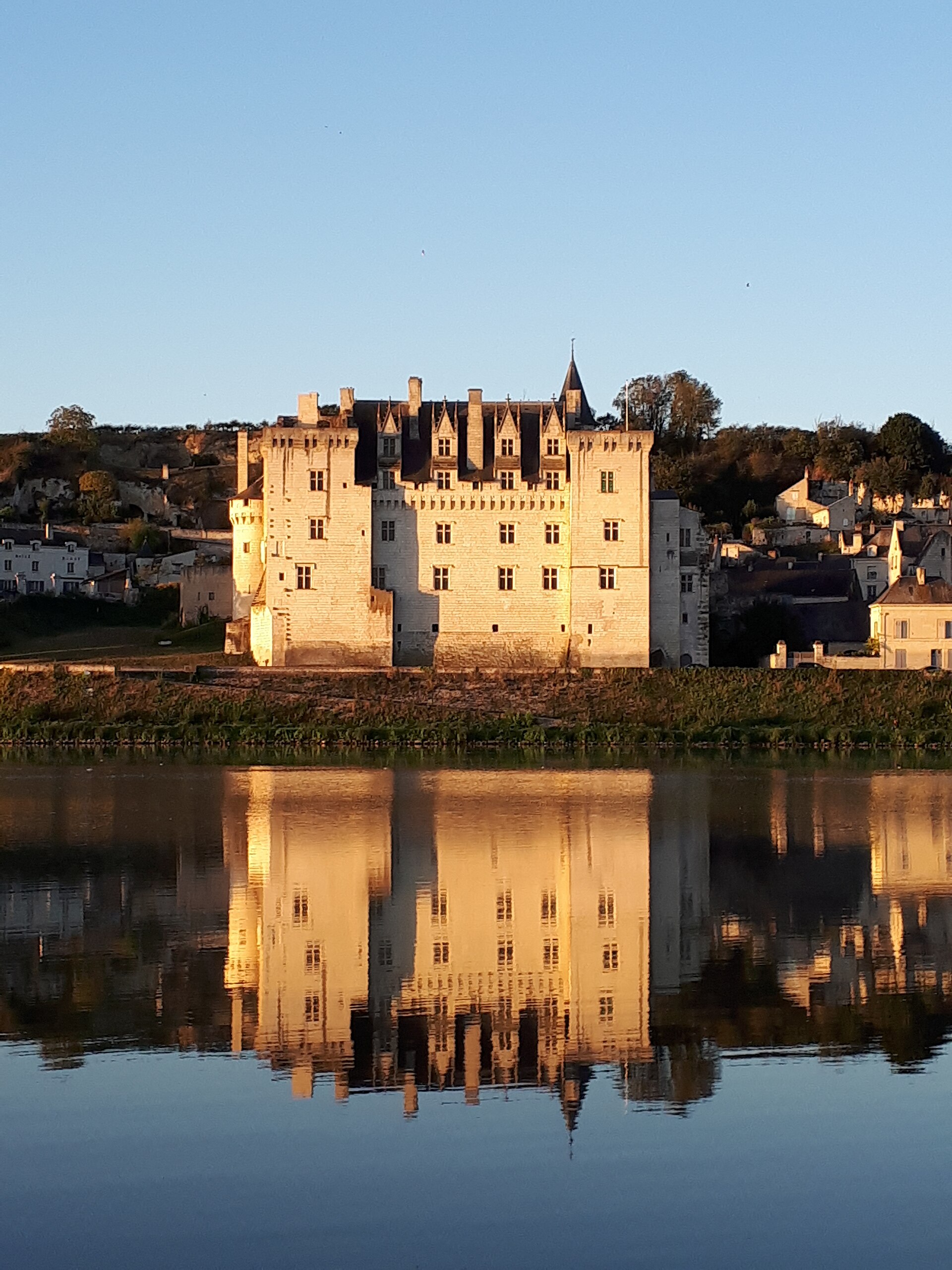
Jean II de Chambes, from 1450The only Loire valley chateau built directly in the bed of the river itself rather than on its bank, a choice that required demolishing the earlier medieval fortress on the same rock and that still defines how the building is seen and photographed today.5
The rediscovered circa-1450 chimney
Original 15th-century masonryUncovered by masons in a former storage room during the 2015-2016 restoration that converted the interior into exhibition space; its restoration was, at last report, still under study with the Batiments de France architects.6
A chateau built into the riverbed
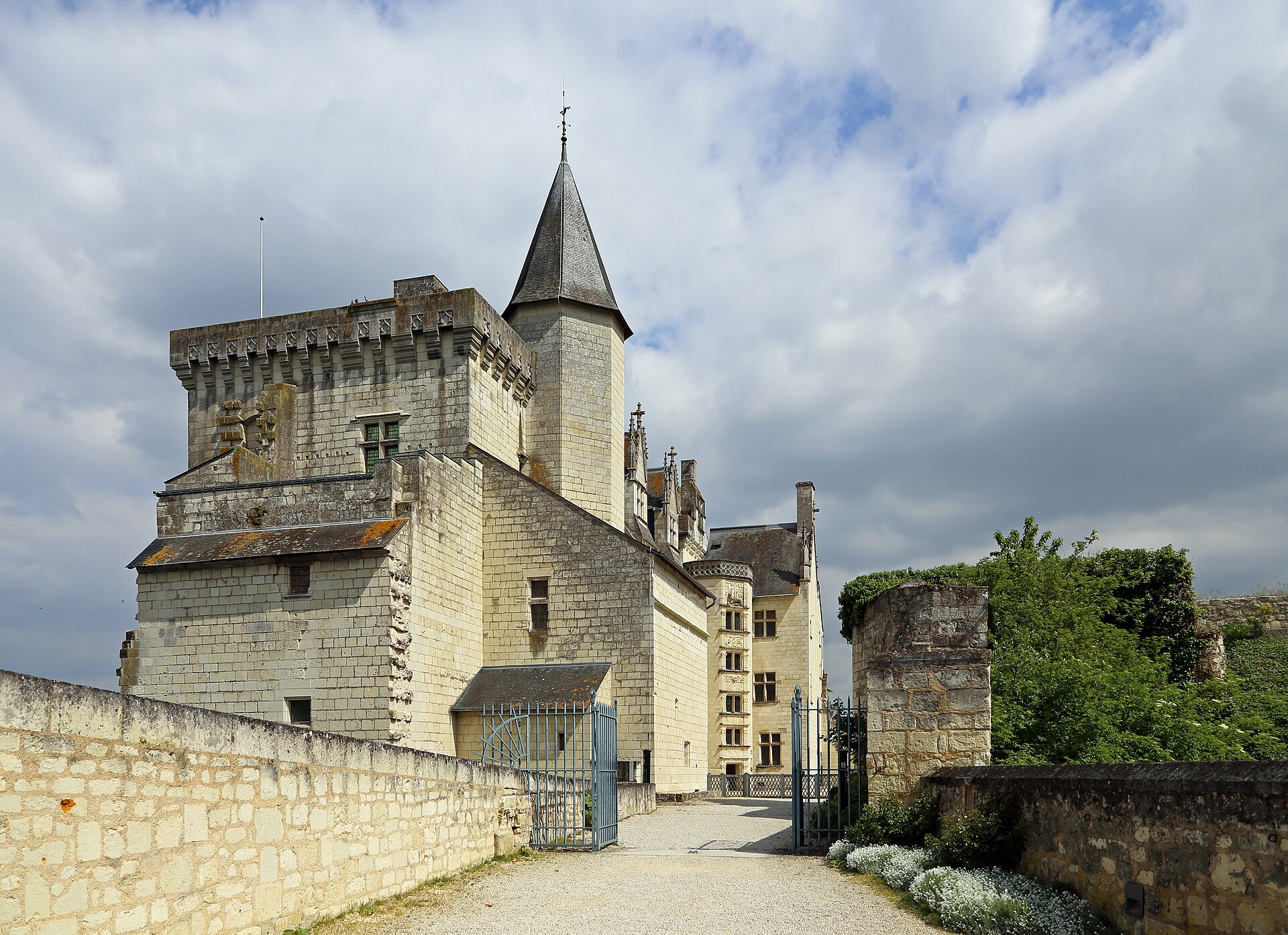
Jean II de Chambes, a senior councillor and chamberlain to Charles VII and Louis XI and, at the time, France's ambassador to Venice, bought the rock at Montsoreau in 1450 and rebuilt on it in the Flamboyant Gothic style between 1450 and 1460, with construction continuing under his family until 1515. The site had already carried two earlier structures, a Gallo-Roman temple or villa and a fortress raised around the year 1000 by Foulques Nerra, at a point where the historic provinces of Anjou, Touraine and Poitou meet and where the new building's builders needed to control river traffic on the Loire. Building the new chateau required demolishing that earlier medieval fortress so the structure could sit on the rock itself.
Montsoreau is the only chateau of the Loire built directly into the riverbed rather than on its bank, and the choice of a residential, Italian-influenced design over a purely military one is credited to Jean II's own experience in Venice: large windows, numerous chimneys and attention to sanitation mark it, alongside Jacques Coeur, as one of the earliest examples in France of a great lord adopting Italian Renaissance principles. His son Jean III de Chambes, who succeeded him in 1473, added the polygonal Renaissance staircase tower, decorated with pilasters, classical medallions, Italianate putti and lion-pawed candelabra motifs beneath a vault the museum's own material describes as palm-tree shaped.
The building gained wider fame through Alexandre Dumas' 1845-46 novel La Dame de Monsoreau, the second part of a trilogy that follows La Reine Margot, in which Dumas plays with a false etymology tracing the name to Mons Soricis, mount of the mouse. J.M.W. Turner painted the chateau on an 1826 tour of the Loire, in a watercolour now held by the Ashmolean Museum in Oxford, and Auguste Rodin drew an idealised view of its north facade around 1897. Parts of the building were listed as monuments historiques in 1862, 1930 and 1938, and the stretch of the Loire Valley between Sully-sur-Loire and Chalonnes, which includes Montsoreau, was inscribed as a UNESCO World Heritage cultural landscape in 2000.
Ruin, a twentieth-century rescue, and public ownership
By the early twentieth century the chateau was in ruins. From 1919 the French state and the Maine-et-Loire general council, prompted by Jean de Geoffre de Chabrignac, ran a campaign of buy-backs and restoration under the direction of the Batiments de France architects, work that continued through the interwar years and the Second World War. From 1956 to 1999 part of the building housed the Musee des Goums marocains et des Affaires indigenes du Maroc, a museum devoted to the Moroccan colonial goum units and French administration in Morocco. A further restoration between 1997 and 2001 prepared the chateau for a public reopening on 6 July 2001, accompanied by a son-et-lumiere show that went on to draw an estimated 35,000 visitors a year. Throughout this period ownership remained with the Maine-et-Loire departmental council, and the building was run as a conventional visited monument rather than as a museum with its own collection.
A private collector takes a 25-year lease
In 2014 the departmental council opened a call for projects as the previous public-service delegation for running the chateau came to an end. Philippe Meaille, a contemporary art collector who had by then lived in Anjou for fifteen years, and Christian Gillet, president of the departmental council, arrived between them at the idea of installing a museum of contemporary art in the building and making contemporary art one of the department's cultural development priorities. Leaks to the press during roughly six months of internal review triggered political controversy before the decision was announced. Frederic Beatse, then leading the Socialist list for the regional elections, said the department's right-wing majority was selling off the family jewels, adding that this was all the more striking because Jacques Auxiette, president of the Pays de la Loire region, had proposed instead a partnership between the chateau and Fontevraud Abbey to strengthen tourism across the wider Saumur area. Gillet announced the council's decision on 19 June 2015, handing the chateau to Meaille through a 25-year bail emphyteotique, a long lease under French law that lets a tenant develop a property in exchange for a return at its end.
Four months of restoration, from December 2015 to March 2016, converted around 2,000 square meters of interior into exhibition rooms under the direction of Dominique Latron, architect des Batiments de France. Workers dismantled the previous museum scenography, re-rendered the walls with traditional lime wash on the tuffeau stone, and rebuilt the lighting and electrical systems to museum standard. During work on a former storage room, masons uncovered a chimney dated to around 1450, whose restoration was, as of the last available report, still under study with the Batiments de France. The Chateau de Montsoreau-Museum of Contemporary Art opened to the public on 8 April 2016.
The collection: Art and Language and the world's largest holding of a radical movement
The museum's permanent collection consists entirely of the Philippe Meaille collection of works by Art & Language, a collective founded in Britain in 1968 and named after its own journal, Art-Language: The Journal of Conceptual Art. Around fifty artists have been associated with the group over time, including Terry Atkinson, David Bainbridge, Michael Baldwin, Ian Burn, Charles Harrison, Joseph Kosuth, Sol LeWitt, Mel Ramsden, Dan Graham and Lawrence Weiner; by 1977, when Mayo Thompson left to concentrate on his band Red Krayola, the group had narrowed to Michael Baldwin, Charles Harrison and Mel Ramsden, who with Baldwin and Ramsden remain the collective's active core. Meaille began assembling the collection in the early 1990s, and it is generally described as the world's largest holding of the group's work, at around 800 pieces, with roughly 80 on view at any time across the museum's two levels.
Before Montsoreau existed, part of the collection had been on long-term loan since 2009 to the Museu d'Art Contemporani de Barcelona, MACBA, where it was the subject of a 2014 retrospective, Art & Language Uncompleted: The Philippe Meaille Collection, with a catalogue involving the group's own artists alongside scholars including Carles Guerra, then MACBA's chief curator, and Matthew Jesse Jackson of the University of Chicago's Department of Visual Arts and Art History.
Works on permanent display at Montsoreau include Mirror Piece, an installation of mirrors of varying sizes and both regular and distorting glass that Michael Baldwin first showed in Coventry in 1966 and that entered the Art & Language corpus after the group's 1968 founding, with related versions held by Tate and the National Gallery of Victoria. The Air-Conditioning Show existed only as text when it first appeared in 1966, reaching print in New York's Arts Magazine in 1967 with help from Robert Smithson, before Joseph Kosuth first installed it in 1972 at the School of Visual Arts Gallery in New York; writing in The Independent, the critic Charles Darwent dated it as the moment British visual art began turning away from being visual at all. The museum also holds the manuscript of Victorine, an opera whose libretto Art & Language began writing in the early 1980s for a planned West German television broadcast timed to the opening of Documenta 7 in 1982, a broadcast that never happened; the finished 1983 libretto was published in the journal Art-Language in 1984, translated into French a decade later for the Jeu de Paume, and performed at the Whitney Biennial in 2012. From the group's more explicitly painted period, the museum holds Index series works from 1986 to 1992, including Index: Now They Are and Index: Incident in a Museum XXII, glass-surfaced paintings that reflect the viewer's own image while obscuring what lies beneath the glass. A standing arrangement with Tate Modern has, since the museum opened, allowed it to show a film on Art & Language co-produced by Tate and the Bloomberg Foundation.
A withdrawal from Barcelona, and how critics have read the project
On 11 October 2017, days after the Catalan parliament's declaration of independence and its immediate suspension, the museum announced it was ending Meaille's loan to MACBA and repatriating the roughly 800 works that had been on deposit there since 2009, citing political instability and legal risk. The decision was reported the same day by the major Spanish newspapers and, over the following days, by outlets including Le Monde, in a piece by Roxana Azimi on 18 October 2017, and Artnet News on 12 October 2017. MACBA responded that it took note of Meaille's decision while stressing that the security of the works had never been in question; the Catalan writer Albert Forns, writing in Frieze, was among those who characterised the withdrawal as a calculation on the collector's part rather than a response to any real risk.
Critical writing about the museum itself has tended to treat the juxtaction of a medieval and Renaissance building with an austere conceptual collection as a considered choice rather than an accident. Reviewing the museum for AOC media in October 2018, the critic Christophe Le Gac took a measured, analytical line on the decision to paint the historic interior walls white rather than leave the stonework exposed, describing the result as a generic contemporary-gallery space that neutralises the castle's historic character. Le Gac reads this as consistent with Art & Language's own historical role in unseating painting's dominance in the 1960s, and treats the museum as choosing art history over heritage tourism despite the building's obvious appeal to visitors who come mainly for the postcard view.
Visitor ratings echo the same split rather than resolving it. As of 17 September 2026 the museum holds 3.4 out of 5 on Google from 1,539 ratings and 3.1 out of 5 on TripAdvisor from 519 reviews. A recurring complaint through 2026 describes rooms that feel empty of the furnishings a traditional chateau visit leads people to expect, projection or audio elements reported not working, and an admission price several reviewers call too high for a short visit; a recurring point of praise, on the same platforms, is the building itself as seen from the river or from the rooftop terrace, and the availability of English-language material for international visitors given that Art & Language's core artists write in English.
Visiting today: a prize, a wild garden and a river port
Since opening, the museum has run an annual programme of temporary exhibitions alongside the permanent collection, ranging from a 2016 painting retrospective of Agnes Thurnauer, to a 2017 exhibition on the designer Ettore Sottsass, to group and single-artist shows through 2025 that have included Roman Signer, Charlotte Moorman, Kenneth Goldsmith and Patrick Tosani. Also since April 2016 the museum has awarded the annual Prix Francois-Morellet, honouring writing on art, presented together with the Journees nationales du livre et du vin; winners have included the Art Press editor Catherine Millet in 2016, the philosopher Michel Onfray in 2017, INHA director Eric de Chassey in 2018, and more recently Kenneth Goldsmith, Orlan, film-maker Michel Hazanavicius and the critic Hans Ulrich Obrist in 2025.
In May 2017 the museum unveiled a redesigned hectare of riverside gardens as a tribute to the naturalist Miriam Rothschild, planted as a deliberately wild, low-intervention ecosystem rather than an ornamental garden, and restored its historic river port the same month to build a river-based cultural programme with local Loire boatmen; both the gardens and the port sit outside the ticketed part of the visit. The 2015-2016 conversion of the interior was built around LED lighting, lime-based renders that let the tuffeau stone regulate humidity on its own, insulated windows and roof spaces, and no mechanical heating or air conditioning, and the museum recycles waste generated by its temporary exhibitions where it can.
Only the ground floor of the museum is wheelchair accessible, and admission is free to visitors with reduced mobility as well as to children under five and to press. A typical visit runs two to three hours, and last entry is 45 minutes before closing. In 2024 the museum received the Wikimedia France Culture Libre-Bronze label for its approach to sharing its content and images under open licences, one reason recent, well-credited photographs of the building are more readily available on Wikimedia Commons than for many comparable institutions.
What visitors say
Opinion on the museum splits along a single line: visitors who come for the Renaissance building and the Loire views tend to leave satisfied, while visitors expecting a furnished historic house or a conventional picture collection often describe the conceptual-art installation as sparse, under-explained and expensive for what they found. Both readings recur across 2026 reviews on the same platforms.
What is praised, what is criticised
- Praised: The exterior architecture and its position directly on the Loire, particularly the view from across the river and at sunset
- Praised: The panoramic view from the rooftop terrace over the confluence of the Loire and the Vienne
- Praised: English-language material provided for international visitors, given that Art & Language's core artists are English-speaking
- Criticised: Several 2026 visitor reviews describe rooms that read as bare or empty compared to what a traditional chateau interior leads them to expect
- Criticised: Recurring complaints that the adult admission price feels high against a visit some reviewers describe as short and light on object labelling and explanation
- Criticised: Multiple 2026 reviews report video or audio elements of installations not working at the time of their visit
Ratings on other platforms
Google: 3.4 from 1,539 ratings, read 17 September 2026
TripAdvisor: 3.1 from 519 ratings, read 17 September 2026
A platform average is a tertiary source: it moves, it is not audited, and we quote no visitor's words.
Questions about Chateau de Montsoreau-Museum of Contemporary Art
Where is Chateau de Montsoreau-Museum of Contemporary Art?
Passage du Marquis de Geoffre, 49730 Montsoreau, France.
How much does it cost to visit?
Adult (18+): EUR 12; Child (5-18): EUR 8; Student / job seeker: EUR 10; Family package (2 adults, 2 children): EUR 29; Annual pass, individual: EUR 30. As confirmed 17 September 2026.
When is it open?
Feb, Mar, Oct, Nov, Dec 12:00-18:00; Apr, May, Jun, Jul, Aug, Sep 10:00-19:00. Closed: January is not listed on the museum's own hours page as of the last check; confirm directly before a January visit. As confirmed 17 September 2026.
What should you see first?
Mirror Piece (Michael Baldwin / Art & Language, 1965); The Air-Conditioning Show (Michael Baldwin / Art & Language, 1966-67, installed 1972); Manuscript of the opera Victorine (Art & Language, libretto; Mayo Thompson, music, 1981-1983); Index series paintings (Art & Language, 1986-1992); The Renaissance staircase tower (Built for Jean III de Chambes after 1473); Grande Salle d'apparat (Great Hall) (15th-century core of the chateau).
What we could not confirm
- The exact current split between the roughly 800 works in the Meaille collection and the number shown at any time is given inconsistently across sources (commonly 80 on view, occasionally described only as a rotating selection); the museum's own current wall count was not independently verified for this record.
- The museum's own hours page, as last checked, lists Feb/Mar/Oct/Nov/Dec and Apr-Sep but not January; whether the museum closes in January or simply omits it from that page was not confirmed.
- Whether the circa-1450 chimney uncovered during the 2015-2016 restoration has since been restored, or remains under study with the Batiments de France, was not confirmed beyond the last available report.
Images
Sources
- 1Chateau de Montsoreau-Musee d'Art Contemporain, official site, Informations pratiques (hours, admission, contact) chateau-montsoreau.com/wordpress/fr/informations-pratiques/
- 2Chateau de Montsoreau-Musee d'Art Contemporain, official site, Le Chateau (building and rooms) chateau-montsoreau.com/wordpress/fr/le-chateau/
- 3Chateau de Montsoreau-Musee d'Art Contemporain, official site, La Collection chateau-montsoreau.com/wordpress/fr/la-collection/
- 4Chateau de Montsoreau-Musee d'Art Contemporain, official site, homepage chateau-montsoreau.com/wordpress/fr/
- 5Wikipedia (English), Chateau de Montsoreau en.wikipedia.org/wiki/Ch%C3%A2teau_de_Montsoreau
- 6Wikipedia (French), Chateau de Montsoreau - musee d'Art contemporain fr.wikipedia.org/wiki/Ch%C3%A2teau_de_Montsoreau_-_mus%C3%A9e_d%27Art_contemporain
- 7Christophe Le Gac, 'Quand la peinture sort de sa toile: Art & Language a Montsoreau', AOC media, 22 October 2018 aoc.media/critique/2018/10/22/peinture-sort-de-toile-art-language-a-montsoreau/
- 8TripAdvisor, Chateau de Montsoreau - Musee d'Art Contemporain (reviews and rating) tripadvisor.com/Attraction_Review-g675426-d1930972-Reviews-Chateau_de_Montsoreau_Musee_d_Art_Contemporain-Montsoreau_Maine_et_Loire_Pays_de_.html
- 9Google search listing, Chateau de Montsoreau-Museum of Contemporary Art (Google rating) google.com/search?q=Chateau+de+Montsoreau+Museum+of+Contemporary+Art+google+reviews
- 10Wikidata, Q36698440 wikidata.org/wiki/Q36698440