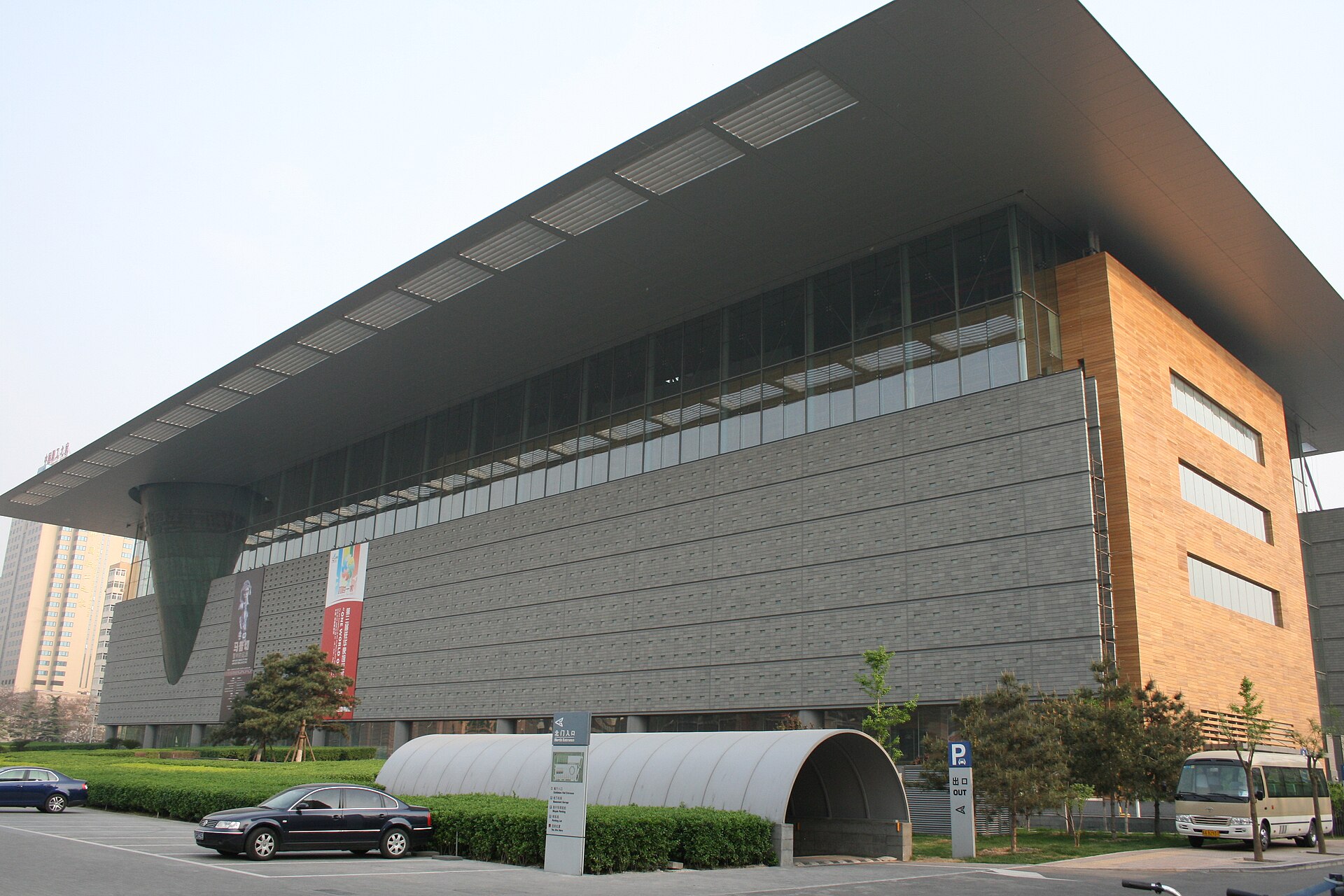
The Capital Museum building at 16 Fuxingmenwai Street, Xicheng District, Beijing, photographed in April 2008. The photographer's recorded coordinates for the shot match the museum's own location.
CC0Capital Museum
Museum · Shoudu Bowuguan · Founded 1981
Open, admission and hours confirmed 31 August 2026 · 14 sources
On this page 16 sections
ContentsClose
The museum's declared strength is Beijing's own material history rather than a single dynasty or medium: excavated objects from within the city itself anchor the core Ancient Capital Beijing exhibition, while separate galleries built by material, bronze, jade, porcelain, calligraphy, painting and Buddhist statuary, hold several hundred pieces each drawn mostly from Beijing-area collections and excavations. The Beijing Folk Customs gallery is a genuine point of distinction among China's major municipal museums, documenting domestic and theatrical life rather than court or military history. The collection is stated at roughly 200,000 relics in total, with several hundred graded as first-class national treasures, though only a portion is on display in the permanent halls at any time.
| Local name | Shoudu Bowuguan |
|---|---|
| Kind | Museum |
| Founded | 1981 |
| City and country |  Beijing, China Beijing, China |
| Address | 16 Fuxingmenwai Street, Xicheng District, Beijing 100045, China |
| Website | capitalmuseum.org.cn |
| Status | Open, confirmed |
| Record last verified |
Visiting
- Hours
- Wed-Mon09:00 to 20:00Summer schedule, 18 May to 18 October: last admission 19:00. Only the ground floor and basement stay open after 17:00.
- Tue-Sun09:00 to 17:00Winter schedule, 19 October to 17 May: last admission 16:00.
- Closed
- Tuesday, during the 18 May-18 October summer schedule. Monday, during the 19 October-17 May winter schedule, except statutory holidays.
- Admission
- General admissionFreeFree to all visitors. A free timed-entry reservation must be booked in advance online, and a passport or Chinese ID is required at the gate to collect the physical ticket.
- Tickets
- capitalmuseum.org.cn/visit The museum's own ticket page.
- Do I need to book?
- Yes. A free timed-entry slot must be reserved online in advance; a passport or Chinese ID card is required to collect the ticket at the entrance.
- Address
- 16 Fuxingmenwai Street, Xicheng District, Beijing 100045, China MapSubway Line 1, Muxidi station, about 500 metres east of the museum
Bus Multiple routes stop nearby, including 1, 21, 65 and 68 - Website
- capitalmuseum.org.cn
- Telephone
- +86 10 6337 0491
Before you go how long, access, photography, bags, eating, shop
- How long to allow
- Visitor reports commonly describe three to four hours to see the permanent halls, or half a day to cover them properly
- Access
- The museum states accessibility services are provided, but visitor reports single out only two lifts serving the upper floors, described as slow and difficult with a stroller or wheelchair when the building is busy
- Photography
- Still photography without flash, tripod or selfie stick is permitted in the permanent galleries; video recording and livestreaming require the museum's permission
- Bags
- Free self-service lockers are provided; oversized items require staff assistance
- Eating
- A cafe and dining area operate inside the building, though one visitor report in 2019 could not locate it
- Shop
- A museum shop sells museum-branded goods and crafts
Prices and hours change. We take them from the institution's own pages and print the day we read them, and you can check the current position at the source we used. Confirm before you travel.
What is inside
Ancient Capital Beijing: History and Culture
The museum's core permanent exhibition, built around roughly 675 excavated objects and tracing the city from its prehistoric and Yan-state beginnings through its status as a Liao and Jin dynasty northern capital, the Yuan dynasty capital of Dadu, and the Ming and Qing imperial capital, into the twentieth century.
Bronze gallery
132 bronze vessels and sets from the Western and Eastern Zhou dynasties, including a bronze lei wine vessel roughly 3,000 years old.
Porcelain gallery
Around 170 porcelain pieces spanning the Song, Yuan, Ming and Qing dynasty kilns, with Ming blue-and-white ware as a particular strength.
Jade gallery
More than 180 jade pieces tracing the material's use from early carving into the imperial era, including a white jade seal cut for the Qianlong Emperor's eightieth birthday in 1791.
Buddhist statuary gallery
262 Buddhist statues spanning several centuries of production, including gilt bronze figures from the Yuan dynasty inlaid with turquoise, displayed alongside the museum's porcelain holdings on the fourth floor.
Beijing Folk Customs gallery
Reconstructions of old Beijing domestic life: courtyard houses, hutong streets, traditional weddings and festival customs, and material on Peking opera. Visitor reports single this hall out more consistently than any of the dynastic-era galleries.
Calligraphy and painting galleries
Roughly 50 Ming and Qing dynasty paintings and 53 Yuan, Ming and Qing calligraphy works.
Scholar's studio gallery
About 150 objects furnishing a traditional scholar's study: brushes, inkstones and furniture.
What to see first
Jingde Street memorial archway
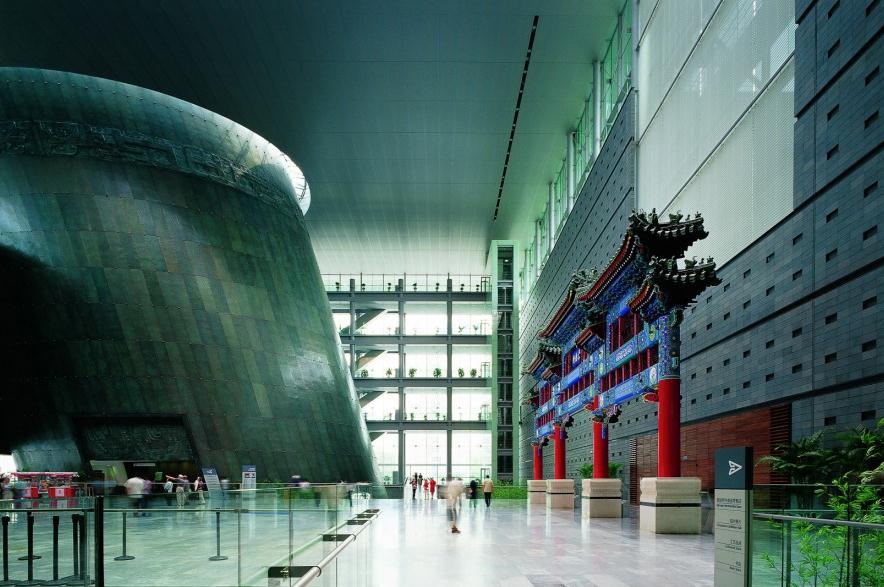
Unknown Ming-dynasty court workshop, erected 1531A three-gate, four-pillar, seven-roof timber paifang that once stood before the Temple of Successive Emperors on Fuchengmen Inner Street, praised by the architectural historian Liang Sicheng as the finest-built and finest-carved of Beijing's ancient archways. Dismantled in January 1954 under Liang's own supervision to save its components when the street was widened, it was stored for nearly half a century before being reassembled inside the new museum building in 2003, becoming the first object installed in the museum under construction. Its front carries repainted decoration; its back was deliberately left unrestored.10
Bronze lei wine vessel
Unknown, Western Zhou dynasty (c. 1046-771 BCE)The anchor piece of the museum's bronze gallery, roughly 3,000 years old, among 132 bronze vessels and sets from the Western and Eastern Zhou dynasties on display.6
Marble stele recording Beijing's status as imperial capital
Qing court workshop, Qianlong reignA white marble monument some 6.7 metres tall and over 40 tonnes, carrying a bilingual inscription setting out the city's significance as capital.6
Ming blue-and-white porcelain vase
Unknown Ming-dynasty kilnDecorated with dragons, clouds and waves; appraised at roughly 10 million yuan in 2000. One of the pieces anchoring the porcelain gallery's holdings of Song-to-Qing wares.6
Imperial jade seal of the Qianlong Emperor
Qing court workshop, 1791A white jade seal carved with a circular dragon motif, made for the Qianlong Emperor's eightieth birthday; part of the jade gallery's holdings of more than 180 pieces.6
Gilt bronze Buddha figure inlaid with turquoise
Yuan-dynasty workshopPart of the museum's 262-piece Buddhist statuary holdings, and one of the objects most often singled out by visitors ahead of the museum's dynastic-history material.8
Qing ivory-handled folding fan inlaid with precious stones
Qing court workshopAn example of the decorative-arts holdings that sit alongside the museum's larger bronze, porcelain and jade collections.8
Beijing Folk Customs gallery reconstructions
N/A - period furnishings and reconstructed settingsLife-size reconstructions of old Beijing courtyard houses, hutong streets, wedding customs and Peking opera material. Named by more visitor reports than any single dynastic-era object as the part of the museum they remember best.9
Exhibitions on now
- On now18 May to 18 Oct 2026Confirmed · check before you travel
A gateway rescued twice, then rebuilt into the museum itself
The Capital Museum's ground-floor ceremonial hall is built around a single object with its own biography: the Jingde Street memorial archway, a three-gate, four-pillar, seven-roof timber paifang erected in 1531 before the Temple of Successive Emperors on what was then Fuchengmen Inner Street. The architectural historian Liang Sicheng called it, and its now-lost twin, the finest-built and finest-carved of Beijing's ancient archways, and argued repeatedly for keeping it in place. In 1953 the city government decided to remove it anyway, citing traffic accidents and structural decay; Liang supervised its careful dismantling in January 1954 so the timber joinery could be preserved rather than destroyed. The components sat in storage for nearly fifty years, moved at one point to the grounds of the Dahui Temple in Haidian District.
When construction of the new Capital Museum began after 2001, its architects built the archway back into the design rather than replicate it. It was reassembled from its original Ming-dynasty components inside the museum's ceremonial hall while the rest of the building rose around it, making it, in the museum's own account, the first object installed in a museum that did not yet exist. Its front face was repainted in traditional colours to its original scheme; its back was deliberately left unrestored, weathered wood beside fresh paint on the same structure, under the principle of restoring the old as old. It now serves as the building's informal landmark, the point where visitors gather and photograph each other before starting a visit.
From the Confucius Temple to Chang'an Avenue
The museum itself is older than its building. It was established in 1981 and opened to the public that year inside the Beijing Confucius Temple and the adjoining Imperial Academy in the city's Guozijian area, then Beijing's principal municipal museum of the city's own history rather than a national collection. Planning for a purpose-built replacement had in fact begun decades earlier, in 1953, but the project did not proceed until it was written into Beijing's Tenth Five-Year Plan at the turn of the century.
Construction of the current building at 16 Fuxingmenwai Street began in December 2001 and the museum formally reopened there on 18 May 2006, International Museum Day. The building was designed by the French architect Jean-Marie Duthilleul, known for large transport and public buildings, working with the Chinese architect Cui Kai. It covers a stated construction area of roughly 64,000 square metres across five floors above ground and two below, combining a rectangular stone-clad block, its walls read by the museum's own account as an echo of the city's old fortifications, with an oval bronze-clad hall whose sloped, excavated profile is meant to evoke an archaeological dig. The museum has since become the lead institution in a wider network under Beijing's one-institution, multiple-sites model, which also covers the Grand Canal Museum of Beijing, a Courtyard House Museum, the Baita Temple management office, a Beijing Cultural Exchange Hall and the Lao She Memorial Hall - separate buildings and separate visits, distinct from the Fuxingmenwai building described on this page.
Beijing's own biography, told hall by hall
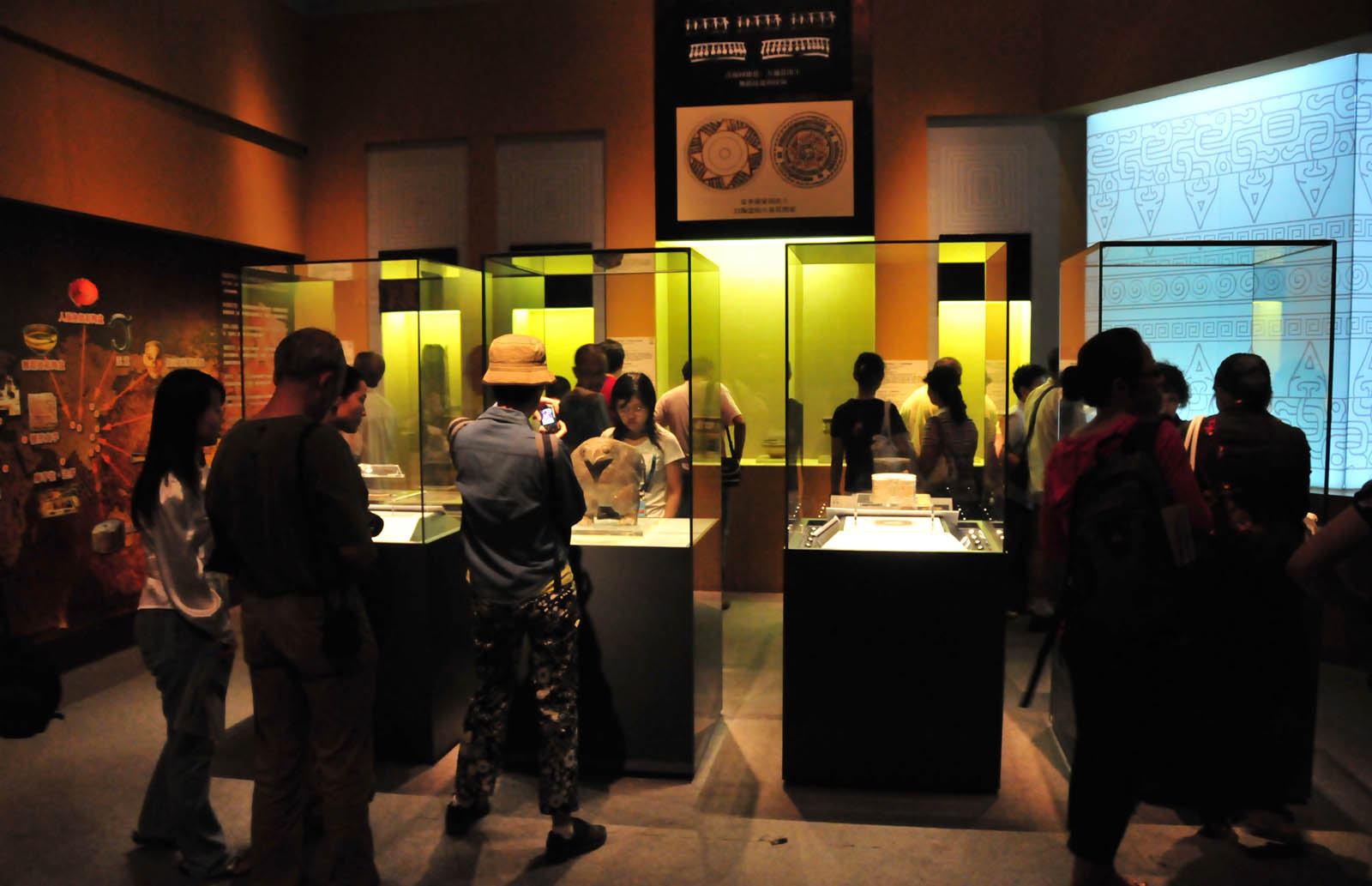
The museum's central and largest permanent exhibition, Ancient Capital Beijing: History and Culture, occupies the second floor and is built around some 675 excavated objects. It follows the city's own political geography rather than a generic dynastic survey: prehistoric and Neolithic settlement in the region, the Western Zhou-era state of Yan whose territory the modern city partly occupies, the city's rise as a northern secondary capital under the Liao and then a full capital under the Jin dynasty, its transformation into Dadu, the Yuan-dynasty capital that fixed much of the modern city's layout, and finally its consolidation as the Ming and Qing imperial capital through to the twentieth century. The exhibition uses maps and models to show the city's boundaries shifting dynasty by dynasty, a structural device several visitors single out as clarifying a history that is otherwise hard to follow on the ground in a city rebuilt so many times over.
The collection said to stand behind these galleries totals in the region of 200,000 cultural relics, only a fraction on display at any time, with several hundred graded as first-class treasures under China's national grading system, and a large share of it recovered from excavations within Beijing itself rather than acquired from elsewhere.
The decorative-arts halls: bronze, jade, porcelain and paint
Above and alongside the history exhibition, separate galleries hold the museum's decorative-arts collections by material. The bronze gallery displays 132 pieces and sets from the Western and Eastern Zhou dynasties, anchored by a bronze lei wine vessel roughly 3,000 years old. The porcelain gallery holds around 170 pieces running from Song through Qing dynasty kilns, with Ming blue-and-white ware, including a vase appraised at roughly 10 million yuan in 2000, forming a particular strength. The jade gallery holds more than 180 pieces tracing the material's carving history into the imperial period, including a white jade seal cut in 1791 for the Qianlong Emperor's eightieth birthday. A separate Buddhist statuary gallery holds 262 figures, among them gilt bronze Yuan-dynasty images inlaid with turquoise, and the calligraphy and painting galleries together hold roughly 50 Ming and Qing paintings and 53 pieces of Yuan, Ming and Qing calligraphy. A sixth-floor scholar's studio gallery reconstructs a traditional study with brushes, inkstones and furniture, around 150 objects in total.
Visitor accounts describe these halls as spacious rather than densely packed, several using the word restrained for a museum of this size, and more than one visitor rates the porcelain and jade material here above the equivalent halls at the National Museum of China on Tiananmen Square, a comparison worth noting precisely because the two institutions are frequently confused for each other despite being separate buildings with separate collections.
Old Beijing life, not only imperial Beijing
The Beijing Folk Customs gallery, on the fifth floor beside the jade gallery, is the hall most consistently named by visitors as the museum's distinct contribution next to its dynastic-history material. It reconstructs the domestic texture of the pre-modern city rather than its politics: courtyard houses and hutong streets rebuilt at scale, the customs surrounding traditional weddings and seasonal festivals, and material relating to Peking opera, the theatrical form most associated with the city. Reviewers who otherwise call the museum skippable next to the Palace Museum or the National Museum of China still tend to describe this hall as worth the visit on its own, framing the museum's real subject as the life of ordinary Beijing residents across the centuries rather than the imperial court alone.
What visitors find, and what they say is missing
On Tripadvisor the museum holds a rating of 4.3 out of 5 from 386 reviews, putting it a fraction below the Palace Museum's 4.4 from a far larger base and close to comparable Beijing institutions such as the Lama Temple. The pattern across individual reviews is consistent: strong praise for the building, for free admission, for light crowds relative to the Palace Museum and National Museum of China, and for the bronze, jade, porcelain and folk-custom halls specifically, set against a recurring judgment that the objects on display, taken individually, do not match the building's ambition or the depth of China's best-known national collections. One August 2026 review calls it not a must-see and describes the artifacts as not particularly impressive while praising the museum's telling of ordinary Beijing life; other reviews single out only two lifts serving the upper floors as slow and difficult for visitors with a stroller or wheelchair, and note that temporary exhibitions, unlike the permanent halls, typically carry no English text. More than one reviewer also mentions the lack of a printed floor plan, leaving the building's six floors and nine-plus halls to be navigated from wall-mounted maps alone.
Visiting today
Admission is free every day the museum is open, but a timed-entry slot must be reserved online in advance, and a passport or Chinese identity card is required at the gate to collect the physical ticket. Current opening hours run 09:00 to 20:00 with last admission at 19:00 during the summer schedule, 18 May to 18 October, when the museum closes on Tuesdays instead of Mondays and only the ground floor and basement remain open after 17:00; outside that window the museum runs 09:00 to 17:00 with last admission at 16:00, Tuesday to Sunday, closed Mondays except statutory holidays. The nearest subway stop is Muxidi on Line 1, about 500 metres west of the museum, with several bus routes also stopping nearby. The building includes a cafe, a museum shop, free self-service lockers for bags, and stated accessibility services, though visitor reports point to the building's two lifts as a practical bottleneck at busy times. Still photography without flash, tripod or selfie stick is permitted throughout the permanent galleries; filming and livestreaming require the museum's permission.
What visitors say
Visitors consistently rate the building itself, a stone-clad, top-lit structure completed in 2006, as highly as anything inside it, and name free admission and comparatively light crowds as reasons to visit even when they call the objects on display secondary to the Palace Museum or the National Museum of China nearby. The permanent Beijing-history and folk-custom halls draw more consistent praise than any single dynastic-era object.
What is praised, what is criticised
- Praised: The building itself, including the ceremonial hall built around the reassembled Ming-dynasty Jingde Street archway
- Praised: Free admission and comparatively light crowds for a museum of its size
- Praised: The bronze, jade and porcelain galleries, which some visitors rate above the equivalent halls at the National Museum of China
- Praised: The Beijing Folk Customs gallery covering courtyard life, hutongs, weddings and Peking opera
- Praised: English-language labelling in the permanent exhibitions
- Praised: Clean facilities and friendly staff
- Criticised: Several visitors call it skippable on a first, time-limited trip to Beijing alongside the Palace Museum and National Museum of China, rating the objects on display as less individually striking than the building housing them
- Criticised: Only two lifts serve the upper floors, reported as slow and difficult with a stroller or wheelchair when the museum is busy
- Criticised: Temporary exhibitions typically carry no English text, unlike the permanent halls
- Criticised: No printed floor plan was available on at least one visit, leaving the layout of nine-plus halls across six floors to be worked out from wall maps
Ratings on other platforms
Tripadvisor: 4.3 from 386 ratings, read 31 August 2026
A platform average is a tertiary source: it moves, it is not audited, and we quote no visitor's words.
Questions about Capital Museum
Where is Capital Museum?
16 Fuxingmenwai Street, Xicheng District, Beijing 100045, China.
How much does it cost to visit?
General admission: free. As confirmed 31 August 2026.
When is it open?
Wed-Mon 09:00-20:00; Tue-Sun 09:00-17:00. Closed: Tuesday, during the 18 May-18 October summer schedule. Monday, during the 19 October-17 May winter schedule, except statutory holidays. As confirmed 31 August 2026.
How do you get there?
Subway: Line 1, Muxidi station, about 500 metres east of the museum; Bus: Multiple routes stop nearby, including 1, 21, 65 and 68.
What should you see first?
Jingde Street memorial archway (Unknown Ming-dynasty court workshop, erected 1531); Bronze lei wine vessel (Unknown, Western Zhou dynasty (c. 1046-771 BCE)); Marble stele recording Beijing's status as imperial capital (Qing court workshop, Qianlong reign); Ming blue-and-white porcelain vase (Unknown Ming-dynasty kiln); Imperial jade seal of the Qianlong Emperor (Qing court workshop, 1791); Gilt bronze Buddha figure inlaid with turquoise (Yuan-dynasty workshop).
What we could not confirm
- The museum's own collection total is given as roughly 200,000 relics in some accounts and 83,000 in others; this page has not been able to establish whether the figures describe different counting methods, different dates, or the effect of the museum's later multi-site expansion, and has not repeated either figure as more authoritative than the other beyond what each source states.
- Several online sources place a bronze zodiac horse head looted from the Old Summer Palace in 1860 and later donated to the Chinese state at the Capital Museum; other sources place the same object, or a related one from the same series, at the Poly Art Museum in Beijing or the National Museum of China. This page has not been able to confirm which institution actually holds it and has therefore not listed it as a highlight.
Images
Sources
- 1Capital Museum, official website, home page capitalmuseum.org.cn/
- 2Capital Museum, official website, visitor guide (hours, admission, transport, facilities) capitalmuseum.org.cn/visit
- 3Capital Museum, official website, About Us (founding date, building history, multi-site network) capitalmuseum.org.cn/about
- 4Wikimedia Commons, Category:Capital Museum commons.wikimedia.org/wiki/Category:Capital_Museum
- 5Wikimedia Commons, File:2008 Capital Museum, Beijing 01.jpg, file description page commons.wikimedia.org/wiki/File:2008_Capital_Museum,_Beijing_01.jpg
- 6TravelChinaGuide, Capital Museum travelchinaguide.com/attraction/beijing/capital-museum.htm
- 7Beijing Municipal Bureau of Culture and Tourism (visitbeijing.com.cn), About Capital Museum english.visitbeijing.com.cn/article/47ONmqUdHgU
- 8China Daily (govt.chinadaily.com.cn), The Capital Museum govt.chinadaily.com.cn/s/201811/30/WS6433abf7498ea274927b5fc2/the-capital-museum.html
- 9Tripadvisor, Beijing Capital Museum reviews tripadvisor.com/Attraction_Review-g294212-d605769-Reviews-Beijing_Capital_Museum-Beijing.html
- 10Beijing Municipal Cultural Heritage Bureau (wwj.beijing.gov.cn), on the Jingde Street memorial archway wwj.beijing.gov.cn/bjww/wwjzzcslm/1737418/1738090/wwgs/623153/index.html
- 11Wikipedia, Capital Museum (identity and coordinate cross-check only, ) en.wikipedia.org/wiki/Capital_Museum
- 12Wikimedia Commons, File:Capital Museum2 Beijing.jpg, file description page commons.wikimedia.org/wiki/File:Capital_Museum2_Beijing.jpg
- 13Wikimedia Commons, File:CapitalMuseum7.jpg, file description page commons.wikimedia.org/wiki/File:CapitalMuseum7.jpg
- 14Wikimedia Commons, File:Capital Museum at dusk 20150829.JPG, file description page commons.wikimedia.org/wiki/File:Capital_Museum_at_dusk_20150829.JPG


